Showing posts with label 1 star. Show all posts

SUPERMAN / WONDER WOMAN VOLUME 2: WAR and PEACE (graphic novel) by Charles Soule


Written by Charles Soule
Art by Tony S. Daniel

Published in 2015 by DC Comics

Synopsis

Superman has fought and defeated Doomsday, but during the fight he was infected with a Doomsday virus of some sort that is slowly merging into his genetic code and changing him into Doomsday.

Superman can hold it off simply by will and the sheer strength of being Superman, but Earth-based planetary defenses have released Kryptonite into the air around the world to drive the Superman/Doomsday hybrid away. Good enough, except that Brainiac has unleashed an attack on Earth and the Justice League really needs Superman's help...

My Review

This graphic novel was confusing and unnecessarily complicated. It seemed like it was an attempt to bring every possible character into the story and it was missing a key component - the fight with Doomsday.

The reason for that is simple - the story of that fight is not included in the Superman / Wonder Woman series. It is actually in a stand-alone volume called Superman: Doomed. The Doomed book is actually part of 3 or 4 different DC Comics story lines that all come together to meet in that story. However, there is no reference to the existence of that volume anywhere in the Superman / Wonder Woman cover art or in a prologue. They simply did not tell the reader that they should have read another story first.

That means this reader went in blind and felt like I was playing catch up the entire time. 

This quote from my review of Volume 1 of this series certainly applies to this volume in spades:

Almost everything about this story feels rushed. It's as if Soule had a 12 or 13 comic's worth of story that he had to tell in just 7 comics. Even worse, the story keeps gliding back and forth in time in a series of flashbacks that are labeled with a little blue box at the top of the first page of the current flashback. "Two hours ago." "Eight hours ago." "Now." They bounce around so much that it just confuses an already rushed story. Also, it ruins the drama because when they are in the "Now" timeline you can see how it all ends up.

I rate this graphic novel 1 star out of 5. Too many flashbacks, too rushed, and, most importantly, they should have told the reader that they were missing a key element of the story if they didn't read a stand alone volume. 

The Superman / Wonder Woman series continues on, but it continues without me.

This graphic novel can be found on Amazon.com here: Superman / Wonder Woman Volume 2: War and Peace.

BEAT the REAPER (audiobook) by Josh Bazell


Published by Hachette Audio in 2007.
Read by Robert Petkoff.
Duration: 6 hours, 49 minutes.
Unabridged
.

The premise of this book is very strong - what if a mafia hitman goes into witness protection, becomes a doctor in a hospital, and then runs into a former mafia colleague who has come to the hospital for a serious surgery. They recognize each other and deadly hijinks ensue.

Sounds good, but the follow through leaves a lot to be desired. The main character is unlikeable almost all of the time - deeply unlikeable. The more you learn about him, the worse he gets. On top of that, the parade of horrible events that happened to him is simply ridiculous - literally stuff stolen from a Timothy Dalton James Bond movie, except even more over the top.

The audiobook reader is great, but the text of the book - not so much.

I rate this book 1 star out of 5. It can be found on Amazon.com here: Beat the Reaper by Josh Bazell.


DEADLANDS: A NOVEL (audiobook) by Victoria Miluch


Published in October of 2023 by Brilliance Audio.
Read by Laura Jennings.
Duration: 9 hours, 24 minutes.
Unabridged.


Synopsis:

Set in a future dystopian Arizona in a United States that is collapsing due to pollution and climate change.

19 year old Georgia lives with her father and her 16 year old brother in an outpost in the Arizona desert north of Phoenix. They are hiding away from the polluted city of Phoenix and the few people that bother to venture out into the wilderness. 

When Georgia and her brother encounter two "hikers" and their car near their outpost, everything changes...

My review:

This book starts out very interesting and then settles into a moody story about relationships, betrayals, and discovery - but I made it sound way more interesting than it actually was. In reality, it was an interesting 45 minute set-up at the beginning and multiple hints that something really dramatic could happen and then nothing happened - again and again and again.

****Spoiler Alert:**** 

Warning: there is a first sexual experience scene that, to me, seemed more like a first sexual assault scene. Some people, like me, really are repulsed by sexual assault scenes. Once again, this followed the pattern of the rest of the book - a very dramatic thing occurs and not much happens as a consequence. 

****End Spoiler****

We never really find out what's going on with America's environment, or why Georgia's father is implementing secret plans, or why Georgia knows all about swimming in oceans when she has lived her entire life in a desert and has never seen a body of water. And, so it goes on and on and on. 

I rate this audiobook 1 star out of 5. If you want to give it a go, it's on Amazon.com here: DEADLANDS: A NOVEL by Victoria Miluch.

MARVEL'S AVENGERS: INFINITY WAR: THE COSMIC QUEST: VOLUME 1: BEGINNING (audiobook) by Brandon T. Snider


Published by Disney in May of 2018.
Read by Tom Taylorson.
Duration: 4 hours, 4 minutes.
Unabridged.


Brandon T. Snider was stuck in a hard place when he was picked to write this book. The Marvel Cinematic Universe (MCU) had just released Infinity War and there was no way that Snider was going to be allowed to release any spoilers for Endgame. In fact, there was really no way that he was going to be allowed to move anything forward in any meaningful way. The ABC TV show AGENTS of SHIELD has been dealing with this problem for years - how do you tell an interesting story when you are so constricted in what you can write about?

Well, in this case, he pretty much failed.

The story centers around two brothers who are MCU characters. No, not Loki and Thor. They are the Collector (featured in the first Guardians of the Galaxy
movie and played by Benicio del Toro) and the Grandmaster (featured in Thor: Ragnarok and played by Jeff Goldblum).
The book is set after Thor: Ragnarok and before Infinity War. The Collector is re-building after the disaster that happened when he was visited by the Guardians of the Galaxy. The Grandmaster has lost everything and is trying to start over again without letting his brother know how far he has fallen.

They decide that their best bet is to look for the Infinity Stones themselves. As they search, they are told the plots of the movies The AvengersThe Age of Ultron and The Guardians of the Galaxy. Of course, the Grandmaster refers to the plot of Thor: Ragnarok


Sadly, these interludes are the best part of the book. Most of the rest of the book consists of the two brothers visiting one seedy location after another on the planetoid Nowhere and doing nothing much. They talk to each other in a passive-aggressive manner, they unite to argue with other people and they are forced to move on.

So, in summary, the best part of this book are the various re-tellings of MCU movies that you have undoubtedly seen. It is pretty clear that this book was a cash grab by Disney for fans desperate for anything Marvel related that might offer a clue to what happened after the events of Infinity War. Don't fall for it.

The audiobook was read by Tom Taylorson who had the unenviable task of trying to play a character played by Jeff Goldblum. Taylorson did a good job of catching the quirkiness of the Grandmaster but only Jeff Goldblum can capture the true spirit of Jeff Goldblum.

I rate this audiobook 1 star out of 5.  It can be found on Amazon.com here: MARVEL'S AVENGERS: INFINITY WAR: THE COSMIC QUEST: VOLUME 1: BEGINNING.

SUPERMAN: THE COMING of the SUPERMEN (graphic novel) by Neal Adams


Published by DC Comics in 2016.
Art by Neal Adams.


A group of men dressed like Superman crash land in an older couple's Iowa cornfield. They then fly to Lex Luthor's corporate headquarters and engage in a fight against an invasion. It is Darkseid's soldiers coming through a red "tunnel" called a "boom tube". The boom tube allows people to travel from one planet to another instantaneously - like a tunnel between worlds.

But, these three new Supermen are not very good at fighting the bad guys are are fairly confused about how to use their super powers. Turns out they are three Kryptonians that have come to defend Earth from an invasion of Darkseid's troops led by his oldest son, the immortal Kalibak, in the hopes that Superman will go to Krypton to deal with a Darkseid invasion. 

Meanwhile, Superman is in the Middle East saving civilians in a war zone. Among those civilians are an orphan and his dog. Superman is stopped by a time-controlling alien that looks like a winged demon and told that he needs to take this boy and his dog home and take care of them.

So, Lois and Clark take this boy in and immediately farm him out to a nanny.

If you noticed the contradiction in the second paragraph (Superman, please defend Krypton from Darkseid's invasion while ignoring Darkseid's invasion of Earth 
led by an immortal thug that can rip down buildings with his bare hands) then that puts you ahead of the author and illustrator. 

This collection of six comics features A LOT of yelling (giant text that fills up chunks of the page), cursing from Superman, almost everybody getting punched in the face so hard that it knocks them out and great lines like this gem from Superman as he fights Kalibak: "RETURN THE BOY! Return the boy, you worthless animal! Nothing requires you. You make our existence ugly with your presence. Give me the boy or your life is forfeit.

The lesson here is that when Superman gets mad, he will kill and he will do it sounding like he is participating in a bad session of Shakespearean improv. I can excuse goofy lines in improv - it's off the top of your head. This mess was actually written out, proofread and inked in over a period of time. 

The drawings are actually not bad at all, but the layout is haphazard. Sometimes it goes all of the way across the two pages, sometimes it goes down the side of the page. It was not uncommon to have to re-read the pages just to figure out what order that it was supposed to be read.

This may very well be the worst graphic novel I have ever read. I rate it 1 star out of 5. It can be found on Amazon.com here: SUPERMAN: THE COMING of the SUPERMEN by Neal Adams.

FLAWED DOGS: THE NOVEL: THE SHOCKING RAID on WESTMINSTER by Berkeley Breathed


Originally published in 2009.

I am a big fan of Berkeley Breathed and have been for 35+ years. I have multiple volumes of his Bloom County books, I enjoyed his movie Mars Needs Moms so much that I went out and bought it after I had rented it. I love his children's book Pete and Pickles.

This book, however, is a rare misfire.

To begin with, the book assumes that you read an earlier childrens book called Flawed Dogs: The Year End Leftovers at the Piddleton "Last Chance" Dog Pound. This book is like a catalog of dogs that no one will adopt because of their flaws. The dogs from the first book are thrown into the Flawed Dogs: The Novel with little or no introduction - just a pack of dogs with names and skills and oddities that the reader had better remember. No character development, no real chance to get to know any of them. There was a whole dog that I had no idea was even in the book until he was shown in an illustration.

The main character of the book is a dachshund named Sam. Sam loves his human, a girl named Heidy who doesn't like dogs because her parents were killed by dogs in some sort of horrible accident that the book was never quite clear about. Sam is slated to participate in the Westminster dog show, but another dog is so jealous that he mutilates himself and sets Sam up so that it looks like he attacked a human baby. Heidy's uncle shoots Sam. But, Sam doesn't die. Instead, he ends up at the "Last Chance" Pound. That is the first half of the book.

Spoiler alert************

The second half of the book is very rushed and features Sam getting his foot in a badger trap, Sam getting hit by a car, Sam spending three years in a laboratory being mutilated for science and Sam being put into a dog fight by his second human owner to pay off a debt. Sam hatches a big, complicated plot (that was vague except for a gag that I have seen done on cartoons ranging from Donald Duck to Scooby Doo) to get even with the poodle that took him away from Heidy.

This book commits too many "sins" - it is a hurried, gruesome mess.

I do not dispute that all of the atrocities that happen to Sam in this book happen to real dogs every day (except for being framed by a poodle.) This book should have been a whole series of books with each book featuring Sam and perhaps a couple of new dogs from the "Last Chance" Pound confronting a new horrible thing that people do to dogs. Not light reading, but made informative and tolerable because they would 
feature the indomitable dachshund Sam coming to the rescue.

End spoiler alert************

I rate this book 1 star out of 5. If you must read it, it can be found on Amazon.com here: FLAWED DOGS: THE NOVEL: THE SHOCKING RAID on WESTMINSTER by Berkeley Breathed.

AMERICAN CIVIL WARS: THE UNITED STATES, LATIN AMERICA, EUROPE and the CRISIS of the 1860s (audiobook) by Don H. Doyle


I tried. I really did.

Published in 2017 by Tantor Audio.
Read by Johnny Heller and Jo Anna Perrin.
Duration: 8 hours, 58 minutes.

Unabridged.

The premise of American Civil Wars is interesting. The idea is to place the American Civil War in the context of the currents of the politics of the larger world of the time in order to show how the war changed the politics of other areas (prime examples are the Dominican Republic and Mexico - both were invaded by European powers while the United States was unable to enforce the Monroe Doctrine) and how those outside political forces influenced the Civil War. One of the stated goals is that teachers read this book and try to bring these insights to their students in the classroom.

Don H. Doyle is the editor of this book. I think that it more accurate to say that he "collected" a series of essays by experts in non-American history that focused on how the Civil War affected their regions. I wish he had been a true editor because this book would have been much less repetitive. I estimate that 2 hours or more of judicial editing could be done to this 9 hour audiobook and do nothing but improve it. As I stated above, this book is supposedly aimed at the non-professional historian, but the writing is almost uniformly done in a dry academic style. The sentences are quite lengthy and hard to follow, especially in the audiobook format. It's not like I am unfamiliar with the topic - this is my 101st review of a Civil War-related book since 2001 and I read many more  before I started reviewing regularly. And, it's not like I am not used to audiobooks - this is 458th audiobook review.

The readers were also an issue. There are two. The first is Johnny Heller. I am literally a big fan of Johnny Heller as an audiobook reader, but he was completely miscast when he was hired to read this book. Audiobook readers are essentially actors performing the book. Heller reads very quickly, which is not usually a problem. But, with the length of these sentences (you can hear the semi-colons and parenthetical insertions), it was hard to keep track of what he was saying sometimes. To solve this, I was forced to re-set my phone's playback to 80% of the normal speed.

Jo Anna Perrin's readings, though, were worse. Robotic is the best description. It is full of strange pauses that remind me of a caricature of William Shatner at his worst. I assumed that she was a friend of the editor who persuaded him that she should read half of this audiobook. I was very surprised to see that she reads a lot of audiobooks. Hopefully, this is not her typical work. Oh, and yes, I did re-set my phone to play at normal speed.

I tried to finish it. I made it 6 hours and 58 minutes and then started listening to an essay that was literally covering the same ground as the previous one and just couldn't do it any longer. I literally have no problem with the research that went into the book or the conclusions of the authors. My problem in entirely in the presentation of the facts. I am reminded of this quote: 
"No harm's done to history by making it something someone would want to read." - David McCullough.

I rate this audibook 1 star out of 5. This book can be found on Amazon.com here: 
AMERICAN CIVIL WARS: THE UNITED STATES, LATIN AMERICA, EUROPE and the CRISIS of the 1860s by Don H. Doyle.

NATIONAL BURDEN: A PATRIOTIC THRILLER (CORPS JUSTICE SERIES, BOOK 5) (audiobook) by C.G. Cooper


Published by Tantor Audio in 2017
Read by David Colacci
Duration: 8 hours, 17 minutes
Unabridged

The Corps Justice series continues its tales of SSI (Stokes Security International), a private security firm that sometimes doubles as the President's personal private paramilitary army that acts when he just can't do things politically.

In National Burden, the President is in political trouble. There is a plot to frame the President and a very connected contact of SSI is concerned about strange movements in the stock market. So, he contacts his friends at SSI to give him a hand. And, they soon discover that things are much worse than they had ever imagined...


Politics, as portrayed in this book, are just not realistic. For example, the President appoints a new Vice President (it was a vacant position) and he just goes to work as the VP. No hearings. No fuss. No muss. No Congressional approval (as required by the 25th Amendment). Imagine all of the squabbling and all of the controversy that would be generated if Donald Trump had to replace Mike Pence as Vice President. It would go on and on for weeks, if not months.

I think the idea of a private army that only answers to the President is just really a bad idea (and very illegal), but the book justifies it by making all of the characters in SSI very honorable, upright heroes who depend on their own sense of justice to guide them. That's great, but we don't depend on self-regulation because, in the long run, it's a horrible idea because people can't be trusted. But, hey, that's not just me. Read the thoughts of the guys who wrote the Constitution - it's why they didn't let the President just do whatever he wanted.


For a book series that is mostly about action (terrorists being foiled, explosions, car chases and the like) there was a surprising lack of action in this book. Lots and lots of talking in offices, hardly any action.

Anyway, if you like political fantasy, I suppose this is the book for you. I found it way too cartoonish.

David Colacci read the audiobook. He reads a lot of C.G. Cooper's books and does a stellar job with the accents and the voices but he couldn't save this book all by himself.

Note: I was sent a copy of this audiobook by the publisher in exchange for an honest review.

I rate this audiobook 1 star out of 5. It can be found on Amazon.com here: National Burden: A Patriotic Thriller (Corps Justice Series, Book 5) by C.G. Cooper.

SHOWDOWN at YELLOW BUTTE by Louis L'Amour


Originally Published in 1953.

Tom Kedrick is a professional soldier who doesn't have a war to fight in right now. But, he has been hired by an acquaintance to lead a crew of hired guns to clear out a group of horse thieves and ne'er do wells from a big parcel of land that is opening up for settlement.

But, when Kedrick arrives the whole thing just doesn't feel right so he starts to nose around some on his own. W
hen Kedrick checks out his opponents, he discovers that they are settlers with families, not thieves and Kedrick is sure that things are not the way that he was told when he was hired on...

This is, by far, the worst Louis L'Amour book that I have read and it is my understanding that it was one of his first. The beginning of the book is dreadfully slow and L'Amour adds characters at a furious rate throughout the book. There must be at least 40 named characters in this 188 page book and most of them deliver only a line or two and then just disappear from the story or are killed off.

My 1953 edition had 188 pages and I quit after 120 pages. I just couldn't stand it any longer.

I rate this book 1 star out of 5.

If you must have this book to complete your Louis L'Amour collection, you can find it here on Amazon.com: Showdown at Yellow Butte.

BATMAN: THE LAZARUS SYNDROME (audiobook) by Dirk Maggs


Published by BBC Worldwide Unlimited in 2010.
Multicast Performance
Duration: 44 minutes


Even though I enjoy the comic book movies and I listen to a few comic book-based audiobooks, I am not a serious comics fan. I dabble. I haven't even been into a real comic book store. I know the big names and their backstories and that's about it.

But, the title of this story ruined the story for me. If you know about the Lazarus Pits then there was no mystery at all. This was just one more problem in a problem-filled audiobook.

First things first, let me be clear that none of the problems in this audiobook come from the actual performance of the book. It is performed like an old-fashioned radio play and the BBC performers did a great job. Sadly, the story itself does not live up to the performances of the actors.

In Batman: The Lazarus Syndrome, Batman is supposed to be dead. He hasn't been seen in a while and Commissioner Gordon receives a tape from Batman that was to be delivered when he died. In the tape he confesses his true identity. 

Meanwhile, Bruce Wayne is selling off Batman properties at fire sale prices. Want an old Batmobile? Bruce Wayne will sell it to you.

So, Commissioner Gordon knows there is a problem, Alfred knows there is a problem and any listener familiar with most of Batman's enemies figured it out once they put together these three facts: 


1) Batman is gone and declared dead,
2) Bruce Wayne is alive but acting weird,
3) The title of the book has the word "Lazarus" in it.

Sadly, this book's plot had real potential. But, the title gives it away and it is way too short. This book could have stretched out for several hours and the listeners could have followed Commissioner Gordon around as he and Dick Grayson try to figure out what is going on. But, instead we got a 44 minute mini-story that tried to do too much in too short of a time and ended up doing not much at all for this listener.


I rate this audiobook 1 star out of 5.

This audiobook can be found on Amazon.com here: Batman: The Lazarus Syndrome

DEEDS of a MASTER ARCHER, A SHORT STORY (short story) by J.H. Bogran


Published as a Kindle e-book in 2012 by Pretur

Estimated length: 28 pages

The story starts with two friends in the modern world trying to move a washing machine from a basement. Suddenly, they are sucked into another world (no explanation) where they discover a typical medieval fantasy village after they rescue a captive princess.

Turns out she was to be a sacrifice to a dragon and the dragon is no mood to be denied. One of the travelers from our world is a former U.S. Marine and somehow this enables him to be proficient with a sword and a bow and arrow. Actually, he is not just proficient - he is a master, as described in the title. I was not aware that the Marines trained in those weapons, but I have never been a Marine, what do I know?

So, the young men do battle not once, but twice with unfamiliar weapons against the shocking might of a dragon while hampered with almost no character development, a story with the thinnest of plots and an absurd willingness on the part of everyone in the story just to go along with this story just because it makes the story go along.

Yikes.

I rate this story 1 star out of 5.
Reviewed on March 25, 2014.

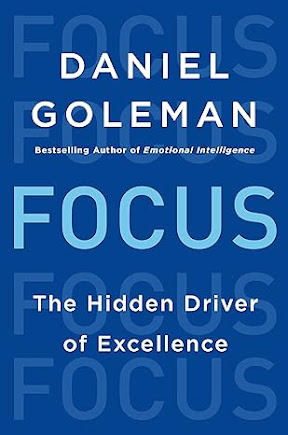
FOCUS: THE HIDDEN DRIVER of EXCELLENCE (audiobook) by Daniel Goleman


"Focus" lacks focus


Published in 2013 by HarperCollins.
Read by the author, Daniel Goleman.
Duration: 8 hours, 8 minutes.
Unabridged

Dr. Daniel Goleman is best known as the author of Emotional Intelligence. In many ways this book is less of a book about the importance of focus and more of a sequel to Emotional Intelligence. It is also a anti-global warming manifesto, an education reform book, a self-help book for business leaders who want to be the real leaders in their offices and there is a little bit about how people are able to focus their attentions a bit more and get better results.

That, of course, is the problem with the book called Focus. The primary topic should be the ability of people to focus and some hints to help you focus better. The book starts out with exactly this...well, focus. We learn how a store detective is able to focus on a crowded room full of bustling and sort out the normal shopping behaviors from the actions of a shoplifter. Goleman discusses how the give-it-to-me-now world of Tweets, Instagram, instant video makes our attention span short (I knew this already - I teach high school and my kids are on their phones all day long and I see the results).


But, then Goleman leaves this area of personal focus largely unexplored and veers into the focus of whole groups of people and uses global warming as his "focus" for this section. I listened to this as an audiobook on CDs and this lasted for more than a CD - well more than an hour of discussion about a topic that is basically off topic. He throws in a suggestion that schools adopt a global warming science project that probably would not hit most state's standards, goes on about carbon footprints, promotes websites that track your carbon footprint, tells how various companies have shrunk their carbon footprints. None of this, not one bit, not one iota, not one word is described in the blurb on the back of the audiobook. I got bored and started skipping whole chunks of text. To his credit, Goleman does point out that the concept of a zero-emission car is a misnomer since electric cars are charged up by an electric grid that is powered largely by coal and coal plants do have emissions (and if you get your electric car charged by a solar panel, there are emissions associated with the manufacture of those panels).  


Then we veer into the world of corporate leadership and the book becomes an extended discussion of what makes a good leader. Turn out it is mostly paying attention the the feelings and needs of those that are following you - this is where the book becomes a sequel to his book Emotional Intelligence with a special focus on CEOs. I felt like I was not the intended reader (or listener, in my case).


Speaking of being a listener, the audio portion of this experience needs to be discussed. The author, Daniel Goleman, read his own book. I am always leery of this because sometimes the author may have a perfectly fine speaking voice but just should not read an audiobook. It is more than a reading, it has to be a performance. Goleman does a lot of public speaking (his website has a place to contact his agent to schedule Dr. Goleman to speak to our corporate gig about leadership, emotional intelligence or maybe even global warming) but public speaking is not the same as reading an audiobook. I cannot hear gestures or hear the fact that the speaker moved across the stage or stood up to put more emphasis on a point in an audiobook. It all has to be done with your voice. Goleman's voice is okay, but not great. He does not quite drone, but it is not really lively either. It definitely took on a nagging tone during the extended global warming discussion. Even worse, there was a bass reverb echo while he spoke that I could not get rid of no matter how much I fiddled with the bass in my car. It sounded like that echo sound you hear when someone is speaking to you on the phone in a small, enclosed room. A professional audiobook should not have this problem. 


Note: This book was sent to me by the publisher in exchange for an honest review.


I rate this audiobook 1 star out of 5. I was so relieved to finish this thing and it took me forever to listen to it.


If you want to give this audiobook a try for yourself you can find it on Amazon.com here: Focus: The Hidden Driver of Excellence.

Reviewed on January 25, 2014.

IN the WAKE of the PLAGUE: THE BLACK DEATH and the WORLD IT MADE by Norman F. Cantor


I Was So Primed to Like This Book...


Published in 2002 by Perennial (HarperCollins)

But...I should have read the back cover of In the Wake of the Plague a little better. Right at the top is the Ring around the rosies children's nonsense song:

Ring-a-round the rosie,
A pocket full of posies,
Ashes! Ashes!
We all fall down.

This is followed by the assertion: "a children's rhyme about the Black Death."

Sadly, this is not true and I have known this since the late 1980s when I was doing my undergraduate studies at Indiana University. Why sadly? Because this would have been such a cool fact! I am a high school history teacher and it would be great to able to say, "Look! Here's a children's rhyme we all know and it has this collection to the Black Plague - see how this historical event reverberates through time and even touches our lives now?"

Yeah. That would have been cool. And it is a fact that Norman F. Cantor (1929-2004), a leading medievalist should have known, especially if he is writing a book about the Black Plague. Instead, he doesn't just reference this little song, he embraces it and uses it as the way to introduce the entire concept, even going so far as to assert that this is the way little kids used to deal with the fear of the plague and deal with the frightening concept of sudden death (pages 5-6).

If this were the only problem, I could forgive Mr. Cantor.

Historians should never judge the people of history by the values of their own modern time and they should always check for their own biases. For example, he goes after the English nobility like a dog goes after a chew toy. He goes after their sexual preferences, their private religious chapels, their political posturing, their wars and more and criticizes them: "Fourteenth-century people lacked the moral categories that could transcend political and social roles. They lacked a critical value system that judged rulers by consequences and not the formal categories in which their behavior was structured." (page 39) In other words, everyone had a part to play and no one ever questioned it.  In fact, he goes even farther on pages 58-59 to assert that these folks showed an astonishing lack of self-awareness, unlike today's modern well-educated elites, of course.

Yes, he does actually assert that modern elites are very reflective. Now, if I say to you name 5 vacuous elites in 15 seconds, could you do it? Can you name 5 people that you know that have a college degree but are still dumber than a box of rocks? Of course, because people nowadays are really about the same as they were then. But, he compares rulers of the past to modern rulers and sincerely sees a difference in the way modern elites act, believe and think about things. On page 39 he attacks Edward III as "a kind of destructive and merciless force." The fact that Edward III's contemporaries believed him to be "a constitutional king and the very model of chivalry and aristocratic honor" merely "illuminates a gap between our world and fourteenth-century Europe." 

Really? President Obama won the Nobel Peace Prize and yet he bragged that he was "really good at killing people" with the drone program (and he is, too - according to UK's The Guardian drones killed more than 500 people in 2012).  My point is not to disparage President Obama but to point out that we (even our leaders) are all able to live with a great deal of dichotomy in our lives - not just back then, but now. It is a part of the human condition and an experienced historian should have known that.

There are also lots of snarky comments, including a really cheap shot at former Prime Minister Margaret Thatcher (1925-2013) on page 93. He is discussing how servant girls who were fired for theft would be expelled from their village to become beggars and/or prostitutes and most likely die on the streets. He notes that this is the kind of welfare program that Thatcher would approve of ("Margaret Thatcher would have loved late fourteenth-century and fifteenth-century England.") Whatever Thatcher thought about the welfare state, I hardly think she was for having young ladies become prostitutes or die of exposure rather than be on the public dole. Over the top, off topic and inaccurate. 

Most of the book reads like it was cobbled together from a combination of
Illustration of people suffering from the
bubonic plague (note the buboes,
or raised bumps)
already printed articles with an obsessive focus on England and a few members of the royal family and which parts of France produced wine and how much that wine was worth and who drank the wine and how much of the wine they imported and ...well, you get the idea.
 

There is just no focus on what the book is supposed to be about - how the Black Plague changed Europe and through Europe changed the world. There is an excellent explanation of the English legal system in the area of real estate and how that legal system helped to consolidate the holdings of some families. But, there is not much explaining how English society was before and after the Black Plague. And, speaking of England, why does Cantor just focus on England for so much of this book? 

The last third of the book is much less snarky and actually deals with the topic that is detailed in the title. The chapter on how many in Europe blamed the Jews for the plague was by far the best written, confirming that blaming European Jews for Europe's troubles has a long, documented history. And, for a change, he actually moved the focus away from England and got out as far as Poland. The chapter on the origins of the plague at the end of the book seemed misplaced (shouldn't it be in the beginning?) and included a serious discussion of the extraterrestrial origin of the Black Plague (yes, he actually discusses and gives credence to a panspermia-type origin to the epidemic). 

The last chapter, "Aftermath" is the outline that should have been fleshed out into the entire book. There is an interesting mention of the fact that the Church had to fill hundreds of open positions and the average age of becoming an ordained priest dropped from age 25 to age 20. "It was a younger, much younger Church that came suddenly into being, and now one staffed heavily with under-educated and inexperienced people." (page 206) Rather than just paragraph on the topic, it would have been worthwhile to explore how the Church changed and if these changes led to the conditions that caused the Protestant Reformation 140 years later.

I rate this book 1 star out of 5. The one good chapter out of ten does not redeem it.

This book can be found on Amazon.com here: IN the WAKE of the PLAGUE: THE BLACK DEATH and the WORLD IT MADE by Norman F. Cantor

THE ROBBERY: A SHORT STORY by John Brinling


Published in 2011 as an e-short story in kindle format.
Estimated length: 11 pages

The most interesting thing about this short story is the opening paragraph:

Like Superman, Walter tried to catch the bullet. Unlike Superman, it went through the fleshy part of his palm between the thumb and forefinger.

After that, the story just deteriorates in a hurry.


Walter is stealing a fortune in bearer bonds from his company without his partner's knowledge, but he gets robbed almost as soon as he steps out on the street. From there, things spiral out of control with one betrayal after another and once it got going it was pretty obvious that it was going for full bore ridiculous - and it got there.


I found none of the characters sympathetic and it was very hard to actually care about them in any way. I rate it 1 star out of 5.

This e-book can be found on Amazon.com here: THE ROBBERY: A SHORT STORY.


Odd Jobs by Ben Lieberman


Starts Out Strong But Changes As The Book Goes Along

Published by Thomas and Mercer in 2013.

Odd Jobs is the story of Kevin Davenport, a financially struggling college student who is working any job he can to pay for college. This summer he is working at Kosher World Meat Factory - it's a nasty job but it pays very well and it will only last a few weeks, right?

Kevin has to struggle because his family life was shattered years ago when his little sister and his father, a prosecutor, were ran over in a hit and run accident that was never solved. His mom never really recovered from the shock and Kevin is hustling to pay for college. But, he gets a bigger shock when he finds out that one of his connections at Kosher World helped kill his father. The more he digs the more he decides he will get his revenge no matter what.

*******Warning: SPOILER ALERT!********

At this point the book completely changes its tone. Rather than being a book about a scrappy lovable loser with some athletic talent and a funny personality, it becomes a dark revenge book in which the lovable loser sells his soul. He needs cash to get revenge so he sells drugs, he operates a sports betting operation (he becomes a bookie), hires guys to offer fake advice to milk gambling addicts with a sports betting service to get even more money. At this point, I wondered what his prosecutor father would have thought about his son breaking the laws and becoming like the organized crime figures that his father was killed for investigating. Way too much detail about dealing drugs and even more detail with lots of slang about the sports betting. I love sports but don't care anything about the betting scene.

So, if you believe a college student, his two stoner friends and his spunky girlfriend can engineer the fall of a mafia kingpin in just a few months, this is your book.

**************End of Spoilers*****************

Note: I received a copy of this book from the publisher in exchange for an honest review through the Amazon Vine program.

I rate this book 1 star out of 5. It can be found on Amazon.com here: Odd Jobs

Reviewed on July 17, 2013.

The Lake House (audiobook) by James Patterson


Yikes!

Published in 2003 by Hatchette Audio
Read by Hope Davis and Stephen Lang.
Duration: 7 hours, 35 minutes.
Unabridged

The Lake House is the story of six bird/human hybrids who are created as the result of genetic experiments. They all can fly and all have superhuman strength.

 This book is very poorly paced. Great chunks of action happen with shorthand writing and then Patterson spends nearly an hour of the 7 1/2 hour book describing two of the characters' first sexual experiences. The Lake House skips over scenes and parts of the story moves in fits and starts. For example, the children all "run" away to live in the woods and eat grubs just to get away from regular human society. Next thing you know, they're back at home without any sort of explanation. I listen to a lot of audiobooks and many of them are abridged so I am used to odd fits and starts by poor editing. I checked the packaging several times while listening to this book to see if it was abridged. Sadly, the herky-jerky nature of the book cannot be blamed on poor editing during the process of abridgement because this is an unabridged reading.

Technical things made the book just seem silly like:

-The smoke detector that goes off only after the house is up in flames struck me as stupid. Just this morning 2 smoke detectors went off in my house because a toaster waffle got a bit burned.

-How about the Subaru that holds 8 people, including 6 of them with wings?


-Why does the bad guy want the kids so badly. He keeps mentioning them as a source of money, but how much money does this guy need? He just performed 30 surgeries at the rate of $100 million each. That's $3 billion!


-If you were going to fight a winged person with a 10 foot wingspan and superhuman strength would you bring a gun? A big knife? A spear? A rocket launcher? Well, the genius supervillain brings a scalpel!


-How about the bemoaning of the fact that no one was talking about the Resurrection Project in the media but then it is brought out in testimony during the custody trial of the century and no one questions it because they knew all about it?


-Can you measure IQ when someone is asleep? No, but the evil genius does anyway.


-Hey - if you are going to write sci-fi get your terms right! Clones are not robots. Robots are not made of flesh. Cyborg is the term you were looking for. Get the terminology right or don't use it, please!


Oh, how the mighty have fallen. This book is bad, especially when compared to other works by Patterson, such as any of the early Alex Cross books. Patterson needs to have an editor really jump all over him and demand the better quality that he is capable of.

The audiobook was read by Hope Davis and Stephen Lang. Both are veteran readers who did a good job with the reading. But, even the best readers in the world could not have done anything to save this stinker of a book.

Note: This book and When the Wind Blows were re-worked to make the basis for Patterson's Maximum Ride series aimed at young adults.

I rate this book 1 star out of 5. It can be purchased at Amazon.com here: The Lake House by James Patterson.

Reviewed on March 2, 2007 (edited on June 26, 2012).

Guilt (Abe Glitsky #2) by John Lescroart


I hate to be the party pooper but...


Published in 1997.

Despite good experience with Lescroart in the past, despite the rave reviews on the back cover of Guilt and a dozen rave reviews inside the front cover, I found myself only caring about what happened to Abe Glitsky. The slow-moving, plodding plot line only reinforced the fact that I did not care what happened to the Mark Dooher. Did he kill his wife? I don't know - it's mentioned in the first sentence in the plot synopsis on the back cover and 200 pages into the book she's still alive and I'm getting irritated at reading about Dooher's connivings to sleep with one of his young employees.

So, anyway, I read exactly 200 pages of this book. It was not easy. I was forcing myself to continue on, much like I would do with a college textbook.

Then I came across the new Tony Hillerman book and I gladly dropped this one into the box of books that I'm dropping off at the Goodwill. Thank goodness I am now "Guilt" free!.

I rate this book 1 star out of 5.

This book can be found on Amazon.com here: Guilt by John Lescroart.

Reviewed on November 26, 2006.

Gun Games (Decker/Lazarus #20) (audiobook) by Faye Kellerman


Poor detective story, mostly the story of a romance between two high school kids


Published by HarperAudio in 2012.
Read by Mitchell Greenberg.
Duration: 12 hours, 1 minute.
Unabridged.

Gun Games is the 20th book in Faye Kellerman's long-running Decker/Lazarus series, featuring police detective Peter Decker and his wife Rina Lazarus. Peter and Rina are serving as foster parents for Gabriel Donatti, a boy with parents who are estranged from him and one another. His father is a mobster and his mother is out of the country starting a new life.

A great deal of the book follows Gabe, although there is a mystery for Peter Decker to solve. It involves a suicide by a student from a local, very expensive private school. The case seems fishy to Decker as he and his team uncover nebulous links to a group of bullies from the elite school who like to pretend they are gangsters, carry weapons and intimidate teens in and out of their school. Unbelievably, these same kids get involved with Gabe and his new girlfriend, Yasmine. Yes, the foster father is investigating a case and the bullies that he can't quite get a handle on end up tangling with his foster son, making the case burst wide open. How many people live in Los Angeles? What are the chances?

My real frustration with the book comes from the lengthy, explicit details of Gabe and Yasmine's exploration into sex. I am in the midst of my 23rd year of teaching high school and middle school students - I am very aware that students have sex. I am a well-read person and hardly am a prude. But, this book crossed the line between demonstrating that Gabe and Yasmine had a strong, physical interest in one another and had begun a sexual relationship and instead went very close to child pornography with its emphasis on details and the constant discussion of Yasmine's physical immaturity when compared to Gabe (she was described as looking like she was 10 years old many times). What could have been a sweet romance between star-crossed lovers quickly (and frequently) became creepy and threw a pall over the entire book.

On top of that, Kellerman's teen characters rarely sound like teens when they talk or text one another. I speak with teens every day and these teens sounded nothing like them. There was very little slang, except for slang that no one under the age of 50 uses (like a boy "taking a shine" on a girl to say that he "liked" her). Most of the teen conversations sounded stilted and overly formal, like teenagers talking to an aged relative at a family gathering. Kids curse - and curse a lot, especially when no parents are around. Even more so when they are trying to act tough, like the gun-toting wannabes from the elite school. Nothing about their conversations sounded remotely authentic.

Narrator Mitchell Greenberg did a solid job with the reading of this story. He is especially good at keeping track of things like mentions that the characters have, for example, runny noses and incorporating that into his voices by making them sound stuffed up.

So, in a sentence - this story has unbelievable coincidences with teens that sound nothing like teens and long, detailed descriptions of underage teens having sex.

I rate this book 1 star out of 5. It can be found on Amazon.com here: Gun Games by Faye Kellerman.

Reviewed on February 27, 2012.

The Boat of a Million Years (audiobook) by Poul Anderson


Ambitious idea but it tends to drag.

Read by Tom Weiner.
Duration: 20 hours, 16 minutes.
Published by Blackstone Audio, Inc.
Unabridged.

Multiple award winner and science fiction legend Poul Anderson’s The Boat of a Million Years did something that science fiction all-too-rarely does when it was published in 1989 – it got the attention of the mainstream literature critics. The New York Times named it a “New York Times Notable Book.” Besides mainstream recognition, it was also nominated for multiple science fiction awards as well.

The Boat of Million Years follows a group of immortal people through their lives. These are regular people in every respect except that they never age. They were not all born at the same time – some were born earlier (as early as 5,000 years ago), some later but there seems to be no pattern that explains their immortality. Their ancestors are not necessarily long-lived, their descendents do not inherit their immortality. They recover quickly from injury (their teeth grow back, for example) but they can be killed by accidents, disease and battle.

Poul Anderson (1926-2001)
The book is not a traditional novel. Rather, it is a series of vignettes – snapshots of these characters at some moment in time, usually a time of great change or opportunity. We follow characters as they explore new trade routes with the Ancient Greeks, or narrowly escape being lynched for being a witch or have a meeting with Cardinal Richelieu (a rarity – the book mostly avoids the temptation of having these characters meet celebrities throughout time).

There are themes and patterns that Anderson develops throughout the book. The immortals are lonely. This is understandable since there are not many of them (and they rarely encounter another one – and if they do, how can you be sure? There is inherent danger in revealing oneself) and the people they grow up with and live with all age and die while they look like they are still 25 years old. Their children and their grandchildren grow old while they remain young. Anderson reminds us of this loneliness over and over again with every character. Anderson does not have these characters come up with much in the way of Great Truths. Yes, they have lots of experience, but are not necessarily wise.

While ambitious, nearly every vignette drags. Perhaps it was the audio format that made certain qualities of Anderson’s writing style leap to the forefront but I quickly grew tired of his frequent descriptions of landscapes by way of lists. I kept imagining bullet points on a PowerPoint presentation rather than the landscapes themselves. The writing is often clunky, almost like everyone is participating in a low budget drive in movie gladiator movie from the 1950s. Tom Weiner’s narration is solid – he does a lot with multiple accents, for example - but he can do little to breathe life into this audiobook. 

I rate this audiobook 1 star out of 5.

This audiobook can be purchased on Amazon.com here: The Boat of a Million Years.


Note: I was sent a free copy of this audiobook by the publisher in exchange for an honest review.

Reviewed on September 18, 2011.

Featured Post

<b><i>BAN THIS BOOK (audiobook)</i></b> by Alan Gratz

Published in 2017 by Blackstone Audio, Inc. Read by Bahni Turpin. Duration: 5 hours, 17 minutes. Unabridged. My Synopsis Ban This Book is t...

Popular posts over the last 7 days