Showing posts with label Washington D.C.. Show all posts

ABRAHAM LINCOLN by James Daugherty


Originally Published in 1943.
The edition I read was a re-print published by Scholastic in 1966.

While not a terribly deep dive into Lincoln, Daugherty's (1889-1974) very readable small telling of his life has some of the most poetic prose I have ever read in a biography. 

There are a couple of factual errors in the book. One example that I noted is the assertion that Robert E. Lee replaced a wounded James Longstreet at the head of what became known as the Army of Northern Virginia in 1862. It was Joseph E. Johnston. That bears very little bearing on the story of Lincoln, even though I am sure he would rather Johnston would have been in the fighting rather than Longstreet. 

Here is an example of Daugherty's excellent prose (concerning Lincoln's early days as a lawyer): 

For the long, bony, sad man who was Billy's partner, the law office became a sanctuary and a refuge and a workshop, where through the years he slowly grew and learned and thought out the dark meanings and drifts of a troubled time. (page 55)

I rate this book 4 stars out of 5. It can be found on Amazon.com here: ABRAHAM LINCOLN by James Daugherty.

SLAPSTICK or LONESOME NO MORE! by Kurt Vonnegut


Originally published in 1976.

Synopsis

In the essay that serves as the prologue to Slapstick, Kurt Vonnegut writes about family, connection, and acceptance. He spends a lot of time talking about his older brother - more than he usually does in his essays. He also talks about his sister - a topic of frequent discussion in his essays. She and her husband both died with days of one another, one of an accident and the other of cancer. Kurt Vonnegut and his wife adopted three of their four children. 

In his essays Vonnegut makes frequent mention of the lack of family connection in our modern world and he thinks we are far the worse off for it. This novel is all about family connection, featuring two physically deformed twins who who are psychically connected.

The twins were kept apart from society in an old mansion on a large estate in order to protect them from society and to protect the reputations of their elite, ultra-rich parents. After all, the "right sort of people" don't have freaks for children.

It was assumed that the children would have mental disabilities. It turns out that they were geniuses, especially when they were physically close to one another...

Kurt Vonnegut (1922-2007)
My Review

This is a truly bizarre novel, even by the standards of Kurt Vonnegut. I liked the book in many ways, but I really can't say that it was a great or even a particularly good novel. There are times when it just gets so weird that the story gets buried in its own absurdities.

In one of his essays, Vonnegut graded all of his books up to that point. He gave Slapstick a grade of 'D.' I will do better than that - I give it 3 stars out of 5 (a solid 'C') because it has a lot of heart. 

This book can be found on Amazon.com here: Slapstick by Kurt Vonnegut. 


EXIT STAGE LEFT: THE SNAGGLEPUSS CHRONICLES (graphic novel) Written by Mark Russell. Illustrated by Mike Feehan


Published by DC Comics in 2018.

Part of the Hannah-Barbera Beyond series.

2019 GLAAD Media Award winner for Outstanding Comic Book

Synopsis:

DC Comics and Hanna-Barbera set out to reimagine some of their late 1950s to 1970s Saturday morning television cartoons, including The Jetsons, The Flintstones, Scooby Doo, Wacky Races, and Space Ghost. Exit Stage Left: The Snagglepuss Chronicles is the last installment of the series.

The graphic novel is set in the Red Scare/McCarthyism era. Congressional subcommittees are looking for Communists in all fields, but they are particularly concerned about Communist entertainers who may be negatively influencing Americans.

Snagglepuss is a very successful New York City playwright. He lives in a world where humans and anthropomorphic animals interact as equals. He moved to New York from Mississippi years ago, but he still speaks in a Southern accent and often uses pithy folksy aphorisms. He is married to an actress, but that is a sham marriage. In reality, Snagglepuss is gay.

Snagglepuss has already appeared before the Congressional sub-committee and he did well. He defended the concept of Freedom of Speech and gave them a verbal tongue lashing that they will never forget. 

But, now the sub-committee is digging deeper into the personal lives of the people it questions, including looking into their sexual preferences. Getting outed could easily destroy the career of any actor, producer, or writer... 

Other Hanna-Barbera characters that appear in this graphic novel include Huckleberry Hound, Quick Draw McGraw, Augie Doggie, Peter Pottamus, and a very creepy-looking Squiddly Diddly.

My Review:

Imagining Snagglepuss as gay and working in the theatre does not take a lot of actual imagination. I had never really thought about it before I ran across this graphic novel, but it tracked pretty well.

There is a great quote in this graphic novel said by Snagglepuss:

"Sometimes we become so preoccupied with the plot of life that we forget - it's only the characters who matter."

The weakness in this graphic novel is that it tries way too hard to incorporate so much of the Cold War into the plot that it just got confusing. There are nuclear tests, Nixon and Kruschev debating, an Iowa farmer throwing ears of corn at Kruschev, and an ongoing debate about national security. 

I am not arguing that these things were not a part of the anti-gay movement in the 1950s, but it distracted from the main plotline too much. It was too far away from the story of Snagglepuss and Huckleberry Hound. To go back to the quote I thought was so great, the graphic novel got so preoccupied with the Cold War tie-in that it forgot about the characters.

If I were part of the discussion with how to make this an effective graphic novel, I would have dealt with more with the "morals" argument and less with the Cold War argument. It would have been more relevant to nowadays with all of the book bans and boycotts over LGBTQ+ issues.

The nice thing about this graphic novel is that it ties in to the actual Hanna-Barbera TV shows that feature these characters and makes sense, as if the readers that remembers those classic shows is a part of Snagglepuss's world.

I rate this graphic novel 4 stars out of 5. Interesting read, thought-provoking, but flawed. It can be found on Amazon.com here: Exit Stage Left: The Snagglepuss Chronicles.

SEPTEMBER 11 ATTACKS: A HISTORY from BEGINNING to END (kindle) by Hourly History


Published in 2024 by Hourly History.

Hourly History's telling of the events of September 11, 2001 is surprisingly well-told for a history that is supposed to take a person about an hour to read. 

Is this a complete history? Hardly. Why not? Read the first paragraph again.

But, it gets all of the elements across in broad strokes - the motives of the
 hijackers, the reasons for their targets, and the mass casualties - but not as bad as they could have been thanks to the bravery and professionalism of the NYPD and FDNY.

The book moves on to discuss the aftermath, including tearing down the remains of the buildings, the creation of the Department of Homeland Security, beefed up airport screenings, and the invasion of Afghanistan in order to search for the Osama Bin Laden and other terrorists responsible for the attacks. All of it is tied up neatly in a bite-sized e-book that younger readers (not kids, but younger adults that simply don't remember 9/11) could read to grasp the basics.

I rate this e-book 4 stars out of 5. It can be found on Amazon.com here: September 11 Attacks: A History from Beginning to End.

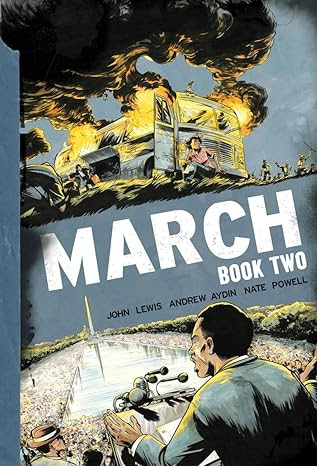
MARCH: BOOK TWO (graphic novel) by by John Lewis and Andrew Aydin


Published in 2013 by Top Shelf Productions.

Written by John Lewis and Andrew Aydin.

Illustrated by Nate Powell.

Congressman John Lewis (1940-2020) continues his life story in book two of the March series, focusing on his struggles in the Civil Rights Movement. The book starts in November of 1960 and ends with the 16th Street Birmingham Church Bombing in September of 1963.


The story includes some very harsh responses to attempts to integrate restaurants in Tennessee, the freedom riders (young African Americans were attempting to desegregate bus lines after a court ordered them to be desegregated), and the bus boycott campaign in Birmingham. 

The violent response is horrible and shocking

Infamous segregationist lawman Bull Connor of Birmingham figures prominently throughout the middle of the book. I am pretty well-versed in the major points of the Civil Rights Movement but I was still moved by the portrayal of the Children's Crusade.

The book includes all of the negotiations, concerns, and demands before the famed March on Washington. Lewis spoke at the march, followed by the world-famous "I Have a Dream" speech by Martin Luther King. 

And, as often happens in this history, a giant step forward is followed by tragedy. In this case, the book ends with the death of 4 girls in the terrorist bombing of a church in Birmingham. 

I rate this book 5 stars out of 5. It can be found at Amazon.com here: MARCH: BOOK TWO (graphic novel) by by John Lewis and Andrew Aydin.

Click here to see my review of March: Book One.

Click here to see my review of March: Book Three.

DIFFER WE MUST: HOW LINCOLN SUCCEEDED in a DIVIDED AMERICA (audiobook) by Steve Inskeep


Published by Penguin Audio in 2023.
Read by the author, Steve Inskeep.
Duration: 8 hours, 57 minutes.
Unabridged.


It's been said that no American has been the subject of more biographies than Abraham Lincoln. I don't know if that it is true, but I do know that it is pretty tough to come up with a new angle on the 16th President. In Differ We Must, NPR reporter/host Steve Inskeep has managed to do just that.

Inskeep follows through Lincoln's life and sees how he dealt with people that he had disagreements with. Some of them were major, some were minor. Sometimes, Lincoln responded to these disagreements by befriending the people he disagreed with, sometimes by patiently arguing his point of view, sometimes by appearing to accommodate them only to slowly change their minds, and sometimes by arguing fiercely against his opponent.

And, sometimes, as in the case of Frederick Douglass, Lincoln realized he was wrong and changed his mind as was the case with Frederick Douglass (and other black dignitaries) and black men serving as soldiers and him dropping his insistence on sending freed slaves to Africa.

One is left to wonder, as always how Lincoln would have reacted to the end of the Civil War and Reconstruction - the ultimate test of his ability to work with people that he disagreed with. We know that his successor, Andrew Johnson, failed that test in a spectacular way, but we will always have to wonder how Lincoln would have done.

While this was a unique entry into the collection of Lincoln biographies, I found it to be merely an "okay" biography. I listened to the audiobook and Inskeep's pleasant reading voice didn't hold my attention particularly well. I rate this biography 3 stars out of 5. It can be found on Amazon.com here: 
DIFFER WE MUST: HOW LINCOLN SUCCEEDED in a DIVIDED AMERICA by Steve Inskeep.

TRACKERS (Trackers, Book 1) (audiobook) by Nicholas Sansbury Smith


Published in 2017 by Blackstone Audio, Inc.
Read by Bronson Pinchot
Unabridged.

Synopsis:

A Colorado police chief named Colton has organized a search for a young girl he suspects has been abducted. He reaches out to the best tracker he knows, Sam "Raven" Spears, for help. Raven is part Sioux and part Cherokee - an important fact because he soon suspects that the abductor is acting out a Cherokee legend featuring cannibals. 

While Colton and Raven are on the hunt, there is a North Korean EMP attack on the United States. For those not aware, EMP stands for Electromagnetic Pulse. Nuclear weapons emit a pulse that absolutely fries most electronics. If you bomb a city normally, the pulse is limited by hills, buildings, and lots of other things.

But, if you blow a nuclear bomb up high up in the air, the bomb doesn't do a lot of damage but the EMP kills all exposed modern cars (older cars have no computer systems, electrical systems, power plants, airplanes, ships, radios, phones, etc. 

The idea behind the North Korean attack is that a few nuclear bombs can expose most of the United States to multiple EMPs and cause our entire society to collapse. EMPs also generate radiation so there will be a weaponized radiation in the form of radioactive rain.

Colton and Raven continue their hunt while also dealing with the collapse of modern American society...

My Review: 

I've read a small handful of novels that feature EMP attacks and more than my share of creepy serial killer books. You'd think that mixing them together would be extra interesting and exciting. But, this was not a good mix. This should have been separated into two books so that the creepy serial killer had more development and had more exploration into the Cherokee mythological story that inspired his craziness.

It sounds like the aftermath of the EMP attack is explored in the next three books in this series but I will not be continuing on.

Why not?

Despite some good moments, so much of this book felt clunky and tired in this book. Surprisingly, even top-notch audiobook reader Bronson Pinchot sounded like he was just mailing it in.

I rate this audiobook 3 stars out of 5. It can be found on Amazon.com here: TRACKERS (Trackers, Book 1) (audiobook) by Nicholas Sansbury Smith.

THE BIG BREAK: THE GAMBLERS, PARTY ANIMALS, and TRUE BELIEVERS TRYING to WIN in WASHINGTON WHILE AMERICA LOSES ITS MIND (audiobook) by Ben Terris


Published in June of 2023 by Twelve.
Read by Tim Andres Pabon.
Duration: 9 hours, 32 minutes.
Unabridged.


Ben Terris offers up a collection of stories about a few of the people that casual political observers have never heard of. I regularly watch the Sunday morning political shows and listen to political podcasts and I'd only heard of 4 of the people featured in this book, and only 1 of them by name. 

That, of course, is the point of the book - a look at the movers and shakers below the obvious level of movers and shakers. Some move and shake a whole lot in the world of Washington politics, some barely do any moving at all, and some used to move and shake a whole lot but now have been sidelined by scandal.

Terris looks at people like Matt Schlapp, who is the head of the Conservative Political Action Committee (CPAC) - the travelling roadshow of right wing politics. Schlapp is an example of a hyper-connected mover and shaker in the book. But, he also looks at people with less influence like a person that runs a website for staff members on Capitol Hill who want to complain about pay and working hours, members of Congress that fart during staff meetings and some that are a little too grabby with the help.

Some of these are compelling stories, some are not. For example, I was not particularly impressed with one of the stories that he started with - a young, idealistic staff member who thought he would make a profound political statement by resigning and then sneaking back into his boss's office (Diane Feinstein) at night and smoking a joint in her chair while recording himself on video. I thought this was a fairly pathetic attempt at protest and I felt pity this young former staffer rather than being impressed by his actions.

The only person that I knew by name was Frank Luntz, a Republican pollster and advisor. Luntsz's specialty is coming up with more politically advantageous wording. He is credited with coming up with the renaming of the estate tax as the "death tax" and global warming as "climate change." Luntz used to do a lot on work on TV on CBS and Fox discussing his polls.

The first part of the book was okay (3 stars), the middle part drug a bit (2 stars) and the last part was pretty good (4 stars.) Do all of the math and that makes it a 3 star book for me.

This book can be found on Amazon.com here: THE BIG BREAK: THE GAMBLERS, PARTY ANIMALS, and TRUE BELIEVERS TRYING to WIN in WASHINGTON WHILE AMERICA LOSES ITS MIND by Ben Terris.

HAS ANYONE SEEN the PRESIDENT? (audiobook) by Michael Lewis


Published by Simon and Schuster Audio in 2018.
Only available in audiobook format.
Read by the author, Michael Lewis.
Duration: 0 hours, 54 minutes.
Unabridged.

Originally, Has Anyone Seen the President was originally written for Bloomberg View, the editorial/opinion site of Bloomberg News. Lewis went to Washington. D.C. during the run up to President Trump's "State of the Union Address". Lewis visits the press room in the White House, speaks with a former press secretary from the Obama Administration and visits with Trump advisor Steve Bannon. He also spends time with a former ethics official in the government who quit because President Trump and his administration openly flout the standards for ethics that were established in previous administrations (like divesting your portfolio of investments that could be a conflict of interest with your position in government). Finally, Lewis ends up watching the State of the Union with Steve Bannon in Bannon's home with running commentary from Bannon.

Michael Lewis, for me, is best known as the author of the books that inspired the movies Moneyball and The Blind Slide.  Turns out that he also writes a lot about finance and politics. Who knew? Well, a whole lot of people did, so I guess I was just out to lunch on Michael Lewis and his many facets.

Steve Bannon
The biggest coup of the entire book is the access to Steve Bannon. Bannon is widely regarded as the man who masterminded Trump's 2016 election win. There used to be people that would say that the secret to Ronald Reagan's success was to just "let Reagan be Reagan" because his folksy charm would work wonders. Bannon was the one advisor that would push to "let Trump be Trump." He recognized that Trump's abrasive style and quirky speaking style repelled people by the millions but it also attracted just as many diehard supporters and that was the secret to victory.

If you are part of the group that is repelled by former President Trump, this book will only confirm that repulsion. Bannon's hired gun style is obvious, but he does nothing to betray former President Trump. If you are a fan of the former president, this book will not shake you from those convictions. It is all old news, albeit old news packaged in an interesting story told by a talented story teller. 

I rate this audiobook 5 stars out of 5. It can be found on Amazon.com here:  HAS ANYONE SEEN the PRESIDENT? (audiobook) by Michael Lewis.

LINCOLN and the FIRST SHOT (Critical Periods of History Series) by Richard N. Current


Originally published in 1963.

27 years ago I took a night class about the Civil War offered by Ball State University in a middle school off campus. It was a great class and Lincoln and the First Shot was the first book that we discussed. The book covers the two month period from the day that Lincoln arrived in D.C. after he was elected President and the day that P.G.T. Beauregard opened fire on Fort Sumter at Charleston, South Carolina.

When the Confederate states seceded they took over all Federal property, including forts and military bases. Two forts were not surrendered - Fort Pickens in Pensacola and Fort Sumter. Fort Sumter was always the most argued over because of the symbolism of being smack in the middle of the main port of the first state to secede. 

Lincoln refused to give up the fort because he refused to give up any of the seceded states. South Carolina demanded the fort because they insisted they were part of a new country and they did not want a foreign power to have a fort blocking a port in their new country.

South Carolina was ready to fire on the fort but did not want to look like they were provoking a fight. A peaceful separation might still be possible. Lincoln was preparing to reinforce the fort if he could - but without provoking a fight. After all, the country might be peacefully reunited. 
Fort Sumter immediately after its surrender
to South Carolina troops in April, 1861.

Neither side wanted to fire the first shot, but both sides could foresee the rush of patriotism that follow if their side were fired upon.

Historian Richard N. Current's description of the situation faced by both the North and the South at the beginning of the crisis was excellent and well done. But, his description of all of the plotting, fake peace proposals and sometimes outright confusion felt like he was stretching out the story to fill the pages of this book - like there was a minimum number of words he had to reach to fulfill his book contract.

So, I rate this book 3 stars out of 5. It can be found here on Amazon.com:  LINCOLN and the FIRST SHOT (Critical Periods of History Series) by Richard N. Current.


TREASON by David Nevin


Published in 2001 by Forge (Tor).

Treason has been in my to-be-read pile for a long time. I was inspired to finally read it after watching the musical Hamilton on a streaming service. As you may know, the character of Aaron Burr plays a large part and I got to wondering exactly what happened to Burr when he went west after his term as Vice President.

The problem, as the author points out, is that we don't really know exactly what Aaron Burr did. He went on trial for treason, but it was a hurried and botched trial and Burr was found not guilty.

Nevin does a solid job of explaining what Burr might have been doing. Nevin goes along with the popular theory that Burr was working with the commanding general of the U.S. Army, James Wilkinson. In 1854, letters were discovered that showed that Wilkinson was in the pay of the government of Spain and was feeding them all sorts of information.

Aaron Burr, 1756-1836.
Nevin supposes that Wilkinson gave Spain false information designed to make Spain attack the United States while Burr was bringing hundreds of men down the Ohio and Mississippi as part of a private army. Burr and Wilkinson were planning to use the Spanish attack as an excuse to initiate martial law in New Orleans, attack Mexico and combine New Orleans, Texas and Mexico into a new country, led by Burr and Wilkinson. Eventually, the states west of the Appalachians would join the new country and New England and New York would break away from the rest of the coastal states and the United States would simply cease to exist.

All of that was interesting, but David Nevin strung this book out and made all of that as boring as possible. He repeated conversations, rants, mental rants and made the pace crawl. The front cover features the Hamilton-Burr duel, but the book barely mentions it with just 6 pages out of a 545 page novel. Hamilton is basically a non-entity, which is weird because Burr is probably most remembered for the duel.

In short, this book is slow and tedious. It took me more than 6 weeks to read it. In the meantime, I read a completely different book because I thought it was more interesting. And magazines. And just goofed around on Facebook.

I rate this book 2 stars out of 5. It can be found on Amazon.com here: TREASON by David Nevin. 2 stars for the coherent theory about Burr's conspiracy.

FRONT ROW at the TRUMP SHOW (audiobook) by Jonathan Karl


Published by Penguin Audio on March 31, 2020.
Read by the author, Jonathan Karl.
Duration: 10 hours, 16 minutes.
Unabridged.


Jonathan Karl has had a long relationship with Donald Trump. Karl is a reporter
Jonathan Karl and Donald Trump in 1994 and nowadays.
(The New Republic, The New York Post, CNN and ABC) and he first met Donald Trump in 1994. Michael Jackson and Lisa Marie Presley had just gotten married and were staying in Trump Tower for their honeymoon. Karl convinced Trump to do an interview about why celebrities would want to stay in his building. Trump personally led Karl on a tour of the building.

Over the years, Karl interviewed Trump multiple times for multiple reasons. Because of this relationship, Karl was called on to interview Trump when he toyed with the idea of running for president before 2016 (5 times).

Karl moved on to be the White House correspondent for the Obama administration for ABC and stayed when Donald Trump was elected.

This book will not change a single mind about President Trump, for or against him so I am not going to even delve into his stories. I thought Karl made a series of fair points.  He was also critical of other administrations and their dealings with the press. But, he didn't go into detail on those because
 it is a book about the "Trump Show".

The book is very listenable. Karl reads his own audiobook and does a great job, which is to be expected considering what he does for a living.

I rate this audiobook 5 stars out of 5. It can be found on Amazon.com here: 
FRONT ROW at the TRUMP SHOW by Jonathan Karl.

STAR SPANGLED SCANDAL: SEX, MURDER, and the TRIAL THAT CHANGED AMERICA (audiobook) by Chris DeRose


Published by Blackstone Audio in June of 2019.
Read by Traber Burns.
Duration: 8 hours, 36 minutes.
Unabridged.


In February of 1859, Daniel Sickles, a sitting U.S. Congressman, shot and killed a man in Washington, D.C. across the street from the White House.

Why is this not just a weird moment in American history?

Five reasons.

#1) Daniel Sickles went on to become the highest-ranking Union officer in the Civil War that did not graduate from West Point. He performed very well at the disastrous Battle of Chancellorsville and performed bravely, but with great controversy at Gettysburg, where he lost a leg.

#2) The victim was Phillip Barton Key, the son of Francis Scott Key, the author of the Star Spangled Banner. Phillip Barton Key was also the U.S. Attorney for Washington, D.C.

#3) Key and Sickles' wife had been carrying on a long-term adulterous affair and Sickles had just discovered this fact.

#4) The new technology of the telegraph spread this story to newspapers across the country and it became THE scandal story of its era. Some newspapers sold literally tens of thousands of copies when this story was on the front page. Record numbers of telegraph messages were sent out across the country - totals only eclipsed by the Civil War just a few months later.

#5) It was the first time the temporary insanity defense was used successfully in the United States and kicked off a wave of similar defenses in adultery cases for most of the next century.

For me, an enthusiastic student of the Civil War, Star Spangled Scandal should have been an amazing book. A future Civil War general is defended in a murder trial by the future Secretary of War during the Civil War (Edwin Stanton). A few days before the murder Sickles, his wife and her lover had all been at a party hosted by Rose O'Neal Greenhow - the future famed Confederate spy who used her parties during the war to gather information. Abraham Lincoln was fascinated by the case and discussed it back home in Springfield, Illinois. Later, he and his wife became friends with Mr. and Mrs. Sickles.

But, this book gets bogged down with long passages from the trial. He literally quotes the opening and closing statements from the trial at great length with no analysis - just copies and pastes it into the book. That might have been all right, unless you have read anything from the 1850's. Verbose and flowery speech abounds. Everyone comes off as a self-important, pompous windbag. It is tedious to listen to. If it could be said in 10 words, they were sure to use 50 or 60.

Here is a great example. This single sentence with more than 90 words was written to the New York Herald by Daniel Sickles to complain that they were writing about his personal life, but they didn't know any of the details and they should just butt out:

"The editorial comments of the Herald of yesterday, although censorious, (of which I do not complain whilst I read them with regret) differ so widely in tone and temper from the mass of nonsense and calumny which has lately been written concerning a recent event in my domestic relations, that I cannot allow a mistake, into which you have been held by inaccurate information, to pass without such a correction as will relieve others from any share of the reproaches which is the pleasure of the multitude at this moment to heap upon me and mine."
An artist's rendering of the murder from Harper's Weekly
 in March of 1859.


If you enjoyed that sentence, you would love the extended quotes from the trial transcript threaded together with an occasional comment for page after page.

I did not enjoy the narration in this book. I only have a couple of readers I will not listen to. Before this book, I only had one reader. Traber Burns has made it two. The reader has the perfect voice for pompous, self-important commentary. He is perfectly suited for this style of writing.

So, I rate this audiobook 2 stars out of 5. Just too many quotes. I get the value of letting the people actually speak for themselves, but this was too much.

This book can be found on Amazon.com here: STAR SPANGLED SCANDAL: SEX, MURDER, and the TRIAL THAT CHANGED AMERICA by Chris DeRose.

NIGHT SCHOOL (Jack Reacher #21) (audiobook) by Lee Child


Published by Random House Audio in 2016.

Read by Dick Hill.
Duration: 13 hours, 7 minutes
Unabridged.

Fans of Jack Reacher know that the Lee Child does not write his books in a linear pattern - he bounces around on the Jack Reacher timeline quite a bit. Night School is set in the 1990's when Reacher was still in the military. Reacher has just come off of a secret mission in the Balkans.  He helped find and eliminate war criminals from the fighting that erupted in the wake of the collapse of Yugoslavia. It was the kind of mission that the government was glad to have done, but not glad to acknowledge.

Reacher receives a medal in a private ceremony and then is sent off to an inter-agency training seminar in the suburbs of Washington, D.C. But, it turns out that there are only two other people at this "training" - an FBI agent and a CIA agent that are also fresh off of missions that 
the government was glad to have done, but not glad to acknowledge.

The State Department has gathered them together as a team of go-getters to figure out what is behind a piece of intelligence that they have picked up thanks to an embedded operative - a terror network is offering $100 million for something to a seller in Germany. Reacher and company are being asked to figure out what is for sale and how they can get it before the bad guys do without losing the operative...

This is my fifteenth Jack Reacher book and it was one of the best. It's got some action, but mostly it is a detective story with really big consequences if it is not solved soon.

Dick Hill read this audiobook. He reads most of this series and that is a very, very good thing because Dick Hill has nailed the narration and character voices perfectly.

I rate this audiobook 5 stars out of 5 and it can be found on Amazon.com here: Night School by Lee Child.

THE INNOCENT (Will Robie #1) by David Baldacci


Originally published in 2012.

The Innocent introduces Will Robie, a professional hit man who works for the United States government. His hits are usually drug cartel leaders, leaders of terrorist organizations and the like.

Robie gets an assignment close to home, which is a weird thing in and of itself. The first two hits described in the book are out of country hits. The fact that they are out of country hits gives the U.S. government a bit of plausible deniability. This new assignment is in Washington, D.C. and, as far as Robie can ascertain, the target is a fellow member of the intelligence community - but not an important one.

He's willing to follow through with it until he sees that the target is actually a mom with a young son and a baby. He hesitates, tries to figure out what is going on and that's when everything goes topsy-turvy in Robie's already convoluted world...
The White House. Photo by Zach Rudisin


This book was not a particularly great book for a couple of reasons. But, I will start with the good parts. The characters are great. Robie is likable character (for a stone-cold assassin) and his character does grow throughout the book. Also, the two supporting characters are interesting and the interaction between all three of them is well done.

But, the plot holes are not just large, they are magnificent. Robie stumbles into a plot, but you find out that he didn't really stumble into it - it was enlarged to include him as well in a giant cat-and-mouse game that makes no sense when you consider how it puts the original conspiracy at so much risk. Also, I knew who it was from the beginning because of a clue that was dropped that I cannot believe Robie did not pick up on and include in a mission debriefing. If he had, the entire plot of the book could have been avoided.

Also, on a pet peeve note there is this:

I am a Spanish teacher. I notice the Spanish in books and Baldacci includes a mis-translated gem on page 182 that tells me that he can't bother to actually check his dictionary translation with any of the millions upon millions of native speakers of Spanish that live in the United States. It's not that hard. It is a symptom of the lack of follow-through that pervades the book and makes for an iffy plot.


I rate this book 2 stars out of 5.

This book can be found on Amazon.com here: The Innocent by David Baldacci.

HAVOC (Philip Mercer #7) by Jack Du Brul


Published in 2006 by Brilliance Audio, Inc.
Read by J. Charles.
Duration: 12 hours, 43 minutes.
Unabridged audio edition.

Jack Du Brul's Havoc is a techno-thriller that races from the Hindenburg disaster to Africa to Washington, D.C to Atlantic City to Niagara Falls to Russia and back to Africa with hardly any time to take a breath. 

The book features Philip Mercer, a geologist by training that often troubleshoots for the White House. This is the seventh book featuring Mercer, a fact that was not on the audiobook label. However, Du Brul does a great job of catching the reader up on what has been going on - I assumed it was the first book in the series as I was listening to it. 

The Hindenburg disaster on May 6, 1937.
The action starts with a traveler on the infamous Hindenburg as it flies to its fate with destiny in Lakehurst, New Jersey in 1937. A crazed man is hiding a secret in a safe in his room and he is afraid that the Nazis know he has it and are plotting to steal it from him. As this man sits and watches his safe he devises a plan to get it safely off of the airship before it lands in New Jersey - he throws it overboard into a farm field with an attached note for Albert Einstein. The note falls off and the safe gets forgotten in the chaos of the Hindenburg disaster.

Fast forward to modern day in the Central African Republic. Mercer accidentally meets Cali Stowe, a fellow American. Mercer tells her he is here to investigate a geological hunch for someone as a favor. She says that she is there to investigate a village that has an extraordinarily elevated cancer rate. They are both telling half-truths. But, most importantly, this village is in the middle of a civil war and a dangerous warlord is on his way, burning and looting as he comes...

As the story progresses, Stowe and Mercer find that they have a mutual interest in this village and in each other. The more they find out about, the more tense the situation becomes. There are a lot of complicated threads in this book but Du Brul does tie them all together at the end

The story is full of action and adventure - some of it fun, some of it believable, some so outrageous that the story borders on silly. Mercer gets to be too much after a while - he is an expert on the Hindenburg, he knows how to fight, he's an expert with pistols, grenades, rifles, knives, swords and even with bows and arrows. He knows about mines, cave-ins, scuba diving, trains, dinosaur bones, forklifts, helicopters, speed boats and bar tending. But, his heart is in the right place and if you just go with the flow and don't think about it it just might not bother you too much. 

The audiobook was read by J. Charles. Charles did a merely okay job with the variety of accents required by this book. He has a hard time with women's voices and Cali Stowe has a lot of lines in this book. His foreign accents all fell into the category of "not an English language accent". Everyone kind of sounded the same. 

I rate this audiobook 3 stars out of 5. It can be found on Amazon.com here: Havoc (Philip Mercer #7) by Jack Du Brul.

Reviewed on July 22, 2014.

THE CAMEL CLUB (Camel Club #1) (audiobook) (abridged) by David Baldacci


Published by Time Warner AudioBooks in 2005.
Read by James Naughton
Duration: 5 hours, 39 minutes
Abridged

Four outcasts form The Camel Club, a team that keeps an eye on the government so that it can discover the "truth". The club is led by Oliver Stone - not the director but a former CIA assassin who has taken the movie director's name. Stone literally stakes out the White House and watches who comes and goes. Reuben Rhodes is a former soldier and DIA member who works in a warehouse. Caleb Shaw works for the Library of Congress and often dresses like he was in the 19th century. The last member is Milton Farb, a computer genius with obsessive compulsive disorder.

These four witness a murder of a government agent on Theodore Roosevelt Island, D.C. area national park. When it looks like the murder is going to be treated as a suicide, the club swings into action with the support of a friendly Secret Service agent and discovers a conspiracy that was even larger than they could have imagined that extends all of the way into the White House itself.

I listened to this book as an abridged audiobook. The unabridged audiobook (read by a different reader) lasted 16 hours and 10 minutes. My abridged version, read by two-time Tony Award-winning actor James Naughton lasted a mere 5 hours and 39 minutes, making it almost exactly one-third the length of the unabridged version. Taking into account that different readers can read at different paces, this abridged version is still missing about two-thirds of the book - and it shows.

The White House
The abridged version introduces characters with little or no explanation (the Reuben Rhodes character gets the short shrift, for sure) and the plot sometimes jumps forward in a herky-jerky fashion. At first, I thought it was because the book was poorly written but then I finally realized that it was abridged after I read the fine print on the back of the box (it is not disclosed anywhere else). Naughton did a solid job as the reader, but I cannot recommend his abridged version. I have not listened to the unabridged version, but it has to be better than the abridged version. 


I rate this abridged audiobook 2 stars out of 5. The unabridged version can be found on Amazon here: The Camel Club. I couldn't find anyone selling the abridged version.

Reviewed on June 27, 2014.

THE BACKUP MEN (Mac McCorkle #3) (audiobook) by Ross Thomas


Originally published in 1971.


Audiobook edition published by HighBridge Audio in 2013.
Read by Brian Holsopple 
Duration: 6 hours, 1 minute.
Unabridged.

Ross Thomas (1926-1995) is a multiple Edgar Award winner. HighBridge Audio is going back and re-releasing a number of his books as audiobooks. 

The Backup Men is #3 in the four part Mac McCorkle series. I had not read or listened to any books by Ross Thomas before this one and, to his credit, Thomas did an extraordinary job of getting this newbie listener up to speed rather quickly.

Mac McCorkle is a part owner of a rather fancy restaurant in Washington, D.C. that he calls a "saloon." His partner is Mike Padillo who used to work for the CIA or a similar government entity (he is never quite clear about this) and is well-known in the professional hitman/bodyguard/spy community. 

Padillo is approached by a couple of well-known members of his professional community, a set of nearly identical male and female twins, the Gothars, to be their backup man in an operation. They are guarding the new king of a country next door to Kuwait. Remember that this is still 1971 so the massive oil fields in the Middle East were still being explored and developed. In this case, this little country was just being opened up to Western oil exploration, assuming that the new king lives long enough to sign the contracts, that is.
Photo by  Niels Noordhoek

It turns out a pair of equally well-known spies/thugs/hit men are out to kill this new king. When the male twin is found dead in McCorkle's apartment Padillo agrees to help the surviving twin escort the new king. McCorkle insists on coming along as a "talented amateur" and the chase begins.

Although this is a shorter-than-average audiobook, it just felt like the first half of the book was going nowhere. There was lots of posturing, discussion about what makes a good saloon (on a separate point, it really irritated me that McCorkle insisted on calling his fancy high-end restaurant a saloon. Simple rule: if you have a maitre d' you are not a saloon), a discussion about restoring old cars and their relative worth and lots of talk about Padillo's past that revealed not much about Padillo's past.

Once the story finally gets moving (about 60% of the way into the book) the action drives the story but the ending is just so-so. 

Brian Holsopple's reading of the book was quite good. He handled a number of different accents quite well. His performance of McCorkle's nearly non-stop stream of smart aleck comments and internal observations was one of the bright spots of this audiobook.

My short take on this story: McCorkle's quirky point of view on the world of international spying and his smart aleck comments make the story more palatable but it was just not enough to make an okay story a great story.

Note: I was given a copy of this audiobook by the publisher in exchange for an honest review.

I rate this audiobook 3 stars out of 5 and it can be purchased at Amazon.com here: The Backup Men by Ross Thomas.  

Reviewed on January 24, 2014.

Supreme Justice: A Novel of Suspense by Phillip Margolin


Originally published in 2010.
Published in 2011 by Harper.

A death row case, the Supreme Court and Homeland Security politics come together in Supreme Justice. The central question of the death row case is does the government have the right to withhold information deemed to be important to national security in a murder trial? In the case featured in the story, Sara Woodruff is a police officer on death row for killing her former lover. She denies any involvement and points the finger at suspected connections with the CIA and Homeland Security. She is sure he was kidnapped from her apartment and executed and the government's refusal to talk is going to cost her her life..

The Supreme Court building
If the story had been told from the point of view of Woodruff's defense team this book may have been quite suspenseful, entertaining and informative. Instead, it is told from the point of view of a set of ongoing Margolin characters: Dana Cutler, Brad Miller and Keith Evans. Miller works at the Supreme Court as a clerk and the justice he clerks for is interested in Woodruff's case. When there is an assassination attempt on the justice, Miller and the justice begin to suspect that there may be something about the Woodruff case that itself that caused the attempt.

Sadly, the book just never seems to take off and too many coincidences start to pile up to make the book a lot less dramatic than it could have been. Rather than building up to the suspected conspiracy, we short-circuit all of that and just start at the top. Throw in a twist that was telegraphed more than 100 pages from the end and a professional woman who does not know how to operate a modern day smart phone (hint: if you take pictures of legal documents that are not supposed to exist, you should e-mail them right away to your partners!) and I just was not impressed as a I have been with other Margolin books.

Not Margolin's best effort.

I rate this book 3 out of 5 stars and it can be found on Amazon.com here: Supreme Justice: A Novel of Suspense.

Reviewed on February 17, 2013.

Featured Post

<b><i>BAN THIS BOOK (audiobook)</i></b> by Alan Gratz

Published in 2017 by Blackstone Audio, Inc. Read by Bahni Turpin. Duration: 5 hours, 17 minutes. Unabridged. My Synopsis Ban This Book is t...

Popular posts over the last 7 days