Showing posts with label J.R.R. Tolkien. Show all posts

A HOBBIT, A WARDROBE and a GREAT WAR: HOW J.R.R. TOLKIEN and C.S. LEWIS REDISCOVERED FAITH, FRIENDSHIP and HEROISM in the CATACLYSM of 1914-1918 (audiobook) by Joseph Laconte


Published in 2015 by Thomas Nelson.
Read by Dave Hoffman.
Duration: 6 hours, 38 minutes.
Unabridged


A Hobbit, a Wardrobe and a Great War is a decent introductory history of World War I from the point of view of the common English soldier, a decent (but incomplete) look at the philosophical and religious trends of the West before and after World War I, decent introductory biographies of C.S. Lewis and J.R.R. Tolkien and really kind of a pleasant mess of a book.
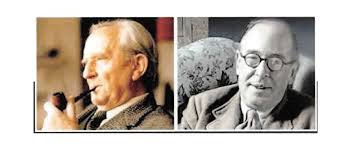
Tolkien (1892-1973) and Lewis (1898-1963)
All of these topics are thrown into the mix in a willy nilly. If that concept bugs you, this is not your book. I found it to be a pleasant enough listen, even if not particularly deep. 

I think the author makes his best points about the complete and utter waste and despair of a World War I battlefield when he compares it to the waste and desolation of Tolkien's Middle Earth battlefields and its heroes. The heroes are not generally the big leaders - they are flawed. They refuse to fight, have preconditions, are misinformed or are so full of their own agendas that the war becomes secondary.

Instead, the true heroes are people like Faramir, the younger brother of the "chosen one" hero whose pride and greed almost ruins the venture from the start. Or, it is 2 little hobbits who no one expects anything from. They literally have no power and yet they convince the very trees of the forest to stride out and destroy one of the enemies' strongholds. Of course, Sam Gamgee stands as the greatest hero of them all in my mind. He is the modeled from the stereotypical British World War I common foot soldier who heads off to fight in the war because it is his duty and keeps slogging all the way through to the end because his friends need him and it is simply the right thing to do. No pretense, just heart.

The connections with C.S. Lewis' fiction were a little less strong for me because I am not as familiar with his work. 

I rate this audiobook 4 stars out of 5. It can be found on Amazon.com here: A HOBBIT, A WARDROBE and a GREAT WAR: HOW J.R.R. TOLKIEN and C.S. LEWIS REDISCOVERED FAITH, FRIENDSHIP and HEROISM in the CATACLYSM of 1914-1918 by Joseph Laconte.

I FIND YOUR LACK of FAITH DISTURBING: STAR WARS and the TRIUMPH of GEEK CULTURE (audiobook) by A.D. Jameson


Published in May of 2018 by Macmillan Audio.
Duration: 6 hours, 58 minutes.
Read by Holter Graham.
Unabridged.


A.D. Jameson is a student of cinema - not just science fiction and fantasy movies, but of cinema in general. I used the word "student" in the previous sentence carefully because he is not just a fan of movies, he studies the directors, the movements and the ideas behind the movies.

Photo by DWD
But, he is also a proud geek - a fan of sci-fi and fantasy literature and movies. Like me, he was really into those genres in middle and high school, moved away from them for a while during and after college and then came back to them in a big way when the Star Wars "Special Edition" movies were released.

My own children do not believe me, but there was once a time when the mere sight of a Star Wars t-shirt or bumper sticker was worthy of comment. Now, they are everywhere. My family probably owns more than 20 Star Wars-related t-shirts alone.

A.D. Jameson explores how this happened by focusing on the world of cinema and television. He argues that Star Trek, not the original run on NBC but the re-run episodes running night after night, day after day until everyday, normal TV viewers got used to the idea of spaceships and aliens. When Star Trek was starting to fizzle out, Star Wars came in and made a big splash - the biggest splash in movie history up to that point. When the Star Wars phenomenon started to fade away, Star Trek came back with the movies and then with four different TV shows that spanned 18 years. Many of those shows aired every day (sometimes multiple times per day) because they were syndicated.

Star Wars came back with the troubled (but immensely successful) prequel series. X-Men movies started coming out - another troubled franchise, but it has been going on for 19 years! The Lord of the Rings movies and suddenly it seemed like every movie was a sci-fi, fantasy or a comic book movie.

As I mentioned, Jameson focuses on TV and especially cinema, spending a lot of time arguing that Star Wars fits perfectly well in with its peers from the time period like Bonnie and Clyde and The Godfather. He makes a compelling argument, one that would undoubtedly be argued against by Martin Scorsese when you consider the ruckus he has kicked up with his comments about the Marvel Cinematic Universe.  While I was interested in all of this exploration of cinema, the book title gives the reader the impression that "geek culture" was going to be explored in a meaningful way. Culture is more than movies. I assumed that the book was going to explore how we went from being a culture where sci-fi and fantasy were fringe movements in everyday life to the point where the truck in the picture I posted with this review is driven around in central Indiana, but it is largely unexplored.

His comments on Star Trek and its influence on culture as a beacon to where we might one day end up as a society (more open, more accepting) were quite good. It occurred to me that among my many behavioral role models are Jesus and Jean-Luc Picard - and those two don't clash with one another at all.

The audiobook was well-read by Holter Graham. He did such a good job at sounding like he was into the topic that I actually assumed that the author was self-narrating the book until I checked.

I rate this audiobook 4 stars out of 5. I have to take off a star for mostly failing to address one of the themes mentioned in the title. Still, it is a good book. It can be found on Amazon.com here: I FIND YOUR LACK of FAITH DISTURBING: STAR WARS and the TRIUMPH of GEEK CULTURE by A.D. Jameson.

The Hobbit (BBC Radio Presents) (audiobook) by J.R.R. Tolkien


A Disappointing Adaptation


Published in 1988 by Bantam Audio Publishing 
Performed by a full cast
Duration: 3 hours, 42 minutes
Abridged and edited for the radio drama format.

Way back in 1968, the BBC created a radio play version of The Hobbit to air in eight 30 minute segments with a full cast, original music and special effects. Due to a dispute between the Tolkien estate and the BBC the original tapes were to have been destroyed. But, the issues were resolved, copies resurfaced and since the late 1980s the BBC has re-issued this version of The Hobbit in various formats. I listened to a 1988 audio cassette version.

J.R.R. Tolkien (1892-1973)
Now, I truly love the story The Hobbit - it is a true classic and I listened to this version to give myself a little reminder of the story before the movie comes out at the end of this year.

However, this audio version has some serious troubles.

First, the positives. The narrator (a character created for this abridgment of the story) is quite good and I rather enjoyed the interaction between the narrator and Bilbo. It reminded me of someone telling a story around a campfire and another person coming in and clarifying a point from time to time as the story was being told.

But, there are problems. The dwarves tended to blend together and sounded like a rowdy, whiny frat party most of the time with a lot of hooting, grunting and complaining. But, with 13 dwarves it would have been very difficult to do much with them anyway, except to cut down on the extra noise of having all or most of them speak at the same time in scene after scene. On top of that, the names are pronounced differently in this version than I have ever heard them. Gandalf is pronounced with the emphasis on the last syllable and sometimes sounds like gand-ELF. Gollum is pronounced Gul-loom.

But, that would have all been understandable and forgivable if that were the worst of the problems. The special effects are horrid. Sometimes they are too loud so that they dominate the scene (as in when they are carried by the giant eagles) and other times they are pathetic. For instance, in the scene with the wargs there is no attempt made to make the wargs sound wolf-like. Instead, the actors are all baying, "Woooo-ooooo-ooo!" at the microphone. Throw in the horrid voices of the thrush and the eagles and scenes that are meant to be a treat becomes something that must be endured. This adaptation was made on the cheap and it shows, especially when compared to the high quality work done by companies like GraphicAudio nowadays.

I rate this audiobook 2 stars out of 5.

This audiobook can be found on Amazon.com here: The Hobbit.

Reviewed on September 22, 2012.

J.R.R. Tolkien (Christian Encounters series) by Mark Horne


A nifty little biography


Published in 2011 by Thomas Nelson

Mark Horne's J.R.R. Tolkien is an enjoyable biography of the famed writer of The Hobbit and The Lord of the Rings trilogy. It is not a large biography (130 pages) but, if you are like me and knew just a little about Tolkien and wanted to know a bit more, this biography fits the bill perfectly.

Horne begins with quite a bit of detail about Tolkien's early life, especially the difficulties caused by the loss of his father when 
he was very young and the death of his mother when he was 12 years old. His mother's faith and the difficulties she endured when she converted to Catholicism are very important foundations of Tolkien's young life.

Tolkien's relationship with his wife Edith (both before and after they were married) are covered quite well. Horne skimps a bit on his children and we almost completely lose track of Tolkien's brother, who endured the same difficulties but chose a different path through life.

Tolkien had no inheritance or lofty standing in society to help him prosper in pre-World War I England. But, he did have a first class mind and despite the distraction of his budding romance with Edith, he was able to procure an academic scholarship to Oxford. Tolkien and academia were a great fit and he continued to teach throughout most of his life. He seems to have been an excellent teachers as his academic programs grew even though he was very much an advocate of letting students have more choices and less rigid programming in their education (this is in line with the general freedoms he promoted throughout his works).
J.R.R. Tolkien (1892-1973)


Academic male companionship was important to Tolkien and he almost always had a group of students and/or professors that he met with regularly. They discussed the news of the day, literature, various academic disciplines and they served as willing foils for each one another's new projects. This seems to have been the great joy of Tolkien's life. C.S. Lewis was one of these companions, being a fellow member of group that called themselves the Inklings.

This little biography's strength is how it tells the tale of the creation of Tolkien's beloved books and their enormous influence on literature and culture even today and how truly surprised Tolkien was at his success. Tolkien was prone to multiple re-writes, self-doubt and what might be referred to as attention deficit disorder when it came to finishing projects - he was constantly adding this or that and re-working sections of books, even while the presses were waiting, as was the case for The Return of the King. Thrown in is Tolkien's omnipresent and ultimately quixotic desire to publish the never-quite-done The Silmarillion, his background source for the world of Middle Earth (it was published after his death after careful editing by his son, Christopher).

I received my copy of this book without charge from Thomas Nelson Publisher's BookSneeze program. There was no expectation of a positive review in exchange for the book, nor would I simply "give" a positive review since that would be unethical.

I rate this biography 5 stars out of 5.

This book can be found on Amazon.com here: J.R.R. Tolkien by Mark Horne.

Reviewed on August 1, 2011.

The Woods Out Back (Spearwielder’s Tale #1) (audiobook) by R.A. Salvatore


Published by Tantor Audio in 2010.
Read by Paul Boehmer.
Duration: 11 hours, 57 minutes.
Unabridged.

Gary Leger lives Massachusetts and is forced to make do with a miserable job in a plastics factory with no real prospects of doing anything but making ends meet at a job that offers little for his very active imagination. A natural athlete with no interest in sports, Gary finds solace in long walks in the woods behind his house and in his dog-eared copy of The Hobbit.

While on one of these hikes, Gary sits for a bit of reading and finds himself staring at a real life pixie who shoots him with a tiny drugged arrow that causes him to faint. When he awakens he is no longer in Massachusetts – he is in the magic-filled world of Faerie. Gary finds that he has been kidnapped from his own world by a leprechaun named Mickey McMickey in order to wear the armor and carry the broken spear of a long dead human king named Cedric Donigarten in an epic quest led by a grumpy elf named Kelsenellenelvial Gil-Ravardy (but everyone refers to him by Kelsey, a fact that makes him even grumpier).

Kelsey is convinced that if he can kidnap the best Dwarven smithy, subdue a dragon in single combat and use them both to re-forge the broken spear (using the fire of a dragon’s breath), the mere fact that it has come back in existance will inspire the people of Faerie to live up to the forgotten standards of their ancestors and restore some of the lost lustre of Faerie. Gary has been chosen to wear the armor because he is the first human that they found in our world that could fit in it, a fact that makes Gary doubt the soundness of the plan quite often. It is not clear why a human from Faerie was not chosen except that all of the humans we meet in the book are physically wrecked by disease and famine or are not of high enough character to fulfill the quest.

Written as a light-hearted adventure, The Woods Out Back (Spearwielder’s Tale #1) works because the reader sees the world of Faerie through his eyes and Faerie is just as new to him as it is to the reader. The customs of the humans, dwarfs, leprechauns, evil witches, goblins, trolls, dragons, giants and elves that Gary encounters confound Gary throughout but, with the help of his companions, Gary and the reader mostly muddle through. One of the most amusing aspects of the book is Gary’s well worn copy of The Hobbit. Mickey McMickey, the leprechaun reads it as they travel and he makes comments throughout.

R.A. Salvatore
When I first began to listen to the book I was trying to imagine parallels with the Wizard of Oz (Dorothy was taken unwillingly to a strange, magical land, she goes on a quest with strange companions, she wants to return home, etc.) but I soon enough realized that Salvatore’s true inspiration was actually The Hobbit. Like Gary Leger, Bilbo Baggins is forced out of his comfortable but very stale day-to-day life in order to go on a quest. Like Bilbo, Gary finds this quest to be eye-opening, fascinating, morally challenging and in the end he is a much better person than when he started.

This is not a perfect book – Gary is often guilty of just accepting the strange things that happen around him as they are rather than asking questions that would help the reader. The language is sometimes stilted with worn, overused phrases (“glowering eyes” was especially grating for this reviewer). The characters are straight from central casting of any Tolkien-inspired book. The audiobook format provides additional issues. Paul Boehmer is the reader and he does a truly great job of creating different voices for the characters. But, his reading of the actual narration of the book (all of the non-speaking parts) is quirky. Oftentimes, he emphasizes his sentences in an odd manner that was distracting for the first couple of hours.

Despite those issues, the book’s fast-paced, good-humored nature draws the reader in and makes the world of Faerie a fine place to visit – good thing there are two more installments!

I rate this audiobook 4 stars out of 5.

This book can be found on Amazon.com here: The Woods Out Back (Spearwielder's Tale)

Reviewed on December 10, 2010.

Roverandom by J.R.R. Tolkein


This one is tricky to review


Originally submitted for publication in 1937 (but rejected). Finally published in 1998.

When reviewing a piece of children's literature, especially a piece by a world-famous author and one that was originally created, not for the general public but to console his young son on the loss of a beloved toy, how can you be fair? Do you let the reputation of the author boost the score? Do you judge this book by the standard of his other books?


Since I have two small children, I decided to judge Roverandom by comparing it to the other children books that I have been reading lately. By that standard, Roverandom comes off as a solid 3 star book. There is little character development - the emphasis is on a fast-moving plot and plenty of inside family references that are covered in the introduction.

This is not a prequel to The Hobbit, but it is a quick, fun read with lots of emphasis on fantasy.

This book can be found on Amazon.com here: Roverandom

I rate this one 3 stars out of 5.

Reviewed on November 27, 2010.

Featured Post

<b><i>BAN THIS BOOK (audiobook)</i></b> by Alan Gratz

Published in 2017 by Blackstone Audio, Inc. Read by Bahni Turpin. Duration: 5 hours, 17 minutes. Unabridged. My Synopsis Ban This Book is t...

Popular posts over the last 7 days