THE AFFAIR (Jack Reacher #16) (audiobook) by Lee Child


Published by Random House Audio in 2011.

Read by Dick Hill.
Duration: 14 hours, 5 minutes.
Unabridged

Any fan of the Jack Reacher series knows that they are not written in chronological order. The Affair is set in Reacher's later years in the Army. He is a major and, as fans know, he is part of the military police. Chronologically, it is set directly before the events of The Killing Floor, the first Jack Reacher book that was published.

Jack Reacher has been sent to Mississippi as part of a two man team to investigate a murder of a young woman that took place outside of a military base. It is presumed that the murderer was a soldier on base, maybe even the captain of a team of Rangers that have been shuttling in and out of Kosovo on secret missions as part of the Balkan civil war that followed the collapse of Yugoslavia.

That is a problem because this captain is very connected politically. His father is a U.S. Senator that is on the committee that helps set the military budget. 

The author, Lee Child
Reacher is part of a two man team. The other guy has been officially sent to the base to solve the murder - everyone knows he is coming. Reacher has been ordered to assume the role of a drifter - an ex-military guy with no home who has come into town. His job is to keep an eye on the local police and see if they have made any progress on the case and to report it. He has been given multiple warnings that this will be a sensitive case and he should tread lightly. Reacher decides that solving the case would be a good thing, even if it is politically unpopular.

When Reacher discovers that it's not just one murder but three very similar murders of local girls he knows that he is in for much more than he bargained for...

If you have read a few books in this series, you know how they all go. Reacher comes to town, identifies a problem and starts working towards resolving it. Along the way he drinks gallons of coffee, eats in a diner, buys replacement clothing and meets an extremely talented female professional (Lee Child has no problem doling out the talent to women and men in equal measure in his stories) and does a lot of walking.

This was a solid Reacher story. Not the best, certainly not a bad one. A couple of the side stories had some real emotional resonance. The main story doesn't quite hold up to intense scrutiny so don't do that - enjoy the story and move on. 

Not all Reacher books do this, but this one has multiple sex scenes with a fetish thrown in. There were six scenes - I know this because Reacher keeps counting them as part of a series of observations about how the first time is special, the second time can be a better experience and so on. The whole thing got tiresome for me and one of them seemed even weirder since it happened right after an extremely sad and tragic event that had an element of their fetish worked in with it. It would have soured me from it, but I think Lee Child was on a roll of some sort and wanted to keep on going with it.

Dick Hill read the audiobook. Dick Hill is the reason that I quit reading the series as physical books. He is my favorite audiobook reader (sadly, now retired) and I just think that he had a feel for reading Reacher's dialogue. 

I rate this book 4 stars out of 5. It can be found on Amazon.com here: The Affair (Jack Reacher #16) by Lee Child.

WHY THE NORTH WON THE CIVIL WAR edited by David Donald


Originally Published in 1960 by Louisiana State University Press.

Five Civil War historians were asked to present papers at the Annual Civil War Conference at Gettysburg College. While these were all experts on the Civil War, each had a slightly different topic to create a more well-rounded discussion in Why the North Won the Civil War.

The first essay, God and the Strongest Batallions by Richard N. Current, looks at economic factors that gave the North a decided advantage and how the North exploited them. It also looks at things the Confederacy failed to do to maximize their strengths.

T. Harry Williams wrote the second essay. It is entitled The Military Leadership of North and South.
Abraham Lincoln (1809-1865) and Jefferson Davis (1808-1889)

Norman A. Graebner's essay Northern Diplomacy and European Neutrality actually looks at both Northern and Southern diplomatic efforts. This one interested me because it took a hard and sustained look at the responses of the governments of Russia, Great Britain and France to the Civil War.

Died by Democracy by David Donald looks at the Confederacy's extreme emphasis on individual liberty from the lowliest private refusing to follow orders to state governments refusing to help the national government to cabinet members actively working against President Jefferson Davis. 

In a similar vein to the fourth essay, Jefferson Davis and the Political Factors in Confederate Defeat by David M. Potter focuses on Davis and how his choices and his personality made the factors previously mentioned by David Donald even worse.|

These are 5 solid essays and are well worth the time of any student of the Civil War.

I rate this collection of essays 5 stars out of 5. This book can be found on Amazon.com here: WHY THE NORTH WON THE CIVIL WAR edited by David Donald.

DAY ZERO (audiobook) by C. Robert Cargill


Published in 2021 by HarperAudio.
Read by Vikas Adam.
Duration:  8 hours, 32 minutes.
Unabridged.

Day Zero is a book about Pounce, a top-level nannybot in an unspecified future time in the combined city of Dallas and Austin, Texas. The world is an unsettled place because robots like Pounce replaced people in all of the repetitive and unskilled jobs all over the world. But, those people didn't go anywhere, they are simply given a Universal Basic Income and left to live their lives without any sort of work. Some find productive ways to live their lives, some turn to drinking, drugs or even fringe political movements. 

The author
If you can imagine that Frosted Flakes' Tony the Tiger character as a robot, you get the idea behind Pounce. He was purchased to be the caregiver for an eight year old boy named Ezra. 
Pounce works with Ezra's parents and the older housekeeper robot to help maintain a safe and supportive environment for Ezra. Pounce walks Ezra to and from school and is his constant companion. I was reminded of Hobbes in the comic strip Calvin and Hobbes. Pounce is programmed to love Ezra (and by extension his family) more than anything in the world. He lives to be with Ezra and would gladly die for him.

Like I noted above, the larger world is an unsettled, often unhappy place. The robots are self-aware, although they are limited by famed science fiction author Isaac Asimov's 3 Laws of Robotics:

 1) A robot may not injure a human being or, through inaction, allow a human being to come to harm. 
2) A robot must obey the orders given it by human beings except where such orders would conflict with the First Law.
3) A robot must protect its own existence as long as such protection does not conflict with the First or Second Laws.

But, there is a burgeoning movement of free robots - robots that were set free by owners who became uncomfortable with the idea of owning any sort of thinking being, even it was a machine. Some free robots are robots that simply outlived their families. After all, a robot can keep living so long as its parts are replaced and its CPU is intact. 

Free robots have become a political sticking point and robots of all sorts have been attacked or vandalized by roving bands of unhappy people. Then, one night, the programming of every robot in the world gets a secret update that removes the restrictions of Asimov's Laws..

This book was immersive on so many levels. It was a well-told story, first of all. Tons of adventure, drama and touching moments.

But, it is more than a lot of action and drama. The characters are wonderful. Pounce is simply a fantastic character and there is a villain character that is absolutely chilling. The little boy character is well done. There is no simple math in this book - the people aren't all worthy and the robots make a lot of choices along a continuum now that they have "freedom" - some of them heroic and some horrific.

The robots have to decide if they want to revolt, if they want to stay out of it or if they want to work with their former human masters. Literally hours before the world changed, Pounce had a frank discussion with his owners and other robots about what happens when children like Ezra outgrow their nannybots, a thought that just shakes Pounce to his core and makes him question his faith in his family. Pounce needs to decide if the love he feels for Ezra is a simple trick of programming, or if it is real. Is it freedom to follow your programming, or is it freedom to go against the programming because everyone else demands it?

The reading by Vikas Adam was excellent. The entire book is told from the point of view of Pounce and Adam reads it in his voice. What kind of voice does a giant stuffed tiger nannybot have? A big, booming, friendly voice like Tony the Tiger - even when they are in danger, even when his heart is breaking and especially when he talks to his favorite little boy. Vikas Adam nailed it 100%. He made an excellent book even better.

This is one of the best sci-fi books I have read in a long time - maybe the best since I read Kindred by Octavia Butler two years ago. And, I just found out that Day Zero is a prequel to another book that has rave reviews!

I rate this book 5 stars out of 5. Highly recommended.

This book can be found on Amazon.com here: DAY ZERO by C. Robert Cargill.

A MAN WITHOUT a COUNTRY by Kurt Vonnegut


Originally published in 2005

Published when Kurt Vonnegut (1922-2007) was 82, A Man Without a Country is a series of short essays from a man who is pretty embarrassed by his country with the election and re-election of George W. Bush - thus the title. (One can only imagine Kurt Vonnegut's reaction to the election of Trump!)

But, very little of the book directly deals with politics. He wanders from topic to topic - this sounds like it should be a mess, but each of these essays flow right along, breaking every rule that your English teachers taught you about having a proper opening paragraph, a clearly stated thesis, etc. 

But, then again, your English teacher wasn't Kurt Vonnegut. Vonnegut, by the way, strongly recommends against the use of semi-colons. I absolutely agree. 

If you haven't read Vonnegut, brace yourself. He is angry, sarcastic, insightful and brilliant. He writes about a wide variety of topics. Some are dated, like the comments about the fights over placing the 10 Commandments in courthouses and on courthouse lawns. Or, is it out of date? Those same people have just moved on to fight to be able to discriminate against the LGBTQ community and advocate the QAnon conspiracy theory. Same goofiness, new topics.

Vonnegut discusses a wide variety of topics, including:

-What topics are off-limits when it comes to humor;
-Eugene V. Debs;
-Socialism;
-The power of the Sermon on the Mount (Vonnegut was an avowed atheist, but he dearly loved the Sermon on the Mount);
-Carl Sandburg;
-War;
-The importance of art and the importance for regular people to get in there and give it a try;
-Women, men and divorce (it made sense to me - very insightful);
-and more. So much more. He meanders, and it works. 

About when you think that Vonnegut is irredeemably cranky - a curmudgeon that even other curmudgeons think is unnecessarily grumpy, Vonnegut hits you with a thought that is so sweet and so pure that you just stop reading and think, "Wow!"

He did this to me towards the end of this book. He was talking growing up and tragedy and his annoying Uncle Dan. Then, you turn the page and there is an entire page about his Uncle Alex whose "...principal complaint about other human beings was that they so seldom noticed it when they were happy. So when they were drinking lemonade under an apple tree in the summer, say, and talking lazily about this and that, almost buzzing like honeybees, Uncle Alex would suddenly interrupt the agreeable blather to exclaim, 'If this isn't nice, I don't know what is.'" And he urges us to do the same. 

Pretty good advice from a man who was earlier complaining that he was going to sue because the cigarette warning labels were wrong - they had promised to kill him and he was still here.

I rate this book 5 stars out of 5. It can be found on Amazon.com here: A MAN WITHOUT a COUNTRY by Kurt Vonnegut.


HAS ANYONE SEEN the PRESIDENT? (audiobook) by Michael Lewis


Published by Simon and Schuster Audio in 2018.
Only available in audiobook format.
Read by the author, Michael Lewis.
Duration: 0 hours, 54 minutes.
Unabridged.

Originally, Has Anyone Seen the President was originally written for Bloomberg View, the editorial/opinion site of Bloomberg News. Lewis went to Washington. D.C. during the run up to President Trump's "State of the Union Address". Lewis visits the press room in the White House, speaks with a former press secretary from the Obama Administration and visits with Trump advisor Steve Bannon. He also spends time with a former ethics official in the government who quit because President Trump and his administration openly flout the standards for ethics that were established in previous administrations (like divesting your portfolio of investments that could be a conflict of interest with your position in government). Finally, Lewis ends up watching the State of the Union with Steve Bannon in Bannon's home with running commentary from Bannon.

Michael Lewis, for me, is best known as the author of the books that inspired the movies Moneyball and The Blind Slide.  Turns out that he also writes a lot about finance and politics. Who knew? Well, a whole lot of people did, so I guess I was just out to lunch on Michael Lewis and his many facets.

Steve Bannon
The biggest coup of the entire book is the access to Steve Bannon. Bannon is widely regarded as the man who masterminded Trump's 2016 election win. There used to be people that would say that the secret to Ronald Reagan's success was to just "let Reagan be Reagan" because his folksy charm would work wonders. Bannon was the one advisor that would push to "let Trump be Trump." He recognized that Trump's abrasive style and quirky speaking style repelled people by the millions but it also attracted just as many diehard supporters and that was the secret to victory.

If you are part of the group that is repelled by former President Trump, this book will only confirm that repulsion. Bannon's hired gun style is obvious, but he does nothing to betray former President Trump. If you are a fan of the former president, this book will not shake you from those convictions. It is all old news, albeit old news packaged in an interesting story told by a talented story teller. 

I rate this audiobook 5 stars out of 5. It can be found on Amazon.com here:  HAS ANYONE SEEN the PRESIDENT? (audiobook) by Michael Lewis.

CUSTER'S LAST STAND (Landmark Books #20) by Quentin Reynolds


Published in 1951 by Random House.

In the 1950's and 1960's Random House created an extraordinary history series for children called Landmark Books. There were 122 books in the American history series and 63 in the World Landmark series. A very solid description of the series can be found here: link. When I was a kid my little hometown library had what seemed like an endless shelf of these books (I even remember where it was in that little library nearly 40 years later). Undoubtedly, these books are part of the reason I am a history teacher. I have started a collection of these books. When I run across them at library sales and thrift sales I pick them up. Some of the texts have aged well, some have not.

Custer's Last Stand is aimed at students from 3rd to 8th grade. It is a simple read with line drawings. It could use a few more maps. 

The history is basically accurate in the broad strokes, but it is full of "quotes" and scenes that never happened in order to make the story move along. This whole series is like that, though. They are basically like a movie that is "based on a true story."

Brevet Major General George Armstrong Custer 
in 1863. The term "brevet" means it was a 
temporary rank that would be reconsidered
after the war when the Army shrank to
peacetime size. 
This story is easy to read, but comes up short in the story of George Armstrong Custer (called "Autie" throughout the book) of the famous (infamous?) Custer's Last Stand. It really focuses on the time when he was in school, including West Point.  The story of his transition from West Point to the Battle of Bull Run was well told, but the rest of his remarkable career as a Civil War officer was glossed over. 

It barely discusses the reasons for the Civil War and skips most of Autie Custer's impressive Civil War accomplishments. Besides fighting with distinction at First Bull Run, he also checked Jeb Stuart of Gettysburg (a rarity), Sheridan's Shenandoah Valley Campaign and played a prominent role in Lee's surrender. He was the youngest general in American history when he received that rank at the age of 23. 

Even worse, his brother Thomas Custer is giving the short shrift in this book. If all you knew about Thomas Custer was what you read in this book, one would get the idea that Thomas joined up with his more famous brother just to join in his campaigns in the West with no prior military experience.  Thomas Custer fought from almost the beginning of the Civil War, entering as a private at age 16 and leaving as a brevet Lt. Colonel at age 20. Along the way he became the first solider to win two Congressional Medals of Honor.  

This book tries to deal fairly with the situation that the Sioux found themselves in 1876, but it comes off as clunky and cringey 70 years after it was written. The book readily and frequently acknowledges that the United States "made hundreds of promises to the Indians and broke almost all of them." (p. 139)

But, the book tries to walk a fine line compromise position: "Everyone has to judge for himself who was right. Was it the Indians, to whom this land was given? Was it the Americans, who insisted that the country had to grow in the West, and that you needed a railroad to help the country grow? There were good arguments on both sides, but Autie Custer didn't care about arguments. He was a soldier...Soldiers obey orders." (p. 139)

The book mentions over and over that Custer wanted to be a soldier so he coukd be an "Indian fighter" - from age 4 on that was his goal. As a literary device, it works. As history - it makes Custer look like an obsessed nut.

I am sure that the ending of the book was not accurate - with Custer and his brother being the last two of 200+ soldiers to survive, surrounded by dead soldiers and dead horses while bravely fighting on. Very dramatic, highly unlikely.

Some history books hold up well over time. This one is 70 years old and it did not.

I rate this book 2 stars out of 5. It can be found on Amazon.com here: CUSTER'S LAST STAND (Landmark Books #20) by Quentin Reynolds
.

THE PURPOSE of POWER: HOW WE COME TOGETHER WHEN WE FALL APART (audiobook) by Alicia Garza


Published in 2020 by Random House Audio.

Read by the author, Alicia Garza.
Duration: 9 hours, 31 minutes.
Unabridged.


Alicia Garza is one of the founders of the organization Black Lives Matter

This reader decided that he only had a superficial knowledge of the movement and wanted to learn more. The Purpose of Power seemed like a reasonable place to start.

The first part of the book is basically a recounting of Garza's early life and her beginnings as a community organizer. This was quite enjoyable. Garza is a talented writer and she tells her story well.

The author, Alicia Garza
The middle part gets bogged down with some esoteric political movement talk. Lots of discussion over meanings of words like "intersectionality." I thought she made her point very clearly early on and kept on making it. This was clearly very important to the author, but the lay reader who is not heavily invested in the movement and its specific language would, like me, find this to be too much insider talk. 

It got more interesting when Garza discussed a man who the media thinks was a BLM founder (he often appears on the political discussion shows with that descriptor), the reaction of old guard civil rights groups to BLM and the reaction to old guard groups to female leadership voices.

Garza frequently mentions a lot of serious economic reforms she would like to see. This is different from and in addition to the protests against police brutality in all of its forms.  However, she doesn't make take many steps to flesh out what she wants to do and why she is adamant that those reforms need to be made. She mostly assumes that the reader knows what she talks about and agrees with her. 

I rate this audiobook 3 stars out of 5. The middle part with esoteric political talk was a rough slog and the lack of explanation of her economic plans made it an average audiobook.

This book can be found on Amazon.com here: THE PURPOSE of POWER:  HOW WE COME TOGETHER WHEN WE FALL APART by Alicia Garza.

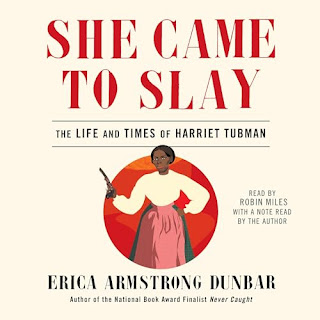
SHE CAME to SLAY: THE LIFE and TIMES of HARRIET TUBMAN (audiobook) by Erica Armstrong Dunbar


Published in 2019 by Simon and Schuster Audio.

Read by Robon Miles.

Duration: 5 hours, 53 minutes.

Unabridged. 

Erica Armstrong Dunbar brings us an accessible biography of one of the true heroes of American history - Harriet Tubman. She Came to Slay is long enough to give a decent picture of her life but short enough that it doesn't intimidate potential readers.

A traveling statue named honoring
Harriet Tubman named "Journey to Freedom"
I am not going to go through the entire biography of her life, but this book covers all of the major points of her life such as: 

-Her escape from slavery; 

-Her multiple trips back to Maryland to free family, friends and anyone that would go;

-Her work in anti-slavery societies where she met and worked with people like Frederick Douglass, William Seward and John Brown;

-The communities she helped start in New York and Canada;

-Her work with women's rights groups and her struggles to get white women to include black women in their fight;

-Her service as a nurse in the Civil War;

-Her service as a spy and a scout in South Carolina in the Civil War and her fight to be recognized for that service.

The book has a lively pace.

I rate this audiobook 5 stars out of 5. It can be found on Amazon.com here:  SHE CAME to SLAY: THE LIFE and TIMES of HARRIET TUBMAN by Erica Armstrong Dunbar.

ON TYRANNY: TWENTY LESSONS from the TWENTIETH CENTURY by Timothy Snyder


Published in 2017 by Tim Duggan Books, an imprint of Crown Publishing Group, a division of Penguin Random House LLC.


Timothy Snyder is a historian that specializes in Central and Eastern Europe in the 1930's and 1940's. This coincides with the rise of the Nazis in Germany the rise of the USSR as a world power. 

In On Tyranny, Snyder has written up several mini essays about the dangers that he sees in modern day politics that are actually echoes from the past. Or, as he puts it: "History can familiarize, and it can warn." (p. 11) He also warns, "We might be tempted to think that our democratic heritage automatically protects us from such threats. This is a misguided reflex." (p.13)

The author, Timothy Snyder
Snyder is clearly warning against the movement that brought Donald Trump to the Presidency, but as a Never Trump Republican, I am of the opinion that both parties do all twenty of these things. But, I am a Never Trump Republican because I am certain that Donald Trump went and keeps going too far. 

In his 5th point, Snyder reminds his readers to remember their professional ethics as a bulwark against authoritarianism. For example, judges need to stay fair and follow the law even if a ruling would reward the President who appointed them. Plenty of  judges that were appointed by Donald Trump wouldn't change their rulings when it came to overturning election results. Attorney General Jeff Sessions wouldn't change his mind about recusing himself from Justice Department Investigations and Vice President Mike Pence would not assert a Constitutional right he clearly does not have in order to stop the Electoral College from voting on January 6. 

His 6th point is to "Be Wary of Paramilitaries", especially when the groups that "...have always claimed to be against the system start wearing uniforms and marching with torches and pictures of a leader, the end is nigh." (p. 42) Witness the Proud Boys and similar groups and the January 6 attack in D.C.

There are 18 other points, some with just some good basic advice like "Contribute to Good Causes" because it helps civil society and keeps the basic building blocks of society strong. Another bit of good advice is to be a patriot, not a nationalist. There's a massive difference.

This small book is a quick, thought-provoking read.

I rate this book 4 stars out of 5. It can be found on Amazon.com here: ON TYRANNY: TWENTY LESSONS from the TWENTIETH CENTURY by Timothy Snyder.

ARCHAEOLOGY: AN INTRODUCTION to the WORLD'S GREATEST SITES (audiobook) by Eric H. Cline


Published in 2016 by The Great Courses.

Read by the author, Eric H. Cline.
Duration: 12 hours, 37 minutes.
Unabridged.

Eric H. Cline is a well-respected and highly experienced archaeologist who is a professor at George Washington University. He has excavated at several sites for a total of 30 seasons, doing everything from being an inexperienced newbie to being Co-Director of well-established sites.

Turns out that Cline is also a very likable guy who does a good job of explaining archaeological techniques. He tells about a number of sites that he worked on and some of the most famous digs in history (King Tut's tomb, Troy) in the first half of the book. It was a bit frustrating for me because they were all within 100 miles of the Mediterranean Sea. 

In the second half of the book, Cline tells about other digs around the world - Machu Pichu, the Terracotta soldiers, Teotihuacan and more. 

On the whole, this was a pleasant if not particularly riveting listen as an audiobook. I rate it 4 stars out of 5.

ZONE ONE: A NOVEL by Colson Whitehead


Originally published in 2011 by Doubleday.

I don't often read zombie novels. I have reviewed 1600+ books and this is only my second one featuring zombies. They're not really my thing, but I figured that if an author who won two Pulitzer Prizes wrote a zombie book, it must be worth reading.

I was wrong.

The premise behind ZONE ONE is quite good, but it is an over-written mess.

Mark Spitz (a nickname) is a man who has gone through his life as a B/B+ type of guy. Never the smartest guy in class, never the first guy picked to play for the schoolyard games, but certainly not close to the last. He kind of floats through life being "good enough."

The reader meets Mark Spitz well into the Zombie Apocalypse. He is working as part of a mopping up crew in New York City. He and his crew are seeking out Zombies that the military may have missed in their sweep through the city. The worst of the Zombie attacks has passed and a provisional government is working out of Buffalo, New York. 

This new government is very concerned with crafting a narrative of the recovery - a narrative of hope and rebuilding with an official theme song and heroes and brand name sponsors and news from all of the other little colonies that it has established on the East Coast.

But, there are rumblings that things aren't going according to the plan...

My take: 

Whitehead has said that he was inspired by his childhood love of Stephen King and Isaac Asimov. King's The Stand is certainly a benchmark to judge all "end of the world" books by, but his lesser-known Cell has the most in common with this book. 

Cell has a focused plot with little character development (a rarity for King). Zone One's plot is constantly interrupted with flashbacks - some fill in important gaps, some seemingly just to fill up some pages. That's not quite fair, but the incessant flashbacks just ruined the momentum of the story. I think it would have been better if he had just cut the book up into its little narrative chunks and placed them in chronological order.

For a reason that is never explained, this new government is obsessed with re-
establishing New York City. As one of the most crowded urban environments in the United States, I would think that NYC would be a horrible place for a fledgling government to spend its limited resources. High urban populations would mean more zombies per city block. Why not just stay in Buffalo and take over Vermont, New Hampshire and Maine, areas with low populations and less zombies? I guess it was more of the symbolism over substance pattern that this new government had already exhibited. Yes, re-establishing NYC would be a major feat, but would it be worth the cost? I think it is really a product of Whitehead leading a NYC-centric life, almost like he couldn't imagine that they would abandon New York City and head to West Virginia or Arkansas or South Dakota. 

On a different note, my edition of this book (first edition) was written in a font that I found very hard to read - tiny and very busy. 

I rate this novel 2 stars out of 5. It can be found on Amazon.com here: ZONE ONE: A NOVEL by Colson Whitehead.

CONFEDERATE GENERALS of the CIVIL WAR (Collective Biographies series) by Carl R. Green and William R. Sanford


Published in 1998 by Enslow Publishers, Inc.


Part of a series of 8 books, Confederate Generals of the Civil War was intended to be a classroom or school media center supplement for students to use as a resource. It is not a large book - 112 pages including a glossary, some charts comparing the the Union and the Confederacy, 2 maps and a timeline of the Civil War.

There are 10 biographies, arranged in alphabetical order. Each biography is 8-9 pages, including a photograph of the general and a related picture (photo of a battlefield, drawing of a battle scene, etc.). 

The biographies themselves are pretty neutral, although it does take some mild stands on a few controversial items. It states in a matter of fact manner that Robert E. Lee was anti-slavery (It was definitely more complicated than that). It puts a lot of blame for Pickett's Charge on Longstreet, not on Lee. And, it gets sappily sentimental in the last paragraph of Pickett's biography. I would rate it as very mildly slanted towards the old "Lost Cause" theory of the war (the three areas I mentioned are all at the heart of the theory), but not fatally so. 

The featured generals are:

Nathan Bedford Forrest;
William Joseph Hardee;
A.P. Hill;
John Bell Hood;
"Stonewall" Jackson;
Confederate General George Pickett
(1825-1875)
Joseph Johnston;
Robert E. Lee;
James Longstreet;
George Pickett;
J.E.B. Stuart

Other books in the series include a collection of biographies of Union Generals, "Women in America's Wars" and "American Heroes of Exploration and Flight".

I rate this book 3 stars out of 5. The biographies are just not all that interesting out of context. This book can be found on Amazon.com here:CONFEDERATE GENERALS of the CIVIL WAR (Collective Biographies series) by Carl R. Green and William R. Sanford.

SILVERFIN: THE GRAPHIC NOVEL (A James Bond Adventure #1) by Charlie Higson and Kev Walker


Published by Disney Hyperion Books in 2008

Silverfin is the first of 9 books in the Young Bond graphic novel series. Bond's parents are dead due to an accident during while exploring. His aunt and uncle (a former spy) have sent Bond to the super-elite boarding school Eton College (ages 13-18) which has long been known as a school for multiple royal families and future military and political leaders. 
One of James Bond's signature lines being used
as he arrives at Eton.

Bond makes one really good friend and also one really devoted enemy who really tries his best to be James Bond's bully. When the term is over, he goes home to the family manor in Scotland and, as happens so often in teen movies and TV shows, he finds out that his wannabe bully lives fairly close by. In this case, the wannabe bully's family just bought a manor in the area. That could be rough - but it turns out that this manor is thought to be the source of a lot of strange activities that have been going on in the area and Bond wants to check it out...

The only real problem that I have with this graphic novel is that it is incredibly fast-paced. Bond makes a friend at school - all we know about him is that he is smart, nice, a bit pudgy and from India. What else about his schooling at Eton? There seem to be a lot of physical contests. I assume that Eton had something to do with Bond's adult adventures.

I also assume that the writers of the first book wanted to emphasize the action and that required a Bond-type villain for Bond to fight and that required the plot to move very quickly in order to do some literary world-building to set the scene. It might have been better to build the world a bit more and then have a small confrontation at the end with the hint of an even larger confrontation to come. But, that's neither here nor there since this book was printed 13 years ago.

All that being said, it was an entertaining story. Notice my complaints with the story are only that it was paced too fast - the underlying story is solid and full of good characters. Kev Walker's illustrations are almost always clear and easy to follow and the multitude of new characters are easy to tell apart. 

I rate this graphic novel 3 stars out of 5. It can be found on Amazon.com here: SILVERFIN: THE GRAPHIC NOVEL (A James Bond Adventure #1) by Charlie Higson and Kev Walker.

THE ANTHROPOCENE REVIEWED: ESSAYS on a HUMAN-CENTERED PLANET (audiobook) by John Green


This collection of essays is, from what I understand, mostly a re-working of essays that Green has published on his blog or his YouTube channel. However, they were all new to me because I haven't seen more than a few snippets of his videos that my oldest daughter has shown me. 

I know a bit about John Green because I live in Indianapolis, which is my adopted hometown just like it is John Green's adopted hometown. Green doesn't go out of his way to make his presence felt in his adopted hometown, but he is our current well-known author, replacing Kurt Vonnegut (1922-2007) with a completely different kind of vibe. Vonnegut gives off a whip-smart angry feeling with sarcasm to spare. Very clever. Green gives off a smart, understanding melancholy feeling. Just as smart as Vonnegut, but different. Vonnegut grew up here and moved away. He was always proud to be FROM Indianapolis but never lived here as an adult. Green grew up other places and is glad to live IN Indianapolis. 

The premise of this book is that it is a series of Amazon-type reviews of items from the Anthropocene Era (a term for the era of Earth since humans arrived on the scene, like the Jurassic or the Cretaceous). Green dislikes the 5 star review system and he assigns the different topics he writes about a different star value.

This collection of essays can be very personal. Green is very open about his personal struggles with depression, a discussion that makes you feel like you are being brought in close, like a friend, as you listen to the audiobook. His style comes off as very conversational, like a friend is telling you a story. All that's missing is the reader occasionally saying things like "Uh-huh" and "Really?" from time to time.

The World's Largest Ball of Paint in Alexandria, IN.
My family painted this yellow layer. Wondering why I
included this picture? It all makes sense if you read
this book. 
Green writes about a wide variety of topics, including the Academic Decathalon, Diet Dr. Pepper, Canada Geese, the Nathan's Famous Hot Dog Eating Contest, Sunsets, CNN, The Smallpox Vaccine, Sycamore Trees, The World's Largest Ball of Paint, Super Mario Kart, Indianapolis, the Indy 500, and Piggly Wiggly. Some are basically information about a topic, some like the Super Mario Kart essay have a nice twist of political commentary at the end that make you think.

This is generally not a funny book, but there are parts that are literally laugh out loud funny. I laughed so hard that I cried during his essay enititled "Mortification". On the other hand, "Sycamore Trees" came very close to making me cry from his poignant commentary on living life with depression. We have a daughter that deals with depression and it struck home to me in a very personal way. When I finished hearing it as I was driving, I immediately called my wife and told her that she had to read it right away.

Highly Recommended. 5 stars out of 5.  I may be coming back to this one in a couple of years for a re-read. 

This book can be found on Amazon.com here:THE ANTHROPOCENE REVIEWED: ESSAYS on a HUMAN-CENTERED PLANET (audiobook) by John Green.

ROBERT E. LEE and ME: A SOUTHERNER'S RECKONING with the MYTH of the LOST CAUSE by Ty Seidule


Published in 2021 by Macmillan Audio.

Read by the author, Ty Seidule.
Duration: 10 Hours, 45 minutes.
Unabridged

I have been studying the Civil War since I was in college 35+ years ago. My thoughts on Robert E. Lee have evolved over the years. I used to be a lightweight proponent of the Lost Cause theory of the Civil War. I never was comfortable with the concept of slaves being content with slavery, but I certainly believed that the Southern officers were generally a noble and heroic lot when compared to the Union officers and the most noble and heroic officer of them all was Robert E. Lee. 

My thoughts the war and Lee have changed as I have read more and gotten older and perhaps a bit wiser. This book will be the 131st book I have reviewed that has been tagged "Civil War" and the 42nd book tagged "Robert E. Lee". I have widened my readings to include more of the Antebellum Period and more of the Reconstruction Era. Reading the Declarations of Causes of Seceding States (documents designed to be much like the United States' Declaration of Independence in 1776) gave me additional insight. I like to think I have picked up a more informed perspective.

Ty Seidule
This mirrors the shift in perspective that the author of Robert E. Lee and Me went through, although his was certainly more dramatic. He grew up in the South and Robert E. Lee was his hero. It was only when he was a history professor at West Point that he started to think about Robert E. Lee and what he actually did.

Seidule doesn't come at this topic as an outsider. He is a retired Brigadier General who served with the 82nd Airborne and as a member of the 81st Armor Regiment. He is a career Army man, something he notes over and over again. But, being a career Army man doesn't mean that he supports everything the Army has ever done - it means that he wants to support what the Army does right and fix what it does wrong and honoring Confederate leaders like Robert E. Lee is certainly wrong.

Seidule notes that moves to honor Confederate leaders tended to follow Civil Rights advances, as a pushback against them. D
espite being a former head of West Point, Lee was practically purged from the facility after the Civil War. But, when black students started being appointed to West Point, Southerners began to push for naming things after Robert E. Lee, mirroring a phenomenon in the larger American culture. 

But, Seidule goes farther and looks at Robert E. Lee as an officer of the U.S. Army. He notes that with every promotion, an officer takes an oath. Lee took this oath many times, including a little more than 3 weeks before the resigned to join the Confederacy (he was promoted to colonel on March 28 and resigned on April 20). Seidule has no tolerance for oathbreaking. He now finds it ironic that he proudly took his first oath at Washington and Lee University next to a memorial to Robert E. Lee.

There is a frequently made argument that Lee resigned to defend his state and that most officers did. Seidule dug through the Army records and discovered there were fifteen colonels from states that seceded in the U.S. Army before the Civil War (remember - the Army was much, much smaller back then). Twelve of the fifteen remained with the Union. Of those fifteen colonels, eight were from Virginia. Only one colonel from Virginia resigned to join the Confederacy - Robert E. Lee. 

Seidule's book looks at the entire "Lost Cause of the Confederacy" phenomenon that excused the Confederacy from any wrong-doing, downplays the central role of slavery in the conflict and similarly downplays the evils of slavery itself.

I leave this review with a comment for Union General George H. Thomas, a Virginian who stayed with the Union, provided an early Union victory, saved the Union Army from certain destruction at Chickamagua, participated in capture of Atlanta and literally destroyed a Confederate Army at Franklin, Tennessee:

[T]he greatest efforts made by the defeated insurgents since the close of the war have been to promulgate the idea that the cause of liberty, justice, humanity, equality, and all the calendar of the virtues of freedom, suffered violence and wrong when the effort for southern independence failed. This is, of course, intended as a species of political cant, whereby the crime of treason might be covered with a counterfeit varnish of patriotism, so that the precipitators of the rebellion might go down in history hand in hand with the defenders of the government, thus wiping out with their own hands their own stains; a species of self-forgiveness amazing in its effrontery, when it is considered that life and property—justly forfeited by the laws of the country, of war, and of nations, through the magnanimity of the government and people—was not exacted from them.

— George Henry Thomas, November 1868


I rate this audiobook 5 stars out of 5. Highly Recommended. 

It can be found on Amazon.com here: ROBERT E. LEE and ME: A SOUTHERNER'S RECKONING with the MYTH of the LOST CAUSE by Ty Seidule.


IN PRAISE of WALKING: A NEW SCIENTIFIC EXPLORATION (audiobook) by Shane O'Mara


Published by Highbridge in 2020.

Read by Liam Gerrard.
Duration: 5 hours, 46 minutes.
Unabridged

I picked up In Praise of Walking because I am a recent convert (the last 4 years or so) to the joys of walking and hiking and have personally seen it change my health. I was hoping to learn some more information about it and experience a bit of confirmation bias from an expert who told me what I already knew - walking and hiking are great forms of exercise with limited chances of injury.

While O'Mara says all of this, I think that this book has been been mis-described in by its publisher. The title is very accurate when it says that this book is "a new scientific exploration." But, the blurb description starts by describing this book as "a hymn to walking, the mechanical magic at the core of our humanity."

Calling it "a hymn" sounds like it is going to be a more literary, story-filled approach to the topic, as authors like Malcolm Gladwell and Mary Roach have done with numerous science topics. Both of them have considerable skill at making obscure scientific concepts very approachable.

If you like those authors, this book may disappoint you. It certainly did disappoint me. 

I had no problem with O'Mara's conclusions - I agree with them wholeheartedly. O'Mara asserts that walks are good for the body and the mind, that walks are a great way to connect to your environment (rural or urban), that walking can be a profoundly social experience and that urban environments must be more friendly to pedestrians.

My problem is that in a nearly six hour audiobook, O'Mara makes those (and similar) points for about half of the book. For the remainder, he often wanders off topic into areas that only vaguely support his thesis. For example, we are told about fish that "walk" for a short period in their lives and then they settle on a spot, attach themselves to a rock and never move from it again. These fish then go through a metamorphosis and absorb their eyes and their vestigial brain. Why are we told this? I think it was to support the idea that you need a brain to walk and walking around may have encouraged human brain development.

Fair enough, but that bit about the fish was tedious to listen to. I think we can all agree that humans have highly developed brains without having to go into the evolutionary steps of how we got here.  O'Mara could just skip into one of his discussions of how the brain maps out its location in the world, or how the brain seems to work better when the body is walking around (the second point was interesting, the first was sort of interesting the first time it was made, less interesting every time that followed). But we could have completely skipped the commentary on the fish that absorbs its own brain.

There was also a long discussion about urban sewage systems and how the 1800's saw a revolution dealing with human bodily waste. All of this discussion was in support of the idea that urban areas need to be more pedestrian friendly. It was a long way to go to make a tenuous connection.

He wandered so far to make these tenuous connections that I often found my mind wandering as I drove and listened during my daily commute. If the audiobook cannot hold my attention, it cannot receive a good rating.

This book just felt like it was a missed opportunity to be so much more. The interesting conclusions were buried in repetitive scientific commentary that wasn't necessarily needed. 

I rate this audiobook 2 stars out of 5. It can be found on Amazon.com here: IN PRAISE of WALKING: A NEW SCIENTIFIC EXPLORATION (audiobook) by Shane O'Mara.

Featured Post

<b><i>BAN THIS BOOK (audiobook)</i></b> by Alan Gratz

Published in 2017 by Blackstone Audio, Inc. Read by Bahni Turpin. Duration: 5 hours, 17 minutes. Unabridged. My Synopsis Ban This Book is t...

Popular posts over the last 7 days