Showing posts with label South Carolina. Show all posts

GRANT and LEE: VICTORIOUS AMERICAN and VANQUISHED VIRGINIAN by Edward H. Bonekemper III


Originally published in 2007.

Edward Bonekemper was a Civil War historian who came to the game kind of late in life - after he retired as an attorney for the federal government. 

However, he brings his skills as an attorney to this book. Imagine a regulatory attorney bringing all of his research to bear in order to win a case by simply  overwhelming the other side with binder after binder of evidence. In this case, the evidence is almost 200 pages of appendices, endnotes, and a bibliography. 

Bonekemper makes an argument in this book that Grant was undoubtedly the superior general when compared to Lee. In fact, he makes the arguments that Grant was the best general in the Civil War by far and Lee squandered his soldiers and his resources by going on the offense almost all of the time.

Being the best general does not mean Grant made no mistakes. It does not mean Grant was perfect. Bonekemper acknowledges mistakes by Grant in every campaign and gives Lee his due from time to time. 

Grant and Lee is really a dual history of these two generals, comparing their pre-war careers and then various stages of the war itself. For example, there is a chapter called May-July 1863 where the Vicksburg campaign is compared to the Chancellorsville/Gettysburg campaigns. 

A constant refrain is that Lee's biggest weakness is that he did not conserve his resources by falling back on the defensive. His argument is that Lee did not grasp the strategic fact that the North had to literally conquer the South while the South just had to stay alive until popular support collapsed in the North and the Europeans recognized the Confederate government. 

Instead of building a series of fortifications and compelling the Union forces to destroy themselves in useless attacks, Lee kept lashing out at Union forces and invaded the North twice only to lose both times and discourage European intervention after both failures.

Lee rarely lost more soldiers than the Union forces he fought, but he did not have a constant supply of new soldiers coming to the front - and the North did. Not only did the North replace soldiers at an amazing rate, they also managed to create all new armies when needed.

I found that I basically agreed with Bonekemper. Grant was the better general. Lee was too focused on Virginia and too eager to go on the offense. He did not save his resources and did not share the ones he had with other theaters of the war.

I rate this book 5 stars out of 5. It can be found on Amazon.com here: GRANT and LEE: VICTORIOUS AMERICAN and VANQUISHED VIRGINIAN by Edward H. Bonekemper III.

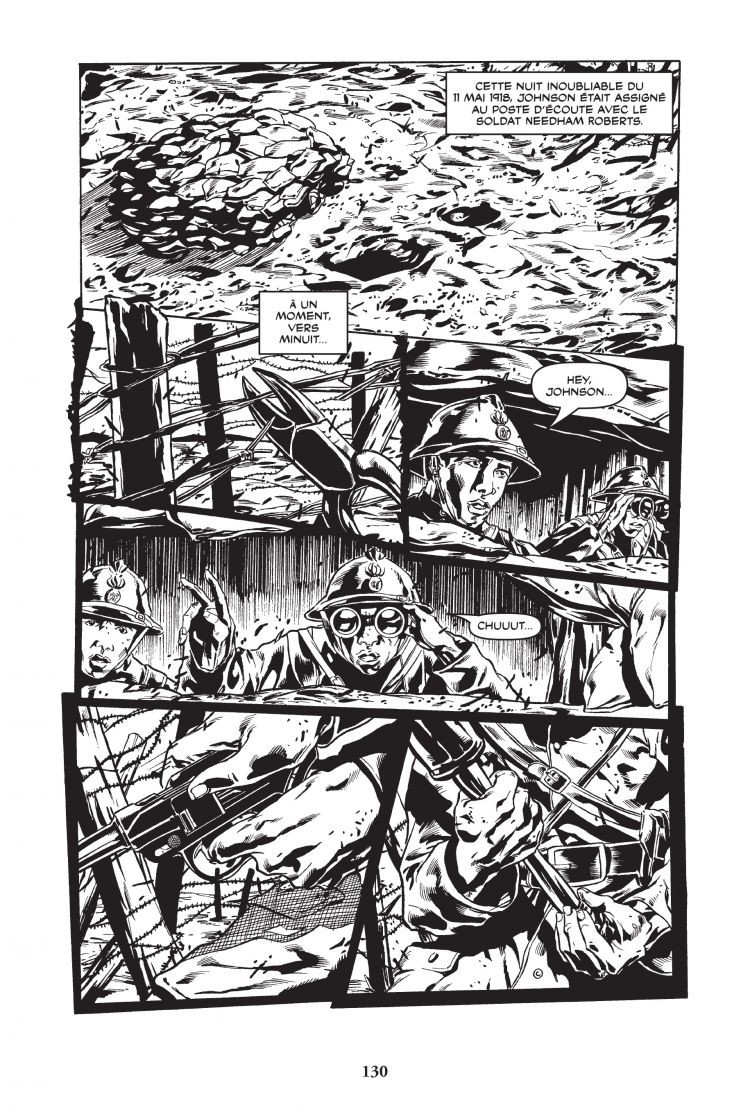
THE HARLEM HELLFIGHTERS (graphic novel) by Max Brooks.


Published by Del Rey in 2014.

Illustrated by Caanan White.

Synopsis:

The Harlem Hellfighters is Max Brooks' history of an all African American unit (the 369th Infantry) that fought on the Western Front alongside French units. They mostly came from New York.

This unit was allowed to fight precisely because they were assigned to a mostly French army. The American army would not let African Americans fight and had originally used the 369th as laborers, alongside civilian laborers.

The French were in need of immediate manpower. French white soldiers already had experience fight alongside regiments of soldiers from their African colonies and were eager to bring American troops to the front, no matter their color.

The 369th spent more time than almost any other American unit on the front lines. They may have spent the most time on the front lines. They were the first Allied unit to reach the Rhine River. 

Legend has it that the nickname "The Harlem Hellfighters" was given to the unit by their German foes.

They were among the first units to return to the United States and were given the honor of marching in a tickertape parade in New York City.

My Review:

The story that Max Brooks tells in this graphic novel is a little herky jerky. He tells the story with plenty of emphasis on individual soldiers, the terrible conditions on the front, and the racism they experienced. But, the overall plot of the war is rather poorly told.


The biggest reason that I am giving this book a rating of 3 stars is the illustrations. I truly dislike the art style. I found it distracting and hard to follow. There were details that are included that just filled the page and often made it difficult for me to figure out what I was supposed to be looking at. I bought this graphic novel from an online source without having seen the art. I hated it so much that I didn't read this graphic novel for nearly 7 months. 

Note: The publisher says that this book is aimed at children 8-12 years old. I believe that all of those ages are too young. It has graphic depictions of the violence of trench warfare. There are bullets blasting though heads, spraying bloods and brains across the page. There is a depiction of a bayonet going into someone's mouth and coming out the back of his skull. 

To be clear, I DON'T have a problem with showing the war as it really was. I DO have a problem with showing an eight year old a soldier being vaporized by an artillery shell. I would give this book a PG-13 rating.

This graphic novel can be found on Amazon.com here: The Harlem Hellfighters by Max Brooks.

BAN THIS BOOK (audiobook) by Alan Gratz


Published in 2017 by Blackstone Audio, Inc.
Read by Bahni Turpin.
Duration: 5 hours, 17 minutes.
Unabridged.

My Synopsis

Ban This Book is the story of Amy Anne Ollinger, a fourth grade girl who is shocked when she gets to the library and finds out that her favorite book, From the Mixed-up Files of Mrs. Basil E. Frankweiler, has been removed from the shelves as part of a book ban. Amy Anne reads all sorts of books (except Captain Underpants books - they're kind of silly) but she loves this book and comes back to it often. She has read it 13 times and wanted to read it again. 

Amy Anne is told that a parent has complained to the school board about several books and they skipped the established plan to deal with these sorts of complaints and simply voted to remove them. 

Amy Anne's parents buy her a copy of the book and she takes it to school to read when she can during the day. Her friends find out about the book ban, see that she has a copy and ask to read it. In return, they offer her copies of banned books that they own. Other kids see their books and things start to get interesting...

My Review

This was a thoroughly enjoyable audiobook. As the plot gets more complicated, the arguments for and against school library book bans are laid out. Amy Anne is against them in general, but she is no absolutist (and neither are her parents.) She knows that she's just not ready for some topics.

To be completely honest, the kids seem pretty advanced for typical fourth graders, but what transpires is not entirely out of the skill set of kids that age.

What I really liked about this book is that Amy Anne epitomizes what John Lewis meant when he said that we should "get in good trouble, necessary trouble, and help redeem the soul of America."

And that brings us to the reason that I listened to this audiobook. In June of 2024 this book made headlines because a Florida school system banned it from its libraries. Yes, the school board rejected the established plan to deal with parent concerns about books, overruled the findings of the system they established and voted to ban Ban this Book. If that sounds familiar, that is because that is what happened in the book (see 5 paragraphs above.)

A school board member who is also a member of Moms for Liberty - a well-known source of book ban lists - asked to have this book banned. Yes, indeed. These moms are really into banning books in the name of Liberty. In fact, they've been successful at banning more than 140 books in this school system alone.

The author
The board looked at the very existence of the book as a challenge to their authority. A board member said, "The title itself and the theme challenges our authority. And it even goes so far as to not only mention books that are deemed inappropriate by school boards, including ours, it not only mentions them but it lists them."

I like this quote from the author about the book bans: "They banned the book because it talks about the books that they have banned and because it talks about book banning. It feels like they know exactly what they're doing and they're somewhat ashamed of what they're doing and they don't want a book on the shelves that calls them out."

I highly recommend this audiobook. I rate it 5 stars out of 5. Lots of fun.

This book can be found on Amazon.com here: Ban This Book by Alan Gratz.


THE MOMENT: THOUGHTS on the RACE RECKONING THAT WASN'T and HOW WE CAN ALL MOVE FORWARD NOW (audiobook) by Bakari Sellers


Published in 2024 by HarperAudio.
Read by the author, Bakari Sellers.
Duration: 4 hours, 33 minutes.
Unabridged.


The Moment that Bakari Sellers refers to in his book is the so-called moment of racial reckoning that came with the murder of George Floyd and the protests all around the country that followed.

Sellers discusses a lot of relevant things that lead up to this moment including the murder of 9 African Americans by a young White supremacist in Charleston in 2015 and Covid-19. But, events like the Buffalo shooting of 2022, continued questionable acts of  and media and political-types discussing the Great Replacement Theory from 2017 until the present day have shown that moment of reckoning was not a big a moment that people supposed it was. Or, it demonstrates that the racist elements in America are pushing back hard.

I have run across Sellers as a guest on a couple of different podcasts that I follow and have always found him to be thoughtful and engaging. I have to admit, however, that I was a little disappointed in this book.

To me this book felt like two different books. I think there was too much time spent discussing the effects of Covid-19 on African American churches. Similarly, Sellers spent a lot of time discussing a police shooting case with an African American that he was involved in as an attorney. It is a sad commentary that I can say that I was only vaguely familiar with the case - and I'm not even sure if the case he referred to was the one I was thinking of because there are just so many.

The author
On the other hand, the other half of the book was compelling. He talked about the hope he had (and still has) after the George Floyd protests, his family, and some successes he has seen. 

Because of this wide variation, I am going to rate this audiobook 3 stars out of 5. This book can be found on Amazon.com here: THE MOMENT: THOUGHTS on the RACE RECKONING THAT WASN'T and HOW WE CAN ALL MOVE FORWARD NOW by Bakari Sellers

THE CORRUPTION of LINDSEY GRAHAM: A CASE STUDY in the RISE of AUTHORITARIANISM (kindle) by William Saletan


Winner of a 2024 Webby Award

The author of this short book (129 pages) makes it clear that he has no particular grudge against South Carolina Senator Lindsey Graham. Lindsey Graham serves as a stand-in for the Republican Party in general. He is a particularly good stand-in because he was there from the very beginning of the Donald Trump phenomenon because he was one of the many candidates for the 2016 Republican nomination. 

President Donald J. Trump and
Senator Lindsey Graham
Graham is also an amazingly frequent guest on the Sunday morning political talk shows, the evening shows on Fox, local TV, and talk radio. Graham loves to talk into microphones and because of that it is very easy to track his gradual moves from being a loudly outspoken opponent of Trump to the most vociferous defender of and apologist for the former president. 

Saletan thoroughly documents this transition and backs up each of these subtle changes with hundreds of actual links to videos, transcripts, and news articles. The reader can check for him/herself. I checked a ton of the links because there were so many ridiculous things that the 45th President has done and said that I simply forgotten about some of them.

This explains the idea behind
the book quite well.
This book is unlikely to change the minds of a MAGA friend of relative so don't even bother. But, if you are wondering how someone like Lindsey Graham could go from saying that Donald Trump was "hateful," a "demagogue," a "kook" and a "race-baiting, xenophobic, religious bigot" (page 8) to being his most prominent apologist, this book documents every baby step that Graham and the Republicans took to get there.

I rate this e-book 5 stars out of 5. It can be found on Amazon.com here: THE CORRUPTION of LINDSEY GRAHAM: A CASE STUDY in the RISE of AUTHORITARIANISM by William Saletan.

See my review of a that book has a similar theme but looks at several other Republicans in addition to Lindsey Graham: 
THANK YOUR for YOUR SERVITUDE: DONALD TRUMP'S WASHINGTON and the PRICE of SUBMISSION by Mark Leibovich.


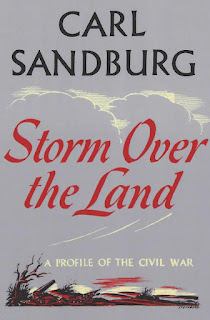
STORM OVER the LAND: A PROFILE of the CIVIL WAR by Carl Sandburg


I read a 2009 re-print published by Konecky and Konecky.

Carl Sandburg (1878-1967)
In 1940, the famed poet, journalist and author Carl Sandburg won a Pulitzer Prize for his four volume biography Abraham Lincoln: The War Years (published in 1939.)

In 1942, his publishers came to him and asked him to re-work the biography into a history of the Civil War in response to America's recent entry into World War II. 

The result is a pretty solid history of the Civil War from basically the Union point of view. 

Carl Sandburg is best known as a poet and that shines though with some of his prose. From time to time, he comes up with a different and interesting way of telling the story of the war. 

The most obvious weakness to this history is the story of African-Americans in the war - the free, the enslaved, the recently freed, the soldiers and others. He mentions them, but does not look at them very hard. To be fair to Sandburg, this book was published 81 years ago and he covered the topic about as well as any mainstream history would have.

I rate this history 4 stars out of 5. It can be found on Amazon.com here: STORM OVER the LAND: A PROFILE of the CIVIL WAR by Carl Sandburg.

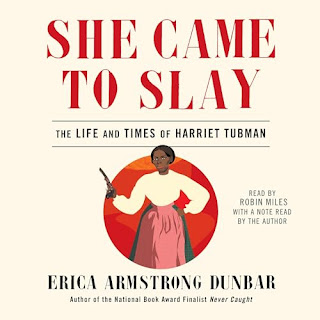
SHE CAME to SLAY: THE LIFE and TIMES of HARRIET TUBMAN (audiobook) by Erica Armstrong Dunbar


Published in 2019 by Simon and Schuster Audio.

Read by Robon Miles.

Duration: 5 hours, 53 minutes.

Unabridged. 

Erica Armstrong Dunbar brings us an accessible biography of one of the true heroes of American history - Harriet Tubman. She Came to Slay is long enough to give a decent picture of her life but short enough that it doesn't intimidate potential readers.

A traveling statue named honoring
Harriet Tubman named "Journey to Freedom"
I am not going to go through the entire biography of her life, but this book covers all of the major points of her life such as: 

-Her escape from slavery; 

-Her multiple trips back to Maryland to free family, friends and anyone that would go;

-Her work in anti-slavery societies where she met and worked with people like Frederick Douglass, William Seward and John Brown;

-The communities she helped start in New York and Canada;

-Her work with women's rights groups and her struggles to get white women to include black women in their fight;

-Her service as a nurse in the Civil War;

-Her service as a spy and a scout in South Carolina in the Civil War and her fight to be recognized for that service.

The book has a lively pace.

I rate this audiobook 5 stars out of 5. It can be found on Amazon.com here:  SHE CAME to SLAY: THE LIFE and TIMES of HARRIET TUBMAN by Erica Armstrong Dunbar.

LINCOLN and the FIRST SHOT (Critical Periods of History Series) by Richard N. Current


Originally published in 1963.

27 years ago I took a night class about the Civil War offered by Ball State University in a middle school off campus. It was a great class and Lincoln and the First Shot was the first book that we discussed. The book covers the two month period from the day that Lincoln arrived in D.C. after he was elected President and the day that P.G.T. Beauregard opened fire on Fort Sumter at Charleston, South Carolina.

When the Confederate states seceded they took over all Federal property, including forts and military bases. Two forts were not surrendered - Fort Pickens in Pensacola and Fort Sumter. Fort Sumter was always the most argued over because of the symbolism of being smack in the middle of the main port of the first state to secede. 

Lincoln refused to give up the fort because he refused to give up any of the seceded states. South Carolina demanded the fort because they insisted they were part of a new country and they did not want a foreign power to have a fort blocking a port in their new country.

South Carolina was ready to fire on the fort but did not want to look like they were provoking a fight. A peaceful separation might still be possible. Lincoln was preparing to reinforce the fort if he could - but without provoking a fight. After all, the country might be peacefully reunited. 
Fort Sumter immediately after its surrender
to South Carolina troops in April, 1861.

Neither side wanted to fire the first shot, but both sides could foresee the rush of patriotism that follow if their side were fired upon.

Historian Richard N. Current's description of the situation faced by both the North and the South at the beginning of the crisis was excellent and well done. But, his description of all of the plotting, fake peace proposals and sometimes outright confusion felt like he was stretching out the story to fill the pages of this book - like there was a minimum number of words he had to reach to fulfill his book contract.

So, I rate this book 3 stars out of 5. It can be found here on Amazon.com:  LINCOLN and the FIRST SHOT (Critical Periods of History Series) by Richard N. Current.


MY VANISHING COUNTRY: A MEMOIR (audiobook) by Bakari Sellers


Published in 2020 by HarperAudio.
Read by the author, Bakari Sellers
Duration: 5 hours, 9 minutes.
Unabridged


I came to My Vanishing Country not knowing a thing about Bakari Sellers. I don't know where I heard about his book, but I had placed a hold on the audiobook at my library. I assume I heard him in an interview on NPR or found his name on a list of prominent books to be released in 2020.

Bakari Sellers in 2018. Photo by Luke Harold.
Sellers has the distinction of being one of the youngest state legislators ever and the youngest African American ever elected to a post in American history. He is from South Carolina, was a member of its legislature for 8 years, is an attorney and is now a commentator for CNN. I am not from South Carolina and I don't have cable or satellite so I had never seen his work on CNN, either. 

My complete unfamiliarity with Sellers made the book a little tedious at times. But, the last quarter of the book is very strong. It was so strong, due to more generalized commentary, that it pulled my score for this book up to 4 stars. 

Sellers read the audiobook himself. I understand the temptation for him to read his own audiobook. After all, his entire career on CNN is based on his ability to speak. He was okay as a reader - neither good nor bad. 

This audiobook can be found on Amazon here: MY VANISHING COUNTRY: A MEMOIR by Bakari Sellers.


APOSTLES of DISUNION: SOUTHERN SECESSION COMMISSIONERS and the CAUSES of the CIVIL WAR (A NATION DIVIDED: STUDIES in the CIVIL WAR ERA) by Charles B. Dew


Originally published in 2001.


The greatest argument among people who study the Civil War isn't who was the best general or what would have happened if Lincoln hadn't have been assassinated or even what would have happened if the Union had lost at Gettysburg.

No, the greatest argument is this: What caused the Civil War?

For the better part of the last century, the argument has been that the Confederacy seceded in order to protect "their rights". The counter-argument has always been to protect "the right to do what?"

For me, the answer has always been a simple one - they fought for their right to own people and to keep African Americans at the bottom of the heap in Southern society. For the Confederate States of America, slavery was the reason to fight. For the Union army, maintaining the Union, with or without slavery, was the reason to fight - a goal claimed many times by Lincoln himself. 


There will be arguments that claim that Confederate states seceded over differences in culture and differences in attitude and the disagreement over federal tax policy. If you think so, I encourage you to read the Ordinances of Secession (basically Declarations of Independence) from Georgia, Texas, Mississippi, South Carolina and Virginia. They are full of all sorts of reasons to secede, but they keep coming back to slavery-related issues. These are wonderful resources because they are frozen in time, before the loss of the war by the Confederacy. Many post-Civil War authors who fought for the South obscure the importance of slavery, perhaps realizing it was a great moral wrong, or perhaps simply being cognizant that slavery had become politically incorrect and it would hurt their overall argument. Let's face it - many Union soldiers became proud of their role in ending slavery long after the war ended, being indifferent to or even mildly pro-slavery during the war.

 Several of the seceding states did more than issue their own Declarations of Independence. Some of these states sent out ambassadors from their newly independent states to try to convince the other slave states to join them. They were generally referred to as Southern Secession Commissioners. The title of this book, Apostles of Disunion refers to them. The Apostles of Jesus were sent out to teach about Jesus. These apostles were sent out by several secessionist states to to convince the other slave states to join them. Just the fact that they were only sent to slave states should serve as a major clue as to what caused the Civil War.

The texts of their letters and speeches make it very clear that their main arguments were these: fear of the abolition of slavery by "Black Republicans", fear of slave revolt, the loss of the investment of money in their slaves, fear of former slaves having the power to vote and the fear of race mixing. William L. Harris, the Commissioner from Mississippi sent to reach out to the state of Georgia said on December, 17, 1860: "Mississippi is firmly convinced that there us but one alternative: This new union with Lincoln Black Republicans and free negroes, without slavery; or, slavery under old constitutional bond of union, without Lincoln Black Republicans, or free negroes either, to molest us. If we take the former, then submission to negro equality is our fate." (p. 87)


He followed up with a comment about how Mississippi would "...rather see the last of her race, men, women and children, immolated in one common funeral pile, than see them subjected to the degradation of civil, political and social equality with the negro race." (p. 89)

Stephen F. Hale (1816-1862. He served Alabama
as a Secession Commissioner and as a Lt. Colonel
in the 11th Alabama. He died of wounds sustained
during the Battle of Gaines' Mill in 1862.
Hale County, Alabama is named for him
.
Stephen F. Hale of Alabama sent a letter to the Governor of Kentucky to convince him to push for secession. In the letter he calls Lincoln's election "...nothing less than an open declaration of war, for the triumph of this new theory of government destroys the property of the South, lays waste her fields, and inaugurates all the horrors of a San Domingo servile insurrection, consigning her citizens to assassination and her wives and daughters to pollution and violation to gratify the lust of half-civilized Africans."

He continued: "What Southern man, be he a slave-holder or non-slave-holder, can without indignation and horror contemplate the triumph of negro equality, and see his own sons and daughters in the not distant future associating with free negroes upon terms of political and social equality, and the white stripped by the heaven-daring had of fanaticism of that title to superiority over the black race which God himself has bestowed?" (p. 98)

The author of Apostles of Disunion included plenty of similar quotes throughout the book and also includes the entire text of the Harris speech and the Hale letter. He found snippets of speeches and letters from the other Commissioners in newspaper articles and journals and found similar comments to the ones in the complete texts. Combine these texts with ambassadors hand-picked by the newly-seceded states and the Ordinances of Secession and you have the answer to why the Civil War started.


I rate this book 5 stars out of 5. It can be found on Amazon.com here: APOSTLES of DISUNION: SOUTHERN SECESSION COMMISSIONERS and the CAUSES of the CIVIL WAR (A NATION DIVIDED: STUDIES in the CIVIL WAR ERA) by Charles B. Dew.

THE SECRET LIFE of BEES by Sue Monk Kidd


Originally published in 2002.

The Secret Life of Bees is set in the summer of 1964. Lily Owens is a young teenager living in small town South Carolina on a peach farm. Her mother died when she was very young, her father is abusive. Her best moments at home come when she is with the housekeeper, Rosaleen. 

The story starts immediately after the passage of the Civil Rights Act of 1964 and Rosaleen, who is African American, decides that she is going to go into town and register to vote. Rosaleen meets some resistance, reacts and gets arrested. Then, she gets a beating and ends up hospitalized. Lily breaks her out and they flee to another small town - Tiburon.

Why Tiburon?

Lily only has a few trinkets from her mother and one of them is a piece of paper with an African American Virgin Mary with Tiburon, SC written on the back. She is determined to find out more about her mother and save her stand-in mother.

When they get to Tiburon, they are directed to "the pink house" and discover a thriving honey business ran by three African American sisters. Lily and Rosalee learn about bees and family as Lily tries to figure out her mother's connection to this place...

There are obvious connections to other Southern "coming of age" stories like A Member of the Wedding or Huckleberry Finn, but this book is unique. The religious angle alone sets it apart (for both good and bad). It is certainly worth your time to read.

I rate this book 4 stars out of 4 and it can be found on Amazon.com here: The Secret Life of Bees by Sue Monk Kidd.

FORT SUMTER 1861 by Albert Castel


Originally published in 1976.
Reprinted and sold by Eastern Acorn Press through the National Park Service.


Something like 24 years ago I went with to Gettysburg with a wife and a friend for a weekend trip. On that trip I bought this little book. It sat on my shelf unread for more than 2 decades. No reason for that - I am an insatiable student of the war. I have reviewed 91 books on the subject before this one. But, it sat there unread until now.

Fort Sumter 1861 is a readable and quite thorough history of the events leading up the famous Firing upon Fort Sumter. The best feature of the small book (fifty 8 1/2 x 11 inch pages) is that it doesn't just tell about Fort Sumter in South Carolina, but also about Fort Pickens in Florida. The book details how Sumter was part of a larger policy. Most histories separate the two of them and that is a mistake.


The book also describes the duplicitous actions of Secretary of State William Seward throughout the affair. Seward seriously doubted the abilities of President Lincoln and tried to conduct his own private negotiations with South Carolina to end the crisis. On top of that, he countermanded some of Lincoln's own directives when it came to relieving Fort Sumter.   

The expected stuff is included as well - who fired the first shot, when the fort was surrendered and so on. This was a $1.25 well-spent 24 years ago. 

I rate this book 5 stars out of 5.

Fort Sumter 1861 can be found on Amazon.com here.

The Glory Field by Walter Dean Myers


Published by Scholastic in January of 1994.

The Glory Field is the story of an African-American family and their tie to a piece of land on Curry Island in South Carolina over the course of 250 years.

Reminiscent of the James Michener sagas that follow the same format, The Glory Field is not nearly as detailed or as rich as a Michener selection. However, Michener's primary audience was adults and Myers' intended audience is young adults, most of whom would not have the patience or the courage to pick up a 1,000+ page book.

Myers has broken this book up into a series of six stories, snapshots of the Lewis family throughout nearly 250 years of history. The quality of the stories goes up and down. The 2nd, 3rd and 4th stories are so-so. The first is vivid, strong and way too short. The last two are so strong that, in my mind, they saved the book. I was considering not including it in my classroom library because of the middle stories - they drug along and just didn't have any pizzazz - they were historically accurate - just with no zip.

So, final grade: 4 stars out of 5 (and a place in my classroom library!)


This book can be found on Amazon.com here: The Glory Field by Walter Dean Myers.

Reviewed on December 7, 2006.

The Swamp Fox of the Revolution (Landmark Books) by Stewart Holbrook


A bit of nostalgia


Published 1959 by Random House
180 pages

Many, many years ago Random House published a series of more than 100 books called "Landmark Books". These were short histories of a little more than 150 pages that were long on action and short on historical analysis.

Nevertheless, these were this history teacher's first introduction to written history. The library in Hope, Indiana had a whole shelf of these books and I happily read about Daniel Boone and the Alamo and John Paul Jones. I happened across this one at a middle school library clearance.

The book delivers as I remember - lots of action and not much into the motivations of Francis Marion and the others who hid in the swamps of South Carolina with him and fought the British Army. That's okay, though. It's aimed at middle schoolers/upper elementary students and they don't care much for analysis anyway. Better to get them an appealing taste of history and let the whys and the wherefores fill themselves in later on.

I give this book 4 stars out of 5. It can be found on Amazon.com here: The Swamp Fox of the Revolution (Landmark Books) by Stewart Holbrook.

Reviewed on April 17, 2007.

They Call Him Cale: The Life and Career of NASCAR Legend Cale Yarborough by Joe McGinnis


A NASCAR legend deserves better


Published in 2008 by Triumph Books.

Cale Yarborough is a living symbol of NASCAR from its beginnings to the very creation of the dizzying heights that it has achieved nowadays. Sadly, most of the Johnny-Come-Lately fans have no idea, or at best, only a very dim idea who he is.

Sadly, this biography of Cale Yarborough, They Call Him Cale: The Life and Career of NASCAR Legend Cale Yarborough, only covers half of his career. Indeed, most of the book covers his life before NASCAR. There are only 203 pages in this biography and he joins NASCAR full-time on page 169. Considering that the last 11 pages discusses his retirement years, that leaves 23 pages to discuss his amazing run of 3 championships in a row, the famous fistfight at the 1979 Daytona 500, his decision to run a partial schedule for more than 7 years and his 11 year stint as team owner (just 5 pages for that).

The book could have been tremendously improved if the author had bothered to interview a few people. After all, his stable of drivers include a bevy of current and recently-retired drivers, including Dale Jarrett and John Andretti (his only win as a car owner came with Andretti). All of these drivers are media friendly. I've heard Andretti speak about Yarborough with nothing but praise.
Cale Yarborough's famed 28 car in the 1980s


The author should have included commentary about how Yarborough was able to field competitive cars running a partial schedule (nearly impossible to do today). How about Yarborough's willingness to have in-car cameras when most did not want them? How about Yarborough's involvement in a group that tried to set up an alternative to NASCAR after he sold his race team? Nope. None of that.

The lack of depth is not too surprising, really. The author's notes (p. 261) say that he got "many" of the stories in his book from Cale's autobiography and most of the rest came from 7 internet sites.

A nice feature of the book is the inclusion of more than 50 pages of tables that detail Yarborough's NASCAR and IROC career and his Indy 500 runs.

A disturbing feature is the naming of each of his children, grandchildren and the little towns in which they live in South Carolina. Jeez. There are weirdos out there, McGinnis. Why give out this sort of detailed info?

I give it two stars. The pre-NASCAR part of the book is interesting. It's just too bad the rest of the book couldn't follow up.

I rate this book 2 stars out of 5. It can be found on Amazon.com here: They Call Him Cale: The Life and Career of NASCAR Legend Cale Yarborough.

Reviewed on May 9, 2008.

Harriet Tubman: Conductor on the Underground Railroad by Ann Lane Petry


Well-written biography of a true American hero


Originally published in 1955.

Harriet Tubman: Conductor on the Underground Railroad is a fantastic little biography of Harriet Tubman (1820-1913). Tubman has always been one of my personal heroes and this book does her story justice.

I would say this book can be easily enjoyed by 4th graders and up. It also could serve as a great starting point for adults that don't know much about slavery and the American Abolitionist movement. While telling the story of Tubman's life, Petry also includes at the end of nearly every chapter historical tidbits about the slavery and the Abolitionist movement at the national level.

The discussion of her service in the Civil War as a scout in the coastal areas of South Carolina spurred me to do some further research. Her commanding officer in the raids was Colonel James M. Montgomery, the nutty commander in the movie Glory with this memorable line: "You see sesesh has to be cleared away by the hand of God like the Jews of old. Now I will have to burn this town." Interestingly, Montgomery also served with John Brown in Kansas. Harriet Tubman also knew John Brown although she was not comfortable with his violent tactics.

I rate this biography 5 stars out of 5.

This book can be found on Amazon.com here: Harriet Tubman: Conductor on the Underground Railroad

Reviewed April 8, 2009.

Bound for the North Star: True Stories of Fugitive Slaves by Dennis Brindell Fradin

An excellent introduction to the topics of slavery and the Underground Railroad.


While Bound for the North Star: True Stories of Fugitive Slaves is obviously aimed for the "young adult" crowd, it would serve as an excellent primer for ANYONE interested in learning more about that sad, sad topic in America's history: slavery.
Harriet Tubman

The author includes 12 stories about slaves who escaped north, mostly with the help of the Underground Railroad. Each story describes a different type of escape or incident - varying from the case of Solomon Northrup - a free black man who was drugged and sold into slavery while he was working in Washington, D.C. to John "Fed" Brown, a field slave who traveled a roundabout trip to freedom covering thousands of miles to John Price - an escaped slave who was captured in Ohio, but was eventually freed thanks to the near-riot of the Oberlin College community. The book ends up with the most famous member of the Underground Railroad, Harriet Tubman, and details a number of her exploits as a Conductor and as a Union Spy during the Civil War.

As a reader, I appreciated the variety of types of escape stories - it did not get stale reading about the same type of escape and the variety of escape plans really was a wonderful testament to human creativity in the face of hardship.

I rate this book 5 stars out of 5.

This book can be found on Amazon.com here: Bound for the North Star: True Stories of Fugitive Slaves

Reviewed on September 1, 2004.

Featured Post

<b><i>BAN THIS BOOK (audiobook)</i></b> by Alan Gratz

Published in 2017 by Blackstone Audio, Inc. Read by Bahni Turpin. Duration: 5 hours, 17 minutes. Unabridged. My Synopsis Ban This Book is t...

Popular posts over the last 7 days