Showing posts with label Africa. Show all posts

CONQUERORS: HOW PORTUGAL FORGED the FIRST GLOBAL EMPIRE (audiobook) by Roger Crowley


Published by Recorded Books in 2015.
Read by Jonathan Davis.
Duration: 13 hours, 7 minutes.
Unabridged.


In the mid-1400s Portugal was poised to be a major world power, despite being a backwater of Europe in so many ways. Portugal sits at the western extreme of Europe, destined to be a minor player in European politics most of the time. All of Portugal's border touches Spain, so if Portugal wanted to interact with anyone but Spain they had to take to the sea.

IThe Portugese developed a new type of little wooden ship called the caravel, armed them with cannons, filled them with food, water, sailors, and stone monuments to mark the areas they explored. They pushed down the coast of Africa, hoping to find a way to the spices of Asia.

They were looking to trade, especially for spices because the Muslim countries had established a stranglehold on the spice trade with the decline and eventual fall on the Byzantine Empire in 1453.  They were also looking to link up with the fabled African Christian king Prester John, join up to defeat the Muslims, spread Christianity, and make a lot of money along the way.

And, with the exception of the Prester John part of the plan, that's basically what happened. Prester John turned out to be the Christian kingdom of Ethiopia. It was real, but not nearly as powerful as the Portugese believed - and it wasn't very interested in attacking the Muslims in a religious war. 

Conquerors: How Portugal Forged the First Global Empire is a pretty thorough look at the Portugese conquistadores and their escapades in the Indian Ocean. From the first, Portugal came with guns a-blazin'. They laid waste to cities, took slaves, took hostages, burnt ships, and were confrontational with almost everyone. 

Then, they headed home and made plans to return with even more ships. They made annual trips and made plans to make permanent posts from Africa to India. 

At this point, this history bogs down. It's not that it isn't accurate - it just becomes a litany of outrageous attacks by the Portugese, a minor setback, and then an even more audacious attack. It all kind of blurred together for me because Crowley didn't take a moment to pull away from the history to do a bit of analysis.

He didn't even step away to look at what the Portugese were doing in other parts of the world, such as Brazil and west Africa and put the Portugese efforts in the Indian Ocean into a larger context until the literal last three or four minutes of the audiobook. The title says it is a book about Portugal's empire and it ignores a lot of their empire.

The audiobook reader was Jonathan Davis. He is a very good reader and has a flair for accentuating the dramatic moments. But, he is also very slow. I rarely do this, but I set the audiobook player to play at 120% and he was still a bit slow at times.

I rate this audiobook 3 stars out of 5. It can be found on Amazon.com here: CONQUERORS: HOW PORTUGAL FORGED the FIRST GLOBAL EMPIRE by Roger Crowley.

HAILE SELASSIE: A LIFE from BEGINNING to END (kindle) by Hourly History


Published in 2021 by Hourly History.

Haile Selassie is one of those men that shows up here and there in a detailed histories of the twentieth century, but I didn't know much about him beyond his determined stand against colonialism before and after World War II.

This small e-book filled in a lot of blanks for me. The Hourly History series consists of biographies and histories that take about an hour to read and, to be honest, this book filled in a lot of those gaps for me - enough that I probably won't look into Haile Selassie any further.

The biography tells the story of Selassie's privileged, very connected upbringing in a monarchial Ethiopia. Selassie used those connections to push his way to the top, but also to tried to modernize his country in order to protect it from European colonization. Imperial Japan did something similar 50 years earlier (not a connection made in the book - just an observation from a history teacher that took a couple of Japanese history classes in college.)

Selassie's life was interesting and often quite tragic. He often was a symbol more than he was substance. He inspired the Jamaican Rastafarian movement, even though he ad nothing to do with it. His pleas to the League of Nations about Italian aggression proved it to be a great idea but an empty promise in the time of actual need. His attempts to modernize Ethiopia made people question the need to have an outmoded style of government led by a man who who wasn't willing to adept to modern times.

I rate this short biography 4 stars our of 5. It can be found on Amazon.com here: Haile Selassie: A Life from Beginning to End by Hourly History.

MARCH: BOOK THREE (graphic novel) by by John Lewis and Andrew Aydin


Published in 2016 by Top Shelf Productions

Written by John Lewis and Andrew Aydin.

Illustrated by Nate Powell.

2016 National Book Award Winner for Young People's Literature

2017 Printz Award Winner

2017 Coretta Scott King Author Award Winner

2017 Sibert Medal Winner

2017 YALSA Award for Excellence in Nonfiction Winner

2017 Walter Award Winner

Congressman John Lewis (1940-2020) continues his life story in book three of the March series, focusing on his struggles in the Civil Rights Movement. The book starts with the 16th Street Birmingham Church Bombing in September of 1963 and ends with the signing of the Voting Rights Act in August of 1965.

These were, by any account, much like the famous Charles Dickens line from A Tale of Two Cities: "It was the best of times, it was the worst of times, it was the age of wisdom, it was the age of foolishness, it was the epoch of belief, it was the epoch of incredulity, it was the season of light, it was the season of darkness, it was the spring of hope, it was the winter of despair..."

It was the best of times in that the Civil Rights Act of 1964 and the Voting Rights Act of 1965 were passed. It was the worst of times because of these landmark laws were passed due to great sacrifices. As noted on page 91, in the state of Mississippi in the summer of 1964 during an attempt to mobilize and register black voters there were "more than 1,000 arrests, 80 beatings, 35 church burnings, and 30 bombings."

A theme that runs throughout the trilogy is that every success is soured by a violent response. I was particularly struck by an act of pointless violence at the end of the book. When the march from Selma, Alabama to Montgomery, Alabama finally happens (it had been turned back on other attempts by violence and by court order) there is a rally, there are speeches, and a concert given by an amazingly diverse crowd of artists - diverse in race and in musical styles. What should have been a beautiful moment is marred by the murder of a volunteer driver named Viola Luzzo from Detroit. She was shuttling people back to Selma. She was heading back to Montgomery to pick up more people when a car pulled alongside. A single shot was fired and she was killed (see picture.)

This is an excellent trilogy and an excellent way to tell this history. I rate this book and the entire trilogy 5 stars out of 5. 

This book can be found on Amazon.com here: MARCH: BOOK THREE (graphic novel) by by John Lewis and Andrew Aydin.

Click here for March: Book One.

Click here for March: Book Two.

ILLEGAL (graphic novel) Written by Eoin Colfer and Andrew Donkin. Illustrated by Giovanni Rigano.


Published in 2018 by Sourcebooks Young Readers.

Illegal is the fictional story of two young brothers from Ghana: Ebo and Kwame. While it is fictional, it is based on lots and lots of true stories.

Most Americans are very aware that immigrants/refugees are fleeing from their native countries and arriving at the border of the United States and are not aware that a similar thing is happening in Europe. 

Europe has a similar refugee/immigrant situation. People are fleeing from the wars in Syria, Sudan, and Yemen. There are also refugees fleeing the brutal poverty and political situations in sub-Saharan Africa. Like in the United States, these immigrants/refugees depend on very shady people to move them closer to their goals.

In this story, two young brothers named Ebo and Kwame live in a village in Ghana. They are orphaned and living with a useless, drunken uncle. They have an older sister that has already crossed the Sahara Desert and the Mediterranean Sea to look for work but they don't know anything about where she ended up or how it is going. 

Kwame is the older brother and he has decided to sneak away and try to get to Europe. He doesn't want to bring along his little brother because he is concerned about his safety, it will cost twice as much if they both go, and there is a superstition that says only one family member should make the trip at a time because it is so dangerous that it just seems all the more likely that there will be a loss in the family.

Ebo will have none of this. He immediately sets off to find his brother at his first stop - Agadez, Niger. Agadez is a city of a little more than 100,000 and serves as the launch point to try to cross the Sahara Desert.

The Sahara is too big to cross on foot so migrants trying to cross it have to have money to pay unscrupulous smugglers (much like Mexico's infamous coyotes.) This is not cheap.

If a migrant is lucky enough not to be robbed and dumped in the desert they arrive in Libya and pay smugglers for a boat ride across the Mediterranean Sea and try to land in Italy or Sicily. This is also not cheap.

Ebo and Kwame work various menial, under the table manual labor jobs while living on the streets and avoiding the police. Life is cheap, hard, brutal, and dirty - yet no one talks about turning back.

My review:

This is an excellent graphic novel. The parallels with the American refugee crisis are striking and equally heartbreaking. I learned a lot and I enjoyed the easy to follow art work as well.

I rate this graphic novel 5 stars out of 5. It can be found on Amazon.com here: ILLEGAL - Written by Eoin Colfer and Andrew Donkin. Illustrated by Giovanni Rigano.

PATHOGENESIS: A HISTORY of the WORLD in EIGHT PLAGUES (audiobook) by Jonathan Kennedy


Duration: 9 hours, 23 minutes.
Unabridged.


Kennedy presents a compelling argument that disease has had a profound impact on world history by just telling a history of Europe from the days of cavemen up until now.

The first 45 minutes or so of this audiobook seemed to be wandering around and not going anywhere, but Kennedy was laying a strong foundation for the rest of the book.

The book makes it painfully obvious that humanity has bounced from one biological disaster to another. Humanity has adapted (either by behavior - like building sanitation systems to deal with body waste to control cholera) or biologically by simply having a large body count until those with immunity can rebuild (the Black Plague is a prime example.)

Kennedy persuasively argues that infection and disease helped the rise of Christianity, the rise of Islam, the end of feudalism, the rise of capitalism, and the European conquest of the Americas. Infection and disease helped create the system of African slavery in the New World and also prevented the European colonization of African until the late 1800s.

This is a very good book. I rate it 5 stars out of 5. It can be found on Amazon.com here: PATHOGENESIS: A HISTORY of the WORLD in EIGHT PLAGUES by Jonathan Kennedy.

WHEN WE'RE HOME in AFRICA (audiobook) by Themba Umbalisi


Published in 2021 by Next Chapter Audio LTD.
Read by Crawford B. Bunkley III.
Duration: 4 hours, 34 minutes.
Unabridged.


I have no idea where I found this book. I think it was a freebie on Audible through Amazon's Prime Reading program. I know that I got it because I am a big reader of Civil War histories and fiction and this sounded like it was right up my alley.

Synopsis:

The description of this book is accurate, to a point. It is about a freed slave who joins the Union Army and then goes from job to job and place to place with a goal of settling in Africa.

My Review:

This book is basically a Forrest Gump type of story - one man goes on an epic journey and ends up going through a lot of the historical movements of the era.

Warning: Lots of *********SPOILERS********all the way to the end of this review.

This audiobook comes in at almost exactly 50% of the run time for FORREST GUMP and covers maybe even more territory. Our hero (his name changes multiple times) begins as a slave in Georgia who is freed by the Union Army. He goes on to:

1. Join the Union Army as an infantry soldier.
2. Participate in the Battle of the Crater.
3. Muster out of the Army.
4. Meet a woman and live with her for a while.
5. Join the Cavalry.
U.S. Army "Buffalo Soldiers"
6. Serve on Indian patrol as a Buffalo Soldier. Fight a number of battles.
7. Serve on the U.S./Mexican border as a Buffalo soldier. Fight a number of battles.
8. Go on trial as a horse thief simply for doing his job.
9. Almost get lynched.
10. Flee into the wilderness to escape the lynching mob.
11. Meet another woman and live with her for a while.
12. Eventually arrive in San Francisco.
13. Get shanghaied onto a ship.
14. Go around the tip of South America to the Atlantic Ocean.
15. Get involved in a mutiny somewhere near the Falkland Islands.
16. Escape the ship with a friend on a little boat with a sail just before the mutineers turn on each other.
17. Sail/Row the boat around the tip of Africa and land on the Indian Ocean side of South Africa.
18. Meet native Africans.
19. Join the British Army in South Africa as a scout. Fight a number of battles.
20. Leave the British Army and join the Zulus.
21. Get married.
22. Become the royal firearms specialist for the Zulu.
23. Watch the Zulu loose to the British and flee to the mountains.
24. Find a group of refugees.
25. Become king of these refugees and make a people out of them.
26. Start a family.

Those are 26 big steps in a 4 hour and 34 minute audiobook. This could have been epic if it were slowed down and each of these steps were explored. I actually skipped things (lots of women end up sleeping with this man) and there were actually steps that were explored in detail, which means that the others got even more of the short shrift treatment.

For example, the women always end up being a side story and the hike from Texas to San Francisco is an epic trip going through multiple Indian territories and crossing the Rocky Mountains and it gets just a few minutes.

This book is really more of a serious treatment of a book series rather than a single book. It is too busy and not filled in with enough detail to make a story. It could have been a decent series.

About the narration. Crawford B. Bunkley III has a great voice, but he read this book too fast. Commas are ignored. Periods are ignored. Just this wonderful voice pushing forward as fast it can while reading a story that just wants to push on as fast as it can.

The only reason that I am giving it 2 stars is because I actually finished it.

This book can be found on Amazon.com here: 
WHEN WE'RE HOME in AFRICA by Themba Umbalisi.

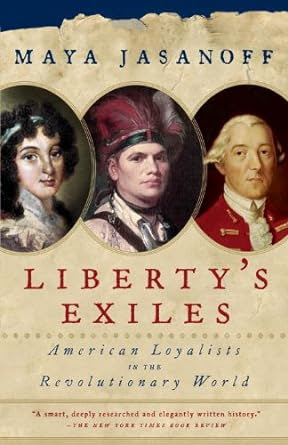
LIBERTY'S EXILES: AMERICAN LOYALISTS in the REVOLUTIONARY WORLD (audiobook) by Maya Jasanoff

Published by Recorded Books in 2012.
Read by L.J. Ganser.
Duration: 16 hours, 10 minutes.
Unabridged.


In 1783, at the end of the Revolutionary War, Loyalists (Americans who opposed the American Revolution and stayed loyal to Britain) had a choice to make - stay and ride out the anti-Loyalist bias in the United States or move somewhere else.

In the two years between the last major engagement (Yorktown) and the official end of the war and withdrawal of British troops the British decided to evacuate any Loyalists that wanted to go to other parts of the British Empire. One of the biggest advocates of this position was Guy Carleton, the British commander in America after Yorktown who later went on to become the Governor-in-Chief of Canada. He had more to do with what happened in this history than any other single person.

Guy Carleton (1724-1808)
The British government made an effort to make things right for these Loyalists. Not many Loyalists were completely reimbursed, but the fact that an effort was made was extraordinary for the day. In some cases, Loyalists were offered large grants of land, in other cases they were offered smaller grants of land and in other cases they were offered pensions and partial reimbursements for lost property. All of these offers were new innovations and a sign that the British government wished to honor the loyalty they had shown.

Some loyalists wanted nothing more than to start over, some looked to just work themselves up the British societal ladder, some wanted to get away from British society and some looked for a chance to get even with the Americans. 

There was a racial component to this as well. The British had offered freedom for any slaves that left their masters and joined their armed forces. The Americans pressured them to return the runaway slaves (including slaves from George Washington and Thomas Jefferson) but the British refused to go back on their deal with the former slaves as a point of honor. However, those former slaves oftentimes were given less money and less land than white Loyalists when they arrived at their new homes.

The British tried to honor the commitments shown by the Native American allies as well, but not nearly as much. 

Loyalists ended up going all over the empire but mostly to Canada. There were several families that went to Bermuda and Jamaica and back to England itself. Several families of African descent moved to Sierra Leone in Africa as part of an experimental colony. A few went even further to India. 

The section on the Canadian settlement was, at first, interesting but it soon got bogged down. It was all relevant detail, but just too much for me. In fact, that's pretty much my review of the entire book.

I rate this audiobook 3 stars out of 5. It can be found on Amazon.com here: LIBERTY'S EXILES: AMERICAN LOYALISTS in the REVOLUTIONARY WORLD (audiobook) by Maya Jasanoff.

GOD IS NOT ONE: THE EIGHT RIVAL RELIGIONS THAT RUN the WORLD - and WHY THEIR DIFFERENCES MATTER (audiobook) by Stephen Prothero


Published in 2010 by HarperAudio.
Read by Paul Boehmer.
Duration: 14 hours, 37 minutes.
Unabridged.


Stephen Prothero is a professor of religion at Boston University. The purpose of God Is Not One is to inform the reader of the eight greatest world religions, their philosophies and their way of looking at the world.

Prothero is very aware that choosing just eight religions is fraught with problems. How do you choose? Is it based on influence? Number of adherents? Importance of the countries it is in? He went through all of those questions again once again when he chose the order he would present the religions he picked.

The religions he profiled are: Islam, Christianity, Buddhism, Hinduism, Confucianism, Judaism, Yoruba religion, and Daoism. He spends about 90 minutes discussing each religion and includes nearly an hour on Atheism at the end, on the theory that militant Atheism (Richard Dawkins, Christopher Hitchens) behaves much like a religion, complete with evangelistic movements and a coherent worldview.
Prothero takes great pains to point out that these religions do not approach the world in the same way. He is pretty irritated at the "all religions are basically the same - they answer the same questions in different ways" view of religion. He thinks it is intellectually lazy. For example, Christianity teaches that the main problem with the world is sin. Daoism doesn't even have that concept - they think the main problem is society polluting people and making them unhappy by making them take on roles that go against their nature. Confucianism thinks the biggest problem is people not knowing their place in society - embrace the role given you and you will be happy. Yoruba religion is all about power, including spiritual power and leveraging it to your advantage. Atheism think religion itself is the problem - but they are usually most vocal against the three monotheistic religions (Islam, Judaism and Christianity). They might be okay with Daoist and Confucian philosophy and some Buddhist sects. Of course, all of those summaries are super-simplistic.

Prothero is not making this point in order to say that the religions of the world can't get along. Rather, he is making this point in order to say that if we are going to get along, we actually have to know what the other religions are saying and where they are coming from.

Prothero's explanations include Western cultural references to movies and books. If you are a well-read person these can be quite helpful.

I rate this audiobook 5 stars out of 5. It can be found on Amazon.com here: GOD IS NOT ONE: THE EIGHT RIVAL RELIGIONS THAT RUN the WORLD - and WHY THEIR DIFFERENCES MATTER by Stephen Prothero.

DESTINY DISRUPTED: A HISTORY of the WORLD through ISLAMIC EYES (audiobook) by Tamim Ansary


Published in 2009 by Blackstone Audio.
Read by the author, Tamim Ansary
Duration: 17 hours, 28 minutes.
Unabridged.


Tamim Ansary has done something that is very hard to do - he has written a long history of a complicated topic without making it boring and after more than 17 hours of discussion, he left me wishing that it was even longer.

Ansary makes the observation that most histories that people in the West (Western Europe and the Americas) read are written from a Western perspective. That makes sense. But, the history of the world is not just the history of Western Civilization. There are multiple civilizations on the planet. Mesoamerica (the Mayas, Aztecs, Toltecs, etc.) is a separate civilization. China is the historic center of another civilization. So is India. And between the West and India and China is another one. Westerners usually refer to it as the Middle East. This book is a history of that civilization from the beginning of recorded history (empires like Bablyon) to 9/11 and the fallout from that terrorist act.

The strength of this book is that it lets the reader see history from another perspective. For example, the Crusades loom large in European history, but they were mostly an irritant to Muslims of the day since Ghenghis Khan was threatening them from Central Asia at the same time. Compared to Ghenghis Khan, the Crusaders were not an existential threat to their civilization. To make an analogy from American history, the Battle of Lexington and Concord looms large in American history textbooks as "The Short Heard 'Round the World", but most English school children have never heard of it.

The audiobook is read by the author and he does a great job. The book is written in approachable, every day language, literally designed to be an introduction to the history of this civilization. He reminds readers of key concepts throughout, showing how older ways of doing things applied to new situations and were adapted. Ansary's reading is excellent.

I rate this audiobook 5 stars out of 5. I highly recommended this audiobook. It can be found on Amazon.com here: DESTINY DISRUPTED: A HISTORY of the WORLD through ISLAMIC EYES by Tamim Ansary.

MOSES by Howard Fast


Originally published in 1958.

Published in 2001 by ibooks.

Howard Fast (1914-2003) was a prolific author of all sorts of works - poetry, plays, screenplays, essays, short stories, science fiction, fiction, articles for various publication and historical fiction. He literally worked as a professional author for his entire life, publishing his first book at age 18 and his last book at age 85.

I've decided to make a commitment to reading a Howard Fast historical fiction book from time to time after I read his novel about the Battle of Lexington and Concord, April Morning, this past summer. It was easily one of the better books I read last year.

Moses is the story of the towering figure of the Old Testament. It was intended to be a two part story, but as Fast notes in a forward to this 2001 reprint, he literally ran out of time to write the second half of the story. This novel covers Moses life up until the time when he kills the Egyptian beating the Hebrew slave and then flees into the wilderness.

You probably won't recognize many features of this story if you are expecting a literal re-telling of the story of the Bible. This 400+ page novel is covered by just 15 verses of the book of Exodus (Chapter 2: 1-15). If you include the setting described in chapter 1, you get to include another 22 verses. That is not much material to write a book with. Even less when you take the supernatural elements out of the story - an interesting choice for a book about Moses. It would have been interesting to see what he had done with the second half of the story - with the plagues and the burning bush and the pillar of fire and so on.

As I read this novel, I did a little research. Fast pulled heavily from non-Biblical traditional stories about Moses and adapted them. I enjoyed the adaptation up until about 3/4 of the way through the book. It was a story about a young, pampered man getting a rough education in love, war, friendship, slavery, and learning how the other 99% lives (you don't get to be any more of a one-percenter than being the son of Pharaoh.)
Howard Fast (1914-2003)

The book takes a turn at that point and Moses seems to realize something that changes his behavior. I am not sure what he realizes but the book seems to meander a bit. Pharaoh's behaviors are pretty random, but Moses acts similarly. For two people that are not related by blood, they sure act a lot like each other.

I think this book is limited by the fact that its ending was never written. Fast was going somewhere with this book and a sequel would have answered a lot of questions.

I rate this book 3 stars out of 5. It can be found on Amazon.com here: Moses by Howard Fast. 

CARTHAGE MUST BE DESTROYED: THE RISE and FALL of an ANCIENT CIVILIZATION (audiobook) by Richard Miles


Published in 2011 by Gildan Media, LLC.
Read by Grover Gardner.
Duration: 14 hours, 9 minutes.
Unabridged.


Carthage has forever been relegated to the second fiddle of the Ancient Mediterranean world - the last power to offer the Roman Republic any sort of serious threat. The also-ran that could have been what Rome became...if only.

But, unlike Rome, no one seems to know much about Carthage except for that they were a sea power, they had battle elephants and Hannibal crossed the Alps leading them in a war against Rome.

Dr. Miles' effort in Carthage Must Be Destroyed is a bit hamstrung from the lack of original sources from Carthage itself - it was looted and destroyed at the end of the Third Punic War. But, he is able to reconstruct a history based on the writings of other countries, including such sources as the Bible, Greek and Roman histories, temples, changes in religious thought architecture and coinage. 
I do appreciate how difficult this must have been, but this book often gets bogged down in multiple long discussions of the coinage (what is on the heads side, what is on the tails side, where the coins were minted, what their exact metallic content was) and other topics that are meant to be supporting of the main story but not the main story itself. I mean, it was like clockwork - 45 minutes has passed, it's time for another extended coinage discussion.

To be frank, the problem with this book is that it simply had no flow. It was often sidetracked into areas that padded its length without adding any additional understanding. It read like an academic text - like one of those textbooks that you HAD to read in school, not like a book that made you want to keep on reading it. I learned a lot, but it was a chore. Too bad, because I picked this one up because I was truly intrigued by the topic.

Award winning audiobook reader Grover Gardner read this audiobook. I generally like Gardner's work, but I was not fond of his folksy style with the academic style of the text. It clearly wasn't a deal breaker since I finished all 14 hours of the book, but I don't think it was a great editorial choice by the producer(s) of the audiobook.

I rate this audiobook 2 stars out of 5. It can be found on Amazon.com here: CARTHAGE MUST BE DESTROYED: THE RISE and FALL of an ANCIENT CIVILIZATION by Richard Miles.

THE TRUTH ABOUT ANIMALS: STONED SLOTHS, LOVELORN HIPPOS, and OTHER TALES from the WILD SIDE of WILDLIFE by Lucy Cooke


Published by Basic Books in 2018.

Zoologist Lucy Cooke explores some of the offbeat bits of the animal world in The Truth About Animals - a book that shows us that most of us think we know a lot about the animal world, but we really don't. None of the animals featured are obscure - they are all well-known, with the possible exception of the eel (at least in the United States). 

The animals featured in the book are: eels, beavers, sloths, hyenas, vultures, bats, frogs, storks, hippos, moose, pandas, penguins and chimpanzees.

Cooke usually begins with a look at the animal in question in historical texts so that we can see that these misunderstandings have been going on for hundreds, if not thousands, of years. For example, bats have been misunderstood and mis-classified since...well, forever. The struggle to figure out how exactly bats travel at night was especially gruesome, featuring scientists blinding live bats, plugging up their noses and coating their bodies with lacquer in an effort to determine exactly how they can fly so well in the dark.

All too often, these animals are associated with an human-introduced invasive species of some sort. Sometimes, they are the victims of that species (frogs) and sometimes they are that species, as in the case of hippos. Did you know that there is a colony of hippos in Colombia? Four of them were introduced by the drug lord Pablo Escobar as a part of a personal zoo but they escaped when his drug empire fell. Now, there are more than 40.
A surprising example of an invasive species -
wild hippos thriving in Colombia
thanks to Pablo Escobar.


Every animal description has a long description of the sex life of the animal. Ironically, this usually comes after a withering commentary about how Victorian or medieval writers were overly concerned about the sex lives of animals. Sometimes it is interesting and has a larger point (as in the story of the eels), other times it is simply presented in a vulgar manner that detracts from the book. 

For example, when Cooke is discussing Hyenas she spends a lot of time talking about the fact that the genitalia of a female hyena look a great deal like those of a male - so much so that they are often confused for males without benefit of a very close inspection (which would be dangerous for most people). This setup makes it difficult for them to mate and makes giving birth a highly dangerous activity. All of that is interesting information. But, calling them "the original chicks with dicks" (p. 73) is unnecessarily crude and that type of thing occurs throughout the book.

I learned a lot with this book. I learned how storks are making a comeback and how they they were the species that taught us about bird migration. In the section on eels, I learned that we are still uncovering mysteries about common animals - even animals that are eaten by the millions. I learned that the female hyena is a mighty animals and she may be the leader of a very large pack with an exceedingly complex social order and a large territory. I learned all about how the sloth is perfectly adapted to his environment and his slow-moving ways are actually an immense advantage. But I was bothered by its too-crude tone when discussing the breeding habits of the animals. For that, I deducted a star. 


I rate this book 4 stars out of 5.

This book can be found on Amazon.com here:  THE TRUTH ABOUT ANIMALS: STONED SLOTHS, LOVELORN HIPPOS, and OTHER TALES from the WILD SIDE of WILDLIFE.


Note: I received a pre-publication copy of this book as a part of the Amazon Vine program in exchange for an honest review.

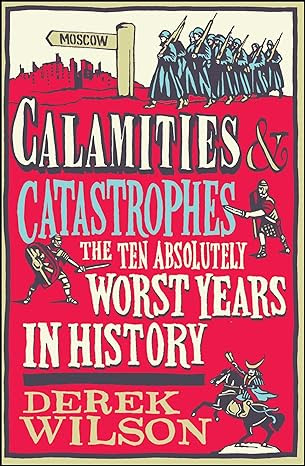
CALAMITIES and CATASTROPHES: THE TEN ABSOLUTELY WORST YEARS in HISTORY by Derek Wilson


Published in 2015 by Marble Arch Press

Going into this book, I knew that I would have a bone to pick with almost every one of the author's choices. After all, there are 5,000 years of recorded history and every last one of them is filled with tragedy. How can you pick and choose the actual worst 10 years?

Wilson, a British historian, focuses in this book on a Western point of view and the earliest date is 541 A.D. So, if you are making a pitch for the 10 worst years in the West in the last 1500 years, his choices are pretty solid.

The years he picks are:

541-542: The first outbreak of the Bubonic Plague weakens the nascent Byzantine Empire and the Persian Empire, killing millions.


1241-1242: The Mongols invade Eastern Europe.

1572: The Spanish Inquisition and everything that came with it.

1631-1632: The worst year of the Thirty Years War.

1709: The Great Freeze

1848: The "Year of Revolutions" in Europe

1865-1866: The assassination of Abraham Lincoln and the failure of the United States to follow through properly with Reconstruction after the Civil War. Also, the rise of terror groups like the KKK.

1942-1943: He almost exclusively focuses on the Russian front - the bloodbaths around Leningrad, Moscow and Stalingrad.


Robert F. Kennedy, Sr. (1925-1968)
1968: The Vietnam War, the assassinations of Martin Luther King and Robert Kennedy, protests around the world.

1994: The Rwandan genocide. There is a lot of focus on how and why the Western powers just watched it happen.

Sometimes, Wilson has a nice turn of phrase in his writing. I especially liked this line from page 151: "Over the centuries, whatever game Europe's nations played, the weakest hand always seemed to be dealt to Poland."

But, there were lots of typos, a weird use of texting-style writing on page 122 and several errors with commas that made me have to re-read passages just to figure out if what Wilson had written was what he really meant to say. Other times, there are factual errors (that may have been editing errors - as I just noted, editing was a real issue in this book). The most egregious error was actually a double error in the same paragraph on page 227. Wilson notes:

 "By the end of 1967 the war had cost the lives of almost 16,000 combat troops and was gobbling up more than $2-3 million per month. What made matters worse was that America's youth had no way of avoiding military service because conscription (the 'draft') still existed."

First: a quick internet search says the Department of Defense spend $168 billion between 1965 and 1972 on military operations in Vietnam. I am sure he meant to say $2-3 billion, not million.

Secondly, there were ways to avoid the draft. Let's look at three recent American presidents. Bill Clinton chose the most popular way to avoid the draft - he went to college. It was no guarantee, but it was a good bet. Many universities grew during the Vietnam War due to increased demand. George W. Bush joined the Air National Guard. Also, it was no guarantee not be sent to Vietnam, but it was not likely. Donald Trump claimed disability (bone spurs in his feet).

I rate this book 3 stars out of 5. The limited focus on the West while claiming to be about all of history was a disappointment. The atrocious editing was also a concern.

This book can be found on Amazon.com here: CALAMITIES and CATASTROPHES: THE TEN ABSOLUTELY WORST YEARS in HISTORY by Derek Wilson.

HAVOC (Philip Mercer #7) by Jack Du Brul


Published in 2006 by Brilliance Audio, Inc.
Read by J. Charles.
Duration: 12 hours, 43 minutes.
Unabridged audio edition.

Jack Du Brul's Havoc is a techno-thriller that races from the Hindenburg disaster to Africa to Washington, D.C to Atlantic City to Niagara Falls to Russia and back to Africa with hardly any time to take a breath. 

The book features Philip Mercer, a geologist by training that often troubleshoots for the White House. This is the seventh book featuring Mercer, a fact that was not on the audiobook label. However, Du Brul does a great job of catching the reader up on what has been going on - I assumed it was the first book in the series as I was listening to it. 

The Hindenburg disaster on May 6, 1937.
The action starts with a traveler on the infamous Hindenburg as it flies to its fate with destiny in Lakehurst, New Jersey in 1937. A crazed man is hiding a secret in a safe in his room and he is afraid that the Nazis know he has it and are plotting to steal it from him. As this man sits and watches his safe he devises a plan to get it safely off of the airship before it lands in New Jersey - he throws it overboard into a farm field with an attached note for Albert Einstein. The note falls off and the safe gets forgotten in the chaos of the Hindenburg disaster.

Fast forward to modern day in the Central African Republic. Mercer accidentally meets Cali Stowe, a fellow American. Mercer tells her he is here to investigate a geological hunch for someone as a favor. She says that she is there to investigate a village that has an extraordinarily elevated cancer rate. They are both telling half-truths. But, most importantly, this village is in the middle of a civil war and a dangerous warlord is on his way, burning and looting as he comes...

As the story progresses, Stowe and Mercer find that they have a mutual interest in this village and in each other. The more they find out about, the more tense the situation becomes. There are a lot of complicated threads in this book but Du Brul does tie them all together at the end

The story is full of action and adventure - some of it fun, some of it believable, some so outrageous that the story borders on silly. Mercer gets to be too much after a while - he is an expert on the Hindenburg, he knows how to fight, he's an expert with pistols, grenades, rifles, knives, swords and even with bows and arrows. He knows about mines, cave-ins, scuba diving, trains, dinosaur bones, forklifts, helicopters, speed boats and bar tending. But, his heart is in the right place and if you just go with the flow and don't think about it it just might not bother you too much. 

The audiobook was read by J. Charles. Charles did a merely okay job with the variety of accents required by this book. He has a hard time with women's voices and Cali Stowe has a lot of lines in this book. His foreign accents all fell into the category of "not an English language accent". Everyone kind of sounded the same. 

I rate this audiobook 3 stars out of 5. It can be found on Amazon.com here: Havoc (Philip Mercer #7) by Jack Du Brul.

Reviewed on July 22, 2014.

MANDELA: AN AUDIO HISTORY by Radio Diaries


Published in 2014 by HighBridge Audio
Hosted by Desmond Tutu
Commentary by Nelson Mandela
Duration: 1 hour, 15 minutes.

Winner of the Audie Award - Audiobook of the Year for 2015.

Considering that Mandela: An Audio History is the history of the entire apartheid era of South Africa in 75 minutes, this short history is surprisingly thorough and very compelling. 

The audiobook tells the story of apartheid through the story of Nelson Mandela - why he decided to fight against it, how he decided to fight against it, his trial for treason, his time in prison, how the struggle continued with him as the symbol of hope and resistance, the collapse of the apartheid system and it ends with the election of Mandela as president. Each chapter begins with a short introduction by Anglican Bishop Desmond Tutu (also a large voice against apartheid).
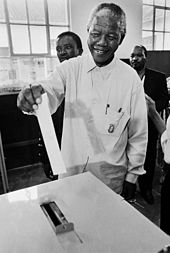
Nelson Mandela  (1918-2013)
casting his vote in the 1994
election.

The story is mostly told through interviews with Mandela and dozens of others and also includes snippets from radio and TV news broadcasts. Of course, details are left out. Desmond Tutu's Nobel Prize is not mentioned and Winnie Mandela is glossed over and nothing is mentioned about their marital troubles (to be expected considering their age difference and considering that he was imprisoned for such a long part of their marriage) and her implication in a murder and virtual endorsement of the heinous practice of necklacing.

But, like I already noted, things have to be left out if the goal is a short history. This is a very fine short history of apartheid - very approachable and I found it to be quite engrossing. 


I rate this audiobook 5 stars out of 5. It can be found on Amazon.com here: Mandela: An Audio History by Radio Diaries

A Dream So Big: Our Unlikely Journey to End the Tears of Hunger by Steve Peifer with Gregg Lewis


A Very Moving True Story


Published in April of 2013 by Zondervan

The hardest book reviews to write are for the books that truly touch you. A Dream So Big had me spellbound from the first and I cannot even attempt to write a proper review.

If you have ever had the scary meeting with a "genetic counselor" at the OBGYN office than you can feel for the Peifer family. In my family's case, the meeting was unnecessary - our daughter was born with no complications. For the Peifer family, this was not the case. Their son was born with severe disabilities and only lived a few days.

Peifer describes the devastation to his family and how he and his family come to join the faculty at a boarding school for the children of missionary families. He describes how a one year gig has become a mission to feed and educate as many Kenyan children as possible.

Peifer's good humor is visible throughout the book and he is a natural self-deprecating storyteller. He balances his tales of the larger mission with lots of stories about the school and his family.

I have included a video so that you can see what he is trying to do in his own words:


If you are moved to help (and he emphasizes that a little bit really does go along way in Kenya), here is the website for Peifer's organization: http://kenyakidscan.org/how-you-can-help/

Note: This book was sent to me by the publisher in exchange for an honest review.

I rate this book an enthusiastic 5 stars out of 5.

This book can be found on Amazon.com here: A Dream So Big: Our Unlikely Journey to End the Tears of Hunger

Reviewed on June 1, 2013.

JSA: The Liberty Files (Justice Society, Elseworlds) (graphic novel) by Dan Jolley and Tony Harris


It was good, but not great.

Published by D.C. Comics in 2004.

I am not the biggest comic book fan. I have barely set foot in a real comic book shop, so I don't even know if the 'Comic Book Guy' on 'The Simpsons' is realistic or not. Continuity means nothing to me. Being a history teacher, I was more intrigued by the history part of the story. (Speaking of continuity, I know for a fact that Superman was fighting Nazis during WWII, just like Bugs Bunny and Daffy Duck - I've seen the movies!)

However, I've read some of the big stuff (Dark Knight I and II, Red Son and a few more). I was dimly aware of some of the heroes featured in this one, which makes sense since JSA was originally intended to promote the lesser known heroes). This one was interesting, but in the end, not as good as I had hoped.

Learning the new characters was fairly easy, but telling them apart in their street clothes was darn near impossible with the exception of Clark Kent, thanks to the trademark cowlick. Also, even though it was a JSA book, the focus seemed to be Batman. Batman vs. "Jack the Grin" (Joker). Batman vs. Scarecrow. Batman making his teammates mad. Batman's introspection. And, finally, Batman vs. 'Superman'. The last one has been done umpteen times, I know, even though I am, as already stated, a casual fan. Heck, I've seen it done in Frank Miller's Dark Knight I and Mark Millar's Red Son, and to be honest, they both did it better (especially Millar's).

An interesting observation - I appreciated the fact that at the WWII Battle of El Alamein, the artists included two well-known fictional characters of this time period in the two page spread (pp. 116-117): Sgt. Rock and PFC Ryan (from Saving Private Ryan).

So, while not a waste of my time, it certainly did not do the job as well as others.

I give this one 3 stars out of 5.

This graphic novel can be found on Amazon.com here: The Liberty Files.

Reviewed on June 17, 2007.

Deogratias, A Tale of Rwanda (graphic novel) by J.P. Stassen


An important tale to be told - unfortunately this one fails to tell it well enough

Published by First Second in 2006.

Deogratias is the name of a young man from Rwanda. The story dances back and forth between pre- and post-1994 massacre Rwanda. Pre-massacre Deogratias is a likeable young man. Post-massacre Deogratias is insane. As one reads this graphic novel one finds out what drove him insane - in a climax that is not all that surprising or shocking (just sad), especially if one knows any of the detail of the Rwanda massacre.

An image from the graphic novel
Great works take the story of one person or group of people in a tragic situation and somehow make their story universal. For example, the Civil War movie Glory is the story of the first all-Black Federal regiment in the Civil War - it is also the story of every soldier - black or white, Union or Confederate. In Saving Private Ryan, the Tom Hanks character epitomizes the average man stuck in a terrible situation doing the best he can and dying in the process.


Deogratias fails to do this. It is too personal. The story is too small. Not to say it isn't important, but rather to say that it fails to become a universal story of the Rwanda tragedy.

My copy of the book has an introduction from Alexis Seigel, the translator. He does an exceptional job of explaining the Rwanda tragedy and its aftermath. I would give his introduction 5 stars.

However, the grade has to go to the graphic novel, not its introduction. So, I give this graphic novel 3 stars out of 5.

This graphic novel can be found on Amazon.com here: Deogratias: A Tale of Rwanda.

Reviewed on December 11, 2006.

This book was listed on a "banned book" list in Florida. Ugh.

And it was put on a book ban list in Tennessee. The article has a searchable database because the list has more than 1,100 unique titles.

Featured Post

<b><i>BAN THIS BOOK (audiobook)</i></b> by Alan Gratz

Published in 2017 by Blackstone Audio, Inc. Read by Bahni Turpin. Duration: 5 hours, 17 minutes. Unabridged. My Synopsis Ban This Book is t...

Popular posts over the last 7 days