Lee: A Life of Virtue (The Generals series) by John Perry


A solid biography in many aspects, but not without its problems

Published in 2010 by Thomas Nelson Inc.

First, a bit about this reviewer and Civil War books. This is my 80th Civil War book. Robert E. Lee figures prominently in almost every one of them. I consider him to be the the most talented general that served on either side in that war and that is high praise indeed because many generals rose to the top and did distinguished themselves in that war. If Lee is the most talented general in that war, he is the most talented American officer of the 19th century and one can make the argument that he may have been the best ever (assuming one overlooks the massive point that he earned that reputation as a fighter by breaking his oath and taking up arms against the United States government, which I am.)
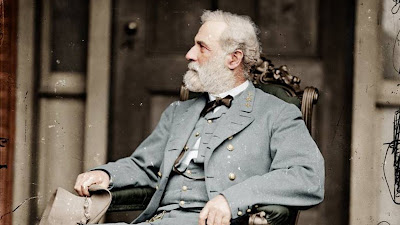
No one did so much with so little against an opponent that was better fed, had better and more numerous weapons, and outnumbered him in literally every battle. He fought with principle and with respect for his enemies (who he refused to call his enemies - he called the Union forces "those people.")

All of that being said, even I cannot approach the standard of hero worship that John Perry creates in the introduction of this book. Perry cites as one of his primary sources the Douglas Southall Freeman biography R. E. Lee.  Freeman was the primary advocate of a revisionist movement of historians popularly called the Lost Cause movement. It emphasizes the noble character of the southern generals, de-emphasizes the importance of slavery as a cause of the Civil War and justifies secession as a legitimate response to aggressive Northern attacks on the Southern way of life and economy. I would consider Lee: A Life of Virtue to be Lost Cause "lite".

For example, Perry makes a big deal of the fact that Lee never personally owned a slave. He also notes that Lee condemned slavery. That is true, but he did not need to personally own a slave - his wife and her family owned more than one hundred slaves and at least one travelled with the family whenever they followed him in his army postings. Condemning slavery while benefitting from it is a difficult position to defend (ask any devotee of Jefferson.)

Clearly, the war was about more than just slavery, but as noted Civil War historian James McPherson notes in his book of essays about the Civil War entitled This Mighty Scourge, modern historians are re-discovering the primacy of slavery in the debates concerning secession. Charles B. Dew notes in Apostles of Disunion, "Defenders of the Lost Cause need only read the speeches and letters of the secession commissioners to learn what was really driving the Deep South to the brink of war in 1860-61."

Perry's biography of Lee, however, is quite good on the whole. He makes the details of Lee's early life interesting, including all of his postings around the country as an engineer in places such as St. Louis and New York City.

More than half of the book concerns his time in the service of the state of Virginia and the Confederate States of America in the Civil War. Perry's description of the battles and the politics of the war is solid, despite glaring glitches such as the time when he refers to the Battle Sharpsburg (Antietam) as "Strategically...relatively unimportant." (p. 167)

Antietam was a massive strategic loss for the Confederacy. This loss caused Lee to stop his strategy of bringing the war to the North for nearly a year and, even more importantly, provided Lincoln with the victory he needed (vague as this victory was) to issue the preliminary version of the Emancipation Proclamation. This document brought in African American soldiers, stopped Britain's attempts to interfere in the war, and laid the groundwork for the laws and Constitutional Amendments that ended slavery forever. Some have argued that Antietam (Sharpsburg) was the most important battle of the war because of all of those strategic losses.


So, to sum up, this is a solid biography, but not perfect. Too much hero worship and a basic misunderstanding of the Union war strategy as typified by the fundamental misunderstanding of the importance of the Battle of Antietam.

I rate this book 3 stars out of 5. It can be found on Amazon.com here: Lee: A Life of Virtue (The Generals series).

Reviewed September 25, 2010.

I reviewed this book in conjunction with Thomas Nelson's BookSneeze program. I was not compensated for this review. The opinions expressed are mine.

Review updated on July 27, 2024.

The Jinglebob Man by Robert Kammen


So, your first question has to be "What is a jinglebob?"

Published in 1995 by Kensington Pub Corp

A jinglebob is part of the little spinny thing on the back of a set of spurs - the sharp part. It makes the "ting, ting, ting" sound you always hear in westerns as the cowboys are walking along and setting up for a big shoot-out.

The main character is The Jinglebob Man because he is imprisoned tortured by a sadistic superior officer with a set of sharpened spurs during the Civil War because he is accused of treason.

Our protagonist, Tyler Carradine, escapes from his prison and is now forever on the run, afraid of meeting someone from his past and in pain due to a lost love that he feels will not accept him due to his physical deformities and the accusations against him.


Carradine stumbles into a corrupt mining town years after the war and is finally forced to turn and fight rather than continue to run. Oh, and he finally has a chance to find love again (but not with his long-lost love).


The plot of the book is pretty basic western fare. Kammen's writing style is uneven. At times, the story flows effortlessly and at other times it seems as though he is trying too hard to sound authentically western and the narration breaks down and trips all over itself.

I rate this book 3 stars out of 5 and it can be found on Amazon.com here: The Jinglebob Man.

Reviewed January 28, 2005.

Riding for the Brand (audiobook) by Louis L'Amour


Good, but predictable

Audio version originally published in 1986 by Random House Audio
Multicast performance with sound effects
Duration: 55 minutes.

I like Louis L'Amour. His descriptions and conversations are top notch. However, his plots are predictable so I really am grading this on a curve.
Johnny Cash, Willie Nelson,
Kris Kristofferson and Waylon Jennings

I am also rating the audio version of Riding for the Brand which is interesting because it is told by Willie Nelson, Waylon Jennings, Kris Kristofferson and Johnny Cash. It was quite enjoyable to hear the four of these men work together - they were all quite good, especially Kristofferson and Nelson.

This audio edition has features that most don't, including special effects and a music soundtrack that was sometimes reminiscent of Clint Eastwood's Spaghetti Westerns and sometimes reminiscent of Silverado. The inclusion of the special effects did speed the plot along (you don't have to describe that people are knocking on the door or riding horses, etc.) but sometimes they are distracting (one scene in particular had an overly loud clock ticking over the top of everyone's voices).

I rate this audiobook 4 stars out of 5.

This audiobook can be found on Amazon.com here: Riding for the Brand.

Reviewed on January 26, 2005.

A Separate Country by Robert Hicks


Tries too hard to set a mood, loses focus on the history.


Published in 2011 by Grand Central Publishing.

As a history teacher, I love well-written historical fiction. It places the reader right in the story. A judicious author can blend the history and the fiction together in a harmless fashion and tell the story in an accurate and entertaining way.

A Separate Country does not live up to those standards. It it presumptuous of an author of historical fiction to take the first person with a very famous historical figure. Commonly, if a first person perspective is used it is with a fictional character - an aide to a general that witnesses events but does not effect them, for example. In this case, Hicks has taken one of the "name" generals from the Civil War and turned him on his head. He has sacrificed the "historical" in the name of the "fiction."

Hicks places John Bell Hood into a series of historic events, some of which are quite true (such as the lottery drawings - many Confederate ex-generals were lottery commissioners) and some of which are of dubious truth (Hood's fascination with the comatose Pascal, for example). A great deal of the book is supposed to be Hood's secret autobiography, but it reads more like a modern blog than a Victorian era journal.

Confederate General John Bell Hood
(1831-1879)
The problem is that Hood's real life story is subordinate to this fiction in the story. It is peopled with characters with symbolic names (for example, Pascal's name is like paschal - an Easter term referring to Jesus and his sacrifice). Hood becomes a part of a much larger morality play about race, love and sacrifice. He even works in a young Homer Plessy, of later Plessy vs. Ferguson claim.

The author, Robert Hicks, is fascinated with Hood's performance at Nashville and Franklin, TN but almost completely ignores his other battles, which read like a roll call of the war itself: The Peninsula Campaign, 2nd Bull Run, Antietam, Fredericksburg, Gettysburg (Also, another historical inaccuracy - Hood never would have heard Lee apologize to the survivors of Pickett's Charge - Hood was in the infirmary trying to save his mangled arm), Chickamauga (where he lost his leg) and Atlanta.

The book is just tedious. The use of three points of view to tell the story guarantee us extended descriptions of the heat, humidity and the lush plant and insect communities of New Orleans. Page after page of descriptions of the plagues that strike New Orleans. Enough already!

This history teacher says pass on this one.

I rate this book 2 stars out of 5. It can be found on Amazon.com here: A Separate Country by Robert Hicks.

Reviewed on August 3, 2009.

Apocalypse Troll  by David Weber


A solid sci-fi story saddled with a fantasy genre name

Published in 2000 by Baen Books.

Just seeing the title of this book you would assume that David Weber's first solo novel is all about ogres, witches and elves. The cover shows differently, of course. The Apocalypse Troll is an action-packed bit of sci-fi that includes time travel, a threat to planet earth and a lovely lady.

Here are the plot basics: an alien race from the future lands on earth in an effort to destroy it and humans from the future arrive in an effort to stop them. But, their defense was less than successful so current day humans are left to fight on with the advice of a surviving human from the future.

And this story works.

Mind you, this is not "great" literature - but it is a romp through space and time with plenty of military action, a truly evil villain and lots of snappy dialogue. Be warned, there is not a lot of character development and the reader really doesn't know the entire backstory until about 1/3 of the way through the book, but it's still a worthwhile read.
 
I rate this book 4 stars out of 5.

This book can be found on Amazon.com here: The Apocalypse Troll. 

Reviewed on August 9, 2009.

The Airmen and the Headhunters: A True Story of Lost Soldiers, Heroic Tribesmen and the Unlikeliest Rescue of World War II by Judith M. Heimann

Originally Published in 2007
An odd and interesting bit of history from the Pacific Front in World War II


The Airmen and the Headhunters: A True Story of Lost Soldiers, Heroic Tribesmen and the Unlikeliest Rescue of World War II  is a well-researched telling of the story of two sets of American fliers (one Army and one Navy) who were shot down over Borneo by the Japanese. The survivors end up living with the Dayaks, the famous headhunters of the highlands of Borneo.
Borneo was largely unmapped and unknown to the West. It was, and still is, one of the remotest locations on earth. Most of Borneo's interior is like the old line, "You can't get there from here." Well, you can if you jump out of an airplane.


The author, Judith Heimann
doing research in Borneo
The author, Heimann, does a good job of giving the reader a feel for the Dayak way of life, but the shortage of maps makes the story of the soldiers being moved from village to village for their protection a frustrating experience. At times, the story bogs down in a series of descriptions about a series of malarial infections, boils that need lancing and endless rice-based meals.

Don't let that stop you from reading this book, though. Any student of World War II should pick this one up just to learn one of the more interesting tales from a remote location in a truly world war.

A PBS documentary was also made with the same title based on the book.

I rate this book 4 stars.

This book can be found on Amazon.com here: The Airmen and the Headhunters.


Reviewed on August 11, 2009

Promised Land by Robert B. Parker


A pivotal moment in the history of the series and an artifact of the 1970s


Published by Random House Audio.
Read by Michael Prichard.

Duration: 5 hours, 27 minutes.
Unabridged.

Over the years I've read all of the Spenser novels, but since I do not have a photographic memory I'm going back and listening to them as audiobooks during my commute.

Promised Land is a pivotal moment in the series because this is the moment in which we meet Hawk - Spenser's erstwhile partner in anti-crime in so many books in the series. Hawk is in his full glory here - a bad man who kills, roughs people up, and intimidates, but still lives by his own code that Spenser somehow senses and respects.

It is also a pivotal moment because there is an incredible amount of conversational psychoanalysis throughout the book, a trait that most Spenser books feature (often to their detriment, in my opinion). Spenser's personality is discussed, male/female relationships, what it means to be a man or a woman, responsibility and more. Out of these discussions come the foundation for the ongoing relationship between Spenser and Susan Silverman that continues throughout the series. Sometimes this is interesting but towards the end I wearied of it and it hurt the flow of the book and my enjoyment of it.

Robert B. Parker
Promised Land is a wonderful artifact of the truly revolutionary nature of the 1970s (For years I've contended that the 1970s were more of a decade of change than the 1960s were). We meet revolutionaries who arm themselves to overthrow "phallic power", we see the changing nature of husband/wife relationships. 

I rate this audiobook 3 stars out of 5. It can be found on Amazon.com here: Promised Land by Robert B. Parker.

Reviewed on August 26, 2009.

Rizzo's War by Lou Manfredo


A different kind of hard-boiled cop story

Joe Rizzo is a detective in NYPD's 62nd Precinct. He is partnered with a young whiz kid newly minted detective and together they solve crimes, talk about crime and we learn how a determined detective can trade favors to skip bureaucratic steps.

Rizzo's War is, in a lot of ways, a non-traditional detective story. Usually, there is an overarching plot (the big crime, in a detective story) and lots of smaller crimes pepper the story as interesting filler. In this book, we get a lot of little crimes to introduce the characters and give the reader the feel for the environment. The actual "big" case doesn't occur until about halfway into the book.

But, that's okay. The characters are interesting. The environment is interesting. The cases are interesting. The book feels like it is an introduction to a series and I hope that it is. I'll look for more Rizzo books.

I rate this book 5 stars out of 5. It can be found on Amazon.com here: Rizzo's War by Lou Manfredo.

Reviewed on August 26, 2009.

Rain Gods: A Novel by James Lee Burke


A dark, wearisome and depressing novel

Published in 2009.

Crime novels come in all sorts of varieties and flavors. At one extreme are the slapstick Evanovich Stephanie Plum books. At the other end come moody and brooding novels like those that James Lee Burke produces. I have read several of his books and I know that they are not fun-loving romps, but the morose nature of this book takes the cake.

James Lee Burke
With the exception of two brief scenes Rain Gods: A Novel was relentless in its brooding tone. I found it wearisome. Every male character is burdened with evil deeds, obsesses over them and then acts out in self-destructive, often violent ways. All of the female lead characters offer wisdom, strength and guidance. There are literally more than a dozen bad guys and it seems that this desert Texas countryside is full of nothing but broken people, hookers, alcoholics, criminals and a couple of cops. Where are the regular people?

The book was just too much death, despair and regret for me.

A wearisome and disappointing read.
 
2 stars out of 5. It can be found on Amazon.com here: Rain Gods: A Novel by James Lee Burke.
 
Reviewed August 26, 2009

Boogers Are My Beat: More Lies, But Some Actual Journalism (audiobook) by Dave Barry. Read by Dick Hill.


Very, very, very good.

Published by Brilliance Audio in 2003.

Duration: 5 hours, 55 minutes.
Read by Dick Hill
Unabridged.

Boogers Are My Beat: More Lies, But Some Actual Journalism is a collection of Dave Barry's columns from the summer of 2000 through September of 2002. They are read expertly by veteran narrator Dick Hill. I usually hear Hill reading crime novels and the like but I was pleased to hear that he has expert comic timing and turns out to be a perfect narrator for Barry's offbeat sense of humor.

Veteran reader Dick Hill
Topics include:

*The 2000 Democrat and Republican political conventions;
*The 2002 Salt Lake Winter Games;
*The Census;
*Camping in a Wal-Mart parking lot;
*and the silly tips in Cosmo magazine on how women can drive men wild.

Dave ends with two long essays about 9/11. One was published on 9/12 and does a great job of summing up the raw feelings and shock of the time. The second essay is much longer - by far the longest of the book. It was published on the one year anniversary of 9/11. It is simply brilliant. It incorporates the Gettysburg Address, an interview with the coroner in charge of the Shanksville plane crash scene and details Barry noted during a visit to both Gettysburg and Shanksville.

I rate this book 5 stars out of 5.

This book can be found on Amazon.com here: Boogers Are My Beat.

Reviewed on September 12, 2010.

Sh*t My Dad Says by Justin Halpern


Published in 2010.

For the first half of this book I found Justin Halpern's Sh*t My Dad Says to be a refreshing change of pace. Finally, a man who says what he thinks - no political scheming, no worrying about the consequences - this man just opens his mouth and says the first profanity-laced thing that pops into his head.

For example, from page 44: "I just want silence...Jesus, it doesn't mean I don't like you. It just means right now, I like silence more."

But, as the stories pile up and the sheer number of comments overwhelm the reader I started to feel there was a subtle, hidden subtext here - life with this man was and is difficult. Actually, it was not all that subtle in the chapter where Halpern's dad had to to be told that Halpern was "tweeting" his quotes to the whole world and had been making money off of the quotes and was going to publish a book about it. The level of concern expressed by his brothers when Halpern told them he had to break the news to their father was enough to make this veteran teacher concerned. If there was no real fear here, than Halpern needed to write this portion more clearly.

To be sure, he has his positive sides. In fact, at first the Dad is really refreshing in his candor but after a while it seems abusive. You don't have to tell everyone every thought you ever have about other people's habits, the dogs defecation routine,  food, Mrs. Dash and whatever other fool thing pops into your head.

Justin Halpern
A little candor - refreshing. Too much candor - well, no one wants to know all of their faults all of the time. Self-censorship, when well-placed, can be a blessing to everyone.
 
In a lot of ways, Halpern is no better than his dad - we are treated to 3 different tales of masturbation - one for the family dog,  two for him, including one where he describes how he fantasized about a girl he went on a trip with to Mexico. That must be a special memory for her now, huh? You did what while you thought about me?
 
I rate this book 3 stars out of 5.

This book can be found on Amazon.com here: Sh*t My Dad Says.

Reviewed on September 12, 2010.


Star Wars Year by Year: A Visual Chronicle by Daniel Wallace, Pablo Hidalgo, Gus Lopez and Ryder Windham


Published in 2010 by DK Publishing

DK Publishing continues a trend of producing lavish coffee table books filled with page after page of montages of full color images. In this case, the topic is the Star Wars phenomenon.


Star Wars Year by Year: A Visual Chronicle is a very large coffee table book - one inch thick, 10 inches wide and nearly a foot high.

This book could just as easily have been called "George Lucas Year by Year." Star Wars dominates Lucas's career like the Eiffel Tower dominates the Paris skyline. Perhaps, even more so.

Boba Fett and George Lucas
As the title states, the book is a visual timeline of George Lucas, the Star Wars franchise and the people and companies involved in its production and promotion. We see early handwritten notes about "Journal of the Whills" - one of the first drafts of Star Wars Episode IV. Later on, we see further updates, including the introduction of a character named Luke Starkiller who, of course, became Luke Skywalker in later revisions. We learn about Lucas's early life, his early films and his influences and a bit about the research he did to create the series.

Included in the timelines are other bits of news about movies, politics and space exploration. For example, on pages 34 & 35 we read about July through December 1974 which includes the first draft of the script for Episode IV, some very early drawings for the TIE Fighters, X-Wings and the Death Star, Nixon resigning as President, the birth of the actor that played Darth Maul in Episode I, early plastic models of the Y-Wing Fighters, the release of The Godfather: Part II (the director is a colleague and friend of Lucas), the production of the first script for another Lucas movie - The Radioland Murders and Christopher Lee's (Episodes II and III) role in a James Bond movie. Every picture has a detailed caption and the story goes on for page after page after page.

Luke Skywalker
It is a fascinating read. I particularly enjoyed the pictures and descriptions of the Star Wars dolls that I collected and nearly wore out as a child. There is also information on the different videogames, novels, radio dramas, fan magazines, board games, fan clubs, appearances on TV shows, the famed Star Wars Christmas Special, John Williams, the cartoon shows, the Lego sets and even the Darth Vader Mr. Potato Head toy.

Lavish, thorough, massive and entertaining - this promises to be a hit with any fan. A can't miss gift.

I rate this book 5 stars out of 5.


This book can be found on Amazon.com here:  Star Wars Year by Year: A Visual Chronicle

Reviewed on September 4, 2010.


Featured Post

<b><i>BAN THIS BOOK (audiobook)</i></b> by Alan Gratz

Published in 2017 by Blackstone Audio, Inc. Read by Bahni Turpin. Duration: 5 hours, 17 minutes. Unabridged. My Synopsis Ban This Book is t...

Popular posts over the last 7 days