Showing posts with label Oregon. Show all posts

THE FREE FALL of WEBSTER CUMMINGS (audiobook) by Tom Bodett


Originally published in 1995 by Brilliance Audio.
Read by the author, Tom Bodett.
Duration: 15 hours, 43 minutes.
Unabridged.


The author and narrator.
I think Tom Bodett's End of the Road series of short stories is just one of the best audiobook experiences out there. Technically, this book is part of that series even though almost none of it takes places in that oddball community of End of the Road, Alaska (it earned its name by being, well, the place where the road ends.)

Bodett is well-known as a frequent panelist on the NPR show Wait Wait...Don't Tell Me! but he is most well-known for his voiceovers for Motel 6 in which he promised in his folksy way, "We'll leave the light on for you."

I say all of this just to say that this book was a major disappointment. 

Everything about this book seems like it should work. It has a grounding in his Alaska stories. It consists of a series of short stories - his area of expertise.

But, there is just way too much going on in this book. There are way too many plotlines going on and Bodett tries to weave them together so they all tie up in a couple of nice little knots at the end and he just doesn't get it done.

There are two plotlines from Alaska, two plotlines from Seattle (one is mysteriously dropped about 1/3 into the book), a cross country plotline from New York City and Los Angeles, a family from Ohio that heads west in stages to find themselves (one finds that Indiana may be far enough west), supernatural forces, PTSD, memory loss, mysticism and a man named Webster Cummings who fell more than a mile from a commercial jet plane over New England and survived. Webster near death experience inspired him to find his biological parents. 

Just too much and I just ended up wanting it to end.

I rate this audiobook 2 stars out of 5. It can be found on Amazon.com here: THE FREE FALL of WEBSTER CUMMINGS (audiobook) by Tom Bodett.
.

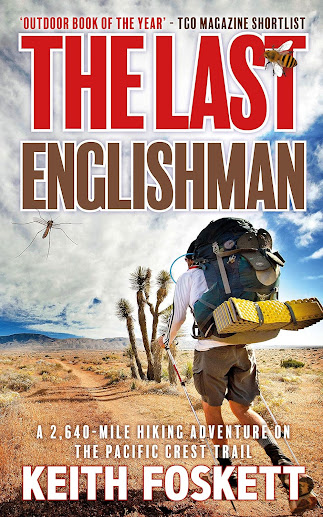
THE LAST ENGLISHMAN: THRU-HIKING the PACIFIC CREST TRAIL (Thru-Hiking Adventures #2) (kindle) by Keith Foskett


Published in 2014.

I have a real weakness for oddball travel books. I have read a memoir about a man that hitchhiked throughout Europe and North Africa, a book about a man's bicycle trip from the UK to India, a book about a man who walked across Afghanistan, a book about a man who rode a motorcycle around the edges of Afghanistan, a book about two women who biked from Turkey to China, a book about a man who walked the length of the Nile, a man who walked the Appalachian Trail with his deeply irresponsible friend from high school...and more. And more. And more.

This book fits in best with my book about the 2,190 mile Appalachian Trail because it is set on the American West's counterpart to that trail: The 2,650 mile Pacific Crest Trail. This trail runs from Mexico to Canada through California, Oregon, and Washington State. 

Foskett is an experienced long-distance hiker but this hike is a challenge for any hiker to complete in a single attempt. The threat of snow in the mountain passes doesn't let hikers start very early up north so hikers start down south and hope to catch a break with the weather. They hike north and try to keep up a good pace so they don't get caught by snow up in the mountains in Washington State as winter comes on.

A great pace is 30 miles per day and even if a hiker can keep that pace up through the worst of the passes, that still makes a 3 month hike. But, hikers don't keep up that pace. They have to take time off of the trail to resupply, pick up pre-mailed packages, rest, and tend to injuries or illness. One can't discount the need to pop off of the trail to literally eat thousands and thousands of calories or simply take a break.

A major theme of the book is Foskett's constant push to make enough miles but this reader was dismayed at how many times he turned a day off of the trail into two or three days in a hiker friendly hotel. I kept on saying, "Go! You're going to get caught in the snow!" Turns out, that's where the title comes from - he ends up so late on the trail that he calls himself "The Last Englishman."

But, my worry about his wasting time and not making it is really a sign that I was invested in this story. It was good enough that I went ahead and bought another  book by Foskett that tells the tale of another long-distance hike. Plus, I am a sucker for oddball travel books. 

I rate this e-book 4 stars out of 5. It can be found on Amazon.com here: THE LAST ENGLISHMAN: THRU-HIKING the PACIFIC CREST TRAIL by Keith Foskett.

Follow this link to see my review of another book by this author. In that book, he hikes the Camino de Santiago in Spain and France.

LIGHT IT UP (Peter Ash #3) (audiobook) by Nick Petrie


Synopsis:

The third entry in the Peter Ash series begins with Peter Ash working on a team rebuilding hiking trails in Oregon and writing long heartfelt letters back to his love interest from the second book.

He makes friends with an older man named Henry (a Vietnam vet, as opposed to Ash being a vet of Iran and Afghanistan.) Henry gets a call from his daughter in Colorado and asks for Henry's help with her business that provides security for some of the legal marijuana businesses.

Turns out that these businesses have to operate completely in cash because marijuana is still illegal so far as the federal government is concerned so banks cannot take credit cards, debit cards or even deposits because it would be considered helping to traffic drugs. This means that there are shipments of pot and shipments of cash coming and going and that can attract bad guys.

An entire security crew has disappeared with the money. Some assume that the security team was attacked and killed or maybe even captured. Others think they ran off with the money. 

Peter and Henry's crew take the next big run and they find out soon enough what happened to the other crew...

My Review:

The action and the adventure were good in this book, but there was a deeper theme in the book about the kind of men that serve in the military. I thought it added a bit of literary dimension that is, frankly, almost never present in these sort of "shoot 'em up" books.

Ash is a traditional principled good guy - a Clark Kent/Luke Skywalker type. A man who joined the military because he saw a need and wanted to help. He meets up with his opposite in this book - a man who joined the military because he could take advantage of the trust given to him to hurt people and satisfy his urges. In the middle, there is a man who served honorably until an arbitrary rule forced him to sell his honor in order to save his family from shame.

I rate this audiobook 4 stars out of 5. It can be found on Amazon.com here: LIGHT IT UP (Peter Ash #3) (audiobook) by Nick Petrie.

SHADOWS REEL (Joe Picket #22) (audiobook) by C.J. Box


Published in 2022 by Recorded Books.

Read by David Chandler.
Duration: 9 hours, 4 minutes.
Unabridged.


Synopsis:

Game Warden Joe Pickett investigates a report of a dead elk. Fearing that it is the victim of a botched attempt at poaching, he investigates. Instead, he finds a burned corpse and falls headlong into another murder investigation.

Meanwhile, Joe's wife Marybeth, the director of the local library discovers an odd package left at the library with connections to a prominent Nazi from World War II.

And...Nate Romanowski is in Denver hunting down an old enemy during the midst of an Antifa/BLM riot.

My review:

This is a book series about a game warden. Oftentimes, he is joined by a former special forces guy who is so into nature that he used to stand naked in a stream of water for hours at a time to get the feel of a river and its entire ecosystem - from the slime at the bottom to the fish to the birds that swoop down to the beavers that dam it up.

Antifa protest in Denver
There was almost no "game wardening" in this book and the man who is derisively called "nature boy" in this book spends 99% of this book navigating the urban world of Black Lives Matter and Antifa.

I have complained in my review of the 20th book in this series, Long Range, that Joe Pickett was getting involved in so many other types of police cases that it is easy to forget that the first books in the series - the books that made me start and keep reading a series - were mostly about game warden activities. Lots of searching for poachers. There was a book about eco-terrorists, one with survivalist weirdos and even a big forest fire.

This book seemed to be careening from one political commentary after another - BLM, Antifa, even Hungary. What does the author say? Antifa - irredeemably stupid. BLM - understandable, but over the top. Hungary, despite the popularity of its President in ultra-conservative circles, is linked in this book with violent reaction over careful consideration.

Is this what the author intended? I have no idea. He seems to be making a lot of political comments in his books lately in the Joe Pickett and the Cassie Dewell series. Some are subtle, some are not. I assume that is what he's pulling his characters out of the Wyoming countryside and placing them in cities all over the West, but maybe not. Maybe I am reading too much into it. Either way, I want Joe Pickett to get his butt back into the woods!

I rate this audiobook 2 stars out of 5. It can be found on Amazon.com here: SHADOWS REEL (Joe Picket #22) by C.J. Box.

GARBOLOGY: OUR DIRTY LOVE AFFAIR with TRASH (audiobook) by Edward Humes


Published in 2015 by Tantor Audio.
Read by Joe Barrett.
Duration: 8 hours, 36 minutes.
Unabridged.


Garbology is the study of garbage. Archaeologists use garbology to learn all about ancient societies - what they ate, their tools, their clothing, their toys, their technology, etc.

You can also apply garbology to modern garbage dumps and Humes uses this as an entrance to discussing all sorts of issues about our modern world and our problem with waste. Humes figures that the average American is on pace to create more than one hundred tons of garbage per person per lifetime. This is higher than the estimates you usually find because those estimates don't include the waste created on your behalf by manufacturers and service providers.

Garbology starts out very strong with a look at how landfills and trash removal have evolved over time. Sounds boring but I found it to be very interesting.

Later, he moved on to pollution, especially ocean pollution and the Great Pacific Garbage Patch - a Texas-sized (at least) collection of plastic that has formed in a giant doldrum area - kind of a dead spot, wind-wise in the middle of a gigantic area of circular rotation. He covers this quite well from two points of view - it's probably already too late and we can fix it if we change some of the ways that we do things.

The last part of the book deals with changes we could make. 

He starts out with a long story about a program that re-purposes art from a landfill. I literally have no problem with art, repurposing items to divert them from landfills or making art from repurposed items diverted from landfills. Humes wrote so much about this interesting, but limited, project that it was as if it was an actual answer to the problem of garbage - as if art installations could absorb all of the garbage.

He addressed reducing the amount we consume by looking at a family that takes that concept to an extreme level (pounds of garbage per year rather than tons of garbage per year), which I thought was off-putting rather than inspirational. It is sipmly too much of a change for me to even ponder. It would have been much more effective, in my opinion, to present someone who has moved to a halfway point towards that extreme. Maybe discuss how companies could change their packaging and what that would mean for consumers.

I suppose my real frustration is that Humes never really addressed the concept of recycling in a systematic way in a book about garbage. He mentioned the famous recycling phrase "Reduce, Re-use, Recycle" multiple times in the book but recycling itself is largely ignored. Lots of talk about art made from garbage, a little talk about recycling. 

I know that the recycling world has changed as Humes was writing this book (several Asian countries used to take literal boatloads of American recycling but have since stopped), but I have been seeing a lot of articles lately about how no one wants to take plastics for recycling so it just ends up getting buried in the landfull and the sheer weight of glass makes it unlikely to be recycled because of the fuel costs to transport the glass to the factories that recycle them. Is recycling even a thing anymore?

There is an interesting section at the end of the book about how Denmark burns almost all of its garbage at super high temperatures to create energy without the waste you would get at a coal plant. Tens of thousands of homes receive power and a ton of garbage becomes a few pounds.

So, to sum up, the good parts of this book are very good. There are a couple of sections that are related by totally unnecessary and may actually hurt the case the author is trying to make. And, he totally ignores a giant part of the whole garbage discussion. For those reasons, I give the audiobook 3 stars out of 5.

GARBOLOGY: OUR DIRTY LOVE AFFAIR with TRASH (audiobook) by Edward Humes can be found on Amazon.com here.

THE HOUSE of DANIEL: A NOVEL of WILD MAGIC, the GREAT DEPRESSION, and SEMIPRO BALL by Harry Turtledove


Published in 2016 by Tom Doherty Associates (A Tor Book)

Harry Turtledove specializes in alternate histories. Usually, he has a big twist - what if the South won the Civil War? What if Atlantis were a real continent? What if the Colonies lost the Revolutionary War? What if MacArthur actually dropped atomic bombs during the Korean War?

The House of Daniel is a different kind of story, with a twist.

To be perfectly honest, I read the description of this book, with its references to The Great Depression, baseball, "hotshot wizards" and zombies and missed the fact that it was actually referring to actual wizards and zombies, not metaphorical wizards (the whiz kid experts that FDR hired) and zombies (the unemployed masses who are desperate for work). I really thought that Turtledove had just written a straight book about semipro baseball in the Great Depression.

And, basically he has. 85% of this story is about baseball.

Jack Spivey does odd jobs, plays semipro baseball for a few bucks a game and a little muscle work for a local mobster-type named Big Stu in Enid, Oklahoma. He is contracted to go to a neighboring town to give a beating to the sibling of a client that is behind on his payments. When the sibling turns out to be a beautiful young woman, Jack can't do it. Instead, he takes a position with a traveling semipro baseball team called "The House of Daniel" and hits the road.

If you don't like baseball, this book will bore you to tears. Jack tells about his life on the road and about dozens of baseball games - sometimes in great detail, with play by play and even pitch by pitch descriptions. 

But, the world that they live in is a little off from our world. Major League Baseball exists, but none of the names are recognizable. Magic exists - regular magic, dark magic and even religious magic. So do vampires. And zombies. And magic carpets. And mystery creatures like chupacabras. 

I really enjoyed this book, despite my original confusion. 

I rate this book 5 stars out of 5. It can be found on Amazon.com here: THE HOUSE of DANIEL: A NOVEL of WILD MAGIC, the GREAT DEPRESSION, and SEMIPRO BALL by Harry Turtledove.


TIES that BIND (Amanda Jaffe #3) by Phillip Margolin


Originally published in 2003.

The most likely candidate to win the presidency is an Oregon Senator. He has a winning public personae, but he is a violent, horrible man in reality. He beats a high end prostitute to death simply because he enjoys inflicting violence. His people cover it up. Everyone is shocked when this Senator is found beaten to death. It looks like the prostitute's pimp killed him. When the pimp kills his court-appointed attorney in the lock up, no one will defend him until Amanda Jaffe is convinced to do it.

Once Amanda starts her investigation, it turns out that things are a lot worse than she thought...
I almost stopped reading this book after the first 50 pages or so. There are very few likable characters anywhere in this book. Everyone seems to be outright evil or compromised.  The only real positive was that the horrible Senator character died a violent death. Let's face it, that's not much of a positive.

But, I stuck with it and, eventually, this book turns into a solid page-turner. It was a welcome change of pace from the non-fiction I have been reading lately.

I rate this book 4 stars out of 5. It can be found on Amazon.com here: TIES that BIND (Amanda Jaffe #3) by Phillip Margolin.

YOU WOULDN'T WANT to BE AN AMERICAN PIONEER! A WILDERNESS YOU'D RATHER NOT TAME by Jacqueline Morley


Illustrations by David Antram.

Published in 2002.

As a history teacher, I think just about all of history is fascinating - the cultural tidbits, the technology, the religious beliefs, the wars, the governments. It's all fascinating! But...convincing my students is another matter entirely. 

This series does an excellent job of looking at history from an interesting point of view and showing why it was tough. The art is accessible and just cartoonish enough to not be one of those boring illustrations that fill history books and plenty realistic enough that to clearly see and understand what is going on.


This series has dozens and dozens of books. This book is about the Oregon Trail and tells all about the trials and tribulations that a pioneer might have come across - everything from river crossings, weather, Pawnees, high priced supplies, the death of the oxen and more.

Fantastic for a classroom library. Great for budding history buffs.


I rate this book 4 stars out of 5. It can be found on Amazon.com here: YOU WOULDN'T WANT to BE AN AMERICAN PIONEER! A WILDERNESS YOU'D RATHER NOT TAME.

Sleight of Hand: A Novel of Suspense (Dana Cutler #4) (audiobook) by Phillip Margolin


Fantastic Narration by Jonathan Davis


Published by Harper Audio in April of 2013.
Performed by Jonathan Davis.
Duration: 8 hours, 10 minutes.
Unabridged.

I have been a fan of Phillip Margolin for years but I have been disappointed with some of his newer books. Sleight of Hand started out fairly weak but the second half was much stronger.

There are two plots at work in this novel. Dana Cutler, appearing in her fourth novel is hired for a bizarre cross country case involving a 500-year-old scepter from the Ottoman Empire. The other story involves fashionable couple Horace and Carrie Blair. Horace Blair is a multi-millionaire international businessman and Carrie is much younger and is a career-focused prosecutor. When Carrie disappears, Horace is charged with her murder and eventually these two stories come together with a true sociopath and that's when the book starts to move.

The best part of this audiobook was the performance of the reader, Jonathan Davis. He told the story (the narration part) with a variety voices, sometimes ironic, sometimes earnest, sometimes neutral. His character voices were excellent. He covered a wide variety of characters - Hispanic, African American, Russian, old, young, male and female - with a great deal of skill. It was like having a whole crew of actors reading the book.

Disclosure: I received a copy of this audiobook from the publisher in exchange for an honest review.

This book can be purchased on Amazon here: Sleight of Hand (Dana Cutler).

I rate this audiobook 4 stars out of 5.

Reviewed on June 10, 2013.

Supreme Justice: A Novel of Suspense by Phillip Margolin


Originally published in 2010.
Published in 2011 by Harper.

A death row case, the Supreme Court and Homeland Security politics come together in Supreme Justice. The central question of the death row case is does the government have the right to withhold information deemed to be important to national security in a murder trial? In the case featured in the story, Sara Woodruff is a police officer on death row for killing her former lover. She denies any involvement and points the finger at suspected connections with the CIA and Homeland Security. She is sure he was kidnapped from her apartment and executed and the government's refusal to talk is going to cost her her life..

The Supreme Court building
If the story had been told from the point of view of Woodruff's defense team this book may have been quite suspenseful, entertaining and informative. Instead, it is told from the point of view of a set of ongoing Margolin characters: Dana Cutler, Brad Miller and Keith Evans. Miller works at the Supreme Court as a clerk and the justice he clerks for is interested in Woodruff's case. When there is an assassination attempt on the justice, Miller and the justice begin to suspect that there may be something about the Woodruff case that itself that caused the attempt.

Sadly, the book just never seems to take off and too many coincidences start to pile up to make the book a lot less dramatic than it could have been. Rather than building up to the suspected conspiracy, we short-circuit all of that and just start at the top. Throw in a twist that was telegraphed more than 100 pages from the end and a professional woman who does not know how to operate a modern day smart phone (hint: if you take pictures of legal documents that are not supposed to exist, you should e-mail them right away to your partners!) and I just was not impressed as a I have been with other Margolin books.

Not Margolin's best effort.

I rate this book 3 out of 5 stars and it can be found on Amazon.com here: Supreme Justice: A Novel of Suspense.

Reviewed on February 17, 2013.

Capitol Murder (audiobook) by Phillip Margolin


Lots of plot threads that eventually tie together


Published by HarperAudio in 2012.
Performed by Jonathan Davis.
Duration: 9 hours, 38 minutes.
Unabridged.

I have been a Phillip Margolin fan since I read his book The Burning Man nearly 15 years ago. I worked at a used book store at the time and I remember turning a couple of people on to Margolin's stuff. I must admit that I have not read some of his more recent books, not out of lack of interest, but mostly due to the pressure of a massive To-Be-Read pile (do you REALLY need to add yet another book to the pile?).

Phillip Margolin
So, when I came across a Margolin audiobook, I knew that this was a good chance to catch up while not adding to the To-Be-Read pile, since I usually listen while doing things like driving.

So, what did I think of Capitol Murder?

First, this book is at least the third book in a series following the adventures of Brad Miller and Dana Cutler. This is not really a problem because Margolin sets up things early on with a dinner party scene that clues in the newbies to the series.

Second, Margolin has many, many plot threads going on at the same time. There is a terrorist plot from Pakistan, the ongoing saga of a serial killer named Clarence Little from an earlier book, an unfaithful Senator who opens himself to blackmail and the interactions of all of these threads in the lives of Dana Cutler and Brad Miller and Brad's wife. About halfway through this book I was pretty sure that Margolin had completely lost his touch and had thrown  bits and pieces of three or four book to fulfill a book contract. I just was not seeing how they all related.

Suddenly, they all come together and things get very, very busy very, very quickly. All of the threads tie together a little too neatly, although I did have a laugh out loud moment at the audacity of Dana Cutler in one of her last scenes. The Epilogue also has a nice twist that makes up for the quick ending of the main storyline.

So, does Margolin still have it? Yeah, he still delivers a very readable thriller. I won't wait so long to read my next one.

The audiobook was read by Jonathan Davis. The performance was often told in an emotionally flat tone of voice, like when reading a non-fiction text. This worked very effectively when describing the preparations of the terrorists or when the story is focusing on the actions of a serial killer. The methodical descriptions seem all  the more menacing when told in a flat matter-of-fact tone. But, when friends are sitting around having drinks and discussing what's been going on in their lives, there should be some punch to the conversation.

I rate this audiobook 4 stars out of 5.

This audiobook can be found on Amazon.com here: Capitol Murder.

Reviewed on July 23, 2012.

The Sandy Knoll Murder: Legacy of the Sheepshooters by Melany Tupper


Could have been so much more


Published in 2010 by Central Oregon Books, LLC

The Sandy Knoll Murder brought a certain type of partnership you come across on those old TV lawyer shows. Perry Mason had Paul Drake. Ben Matlock had Tyler Hudson, Conrad McMasters and Cliff Lewis. What did they have? Tremendous investigators - researchers that covered the whole thing and then turned it over to someone else to make it sound nice for the judge and the jury.

Melany Tupper has thoroughly investigated (and thoroughly documented) the murder of John Creed Conn in 1904. She is a great investigator, especially considering that the murder happened more than 100 years ago.

Here are the basics:

Conn was a frontier businessman who disappeared, presumed to have committed suicide or accidentally drowned but than his body suddenly appeared on Sandy Knoll 7 weeks later.


At the same time, sheep were being slaughtered dozens and sometimes even hundreds at a time in yet another confrontation between cattle ranchers and sheepherders and there was a possible serial killer was living in and around the area.

All of this sounds like a great recipe for an exciting bit of history. This is where my reference to Perry Mason and Ben Matlock comes in. Tupper could easily be compared to one of his investigators.  Note that Paul Drake does the investigating for Perry Mason - but Perry Mason tells the story in the courtroom. Matlock did not do the difficult leg work - he had others do that while he weaved it together into an interesting, folksy, and convincing tale in order to save his clients. Tupper has dug and scraped at a history that was presumed to be "settled" and came up with a completely different conclusion than the settled upon facts of the case. This is a very good bit of investigative work.

Central Oregon Sheepherders
But, it is hard to read, especially the first few chapters. There is an assumption that the reader knows all about the Conn incident and the sheepshooters (I only know about this book and this particular incident because it was brought to my attention on an auto racing internet board). This is a critical mistake and makes the beginning of the book difficult at best. The commentary about Ray Jackson at the end of the book are quite good and quite convincing but too many times it was a hard slog to get to that point.

Working with another author to make the presentation more palatable and would have done this thorough and impressive piece of research a favor.

This book can be found on Amazon.com here: The Sandy Knoll Murder: Legacy of the Sheepshooters

I rate this book 2 stars out of 5.

Reviewed on January 2, 2011.

Bye Bye Miss American Empire: Neighborhood Patriots, Backcountry Rebels, and Their Underdog Crusades to Redraw America's Political Map by Bill Kauffman


While I am sympathetic to a point, Kauffman drives his point home with so much rancor and vigor that I ended up being both bored and repulsed.

Published in 2010 by Chelsea Green Publishing.

Bye Bye Miss American Empire takes what should have been a fun look at the various groups that want to split apart current U.S. states and/or make independent countries out of U.S. states and turns it into a long, repetitive, angry rant about American foreign policy, both Presidents Bush and the United States (indivisible, as the pledge goes) in general.

Kauffman starts off on the right foot with an introduction to these various splinter groups (or groups that wish to splinter America, to be more accurate) by taking the reader to a meeting of secessionist movements from all around the country in Vermont. For me, this was the first and last enjoyable chapter.

Kauffman then launches into an extended discussion of secessionist movements in America in which he "scores points" by making multiple snide comments about the Constitution's use of the phrase "more perfect" (just to clarify, it means that it is intended to push the Union closer towards perfection, not that it was already perfect and now it becomes even more so), advocates the murder of Founding Fathers (Alexander Hamilton on page 13) and gets into a political argument with a master politician (Abraham Lincoln, on page 34) that only serves to demonstrate that Kauffman has not truly listened to what Lincoln was saying. Lincoln declared that "secession is the essence of anarchy." Kauffman scoffs and fails to truly follow Lincoln's logic. If New York City were to secede from the United States (a popular notion, Kauffman notes,  several times in American history), what would make it stop there? Could the Bronx secede from New York City? Could an individual neighborhood secede from the Bronx? Could an apartment building secede from that neighborhood? Could a single apartment secede from that building? Could an individual person in a room secede from that apartment? That would indeed be anarchy and that was the argument that Lincoln was making.

Kauffman moves on to explore the idea of New York State and New York City separating. I truly have sympathy for the upstate New Yorker. The provincial, self-important thinking of NYC is difficult for anyone in "flyover country" to stomach -  being politically attached to it must be frustrating in the extreme.

The Great Seal of the
proposed State of
Jefferson.
Other secessionist movements covered in this book include Puerto Rico, Hawaii, Alaska, the South and various movements to create 2 or more states out of several states, including a very commonsense one to break California up into 2, 3 or even 4 states. Kauffman's description of the various attempts to turn northern California and parts of southern Oregon into the State of Jefferson is quite interesting.

Kauffman makes his points throughout the book and can write with an amusing twist. Unfortunately, he throws in so many other snide comments and forced witty observations that don't really tell the reader anything except Kauffman's political leanings that I found myself wondering if this book could have been shrunk by 40 or 50 pages if a strong-handed editor had taken control of this project. Kauffman tells you early on his opinion on Bush, the War on Terror and why the principle of "one man, one vote" is unfair (I am not sure why he thinks rural voters should get more representation than urban voters, but he does). He also tells you about these items in the middle and at the end of the book many, many times. Enough already! Is this a book about secessionist movements in America or a personal political rant?

Long story short - great topic, maybe even the right guy to write this book, with the proper editor. But, in the end, I found that the topic was overwhelmed by all of the other baggage.

I rate this book 2 stars out of 5.

This book can be found on Amazon.com here: Bye Bye, Miss American Empire: Neighborhood Patriots, Backcountry Rebels, and their Underdog Crusades to Redraw America's Political Map

Reviewed on December 18, 2010.

Wild Justice (Amanda Jaffe #1) by Phillip Margolin


Finally, Margolin is back on his game!


Published in 2000.

I've read Margolin's books since I came across The Burning Man but I've been sorely disappointed by many one of them since because they have never approached the power or the storytelling of that book.

While Wild Justice is very much different than The Burning Man, it is a great page turner. I found the story to be inventive, if not twisted. Although, I figured out who the killer was with about 100 pages to go, there were so many plot twists that I doubted my conclusion several times. The ending was tension-filled and full of poetic justice. I'll be reading more.

I rate this book 5 stars out of 5. It can be found on Amazon.com here: Wild Justice (Amanda Jaffe #1) by Phillip Margolin.

Reviewed on October 26, 2004.

METAtropolis: The Dawn of Uncivilization (audiobook) collection edited by John Scalzi


Up and down - the ups are solid, the downs are low, so low I nearly quit listening

Published in 2008 by Audible Studios.
Performed by 
Michael Hogan, Scott Brick, Kandyse McClure, Alessandro Juliani, Stefan Rudnicki, John Scalzi
Duration: 9 hours, 7 minutes.
Unabridged

METAtropolis: The Dawn of Uncivilization is a collection of short stories about a fictional future world in which the United States government is much weaker and local governments have had to shoulder most of the responsibility for governing. We get to see 4 future settings in this anthology - Cascadia in the American Northwest, Detroit, New St. Louis and Scandinavia. While the U.S. government is much weaker, the role of technology has grown much stronger. There are virtual on-line worlds and cellphones are everywhere and even more plugged in than they are now. The five authors sat down and mapped out the ground rules of this future world and than separated to write their stories. John Scalzi edited the collection and was the last one to write a story. He specifically tailored his story to fill in the blanks left by the other four.

So far, so good but what about the individual stories?

What's good is pretty good, what's bad is real, real bad.

The first story is "In the Forests of the Night," by Jay Lake. It is bad. The worst of the bunch. The story concerns a messiah-like figure called Tyger Tyger who arrives at Cascadia, a city of anti-technology greens in the Cascades in the Washington/Oregon area. The messiah-figure concept was done poorly. The anti-capitalist, anti-technology, anti-religion angle was silly (for example, in one scene creationists storm the geology department of a university and kill all of the geologists).

I doubt that Lake actually understands the meaning of the political term "Libertarian" and he certainly overuses the phrase "reputation economics" - in fact the concept is bantered around in the book so often that you'd think this was a new idea. Nah - just overuse of a cool-sounding phrase. The government of Cascadia is so loose and yet so complicated that it reminded me of the peasant collective government in Monty Python and the Holy Grail described by Dennis the Peasant ("Come and see the violence inherent in the system. Help! Help! I'm being repressed!").

Lake's premise that you can hide an entire city under the basalt and loam (two more overused words in this story - buy a thesaurus, man!) and keep all of the heat created by people just living hidden from heat-detecting satellites is so silly that I have to wonder why this wasn't sent back for a re-write. 1 star for this story.


The second story is set in Detroit. It is "Stochasti-City," by Tobias Bickell. I enjoyed this one. It explored the conditions of America in this world the authors created and the story was in and of itself interesting as well. 4 stars

"The Red in the Sky is Our Blood" by Elizabeth Bear is the third story. It is forgettable except that I noted that it was the victim of long soliloquies about the evils of globalization. 1 star.

"Utere Nihil Non Extra Quiritationem Suis" by John Scalzi is the fourth story, and in my opinion, the best of the bunch by far. It had the most important thing that any story has to have - good characters. As a bonus, the slacker is kinda likable and we do get to learn even more about the world these authors created because, as I already noted, he specifically tailored his story to fill in the blanks left by the other four. 5 stars.

"To Hide from Far Celenia" is the last story. Written by Karl Schroeder, it builds on the notion that people can and will retreat into a video game world. This is not news - people do that now with online games. There are already online economies. They'll do it even more with the addition of 3D video glasses that overlay the online world over the real one. The story just didn't really go anywhere and the author's comments on economics are a joke. Too many long monologues - at points it was like listening to a half-baked graduate dissertation on economics and computer technology. I only finished it because I had already invested so much time listening to the other stories. I have to give it 1 star.

So - 5 stories with scores of 1 + 4 + 1 + 5 + 1. That equals 12. 12/5 = 2.4

Total score: 2 out of 5 stars.

This audiobook can be found on Amazon.com here: METAtropolis.

Reviewed on January 27, 2010.

Featured Post

<b><i>BAN THIS BOOK (audiobook)</i></b> by Alan Gratz

Published in 2017 by Blackstone Audio, Inc. Read by Bahni Turpin. Duration: 5 hours, 17 minutes. Unabridged. My Synopsis Ban This Book is t...

Popular posts over the last 7 days