Showing posts with label poverty. Show all posts

WE LIVE HERE: DETROIT EVICTION DEFENSE and the BATTLE for HOUSING JUSTICE (graphic novel) by Jeffrey Wilson and Bambi Kramer


Published in 2024 by Seven Stories Press.

The 2008 Financial Crisis and the Great Recession that followed led to a myriad number of local problems all over the United States. In some places, major projects slowed or stopped. In others, manufacturing came almost to a halt. In others, there were so many subprime mortgages issued in that area that the housing market practically collapsed.

Detroit is famously home to tons of auto-related factories and they all slowed dramatically. It was so bad during the Great Recession that the American auto industry had to be bailed out by the federal government. Those job losses left the Detroit economy in a shambles.

On top of that, Detroit was one of the places with simply too many subprime mortgages. It wouldn't have been a problem if Detroit's economy didn't have any hiccups. The problem is that the Great Recession was much, much more than a hiccup - it was like a financial bomb went off in the city.

This graphic novel details the financial troubles that Detroit faced and how many of the subprime loan programs worked, including government supports that simply dried up when the property tax started to dry up. All of these led to an eviction of foreclosure crisis that snowballed across the city.

The best part of the book are the stories of neighbors banding together to prevent foreclosures. They literally blocked streets and called banks day and night urging them to negotiate with their mortgage customers. This should have been a no-brainer - the banks already had a glut of homes in the same neighborhoods. When too many homes are for sale, the prices are driven down so low that the banks may never get their money back. 

I do like the idea behind this book - using the graphic novel format to preserve local history. It was a lot more interesting than reading an article about the topic. It was quite effective in telling the story of neighbors that defended their homes because, as the title says, "We live here!"

I did have one complaint - the simple pencil illustrations are fine, but some of the characters look the same and it was hard to tell whose story we were reading about.

I rate this graphic novel 4 stars out of 5. It can be found on Amazon.com here: WE LIVE HERE: DETROIT EVICTION DEFENSE and the BATTLE for HOUSING JUSTICE by Jeffrey Wilson and Bambi Kramer.

LYNDON B. JOHNSON: A LIFE from BEGINNING to END (BIOGRAPHIES of U.S. PRESIDENTS) (kindle) by Hourly History


Published by Hourly History in March of 2024.

Hourly History publishes an extensive line of histories and biographies that are intended to be read in about an hour. With that limit, none of these are the definitive biographies, but most of them  give the average reader a good sense of who the person was and why they were important. 

Lyndon Baines Johnson (LBJ) was the 36th President of the United States. One thing I particularly like about this biography is that it tells about his formative experiences in Texas as a young man, especially his short stint as a public school teacher in a very poor area of rural Texas. Getting to know those students really gave him the desire to want to create government programs to help alleviate poverty. 

This biography is a little skewed towards Johnson's early life, but it's not particularly hard to find information about LBJ's time as President and the series offers books on the big events of his administration like the Vietnam War and the Civil Rights movement if you would like to read more.

I rate this e-book 4 stars out of 5. It can be found on Amazon.com here: Lyndon B. Johnson: A Life from Beginning to End

THE HOUSE on MANGO STREET (audiobook) by Sandra Cisneros

Originally Published in 1983.
Read by the author, Sandra Cisneros.
Duration: 2 hours, 18 minutes.
Unabridged

The House on Mango Street is the story of a Hispanic girl named Esperanza who grows up in a little house in a poor neighborhood in Chicago. Her story is told in a series of unrelated vignettes (44 in all) that tell some sort of story about her family life or the neighborhood itself. In some, the main character clearly has no idea of the more adult themes that occur around her, while in others she is very astute and understands the larger implications. 

At first, Esperanza's family intends that the house is going to be a temporary stop on their climb towards economic success in America. But, they never quite are able to move out of this troubled neighborhood and the reader is able to see how the neighborhood affects the lives of everyone around Esperanza as she grows up.

To be fair, the neighborhood is not all bad, but it is a tough place for children to grow up and keep their innocence. Some kids run away, some get married early and try to build some stability (one gets married extremely early.) Esperanza is determined to work her way out of the neighborhood and then come back and help others get out.

I read this book for two reasons:
1) It has a tremendous reputation. 
2) It has been placed on multiple book ban lists and I like to read those books to form my own opinion (unlike a lot of people who ban them.)

My review:

The author, Sandra Cisneros
I found that this book's biggest issue was that it was just boring. It's a 2 hours audiobook and I found myself wanting to listen to anything else at times. I simply could not get into this story. 

I certainly wouldn't ban this book. It has a lot of adult themes, but I think too many sheltered adults don't realize that a lot of kids live very unsheltered lives. This book will come off as very real to a lot of those kids, assuming that they can get past the back that it is a very, very tedious read. This 30+ year teacher would put it in a classroom library or in a school library and support any student wanting to read it. 

Here are two stories about districts that have banned this book - one based in Texas and one based in Florida.

I rate this book 2 stars out of 5. It can be found on Amazon.com here: 
THE HOUSE on MANGO STREET by Sandra Cisneros.


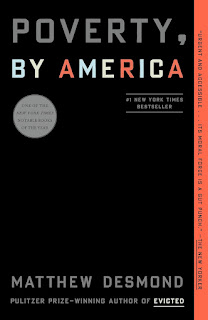
POVERTY, BY AMERICA (audiobook) by Matthew Desmond


Published in 2023 by Random House Audio.
Read by Dion Graham.
Duration: 5 hours, 40 minutes.
Unabridged.


As of the day I am writing this review, 7 of the top 10 richest people in the world live in the United States (the least wealthy has $80 billion.) The rate continues on when you go down the list - 14 of the top 20 live in the United States. 

The United States has 650 billionaires.

But, the official poverty rate in the United States at this moment is 11.5% - the highest rate in the in the leading industrialized economies of the world. This chart shows that it has bounced around between 10.5% and 15%, depending on the economic recessions and the like for the last 30 years. During this entire time, the United States has been the leader in wealth creation for the entire planet.

The author, Matthew Desmond
Sociology professor Matthew Desmond set out to find out why.

It's easy to look at those billionaires and note that they don't pay their fair share. The tax code is tailor made to keep them rich. There are deductions and accounting tricks that people who make less than a million dollars a year cannot imagine. 

But, Desmond notes that people who make less than a million dollars a year take advantage of deductions and accounting tricks that people living in poverty can ever imagine taking.

For example, in my state (Indiana) there is a 20% state income credit for every dollar placed in a 529 college savings account. The growth in value is not taxed and for every dollar you put in up to $7,500 you get 20 cents back. Put in the full amount, the taxpayers of Indiana give you $1,500. Show me a family of four living at the poverty line ($30,000 in 2023 according to this chart) that has an extra $7,500 - or even $500 - sitting around to invest in a college savings account. 

Poor people can receive rent subsidies - if there are enough funds and enough spots available. But everyone with a mortgage receives a mortgage subsidy by being able to write off the mortgage interest. That subsidy has no practical limit. You can get it for financing a tiny home in rural Arkansas or a penthouse condo that looks over Central Park in NYC. That adds up to billions upon billions of dollars every year.

Desmond goes on like this to demonstrate that the system is almost like an inverse pyramid - the higher up you go the more perks and discounts and breaks you get. And, at the bottom, there's some perks - but nothing like you get at the top where some people (like our 45th President) don't even pay federal income taxes some years. Former President Trump paid no taxes in 2020 and only $750 in 2017 and 2018. From 2015-2020 he paid $1.8 million in taxes, which is a lot, but he claims to be a billionaire. A billion is 1,000 million dollars, so he paid about 2/1,000 of his total wealth. I know I paid more than 2/1,000 of my total wealth in my combined federal income taxes for those six years.

Desmond goes on with other things. For example, you can get approved to pay a $1,700/month rent so much easier than to pay a $1,200/month mortgage on the same property. Profit margins on rentals are the highest in poor neighborhoods - even after factoring in things like more maintenance on the (typically) older homes in poorer neighborhoods.

The audiobook was read by Dion Graham who is simply one of the best audiobook readers on the scene right now. 

I rate this audiobook 5 stars out of 5. It will certainly give you plenty to think about. It can be found on Amazon.com here: Poverty by America by Matthew Desmond

This article from NPR does a very good job of reviewing this book as well.

SQUEEZED: WHY OUR FAMILIES CAN'T AFFORD AMERICA (audiobook) by Alissa Quart


Published by HarperAudio in June of 2018.
Read by Carly Robins.
Duration: 8 hours, 52 minutes.

Unabridged.

The premise of Squeezed is that middle class Americans are feeling "squeezed" economically because...they are.

I heard an interview with this author on NPR and I was intrigued so I decided to check out her book.

Quart lists several factors, some more plausible than others. She is very big on the concept that the "caring careers" are under-paid due to latent sexism, since the majority of the people in those careers are female. These careers include nurses, daycare personnel and teachers.

She correctly notes that raising children is expensive and daycare is a big part of that. A great deal of the book is spent on this topic, including alternative arrangements to traditional daycare, experiments in state-funded pre-school and the struggles of single parents having to work and pay for daycare. 


The author, Alissa Quart
She calls into question the idea that everyone should attend college to move up in the world. In some states, the majority of people who graduate from law school never actually practice law - because there are simply too many graduates. Some people try to re-boot their professional lives by getting re-trained only to find out that the re-training was expensive and practically worthless. 

The book begins with a look at several adjunct professors who eke out a living teaching at several colleges with class-by-class contracts. These are non-tenure track jobs and there is no way an adjunct lecturer could make a decent living, even while teaching a full load of classes. The days when one could get their PhD and get a decent job teaching at a university are mostly gone - in some schools a majority of the classes are taught by adjuncts with their class-by-class contracts.

In the middle, she looks at public education, specifically New York City's system. This is a long, convoluted mess of a section, much like New York's schools. The reason I say that it is a mess is that New York's system in unlike any other system in the country so almost nothing that she notes about their system corresponds to the schools systems the vast majority of Americans experience. More about this down below.


The last portion of the book looks at the role of technology in "squeezing" the middle class. She quotes a report from Ball State University that says that most job losses have not come from moving facilities to foreign countries, but instead have come from technology taking over jobs. Hospitals are looking at robots to deliver medicine and other items. There is a very real possibility that long haul trucks will be automated in the future as well. Just yesterday, I was in a McDonald's that installed a series of touch screen kiosks to replace their cashiers (I didn't use them, though. I didn't even notice them until after I already was eating at my table).

Her final answer is a Universal Basic Income (UBI). This is the idea that the government makes sure every individual and every family has at least so much money. Here's a link to explain it better: UBI. I'm not going to try to explain it in more detail because I don't think it is even a realistic proposal - whether it works or not. It is a non-starter of an idea in the United States.

There may well be a great book out there about the middle class being "squeezed", but I think this one falls short. She misses too many things, such as our collective failure to promote the trades in schools. Electricians, plumbers and auto mechanics make pretty good money. Maybe some of the re-training money she discussed in the book would have been better spent learning how to install HVAC systems.

As I noted before, way too much of this book is rooted in the New York City experience - their schools, their rents, their pre-school program and more. While I freely admit, NYC is America's biggest and most important city, it is not remotely close to the experience of most Americans. There are roughly 9 million New Yorkers and roughly 325 million Americans. You do the math.

The audiobook was read by Carly Robins. She did a great job of reading the book, including the nice touch of throwing in a little bit of accent during a Dolly Parton quote.

I rate this audiobook 3 stars out of 5 and it can be found on Amazon.com here: SQUEEZED: WHY OUR FAMILIES CAN'T AFFORD AMERICA by Alissa Quart.

THE HATE U GIVE (audiobook) by Angie Thomas


A Review of the Audiobook.


Published by HarperAudio in 2017.
Read by Bahni Turpin

Duration: 11 hours, 40 minutes
Unabridged

Starr Carter lives two lives in The Hate U Give.

She is an African American high school junior that lives in a rough African American neighborhood. Her best friend was killed in front of her, accidentally caught up in a drive-by shooting, so Starr's parents drive her 45 minutes (one way) out to a "white" school out in the suburbs for her own safety. 

She works in her neighborhood, at her father's store, on the weekends but she feels like she doesn't really live there. Most people don't even know her real name - they know here as "King's daughter that works in the store." She feels like no one at her school knows her either - she speaks differently, acts differently and cares about different pop culture things. She has a white boyfriend - a fact she hides from her father.

On a Friday night Starr goes to a massive party in her neighborhood and meets a boy she grew up with (his grandmother babysat both of them for years). After a scuffle turns into gun play they leave in his car. They get pulled over, the traffic stop goes bad and the officer shoots and kills her friend. The officer claims that he thought her friend had a gun (he didn't - he had a hairbrush).

Both of Starr's worlds come crashing down. In the neighborhood she feels unsafe, the police pressure her family to be quiet and others pressure her to speak up and tell the world about what happened. At school, she hides the fact that she was at the shooting and is mortified when some of her friends make callous racist comments.

Starr doesn't trust the police, but her uncle that she trusts more than anyone else in the world is a policeman. She is proud of her neighborhood, but she never speaks about it at school. She loves her friends at school, but they never come to her home. She loves her boyfriend, but she hides her home and her family from him and she hides him from her family. She is afraid to tell the world about what she saw, but she knows she must. Does she trust the system, like her uncle wants her to do? Does she fight back with her words and her testimony or does she do something more?

I am a middle-aged white man who teaches in an urban high school that is majority minority. I make the lighter-weight version of the trip that Starr makes every day - but in reverse. The cultural notes that author includes struck true to me and made it all the more enjoyable.

The title comes from a quote from Tupac Shakur. Here is how the book explains it: 
“Pac said Thug Life stood for “The Hate U Give Little Infants F***s Everybody. T-H-U-G-L-I-F-E. Meaning what society gives us as youth, it bites them in the a** when we wild out. Get it?” This theme is explored throughout.

I enjoyed the audiobook presentation of this book. The reader, Bahni Turpin, just nailed it. She sounded like my students. Great job.

Note: This book has a lot of vulgar language in it. Guess what? Kids like to use vulgar language. People in stressful situations use vulgar language. If that offends you, you will not enjoy this book.


I rate this audiobook 5 stars out of 5.

This book can be found on Amazon.com here: The Hate U Give

Update February of 2022: This book has now been tagged on my blog with the tag "MAGA Censorship List". Here is why: Click here for article. Also here. Also here (note: read the attached Google Doc that serves as a "review" of the book. One of the concerns of this chapter of Moms for Liberty is a possible George Floyd reference. This book was first published in February of 2017. Floyd died in May of 2020. I verified this with 20 seconds of Google searching. But, at least the unknown reviewer seems to have actually read the book.)

THE WAR on KIDS: HOW AMERICAN JUVENILE JUSTICE LOST ITS WAY by Cara H. Drinan


Published by Oxford University Press in November of 2017.

Cara H. Drinan is a law professor at The Catholic University of America in Washington, D.C. Her book The War on Kids: How American Juvenile Justice Lost Its Way deals primarily with the changes to the justice system over the last 30 years and the mostly unforeseen consequences of those changes.

Drinan discusses how in the late 1980's and early 1990's the United States was experiencing a crime wave, including "the nation's peak murder rate" (p. 156) and a number of these criminals were minors. Lawmakers responded by making it easier to move cases involving juvenile offenders into adult court. Juvenile court, although imperfect, at least made some attempt to accommodate itself to the specific needs of youth offenders and offered opportunities to rehabilitate themselves. It also recognized the fact that young people's brains just work differently than adult brains - a point Drinan brings up often throughout the book,

Early in the book, Drinan offers a powerful set of facts about the effects of poverty on youth and the truly dreadful conditions that some young people grow up in. Chapter 2's detailed description of Terrence Graham's childhood is tough reading. He was failed by nearly every adult relative in his life and was clearly failed by the social workers that knew the conditions he lived in and did nothing to remove him from a home filled with drugs, hunger, violence, chaos and deprivation. I wouldn't have let a dog stay in that house, let alone a human child.

Drinan also describes how defendants in the justice system often have to depend on understaffed public defender offices that clearly don't have the time to do much more than process their clients and hope for the best. The book Rights at Risk: The Limits of Liberty in America by David K. Shipler also covers this topic very well. Minors moved up into adult court become a part of an already over-burdened system. 

Not that the juvenile courts are doing much better. On pages 58 and 59 Drinan details a litany of failings, including statistics that show more than half of the minors held in juvenile detention don't even have an attorney. Public defenders that deal in juvenile law are overwhelmed. The industry standard is no more than 200 cases per defense attorney. Some have caseloads with more than 1,500 clients. There is no way they can do any sort of quality work with that sort of caseload. To make matters worse, many are not even trained in juvenile law. 

Drinan argues that there need to be a whole series of safety nets in place to help young people like Terrence Graham from getting into the justice system in the first place, but she offers precious few specifics. She also argues for rehabilitative programming in juvenile detention but only offers one detailed description - a program in Missouri that does sound promising. It is so promising that it makes me wonder why the other states haven't adopted it as well.

The second half of this slim book is a tough read. Not due to the content, but due to a lot of legalese. She makes a series of recommendations that sound all right, but I really can't say for sure because I am not an attorney. It's almost like she forgot who her intended audience was at the halfway point of the book and lapsed into jargon and started talking to the attorneys reading the book.

There are times when Drinan comes off as more than a little naive. She often reminds the reader that youth are often impulsive and their brains don't work like an adult human's brain. True enough. At times, though, she sounds like she would excuse nearly any crime simply because the perpetrator was a youth and youth can be more easily rehabilitated than adults. One case study involved a young man that lured another to a car wash so he could "talk" about an issue they were having. Instead, he ambushed him and shot him three times with a rifle. This is different than a young person who is serving time because he was the driver waiting outside in the car during a robbery in a store that resulted in someone being shot.


The closing is an unsatisfying mish-mash that takes way too many shots at Donald Trump. I am not a fan of the President. Despite all of his faults though, he is a political newbie and had nothing to do with the current state of the juvenile justice system.

Read the first half of this book to find out the depth of the problems with our juvenile justice system. It is powerful reading.

I rate this book 3 stars out of 5.


This book can be found on Amazon.com here: THE WAR on KIDS: HOW AMERICAN JUVENILE JUSTICE LOST ITS WAY by Cara H. Drinan.

Note: I received an advance uncorrected proof of this book for free so that I could write an honest review as a part of the Amazon Vine Program.

THE OTHER WES MOORE: ONE NAME, TWO FATES (audiobook) by Wes Moore


I Blasted Through this Audiobook.


Published by Random House Audio in 2010.
Read by the author, Wes Moore.
Duration: 6 hours, 12 minutes
Unabridged


Wes Moore, the author of The Other Wes Moore, is originally from a tough Baltimore neighborhood. His family struggled with loss, poverty, his neglect of his own education and rebellious flirtation with crime. But, he "made it", eventually becoming a Rhodes Scholar, have a career in international finance (which was interrupted when he volunteered to serve as a paratrooper in Afghanistan), and now heads two educational foundations, writes articles and makes political commentary.
One day, Moore was sent an article about another young man from Baltimore also named Wes Moore. The other Wes Moore is a convicted murderer and is serving time in prison. This prompted the author to reach out to the other Wes Moore and eventually write this dual biography about how they both ended up in two very different places.

It is not a judgmental book. The author is very aware that he was oftentimes on a path very similar to that of the other Wes Moore and sometimes it is hard to tell their stories apart.

It is a very absorbing story. I listened to the audiobook version of this book over the course of a weekend, going out of my way to find reasons to listen. The narrator is the author, which can sometimes be a bad idea. In this case, the author is an excellent reader.

This is simultaneously an inspiring and depressing book and well worth your time.

I rate this audiobook 5 stars out of 5.

This audiobook can be found on Amazon.com here: The Other Wes Moore.

HILLBILLY ELEGY: A MEMOIR of a FAMILY and CULTURE in CRISIS (audiobook) by J.D. Vance


Published in 2016 by HarperAudio.
Read by the author, J.D. Vance.
Duration: 6 hours, 49 minutes.
Unabridged.

Sometimes, I find it hard to write a review of an audiobook, especially an audiobook like this one. I find it hard - not because it is a bad book but because it is so good and I don't know how to convey my thoughts without giving a blow-by-blow book report of the book.

So, in short, J.D. Vance tells the story of his upbringing in Hillbilly Elegy. He calls his family hillbillies but also calls that same group rednecks or poor white trash. When I was a kid in southern Indiana, we called them poor white trash. His family came from eastern Kentucky (as did part of my own a hundred years ago) and was part of an exodus from the area in the 1950s. These hillbillies brought their culture with them and Vance spends the rest of the book telling a dual story - the story of his family and the story of how this Appalachian culture is struggling in modern America.

The title of the book tells you that this is often a somber book since an elegy is a sad poem or song to praise and express sorrow for the dead. Vance's family history is not a particularly happy one, but it is far from universally tragic. I think that Vance is expressing sorrow for working class whites as a whole. Their culture is leaving them poorly equipped for the America they are born into.
Vance touches on this at one point, but as a teacher in an urban school system, I found that a lot of what he was talking about applied to what I see every day at school. What he talks about in this book can certainly be extrapolated out to apply to other cultures. In this case, what is more important is not race but poverty. It reminded me of the little bit of training I have had with Dr. Ruby Payne and her insights into generational poverty and its own unique culture. 

What works best with this book is Vance's technique of telling his own story and using it to illustrate larger insights into his own culture of generational poverty. You learn precisely because you start to care for people like his profane and loving grandmother - a woman that should not have been the impetus for Vance's success based on her track record with family relationships but ended up being the one person that made all of the difference.

This audiobook was read by the author. That can be tricky, especially if the author is not particularly a good reader. Vance is hardly a professional reader but his accent and tone make it better than a professional reader really could have.

I rate this audiobook an enthusiastic 5 stars out of 5.


This audiobook can be found on Amazon.com here: Hillbilly Elegy: A Memoir of a Family and Culture in Crisis by J.D. Vance.

Note: I wrote this review 7 years before Vance became the MAGA Republican Vice Presidential candidate. Despite enjoying the book, I am profoundly disappointed in his politics since I am a Never Trump Republican, like Vance used to be. Why did he change? I can only refer you to this short book about another Republican politician: The Corruption of Lindsey Graham.

THE EASTERN STARS: HOW BASEBALL CHANGED the DOMINICAN TOWN of SAN PEDRO de MACORIS by Mark Kurlansky


Published in 2010 by Riverhead Books

The Eastern Stars is more a history of the Dominican Republic than a baseball book, but as author Mark Kurlansky clearly demonstrates, for the last 40 years or so the history of the Dominican Republic has clearly been molded and in some ways defined by its love of baseball. It is also a clear sign of the unhealthy state of economic affairs in a country when so many young people see no hope in moving up in the world except for playing professional baseball in America.

Kurlansky takes his readers through a meandering history of the Dominican Republic, moving backwards and forwards through time detailing a number of interesting stories about this Caribbean country but always coming back to the present to touch base and remind the readers that this is a baseball book, too. 

The Dominican Republic has had a long love affair with baseball thanks to American economic and military excursions into the country. It also has been so poorly managed by it various governments that for decades many young men have sacrificed everything in order to make it on to an American Major League Baseball team roster. Who can blame them - in 2006 ten percent of all major leaguers were from the Dominican Republic (p. 75). So many young men hope to win a contract, play for a few years and then return to the Dominican Republic and live like kings in their gated communities back in their hometowns.

Scouts prowl dusty sandlots looking for some spark of talent, even of the players are using balls made out socks and gloves made out of cardboard, the talent shines through. Or, at least they hope that it does.  Top prospects are enrolled in one of many "schools" that teach a lot of baseball and English and some math and science. In return, these schools get a cut of their contracts for helping to develop their talent. Even the Japanese teams have started sending scouts to the Dominican Republic.

As the title states, the real focus is the small fishing town of San Pedro de Macoris. It is unremarkable in every way except that it keeps producing major league baseball players. 

Why?

Kurlansky never comes out and says it, but after reading so many pages about the Dominican Republic and its sad history the reader just knows that it is because there really isn't anything else. It's either fishing in ever-more-depleted waters for less and less fish for more and more work or its baseball. Meanwhile, you can watch the SUVs of retired major leaguers pick their way around the potholes of roads that haven't been repaired in years and probably won't be anytime soon and know that the only rational choice is to put all of your effort into baseball and only baseball. Everything else is a sucker bet.

Note: many other reviewers have been critical of Kurlansky's detailing of some of the facts about the careers of some of the Dominican players the he describes, getting batting averages wrong and some of the dates wrong. No sport generates factoids like baseball and it is disappointing that Kurlansky has so many errors. But, read the book for what it was intended to be - a history of the Dominican Republic detailing how it became a sort of incubator for major league baseball players.

This book can be found on Amazon here: The Eastern Stars: How Baseball Changed the Dominican Town of San Pedro de Macoris.

I rate this book 4 stars out of 5.

SCARCITY: WHY HAVING TOO LITTLE MEANS SO MUCH (audiobook) by Sendhil Mullainathan and Eldar Shafir


Published by Simon and Schuster in 2013

Read by Robert Petkoff
Duration: 8 hours, 47 minutes.

I teach in a public high school that is in the midst of transforming from a suburban/affluent to an urban/poverty school. I currently teach Spanish but I am also licensed to teach several social studies classes including economics. While this hardly makes me an economist, it does mean that I know enough about economics to make me dangerous to myself.

I always think that it is interesting when economists take on non-traditional topics, like the Freakonomics guys do. In this case Sendhil Mullainathan and Eldar Shafir look at the effect of scarcity on impulse control, poverty, time management, dieting and lonely people. Kids at my school have a horrible time with impulse control, poverty and time management so I was hooked when the authors started to look at how scarcity affects these behaviors.

Through a series of studies (theirs and others) they demonstrate that people who are financially insecure, lacking food, lacking companionship or are too busy tend to tunnel vision and make decisions that make sense in the short term (like rolling over a payday loan because there is not enough money to pay the rent now) but make little sense in the long term (the payday loan will just get bigger and harder to pay every time it is rolled over to the next month and there will also be rent to pay next month). They postulate that the human mind is like a computer in that it has limited computational resources. If you run too many programs on the computer it bogs down. If you tax the human mind with too many preoccupations it bogs down as well. They call this taxing the mind's "bandwidth." The interesting studies that are detailed in this book show that that this bandwidth tax can result in up to 13 IQ points loss in the same people.
That difference in IQ points explains a lot of the lack of impulse control and poor financial decisions. I see it all the time at my school. A student's grade crashes and when you talk to a parent you find out that the kid's parents are getting a divorce or one of them has lost a job or a big brother is in jail or they were evicted or something else is taxing the kid's bandwidth. The author's go to pains to note that this is different than just stress. This is a crushing preoccupation.

In economic theory there is a useful affectation called homo economicus - economic man. Economic man responds rationally to incentives and is the stand in that shows the supply/demand curve in action (For example, does homo economicus buy the upgraded smart phone at the store for $300 now or online for $245 even if he has to wait a week to get it?). Well homo economicus makes sense on paper but this book gives us the studies that show why real people don't always act in the same ways.

The studies are interesting, the conclusions are fascinating and there are even some practical suggestions offered. I found it to be quite enlightening.

I listened to the audiobook version of Scarcity and I thoroughly enjoyed the narration by Robert Petfkoff - his style blended perfectly with the "for the layman" writing style of the authors. In addition to being interesting, this book was just a great listen.

Note: I was sent a copy of this book by the publisher in exchange for an honest review.

I rate this audiobook 5 stars our of 5. It can be found on Amazon.com here: SCARCITY: WHY HAVING TOO LITTLE MEANS SO MUCH (audiobook) by Sendhil Mullainathan and Eldar Shafir.

Parliament of Whores: A Lone Humorist Attempts to Explain the Entire U.S. Government by P.J. O'Rourke


Originally published in 1991.
I read the 1992 Vintage Books paperback edition.

Dated but still has teeth.

P.J. O'Rourke goes after the ridiculousness that is the federal government with his trademark irreverent style in his 1991 book Parliament of Whores: A Lone Humorist Attempts to Explain the Entire U.S. Government.

Some of the commentary is dated (lots of talk about the forgettable 1988 presidential election with Republican George H.W. Bush going against Democrat Michael Dukakis. Also, the first one I voted in) but some of it is incredibly relevant. For example, the story of the National Highway Traffic Safety Administration (NHSTA) looking into the mystery of suddenly accelerating Audis 1n 1986 was reminiscent of the same problem with Toyotas that filled the news channels in 2009 and 2010.


Perhaps O'Rourke's most famous line comes from this book: "Giving money and power to government is like giving whiskey and car keys to teenage boys." (pg. xvii in the preface) This sentiment is pretty typical of the book as a whole and one that I generally agree with. O'Rourke talks with former advisors to presidents, shadows a congressman, talks with lobbyists, bureaucrats, policeman, people who live in atrocious government "projects" built for the poor to live in, and more.

P.J. O'Rourke
O'Rourke notes on page 36: "It is a popular delusion that the government wastes vast amounts of money through inefficiency and sloth. Enormous effort and elaborate planning are required to waste this much money." And, O'Rourke proceeds to show the reader how and makes a solid case for a smaller, leaner government. He also explains how it got to be such a mess.

There are times when he fails to make his case. For me, the chapter on agriculture ("Agricultural Policy: How to Tell Your Ass From This Particular Hole in the Ground") was a nice lesson on overlapping government programs that seem absurd. For example, he bemoans the fact that there are so many government interventions that the marketplace is not really a factor in agricultural policy. That is true enough, but he negates his own argument on page 148 when he notes that "Cheap plentiful food is the precondition for human advancement. When there isn't enough food, everybody has to spend all of his time getting fed and nobody has a minute to invent law, architecture or big clubs to hit cave bears on the head with...we wouldn't grow food, we'd be food." O'Rourke seems to miss (or ignore) that the convoluted system of price supports, payments to keep fields idle and grants have the practical result of keeping plenty of extra food being produced and more than enough producers on hand. That way, if there is a massive drought (like the drought of 2012) there is plenty of food to make up for it. Because it is deals with food, the system is rigged to encourage over-production. Could it be more efficient? Sure. Could it be done smarter? Sure. But, O'Rourke fails to make his case that it should not be done at all.

O'Rourke's look into anti-poverty programs demonstrate that they were not working and that poverty is not easily solved and "You can't get rid of poverty by giving people money." (pg. 128, emphasis his) If nothing else, this chapters reveals that O'Rourke is not simply a know-it-all. He knows that he does not know how to "fix" poverty and that government is certainly no doing a good job of it, either.

This is an entertaining read, even if you don't agree with all of his conclusions. I started this book one day when I misplaced the book I had been reading. In just a couple of pages I knew had to finish this one first. Entertaining, often profane, never boring.

I rate this book 5 out of 5 stars and it can be found on Amazon.com here: Parliament of Whores: A Lone Humorist Attempts to Explain the Entire U.S. Government.

Reviewed on February 22, 2013.

Deer Hunting With Jesus: Dispatches From America's Class War by Joe Bageant


Published in 2007 by Crown Publishers

Just to get it out of the way, Joe Bageant (1946-2011) and I differ politically despite sharing similar roots. We both grew up in rural America near a working class town. We both were educated in the local public schools and left to go to college and never really went back except to visit (although do I live in a working class neighborhood in a city). Admittedly, his town (Winchester, Virginia) is a little more poor and run down than mine but I may be remembering my home with rose-colored glasses and he may be intentionally focusing on the worst aspects of his.

But, Bageant did return to Winchester in order to write Deer Hunting with Jesus. He returned to be a foreign correspondent of sorts. His aim is to explain white working-class America ("...that churchgoing, hunting and fishing Bud Light-drinking, provincial America...the people who cannot, and do not care to, locate Iraq or France on a map - assuming they even own an atlas." [p.2]) to the left-leaning, college-educated urban wine and cheese set.

Bageant's prose is interesting and lively, but prone to exaggeration, much like a liberal version of P.J. O'Rourke or like the overwrought rantings of stand up comics like Dennis Leary or Lewis Black or Dennis Miller. His points are there and based on real situations but he takes liberties to make his point or to get a good punchline so take everything with a grain of salt. For example, he argues that Presidents don't come from modest beginnings in a rather nice rant but since FDR they all have except for JFK and the Bushes (and maybe Carter, but the other two families were far, far richer than his).

Sometimes his devotion to a certain line of thought leads him to contradictory comments. For example, he deplores the way social security does not take care of widows very well and how it does not pay enough to really take care of a retired worker. But, he rants against any sort of privatization of Social Security over and over again (you may remember that Bush43 tried to reform Social Security right after he re-election) even though the proposed reforms were modeled after programs that let workers pass on the proceeds of their investments to their widowed spouses or even their children.  See page 236-242 for the longest rant on this topic.

Clearly, Bageant does not seem to grasp the religious aspect of Winchester. He does not completely belittle religious belief but he does not understand it. I was struck by an incident early on in the book. He does not grasp the profound generosity of a small congregation of relatively poor people that buys an old pickup truck for a couple that lost theirs to repossession. The congregation has little money and yet they pool what little they have together to  give two of its members an expensive gift (even an old truck costs several hundred dollars). I find that to be a remarkable act of Christian charity. Instead, he dismisses the whole thing with a single comment.

Bageant does a fabulous job of explaining guns, gun rights and notes correctly on page 129 that beginning in the 1960s the left was "arrogant and insulting because they associated all gun owners with criminals but were politically stupid."

Generally, I found the book to be very entertaining, full of interesting commentary but incorrect in almost all of its conclusions.

I rate this book 4 stars out of 5.

This book can be found on Amazon.com here: Deer Hunting with Jesus.

Reviewed on February 16, 2012.

Rights at Risk: The Limits of Liberty in America by David K. Shipler


Highly Recommended


Published by Alfred A. Knopf in 2012

Last summer I read David K.Shipler's first book on this topic, The Rights of the People: How Our Search for Safety Invades Our Liberties (see my review by clicking here) and I found it to be the most profound book I read that summer and maybe all year. I began my review of that book with this thought:

"I always tell people that the traditional left-right continuum used to describe someone's politics is so inaccurate as to be useless. Really, what is the difference between an aging hippie living on a hill somewhere  raising some dope for personal use and telling the government to get out of his business and a Barry Goldwater-type conservative (like me) living by himself on a hill somewhere that tells the government to get its nose out of his business? Some dope. Otherwise, they are both determined advocates of civil liberties - keep out of my business if it is not hurting anyone else."

When I read the first book I was expecting to get a snoot full of political commentary that I disagreed with from a New York Times reporter with a left-wing agenda. To be blunt, I was expecting one of those political attack books that Al Franken, Michael Moore, Ann Coulter and David Limbaugh produce with regularity (Well, Al Franken is busy being a Senator now so I suppose he has stopped). Instead, I found the book to be politically balanced and quite remarkable. This book is just as remarkable, if a little less balanced by the inclusion of a half-dozen snide comments that should have been edited out, in my opinion.


Rights at Risk focuses on multiple topics but here are the chapter titles (with descriptions): Torture and Torment (being abused while being investigated), Confessing Falsely (how some people, especially young people and the mentally impaired, are tricked into confessions), The Assistance of Counsel (the defense side of the trial), The Tilted Playing Field (the prosecution side of the trial), Below the Law (the lack of rights of immigrants, legal and illegal), Silence and Its Opposite (freedom of speech in turbulent times), A Redress of Grievances (spying on protesters, "free speech zones") and Inside the Schoolhouse Gate (freedoms of students and teachers).

Torture and Torment includes a discussion of jailhouse torture such as physically abusing suspects and CIA torture. It demonstrates that the famed water-boarding sessions have poisoned several other cases. The good news in the cases of the police abuse is that the system, in the cases Shipler cited, mostly worked to flush out the bad cops. Mostly, but not always. A weaker part of Shipler's argument comes from the discussion of people wanted for trial in America but arrested in foreign countries. He argues, correctly, that many countries do not offer any protection for defendants. But, his arguments are not as tight here and led me to the inevitable conclusion that anyone who confesses to a crime in a foreign country can just claim that they were tortured into confessing and the confession should be dropped. Arrested in Luxembourg? Claim torture and post-traumatic stress disorder.
The chapter entitled Confessing Falsely is quite interesting. Shipler discusses the various training methods police learn on how to question suspects and how those very methods can lead to false arrest and false trials and leave the real criminals out on the streets. He also writes about instances in which the rights of the accused were short-circuited in order to facilitate a confession. He includes a recommendations for how to address these problems, including the videotaping of all interrogations and prohibiting the questioning of children without the presence of his or lawyer or a parent.

You know the old adage, "You get what you pay for?" Well, the chapter The Assistance of Counsel was disturbing because it proves it. Public defenders in areas that have professional public defender offices are overwhelmed. In states and locales that have court-appointed public defenders from the general ranks of area defense attorneys there are serious issues of quality. Shipler encountered judges that admit to appointing certain defense attorneys over and over because they don't fuss much in court. Others appoint lots and lots of cases to their political contributors. Those attorneys make a good living on the sheer volume of these cases. But, appointing cases based on these criteria is not a solid foundation for justice. On top of that, court-appointed defenders have almost no budget for experts and in most cases, there are no funds available for appeals. It really is stacked against poor defendants.

The Tilted Playing Field looks at all of the tools the government has to coerce cooperation, including threats of deportation, violation of probation, plea bargaining and asset forfeiture. I was disturbed by the practice of sentencing based on parts of the case that were dismissed. For example, if you have a gun illegally and are brought up on charges of trafficking drugs and are found not guilty of the drug charge, some courts will still sentence you more severely for the gun charge because of the drug charge, that you were acquitted of.

Below the Law discusses the status of legal and illegal immigrants in the justice system. To be blunt, they don't have much status. I was especially disturbed to discover that a great number of immigration judges have no particular experience in immigration law except for a single short class with an online quiz taken the next day (page 144). This makes for poor justice when the judge is not an expert. Would you go to probate court with a judge who know next to nothing about wills? The case of the political refugee who was arrested for not having his papers and was on the deportation list is especially disturbing. Luckily, the refugee learned from other detainees that he did not need papers as a refugee. He told his attorney who educated both the prosecutor and the judge on this legal point. They were directed to a page on their own website that explained the law. (pages 184-5)

The chapter Redress of Grievances demonstrates that we spend an awful lot of time spying on groups that exercise their right to protest. While most of these groups would be silly to spy on, Shipler seems that there would never be a need to look at any of these groups at all. I don't know where the line is, but it is clear that some law enforcement groups are over-zealous and act spitefully towards protesters. For example, the Maryland State Police surveilled an anti-death penalty group and listed some of its members in an anti-terrorism database despite having no evidence of a crime. (page 229) In at least one case, Shipler does hurt his own argument. He notes the famed WTO riots in Seattle in 1999 (nicknamed the "Battle in Seattle" by some) one page and argues that the Washington, D.C, police had no reason to be worried about planned demonstrations against World Bank and the IMF meetings six months later. (pages 234-236) Shipler ends the chapter with a long discussion on flag-burning, which has been ruled legal for a long time and is still news to some and the Westboro Baptist Church protesters.

Inside the Schoolhouse Gate was the most interesting chapter for me because I am a teacher. It is a maxim that students have the right to express political opinions. But, since attendance at school is compulsory, it is also a maxim that you have the right to attend school and not be harassed. For example, is a Malcolm X t-shirt a threat to white students? Is a Hank Williams, Jr. t-shirt with a Confederate flag on it a threat to black students? Are both, or neither, disruptive to school so that teaching becomes difficult? Can high school newspapers be censored by their schools? (page 274, 278-9) Even worse, in my mind are the speech codes  at universities and designated "free speech zones," especially on public university campuses. Silly me, I thought the entire country was a free speech zone. I suppose we don't want students to discover new and different thoughts while being educated...

Shipler concludes with this thought: "If every American school taught the Bill of Rights in a clear and compelling way, if every child knew the fundamental rules that guide the relationships between the individual and the state, then every citizen would eventually feel the reflexive need to resist every violation. We had better begin now, for rights that are not invoked are eventually abandoned."

As a social studies teacher, I wholeheartedly agree and I worry because we are cutting those very classes across the country in order to make sure we pass the math and English standardized tests. The school I taught in last year cut 20% of the social studies classes in the third 9 weeks in order to provide more time for  English practice (language arts stuff, not English for non-English speakers) with a prescribed, decidedly non-social studies curriculum. I wonder what was cut?


I rate this book 5 stars out of 5.

This book can be found on Amazon.com here: Rights at Risk.

Reviewed on July 13, 2012.

Nickel and Dimed: On (Not) Getting By in America by Barbara Ehrenreich

Note: this review was slightly edited on June 21, 2025


First Edition published May of 2001 by Metropolitan Books

I've had Nickel and Dimed read for nearly a month now and I just haven't had the faintest idea about what I should say about it. It is remarkably good and remarkably bad all at the same time.

The idea behind the book is simple - in 1998 a reporter goes "undercover" to explore the world of the $5 - $7 job market. She becomes a waitress, a house cleaner and an employee at Wal-Mart.

So, let's start with the positives:

-This is a well-written and entertaining book.

-The workload at her different jobs is accurately described, especially the work at Wal-Mart (I know since I worked at one of their national competitors stocking shelves, unloading trucks, and working the 'back room' for 5 years as a second job when my wife lost her white-collar job and the bills started to pile up).

-I give Ms. Ehrenreich credit for going out there and trying the jobs rather than studying them like a sociology experiment.

Negatives:

-Ms. Ehrenreich keeps on mentioning that she is "middle class" but her unfamiliarity with the rigors of the $5-7/hour job market shows me that she's had a pretty pampered work life. She claims on page 201 that she writes off more than $20,000 a year in mortgage deductions alone on her taxes - this is not the middle class that I know and understand (Note from the year 2025 - remember that this book was written in 2001 so the numbers are much higher nowadays). She did little research about where to buy her clothes, find her cheapest rents or buy the cheapest food. $40 for a pair of work pants? No visits to Goodwill or yard sales? She rents by the week and picks two super-touristy spots (with their very high rents) to start her experiment? All of these things add up to invalidate big chunks of her experiment in my mind.

-She spends an inordinate amount of time discussing Wal-Mart's policy of having employees take a drug test (at least 25 pages). She even claims it might violate her 4th Amendment rights on p. 209 even though those Constitutional restrictions only apply to government, not private employers. She does not grasp the concept that those drug screens don't catch many drug users because they don't even bother to apply. She also fails to grasp that some employees need to be drug free when at work - I worked with a forklift every day at my $7.25/hour 2nd job at a competitor of Wal-Mart that also had a drug screen - it was dangerous enough without throwing drugs into the mix. Many employees are cross-trained and may cashier, use a forklift, collect carts and stock shelves in a single shift.

-I'm truly surprised that she was able to get 40 hours/week at Wal-Mart - their reputation is to work people 25-30 hours/week to avoid overtime and having to offer insurance at any cost. That rang very false to me.

So, to sum up: well-written but flawed because the author had not done a lot of her simple research ahead of time. In my mind, she showed disrespect to the very people she was supposed to be learning about. So, these strong positives and strong negatives add up to a 3 star average.

This book can be found on Amazon.com here: Nickel and Dimed: On (Not) Getting By in America.

Reviewed on December 29, 2007.

This book has been c
hallenged and banned multiple times for drug references and "profanity, offensive references to Christianity, and biased portrayal of capitalism." See this site for more information.

The Hole in Our Gospel by Richard Stearns


Touching, Powerful Look at Extreme Poverty and at What Christians Can Do


Published in 2010.

Richard Stearns has been the president of World Vision U.S., perhaps the leading Christian relief organization in the world, since 1998. In The Hole In Our Gospel Stearns lays out powerful, persuasive arguments for the need for Christians to act out their faith, especially when helping "the least of these." (Matthew 25:40)

The book's title comes from the visual image of literally cutting out the parts of the Bible that are uncomfortable for you. Stearns asserts that we have cut out the parts that demand the church act because of a desire to avoid the concept of doing good works to get into heaven. Clearly, the Bible states that faith alone is all that is required. The church has stopped with that and is ignoring the opportunities to do good works in the name of Christ.

Stearns is quick to affirm that good works without faith is pointless for salvation. But, he is fond of quoting Matthew 25 and the Book of James which note that works should proceed from faith - they are a sign of a healthy faith. As James notes: "Faith without works is dead."

Once Stearns establishes his religious foundation and his personal story, he describes the great need across the planet with several heartbreaking stories and statistics. Children forced into slavery, women mutilated by child soldiers, starving families (including a woman in Haiti who was trying to give her children to anyone who could just feed them) and on and on.

Stearns reminds his Christian readers that Christ wanted his church to remember the poor, have compassion on them as he did so often. Stearns is not advocating handouts (although there are clearly times for that, such as with the woman I wrote about in the previous paragraph). Rather, he tells several stories based around the idea of "microlending" - building up capital in a neighborhood or region so that they can be self-sustaining. I found that to be the part that was the most exciting - getting some economic momentum going in those areas while advancing the Gospel.

That being said, Stearns does veer off course a couple of times and wander into hyperbole (I hope - otherwise he has no real sense of economics and his microlending stories make me doubt that). For example, on page 141 he writes, "The wealthiest countries...spend 90 percent of the world's health care dollars, allowing the remaining four-fifths of the planet to spend only 10 percent of the money." Allow? I was unaware that the industrialized world was actually keeping the undeveloped world on a budget and we only allow them to spend a certain amount. It would be more accurate to say that most of the world gets the same medical treatment (or, more accurately, lack thereof) that has been available throughout human history and the developed world has developed the wealth to spend more (tons and tons more).

But, 99% of the book is dead on correct in my eye. There is an awful need out there and the church seems to be ignoring it. The Hole In Our Gospel is a powerful call to action.

I rate this book 5 stars out of 5.

This book can be found on Amazon.com here: The Hole in Our Gospel by Richard Stearns.

Reviewed July 29, 2010.

Featured Post

<b><i>BAN THIS BOOK (audiobook)</i></b> by Alan Gratz

Published in 2017 by Blackstone Audio, Inc. Read by Bahni Turpin. Duration: 5 hours, 17 minutes. Unabridged. My Synopsis Ban This Book is t...

Popular posts over the last 7 days