Showing posts with label Missouri. Show all posts

GRANT and LEE: VICTORIOUS AMERICAN and VANQUISHED VIRGINIAN by Edward H. Bonekemper III


Originally published in 2007.

Edward Bonekemper was a Civil War historian who came to the game kind of late in life - after he retired as an attorney for the federal government. 

However, he brings his skills as an attorney to this book. Imagine a regulatory attorney bringing all of his research to bear in order to win a case by simply  overwhelming the other side with binder after binder of evidence. In this case, the evidence is almost 200 pages of appendices, endnotes, and a bibliography. 

Bonekemper makes an argument in this book that Grant was undoubtedly the superior general when compared to Lee. In fact, he makes the arguments that Grant was the best general in the Civil War by far and Lee squandered his soldiers and his resources by going on the offense almost all of the time.

Being the best general does not mean Grant made no mistakes. It does not mean Grant was perfect. Bonekemper acknowledges mistakes by Grant in every campaign and gives Lee his due from time to time. 

Grant and Lee is really a dual history of these two generals, comparing their pre-war careers and then various stages of the war itself. For example, there is a chapter called May-July 1863 where the Vicksburg campaign is compared to the Chancellorsville/Gettysburg campaigns. 

A constant refrain is that Lee's biggest weakness is that he did not conserve his resources by falling back on the defensive. His argument is that Lee did not grasp the strategic fact that the North had to literally conquer the South while the South just had to stay alive until popular support collapsed in the North and the Europeans recognized the Confederate government. 

Instead of building a series of fortifications and compelling the Union forces to destroy themselves in useless attacks, Lee kept lashing out at Union forces and invaded the North twice only to lose both times and discourage European intervention after both failures.

Lee rarely lost more soldiers than the Union forces he fought, but he did not have a constant supply of new soldiers coming to the front - and the North did. Not only did the North replace soldiers at an amazing rate, they also managed to create all new armies when needed.

I found that I basically agreed with Bonekemper. Grant was the better general. Lee was too focused on Virginia and too eager to go on the offense. He did not save his resources and did not share the ones he had with other theaters of the war.

I rate this book 5 stars out of 5. It can be found on Amazon.com here: GRANT and LEE: VICTORIOUS AMERICAN and VANQUISHED VIRGINIAN by Edward H. Bonekemper III.

THE ASCENT: A NOVEL (Kurt Argento #1) (audiobook) by Adam Plantinga


Published in 2024 by Grand Central Publishing

Read by Charles Halford and Christine Lakin.

Duration: 10 hours, 44 minutes.

Unabridged.

Synopsis

The Ascent features Kurt Argento, a former Detroit police officer. His wife died from cancer and he is not dealing with it well. During a small riot, he defied orders to protect a civilian and hospitalized several members of a gang with his night stick - he literally worked out some of his grief on their not very sympathetic bodies. It was heroic act, but because he disobeyed orders he was forced to resign.

Argento takes his dog and heads out towards California. For some reason, he has it in his head that seeing the Pacific Ocean would be a good thing for his peace of mind. While traveling through Missouri he ends up in a scuffle with a corrupt local sheriff. The sheriff claims that his jail cells are too full so he can store Argento in a nearby for-profit state prison in hopes of Argento getting caught up in some sort of prison fight and perhaps getting shanked.

Before Argento can even get logged in to the prison it erupts in a completely out of control riot. To make matters worse, the governor's daughter is also in the prison as part of a visit for a college class and the only way to safety requires them to travel through every floor of the prison to get to the roof...

My Review

If you like the Jack Reacher novels, this book will feel very familiar. The book's plot is obvious when you read the summary, but almost all of it is a good read with unlikely, but not impossible, complications. There are two parts that are extremely (and unnecessarily) graphic. 

This book would make a pretty good plot for a videogame.

I rate this book 4 stars out of 5. It can be found on Amazon.com here: The Ascent by Adam Plantinga

VICKSBURG, 1863 by Winston Groom


Originally published by Knopf in 2009.

Winston Groom will always be best known as the author of Forrest Gump, but he should be equally well known as the author of a series of well-told American histories. Included in those histories is a trilogy of Civil War histories that focus on the Western Theater of the war.

Vicksburg 1863 is the second book in the trilogy, but it can be easily read as a stand-alone history. After a short introduction to the war itself, it follows Grant's campaign to take the Mississippi River away from the Confederacy, beginning with a mess of a battle in Missouri that proved nothing of any importance except that Grant was game to fight and push forward, even if the conditions were not perfect.

That, it turns out, was pretty much the key to Grant's eventual success in this campaign and in the war.

From there, we follow Grant through Kentucky, into Tennessee and the terrible Battle of Shiloh. Although ultimately successful, this marked a low point for Grant because he nearly lost his army. His immediate superior came to Shiloh to supervise him and killed most of the momentum of the campaign

Eventually, Grant regained his command (his superior officer was promoted to a desk position in the Eastern Theater) and began his campaign to remove the last major obstacle for Union control of the Mississippi River - Vicksburg, Mississippi.

Vicksburg was a challenge due to its location on an imposing cliff on a massive bend in the Mississippi River. The Confederate military placed cannons on the cliff that threatened any ship that dared to try to pass by. This book details the many efforts he made to bypass Vicksburg, including attempts to build a canal to reroute the Mississippi and an attempt to go through the swamps around Vicksburg. Eventually, he crossed the river south Mississippi and quickly moved his army to cut off Vicksburg, lay siege to it while also engaging and driving away any Confederate troops that could have helped to lift the siege.

Some people will argue with Groom's assertion that Grant did have bouts of drunkenness during the campaign. He describes a rather wild bender featuring Grant cruising through the swampy rivers north of Vicksburg during a lull during the siege, switching boats, and looking for more and more booze. Grant's defenders will deny it all, Grant's detractors will claim it was probably even worse. I go with the simple knowledge that addiction is powerful and Grant often brought along people that kept him accountable. If those people weren't around, I can easily imagine him falling off the wagon. Whether it was a wild run through the swamps or a binge drunk in the corner of a cabin...well, that depends on who told the story back then and who is writing the story now.

I rate this history 5 stars out of 5. It reads as easy as a novel. It can be found on Amazon.com here: Vicksburg, 1863 by Winston Groom.

See my review of Groom's Shiloh, 1862 here. 

FAHRENHEIT 451 (audiobook) by Ray Bradbury


Originally published in 1953.

I listened to the Tantor Media audio version published in 2010.

Read by Stephen Hoye

Duration: Approximately 5.5 hours

Unabridged

Synopsis: 

Guy Montag is a fireman in a future United States. Firemen in the future do not fight fires. Instead, they burn books, newspapers, magazines that people have hidden away. If you hide forbidden media in your home your home will be burned to make sure all of the books are gone and to serve as a warning to rest of the neighborhood. 

Montag is great at his job, but he has his doubts. Every once in a while he takes a book home. He hides them in the ventilation system of the house. No one knows, not even his wife. Those doubts are accelerated when his team witness a woman die in the fire with her books rather than live without them...

My review: 

This book has an interesting history. Bradbury started building the world that this book is set in with some short stories of a dystopian future where everyone is absorbed by personalized television screens. His publisher urged him to expand the ideas into a book. Bradbury knocked out Fahrenheit 451 in just 9 days on a rented typewriter that cost him 10 cents per half hour.

The book itself has action but it oftentimes felt like essays attached by plot points. It seems to me that the speed in which the book was written probably led to this sort of construction. The essays took the form of extended trains of thought by Montag or long speeches/rants from Montag's boss, Captain Beatty. These "essays" make all of the arguments of the story such as the justifications for mass censorship, the arguments against it, and the lack of human contact in a mass media world.

Bradbury accurately predicted a lot of the modern world in this book. When it comes to technology, he predicted the ATM, giant screen televisions, and earbuds. Culturally, he predicted the rise of sports TV, the inane reality TV shows like The Real Housewives, and the addiction to pop culture and electronic media that may be a factor in the high rates of depression among young people nowadays.

This has to be considered Bradbury's masterpiece. It is such a powerful manifesto against censorship. 

NOTE: If you appreciate irony, please read this bit about how THE anti-censorship novel of the 20th century was edited to remove or change controversial and offensive words and scenes without the knowledge of the author - FOR TWELVE YEARS!

NOTE: Also on the "if you appreciate irony" category - Fahrenheit 451 was put on a book ban list in Tennessee. The article has a searchable database because the list has more than 1,100 unique titles.


I rate this book 5 stars out of 5. It can be found on Amazon.com here: FAHRENHEIT 451 by Ray Bradbury.

THE KINGDOM, the POWER, and THE GLORY: AMERICAN EVANGELICALS in an AGE of EXTREMISM (audiobook) by Tim Alberta


Published by HarperAudio in December of 2023.
Read by the author, Tim Alberta.
Duration: 18 hours, 16 minutes.
Unabridged.


Tim Alberta is a writer for The Atlantic and also an Evangelical. He grew up in the faith, but is very troubled by the tendency towards Christian Nationalism. He was inspired to write this book after an incident at his father's funeral at the church he grew up in. 

Alberta embarked on a cross-country exploration of the intersection of Evangelicals and politics at Christian Nationalism - and how this combination is changing Evangelicals and they way they are perceived.

Alberta does not come at this as an outsider. As I already noted, he grew up in the church - and still belongs to a church. To me, this is important. I read another book with a similar theme (The Power Worshippers: Inside the Dangerous Rise of Religious Nationalism) that just didn't hit the right tone and answer the right questions because the author was coming from the outside. She didn't know the ins and outs and didn't truly understand the people she was writing about.

Russell Moore recently wrote a book (Losing Our Religion: An Altar Call for Evangelical America) that addresses problems among American Evangelicals from the inside, but it's not really a book about politics. The closest book to Alberta's is the excellent Jesus and John Wayne: How White Evangelicals Corrupted a Faith and Fractured a Nation. The two books don't really cover the same territory, but they certainly run in parallel lines and they do not present a pretty picture of contemporary Christianity.

The author, Tim Alberta
Alberta looks at the struggles of his home church, Liberty University and its rise to prominence by promoting politics instead of Christianity, Brian Zahnd's church's struggle when he went out of his way to reject Christian Nationalism, the Southern Baptist Convention's struggles with sexual abuse charges and, of course, the ever-present influence of Trump and Trumpism.

I found this book to be a fascinating look into this dangerous mix of Christianity and politics. I blasted through this 18 hour audiobook in just a few days and I wish it was twice as long.

I highly recommend this book.

5 stars out of 5.

This book can be found on Amazon.com here: THE KINGDOM, the POWER, and THE GLORY: AMERICAN EVANGELICALS in an AGE of EXTREMISM by Tim Alberta.


THE AMERICAN DREAM? A JOURNEY on ROUTE 66 DISCOVERING DINOSAUR STATUES, MUFFLER MEN, and the PERFECT BURRITO: A GRAPHIC MEMOIR by Shing Yin Khor


Published in 2019 by Zest Books.
Illustrated by the author, Shing Yin Khor.


In another recent review I wrote this:

I have a real weakness for oddball travel books. I have read a memoir about a man that hitchhiked throughout Europe and North Africa, a book about a man's bicycle trip from the UK to India, a book about a man who walked across Afghanistan, a book about a man who rode a motorcycle around the edges of Afghanistan, a book about two women who biked from Turkey to China, a book about a man who walked the length of the Nile, a man who walked the Appalachian Trail with his deeply irresponsible friend from high school...and more. And more. And more.

This book continues that tradition with a twist - it is done in comic book style. Usually, this is called a graphic novel, but this book is not a novel because it is not fiction. The author calls it a "graphic memoir."

Illustration from the back cover
The author/illustrator is an immigrant from Malaysia. She came over as a child and is very familiar with southern California. She realizes that she doesn't really know a lot about the rest of her adopted country so she decides to travel the old Route 66.

The author travels with only her little dog as a companion. She is on a tight budget so she often sleeps in her car.

Along the way she sees a lot of interesting Americana, Americans of all types and ponders her relationship with the country and its people. Plus, her dog makes friends everywhere.

I rate this graphic memoir 4 stars out of 5. It can be found on Amazon.com here: THE AMERICAN DREAM? A JOURNEY on ROUTE 66 DISCOVERING DINOSAUR STATUES, MUFFLER MEN, and the PERFECT BURRITO: A GRAPHIC MEMOIR by Shing Yin Khor.

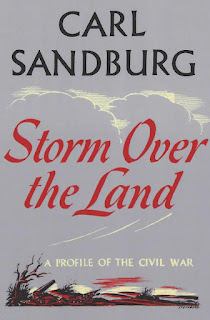
STORM OVER the LAND: A PROFILE of the CIVIL WAR by Carl Sandburg


I read a 2009 re-print published by Konecky and Konecky.

Carl Sandburg (1878-1967)
In 1940, the famed poet, journalist and author Carl Sandburg won a Pulitzer Prize for his four volume biography Abraham Lincoln: The War Years (published in 1939.)

In 1942, his publishers came to him and asked him to re-work the biography into a history of the Civil War in response to America's recent entry into World War II. 

The result is a pretty solid history of the Civil War from basically the Union point of view. 

Carl Sandburg is best known as a poet and that shines though with some of his prose. From time to time, he comes up with a different and interesting way of telling the story of the war. 

The most obvious weakness to this history is the story of African-Americans in the war - the free, the enslaved, the recently freed, the soldiers and others. He mentions them, but does not look at them very hard. To be fair to Sandburg, this book was published 81 years ago and he covered the topic about as well as any mainstream history would have.

I rate this history 4 stars out of 5. It can be found on Amazon.com here: STORM OVER the LAND: A PROFILE of the CIVIL WAR by Carl Sandburg.

THE ADVENTURES of HUCKLEBERRY FINN (audiobook) by Mark Twain


Originally published in 1884 (U.K.) and 1885 (U.S.)
This audiobook version published in 2008 by Tantor Audio.
Read by William Dufris.
Duration: 9 hours, 44 minutes.
Unabridged.


I would feel silly writing a synopsis of this book. This is the book that Ernest Hemingway said is the source of all modern American literature. It is almost universally recognized as not only "a" Great American Novel, but is oftentimes acclaimed as "THE" Great American Novel.

So, I will skip all of that discussion and just move on to a review of the audiobook presentation and what I thought of the book.

The audiobook reader was William Dufris (1958-2020),  a celebrated voice over actor and the reader of dozens and dozens of audiobooks. He did a fantastic job of creating voice after voice after voice. It was quite impressive.

An original illustration by E.W. Kemble
from the 1884 printing of this book
As for the novel, well that was less impressive than I remembered. I read this book in elementary school and almost all of the satire and character growth went right over my head. I re-read it in high school for an AP Literature class. We had to write a lengthy paper that we literally worked months on. We even took a trip to a university library to dig through the stacks to find literary criticisms and cite them. It was, by far, more complicated and longer than any other paper I wrote in my college career.

All of that work writing about the same book soured me on re-reading the book until now, 38 years later. 

So, what did I think?

I was surprised at how many of the plot points I had forgotten. For example, Tom Sawyer is in this book a lot more than I remembered and he is really annoying. I know that is intentionally built in as a part of the book for thematic reasons - Huck is on his way to being a man and Tom is still a boy in many ways - but I still felt that it was tough going when Tom is in the story.

It took me quite a while to get through this audiobook. I could only go for 20 minutes or so at a time and then I had to leave it for a while. In comparison, I listened to a different audiobook today for more than 4 hours. Maybe it was because it was told in first person, I am not sure. 

Despite the importance of this novel, I honestly can't rate it any more than 3 stars out of 5.

This book can be found on Amazon.com here: THE ADVENTURES of HUCKLEBERRY FINN by Mark Twain.

DEEP SLEEP (Devin Gray Book 1) (audiobook) by Steven Konkoly


Published in February of 2022 by Brilliance Audio.
Read by Seth Podowitz.
Duration: 10 hours, 18 minutes.
Unabridged.


Synopsis:

Devin Gray is a retired military operator working for a high-end private security contractor. He is on assignment that goes a little sideways in the D.C. metro area and he is sent away to let things cool off.

While packing up to go, he is contacted about his mother. She is estranged from the rest of the family because she is always off researching a conspiracy theory, which is kind of ironic because she works in a government intelligence agency that looks for conspiracies. She is dead after some short of shoot out in Tennessee and everyone is keeping it quiet.

Gray discovers a note from his mother to him with instructions. It turns out to lead to her evidence that proves the conspiracy and he finds it to be plausible enough to reach out to others. Once they start digging, they find more than it is worse than they ever imagined...

My review: 

I was excited about this book. I really enjoyed the first two book of an his unfinished Rogue State series (link to review of the first book here: Fractured State.) That series is full of non-stop and, frankly, ridiculous action - but it is fun and demands your attention.

This book had a complicated conspiracy that you know in your head is simply too complicated to work, but your gut says, "Oh crap! This could really happen!" I had no problem with the premise of the book.

I had problems with the pacing of the book and the proliferation of characters. Konkoly decided to make characters out of some of the bad guys in an effort to confuse the reader at first. It worked and it was kind of a good choice except that he keeps on adding character after character after character and this audiobook reader got confused as to who exactly was who. I just decided to ignore character names and label them "good guy" and "bad guy" in my head. That totally defeated the purpose of creating a named character with lines and a personality, but I couldn't keep up. When one of them goes down in a gun fight, I didn't care a whole lot - I just kept a little running tally in my head to see if any of the good guys were going to survive.

For an action story, this book has an awful lot of sitting around and talking. Sitting around and talking in a restaurant, in a car, in a secret hideout, in another car, in an SUV, in a rented house, in another SUV, in a hotel, in a mansion, in a helicopter, in another hotel.

So many of these conversations were repeats of other conversations. The conspiracy is discovered and then explained to another person. That person explains it to a small group. That group explains and discusses with another group and by that point I felt like I could have stepped in and gave the explanation myself.

So, to sum up - too many characters makes the story hard to follow. Too much repeat conversations stretched the story out for no real reason.

On a pet peeve note: Konkoly is from Indianapolis and lives in Indianapolis. So do I. I was pleased to see part of the book took place in an Indianapolis suburb that he described perfectly (Carmel.) However, the audiobook reader mispronounced it. It is pronounced the way many people mispronounce the candy "caramel." He pronounced it like the California city "Carmel by the Sea." This was not important to the story and people who do not live in Indiana would have no idea but considering that the author lives here...

I rate this audiobook 2 stars out of 5. I will not be moving on to book two in this series. This book can be found on Amazon.com here:  DEEP SLEEP (Devin Gray Book 1) (audiobook) by Steven Konkoly.

MESSY GRACE: HOW a PASTOR with GAY PARENTS LEARNED to LOVE OTHERS WITHOUT SACRIFICING CONVICTION (audiobook) by Caleb Kaltenbach


Be Warned - it changes tone quite abruptly

Published in 2015 by ChristianAudio.com

Read by the author, Caleb Kaltenbach.
Duration: 6 hours, 3 minutes.
Unabridged.


I checked out the audiobook version of Messy Grace from my local library using the Overdrive app. I highly recommend this app, but it does have a small failing - it does not include any sort of reviews of the digital ebooks or audiobooks. It only includes the publisher's description and the publisher's description of this audiobook only tells part of the story. 

As the title says, Kaltenbach did indeed grow up with gay parents. They married young and divorced after a few years. His mother lived life as a married couple with another woman (this was pre-gay marriage) and his father lived as a closeted gay man. His mother hated Christians because of Westboro Baptist Church-type protesters, but to be fair to his mother, there are plenty of people that express in private the same thoughts that the Westboro folks publicly proclaim. Kaltenbach does not deny this - in fact he decries it throughout the book.

Kaltenbach spends the first 60% of the book or so telling the story of his life and about his parents. He is very much against the Pharisee-type behavior you see in plenty of churches - the behavior that automatically rejects anyone that doesn't seem church-y enough. Kaltenbach argues you can't reach the "lost" if you don't actually engage with them - something that Jesus said and did over and over again.

As Kaltenbach discusses this point, he begins to sound less like he is making projects out of people rather than reaching out to people because they are friends and family. I didn't have a way to describe this inkling in the back of my mind until Kaltenbach did - he said churches have to be careful of this very thing and he called it "project vs. people". It ends up sounding like, "We're going to save a gay man" instead of "I think my friend Bob would really like to check out my church and my church would really like my friend Bob." 

The problem with turning people into projects is that once the project is done (the project joins the church) you move onto to a new project and drop the old project. But, people aren't projects so you are just dropping this person that you made big investment in because you weren't friends with them - you were busy fixing them.
The author and narrator,
Caleb Kaltenbach

But, the part that really bothered me above all else was the fact that the book pitches itself as a pro-gay inclusion book right up until the moment that it is not. Once it switches gears it hurts every other argument the book made before. It becomes a turn people into projects book. It becomes a "pray the gay away" book of sorts. The celibacy passage was completely horrible. 

My suggestion: read the first half of the book and then stop.

I rate this book 2 stars out of 5. I took away 3 stars because of the contradictory message and the deceptive description from the publisher.

This audiobook can be found on Amazon.com here: MESSY GRACE: HOW a PASTOR with GAY PARENTS LEARNED to LOVE OTHERS WITHOUT SACRIFICING CONVICTION by Caleb Kaltenbach.


THE PURPOSE of POWER: HOW WE COME TOGETHER WHEN WE FALL APART (audiobook) by Alicia Garza


Published in 2020 by Random House Audio.

Read by the author, Alicia Garza.
Duration: 9 hours, 31 minutes.
Unabridged.


Alicia Garza is one of the founders of the organization Black Lives Matter

This reader decided that he only had a superficial knowledge of the movement and wanted to learn more. The Purpose of Power seemed like a reasonable place to start.

The first part of the book is basically a recounting of Garza's early life and her beginnings as a community organizer. This was quite enjoyable. Garza is a talented writer and she tells her story well.

The author, Alicia Garza
The middle part gets bogged down with some esoteric political movement talk. Lots of discussion over meanings of words like "intersectionality." I thought she made her point very clearly early on and kept on making it. This was clearly very important to the author, but the lay reader who is not heavily invested in the movement and its specific language would, like me, find this to be too much insider talk. 

It got more interesting when Garza discussed a man who the media thinks was a BLM founder (he often appears on the political discussion shows with that descriptor), the reaction of old guard civil rights groups to BLM and the reaction to old guard groups to female leadership voices.

Garza frequently mentions a lot of serious economic reforms she would like to see. This is different from and in addition to the protests against police brutality in all of its forms.  However, she doesn't make take many steps to flesh out what she wants to do and why she is adamant that those reforms need to be made. She mostly assumes that the reader knows what she talks about and agrees with her. 

I rate this audiobook 3 stars out of 5. The middle part with esoteric political talk was a rough slog and the lack of explanation of her economic plans made it an average audiobook.

This book can be found on Amazon.com here: THE PURPOSE of POWER:  HOW WE COME TOGETHER WHEN WE FALL APART by Alicia Garza.

THREE LINKS of a CHAIN: A NOVEL by Dennis Maley


Published on July 7, 2015 by Jubilo

In many ways, the fight over whether Kansas would be a slave state or a free state was the first fighting of the Civil War. 

In a shortsighted move, the Congress of the United States decided to let the Kansas Territory decide for itself if it wanted to be a slave or a free state. It was shortsighted because it put off a festering political problem and let it be decided in a far away territory with little thought to what would happen in that territory. Immediately, this became a real-life struggle, the physical embodiment of the arguments taking place across the country about slavery and its future. Slave states rightly determined that they needed to bring Kansas in as a slave state and they immediately sent financial backing to support pro-slavery settlers and pro-slavery men from neighboring Missouri who would cross the border and illegally vote in the election.

Abolitionists sent settlers, financial aid and weapons to counter. Soon enough, neighbor was fighting neighbor (John Brown of the infamous Harper's Ferry raid got his start here by killing a number of his pro-slavery neighbors with broadswords) and a series of tainted elections were held. Multiple governments claimed to be in charge of the state, multiple federal investigations resulted in nothing but contradictory conclusions, depending on the political affiliations of the investigators. 

Three Links of a Chain starts in Missouri, very close to the border with Kansas. Blanche is a slave working for the local newspaper owner. The town is in an uproar due to its proximity to Kansas. Men are planning to illegally vote one side or another, arms are being sent across the border and ugly fights and arguments are breaking out everywhere.

A slave auction
Blanche is not happy being a slave but figures that he has got things all figured out and will eventually be free due to his careful manipulation of the slave system. He can read, is free to work on the side for extra cash and is confident that he is superior to any field hand slave.

Blanche's plan is simple - he will work for the cash to pay for his freedom or he will simply outlive his master who has promised him that he placed instructions in his will to free him when he dies. But, when his master dies during a fight Blanche finds out that his master may not have done as he promised. When he breaks into his master's widow's house to look for a copy of the will he discovers that she has burned it and she intends to keep him as a slave forever.


Blanche runs at the first good opportunity and heads straight into chaos of Bleeding Kansas followed by slave catchers and encouraged by members of the Underground Railroad. Maybe he can make it if he can determine who is really a friend, who is really a foe.

This is a solid piece of historical fiction. Blanche and most of the characters are composites based on real people. The author's research shows and he is able to give a real feel for the chaos of the times and the precarious life of a slave. The descriptions of Blanche's flight and of the people he meets in Kansas are well done. The only real problem that I had with the book is that Blanche has so many of these interesting episodes and brushes with danger and the same slave catcher over and over again that this middle-aged reader began to doubt that any one person could have so many close calls and still have any hope of escaping. But, I am considerably older than the intended audience and I doubt kids would think twice about it. I took off a star because of it, though.

I imagine that the author found so many great tales of close calls involving runaway slaves while doing his research that he could not bear to cut any of them so he worked them all into Blanche's escape story. I can certainly understand that sentiment. 


As a history teacher, I would certainly recommend this book as a great supplement in a history class. 

I rate this book 4 stars out of 5. 

This book can be found on Amazon.com here: Three Links of a Chain.

Note: I was sent an advance review copy of this book at no charge so that I could write an honest review.

The Court Martial of Daniel Boone by Allan W. Eckert


Not your traditional piece of historical fiction

Originally Published in 1973.

Nominated for seven Pulitzer Prizes in literature over his career, Allan W. Eckert brings us the little-known true story of Daniel Boone's court martial in Kentucky during the American Revolution.

The bare facts are that Boone and a great portion of the fighting men from Boonesborough were captured by Shawnee raiders who took all of them back into modern day Ohio and eventually some were taken to Detroit to meet with the British Lt. Governor Henry Hamilton, known as the "Hair Buyer" for his policy of buying scalps of settlers.

Boone behaved so strangely during this entire episode that when he finally escaped the Shawnee he was brought up on charges and court-martialed.

Daniel Boone (1734-1820)
The Court-Martial of Daniel Boone narrates the court martial and not the actual events. Eckert tells the story much like a modern courtroom drama. Boone had an unorthodox defense style that allows the prosecution to lay out their entire argument and puts Boone in the worst possible light. Of course, Boone would not be the celebrated figure he is today if here were found guilty so the outcome is never really in doubt. But, Eckert does allow a great deal of tension to build in the form of indignation on the part of the reader.

An enjoyable piece of historical fiction. I rate this book 4 stars out of 5.

This book can be found on Amazon.com here: The Court-martial of Daniel Boone.

Reviewed on January 28, 2011.

Featured Post

<b><i>BAN THIS BOOK (audiobook)</i></b> by Alan Gratz

Published in 2017 by Blackstone Audio, Inc. Read by Bahni Turpin. Duration: 5 hours, 17 minutes. Unabridged. My Synopsis Ban This Book is t...

Popular posts over the last 7 days