Showing posts with label global warming. Show all posts

BELOW ZERO (Joe Pickett #9) by C.J. Box


Published in 2009 by G.P. Putnam's Sons.

Years ago, person who left a comment on one of my Amazon reviews told me about C.J. Box and gave me the title to his first book featuring Joe Pickett. I found it at the library and I was hooked. If you like Michael Connelly or Robert Crais, you will love C.J. Box. If you like Tony Hillerman's Navajo Tribal Police books than I am sure that you will enjoy Box's descriptions of the local landscape and the people of Wyoming.

In Below Zero Wyoming Game Warden Joe Pickett is working on two cases. The first case (and the minor one in the story) concern's Joe's pursuit of the Mad Archer, a poacher that likes to shoot his arrows at just about anything. Besides out of season game, the Mad Archer has shot a bald eagle and Tube, the ultra-friendly Corgi-Labrador mix that Pickett has adopted. Joe arrests him and he promptly skips town while out on bail and Joe goes back on the hunt for him.

The main story concerns a dying Chicago mobster enforcer named Stenko and his ultra-environmentalist son who wants Stenko to make amends for the gigantic carbon footprint that he has accrued over a lifetime of high roller living. Stenko and his son are roaming through South Dakota, Wyoming and Colorado looking for opportunities to stop people from contributing to America's overall carbon footprint. Typically, this involves Stenko using skills with a pistol to kill heavy polluters or try to shake them down to pay for carbon offsets.

At first I was thrown off by the heavy-handed tactics of Stenko and son, thinking that it was over-the-top nonsense. But, I started doing some more thinking and I remembered some quotes from ultra-environmentalists like these:

"I suspect that eradicating small pox was wrong. It played an important part in balancing ecosystems." -- John Davis, editor of Earth First! Journal

"Phasing out the human race will solve every problem on earth, social and environmental." -- Dave Forman, Founder of Earth First!

and

"To feed a starving child is to exacerbate the world population problem" -- Lamont Cole

So, take these comments and add action to them and Stenko and son don't seem quite so unrealistic. 

Normally, Joe Pickett wouldn't be too worried about this mobster since it is not really a game warden issue. But, when Joe's daughter gets a phone call from April Keeley (their foster daughter that was presumed to be dead from a federal raid in an earlier book) he cannot help but be curious - even more so when it looks like April is being forced to ride along with Stenko and son...

Nate Romanowski plays a large role in this story. Normally, I am not a fan of Nate, but I liked him quite a bit in this one. In fact, I liked this book quite a bit. I tore right through it.

Great quote from the book: "...there is no sound in nature that makes men move along faster than the pumping of a shotgun." (p. 39)

I rate this book 5 stars out of 5. It can be found on Amazon.com here: BELOW ZERO (Joe Pickett #9) by C.J. Box.

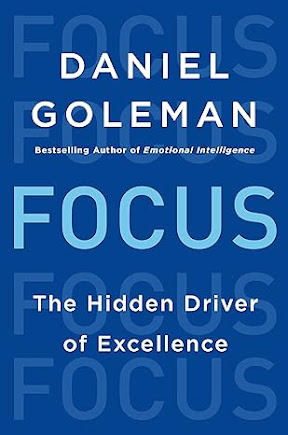
FOCUS: THE HIDDEN DRIVER of EXCELLENCE (audiobook) by Daniel Goleman


"Focus" lacks focus


Published in 2013 by HarperCollins.
Read by the author, Daniel Goleman.
Duration: 8 hours, 8 minutes.
Unabridged

Dr. Daniel Goleman is best known as the author of Emotional Intelligence. In many ways this book is less of a book about the importance of focus and more of a sequel to Emotional Intelligence. It is also a anti-global warming manifesto, an education reform book, a self-help book for business leaders who want to be the real leaders in their offices and there is a little bit about how people are able to focus their attentions a bit more and get better results.

That, of course, is the problem with the book called Focus. The primary topic should be the ability of people to focus and some hints to help you focus better. The book starts out with exactly this...well, focus. We learn how a store detective is able to focus on a crowded room full of bustling and sort out the normal shopping behaviors from the actions of a shoplifter. Goleman discusses how the give-it-to-me-now world of Tweets, Instagram, instant video makes our attention span short (I knew this already - I teach high school and my kids are on their phones all day long and I see the results).


But, then Goleman leaves this area of personal focus largely unexplored and veers into the focus of whole groups of people and uses global warming as his "focus" for this section. I listened to this as an audiobook on CDs and this lasted for more than a CD - well more than an hour of discussion about a topic that is basically off topic. He throws in a suggestion that schools adopt a global warming science project that probably would not hit most state's standards, goes on about carbon footprints, promotes websites that track your carbon footprint, tells how various companies have shrunk their carbon footprints. None of this, not one bit, not one iota, not one word is described in the blurb on the back of the audiobook. I got bored and started skipping whole chunks of text. To his credit, Goleman does point out that the concept of a zero-emission car is a misnomer since electric cars are charged up by an electric grid that is powered largely by coal and coal plants do have emissions (and if you get your electric car charged by a solar panel, there are emissions associated with the manufacture of those panels).  


Then we veer into the world of corporate leadership and the book becomes an extended discussion of what makes a good leader. Turn out it is mostly paying attention the the feelings and needs of those that are following you - this is where the book becomes a sequel to his book Emotional Intelligence with a special focus on CEOs. I felt like I was not the intended reader (or listener, in my case).


Speaking of being a listener, the audio portion of this experience needs to be discussed. The author, Daniel Goleman, read his own book. I am always leery of this because sometimes the author may have a perfectly fine speaking voice but just should not read an audiobook. It is more than a reading, it has to be a performance. Goleman does a lot of public speaking (his website has a place to contact his agent to schedule Dr. Goleman to speak to our corporate gig about leadership, emotional intelligence or maybe even global warming) but public speaking is not the same as reading an audiobook. I cannot hear gestures or hear the fact that the speaker moved across the stage or stood up to put more emphasis on a point in an audiobook. It all has to be done with your voice. Goleman's voice is okay, but not great. He does not quite drone, but it is not really lively either. It definitely took on a nagging tone during the extended global warming discussion. Even worse, there was a bass reverb echo while he spoke that I could not get rid of no matter how much I fiddled with the bass in my car. It sounded like that echo sound you hear when someone is speaking to you on the phone in a small, enclosed room. A professional audiobook should not have this problem. 


Note: This book was sent to me by the publisher in exchange for an honest review.


I rate this audiobook 1 star out of 5. I was so relieved to finish this thing and it took me forever to listen to it.


If you want to give this audiobook a try for yourself you can find it on Amazon.com here: Focus: The Hidden Driver of Excellence.

Reviewed on January 25, 2014.

No, They Can't: Why Government Fails - But Individuals Succeed (audiobook) by John Stossel


Libertarianism thought delivered painlessly by nice guy Stossel


Published April 10, 2012 by Simon and Schuster Audio.
Read by the author, John Stossel
Duration: 9 hours, 14 minutes

The title of this audiobook, No, They Can't is a play on the 2008 campaign slogan of then-candidate Obama, "Yes We Can!" Stossel, of course, is the TV consumer reporter turned anchor of ABC's 20/20 who now hosts a weekly show of Fox Business News and a series on one-hour specials on Fox News. He has won nineteen Emmy Awards. He begins his book with an explanation of why he left ABC after more than 20 years and how the culture of ABC made it very uncomfortable for him to explore stories in any way except the tried and true politically correct way.

The premise of the this audiobook is that the entire thought process behind that campaign slogan is wrong  - the government cannot do a lot of the things that people want it to do, and even if everyone agreed it should give those things a try, it would do a very poor job of them because government is inefficient at almost everything it does.

Stossel is an outspoken but soft-spoken Libertarian and he makes a very thoughtful presentation of Libertarian thought on a variety of topics. He generally starts with a variation on this phrase: "Intuition tells me...but reality has taught me..." and presents a commonly held belief (like minimum wage laws helping younger workers) and then presents research that shows that that belief is incorrect (many have no skills and having to pay them more than they are worth means they are unlikely to be hired in the first place).

Stossel covers a variety of topics including free trade, how federal regulations can help the businesses they are intended to regulate, food police, government-provided health insurance, the "nanny state" government, gun control and lots more. The strength of the audiobook is not the ideas (they are fairly standard Libertarian fare) but the way that Stossel presents them. Stossel is inherently likable and he has done a lot of thinking and research to present his arguments in clear, everyday language. His "Intuition tells me...but reality has taught me..." format acknowledges the logic of people that disagree with him and then he lays out his arguments with his nice guy style.

I rate this book 5 stars out of 5. it can be found on Amazon.com here: No They Can't: Why Government Fails - But Individuals Succeed by John Stossel.

Reviewed on May 30, 2012.

The Great Warming: Climate Change and the Rise and Fall of Civilizations by Brian Fagan


Disappointed


Published in 2008 by Bloomsbury Press.

My mother in law bought me three Brian Fagan books for Christmas last year because they were on my Amazon Wish List. I read the first one The Little Ice Age: How Climate Made History, 1300-1850 right away and enjoyed it. I gave it four stars. .

I was saving this one, hoping to enjoy it just as much. Now, I am worried that I'll never muster enough interest to read the third one.

The Great Warming: Climate Change and the Rise and Fall of Civilizations seems rushed - a poorly edited and a poor man's version of Jared Diamond's Collapse: How Societies Choose to Fail or Succeed with some global warming hype thrown in for good measure. Many of the cultures covered by Fagan were actually covered in Diamond's more detailed book.

Fagan looks at the time of the Medieval Warming Period, approximately from 800 AD to 1300 AD, and the effects of this slightly warmer time on numerous societies, including Western Europe, the Mongols, the Inuit, the Pueblos, the peoples of California, China, Easter Island and the Khmer of Southeast Asia. This is not a long book so there is just a snapshot of each civilization. Fagan notes that the data suggests that the Medieval Warm Period was a time of frequent droughts for nearly everyone but Central Asia and Europe. He points to research that suggests El Nino events caused or contributed greatly to the Medieval Warming Period.

Fagan theorizes that the Warming Period destroyed multiple civilizations and that we may suffer the same fate (pages 238-242). But, Fagan fails to note what he himself has written throughout the book - we do not understand climate systems. We think that some of these things may (might, probably, the data suggests - you pick the euphemism) be related but in reality we are unsure. Yes, we are warmer now than we were in 1860, at the end of the Little Ice Age but our warming may or may not have a thing to do with the warming of the past. They may be caused by different things. Fagan goes with the theory of man-made global warming which means his dire warnings from the past ("Today, we are experiencing sustained warming of a kind unknown since the Ice Age. And this warming is certain to bring drought..." - p. 239) are probably pointless since they were not caused by man-made global warming. Fagan points out the droughts during the Medieval Warming Period were caused by El Nino events that lasted for years. Were those events caused by the heat or did they create the heat? I suggest Fagan has fallen victim to the old causation/correlation trap. Certainly there is not enough hard data to suggest that the weather patterns of the Medieval Warming Period will be repeated in the 21st Century.

Fagan's thesis of man-made global warming (and the near-constant nagging throughout the book) is weakened by his own charts on pages 17 & 19 which clearly show a cooler period ending about 800 AD, a warmer period from 800-1300, a cooler period from 1350-1860 and a warmer period from 1860 to the present. The pattern is cool-warm-cool-warm. All of the comments about how we don't understand climate and the cool-warm-cool-warm pattern negate a good portion of the book.

There are other niggling details, such as the self-contradictory paragraph on page 123 that notes that NO ONE in the history of the entire world depended on acorns as much as the California Indians. Except, of course, for the Syrians that depended on them for their ENTIRE diet 14,000 years ago that he mentioned earlier in the same paragraph. His explanation of why the Pueblos were abandoned by a Anasazi flies in the face of more recent scholarship. Fagan makes it sound orderly ("Fortunately, the ancient traditions kicked in and people adjusted by moving away, household by household." - page 136) even though there is evidence some Pueblos were burned and were hastily abandoned (their belongings were left behind and scattered about) and there may have been widespread cannibalism (he poo-poos it as a bit of "ritual cannibalism"). To me that sounds like chaos, civil war or possibly invasion, not a gradual decline and walking away from a civilization.

For me, the final straw was the offhand comment on page 153 that maybe the Mayans could have stopped Cortes from invading Central Mexico and defeating the Aztecs if they hadn't have collapsed due to the Warm Period. Cortes landed in Veracruz. Veracruz was not a Mayan area. They were influenced by trade with Mayans but they were not Mayan. 

I am hardly an expert, but if I spot these problems how many more are there?

So, my final assessment in a word: Disappointed.

I rate this book 2 stars out of 5

This book can be found on Amazon.com here: The Great Warming: Climate Change and the Rise and Fall of Civilizations by Brian Fagan.

Reviewed on November 6, 2009.

Featured Post

<b><i>BAN THIS BOOK (audiobook)</i></b> by Alan Gratz

Published in 2017 by Blackstone Audio, Inc. Read by Bahni Turpin. Duration: 5 hours, 17 minutes. Unabridged. My Synopsis Ban This Book is t...

Popular posts over the last 7 days