Showing posts with label LBJ. Show all posts

LYNDON B. JOHNSON: A LIFE from BEGINNING to END (BIOGRAPHIES of U.S. PRESIDENTS) (kindle) by Hourly History


Published by Hourly History in March of 2024.

Hourly History publishes an extensive line of histories and biographies that are intended to be read in about an hour. With that limit, none of these are the definitive biographies, but most of them  give the average reader a good sense of who the person was and why they were important. 

Lyndon Baines Johnson (LBJ) was the 36th President of the United States. One thing I particularly like about this biography is that it tells about his formative experiences in Texas as a young man, especially his short stint as a public school teacher in a very poor area of rural Texas. Getting to know those students really gave him the desire to want to create government programs to help alleviate poverty. 

This biography is a little skewed towards Johnson's early life, but it's not particularly hard to find information about LBJ's time as President and the series offers books on the big events of his administration like the Vietnam War and the Civil Rights movement if you would like to read more.

I rate this e-book 4 stars out of 5. It can be found on Amazon.com here: Lyndon B. Johnson: A Life from Beginning to End

RUN: BOOK ONE (graphic novel) by John Lewis and Andrew Aydin


Illustrated by L. Fury and Nate Powell.
Published by Harry N. Abrams in 2021.


This spring I read the MARCH, the three volume graphic novel series about Congressman John Lewis (1940-2020) and the Civil Rights movement. When I finished the series, I thought to myself that it would be interesting to see how John Lewis ran for Congress and the struggles he encountered in an era where the KKK still openly marched.

My Synopsis:

The graphic novel RUN picks up right where MARCH trilogy left off. At the end of the MARCH trilogy, there was a celebration of the passage of the Civil Rights bills - a moment of success. There was also the murder of a volunteer who was helping with the celebration by anti-Civil Rights forces.

RUN explores what happened after the Student Non-Violent Coordinating Committee (SNCC) had it first taste of success. 
At the end of MARCH, there was a celebration of the passage of the Civil Rights bills. With that, a long-term goal achieved there was a lot of discussion about where to go next. there were a lot of things to consider, including the beginnings of the Vietnam War.

The discussions soon became arguments and those arguments led people to leave the SNCC and for the movement to fragment. Some pushed for more of the same strategies due to a belief in the power of non-violence and for the simple reason that they had been effective up to this point. 

Others, led by Stokely Carmichael, wanted to pursue separatist strategies. Eventually, this leads John Lewis to leave the SNCC and run for political office.

My Review:

As I look over what I wrote in my synopsis of the book, it sounds boring. It really was not. You normally don't hear much about the Civil Rights movement after the passage of the Voting Rights Act and the Civil Rights Act in 1964 and 1965, so I found it interesting.

Sadly, Lewis died before this book was finished and I doubt there will be more in this series. 

I rate this graphic novel 5 stars out of 5. It can be found on Amazon.com here: RUN by John Lewis and Andrew Aydin.

MARCH: BOOK THREE (graphic novel) by by John Lewis and Andrew Aydin


Published in 2016 by Top Shelf Productions

Written by John Lewis and Andrew Aydin.

Illustrated by Nate Powell.

2016 National Book Award Winner for Young People's Literature

2017 Printz Award Winner

2017 Coretta Scott King Author Award Winner

2017 Sibert Medal Winner

2017 YALSA Award for Excellence in Nonfiction Winner

2017 Walter Award Winner

Congressman John Lewis (1940-2020) continues his life story in book three of the March series, focusing on his struggles in the Civil Rights Movement. The book starts with the 16th Street Birmingham Church Bombing in September of 1963 and ends with the signing of the Voting Rights Act in August of 1965.

These were, by any account, much like the famous Charles Dickens line from A Tale of Two Cities: "It was the best of times, it was the worst of times, it was the age of wisdom, it was the age of foolishness, it was the epoch of belief, it was the epoch of incredulity, it was the season of light, it was the season of darkness, it was the spring of hope, it was the winter of despair..."

It was the best of times in that the Civil Rights Act of 1964 and the Voting Rights Act of 1965 were passed. It was the worst of times because of these landmark laws were passed due to great sacrifices. As noted on page 91, in the state of Mississippi in the summer of 1964 during an attempt to mobilize and register black voters there were "more than 1,000 arrests, 80 beatings, 35 church burnings, and 30 bombings."

A theme that runs throughout the trilogy is that every success is soured by a violent response. I was particularly struck by an act of pointless violence at the end of the book. When the march from Selma, Alabama to Montgomery, Alabama finally happens (it had been turned back on other attempts by violence and by court order) there is a rally, there are speeches, and a concert given by an amazingly diverse crowd of artists - diverse in race and in musical styles. What should have been a beautiful moment is marred by the murder of a volunteer driver named Viola Luzzo from Detroit. She was shuttling people back to Selma. She was heading back to Montgomery to pick up more people when a car pulled alongside. A single shot was fired and she was killed (see picture.)

This is an excellent trilogy and an excellent way to tell this history. I rate this book and the entire trilogy 5 stars out of 5. 

This book can be found on Amazon.com here: MARCH: BOOK THREE (graphic novel) by by John Lewis and Andrew Aydin.

Click here for March: Book One.

Click here for March: Book Two.

LEADERSHIP: IN TURBULENT TIMES (audiobook) by Doris Kearns Goodwin


Published in 2018 by Simon and Schuster Audio

Read by Beau Bridges. David Morse, Richard Thomas, Jay O. Sanders and the author.

Duration: 18 hours, 5 minutes.

Unabridged.


Doris Kearns Goodwin often is labeled with the title "presidential historian" and, really, that is a pretty accurate term for her. As a young historian, she worked personally with Lyndon Johnson on his presidential memoirs. She has written about both Theodore Roosevelt and Franklin Delano Roosevelt. Her book Team of Rivals is a modern classic and has redefined the popular image of the Lincoln administration.

In Leadership: In Turbulent Times, she looks at various qualities of leadership that each of these very different men exhibited. She begins with interesting pre-presidential biographies of each of these men. She focuses on Lincoln's expressed desire to become a person that was worthy of the esteem of his community. Theodore Roosevelt's ceaseless energy and desire to experience new things led him to meet all sorts of people and learn about their concerns. FDR's efforts to recover from polio were above and beyond. Also, she focuses on his habit of hiding his own problems from the people around him. LBJ's relentless push to put connect himself to people in power is interesting - a road map to power, if you will. But, it is not particularly inspiring (that comes later on for LBJ).

The author, Doris Kearns Goodwin
If the book were just those early biographies, it would be an impressive book. But, it goes on to look at an individual theme (in the case of Theodore Roosevelt, a single crisis) that developed in each man's presidency.

With Lincoln, the theme is the end of slavery. With Theodore Roosevelt, the crisis is a national coal strike (May - October 1902) that threatened to literally freeze millions of people. With FDR, the crisis is the Great Depression and his willingness to try and discard and try again in order to alleviate the suffering. For LBJ, the focus is on his push to pass Civil Rights legislation in wake of President Kennedy's assassination and the political cost he suffered in doing so. She also comments on the Vietnam War being the tragic result of his singular focus on domestic policy.

She identifies individual leadership lessons as she goes along. I have no idea how many there are because I listened to it as an audiobook and was not able to write them down as I went along.

Speaking of the audiobook version, this audiobook is read by five different readers. The author reads the opening and closing. The sections on the Presidents are each read by a different award-winning actor. Beau Bridges was absolutely excellent as the reader for the LBJ section. I wish he'd read more audiobooks.

I rate this audiobook 5 stars out of 5. It can be found on Amazon.com here: LEADERSHIP: IN TURBULENT TIMES by Doris Kearns Goodwin.

THE SOUL of AMERICA: THE BATTLE for OUR BETTER ANGELS (audiobook) by Jon Meacham


Published in 2018 by Random House Audio.
Read by Fred Sanders and the author, Jon Meacham.

Duration: 10 hours, 55 minutes.
Unabridged.

In The Soul of America, Jon Meacham takes a look at Presidential leadership from the Civil War onward, particularly the power of the President to lead the country to "do the right thing" in a time of crisis. He has a particular focus with how the President deals with people who want to abuse the rights of others. Well, to be completely honest, Meacham does not have a complete clear thesis in this book and I am not 100% sure what his overall goal was. What it turned out to be was an interesting, rambling work that looked at several crisis points in American history and how the politicians, mostly presidents, responded.

He looked at Lincoln (the source of the title), Grant during Reconstruction and the rise of the KKK, Theodore Roosevelt, Woodrow Wilson, Franklin Roosevelt, Harry Truman, Eisenhower, JFK and LBJ. There is a little discussion of George W. Bush and there is an implied criticism of Donald Trump at times, especially when he discusses demagogues like Huey Long and Joseph McCarthy. 

Meacham is much kinder towards Woodrow Wilson than most historians, when one considers how much he abused his authority during World War I (he acknowledges it and moves on). His look at LBJ was similarly friendly, but was much more interesting and inspiring because it focused on his work to get the Civil Rights legislation passed (and virtually ignored the Vietnam War).

The audiobook was read by Fred Sanders. He did a fine job, but I actually enjoyed the reading of the opening and closing thoughts by the author more.
LBJ and MLK discussing Civil Rights strategy - 

So, to sum up, this was an enjoyable, if muddled book. Worthy of your time.

I rate this audiobook 4 stars out of 5. It can be found on Amazon.com here: THE SOUL of AMERICA: THE BATTLE for OUR BETTER ANGELS.

SHADOW WARRIOR: WILLIAM EGAN COLBY and the CIA (audiobook) by Randall B. Woods


I have rarely been so glad to have been done with an audiobook as I was with this one.


Published in 2013 by Post Hypnotic Press
Narrated by Michael Puttonen
Duration: 21 hours, 56 minutes.
Unabridged.

William Egan Colby was present at the beginnings of the CIA and served as an inserted commando with the Office of Strategic Services (OSS) in both France and Norway during World War II, pioneering the kind of action he advocated for during his years in the CIA.

The beginning of Shadow Warrior is excellent as it details Colby's life and his World War II exploits. But, as it transitions from World War II to the early years of the Cold War to the Vietnam War the book becomes bogged down, especially in the endless detail about the politics of South Vietnam. Clearly, the Vietnam War was a pivot point for America and for Colby so it should be stressed. However, hours and hours of details about the governing elite of the doomed country were simply tedious.

Colby moves back to America and into the halls of power in the CIA just as the Watergate Crisis is starting to break. America's faith in government was at a low point and people were starting to ask if the CIA should be restrained. Colby had worked his way up to be the Director of the CIA. Colby was as honest as he could be and still keep the CIA open and running as an effective intelligence and counter-intelligence unit. But, once again, the forward momentum of the book is swamped with details. 

Look, I am a high school history teacher. I love history. But, I have rarely been so glad to have done with an audiobook as I was with this one.  
William Colby
(1920-1996)
Making it worse, the reader, Michael Puttonnen insisted on reading quotes from different politicians of the 1960s and 1970s with in an impersonated voice. His LBJ was subtle, but his Nixon and Kissinger voices were not very good and I found them to be distracting
.

I rate this audiobook 2 stars out of 5. I cannot rate it 1 star because I did learn a few things along the way.

Note: I was sent a free copy of the mp3 CD audiobook by the publisher in exchange for a fair review.

It can be found on Amazon.com here: Shadow Warrior: William Egan Colby and the CIA.

American Chronicles: The Vietnam War (audiobook) by NPR


Published in 2013 by HighBridge Audio
Multicast performance
Duration: 3 hours, 40 minutes

In American Chronicles: The Vietnam War, NPR has collected 24 stories that were originally broadcast over their radio network concerning the Vietnam War. All of the stories are high quality productions. Some are quite moving. All are informative.

The collection starts with a look at the Vietnam War Memorial in Washington, D.C. followed by a story about a Washington, D.C. anti-war protest that was broadcast on NPR’s very first day (May 3, 1971). As the collection goes along the listener is treated to stories of Red Cross workers, orphans of the war, the analyst that leaked “The Pentagon Papers”, two stories by Walter Cronkite, actual tapes of Lyndon Johnson discussing how to present the war to the American people, the My Lai Massacre, refugees who fled the North Vietnamese conquest of South Vietnam, pilots and sailors that saved those refugees, the Kent State shootings and so much more.

South Vietnamese helicopter being pushed
 off the deck of the USS Okinawa to make
room for incoming refugees during

the evacuation of Saigon
The collection has a weak spot, however. There is little discussion as to the beginnings of the war and almost nothing said about the rationale behind it. There are multiple stories about protesters and not much about why the war started in the first place.

However, the last CD of this three CD set is very moving. It focuses on the end of the war, including audio spliced in from “letters” that were sent home on audiotape describing the chaos of the evacuation of Saigon as the South Vietnam collapsed in the face of the final push by North Vietnam. Some of the stories are depressing. One is a great testament to the U.S. Navy and its commitment to help as many of the refugees as possible. Perhaps the most moving of these audio letters is from the man whose name is the last name on the Vietnam War Memorial – the literal last man to die in the war (and its little side wars in neighboring countries).

I rate this book 4 stars out of 5 and it can be found on Amazon.com here: American Chronicles: The Vietnam War.

Reviewed on February 12, 2013

Note: This audiobook was provided to me free of charge by the publisher in exchange for an honest review. 

The Presidents Club: Inside the World's Most Exclusive Fraternity (audiobook) by Nancy Gibbs and Michael Duffy


Very Interesting History of the Modern Presidency


Published by Simon and Schuster Audio in 2012
Read by Bob Walter
Duration: 22 hours, 1 minute
Unabridged

Nancy Gibbs and Michael Duffy, both editors at Time, have delivered a very listenable, fascinating look at each American president from Harry Truman to Barack Obama. No matter their political persuasion, their life experiences or their qualities as a human being, all 12 of these men share one thing: they were once President. This is an exclusive club and it seems that just about every president has looked to a former president for a shoulder to lean on, advice or even as a personal envoy sent to convey a sense of urgency to the message.

The Presidents Club is told in a rough chronological order starting with Truman. When Truman was President there was only one other member of the Presidents Club: Herbert Hoover. Yes, the same Hoover that Truman and FDR disparaged for 12 years. However, to his credit, Truman sent out feelers and discovered that Hoover was still willing and able to help. Together, they set up the ground rules for this "club." Hoover was tapped by Truman to get food to Europe at the end of World War II (Hoover did this at the end of World War I as well) and to help re-organize the Executive Branch.

Gibbs and Duffy discuss how each President interacted with his predecessor and his successor and even other presidents (for example, Nixon interacted with every President from Truman to Clinton). Gerald Ford had a similar lengthy history. They also discuss how the "Club" grew and shrank over the years. During Bill Clinton's presidency, there were as many as six members (Nixon, Ford, Carter, Reagan, Bush41 and Clinton). At one point in the Nixon years, there was only Nixon.
The current "Presidents Club" membership:
George H.W. Bush (41), 
Barack Obama,
George W. Bush (43), Bill Clinton and Jimmy Carter.

If you are a political junkie or a fan of modern American history, this anecdote-filled book is a must-read. It gives a different feel for the men, their personalities and their legacies. For example, I was surprised at how often Johnson reached out to Eisenhower for advice and reassurance concerning the Vietnam War.  I was even more surprised at how often Johnson was out hustled politically by Richard Nixon. I know Johnson was a world class politician, but Nixon maneuvered him and manipulated him throughout 1968. Johnson fared no better in his post-Presidential years.

Nixon comes off as talented but very deeply flawed. The authors quote longtime advisor to multiple presidents, Brent Scowcroft, calling Nixon a "shit" and former President George H. W. Bush (Bush41) referred to him as "first-rate intellect but also a third-rate person." However, you do have to admire how Nixon calculates how to get to the forefront of American politics again and again and again. Reagan comes off surprisingly cold. Carter, as an enigma. Gerald Ford comes off as principled and maybe even heroic for his decision to pardon Nixon and destroy any chance he had to be elected. The Clinton-Bush41 friendship was a joy to learn about and the source of some of the best stories.

Leadership lessons abound in this book. Every president had his own style in office and some even managed to exert a large influence long after they left office. Some Presidents chart the general path and expect their subordinates to follow it. Others are intimately involved in so many decisions that they are spread too thin. Some are charmers. Some intimidate. Some scheme and plan every move. No matter the president, Gibbs and Duffy take the reader behind the scenes and give a sense of the times and the way their administrations worked.


I found this audiobook to be thoroughly enjoyable. Bob Walter's narration was excellent. He varied his rate, read with a lot of emphasis and made a 22 hour long audiobook fly by. I particularly enjoyed his very slight inflections he put in his quotes. For example, his LBJ quotes had a small amount of Texas twang and his Reagan quotes had his characteristic tone to them (If you were alive during the Reagan Administration, think about his famed "Well...").

I rate this audiobook an enthusiastic 5 stars out of 5.

This book can be found on Amazon.com here: The Presidents Club.

Reviewed on February 1, 2013

Note: This audiobook was provided to me free of charge by the publisher in exchange for an honest review. I honestly thought this was an exceptional audiobook.

Killing Kennedy: The End of Camelot (audiobook) by Bill O'Reilly and Martin Dugard


Published in 2012 by MacMillan Audio
Duration: 8 hours, 25 minutes
Unabridged
Read by the author, Bill O'Reilly

I was a little reluctant to listen to this audiobook because of the author. Not Martin Dugard. This is the third book I have read or listened to that he has written or co-written and I know he can really tell a story. No, it's Mr. "No Spin Zone" that I cannot stand. Our politics are similar but I just find O'Reilly difficult to stomach.

That being said, I enjoyed this audiobook quite a lot.

John Fitzgerald Kennedy
(1917-1963)
O'Reilly narrates Killing Kennedy, which means it's a mixed bag for me. He speaks for a living so he reads it well and knows what phrases and words he wanted to emphasize but, like I said above, a little O'Reilly goes a long way for me. Also, his frequent use of dramatically read foreshadowing that alludes to the date of JFK's assassination got very old very fast.

But, the positives are the way the book is presented. O'Reilly tells the story of JFK from PT 109 forward and gives the reader of the man Kennedy was becoming. JFK's family life, his relationship with his brothers, LBJ and Jackie are explored in great detail and presented in an interesting fashion and really expose Kennedy's good points as well as his considerable failings.

As they tell the story of the Kennedy Administration, O'Reilly and Dugard lay out all of the parties that have been blamed for the assassination: the Cubans, the CIA, the FBI, the Mafia, anti-civil rights crazies and Lee Harvey Oswald. O'Reilly and Dugard acknowledge that these other groups had a grudge against Kennedy but they go with the traditional explanation of Lee Harvey Oswald.

Perhaps the best piece of the book is how well they tell the story of Jackie Kennedy on the day of the assassination. It is a fine piece of writing that brought tears to my eyes at one point (please note, I have not been a particular fan of JFK or of O'Reilly so the fact that a bit of writing read by O'Reilly about JFK brought tears to my eyes speaks volumes about its power).

Well done.

I rate this audiobook 5 stars out of 5.

Reviewed on December 22, 2012

Note: I was provided a copy of this audiobook by the publisher in the hopes of receiving an honest review.

This audiobook can be found on Amazon.com here: Killing Kennedy.

Indomitable Will: LBJ in the Presidency by Mark K. Updegrove


Published by Crown Publishers in March of 2012

Indomitable Will: LBJ in the Presidency is a biography composed mostly of snippets of interviews edited together to tell President Lyndon Johnson's story.

The book is designed to give the reader a view of Lyndon Johnson - the man. Johnson was a controversial man  - easily one of the most controversial of the 1960's. He is easily caricatured and mis-characterized. This ambiguity is odd considering that he was one of the most successful presidents of all time when it came to pursuing and passing a legislative agenda. If not for the Vietnam War, his legacy might be much different today.

Lyndon Baines Johnson
(1908-1973)
While I learned a lot more facts about Johnson than I knew before reading this book, I did not get a better read on the man himself. His motivations were so mixed and his outbursts so frequent that I could not (and still cannot) tell if he put himself behind legislation like the Civil Rights Act of 1964 to make a name for himself, because it was the right thing to do or if it was done just to confound people. Perhaps it was all three. Was he a bully, a flirt, a schmoozer or just the most versatile politician of his era?

Johnson's stormy relationship with Eastern elites shines through, but this is well-known. Johnson's frequent womanizing is alluded to just once despite numerous pages dedicated to the relationship between LBJ and "Lady Bird" Johnson. This issue is emblematic of a problem with the book in general. The author if the director of the Lyndon Baines Johnson Presidential Library Museum in Austin, Texas. As such, he has access to more of Johnson's papers than just about anyone else. But, I think it is clear that this book was written from the perspective of a fan of LBJ. Fans diminish (or even explain away) the negatives and focus on the positives.

The oral history format of the book was sometimes interesting, but oftentimes it was very repetitive with multiple people expressing the same or very similar thoughts back to back on LBJ and the issues of the day.

Bottom line: the book does little to shed light on the mercurial personality of LBJ. I you know nothing about LBJ, this is a solid place to start. If you know something about him already, you will know more after the reading the book and still not really know the man.

I rate this book 3 stars out of 5.

This book can be found on Amazon.com here: Indomitable Will: LBJ in the Presidency

Reviewed on November 4, 2012

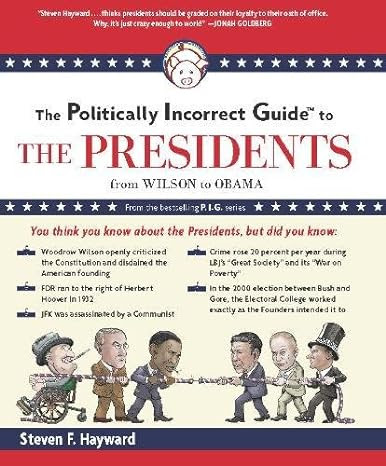
The Politically Incorrect Guide to the Presidents from Wilson to Obama (P.I.G. Series) by Steven F. Hayward


An entertaining read and a great way to rate the presidents

Published in 2012 by Regnery Publishing, Inc.

First and foremost, the latest entry in the P.I.G. series is a great read. Steven Hayward is to be commended for making what could have been a very stale read into an entertaining read - he has a light touch.

Secondly, how sad is it that grading presidents by how well they "preserve, protect, and defend" the constitution is a unique idea?

Hayward begins The Politically Incorrect Guide to the Presidents with a look at what the founders wrote about the office of the president and compares that to the modern presidency. He then looks at the presidency in the 19th century and how most presidents took the restrictions of the Constitution very seriously.

As Hayward proceeds to grade the 17 presidents we have had from 1913 until the 2012 (from Wilson to Obama) on an A to F scale (just like in school) he gives a thumbnail sketch of each president with the major issues of the election and/or his time in office, where he diverged from the Constitution (or supported it) and how the Supreme Court justices he appointed fared by way of the Constitution as well.

Each president gets about 8-12 pages per term in office and the text includes sidebar boxes with recommended readings, great quotes and interesting factoids. The overall grade is presented on the first page of each president's particular chapter and the last page explains how it was arrived at.

Richard Nixon, president from 1969-1974
So, what did I think? I agreed with the great majority of the grades given, although there were some I would have been a little tougher on or a little easier on (a C+ vs. a C- type of thing). I very much disagreed with the C+ for Richard Nixon - and not because of Watergate (although Hayward largely excuses it with the "the other guys did it, too!" defense) . The growth of the regulatory bureaucracy under Nixon was incredible - according to a factoid on page 173 it grew by 121% under Nixon. Throw in federal wage and price controls and I don't see how you can give Nixon the C+ that Hayward does.

But, that is just one grade out of 17 (and even that chapter was interesting). This is a book that I am going to keep handy for those great online political debates. Nothing like a great Warren G. Harding quote like this one: "There is not a menace in the world today like that of growing public indebtedness and mounting public expenditure" to get a little discussion going in this election year, huh?

Note: I would love to see an expanded re-issue of this book with 2 co-authors. One co-author would be a presidential historian who would provide a lot of the heavy lifting for the section detailing the history of each president's administration. The third co-author would be someone from the left politically. This would be a much larger book, but also a much more comprehensive and accurate book. 

I rate this book 5 stars out of 5.

This book can be found on Amazon.com here: The Politically Incorrect Guide to the Presidents from Wilson to Obama.

Reviewed on March 23, 2012.

Character Above All: Ten Presidents from FDR to George Bush edited by Robert A. Wilson


Fascinating! Informative!


Published in 1996.

As the title implies, Character Above All: Ten Presidents from FDR to George Bush is a collection of biographical essays on each of the 10 presidents from FDR to George H.W. Bush (Bush 41) by 10 different authors who are either expert historians or knew the President while in office. The thing that ties them all together is that each essay is supposed to look at each man as president and find that one part of his character that made him the type of president he was. Each essay is about 30 pages and it makes for interesting reading.

A good sample would come from Doris Kearns Goodwin's look at Franklin Delano Roosevelt. She asserts that the most valuable component of his personality was his self-confidence. I thought this quote from FDR makes the point wonderfully: "I'll tell you...at night when I lay my head on my pillow, and it is often pretty late, and I think of the things that have come before me during the day and the decisions that I have made, I say to myself - well, I have done the best that I could, and turn over and go to sleep."

The essays are wonderful - some inspiring, such as Gerald Ford's, some disturbing such as JFK's. However, all are well-written and this is a fantastic collection.

This book can be found on Amazon here: Character Above All: Ten Presidents from FDR to George Bush   

I rate this book 5 stars out of a possible 5 stars.
 
Reviewed on February 11, 2005.

Featured Post

<b><i>BAN THIS BOOK (audiobook)</i></b> by Alan Gratz

Published in 2017 by Blackstone Audio, Inc. Read by Bahni Turpin. Duration: 5 hours, 17 minutes. Unabridged. My Synopsis Ban This Book is t...

Popular posts over the last 7 days