Showing posts with label MLK. Show all posts

LYNDON B. JOHNSON: A LIFE from BEGINNING to END (BIOGRAPHIES of U.S. PRESIDENTS) (kindle) by Hourly History


Published by Hourly History in March of 2024.

Hourly History publishes an extensive line of histories and biographies that are intended to be read in about an hour. With that limit, none of these are the definitive biographies, but most of them  give the average reader a good sense of who the person was and why they were important. 

Lyndon Baines Johnson (LBJ) was the 36th President of the United States. One thing I particularly like about this biography is that it tells about his formative experiences in Texas as a young man, especially his short stint as a public school teacher in a very poor area of rural Texas. Getting to know those students really gave him the desire to want to create government programs to help alleviate poverty. 

This biography is a little skewed towards Johnson's early life, but it's not particularly hard to find information about LBJ's time as President and the series offers books on the big events of his administration like the Vietnam War and the Civil Rights movement if you would like to read more.

I rate this e-book 4 stars out of 5. It can be found on Amazon.com here: Lyndon B. Johnson: A Life from Beginning to End

RUN: BOOK ONE (graphic novel) by John Lewis and Andrew Aydin


Illustrated by L. Fury and Nate Powell.
Published by Harry N. Abrams in 2021.


This spring I read the MARCH, the three volume graphic novel series about Congressman John Lewis (1940-2020) and the Civil Rights movement. When I finished the series, I thought to myself that it would be interesting to see how John Lewis ran for Congress and the struggles he encountered in an era where the KKK still openly marched.

My Synopsis:

The graphic novel RUN picks up right where MARCH trilogy left off. At the end of the MARCH trilogy, there was a celebration of the passage of the Civil Rights bills - a moment of success. There was also the murder of a volunteer who was helping with the celebration by anti-Civil Rights forces.

RUN explores what happened after the Student Non-Violent Coordinating Committee (SNCC) had it first taste of success. 
At the end of MARCH, there was a celebration of the passage of the Civil Rights bills. With that, a long-term goal achieved there was a lot of discussion about where to go next. there were a lot of things to consider, including the beginnings of the Vietnam War.

The discussions soon became arguments and those arguments led people to leave the SNCC and for the movement to fragment. Some pushed for more of the same strategies due to a belief in the power of non-violence and for the simple reason that they had been effective up to this point. 

Others, led by Stokely Carmichael, wanted to pursue separatist strategies. Eventually, this leads John Lewis to leave the SNCC and run for political office.

My Review:

As I look over what I wrote in my synopsis of the book, it sounds boring. It really was not. You normally don't hear much about the Civil Rights movement after the passage of the Voting Rights Act and the Civil Rights Act in 1964 and 1965, so I found it interesting.

Sadly, Lewis died before this book was finished and I doubt there will be more in this series. 

I rate this graphic novel 5 stars out of 5. It can be found on Amazon.com here: RUN by John Lewis and Andrew Aydin.

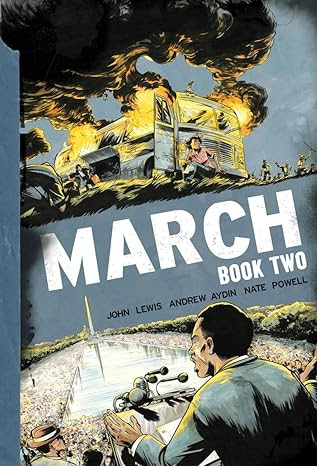
MARCH: BOOK TWO (graphic novel) by by John Lewis and Andrew Aydin


Published in 2013 by Top Shelf Productions.

Written by John Lewis and Andrew Aydin.

Illustrated by Nate Powell.

Congressman John Lewis (1940-2020) continues his life story in book two of the March series, focusing on his struggles in the Civil Rights Movement. The book starts in November of 1960 and ends with the 16th Street Birmingham Church Bombing in September of 1963.


The story includes some very harsh responses to attempts to integrate restaurants in Tennessee, the freedom riders (young African Americans were attempting to desegregate bus lines after a court ordered them to be desegregated), and the bus boycott campaign in Birmingham. 

The violent response is horrible and shocking

Infamous segregationist lawman Bull Connor of Birmingham figures prominently throughout the middle of the book. I am pretty well-versed in the major points of the Civil Rights Movement but I was still moved by the portrayal of the Children's Crusade.

The book includes all of the negotiations, concerns, and demands before the famed March on Washington. Lewis spoke at the march, followed by the world-famous "I Have a Dream" speech by Martin Luther King. 

And, as often happens in this history, a giant step forward is followed by tragedy. In this case, the book ends with the death of 4 girls in the terrorist bombing of a church in Birmingham. 

I rate this book 5 stars out of 5. It can be found at Amazon.com here: MARCH: BOOK TWO (graphic novel) by by John Lewis and Andrew Aydin.

Click here to see my review of March: Book One.

Click here to see my review of March: Book Three.

MARCH: BOOK ONE (graphic novel) by John Lewis and Andrew Aydin


Published in 2013 by Top Shelf Productions.
Written by John Lewis and Andrew Aydin.
Illustrated by Nate Powell.

Winner: National Book Award

Winner: Will Eisner Comic Industry Award

Winner: Coretta Scott King Book Award

Winner: ALA Notable Books

Winner: Reader's Digest Graphic Novels Every Grown-Up Should Read

Congressman John Lewis (1940-2020) tells his life story in this graphic novel, focusing on his struggles in the Civil Rights Movement. This is the first book in a trilogy, covering the first 20 years of his life.

Lewis is interested in three things as a young man - education, preaching, and the Civil Rights movement. Lewis listens to the traditional African American leaders and he hears talk of moderation (or, even worse, nothing at all about Civil Rights.) He doesn't know what to do, but he knows this is not the way forward. 

Lewis's growing frustration and the moment when Lewis hears MLK.
One day, he hears Martin Luther King, Jr. speak over the radio and he knows the way to go: non-violent resistance.

The last half of the book goes into the effort to integrate lunch counters in several department stores in Nashville, Tennessee. He details the training, the cat and mouse tactics and the way the movement grew and grew to the point that it simply overwhelmed the legal system. 

So, the legal system withdrew and let vigilantes try to deter them. Anyone who has studied the time period knows about the violence and how it ended up in the end, but that doesn't stop the reader from being drawn in. 

This graphic novel can be found on Amazon here: MARCH: BOOK ONE (graphic novel) by John Lewis and Andrew Aydin.

Click here for my review of March: Book Two

THE AMERICAN STORY: CONVERSATIONS with MASTER HISTORIANS (audiobook) by David M. Rubinstein


Published in 2019 by Simon and Schuster Audio.
Voice work by various historians hosted by David M. Rubinstein.
Duration: 9 hours, 52 minutes.
Unabridged
.


David M. Rubinstein is an avid amateur historian and financial supporter of history-related projects. He organized a series of 16 interviews of historians by the Library of Congress with the intended audience to be actual members of Congress with invited guests. 

He picked historians who have written popular and professionally respected histories and biographies of famous Americans such as Ron Chernow (Alexander Hamilton), David McCullough (Adams and Truman), Cokie Roberts (Abigail Adams) and Doris Kearns Goodwin (Lincoln) and just let them discuss the person they studied.

Doris Kearns Goodwin
The audiobook consists of the actual audio of these interviews with a little introduction

The interviews were all solid, but could have been better if Rubinstein had not insisted on inserting himself in the middle of them so often. So many times the historian would be discussing an interesting topic and Rubinstein would interrupt to ask a question that totally changed the trajectory of the conversation. I noted to my wife that Cokie Roberts and Doris Kearns Goodwin were best at fielding his questions and then going right back to the topic they were pursuing. Perhaps they have a lot more experience with men interrupting to say something that was not relevant. 

This is still a good listen and I do recommend it. I did remove 1 star for the interruptions. Yes, I found the interruptions to be that annoying.

I rate this book 4 stars out of 5. This book can be found on Amazon.com here: THE AMERICAN STORY: CONVERSATIONS with MASTER HISTORIANS by David M. Rubinstein.

THE SOUL of AMERICA: THE BATTLE for OUR BETTER ANGELS (audiobook) by Jon Meacham


Published in 2018 by Random House Audio.
Read by Fred Sanders and the author, Jon Meacham.

Duration: 10 hours, 55 minutes.
Unabridged.

In The Soul of America, Jon Meacham takes a look at Presidential leadership from the Civil War onward, particularly the power of the President to lead the country to "do the right thing" in a time of crisis. He has a particular focus with how the President deals with people who want to abuse the rights of others. Well, to be completely honest, Meacham does not have a complete clear thesis in this book and I am not 100% sure what his overall goal was. What it turned out to be was an interesting, rambling work that looked at several crisis points in American history and how the politicians, mostly presidents, responded.

He looked at Lincoln (the source of the title), Grant during Reconstruction and the rise of the KKK, Theodore Roosevelt, Woodrow Wilson, Franklin Roosevelt, Harry Truman, Eisenhower, JFK and LBJ. There is a little discussion of George W. Bush and there is an implied criticism of Donald Trump at times, especially when he discusses demagogues like Huey Long and Joseph McCarthy. 

Meacham is much kinder towards Woodrow Wilson than most historians, when one considers how much he abused his authority during World War I (he acknowledges it and moves on). His look at LBJ was similarly friendly, but was much more interesting and inspiring because it focused on his work to get the Civil Rights legislation passed (and virtually ignored the Vietnam War).

The audiobook was read by Fred Sanders. He did a fine job, but I actually enjoyed the reading of the opening and closing thoughts by the author more.
LBJ and MLK discussing Civil Rights strategy - 

So, to sum up, this was an enjoyable, if muddled book. Worthy of your time.

I rate this audiobook 4 stars out of 5. It can be found on Amazon.com here: THE SOUL of AMERICA: THE BATTLE for OUR BETTER ANGELS.

BLACK PROFILES in COURAGE: A LEGACY of AFRICAN-AMERICAN ACHIEVEMENT by Kareem Abdul-Jabbar and Alan Steinberg


Originally published in 1996.

With Black Profiles in Courage, Kareem Abdul-Jabbar presents a look at American history through a different lens than you usually see. This book follows from even before the arrival of Columbus through Rosa Parks receiving her just accolades in the 1990's. His underlying theme, as explained in the title, is that African-Americans have been contributing in important ways the entire time, but they are often "whitewashed" from history.

Abdul-Jabbar is best known for his time as a top-level basketball player. But he is not just a jock (if you are a fan, you know he never was JUST a jock.) He is also an amateur historian - and quite a thoughtful one. Clearly, he was inspired by the book Profiles in Courage by John F. Kennedy but this book is not structured in any way like that classic.

The book starts with its weakest proposition from a historical perspective. There are historians that assert that African peoples were heavily involved in Mesoamerican history (Mayas, Aztecs, Olmecs) and Abdul-Jabbar agrees with them. While it is interesting to ponder, I think that, at best, it can be said that there maybe some influence there - or maybe not. We cannot be definitively sure, even if there are tantalizingly suggestive clues, due to the lack of historical records on both sides of the Atlantic and a genetic record that has been muddled by intermixing for the last 500+ years. 

But, the rest of the book is really quite strong. I very much enjoyed his biographical sketches of Crispus Attucks, Harriet Tubman and Frederick Douglass, especially Crispus Attucks. Abdul-Jabbar makes a solid case that the people he discusses should be part of everyone's history books, not just special themed history books.

I rate this book 4 stars out of 5.

This book can be found on Amazon.com here: BLACK PROFILES in COURAGE: A LEGACY of AFRICAN-AMERICAN ACHIEVEMENT by Kareem Abdul-Jabbar and Alan Steinberg.

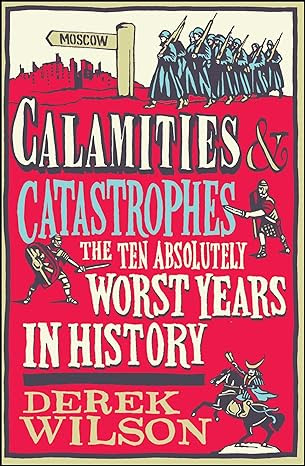
CALAMITIES and CATASTROPHES: THE TEN ABSOLUTELY WORST YEARS in HISTORY by Derek Wilson


Published in 2015 by Marble Arch Press

Going into this book, I knew that I would have a bone to pick with almost every one of the author's choices. After all, there are 5,000 years of recorded history and every last one of them is filled with tragedy. How can you pick and choose the actual worst 10 years?

Wilson, a British historian, focuses in this book on a Western point of view and the earliest date is 541 A.D. So, if you are making a pitch for the 10 worst years in the West in the last 1500 years, his choices are pretty solid.

The years he picks are:

541-542: The first outbreak of the Bubonic Plague weakens the nascent Byzantine Empire and the Persian Empire, killing millions.


1241-1242: The Mongols invade Eastern Europe.

1572: The Spanish Inquisition and everything that came with it.

1631-1632: The worst year of the Thirty Years War.

1709: The Great Freeze

1848: The "Year of Revolutions" in Europe

1865-1866: The assassination of Abraham Lincoln and the failure of the United States to follow through properly with Reconstruction after the Civil War. Also, the rise of terror groups like the KKK.

1942-1943: He almost exclusively focuses on the Russian front - the bloodbaths around Leningrad, Moscow and Stalingrad.


Robert F. Kennedy, Sr. (1925-1968)
1968: The Vietnam War, the assassinations of Martin Luther King and Robert Kennedy, protests around the world.

1994: The Rwandan genocide. There is a lot of focus on how and why the Western powers just watched it happen.

Sometimes, Wilson has a nice turn of phrase in his writing. I especially liked this line from page 151: "Over the centuries, whatever game Europe's nations played, the weakest hand always seemed to be dealt to Poland."

But, there were lots of typos, a weird use of texting-style writing on page 122 and several errors with commas that made me have to re-read passages just to figure out if what Wilson had written was what he really meant to say. Other times, there are factual errors (that may have been editing errors - as I just noted, editing was a real issue in this book). The most egregious error was actually a double error in the same paragraph on page 227. Wilson notes:

 "By the end of 1967 the war had cost the lives of almost 16,000 combat troops and was gobbling up more than $2-3 million per month. What made matters worse was that America's youth had no way of avoiding military service because conscription (the 'draft') still existed."

First: a quick internet search says the Department of Defense spend $168 billion between 1965 and 1972 on military operations in Vietnam. I am sure he meant to say $2-3 billion, not million.

Secondly, there were ways to avoid the draft. Let's look at three recent American presidents. Bill Clinton chose the most popular way to avoid the draft - he went to college. It was no guarantee, but it was a good bet. Many universities grew during the Vietnam War due to increased demand. George W. Bush joined the Air National Guard. Also, it was no guarantee not be sent to Vietnam, but it was not likely. Donald Trump claimed disability (bone spurs in his feet).

I rate this book 3 stars out of 5. The limited focus on the West while claiming to be about all of history was a disappointment. The atrocious editing was also a concern.

This book can be found on Amazon.com here: CALAMITIES and CATASTROPHES: THE TEN ABSOLUTELY WORST YEARS in HISTORY by Derek Wilson.

WHY WE CAN'T WAIT by Dr. Martin Luther King, Jr.


Originally published in 1964.

Why We Can't Wait is Martin Luther King's (1929-1968) well-written defense of the Civil Rights Movement. As the title suggests, it is the argument detailing why African-Americans could no longer wait for the rights that they were guaranteed by the Constitution to be eventually given to them and the best way to do that was the application of nonviolent direct action. 

The strongest part of the argument is the middle third - the entire text of his famed Letter from Birmingham Jail. I think Letter from Birmingham Jail is one of the most profound documents in American history. Its arguments pull from multiple points and authors in history, the very documents and history that white Americans prided themselves as the roots of their own country while King sat in a jail - and shows that those roots were being ignored in defense of the indefensible when it came to African-Americans. It is truly a brilliant piece of writing because it is shows America why it was wrong in its own words in simple, direct, respectful words, calling it to rise up to its own ideals.

I rate this book 5 stars out of 5.

This book can be found on Amazon.com here: Why We Can't Wait.

THE JEFFERSON RULE: WHY WE THINK the FOUNDING FATHERS HAVE ALL the ANSWERS (audiobook) by David Sehat


Published by Tantor Audio in May of 2015
Read by Tom Perkins
Duration: 8 hours, 16 minutes

If you are a person that likes to debate on the internet than you have undoubtedly experienced Godwin's Law. Godwin's Law states that if you debate long enough on the internet, someone will inevitably make a comparison to Nazism, Hitler, the Holocaust ("You don't like Donald Trump's hair? What are you? The hairdo Nazi?!?"). 

A similar rule exists when discussing American politics - eventually someone will refer back to the Founding Fathers. It is especially easy to quote Thomas Jefferson - he was so prolific and well-written that it is easy to break out a quote to support your point of view. In the case of Jefferson, it is often too easy because he was extremely inconsistent in his political views. To start easy, he did write "
We hold these truths to be self-evident: that all men are created equal; that they are endowed by their Creator with certain unalienable rights; that among these are life, liberty, and the pursuit of happiness." And, he also owned a whole lot of people and certainly did not allow them liberty or the pursuit of happiness. He was also advocated strictly following the letter of the Constitution...until it suited him not to when he became President, like with the Louisiana Purchase.

So, Jefferson is quoted all of the time because, likely as not, he has written or uttered a very lofty-sounding quote that supports your point of view, no matter what it is. In short, the man was so inconsistent that he was, at one point or another, on your side and and at a different point he was also against it.

Sehat uses this as a jumping off point in The Jefferson Rule to look at two general phenomena. The first is the traditional big activist government vs. small strict constructionist government argument. In the Washington Administration this was personified with Alexander/Washington on one side and Jefferson on the other.


But, the argument continues throughout American history and Sehat looks at some of the high points in his study, including the debate on slavery, the two crises with secession, The New Deal, the Civil Rights movement, The Reagan Revolution, The War on Terror, Obamacare and the Tea Party movement. 

In his second point, he notes that politicians have always referred back to the Founders and referred to them as if they were a united front, despite the ugly split in the Washington Administration itself. Also, the image of the Founders is changed as needed by current politicians.

I found the whole book to be fascinating and a well-told tour of American history. There were times when I thought Sehat was surprisingly harsh on the liberal side of things than I found him to be equally harsh on the conservative side. To be fair, I think Sehat is harsh on politicians in general and finds them all, no matter their political stripe, guilty of the same sin when it comes to referring to the Founding Fathers.

I rate this book 5 stars out of 5.

This book can be found on Amazon here: 
The Jefferson Rule: Why We Think the Founding Fathers Have All the Answers

LETTER from BIRMINGHAM JAIL (audiobook) by Martin Luther King, Jr.


A Brilliant Essay

Published by Mission Audio in April of 2013.
Originally published in 1963 in various newspapers and magazines
Read by Dion Graham
Duration: 51 minutes

This letter was written in response to a group of African American preachers who were calling for an end to the nonviolent resistance to the racist order in Birmingham, Alabama. This included sit-ins, marches and violating a court order to end all such demonstrations. King was arrested for violating this order (yes, he was arrested for speaking his mind and being involved in a peaceful assembly - a double violation of his First Amendment rights) and kept is squalid conditions in the overcrowded Birmingham jail.

Recreation of the Birmingham Jail cell where this letter was
written at the National Civil Rights Museum in Memphis,
Tennessee. Photo by Adam Jones, Ph.D.
 
Letter from Birmingham Jail was written, at first, on scrap bits of paper and smuggled out by way of his lawyers and re-assembled by his supporters on the outside. The last parts were written on a note pad. The fact that it was written in such a herky-jerky fashion and yet is so cohesive and consistent throughout is simply amazing to me considering how much I go back and revise as I write and discard entire paragraphs as I go along. 

The document itself is more than just a civil rights letter. It is one of those basic expressions of what it is to be an American and why it is so important to guard those rights. As I listened, I was struck by the irony that his arguments were so much like those of the Founding Fathers. In fact, they work so well because King was intentionally using their arguments as his arguments. He was intentionally using the language of those that would oppose his demands for equal rights against them. The letter abounds with Biblical references, references to the Ancient Greeks, the Founders and even to his namesake, Martin Luther. It uses the philosophical underpinnings of Western Culture to demand that Western Culture live up to its own ideals. 

And, it is brilliant.

King's mugshot from his arrest.
I am a history teacher and I would feel completely comfortable placing this document right next to Jefferson's Preamble to the Declaration of Independence, Thomas Payne's Common Sense and Lincoln's Gettysburg Address and Second Inaugural Address in a list of required readings for an American history class. 

Although this was written as a letter, it reads remarkably well as a speech. Dion Graham's performance is excellent. Of course, it helps when your source material is so good. But, do not take this at a swipe at Graham's abilities. He did not choose to mimic King. Instead, he read it in his own voice and he nailed all of the points perfectly. I do not think anyone could read it any better.

I rate this audiobook 5 stars out of 5. 

This audiobook can be found on Amazon.com here: Letter from Birmingham Jail.

This book was added to a "book ban" list in Florida in 2022. Ugh.

Killing Kennedy: The End of Camelot (audiobook) by Bill O'Reilly and Martin Dugard


Published in 2012 by MacMillan Audio
Duration: 8 hours, 25 minutes
Unabridged
Read by the author, Bill O'Reilly

I was a little reluctant to listen to this audiobook because of the author. Not Martin Dugard. This is the third book I have read or listened to that he has written or co-written and I know he can really tell a story. No, it's Mr. "No Spin Zone" that I cannot stand. Our politics are similar but I just find O'Reilly difficult to stomach.

That being said, I enjoyed this audiobook quite a lot.

John Fitzgerald Kennedy
(1917-1963)
O'Reilly narrates Killing Kennedy, which means it's a mixed bag for me. He speaks for a living so he reads it well and knows what phrases and words he wanted to emphasize but, like I said above, a little O'Reilly goes a long way for me. Also, his frequent use of dramatically read foreshadowing that alludes to the date of JFK's assassination got very old very fast.

But, the positives are the way the book is presented. O'Reilly tells the story of JFK from PT 109 forward and gives the reader of the man Kennedy was becoming. JFK's family life, his relationship with his brothers, LBJ and Jackie are explored in great detail and presented in an interesting fashion and really expose Kennedy's good points as well as his considerable failings.

As they tell the story of the Kennedy Administration, O'Reilly and Dugard lay out all of the parties that have been blamed for the assassination: the Cubans, the CIA, the FBI, the Mafia, anti-civil rights crazies and Lee Harvey Oswald. O'Reilly and Dugard acknowledge that these other groups had a grudge against Kennedy but they go with the traditional explanation of Lee Harvey Oswald.

Perhaps the best piece of the book is how well they tell the story of Jackie Kennedy on the day of the assassination. It is a fine piece of writing that brought tears to my eyes at one point (please note, I have not been a particular fan of JFK or of O'Reilly so the fact that a bit of writing read by O'Reilly about JFK brought tears to my eyes speaks volumes about its power).

Well done.

I rate this audiobook 5 stars out of 5.

Reviewed on December 22, 2012

Note: I was provided a copy of this audiobook by the publisher in the hopes of receiving an honest review.

This audiobook can be found on Amazon.com here: Killing Kennedy.

The Culture of Disbelief: How American Law and Politics Trivialize Religion by Stephen L. Carter


A
thoughtful look at the poo-pooing of religion by secular American society


Published in 1993 by Basic Books.

I found The Culture of Disbelief: How American Law and Politics Trivialize Religion while reading another book by Stephen L. Carter, one that I did not care for, Jericho's Fall. However, I am glad I read Jericho's Fall because I found this book listed on a page of the author's other works.


Read the discussion boards on popular blogs, newspaper pages and any other site that attracts people from all walks of life and you will find a strong anti-religious bias. In fact, there is a rather insulting review of this book that does much the same on Amazon.com. Carter takes a look at this relatively new fact of American life - the secularization of everything and the expectation that religious people treat "God as a hobby" and the expectation of people not to use their religious beliefs as a framework for their lives. Fear of someone "imposing" one's religion on another rules all.

Carter explores the history of this movement, looks at legal cases that have run roughshod over religion and discusses the irony of the fact that Martin Luther King and the Civil Rights Movement was based on religious arguments against discrimination and highlighted the main strength of autonomous religion in a pluralistic society: it can serve as a counterweight to government. In more common terms, it can "speak truth to power."

Carter is far from advocating theistic government (he is, in my opinion, very liberal politically), he is merely pointing out that religion cannot be a tool of the state - they have different goals. He warns that "nearly everyone seems to operate with the general presumption that the government can and should regulate in whatever areas suit its constituents' fancy - unless opponents can interpose a claim of constitutional right. And as federal constitutional rights go, the right to exercise religion freely is quite near the bottom of the totem pole."(p. 138)

The only problem with this book is that it is dated. There are many, many references to the 1992 Republican Convention (one that I vaguely remember for a particularly vitriolic speech by Patrick Buchanan) which was the last big national event that involved religion and politics. I would love for Stephen L. Carter to re-write this book and include recent events such as the Jeremiah Wright controversy, the Schiavo case, Islam in America and so much more.

I rate this book 5 stars out of 5.

This book can be found on Amazon.com here: The Culture of Disbelief.

Reviewed on September 19, 2009.
<

Featured Post

<b><i>BAN THIS BOOK (audiobook)</i></b> by Alan Gratz

Published in 2017 by Blackstone Audio, Inc. Read by Bahni Turpin. Duration: 5 hours, 17 minutes. Unabridged. My Synopsis Ban This Book is t...

Popular posts over the last 7 days