Showing posts with label England. Show all posts

HARLEQUIN (Grail Quest 1) (audiobook) by Bernard Cornwell


Originally published in 2000.

Performed by Andrew Cullum.

Duration: 14 hours, 49 minutes.

Unabridged.

Also published under the alternate title "The Archer's Tale"

Harlequin is the tale of Thomas of Hookton during the early years of the Hundred Years' War. Hookton was a tiny English fishing village that was destroyed by French raiders from a ship. The raiders burn and loot the village, kidnap as many women they can, burn the village, and steal a religious relic - the famed lance that St. George used to kill the dragon.

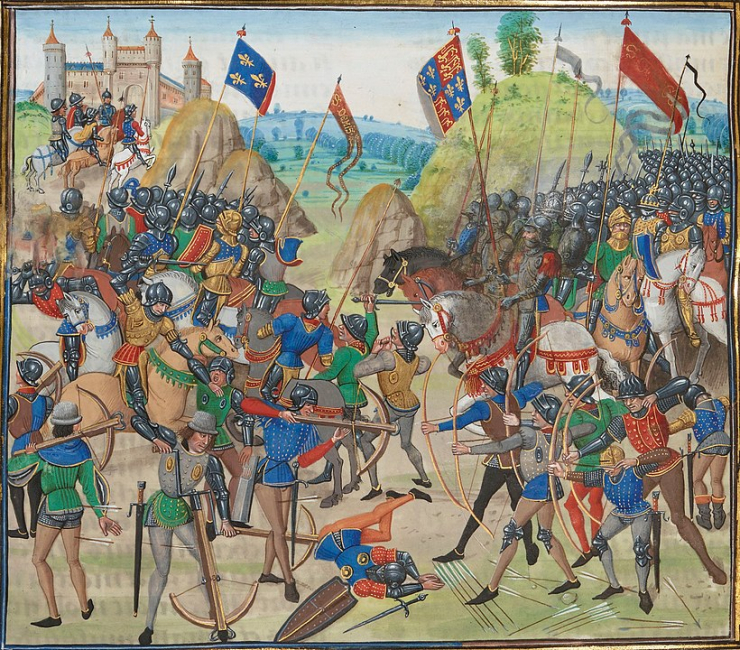
Thomas heads off to join up as an English archer so he can get his revenge on the French noblemen that destroyed his hometown and get St. George's lance back. The bulk of the book is about his adventures in France in a series of battles in the Hundred Years' War serving as a harlequin.  A harlequin was the French term for an English long bow archer.

The battle scenes in this book are unbelievably well-told and Andrew Cullum's performance as the reader is fantastic - one of the best performances I have ever heard and this is my 799th audiobook review. 

But, I found the stuff in between the battles to be quite tedious. Normally, I am cool with all of the medieval rules and the posturing - but this was simply too much. This leaves me in the weird situation of praising a book, giving it a positive score (4 out of 5 stars) and choosing not to move on with the rest of the series.

This book can be found on Amazon.com here: Harlequin by Bernard Cornwell.

THE EARLY MIDDLE AGES (The Great Courses) (audiobook) by Philip Daileader


Published in 2013 by The Great Courses.
Lectures delivered by the author, Philip Daileader.
Duration: 12 hours, 32 minutes.
Unabridged.

The idea behind The Great Courses is that anybody can have access to high quality college instructors who are truly experts in their fields. In this course the focus is the Early Middle Ages (roughly 300 CE to 1000 CE). 

Daileader starts with the start of the decline of the Roman Empire, somewhere around the year 300 CE. He looks at the trends of the late Roman Empire and how they led to the fall of the Roman Empire in the West (Rome, not Constantinople) and how those trends led to the political and economic systems that typify the time period we know as the Middle Ages.

There is a heavy focus on what is now France, which is well-deserved since Charlemagne is one of the biggest historical figures of this era. But, other areas get a fair amount of attention, like Ireland, Spain, and the Islamic world. The sudden appearance of the Vikings contributed a lot as well. The Byzantine Empire

Church doctrine and politics play a prominent role throughout.

I found this series of half hour lectures to be interesting, but not riveting. The section on the political machinations that eventually led to the rise of Charlemagne's empire was slow - necessary but tedious until it finally pays off and you just sit and wonder how it all worked out the way it did. 

I rate this audiobook 4 stars out of 5. It can be found on Amazon.com here: The Early Middle Ages (The Great Courses) by Philip Daileader.  

THE FEARLESS BENJAMIN LAY: THE QUAKER DWARF WHO BECAME the FIRST REVOLUTIONARY ABOLITIONIST (audiobook) by Marcus Rediker


Published in 2017 by Brilliance Audio.
Read by Cornell Womack.
Duration: 7 hours, 2 minutes.
Unabridged.

As the title states, Benjamin Lay (1682-1759) was indeed a Quaker and a dwarf. He grew up in the Quaker faith in England, learned how to spin cloth and sew gloves and then took those skills to see and became a sailor. Eventually, he settled in Barbados and became a merchant. Barbados was a plantation colony and Lay got to know several of the slaves and their owners and the experience turned him into an abolitionist, a concept that was nearly unknown in a world where slavery was commonplace.

Lay moved to Philadelphia and naturally joined the local Quakers. Lay had always been an agitator back in England and was often in trouble with local church officials for questioning what they were teaching. Now, he ramped things up considerably in the hopes of convincing the Quakers that slavery was an evil that should not be tolerated in their midst.

He published an anti-slavery book that was published by Benjamin Franklin - a fact that Franklin kept secret because being anti-slavery was a radical idea. Later, Franklin himself became a public face for anti-slavery but Lay was far ahead of him.

Lay also protested physically and verbally at every Quaker meeting (service) that he attended. He called out the slave owners by name and was often punished for it.

He ended up living in a little hut on the edge of Philadelphia where he refined his beliefs ever further and became a vegan because he did not want to harm any living creature.

This bare bones outline of his life seems radical and interesting, but the presentation in the book was not. This is one of those biographies that seeks to include every detail of its subject's life and in doing so becomes his or her definitive biography. It's a worthy goal, but the first 2-3 hours of this book featured a whole lot of citations of church paperwork about whether or not Benjamin Lay was in good standing or not and what he would have to do to return to good standing. It was tedious. 

The reading by Cornell Womack was subpar. He has a distinctive voice, but he often reads mundane things (like lists) as if they are dramatic moments. It got old, especially when combined with the excessive detail.

I rate this audiobook 3 stars out of 5. It can be found on Amazon.com here: The Fearless Benjamin Lay: The Quaker Dwarf Who Became the First Revolutionary Abolitionist.


BRIAN EPSTEIN: A LIFE from BEGINNING to END (kindle) by Hourly History


Published by Hourly History in 2024.

Brian Epstein was a record store owner from Liverpool that heard the Beatles play in a local club and decided that they were going to be really big and he knew how to make that happen. He asked for a meeting to discuss being their manager and about two months later they had an official deal.

The young Beatles were impressed by Epstein. He dressed well, had polished mannerisms, drove a nice car, and had the most successful record store in Liverpool.  Not much about Epstein's earlier ventures would have indicated that Epstein would have had any success at managing the Beatles. He was a college dropout and had bounced around from one thing to another until his father let him use part of the family store to sell records. He parlayed that into a stand-alone store and became well-known in the Liverpool music scene. 

To be fair, this was a different music scene than what followed from the 1970s. It was very much a bottom up industry - a band could become big in a relatively small market, like Liverpool and, based on local record sales, could explode out into the world. Tommy James and the Shondells (not in this book) did a similar thing out of Pittsburgh, as detailed in his autobiography that I have previously reviewed. 

From left to right: George, Paul, Ringo, Brian and John.
Epstein cleaned up the Beatles and made them in his own image. He put them in suits and made them be very polite and polished (but still fun) young men. They rocketed to the top, and Epstein managed it all - the TV appearances, tours, the hotels, the venues. He did it all with no prior experience and it seemed to take a massive toll on him, leading to drug abuse and his eventual death in 1967 at the age of 32.

This little biography (it takes about an hour to read, as does everything from the publishers at Hourly History) covers a lot of detail. The reader learns about the original Beatles drummer (Pete Best) was pushed out in favor of Ringo Starr, Epstein's semi-closeted homosexuality, the drug abuse, all while presenting Epstein in a humane light. Some of Hourly History's biographies fail to give the reader a sense of the person behind the story. This one succeeded.

I rate this short e-book 5 stars out of 5. It can be found on Amazon.com here: Brian Epstein: A Life from Beginning to End.

FALKLANDS WAR: A HISTORY from BEGINNING to END by Hourly History


Published in 2020 by Hourly History

Hourly History specializes in one hour reads about a historical topic. Giant events in history don't fare to well in this series, but a war that lasted 2 and 1/2 months is perfect for this format.

This little history tells the history of the Falklands (it keeps switching hands between the U.K., Argentina, and France with occasional periods pf complete abandonment) and continues on to detail the political situations in Argentina and the U.K. leading up to the war.

I was 14 years old during this war and one of my friends was very interested in this war while it was going on so I heard about it a lot. But, it turns out that I was about half right about everything I remembered. Surprise! 14 year old misses a lot of things!

I thought this was an excellent little history. I rate this e-book 5 stars out of 5. It can be found on Amazon.com here: Falklands War: A History from Beginning to End


MALAYAN CAMPAIGN: A HISTORY from BEGINNING to END (kindle) by Hourly History


Published by Hourly History in 2021.

Hourly History writes short histories and biographies that take the average reader about an hour to read. Sometimes they try to explain too much in a short book (such as the Mayan Civilization, for example.) But, an hour is plenty of time to explain the basics of a military campaign that lasted 2 months and 8 days.

When the Japanese Navy attacked the American naval forces at Pearl Harbor in Hawaii on December 7, 1941 it was actually part of a much larger, highly coordinated push against all Western forces in the Pacific and in East Asia. American forces were also attacked in the Philippines, for example.

This push also included the British-held Malay Peninsula and Singapore that started on December 8.

Britain had not provided much of a defense for this area, which was understandable considering the dire threat Britain itself faced from Nazi forces in Europe.

The Japanese landed with a slightly smaller force than the British had, but the British were completely surprised by the attack and the Japanese pushed hard towards Singapore and never stopped pushing. This did not allow the British to coordinate their forces and led to a quicker defeat.

British forces in this area did not have top shelf equipment, unlike the Japanese. The most surprising piece of military equipment in the campaign was something no one really expected - bicycles. The Japanese utilized bicycles to move their infantry quickly down the peninsula, despite the rugged terrain.

For a reader that is looking to fill in a few blank spots in their knowledge of World War II, this series would be a good place to start. 

I rate this e-book 4 stars out of 5. It can be found on Amazon.com here: Malayan Campaign: A History from Beginning to End.

AGE of REVOLUTIONS: PROGRESS and BACKLASH from 1600 to the PRESENT (audiobook) by Fareed Zakaria


Published by Simon and Schuster Audio in 2024.

Read by the author, Fareed Zakaria
Duration: 13 hours, 2 minutes.
Unabridged.

Fareed Zakaria's Age of Revolutions: Progress and Backlash from 1600 to the Present is exactly what the title says it is.

Zakaria writes about the beginnings of capitalism, multi-cultural societies, globalism, democracy, the industrial revolution, the French Revolution, the Russian Revolution, Fascism, the failed Arab Spring, LGBTQ+ rights, and the rise illiberal democracy and the return on authoritarianism and the forces that pushed back (or overturned) them.

The author
Zakaria has clearly done his research and writes in such a way that it flows from one topic to another almost as if they entire book was just one big story (which it is, if you look at it as the story of humanity, especially The West.)

If you find yourself wondering how we got here, this is a good place to start. Zakaria breaks down complex movements and ideas and makes them understandable.

I rate this audiobook 4 stars out of 5. It can be found on Amazon.com here: Age of Revolutions: Progress and Backlash from 1600 to the Present by Fareed Zakaria

PRINCESS DIANA: A LIFE from BEGINNING to END(BIOGRAPHIES of BRITISH ROYALTY) (kindle) by Hourly History


Published in 2022 by Hourly History

This was a very odd choice for me to read for a couple of reasons:

1) I don't normally enjoy the gossip magazine type of stories.
2) I don't follow the modern English royal family - I find them to be annoying.
3) I don't really follow the English royal family in the history books, either.

Here's how we got here. Hourly History offers several free e-books every weekend and I picked up the book on Princess Diana for some unknown reason. And, six months later I accidentally picked the Princess Diana book with my fat thumb while using my e-reader app on my phone. I could have removed the download, but I decided to just go with it. Turns out, this was a happy accident.

I am not going to go over Diana's life story in this review. I will just say that this rather short biography (the publisher intends that its books take about an hour to read) was interesting and pleasant to read. A lot of it was information I remember just from being alive when all of this story was going on, but it was well-written.

I rate this e-book 4 stars out of 5. It can be found on Amazon.com here: PRINCESS DIANA: A LIFE from BEGINNING to END(BIOGRAPHIES of BRITISH ROYALTY) by Hourly History.

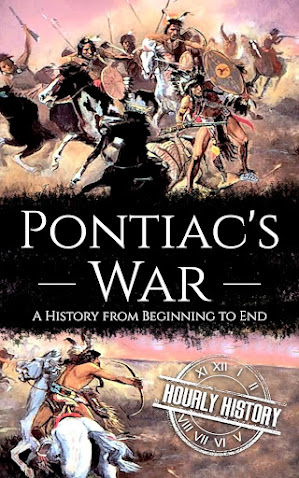
PONTIAC'S WAR: A HISTORY from BEGINNING to END (kindle) by Hourly History


Published by Hourly History in 2021.

Hourly History publishes histories and biographies that you can read in about an hour. That can be a tough job for larger topics in history like "The Industrial Revolution" or "The Roman Empire" but it works out about right for this short war (1763-1766.)

The war arose directly from unaddressed issues as a consequence of the French and Indian War (1754-1763.) In the French and Indian War, the American frontier became a battlefield. American settlements were wiped out, Native American villages were destroyed. French and English soldiers participated and ultimately agreed to a settlement that ignored the realities of the vast borderlands between the colonies and the Native Americans.

The biggest issue was constant push westward from European (American) settlers into areas that were already inhabited by Native Americans. The colonies were all for this westward push, even if the British government was ambivalent or even against the idea. 

Pontiac was an Ottawa. They were centered in the Great Lakes in and around Michigan. Pontiac wanted the French government to resume control of the area - something that simply was not going to happen.

Pontiac was sick of the English colonies moving westward. He encouraged all of the Native American groups to join together to overwhelm the British forts in Michigan, Indiana, Ohio, Pennsylvania and upstate New York. He led an attack against Fort Detroit that failed, but a number of smaller forts fell, including Fort Ouiatenon near modern-day Lafayette, Indiana. I only mention Fort Ouitatenon because I live in Indiana, have been to the fort, and this is the only time I have ever seen the fort mentioned in a history book.

Once the British figured out that it was a united push against their forts and settlements they slowly pushed more troops into the area. They began with only 500 soldiers to hold an area that comprises all or parts of upstate New York, western Pennsylvania, Ohio, Indiana, Michigan, part of Illinois and nearby areas of southern Canada.  Transportation was horribly slow and more than once the united Native Americans attacked, blocked or diverted attempts to reinforce forts. 

It isn't quite clear how big a part Pontiac had in this war. The British considered him to be one of the big leaders - big enough that they called the war Pontiac's Rebellion. But, seeing the number of other critical errors and misunderstandings they committed during the war, it is entirely possible that they imagined him to be THE leader when he was actually one of a number of leaders.

The agreements in this war didn't last for long and did not resolve the underlying issues. There were three other wars and countless skirmishes in this area with the exact same issues in the 50 years that followed. 

I rate this short e-book 5 stars out of 5. It can be found on Amazon.com here: PONTIAC'S WAR: A HISTORY from BEGINNING to END by Hourly History.

THE LAST SAXON KING: A JUMP in TIME NOVEL, BOOK ONE (audiobook) by Andrew Varga


Published by Imbrifex Books in March of 2023.
Read by Mark Sanderlin.
Duration: 8 hours, 49 minutes.
Unabridged.


Synopsis:

Dan Renfrew is a self-described homeschooled nerd and his life has been turned upside down. He watched his father get stabbed by a stranger who invaded their house and he has no idea if he is even alive. 

Now, thanks to a magical device, Dan is in Medieval England and caught up in an army on the move. He learns that his father is a "time jumper" - men tasked to fix glitches in time and make sure the timeline plays out the way it is supposed to.

The year is 1066 - just a few days before King Harold Godwinson meets and defeats one of the last Viking invasions of England at the Battle of Stamford Bridge. Even more importantly, King Harold will be forced to meet the forces of William, the Duke of Normandy in just a few days and will be defeated at the Battle of Hastings.

But, something is wrong and even though Dan has almost no idea what to do, he has to make sure that history isn't manipulated by sinister forces that can also travel in time...

My review:

Harold Godwinson from the Bayeux Tapestry
I liked this book quite a bit. The history is gritty and full of gore thanks to Dan being plunked in the middle of (arguably) the two most important battles of the  English medieval era. Limbs get hacked off, blood sprays in people's faces and intestines spill out onto the ground. None of this glorified in the book - in fact, Dan is horrified over and over again at the brutality of it all. 

The addition of the evil "time jumpers" adds a level of danger and intensity to the experience, especially when the reader finds out more about them in the last part of the book. And, it turns out that Dan is not the only good "time jumper" back in 1066, which lets the reader learn more about what is going on bit by bit as Dan learns.

The epilogue at the end of the story fleshes out the history that Dan just went through a bit more to give the reader some additional context. 

Since this book is the start of a series, the most important questions is "Would you read book 2 in the series?"

The answer is yes, I think this series looks like it could be quite strong. 

I rate this audiobook 4 stars out of 5. It can be found on Amazon.com here: THE LAST SAXON KING: A JUMP in TIME NOVEL, BOOK ONE by Andrew Varga.

GALLIPOLI CAMPAIGN: A HISTORY from BEGINNING to END (kindle) by Hourly History


Published by Hourly History in December of 2022.

The short histories produced by Hourly History are designed to read in about an hour. In some cases the size limit makes for a very incomplete history. In this case, I thought that topic and the size limit matched up pretty well.

The Gallipoli Campaign was an unmitigated disaster during World War I. Winston Churchill (yes, the famous one from World War II) was the head of British navy and thought up a plan to do three things:

1) relieve the pressure on Russia from the Germans and the Ottomans;
2) possibly knock the Ottoman Empire out of the war;
3) encourage the Germans to divert more troops away from the French front to support the Ottoman Empire.

The plan Churchill came up with was to land thousands of soldiers from France, Britain, Australia and New Zealand on the Gallipoli Peninsula at the edge of the Aegean Sea in a quick and bold attack.

Troops from Australia and New Zealand landing at 
Gallipoli - April 25, 1915.
What actually happened was bold, but certainly not quick. The attack was disjointed and so poorly planned that the Ottomans were entirely prepared for the invasion...

Normally, I really don't care much for studying up on World War I - it was started for rather silly reasons in my opinion and the United States had little reason to get involved (Yes, I know that the Gallipoli campaign was before the U.S. got involved.) 

That being said, I was glad to learn more about the campaign that is always referred to in the histories I have read, but never explored in any sort of depth. This book gave me enough information to fill in this gap in my knowledge to my satisfaction.

I rate this book 4 stars out of 5. It can be found on Amazon.com here: GALLIPOLI CAMPAIGN: A HISTORY from BEGINNING to END (kindle) by Hourly History.


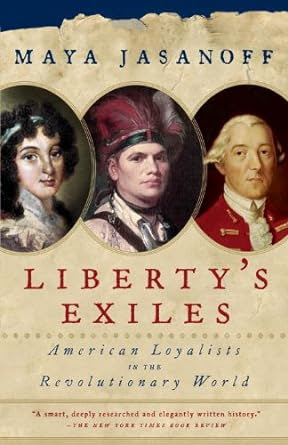
LIBERTY'S EXILES: AMERICAN LOYALISTS in the REVOLUTIONARY WORLD (audiobook) by Maya Jasanoff

Published by Recorded Books in 2012.
Read by L.J. Ganser.
Duration: 16 hours, 10 minutes.
Unabridged.


In 1783, at the end of the Revolutionary War, Loyalists (Americans who opposed the American Revolution and stayed loyal to Britain) had a choice to make - stay and ride out the anti-Loyalist bias in the United States or move somewhere else.

In the two years between the last major engagement (Yorktown) and the official end of the war and withdrawal of British troops the British decided to evacuate any Loyalists that wanted to go to other parts of the British Empire. One of the biggest advocates of this position was Guy Carleton, the British commander in America after Yorktown who later went on to become the Governor-in-Chief of Canada. He had more to do with what happened in this history than any other single person.

Guy Carleton (1724-1808)
The British government made an effort to make things right for these Loyalists. Not many Loyalists were completely reimbursed, but the fact that an effort was made was extraordinary for the day. In some cases, Loyalists were offered large grants of land, in other cases they were offered smaller grants of land and in other cases they were offered pensions and partial reimbursements for lost property. All of these offers were new innovations and a sign that the British government wished to honor the loyalty they had shown.

Some loyalists wanted nothing more than to start over, some looked to just work themselves up the British societal ladder, some wanted to get away from British society and some looked for a chance to get even with the Americans. 

There was a racial component to this as well. The British had offered freedom for any slaves that left their masters and joined their armed forces. The Americans pressured them to return the runaway slaves (including slaves from George Washington and Thomas Jefferson) but the British refused to go back on their deal with the former slaves as a point of honor. However, those former slaves oftentimes were given less money and less land than white Loyalists when they arrived at their new homes.

The British tried to honor the commitments shown by the Native American allies as well, but not nearly as much. 

Loyalists ended up going all over the empire but mostly to Canada. There were several families that went to Bermuda and Jamaica and back to England itself. Several families of African descent moved to Sierra Leone in Africa as part of an experimental colony. A few went even further to India. 

The section on the Canadian settlement was, at first, interesting but it soon got bogged down. It was all relevant detail, but just too much for me. In fact, that's pretty much my review of the entire book.

I rate this audiobook 3 stars out of 5. It can be found on Amazon.com here: LIBERTY'S EXILES: AMERICAN LOYALISTS in the REVOLUTIONARY WORLD (audiobook) by Maya Jasanoff.

CRIMEAN WAR: A HISTORY from BEGINNING to END (kindle) by Hourly History


E-book published by Hourly History in 2020.

Hourly History specializes in histories and biographies that take about an hour to read. In the case of the Crimean War (1853-1856), I think that's about right.

The war was the result of European alliance politics. Russia was looking to push into Ottoman territory. The Ottomans were considered to be pretty weak and certainly on the decline after centuries of being a major power. The Austrian Empire was a traditional ally to the Russians, but decided to stay neutral. The Prussians were just starting out so no one really cared what they did. Even though they had been traditional rivals for centuries, England and France decided that they had to intervene on behalf of the Ottoman Empire in order to stop Russia from becoming too powerful. 

The French and the English sent troops all of the way to the Ottoman Empire and then up into the Black Sea and landed troops on the Crimean Peninsula and the war was on.

The war itself is worthy of note for several reasons, including:

1) France and England worked together as allies. It was the beginning of what has mostly been the default position ever since;
2) Florence Nightingale's work as a nurse;
3) The Charge of the Light Brigade and the poem of the same name describing the futility of the attack and the by Alfred, Lord Tennyson featuring the line "Theirs not to reason why, Theirs but to do and die";
4) Exposed the weaknesses of Russia and the Ottoman Empire. Those weaknesses led to revolutions within 70 years;
5) It was demonstrated that rifled weapons were vastly superior to older style weapons;
6) Trench warfare was introduced. This pointed towards what would be the signature fighting style of World War I sixty years later;
7) The media of the day was able to relatively quickly send stories back from the front due to new technologies;
8) Photography brought realistic views of the war back to the English and French public.

This book does a good job of explaining the war, the causes, the military results and the short term and long term results. 

I rate this e-book 5 stars out of 5. It can be found on Amazon.com here: Crimean War: A History from Beginning to End

THE HUNDRED YEARS WAR: A HISTORY from BEGINNING to END (kindle) by Hourly History


E-book published in 2019 by Hourly History.

Hourly History is a series of histories and biographies that a reader can read in about an hour. Sometimes, that works out quite well. Sometimes, the topic is just too big to cover in an hour.

I think the Hundred Years War is one of those topics. 

Before I read this book I knew a few facts about the war: It was over dynastic struggles over the throne of France, the Battle of Agincourt, Joan of Arc.

Nothing in this book is incorrect, but I didn't really learn a lot more than I knew before. There is a parade of kings, royal family members and advisors - but there's rarely any detail that makes it interesting. For example, the book mentions an insane French king, but it does not mention that he believed that he was made out of glass and believed that he had to be careful that he would get bumped over and would smash to pieces. 


If you know literally nothing of the war, this is an adequate place to start.

I rate this audiobook 2 stars out of 5. It can be found on Amazon.com here:  
THE HUNDRED YEARS WAR: A HISTORY from BEGINNING to END (kindle) by Hourly History.

KING RICHARD III: A LIFE from BEGINNING to END (BIOGRAPHIES of BRITISH ROYALTY) by Hourly History


Published in 2019 by Hourly History.


Hourly History is a series of histories and biographies that a reader can read in about an hour. Sometimes, that works out quite well. Sometimes, the topic is just too big to cover in an hour.

I am an avid reader of history, but I have areas of weakness that I am perfectly willing to shore up a bit, but I don't want to invest a ton of time. I want to know a bit more, not become an expert. The British Royal Family is just one of those areas for me. I know more than most people, but I can see the glaringly empty areas of my own ignorance.

I recently read Hourly History's biography of Henry VII (the king that defeated Richard III in battle and took his throne). Usually, I find the British Royal family to be a tedious topic, but I found the Henry VII biography to be quite interesting. I was hoping to have a similar experience with the biography of Richard III.

King Richard III (1452-1485)
Richard III took the throne towards the end of the slow motion civil war known as The War of the Roses. Richard started out as a loyal and devoted follower of his brother (Edward IV) who pretty much let him rule Northern England as a sort of mini-kingdom. Richard dealt with Scotland and border incursions and consolidated English royal control over some of the major noble families of the region.

When Edward IV died, Richard was supposed to step in and serve as Lord Protector for Edward V. Edward V was only twelve years old and Richard was to rule in his stead until Edward V came of age. 

This is where Richard III's story becomes complicated and very much like an episode of Game of Thrones...

This is an exciting story (Shakespeare wrote a play about it because it was so rich in drama) but this short biography just fails to convey that drama. 

I rate this biography 3 stars out of 5. It can be found on Amazon.com here: KING RICHARD III: A LIFE from BEGINNING to END (BIOGRAPHIES of BRITISH ROYALTY) by Hourly History.

KING HENRY VII: A LIFE from BEGINNING to END (BIOGRAPHIES of BRITISH ROYALTY) by Hourly History


Hourly History is a series of histories and biographies that a reader can read in about an hour. Sometimes, that works out quite well. Sometimes, the topic is just too big to cover in an hour.

I am an avid reader of history, but I have areas of weakness that I am perfectly willing to shore up a bit, but I don't want to invest a ton of time. I want to know a bit more, not become an expert. The British Royal Family is just one of those areas for me. I know more than most people, but I can see the glaringly empty areas of my own ignorance.

King Henry VII of England (1457-1509)
Henry VII was the king that ended the a civil war between competing royal families - The War of the Roses. It was not a sure thing, though. It was a long shot for him to even survive, let alone make it to the throne. Normally, these complicated royal stories bore me, but this one had a lot of dramatic elements - murder of children, escapes, battles, betrayal, the death of a king on the battlefield, and more.

The length of this e-book was perfect. I rate this e-book 4 stars out of 5. It can be found on Amazon.com here: 
KING HENRY VII: A LIFE from BEGINNING to END (BIOGRAPHIES of BRITISH ROYALTY) by Hourly History.

THE BOMBER MAFIA: A DREAM, A TEMPTATION and the LONGEST NIGHT of the SECOND WORLD WAR (audiobook) by Malcolm Gladwell


Published in 2021 by Pushkin Industries.
Read by the author, Malcolm Gladwell.
Duration: 5 hours, 14 minutes.
Unabridged.


Before there was a U.S. Air Force, there was the U.S. Army Air Corps. Before the Army Air Corps (re-organized as the U.S. Army Air Forces in 1942) built the largest collection of flying fighting machines to relentlessly bomb the Axis Powers in World War II, they had a tiny budget and a few air bases. One of these was Maxwell Field, a training facility in Alabama. That facility became the intellectual home of a group of pilots who espoused the concept of precision bombing. They were known as The Bomber Mafia.

Precision bombing is the theory that teaches that you don't have to blow an enemy's entire military to pieces, you can just hit certain key industries and choke out their ability to produce more weapons/feed their people/move soldiers and so on. This was intended to be a more humane way to wage war - an antidote to the mass slaughter the world saw in World War I. Precision bombing could end wars before they got to that point by simply forcing an opponent to stand down. The invention of the Norden Bomb Sight convinced them that bombers could fly as high as they wanted over the enemy and could still drop bombs precisely where they wanted them

The other argument when it comes to bombing is strategic bombing. Strategic bombing, in simple terms, is brute force bombing. It is simply dropping bombs on enemy territory to inflict maximum mayhem and damage with the goal of breaking the morale of the enemy. Think of it as something like Sherman's infamous March to the Sea from the Civil War, but delivered from the air.

In the European Theater, the U.K.'s Royal Air Force followed a policy of strategic bombing. They flew at night in order to give their pilots cover and they indiscriminately dropped bombs on German cities. The Americans flew during the day and used the daylight to try to hit certain high value targets as part of a precision bombing strategy. 

This audiobook is about the debate over the two points of view, specifically in the Pacific Theater. For months, the United States tried precision bombing, but a combination of things made it difficult, including factors like the weather was much more erratic and the manufacturing base was more diffuse (a lot of parts were actually made by small-time family-based manufacturers).

US Navy Grumman TBF Avenger aircraft dropping
bombs on 
Hakodate during July 1945
When Curtis LeMay arrived in the Pacific Theater, he brought a different plan. He had personally flown and led precision bombing missions and was not impressed. He brought massive fire bombing campaigns to Japan and leveled city after city.

Gladwell comes up with a mixed bag of conclusions. He gives the impression that strategic bombing was the obvious choice, but it clearly wasn't that simple. LeMay leveled huge chunks of 66 Japanese cities and the Japanese kept on fighting. Tokyo was hit so hard that it was actually removed from the official target list. 

Imagine of the situation was reversed and America was subject to such attacks. New York City would be hit so hard that it was effectively gone and so would the next 65 cities by population. That would include Chicago, Los Angeles and Dallas, of course. But that would also include the destruction of such smaller cities as Indianapolis, Albuquerque, Milwaukee, Cleveland, Fresno, San Juan (Puerto Rico), Tulsa, Corpus Christi, Tampa and Cincinnati.  Would we have kept fighting?

I say we would have kept right on fighting. Strategic bombing was used against England at the beginning of the war and, in the end, it seems to have made England all the more determined to fight and inflict as much strategic bombing as possible on Germany. One could argue that the Germans and Japanese surrenders owed more to fear of Soviet occupation than a desire to end the firebombings. 

Gladwell brings the discussion into the modern world with discussions of cruise missiles that can hit specific GPS locations and drones that can target individual people. He gives the impression that precision bombing is actually the way to go. 

But, did our targeted "Shock and Awe" campaign in the Iraq in 2003 make the Iraqi people decide to just go along with America's plans? Did the Taliban just quit even though we killed who knows how many of them with drone attacks that demonstrated we have the ability to sift through all of the data, figure out who they are and find them no matter where they hide?

What were are left with is an unresolved question even though Gladwell gives the impression that he did provide them.

But, the discussion was interesting.

This audiobook was produced by Gladwell's podcasting company. He includes special effects and audio from the time period and interviews that were conducted after the war. It was a really slick production.

I rate this audiobook 4 stars out of 5. It can be found on Amazon.com here: THE BOMBER MAFIA: A DREAM, A TEMPTATION and the LONGEST NIGHT of the SECOND WORLD WAR (audiobook) by Malcolm Gladwell.

KING PHILLIP II: A LIFE from BEGINNING to END (Kindle) by Hourly History


Published in 2020 by Hourly History.

King Philip II (1527-1598) ruled Spain at its most powerful. This is the Spain that took over Portugal, consolidated its New World holdings, conquered the Philippines, stopped Ottoman naval expansion in the Eastern Mediterranean, stopped Protestant expansion in several areas yet lost the Spanish Armada to the English and suffered a series of losses in the Netherlands. It was the first that could reasonably claim that the sun never set on its empire. 

Philip's personal life takes up a lot of this book. For such a powerful man, his personal life had to humble him. He had multiple wives who died from a variety of ways, but usually related to giving birth.  He also lost several children.

His oldest son suffered from physical and mental illnesses that were so pronounced that the Philip II stepped in and barred his son from being next in line for the throne. That son died in custody, possibly by making himself ill while being held in confinement by poisoning himself or freezing himself by covering himself in ice and sleeping on beds of ice.

The beauty and the weakness of this book series is the brevity of each book. They are designed to be read in about an hour, which means I can explore a whole new area or person with little time commitment. But, I always end up with questions. In this book, Philip's self-assigned role as a defender of the Catholic faith and the politics in that arena was given light treatment.

I rate this short e-book 3 stars out of 5. Nothing wrong with this book - it doesn't make the reader an expert, but it did fill in some blanks in my personal knowledge of this time period.

This e-book can be found on Amazon.com here:  King Philip II: A Life from Beginning to End in 2020 by Hourly History.


SUBHAS CHANDRA BOSE: A LIFE from BEGINNING to END (kindle) by Hourly History


Published by Hourly History in 2020.


I am an avid reader of history, but I have areas of weakness that I am perfectly willing to shore up a bit, but I don't want to invest a ton of time in. The long history of India is just one of those areas for me. I know more than most people, but I can see the glaringly empty areas of ignorance.

Subhas Chandra Bose was one of those people for me. I had heard of him, but only described as sort of an "anti-Ghandi". He wanted independence as much as Ghandi did, but thought the non-violent protests were a waste of time. Subhas Chandra Bose was not only willing to fight - he thought it was the only way India would be free of English rule.

Bose was born in India but formally educated in England. He was poised to take his place in the bureaucracy of colonial India. But, he rejected that offer and became active in the independence movement. 

As World War II loomed, Bose saw it as an opportunity to free India. He approached the Fascist powers for support. Germany and Italy poo-pooed him but Japan saw the potential and financed a army of Indian nationals - but waited too late to make a difference. 

The beauty and the weakness of this book series is the brevity of each book. They are designed to be read in about an hour, which means I can explore a whole new area or person with little time commitment. But, I always end up with questions. In this book, I found myself wondering how much faith the Japanese really had in Bose and his army and why they waited so long to fund it.

I rate this book 4 stars out of 5. It can be found on Amazon.com here:  SUBHA CHANDRA BOSE:  A LIFE from BEGINNING to END (kindle) by Hourly History.

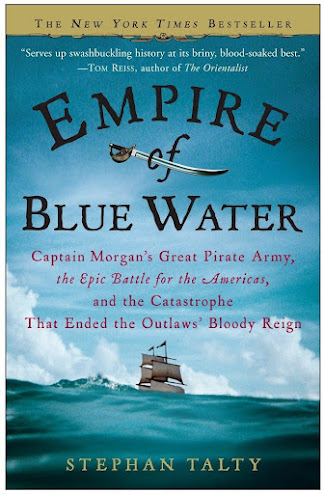
EMPIRE of BLUE WATER: CAPTAIN MORGAN'S GREAT PIRATE ARMY, the EPIC BATTLE for the AMERICAS, and the CATASTROPHE that ENDED the OUTLAWS' BLOODY REIGN (audiobook) by Stephan Talty


Published in 2007 by Random House Audio
Read by John H. Mayer
Duration: 13 hours, 26 minutes.
Unabridged.

Stephan Talty writes a lot about pirates in Empire of Blue Water. Not modern pirates, but the swashbuckling pirates that most Americans imagine when they hear the word "pirate". The modern personification of that word is Johnny Depp's Captain Jack Sparrow. In the late 1600s, the personification of that word was a Welshman named Henry Morgan.

Morgan was technically not a pirate. He was a privateer. If you were in the Spanish government, there was not much of a difference between a privateer and a pirate, except that privateers came with an extra level of annoyance. 

17th century England did not have the money to expand the Royal Navy enough to confront Spain. Spain was more than 200 years into looting the Americas and had a very, very large navy to protect that loot as it came across the Atlantic to the home country. 

England did have something that Spain did not have - a lot of entrepreneurs that owned their own ships. England decided to license any interested ships to attack Spanish ships for their cargoes. The crown got a cut and basically a navy for hire. 

Privateer ships were staffed by a diverse group of men (women were almost never allowed on one of their ships). They were very democratic - everyone got to vote on targets and everyone got an equal share of the booty afterwards. Bonus shares were given to men who performed bravely or completed certain acts in battle. Once a target was chosen, the officers had command and their orders were to be followed - or else. Officers got bonus shares. If you were injured, you were compensated from the loot. If you died, your heirs were compensated. 

Pirate ships worked a lot like privateer ships, except they did not have to report back to any government and share any of their treasure. But, they had no safe havens to return to. If a Spanish ship chased a privateer, it could, theoretically, flee towards any English port and find safety. 

Jamaica served that purpose in the Caribbean, particularly the city of Port Royal. Port Royal was destroyed by an earthquake in the 1690s. It was never rebuilt, but at one point it was the largest and wildest city in any English colony in the New World. You could easily make an argument that it was the wildest port in the entire English empire.

The danger with privateers, of course, is that once unleashed, they are hard to rein in. The English came to an agreement with the Spanish that was dependent on the privateers stopping and then had a very hard time bringing them under control - until someone had the bright idea (not being sarcastic) of bringing Henry Morgan into the government of Jamaica and letting the ultimate privateer bring the privateers under control.

Talty talks about A LOT of things in this book. It is a thorough examination of the entire privateer phenomenon - from the instability of the Spanish royal family to the ossification of the Spanish bureaucracy to the craziness of Port Royal, Talty tells the story well. 


Where he falls short is the description on just about any military campaign. It becomes an unending list of what happened in the order they happened - like a series of bullet points on a boring history professor's PowerPoint. As an audiobook listener, I frequently found my attention wandering at the points that should have been the most interesting parts of the book simply because of the way it was presented. 

Because of that, I am going to give this audiobook a score of 3 stars out of 5. I was irritated at the number of times I had to go over parts of the audiobook because of the way it was told.

This book can be found on Amazon.com here: EMPIRE of BLUE WATER: CAPTAIN MORGAN'S GREAT PIRATE ARMY, the EPIC BATTLE for the AMERICAS, and the CATASTROPHE that ENDED the OUTLAWS' BLOODY REIGN by Stephan Talty.

Featured Post

<b><i>BAN THIS BOOK (audiobook)</i></b> by Alan Gratz

Published in 2017 by Blackstone Audio, Inc. Read by Bahni Turpin. Duration: 5 hours, 17 minutes. Unabridged. My Synopsis Ban This Book is t...

Popular posts over the last 7 days