Showing posts with label economics. Show all posts

WE LIVE HERE: DETROIT EVICTION DEFENSE and the BATTLE for HOUSING JUSTICE (graphic novel) by Jeffrey Wilson and Bambi Kramer


Published in 2024 by Seven Stories Press.

The 2008 Financial Crisis and the Great Recession that followed led to a myriad number of local problems all over the United States. In some places, major projects slowed or stopped. In others, manufacturing came almost to a halt. In others, there were so many subprime mortgages issued in that area that the housing market practically collapsed.

Detroit is famously home to tons of auto-related factories and they all slowed dramatically. It was so bad during the Great Recession that the American auto industry had to be bailed out by the federal government. Those job losses left the Detroit economy in a shambles.

On top of that, Detroit was one of the places with simply too many subprime mortgages. It wouldn't have been a problem if Detroit's economy didn't have any hiccups. The problem is that the Great Recession was much, much more than a hiccup - it was like a financial bomb went off in the city.

This graphic novel details the financial troubles that Detroit faced and how many of the subprime loan programs worked, including government supports that simply dried up when the property tax started to dry up. All of these led to an eviction of foreclosure crisis that snowballed across the city.

The best part of the book are the stories of neighbors banding together to prevent foreclosures. They literally blocked streets and called banks day and night urging them to negotiate with their mortgage customers. This should have been a no-brainer - the banks already had a glut of homes in the same neighborhoods. When too many homes are for sale, the prices are driven down so low that the banks may never get their money back. 

I do like the idea behind this book - using the graphic novel format to preserve local history. It was a lot more interesting than reading an article about the topic. It was quite effective in telling the story of neighbors that defended their homes because, as the title says, "We live here!"

I did have one complaint - the simple pencil illustrations are fine, but some of the characters look the same and it was hard to tell whose story we were reading about.

I rate this graphic novel 4 stars out of 5. It can be found on Amazon.com here: WE LIVE HERE: DETROIT EVICTION DEFENSE and the BATTLE for HOUSING JUSTICE by Jeffrey Wilson and Bambi Kramer.

TYRANNY, INC.: HOW PRIVATE POWER CRUSHED AMERICAN LIBERTY - AND WHAT to DO ABOUT IT (audiobook) by Sohrab Ahmari


Published in 2023 by Random House Audio.
Read by the author, Sohrab Ahmari.
Duration: 7 hours, 30 minutes.
Unabridged.

Writing about government overreach is a common theme among conservatives like Sohrab Ahmari. In Tyranny, Inc. he switches gears and writes about overreach from the private sector instead. 

He talks about predatory hedge funds that purchase reasonably healthy companies, load them with debt, and then let them die. He tells the pathetic story of the decline and fall of both Sears and K-Mart, but it's happened over and over again with multiple companies.

He also talks about a number of court cases, legal rulings, new laws, and relatively new interpretations of laws that have slid the balance of societal power to private corporations. He gives tons of examples like expansive Non-Disclosure Agreements, tracking software on employee's private phones because they are forced to use them for work, and hidden clauses in multi-page employment agreements that give employers perpetual rights to use their employees' physical likeness, speaking voices, and singing voices.

He's not so keen on privatization of public services, like fire and ambulance services and tells some horror stories about those as well.

His answer is to empower the employee and the consumer through things like breaking the stranglehold of the NDA system, breaking up monopolies, and bringing back unions as a counterweight to corporate power.

This book is guaranteed to generate thought, even if you disagree with its conclusions. I rate this book 4 stars out of 5. It can be found on Amazon.com here: TYRANNY, INC.: HOW PRIVATE POWER CRUSHED AMERICAN LIBERTY - AND WHAT to DO ABOUT IT by Sohrab Ahmari.


AGE of REVOLUTIONS: PROGRESS and BACKLASH from 1600 to the PRESENT (audiobook) by Fareed Zakaria


Published by Simon and Schuster Audio in 2024.

Read by the author, Fareed Zakaria
Duration: 13 hours, 2 minutes.
Unabridged.

Fareed Zakaria's Age of Revolutions: Progress and Backlash from 1600 to the Present is exactly what the title says it is.

Zakaria writes about the beginnings of capitalism, multi-cultural societies, globalism, democracy, the industrial revolution, the French Revolution, the Russian Revolution, Fascism, the failed Arab Spring, LGBTQ+ rights, and the rise illiberal democracy and the return on authoritarianism and the forces that pushed back (or overturned) them.

The author
Zakaria has clearly done his research and writes in such a way that it flows from one topic to another almost as if they entire book was just one big story (which it is, if you look at it as the story of humanity, especially The West.)

If you find yourself wondering how we got here, this is a good place to start. Zakaria breaks down complex movements and ideas and makes them understandable.

I rate this audiobook 4 stars out of 5. It can be found on Amazon.com here: Age of Revolutions: Progress and Backlash from 1600 to the Present by Fareed Zakaria

HOW the SOUTH WON the CIVIL WAR: OLIGARCHY, DEMOCRACY, and the CONTINUING FIGHT for the SOUL of AMERICA by Heather Cox Richardson


Originally Published in 2020.
Published by Oxford Press in 2022.


Historian Heather Cox Richardson has made herself into a name brand historian with her near-daily first drafts of history in which she writes up the day's political news and ties in similar historic themes or long-running trends. 

How the South Won the Civil War follows along those lines. 

The book looks at two long-standing trends in American points of view in American history that are in constant tension with one another.

This quote from page xv of the introduction gets the thesis of the book pretty well:

America began with a great paradox: the same men who came up with the radical idea of constructing a nation on the principle of equality also owned slaves, thought Indians were savages, and considered women inferior. This apparent contradiction was not a flaw, though; it was a key feature of the new democratic republic. For the Founders, the concept that "all men are created equal" depended on the idea that the ringing phrase "all men" did not actually include everyone."

She continues: "So long as these lesser people played no role in the body politic, everyone within it could be equal. In the Founders' minds, then, the principle of equality depended on inequality."

That is the heart of the thesis - some think that everyone should be able to participate, others think that only the best people should participate because some people cannot handle the responsibility (or just want to do all of the wrong things with the power.)

Richardson goes through history and shows how this has played out over the decades. A big theme is that, in general, the South has believed that not everyone should participate. The North has gone back and forth, but consistently more on the side on equality than the South. 

The Civil War was obviously a major flare up in this ongoing struggle and seemed to end the paradox once and for all. But, the same issues migrated west and the Western states generally joined the South as time went on, especially as the Democrats stopped being the conservative party when it came to race relations after the elections of 1964, 1968, and 1972. Movement Conservatives discovered that racists liked it when they said things like letting states keep their own rules about who gets to vote and being able to create special public schools so that they stay segregated.

Not every Republican followed this line of thought and the mainstream Republican Party denied that this line of thought even had a popular foothold. But, the Tea Party Movement followed by MAGA and Christian Nationalism has pushed the radicals (the old John Birch Society types) into the forefront. Trump didn't create it, but he found it and exploited it.

The MAGA movement and Christian Nationalism continues this cementing of the West and the South and the belief that some people should not have a say. Nowadays, it is not slavery or Jim Crow or forcing people to be IN the closet, but MAGA shows spend an inordinate amount of time on gay marriage, trans people, and the bogeyman of CRT. It's not the same old thing (well, it oftentimes is for the LGBTQ+ folks, especially for trans people) but it certainly rhymes.

The only complaint I have about the book is that the author fails to see that the same type of elitism exists in both parties.  Examples include FDR and his brain trust, a center-left media that laid out a certain world view for 40 years and still tries to (I mostly agree with that view, but I also acknowledge that it existed and still exists in a much weakened state.)

I rate this book 4 stars out of 5. It can be found on Amazon.com here: HOW the SOUTH WON the CIVIL WAR by Heather Cox Richardson.

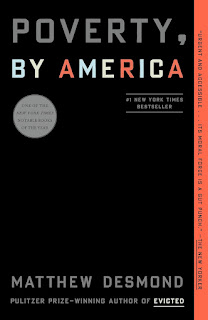
POVERTY, BY AMERICA (audiobook) by Matthew Desmond


Published in 2023 by Random House Audio.
Read by Dion Graham.
Duration: 5 hours, 40 minutes.
Unabridged.


As of the day I am writing this review, 7 of the top 10 richest people in the world live in the United States (the least wealthy has $80 billion.) The rate continues on when you go down the list - 14 of the top 20 live in the United States. 

The United States has 650 billionaires.

But, the official poverty rate in the United States at this moment is 11.5% - the highest rate in the in the leading industrialized economies of the world. This chart shows that it has bounced around between 10.5% and 15%, depending on the economic recessions and the like for the last 30 years. During this entire time, the United States has been the leader in wealth creation for the entire planet.

The author, Matthew Desmond
Sociology professor Matthew Desmond set out to find out why.

It's easy to look at those billionaires and note that they don't pay their fair share. The tax code is tailor made to keep them rich. There are deductions and accounting tricks that people who make less than a million dollars a year cannot imagine. 

But, Desmond notes that people who make less than a million dollars a year take advantage of deductions and accounting tricks that people living in poverty can ever imagine taking.

For example, in my state (Indiana) there is a 20% state income credit for every dollar placed in a 529 college savings account. The growth in value is not taxed and for every dollar you put in up to $7,500 you get 20 cents back. Put in the full amount, the taxpayers of Indiana give you $1,500. Show me a family of four living at the poverty line ($30,000 in 2023 according to this chart) that has an extra $7,500 - or even $500 - sitting around to invest in a college savings account. 

Poor people can receive rent subsidies - if there are enough funds and enough spots available. But everyone with a mortgage receives a mortgage subsidy by being able to write off the mortgage interest. That subsidy has no practical limit. You can get it for financing a tiny home in rural Arkansas or a penthouse condo that looks over Central Park in NYC. That adds up to billions upon billions of dollars every year.

Desmond goes on like this to demonstrate that the system is almost like an inverse pyramid - the higher up you go the more perks and discounts and breaks you get. And, at the bottom, there's some perks - but nothing like you get at the top where some people (like our 45th President) don't even pay federal income taxes some years. Former President Trump paid no taxes in 2020 and only $750 in 2017 and 2018. From 2015-2020 he paid $1.8 million in taxes, which is a lot, but he claims to be a billionaire. A billion is 1,000 million dollars, so he paid about 2/1,000 of his total wealth. I know I paid more than 2/1,000 of my total wealth in my combined federal income taxes for those six years.

Desmond goes on with other things. For example, you can get approved to pay a $1,700/month rent so much easier than to pay a $1,200/month mortgage on the same property. Profit margins on rentals are the highest in poor neighborhoods - even after factoring in things like more maintenance on the (typically) older homes in poorer neighborhoods.

The audiobook was read by Dion Graham who is simply one of the best audiobook readers on the scene right now. 

I rate this audiobook 5 stars out of 5. It will certainly give you plenty to think about. It can be found on Amazon.com here: Poverty by America by Matthew Desmond

This article from NPR does a very good job of reviewing this book as well.

THE GRAPES of WRATH (audiobook) by John Steinbeck


Originally Published in 1939.
Audiobook version published in 2011 by Penguin Audio.
Performed by Dylan Baker.
Duration: 21 hours, 1 minute.
Unabridged.

Winner of the National Book Award.
Winner of the Pulitzer Prize.
Declared to be the best-selling book of 1939 by the New York Times.

I last read The Grapes of Wrath when I was in high school, nearly 40 years ago. It was assigned reading for my English class and all I really remembered about it was a couple of scenes. I remembered the last scene, with the flood and starving man. And I remembered and early scene where the tractor operator is plowing up the farms, the farmyards and even intentionally damaging homes in Oklahoma. Besides that, I had nothing but a pervasive memory of sorrow and injustice.

I've always thought of this book and Of Mice and Men as kind of a set of books about migrant farm workers during the Great Depression. I've read Of Mice and Men 5 or 6 times, though - a fact that I can one hundred percent attribute to the fact that The Grapes of Wrath is 6 or 7 times longer. 

The Grapes of Wrath is longer and it is much more powerful. 

I am not going to go through all of the plot details for a book that has been labeled in the top 100 books by Le Monde, the BBC, Time magazine and The Daily Telegraph, but I am going to tell you the thoughts I had as I listened.

The book follows the Joad family as they lose their farm, load up all of their family and their worldly goods and head off to California in search of plentiful farm labor jobs that they have been told exist. They join tens of thousands of economic refugees and take Route 66 to California. Collectively, they were insultingly referred to as "Okies."

The problem is that while the jobs do exist, California is a magnet for economic refugees having 10 men and women show up for each job drives the wage down to starvation level. No one can get ahead and they are forced to live in shanty town camps on the edge of town. When the harvests are done, the sheriff and a bunch of local tough guys force everyone out and burn the camp to the town so they can't settle down.

As I was listening, I noted that some things haven't changed. Any time someone discusses organizing the workers or improving the working conditions someone accuses them of being a socialist. Not much has changed almost 85 years later. There are also parallels to the modern era migrant farm workers.

This book is compelling from beginning to end and is performed (not read - performed) wonderfully by Dylan Baker. He creates a series of unique voices and just hits all of the right notes throughout. 

This book deserves all of the hype.

I rate this book 5 stars out of 5. It can be found on Amazon.com here: THE GRAPES of WRATH (audiobook) by John Steinbeck.

OF BOYS and MEN: WHY the MODERN MALE IS STRUGGLING, WHY IT MATTERS, and WHAT to DO ABOUT IT (audiobook) by Richard V. Reeves


Published in September of 2022 by Blackstone Publishing.
Read by the author, Richard V. Reeves.
Duration: 6 hours, 55 minutes.
Unabridged.

Men, as a group, are struggling in today's economy. The average male's income has falling in inflation-adjusted terms, especially so when you factor out upper class and upper middle class men.

Men are more likely to be arrested, be addicts, be homeless, and more likely to succeed at killing themselves.

Boys are struggling in today's educational system. They are far more likely to be suspended, expelled or placed in a special education program. They are far less likely to graduate from high school. They far less likely to attempt any sort of post-secondary education (a majority of all college students are female) or training and far less likely to complete that training or degree - even in the rare situations where the post-secondary training and/or education are essentially free.

Reeves, an economist with the Brookings Institutions, sees these trends as part of a larger problem and does not see it as a problem caused by women being part of the workplace, going to college or participating in advanced training. That is a reality and he has literally no interest in changing it. He makes this point several times. 

I highly recommend this book. It offers an honest assessment of where we are as a country and that assessment is often depressing. But, Reeves  doesn't just list a bunch of problems. He offers practical solutions that are based on policies that have already proven successful in other ways.

The audiobook is read by the author. He does an excellent job, which is not always the case when authors decide to read their own audiobooks.
 
I rate this book 5 stars out of 5. It can be found on Amazon.com here: OF BOYS and MEN: WHY the MODERN MALE IS STRUGGLING, WHY IT MATTERS, and WHAT to DO ABOUT IT by Richard V. Reeves.

THE PARANOID STYLE in AMERICAN POLITICS and OTHER ESSAYS by Richard Hofstadter


-Originally published by Harper's Magazine in 1964 and in book form by Alfred A. Knopf in 1965.
-Audiobook published in 2018 by Tantor Audio.
-Read by Keith Sellon-Wright.
-Duration: 10 hours, 44 minutes.
-Unabridged.


Award-winning historian Richard Hofstadter (1916-1970) wrote these essays over a series of years and compiled them into a collection with a loose theme of how American politics is affected by paranoid conspiracies. 

Barry Goldwater (1909-1998)
He starts with the presidential candidacy of Barry Goldwater and the political commentary of groups like the John Birch Society. His descriptions of the Goldwater campaign sound so much like the Trump campaign of 2016 that a reader can almost replace the name Goldwater with the name Trump. The details are, of course, different, but the tone is practically the same. 

The ideological framework of the John Birch Society is replaced with QAnon, the fear of communism is replaced with the fear of immigrants but the tone is practically the same.

That is the main theme of the first half of the book - the near-constant presence of a paranoid fear that some group is trying to overthrow the American way of life. 

 
"The enemy is clearly delineated: a perfect model of malice, a kind of amoral superman -- sinister, ubiquitous, powerful, cruel, sensual, luxury-loving. Unlike the rest of us, the enemy is not caught in the toils of the vast mechanism of history, himself a victim of his past, his desires, his limitations. He wills, indeed, he manufactures, the mechanism of history, or tries to deflect the normal course of history in an evil way. He makes crises, starts runs on banks, causes depressions, manufactures disasters, and then enjoys and profits from the misery he has produced. The paranoid's interpretation of history is distinctly personal: decisive events are not taken as part of the stream of history, but as the consequences of someone's will. Very often, the enemy is held to possess some especially effective source of power: he controls the press; he has unlimited funds; he has a new secret for influencing the mind (brainwashing); he has a special technique for seduction (the Catholic confessional)..."

This paranoid strain is not unique to America, of course. For example, the fear of the Illuminati and English fears of a Catholic revolution. 

The fears of a Catholic revolution spread to America as well, but that was just a part of a whole series of paranoid conspiracies that Hofstadter points out. I decided to come up with my own list. Hofstadter passed away in 1970 so he never heard of the paranoid conspiracy theories that I remember being actively discussed (some quite seriously) in my lifetime.

Here is a list of all paranoid conspiracies that I remember (starting from the early 1980's):
 
-Satan worshipers were killing thousands of children in day cares across the country;
-back masked lyrics were brainwashing people that listened to rock music and making them kill themselves;
-Dungeons and Dragons was causing kids to go crazy (Tom Hanks made a movie about it!); 
-the New World Order was taking over America and flying black helicopters all over America and leaving secret messages for soldiers on the back of interstate road signs;
-FEMA camps. This is one of my personal favorites because the AMTRAK train yard in Beach Grove, Indiana was to be converted into a secret government concentration camp (Beach Grove is a neighborhood in Indianapolis, where I live);
-President Obama was a secret gay Muslim who was selling out America;
-QAnon with all of its weirdness (including a resurgence of the lizard people in some strains);
-crisis actors creating all of the school shootings (Alex Jones);
-Former President Trump's Stop the Steal movement with Italian satellites and Venezuelan vote tabulators conspiring to steal an election.

The rest of the book is not nearly as interesting. It has rather lengthy essays on the Spanish-American War, the Anti-Trust movement and the Free Silver movement. They made the point that the earlier essays did, but not nearly as directly and they weren't nearly as interesting.

The entire collection is written in an academic style that is not particularly welcoming to the reader. The author makes a point that the paranoid style of politics is not exclusively a feature of the Right, but he provides no examples of it from the Left, except maybe with the Free Silver movement. The politics of that movement are convoluted enough that you can't really get a good feel if it is a movement of the Left or the Right.

To sum up, the part of the book that discusses the 1950's and 1960's is great. The rest of rather tedious. The first part is worth listening to if for no other reason than to get the reference when you hear it in a political discussion.

I rate this book 3 stars out of 5. It can be found on Amazon.com here: 
THE PARANOID STYLE in AMERICAN POLITICS and OTHER ESSAYS by Richard Hofstadter.

WEST from APPOMATTOX: THE RECONSTRUCTION of AMERICA after the CIVIL WAR (kindle) by Heather Cox Richardson


Published in 2007.

Heather Cox Richardson is a historian I have only recently discovered because of her prolific social media presence that she developed while under Covid lockdown. She writes a daily news summary of a few paragraphs with a view towards how these events match up with historical events or trends. Plus, she takes questions from people and develops a one hour daily online lecture. They are interesting, sometimes rambling little presentations and this book shares a lot of the same features. 

In West from Appomattox, Richardson is looking at the time right after the Civil War in American History.  In the history books, Reconstruction, the Old West, the Gilded Age and the Spanish-American War are all treated a separate things. Combining all of these typical divisions of American history into one book makes for a more comprehensive study of the time period. 

Teddy Roosevelt (center with glasses) and
the Rough Riders in the Spanish-American War
Traditionally, they are studied separately - in a typical history book they are literally different chapters. Mostly, Richardson does this, too. Mostly - but she is very willing to cross over to the other areas of study. 

For example, it really impossible to understand the Old West without having an understanding of Reconstruction and of the Gilded Age. Reconstruction encouraged a lot of people to move West. The West received attention and governmental support for economic development and the South did not. The economic growth in the Northeast was largely possible because of Federal Government support of resource extraction from the West. Federal support of settlement of the West and Federal support of building a network of privately owned railroads helped spur further economic growth in the Northeast.  

Due to the overlapping nature of the book, there are a lot of overlapping stories and themes. I don't consider it to be a weakness, though. I consider it to be a reminder that the same policies, the same movements and the same rules were affecting the whole country. 

This time period was truly the transition from the old Revolutionary Era politics to our current modern political system because slavery was finally out of the way. Instead of discussing what to do about slavery it became a discussion about when (or even if) government power should be used to intervene in the free market or to help certain people in society. 

In the South, pushing for public schools for poor children was often decried as Socialist because rich people were being taxed to provide a basic education for the children of the poor. It was even more Socialist if it meant funding schools for poor black children. Meanwhile, out in the Western states the government actively intervened in the Free Market by handing out 160 acre parcels of land, providing land grants to fund railroads and breaking treaties with Native Americans and clearing them out of the way to provide access to mineral wealth.

The point about Socialism is interesting. Richardson pointed out something that I have noticed about American political discussions - we throw about the term Socialism and use it with a completely different meaning than the meaning the rest of the world uses. When everyone discusses Socialism, they are talking about the government owning the means of production (factories, farms, mines, etc.). In the United States, it is tossed about when we talk about taxing anyone to pay for community services and we have done that ever since the time period this book covers. I still hear this argument used against the existence of public schools, public libraries and even public roads. In the United States, Socialism is also a term used to describe non-economic things such as Covid mask mandates and gay marriage because the term has consistently been used by the current conservative party (the Dems back in the 1800s and the GOP nowadays) to discredit new concepts. 

I rate this history 5 stars out of 5. It can be found on Amazon.com here:  WEST from APPOMATTOX:  THE RECONSTRUCTION of AMERICA after the CIVIL WAR (kindle) by Heather Cox Richardson.

WILDLAND: THE MAKING of AMERICA'S FURY (audiobook) by Evan Osnos


Published in September of 2021 by Macmillan Audio.

Read by the author, Evan Osnos.
Duration: 17 hours, 7 minutes.
Unabridged.

Evan Osnos is a reporter for The New Yorker. He was inspired to write about the phenomenon of Donald Trump and the 2016 and 2020 elections when he returned from an multi-year assignment in China and noted that politics, journalism and even economics in the United States had changed. He didn't use this analogy, but I will: Parents don't notice their kids changing and growing because they see them every day. But, the aunts and uncles who only see them at the holidays can easily detect the changes.

For Wildland Osnos went to three places that he used to live to investigate: Greenwich, Connecticut; Chicago, Illinois; and Clarksburg, West Virginia. 

In West Virginia, he primarily looks at the changes in journalism such as the loss of local news and small town newspapers. He also looks at government pulling back environmental regulations and business avoiding responsibilities such as living up to pension obligations and cleaning up their messes. The shenanigans from Peabody Energy to avoid pension obligations were especially egregious.

In Connecticut he follows up on the business theme by looking at Greenwich - a town seemingly full of hedge fund managers. Really, it's not, but their wealth and their change of mindset is changing the town. The mindset embraces famed economist Milton Friedman's maxim that the purpose of a corporation is to maximize returns for its shareholders. I grew up in a town with one very large corporation with multiple factories. It provided scholarships, paid for public art and architecture and provided benevolent leadership through boards, committees and generally being engaged with the community that its leadership lived in and provided its labor force. 

In Chicago, he looks at the near-collapse of some communities - the ones that make the news all of the time for the murders. He discusses how the manufacturing base of Chicago left and how that helped lead to the decline of some neighborhoods. which ties into the Greenwich part of the book.

On top of all of this, throw in the Supreme Court case generally known Citizens United. It opened up the flood gates for money in politics. Now millions of dollars could be spent on primary campaigns. In 2020, my state was not really a player in Presidential politics, but we saw almost non-stop ads over 1 race for the House of Representatives. One ad after another from both sides. Those kinds of ad campaigns are the result of the Citizens United decision in 2010.  The Supreme Court held that the First Amendment prohibits the government from restricting independent expenditures for political campaigns by corporations, including non-profit corporations, labor unions, and other associations. With that decision, politics changed.     

Outsiders with a lot of money now had a chance to come in and be effective without having the strong organization and the political contacts of a political party.    

The book takes a long time to develop and I nearly quit several times in the first couple of hours. There was so much talk of hedge fund managers and the new prevailing mercenary quality in big business. Notice that I said "prevailing" - the mercenary quality has always been there but it was restrained by other cultural norms. But, once it moves on to West Virginia and Chicago the book got more interesting to me. I guess it's simply because I don't know ultra-rich hedge fund managers and I don't identify with that lifestyle, but I do know poor black people in a big city and I grew up in a rural area. 

At the halfway point, he starts to tie all of this stuff together and then the book gets good. About 3/4 of the way through the book he starts to tie in the rise of Trumpism. To be honest, I had forgotten that this was the point of the book in the frist place. 
Osnos ties it together. It's not some big nefarious plot, but rather the result of a lot of forces converging - the Citizens United decision, the change in the philosophy of big business, the loss of local news reporting, the loss of good jobs in rural areas and the big cities all come together.

Toss in a great deal of frustration, Osnos makes it seem that the arrival of a person like Donald Trump was inevitable. I contend that it also explains Bernie Sanders. Like Trump, Sanders is truly a political outsider. Sanders isn't even a member of the Democrat party and has not put in a lot of work building the party organization. Still, he almost won their nomination in 2016 and ran very strong in 2020 because this decision lets money make up for not being part of a party and having access to all of the connections and organization that political parties can provide. 

This book doesn't have a lot of answers, but it points out a lot of problems and you have to know what the problems are before solutions can be found.

I rate this audiobook 5 stars out of 5. It can be found on Amazon.com here: WILDLAND: THE MAKING of AMERICA'S FURY by Evan Osnos.

GARBOLOGY: OUR DIRTY LOVE AFFAIR with TRASH (audiobook) by Edward Humes


Published in 2015 by Tantor Audio.
Read by Joe Barrett.
Duration: 8 hours, 36 minutes.
Unabridged.


Garbology is the study of garbage. Archaeologists use garbology to learn all about ancient societies - what they ate, their tools, their clothing, their toys, their technology, etc.

You can also apply garbology to modern garbage dumps and Humes uses this as an entrance to discussing all sorts of issues about our modern world and our problem with waste. Humes figures that the average American is on pace to create more than one hundred tons of garbage per person per lifetime. This is higher than the estimates you usually find because those estimates don't include the waste created on your behalf by manufacturers and service providers.

Garbology starts out very strong with a look at how landfills and trash removal have evolved over time. Sounds boring but I found it to be very interesting.

Later, he moved on to pollution, especially ocean pollution and the Great Pacific Garbage Patch - a Texas-sized (at least) collection of plastic that has formed in a giant doldrum area - kind of a dead spot, wind-wise in the middle of a gigantic area of circular rotation. He covers this quite well from two points of view - it's probably already too late and we can fix it if we change some of the ways that we do things.

The last part of the book deals with changes we could make. 

He starts out with a long story about a program that re-purposes art from a landfill. I literally have no problem with art, repurposing items to divert them from landfills or making art from repurposed items diverted from landfills. Humes wrote so much about this interesting, but limited, project that it was as if it was an actual answer to the problem of garbage - as if art installations could absorb all of the garbage.

He addressed reducing the amount we consume by looking at a family that takes that concept to an extreme level (pounds of garbage per year rather than tons of garbage per year), which I thought was off-putting rather than inspirational. It is sipmly too much of a change for me to even ponder. It would have been much more effective, in my opinion, to present someone who has moved to a halfway point towards that extreme. Maybe discuss how companies could change their packaging and what that would mean for consumers.

I suppose my real frustration is that Humes never really addressed the concept of recycling in a systematic way in a book about garbage. He mentioned the famous recycling phrase "Reduce, Re-use, Recycle" multiple times in the book but recycling itself is largely ignored. Lots of talk about art made from garbage, a little talk about recycling. 

I know that the recycling world has changed as Humes was writing this book (several Asian countries used to take literal boatloads of American recycling but have since stopped), but I have been seeing a lot of articles lately about how no one wants to take plastics for recycling so it just ends up getting buried in the landfull and the sheer weight of glass makes it unlikely to be recycled because of the fuel costs to transport the glass to the factories that recycle them. Is recycling even a thing anymore?

There is an interesting section at the end of the book about how Denmark burns almost all of its garbage at super high temperatures to create energy without the waste you would get at a coal plant. Tens of thousands of homes receive power and a ton of garbage becomes a few pounds.

So, to sum up, the good parts of this book are very good. There are a couple of sections that are related by totally unnecessary and may actually hurt the case the author is trying to make. And, he totally ignores a giant part of the whole garbage discussion. For those reasons, I give the audiobook 3 stars out of 5.

GARBOLOGY: OUR DIRTY LOVE AFFAIR with TRASH (audiobook) by Edward Humes can be found on Amazon.com here.

THE PURPOSE of POWER: HOW WE COME TOGETHER WHEN WE FALL APART (audiobook) by Alicia Garza


Published in 2020 by Random House Audio.

Read by the author, Alicia Garza.
Duration: 9 hours, 31 minutes.
Unabridged.


Alicia Garza is one of the founders of the organization Black Lives Matter

This reader decided that he only had a superficial knowledge of the movement and wanted to learn more. The Purpose of Power seemed like a reasonable place to start.

The first part of the book is basically a recounting of Garza's early life and her beginnings as a community organizer. This was quite enjoyable. Garza is a talented writer and she tells her story well.

The author, Alicia Garza
The middle part gets bogged down with some esoteric political movement talk. Lots of discussion over meanings of words like "intersectionality." I thought she made her point very clearly early on and kept on making it. This was clearly very important to the author, but the lay reader who is not heavily invested in the movement and its specific language would, like me, find this to be too much insider talk. 

It got more interesting when Garza discussed a man who the media thinks was a BLM founder (he often appears on the political discussion shows with that descriptor), the reaction of old guard civil rights groups to BLM and the reaction to old guard groups to female leadership voices.

Garza frequently mentions a lot of serious economic reforms she would like to see. This is different from and in addition to the protests against police brutality in all of its forms.  However, she doesn't make take many steps to flesh out what she wants to do and why she is adamant that those reforms need to be made. She mostly assumes that the reader knows what she talks about and agrees with her. 

I rate this audiobook 3 stars out of 5. The middle part with esoteric political talk was a rough slog and the lack of explanation of her economic plans made it an average audiobook.

This book can be found on Amazon.com here: THE PURPOSE of POWER:  HOW WE COME TOGETHER WHEN WE FALL APART by Alicia Garza.

WHEN to ROB a BANK...and 131 MORE WARPED SUGGESTIONS and WELL-INTENDED RANTS (audiobook) by Steven D. Levitt and Stephen J. Dubner


Published in 2015 by HarperAudio.
Duration: 8 hours, 13 minutes.
Read by Steven D. Levitt, Stephen J. Dubner and Erik Bergmann.
Unabridged.


Levitt and Dubner are the authors the co-creators of the Freakonomics franchise. They have published several books, have a radio show, have a website and have had a long-running column in the New York Times. All of them have featured odd takes on economic theories (as the title of this book suggests). They also have a blog that they used as a place to put their odd thoughts - not complete articles or chapters.


This book consists of 132 entries from their blog. And, that, in short, is the weakness of this audiobook. Their other works are much more thought out and this one just feels like the results of a preliminary brainstorming session. There were some interesting entries and there were some real clunkers. Also, there were way too many entries about gambling. I have absolutely no interest in gambling but the authors are really into it. 

Bottom line: the quality of this book does not live up to the quality of their other books.

I rate this audiobook 3 stars out of 5. It can be found on Amazon.com here: WHEN to ROB a BANK...and 131 MORE WARPED SUGGESTIONS and WELL-INTENDED RANTS by Steven D. Levitt and Stephen J. Dubner.

A SHORT HISTORY of RECONSTRUCTION: 1863-1877 (audiobook) by Eric Foner


Originally published in book form in 1990.
Published in 2017 by Blackstone Audio.
Read by Paul Heitsch.
Duration: 12 hours, 33 minutes.
Unabridged (see below)

Clocking in at 12 and one-half hours, A Short History of Reconstruction: 1863-1877 is an abridgment of a larger work about Reconstruction that Foner published in 1988.  Still, it is plenty long enough to reveal the scope of the tragedy that was the post-Civil War Reconstruction.

Abraham Lincoln often thought about the conditions necessary to bring the seceded states back into the Union. He called that plan Reconstruction because the separate state governments would be rebuilt and then the Union itself would be reformed.

There were certain ground rules, including not letting power players in the Confederate and seceded state governments return to power. Most importantly, slavery had to be ended in the areas under the authority of the Emancipation Proclamation that was effective on January 1, 1863.

When Lincoln was assassinated, Vice President Andrew Johnson was forced to take the lead in Reconstruction. However, he was not nearly the politician that Abraham Lincoln was and soon enough, the Congress took the lead in Reconstruction. Their disagreements over Reconstruction was one of the reasons Johnson was impeached.

But, there were still promising results. African Americans voted and started schools and their own churches and went to Congress and became sheriffs and city council members and more.

Grant's eight years as President were a mixed bag. The KKK flared up again only to be squashed by outright military intervention. But, the North was tired of dealing with the South and its issues. If you start counting at the start of the Civil War, by the time the election of 1877 came along, they had been dealing with the those issues for 17 straight years. To get a contemporary 21st century analogy - think about how strong the American public feels about the war in Afghanistan in the year 2020. So, when the election of 1876 was too close to call, a deal was made and Reconstruction came to an end under Rutherford B. Hayes.

Foner details how almost everything fell apart and so many fell into the near-serfdom of sharecropping and Jim Crow laws. Interestingly, the GDP of the South was the same in 1900 as it was in 1880 - absolutely no economic growth at all over 20 years.
President Andrew Johnson (1808-1875)


Foner does point out that things weren't a whole lot better for African Americans in the North and that organized labor of any sort in general struggled in the North (and was practically non-existent in the South).

The audiobook was read by Paul Heitsch whose reading style reminded me (too often) of the automated voice you get when you call a bank or an airline. Also, he mispronounced several words. For example, he consistently mispronounced the word "lien" (used throughout the sharecropper section) lee-un.

This was not a pleasant book - no one likes to hear about the almost complete failure of the country to protect the civil rights of its people. But, this is an important piece of our history.

I rate this audiobook 4 stars out of 5. It can be found on Amazon.com here: A Short History of Reconstruction: 1863-1877.


IN DEFENSE of ELITISM: WHY I'M BETTER THAN YOU and YOU'RE BETTER THAN SOMEONE WHO DIDN'T BUY THIS BOOK (audiobook) by Joel Stein


Published in October of 2019 by Grand Central Publishing.
Read by the author, Joel Stein.
Duration: 7 hours, 18 minutes.
Unabridged.


Joel Stein's In Defense of Elitism: Why I'm Better Than You and You're Better Than Someone Who Didn't Buy This Book is an interesting book. The title suggests that it is a tongue-in-cheek look at politics, but it is much more than that. To be sure, there are plenty of jokes, wisecracks, puns and witty observations of varying quality throughout the book. But, there is also a lot of solid political analysis, especially in the last third of the book.

Stein's primary argument is that populism, embodied by both Donald Trump and Bernie Sanders for the last 4 years, is a road to nowhere except authoritarianism. Stein, like most elites, is worried more about Trump than Sanders (makes sense - he is President, while Sanders is a Senator).

Trump is well-known for his anti-intellectual tenancies. He discounts expertise and people that might have been called eggheads a few years ago. He As evidence for this, just note the number of things that President Trump has claimed that he knows more about than anyone else: drones (January 2019), technology (December 2018), renewable energy (April 2016), the visa system (March 2016), ISIS (November 2015). In July 2016 he said he even knows more about Senator Cory Booker than Senator Cory Booker does (
"I know more about Cory than he knows about himself." )*
The author and narrator, Joel Stein

No one can be an expert on everything. That is where Elites come in, according to Stein. Stein explains this part rather poorly (in the first 10% or so of the book), because he insists on talking about his Elite friends. He name drops a ton of people who seem to be experts on everything - which is exactly what Stein is decrying. I recognized none of them except for Rob Reiner, who is not an expert on anything except making movies. He's very good at that, but I wouldn't go to him for his thoughts on tax policy.

The book gets so much better from this point on. Stein decides to go to a town in the county that voted with the highest percentage for Trump - Miami, Texas. He doesn't know what to expect, which this Hoosier who grew up in rural Indiana finds hilarious. It is a completely different world than his, which he acknowledges is part of the problem. Stein is kind with his descriptions of the people of Miami (pronounced My-am-uh) and seems to enjoy himself while he is there.

Stein also interviews Scott Adams, the creator of the Dilbert cartoon. Adams has become an anti-expert advocate, which is sort of ironic for the creator of a cartoon that continually makes fun of a boss and a bureaucracy that discounts the engineers (the experts) who are creating the products their company markets and sells. He also interviews Tucker Carlson. I was surprised. Before I heard this book, I would have suspected that I would have enjoyed the Adams interview and been dismayed by the Carlson interview. Instead, it was completely reversed. Tucker Carlson makes a lot of good points (not all, but a lot) and Adams comes off as an opportunistic nut.

Stein's thesis, when he finally gets around to it, is that there are two kinds of elites out there. The first group is the intellectual elites (like Stein and Rob Reiner and, of course, the late William F. Buckley who was the ultimate member of the intellectual elite). They value policy discussions, connections to other elites of all stripes and ideas. He calls the other group "boat elites" because they value possessions over ideas. He goes on to describe them like this: 

"The boat elite are steeped in honor culture. Dignity is their most valuable nonboat possession. If their girlfriend gets insulted, they fight. If their friend gets in a fight, they fight. If their fighting ability is questioned, they fight. When they get cut off, they honk. Then they yell at the other driver to get out of their car and fight. The intellectual elite don't do this because we know that honking and yelling makes it hard to hear NPR stories."


It is actually a pretty sophisticated observation for a guy trying to sneak in funny comments all of the time. It explains why President Trump is trying to prove to everyone that he is an expert on everything. It makes you look bad to ask for help on anything (like most men and asking for directions).

I enjoyed this audiobook. I blew right through it in two days. Not a perfect book, but an interesting book and full of some big ideas presented in an unorthodox way.

I rate this audiobook 4 stars out of 5. It can be found on Amazon.com here: IN DEFENSE of ELITISM: WHY I'M BETTER THAN YOU and YOU'RE BETTER THAN SOMEONE WHO DIDN'T BUY THIS BOOK by Joel Stein.


*Source for all of these claims: Axios.com "Everything Trump Says He "knows more about than anybody"

IRRATIONALLY YOURS: ON MISSING SOCKS, PICKUP LINES, and OTHER EXISTENTIAL PUZZLES (audiobook) by Dan Ariely


Published in 2015 by HarperAudio.
Read by Simon Jones.
Duration: 3 hours, 22 minutes.
Unabridged.


The author, Dan Ariely
Behavioral economist Dan Ariely has written a lot of books and articles about his various behavioral experiments. I was not aware that he had a regular column in the Wall Street Journal that functions an awful lot like the Dear Abby column has done in newspapers for more than 60 years. People write in questions about relationships or work concerns and Ariely tries to come up with a concise, humorous answer.

The fact that Ariely is a famous behavioral economist did little to make this collection feel any different than a collection of Dear Abby columns. It was not a bad listen, but not a great one either.

I rate this audiobook 3 stars out of 5. It can be found on Amazon.com here: IRRATIONALLY YOURS: ON MISSING SOCKS, PICKUP LINES, and OTHER EXISTENTIAL PUZZLES by Dan Ariely.

PREDICTABLY IRRATIONAL: THE HIDDEN FORCES THAT SHAPE OUR DECISIONS (audiobook) by Dan Ariely


Published in 2008 by HarperAudio.
Read by Simon Jones.
Duration: 7 hours, 22 minutes.

Unabridged.

Dan Ariely is a behavioral economist. Predictably Irrational looks at the assumption made by economists that people make rational decisions based on their input. Ariely delights in pointing out that oftentimes we don't make rational choices - we make irrational ones and we keep making the same types of irrational choices time after time after time.

For example, if you own a restaurant and you want to sell more of your most expensive dish, all you have to do is place an even more expensive meal on the menu. It could be that no one will ever buy that most expensive meal, but they will buy more of what used to be the most expensive meal because it now looks like a comparative bargain.

I enjoyed the commentary on the old marketing campaign called The Pepsi Challenge. In blind taste tests, Pepsi beat Coca-Cola by a wide margin. But, when the taste testers could see the cans of soda, Coca-Cola won by a wide margin. Why? Confirmation bias - taste testers liked Coca-Cola better because they expected to.


Ariely's points are good, but the time required to set up his explanations (in other words, the description of the experiments, how they tried to control for biases, etc.) were so long that they really hurt my enjoyment of the book. I understand that it is important to describe the experiments so that the reader can judge that it was done fairly, but it was, at times, quite tedious. I also think he used his best points at the beginning of the book as a hook to get you into the book but as the book went along, it got less interesting.

The audiobook was read by Simon Jones. He has an interesting and lively voice and made the tiresome descriptions of the experiments tolerable.

I rate this audiobook 3 stars out of 5.

It can be found on Amazon.com here: PREDICTABLY IRRATIONAL: THE HIDDEN FORCES THAT SHAPE OUR DECISIONS.

Featured Post

<b><i>BAN THIS BOOK (audiobook)</i></b> by Alan Gratz

Published in 2017 by Blackstone Audio, Inc. Read by Bahni Turpin. Duration: 5 hours, 17 minutes. Unabridged. My Synopsis Ban This Book is t...

Popular posts over the last 7 days