Showing posts with label New Orleans. Show all posts

VICKSBURG, 1863 by Winston Groom


Originally published by Knopf in 2009.

Winston Groom will always be best known as the author of Forrest Gump, but he should be equally well known as the author of a series of well-told American histories. Included in those histories is a trilogy of Civil War histories that focus on the Western Theater of the war.

Vicksburg 1863 is the second book in the trilogy, but it can be easily read as a stand-alone history. After a short introduction to the war itself, it follows Grant's campaign to take the Mississippi River away from the Confederacy, beginning with a mess of a battle in Missouri that proved nothing of any importance except that Grant was game to fight and push forward, even if the conditions were not perfect.

That, it turns out, was pretty much the key to Grant's eventual success in this campaign and in the war.

From there, we follow Grant through Kentucky, into Tennessee and the terrible Battle of Shiloh. Although ultimately successful, this marked a low point for Grant because he nearly lost his army. His immediate superior came to Shiloh to supervise him and killed most of the momentum of the campaign

Eventually, Grant regained his command (his superior officer was promoted to a desk position in the Eastern Theater) and began his campaign to remove the last major obstacle for Union control of the Mississippi River - Vicksburg, Mississippi.

Vicksburg was a challenge due to its location on an imposing cliff on a massive bend in the Mississippi River. The Confederate military placed cannons on the cliff that threatened any ship that dared to try to pass by. This book details the many efforts he made to bypass Vicksburg, including attempts to build a canal to reroute the Mississippi and an attempt to go through the swamps around Vicksburg. Eventually, he crossed the river south Mississippi and quickly moved his army to cut off Vicksburg, lay siege to it while also engaging and driving away any Confederate troops that could have helped to lift the siege.

Some people will argue with Groom's assertion that Grant did have bouts of drunkenness during the campaign. He describes a rather wild bender featuring Grant cruising through the swampy rivers north of Vicksburg during a lull during the siege, switching boats, and looking for more and more booze. Grant's defenders will deny it all, Grant's detractors will claim it was probably even worse. I go with the simple knowledge that addiction is powerful and Grant often brought along people that kept him accountable. If those people weren't around, I can easily imagine him falling off the wagon. Whether it was a wild run through the swamps or a binge drunk in the corner of a cabin...well, that depends on who told the story back then and who is writing the story now.

I rate this history 5 stars out of 5. It reads as easy as a novel. It can be found on Amazon.com here: Vicksburg, 1863 by Winston Groom.

See my review of Groom's Shiloh, 1862 here. 

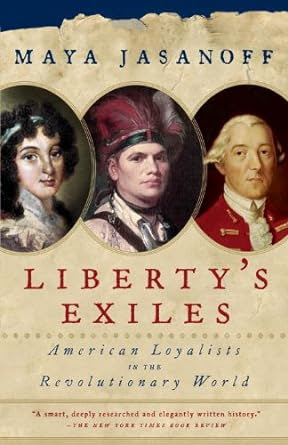
LIBERTY'S EXILES: AMERICAN LOYALISTS in the REVOLUTIONARY WORLD (audiobook) by Maya Jasanoff

Published by Recorded Books in 2012.
Read by L.J. Ganser.
Duration: 16 hours, 10 minutes.
Unabridged.


In 1783, at the end of the Revolutionary War, Loyalists (Americans who opposed the American Revolution and stayed loyal to Britain) had a choice to make - stay and ride out the anti-Loyalist bias in the United States or move somewhere else.

In the two years between the last major engagement (Yorktown) and the official end of the war and withdrawal of British troops the British decided to evacuate any Loyalists that wanted to go to other parts of the British Empire. One of the biggest advocates of this position was Guy Carleton, the British commander in America after Yorktown who later went on to become the Governor-in-Chief of Canada. He had more to do with what happened in this history than any other single person.

Guy Carleton (1724-1808)
The British government made an effort to make things right for these Loyalists. Not many Loyalists were completely reimbursed, but the fact that an effort was made was extraordinary for the day. In some cases, Loyalists were offered large grants of land, in other cases they were offered smaller grants of land and in other cases they were offered pensions and partial reimbursements for lost property. All of these offers were new innovations and a sign that the British government wished to honor the loyalty they had shown.

Some loyalists wanted nothing more than to start over, some looked to just work themselves up the British societal ladder, some wanted to get away from British society and some looked for a chance to get even with the Americans. 

There was a racial component to this as well. The British had offered freedom for any slaves that left their masters and joined their armed forces. The Americans pressured them to return the runaway slaves (including slaves from George Washington and Thomas Jefferson) but the British refused to go back on their deal with the former slaves as a point of honor. However, those former slaves oftentimes were given less money and less land than white Loyalists when they arrived at their new homes.

The British tried to honor the commitments shown by the Native American allies as well, but not nearly as much. 

Loyalists ended up going all over the empire but mostly to Canada. There were several families that went to Bermuda and Jamaica and back to England itself. Several families of African descent moved to Sierra Leone in Africa as part of an experimental colony. A few went even further to India. 

The section on the Canadian settlement was, at first, interesting but it soon got bogged down. It was all relevant detail, but just too much for me. In fact, that's pretty much my review of the entire book.

I rate this audiobook 3 stars out of 5. It can be found on Amazon.com here: LIBERTY'S EXILES: AMERICAN LOYALISTS in the REVOLUTIONARY WORLD (audiobook) by Maya Jasanoff.

TREASON by David Nevin


Published in 2001 by Forge (Tor).

Treason has been in my to-be-read pile for a long time. I was inspired to finally read it after watching the musical Hamilton on a streaming service. As you may know, the character of Aaron Burr plays a large part and I got to wondering exactly what happened to Burr when he went west after his term as Vice President.

The problem, as the author points out, is that we don't really know exactly what Aaron Burr did. He went on trial for treason, but it was a hurried and botched trial and Burr was found not guilty.

Nevin does a solid job of explaining what Burr might have been doing. Nevin goes along with the popular theory that Burr was working with the commanding general of the U.S. Army, James Wilkinson. In 1854, letters were discovered that showed that Wilkinson was in the pay of the government of Spain and was feeding them all sorts of information.

Aaron Burr, 1756-1836.
Nevin supposes that Wilkinson gave Spain false information designed to make Spain attack the United States while Burr was bringing hundreds of men down the Ohio and Mississippi as part of a private army. Burr and Wilkinson were planning to use the Spanish attack as an excuse to initiate martial law in New Orleans, attack Mexico and combine New Orleans, Texas and Mexico into a new country, led by Burr and Wilkinson. Eventually, the states west of the Appalachians would join the new country and New England and New York would break away from the rest of the coastal states and the United States would simply cease to exist.

All of that was interesting, but David Nevin strung this book out and made all of that as boring as possible. He repeated conversations, rants, mental rants and made the pace crawl. The front cover features the Hamilton-Burr duel, but the book barely mentions it with just 6 pages out of a 545 page novel. Hamilton is basically a non-entity, which is weird because Burr is probably most remembered for the duel.

In short, this book is slow and tedious. It took me more than 6 weeks to read it. In the meantime, I read a completely different book because I thought it was more interesting. And magazines. And just goofed around on Facebook.

I rate this book 2 stars out of 5. It can be found on Amazon.com here: TREASON by David Nevin. 2 stars for the coherent theory about Burr's conspiracy.

PATRIOTIC FIRE: ANDREW JACKSON and JEAN LAFITTE at the BATTLE of NEW ORLEANS (audiobook) by Winston Groom


Published in 2006 by Tantor Media.
Read by Grover Gardner.
Duration: 10 hours, 10 minutes.
Unabridged.


Winston Groom, best known as the author of Forrest Gump, is also a historian of sorts. He has written 14 non-fiction books, using his research skills he honed as a journalist to investigate a historical topic.

In this case, the topic Patriotic Fire is the Battle of New Orleans. Most people know everything they know about the battle from the catchy Johnny Horton song:

In 1814 we took a little trip, 

Along with Colonel Jackson down the mighty Mississip
We took a little bacon and we took a little beans
And we caught the bloody British in the town of New Orleans.


I knew a little bit more, having read a little about the battle. I didn't know much, however, not really being a fan of the War of 1812 or Andrew Jackson. But, I am a fan of Winston Groom so I decided to give it a try.

Groom is skilled at telling a narrative history and at the end, I had a much better idea of how the Battle of New Orleans was fought. He also is excellent at fleshing out the historical figures and making them feel more like real people.

For example, Jean Lafitte. I knew Lafitte's home base was in the islands in the
Jean Lafitte (1776-1823)
swampy river delta south of the city, but since he has always been described as a pirate, I assumed it was some sort of gang headquarters. Instead, Lafitte was a privateer and a smuggler. A privateer is, to be generous, a legal pirate, getting permission from various governments at war to attack the commerce of their enemies.

I was surprised that Lafitte's island was less of a pirate headquarters and more of a warehouse selling items he regularly smuggled and special items he captured as a privateer. Lafitte wasn't really a pirate king so much as a pirate businessman who often lived out in the open in New Orleans. His life was hardly that of a hardened criminal on the run - it was much more like that of a mafia don rather than a wild-eyed pirate with a dagger clenched in his teeth.

The audiobook was read by veteran reader Grover Gardner. Whenever I listen to one of his audiobooks, I start out hating his folksy reading style. But, as it goes along, I find myself really enjoying it, almost like comfort food.

I rate this book 4 stars out of 5. It can be found on Amazon.com here: PATRIOTIC FIRE: ANDREW JACKSON and JEAN LAFITTE at the BATTLE of NEW ORLEANS by Winston Groom.

FIRE in the WATER by James Alexander Thom


Published in 2015 by Blue River Press

Not many people know about the horrible story of the Sultana, a paddlewheel steamboat that sank into the Mississippi River in April of 1865. It is the worst maritime disaster in American history but was largely overshadowed by the events surrounding the assassination of Abraham Lincoln and his dramatic funeral train tour from Washington, D.C. to Springfield, Illinois. The Sultana was grossly overcrowded. It was designed to carry 376 passengers, but it was carrying 2,155 passengers when three of its boilers exploded in the early morning hours of April 27, 1865.  Most of its passengers were survivors of the infamous Andersonville prisoner of war camp that were being shipped home. 

This book is technically a sequel to Saint Patrick's Battalion. It continues the story of a boy who traveled with an American army during the Mexican War. In Fire in the Water, that boy has grown up and become a famous war correspondent. He is traveling to Springfield with his newlywed wife to cover Lincoln's funeral. Along the way, he interviews as many of the former prisoners of war to work on a story about Andersonville.

This book starts out too slowly, but the last 50 pages or so are full of the kind of magic that James Alexander Thom can bring to historical fiction. 

I rate this book 4 stars out of 5.

This book can be found on Amazon.com here: Fire in the Water by James Alexander Thom.

DROWNED CITY: HURRICANE KATRINA & NEW ORLEANS (graphic novel) by Don Brown


Published in August of 2005 by HMH Books for Young Readers.

Written and illustrated by Don Brown

Sibert Honor Medalist
Kirkus' Best of 2015 list
School Library Journal Best of 2015
Publishers Weekly's Best of 2015 list
Horn Book Fanfare Book 
Booklist Editor's Choice.

The story of Hurricane Katrina has been told many ways in many different formats but this graphic novel by Don Brown is undoubtedly one of the more powerful re-tellings. The powerful combination of the simple text combined with the simple, sad drawings of this tragedy work together to move the reader.

There is no main character to the book, just a simple re-telling of the story, starting with the birth of the storm, continuing on with the multiple mistakes leading up to the flood, the horror that followed and finally following on to the re-building of the city. 

From time-to-time an unknown person will speak directly to the reader, such as when a FEMA employee says, "When I have a nightmare, it's a hurricane in New Orleans." At another point, a train conductor stands on any empty train platform next to his train and says, "We offered...to take evacuees out of harm's way. The city declined." It turns out that all of these quotes are real quotes from real people that are endnoted in the back of this graphic novel.

This is well worth your time and a portion of the proceeds are donated to Habitat for Humanity.


I rate this graphic novel 5 stars out of 5. Excellent.

As of the date of this review, this graphic novel was being sold for $12.58 on Amazon.com. Check here for current pricing: Drowned City: Hurricane Katrina and New Orleans.

NPR ROAD TRIPS: NATIONAL PARK ADVENTURES: STORIES THAT TAKE YOU AWAY (audiobook)


Published in 2012 by HighBridge
Multicast performance
Duration: 1 hour, 7 minutes


NPR has searched its archives for stories about America's National Park System for this enjoyable collection. These stories don't just tell us about the park but tell us an interesting story in the park.

The stories vary from the humorous (the story about the smallest National Park - Thaddeus Kosciuszco National Memorial in Philadelphia which consists of a single room and covers .02 acre to honor this figure from the Revolutionary War) to the wondrous (Death Valley in full bloom after a once-in-a-lifetime rainstorm). The listener learns about the small city of employees that run Grand Canyon National Park, spooky tales of love at White Sands, an effort to preserve the music of New Orleans and a park employee who charts and maps the roadkill that he finds as he goes about his work. 

The audio quality is, of course, excellent since these stories were originally produced for broadcast on NPR. Besides that, this is an interesting collection - the stories are not repetitive, they alternate in mood and length and come together to make an excellent listening experience.

I rate this collection 5 stars out of 5.

This CD can be purchased on Amazon here: NPR Road Trips: National Park Adventures: Stories That Take You Away . . .

AFTER LINCOLN: HOW the NORTH WON the WAR and LOST the PEACE (audiobook) by A.J. Langguth


Audio edition published by Tantor Audio in September of 2014
Read by Tom Perkins
Duration: 13 hours, 29 minutes
Unabridged

Years ago, when I reviewed Doris Kearns Goodwin's monumental history of the Lincoln Administration, Team of Rivals, I noted that it was way too long and that I wished she had made it even longer by continuing to write about this team as they transitioned into the Andrew Johnson Administration. This book is similar to Team of Rivals in that it looks at individuals in the Lincoln Administration (and thus covers a lot of territory covered more thoroughly by Doris Kearns Goodwin) but it does continue on.
Nathan Bedford Forrest (1821-1877)

The book is mostly told through a series of biographies, ranging from Lincoln to Charles Sumner to the conspirators in the Lincoln assassination to O.O. Howard and even to Nathan Bedford Forrest. After Lincoln covers a lot of ground without really coming up with anything new, at least not for this serious student of the Civil War.

Most histories of Reconstruction talk about the Freedman's Bureau and the African-Americans that were sent to Congress and then just kind of drift off to some discussion of carpetbaggers and the Ku Klux Klan and the deal that ended Reconstruction without much discussion or insight into what happened to change the national mood and let Black Americans lose so much of what they had gained.

This book offers no new analysis, either. It does pick a few people, some famous, some infamous and some relatively unknown and follow them throughout the lead-up to the Civil War, through the War and into Reconstruction. Sometimes, their stories are interesting, sometimes not so much.

I listened to this as an audiobook so it is difficult for me to measure exactly how much space was devoted to the three segments of the book that I mentioned before: Before the war, the war itself and after the war. By far the most interesting, and I think the most detailed section was the first one. The end of the book felt rushed and the rich story-telling just was not there like it was in the first part.


Tom Perkins read the audiobook. He did a good job, including actually creating voices for some of the historical personalities.

I rate this audiobook 3 stars out of 5.

This audiobook can be found on Amazon.com here:  
After Lincoln: How the North Won the Civil War and Lost the Peace.


NPR DRIVEWAY MOMENTS: ALL ABOUT ANIMALS (audiobook)


My daughters and I give it 5 stars


Published in 2007 by HighBridge Company
Multicast performance
Duration: approximately 1.5 hours

NPR has a series of audiobooks published through HighBridge Company called Driveway Moments with the added thought that these are "radio stories that won't let you go." These are designed to be the types of stories that you sit in the car in your driveway and continue to listen to after you've arrived home.

In this collection the stories are about animals. We've got cats, dogs, raising baby hummingbirds and letting them go (it brings a tear to the eye), a giant turtle in Vietnam, a drive through pig semen store, a parrot that talks with the voice of the storyteller's deceased mother's voice, and a farm for retired racehorses. There is also a long story about how pets made it through the chaos of Hurricane Katrina in New Orleans. This is a tough story with lots of sad stories and great stories of re-uniting people and their animals. 

The collection ends with a touching tribute by frequent NPR contributor Daniel Pinkwater to his recently deceased dog. It is so touching that I have gotten a catch in my throat both times I have tried to describe it to my wife.

I listened to this collection with my two daughters (3rd and 9th grade) and it generated a pretty good discussion over the Hurricane Katrina story. The pig semen story went over the little one's head and the last story by Daniel Pinkwater touched us all.

The audio quality is very good since these stories were all broadcast over NPR. My kids did not appreciate NPR's offbeat musical interludes between stories, but all three of us rated this collection 5 stars out of 5.

This audiobook can be found on Amazon.com here: NPR DRIVEWAY MOMENTS: ALL ABOUT ANIMALS.


Reviewed on October 27, 2014.

THE MEN WHO UNITED the STATES: AMERICA'S EXPLORERS, INVENTORS, ECCENTRICS and MAVERICKS and the CREATION of ONE NATION, INDIVISIBLE (audiobook) by Simon Winchester


Published in 2013 by Harper Audio
Read by the author, Simon Winchester
Duration: 13 hours, 33 minutes

Simon Winchester's sprawling book, The Men Who United the States, tells a history of the United States organized around five themes: Wood, Earth, Water, Fire and Metal. To be honest, I largely ignored the themes and just enjoyed listening to this magnificent, chaotic, rambling history.

Starting roughly with Lewis and Clark (Winchester backtracks a lot), the story of America is told through the tales of the people that made America a more perfect union through their explorations or their inventions. The reader (or listener if you are enjoying the audiobook) is told about Lewis and Clark and the Pony Express and the invention of the telegraph, the first transcontinental rail line, the exploration of the Grand Canyon, the role of New Harmony (Indiana) in the study of American geography,  a con game involving jewels, how George Washington toured the Frontier before he became president, the Erie Canal, the telephone, Edison vs. Tesla, the first plane to travel across America, television, radio, the internet, modern day nuclear silos, the path of the Mississippi River and so much more that I cannot possibly remember it all.


I listen to audiobooks as I drive and this book was like having a history professor just ramble along with the most interesting stories about American history and the interesting places he has been. Like in a conversation, the story meanders but it flows quite naturally almost all of the time as the author throws in lots of interesting anecdotes about his own experiences, the lives of related historical figures or just something that was odd.

The author, Simon Winchester, narrates his own audiobook. It always concerns me when I see that the author is the reader of his or her own audiobook. Frankly, most authors do not have the voice or the skill to pull it off. Winchester's voice is pleasant and he succeeds with his narration even though his English accent sometimes made for some interesting pronunciations and served to remind me that he is not an American by birth but by choice (he recently became a Naturalized citizen).

I rate this audiobook 5 stars out of 5.

This book can be found on Amazon.com here: The Men Who United the States

Reviewed on February 28, 2014

Two for Texas (audiobook) by James Lee Burke


Read by Will Patton
Published by Simon and Schuster Audio 2013
First published in 1982
Duration: 5 hours, 23 minutes

James Lee Burke is a prolific writer with more than thirty books, most set in New Orleans and Texas.  Two for Texas takes place in both places. Son Holland is the main character. He has been falsely accused of being involved in a crime ring and sentenced to hard time in a Louisiana penal camp by the French gentlemen that control the city.

While in this camp, Holland meets Hugh, a loud-mouthed, opinionated, walleyed older man who engineers a chance to escape to Texas. But, when they escape they end up killing one of the two downright evil French brothers that run the camp. This is 1834 and Texas is a foreign country – technically still a part of Mexico but certainly preparing to rebel and create the Republic of Texas.

Sam Houston (1793-1863)
Hugh and Holland live among Indians, dodge the Mexican Army and flee the posse sent after them from the prison (led by the surviving evil French brother) that is pursuing them. They decide to hide by joining General Sam Houston’s fledgling army as war between Mexico and Texas erupts.

Veteran actor Will Patton did an outstanding job with this book. He covered a wide variety of accents making them all unique. But, his best performance was reserved for the character of Hugh. Hugh’s smart comments, bad attitude and ability to tell the most elaborate lies at the drop of the hat make him a memorable character. Patton’s raspy characterization makes every scene with him pop.

Note: The book’s description on the back of the box claims that Hugh and Holland join the Texas Rangers and fight in the Battle of the Alamo. Rest assured, they do neither.

I rate this audiobook 5 stars out of 5.

This audiobook can be found on Amazon.com here: Two for Texas

Reviewed on February 12, 2013.

Note: This audiobook was provided to me free of charge by the publisher in exchange for an honest review. 

War on the Waters: The Union and Confederate Navies, 1861-1865 (audiobook) by James M. McPherson


Published by Blackstone Audio in 2012.
Read by Joe Barrett
Duration: 8 hours, 55 minutes.
Unabridged

James McPherson is undoubtedly the most popular living Civil War historian. He writes in a common, easy-to-understand style that flows nicely and does not dumb down the facts. His latest book, War on the Waters: The Union and Confederate Navies, 1861-1865 continues that tradition.

Union Admiral David D. Porter -
Leader of the Naval forces in the
Vicksburg campaign.
If you read a typical Civil War history you get a just a little bit of the information, usually in passing, about the war on the open sea, in the bays, harbors, up and down the rivers and even in the swamps. McPherson reverses that arrangement in this book and focuses on the strategies, personalities and challenges that faced both navies and mentions the land campaigns in passing. If you are a frequent reader of Civil War books, little of this material will be new. But, the special focus does make the story of the naval forces more cohesive than is usually found in histories.

Starting with Fort Sumter and the formation of the Anaconda Plan, McPherson hits all of the typical highlights, including the Mason and Slidell Affair, privateers, the taking of New Orleans, the repeated tries to take Charleston, the Merrimack (Virginia) vs . the Monitor fight, the river campaigns in the West, including the long struggle for Vicksburg, the taking of Mobile ("Damn the Torpedoes! Full speed ahead!") and more. Typical of McPherson, he includes smaller stories that make the war more real and interesting, such as the time a Union gunboat captured a Confederate train and the cattle rustling gunboats.

Joe Barrett narrated the audiobook. He has sort of a "folksy" reading voice which is pleasant enough. His real strength, however, was the way he gave individual voices to direct quotes, including a soft southern accent for Union Admiral Farragut who was born in and lived in the south but went for the Union and a high-pitched accent for Lincoln. Movie directors love to give Lincoln a baritone voice but all accounts talk about his high-pitched Midwestern accent.

I rate this audiobook 4 stars out of 5. A must-read for all serious students of the Civil War and/or the Navy.

This audiobook can be found on Amazon.com here: War on the Waters: The Union and Confederate Navies, 1861-1865 (The Littlefield History of the Civil War Era) 

 Reviewed on October 25, 2012.

Jackson: The Iron-Willed Commander (The Generals Series) by Paul Vickery


A Nifty Little Biography


Published by Thomas Nelson in 2012.

Jackson: The Iron-Willed Commander is a welcome addition to a larger series called The Generals that offers relatively short biographies (about 200 pages) of America's better-known generals. This book is by no means the definitive biography of Andrew Jackson, but it is great introduction to this controversial man.

Andrew Jackson lived most of his life on the American frontier. His most famous battle was, of course, the Battle of New Orleans in the last moments of the War of 1812 (technically, it took place after the treaty was signed) but by that time Jackson was a veteran of many battles. He had already fought the British in two wars, skirmished with the Spanish several times and was involved in multiple frontier wars with Native Americans. Throw in Jackson's willingness to duel and one quickly realizes that Jackson thrived on action and danger. A great deal of his life seems to be consumed by organizing for a campaign, going out on a military campaign, recovering from injury sustained in a battle or a duel or recovering from an illness he contracted while on a campaign. His wife, Rachel, must have been a very patient woman.

Rather than go into the details of Jackson's life, I will comment on the presentation of Jackson's more controversial decisions in the book. Jackson is reviled in many Native American communities for his policy of  forcing Native Americans out of their traditional land and making them settle across the Mississippi, including villages and communities that sided with him during the wars and including groups that decided to live like white society. Vickery is to be commended for doing what so many biographers would not do - he explains why Jackson did this. Many writers would scold Jackson, but Vickery explains Jackson's reasoning without excusing him. It makes for a better biography if one can understand the thinking of the time.

Andrew Jackson (1767-1845)
Since it is a part of a series about generals, most of the book focuses on Jackson's long and varied military career. Jackson's presidency merits a few pages as does his personal life. This is a nifty little biography and I recommend it as a great place to start a study of Andrew Jackson or the frontier times of the South.

I received this book as a part of Thomas Nelson's Booksneeze program in exchange for an honest review.

Reviewed on July 24, 2012.

This book can be found on Amazon.com here: Jackson: The Iron-Willed Commander

I rate this book 5 stars out of 5.

The Long Hunters by Jason Manning


A solid bit of historical fiction

Published in 2002.

Jason Manning has written a series of novels about the Barlow family, starting with Lt. Timothy Barlow. The Long Hunters is set during the War of 1812 and the Seminole War and features Barlow, young Ensign Sam Houston, General Andrew Jackson and a Creek warrior/family man named Rook. The book covers the Battle of Horseshoe Bend and some of Jackson's Seminole Campaign in some detail, while we get a history book type overview of the Battle of New Orleans.

Manning's books are always well-researched and I am always a bit surprised that his stuff is always marketed with the pulp fiction westerns. Not that I dislike a good Western, mind you, but Manning's stuff is a cut above.

The next book in the series is The Fire-Eaters.

I rate this novel 4 stars out of 5 and it can be found on Amazon.com here: The Long Hunters

Reviewed on August 30, 2008.

Cadillac Jukebox (Dave Robicheaux mysteries) by James Lee Burke


Atmosphere fails to carry the day...

Originally Published in 19996.

Cadillac Jukebox is part of a series of books written about an ex-New Orleans cop named Dave Robicheaux and his trials and tribulations. This book continues some of the same themes that characterize the series as a whole, such as racism, race relations, the difficulties of being a cop while also being father and husband.

James Lee Burke
I love the setting and the details Burke puts in his books about New Orleans and the whole Bayou scene. He shows us the seemy side of New Orleans (which is not too hard to do - if you've ever been there you know what I mean. Not that every other city is problem-free, its just that New Orleans seamy side is very public - hey, its one of the attractions). Burke has a great ear for accents, and this makes parts of his books fun to read. However, his books can be depressing. No one rides off happily in the sunset.

This particular book concerns a white man jailed in the 1990s for the murder of an NAACP leader in the 1960s. He claims he did not do it, but the man running for governor made his reputation proving he did. Dave R. happens to know both men and gets dragged into the controversy against his better judgement...

I rate this book 3 stars out of 5. Great atmosphere, unnecessary plot twists.

This book can be found on Amazon.com here: Cadillac Jukebox (Dave Robicheaux mysteries) by James Lee Burke.

Reviewed February 11, 2005.

A Separate Country by Robert Hicks


Tries too hard to set a mood, loses focus on the history.


Published in 2011 by Grand Central Publishing.

As a history teacher, I love well-written historical fiction. It places the reader right in the story. A judicious author can blend the history and the fiction together in a harmless fashion and tell the story in an accurate and entertaining way.

A Separate Country does not live up to those standards. It it presumptuous of an author of historical fiction to take the first person with a very famous historical figure. Commonly, if a first person perspective is used it is with a fictional character - an aide to a general that witnesses events but does not effect them, for example. In this case, Hicks has taken one of the "name" generals from the Civil War and turned him on his head. He has sacrificed the "historical" in the name of the "fiction."

Hicks places John Bell Hood into a series of historic events, some of which are quite true (such as the lottery drawings - many Confederate ex-generals were lottery commissioners) and some of which are of dubious truth (Hood's fascination with the comatose Pascal, for example). A great deal of the book is supposed to be Hood's secret autobiography, but it reads more like a modern blog than a Victorian era journal.

Confederate General John Bell Hood
(1831-1879)
The problem is that Hood's real life story is subordinate to this fiction in the story. It is peopled with characters with symbolic names (for example, Pascal's name is like paschal - an Easter term referring to Jesus and his sacrifice). Hood becomes a part of a much larger morality play about race, love and sacrifice. He even works in a young Homer Plessy, of later Plessy vs. Ferguson claim.

The author, Robert Hicks, is fascinated with Hood's performance at Nashville and Franklin, TN but almost completely ignores his other battles, which read like a roll call of the war itself: The Peninsula Campaign, 2nd Bull Run, Antietam, Fredericksburg, Gettysburg (Also, another historical inaccuracy - Hood never would have heard Lee apologize to the survivors of Pickett's Charge - Hood was in the infirmary trying to save his mangled arm), Chickamauga (where he lost his leg) and Atlanta.

The book is just tedious. The use of three points of view to tell the story guarantee us extended descriptions of the heat, humidity and the lush plant and insect communities of New Orleans. Page after page of descriptions of the plagues that strike New Orleans. Enough already!

This history teacher says pass on this one.

I rate this book 2 stars out of 5. It can be found on Amazon.com here: A Separate Country by Robert Hicks.

Reviewed on August 3, 2009.

Featured Post

<b><i>BAN THIS BOOK (audiobook)</i></b> by Alan Gratz

Published in 2017 by Blackstone Audio, Inc. Read by Bahni Turpin. Duration: 5 hours, 17 minutes. Unabridged. My Synopsis Ban This Book is t...

Popular posts over the last 7 days