Showing posts with label Bible. Show all posts

WELCOMING the STRANGER: JUSTICE, COMPASSION, and TRUTH in the IMMIGRATION DEBATE by Matthew Soerens and Jenny Yang


Published in 2018 by IVP.

A few years ago I was determined to learn a lot about immigration in the United States. I bought Welcoming the Stranger during that time, but I put it aside because the other books I had read were, to put it simply, not good. 

So, this book went into the dreaded to-be-read pile, and it might have stayed there forever except for the reelection of President Trump. His actions to fight immigration of just about any sort prompted me to pick up this book and learn a little more about the immigration system.

Even though this book was written in 2018, just 7 years ago, some parts of it felt hopelessly out of date thanks to Trump's relentless push against so many norms, rules, and laws in 2025 when it comes to immigration. 

The basics are there, however, so the book does have value as a primer on immigration. But, the book is more than that - it is a Christian look at this issue because the authors work for World Relief, a Christian organization that works with refugees around the world and helps immigrants seeking asylum in the United States. Their budget was decimated when the DOGE cuts came after USAID funding in January of 2025.

Even though this book was written long before that, its look at what the Bible teaches about how to deal with foreign people living among God's people. The book is actually designed to be used as a small group Bible study - there are discussion questions included in the back.

I rate this book 4 stars out of 5. It can be found on Amazon.com here: Welcoming the Stranger: Justice, Compassion, and Truth in the Immigration Debate.

THE GIFTS of the JEWS: HOW a TRIBE of DESERT NOMADS CHANGED the WAY EVERYONE THINKS and FEELS (The Hinges of History Series #2) by Thomas Cahill


Originally published in 1998 by Nan A. Talese/Anchor Books in 1998.

The Gifts of the Jews is the second book in The Hinges of History Series by Thomas Cahill. It is a series of histories that look at important long term movements in history that helped create Western Civilization. 

I read this book when it was first published and I placed it on my shelf and did not touch it for more than 20 years. Over time, I remembered it as 
remembered it as a dense tome and continued to keep it on my shelf as more of a trophy to my ability to read through difficult books than for any desire to go back and consult it or even re-read it. That changed when we stuck at home during the pandemic quarantine and we came to realize that our extensive bookshelves were overwhelmed and a purge was in order. This book was "purged" from the shelves, but went in to my to-be-read pile after I leafed though it.

I don't know why I remembered this book as hard to read. Cahill has a real gift for writing. This book was usually interesting (often immensely interesting), easy to read and offered challenging takes on the Old Testament. 


Cahill starts with a look at religious worship and religious belief in ancient Mesopotamia and Egypt. He emphasizes that everything was viewed as an unchanging cycle. This makes sense when you look at nature - the seasons, the lunar cycle, menstrual cycles, the unending cycle of birth and death and more birth and so on. The individual is not particularly important to society (everyone has a place and stays in their place and does what is expected) and the big gods don't particularly care about the individual (sacrifices are done by professionals to the bigger gods). Household gods do care about the individual, but they are limited in power and are prone to capricious behavior. Think about the Greek myths or even the famed literary character Conan the Barbarian who worships Crom - a god who does little to encourage or discourage his followers and mostly just watches over things in a generally disapproving way. 

Cahill asserts that the Old Testament is a change in that pattern. He is not unique in this thought - I have heard it at my church on a pretty regular basis. The argument is that Abraham changes the mold by stepping away from Ur, a Mesopotamian city state at the behest of God. Abraham leaves the faceless masses and becomes a known personality. The cycle stops and instead becomes a timeline following Abraham and his descendants and a relationship between a deity and his people. 

Cahill builds on this theme and shows that, over time, it becomes more than a relationship between a whole people and God and becomes more of relationship between God and individual people in that group (as typified by David).

During the exile in Babylon, the relationship changed again. Judaism had been forced to return to its roots in Mesopotamia and had to come up with a new paradigm or whither away. 
The temple and its sacrifices were literally gone. 

He dates the book of Ruth as being written in post-exile times (even though it describes pre-kingdom times) and notes that it is a story of regular people trusting in God and doing what is right. Even more importantly, Ruth - the title character - is not even Jewish. It is an effort towards inclusion. One does not have to be a literal child of Abraham to join his people. Judaism is no longer about blood or the location of a temple or even having a temple.

Cahill notes: If their identity as a nation was gone (or at least fundamentally altered), "what more could he possibly want from them? It was in the midst of this conundrum that the unheeded words of the prophets came back to them. God wanted something other than blood and smoke, buildings and citadels. He wanted justice, mercy and humility. He wanted what was invisible. He wanted their hearts - not the outside, but the inside." (p. 226)

I enjoyed this book, but I think Cahill oversold some aspects. There are certainly cycles to Judaism. For example, the Torah is read in worship in a cycle and the annual religious holidays are a cycle. But, maybe I am nitpicking.

There are parts of this book that dragged, especially in the first quarter. But, the rest of it was well worth my time to read. Turns out that I also had the third installment of this series on my shelf so I will be reading it soon. The lesson? Sometimes, it's a good idea to clear off the old book shelves and re-read a book you haven't looked it in a while.

I rate this book 4 stars out of 5. It can be found on Amazon.com here: THE GIFTS of the JEWS: HOW a TRIBE of DESERT NOMADS CHANGED the WAY EVERYONE THINKS and FEELS (The Hinges of History Series #2) by Thomas Cahill.

MOSES by Howard Fast


Originally published in 1958.

Published in 2001 by ibooks.

Howard Fast (1914-2003) was a prolific author of all sorts of works - poetry, plays, screenplays, essays, short stories, science fiction, fiction, articles for various publication and historical fiction. He literally worked as a professional author for his entire life, publishing his first book at age 18 and his last book at age 85.

I've decided to make a commitment to reading a Howard Fast historical fiction book from time to time after I read his novel about the Battle of Lexington and Concord, April Morning, this past summer. It was easily one of the better books I read last year.

Moses is the story of the towering figure of the Old Testament. It was intended to be a two part story, but as Fast notes in a forward to this 2001 reprint, he literally ran out of time to write the second half of the story. This novel covers Moses life up until the time when he kills the Egyptian beating the Hebrew slave and then flees into the wilderness.

You probably won't recognize many features of this story if you are expecting a literal re-telling of the story of the Bible. This 400+ page novel is covered by just 15 verses of the book of Exodus (Chapter 2: 1-15). If you include the setting described in chapter 1, you get to include another 22 verses. That is not much material to write a book with. Even less when you take the supernatural elements out of the story - an interesting choice for a book about Moses. It would have been interesting to see what he had done with the second half of the story - with the plagues and the burning bush and the pillar of fire and so on.

As I read this novel, I did a little research. Fast pulled heavily from non-Biblical traditional stories about Moses and adapted them. I enjoyed the adaptation up until about 3/4 of the way through the book. It was a story about a young, pampered man getting a rough education in love, war, friendship, slavery, and learning how the other 99% lives (you don't get to be any more of a one-percenter than being the son of Pharaoh.)
Howard Fast (1914-2003)

The book takes a turn at that point and Moses seems to realize something that changes his behavior. I am not sure what he realizes but the book seems to meander a bit. Pharaoh's behaviors are pretty random, but Moses acts similarly. For two people that are not related by blood, they sure act a lot like each other.

I think this book is limited by the fact that its ending was never written. Fast was going somewhere with this book and a sequel would have answered a lot of questions.

I rate this book 3 stars out of 5. It can be found on Amazon.com here: Moses by Howard Fast. 

RESCUING the BIBLE from FUNDAMENTALISM: A BISHOP RETHINKS the MEANING of SCRIPTURE by John Shelby Spong


Originally published in 1991.


John Shelby Spong (1955-2021) was the retired Episcopal Bishop of Newark, New Jersey. He wrote a series of books with themes similar to this one, but Rescuing the Bible from Fundamentalism is one of the earlier explorations into this topic. Seeing as how it is an early look, it is a little muddled.

Sprong makes a compelling argument that the entire Bible is not actually literal written history. This is an easy argument to make with some books. Jonah, for example, clearly has a point about people valuing things and/or revenge over other people.  This does not mean that the book does not have value - it is my favorite book in the Bible because of the points it makes, regardless of the value of the book as a history text.

Spong's embryonic thesis is that these stories had great value in their time period and had great meaning according to their world view but don't necessarily have to be real. He did not make this analogy, but I will. Compare them to Jesus' parables. No one insists that the Good Samaritan or the Prodigal Son were real people. Still, those stories are among the most powerful teachings of Jesus and are very instructive for Christians.

Spong argues that the insistence on revering every chapter and verse as unadulterated actual history weakens the overall Christian message because sometimes the verses contradict themselves. Many times, he nitpicks which, ironically, similarly weakens his overall message.
The author
If Spong had stopped there, I'd have been completely with him. Spong goes onto a tear and goes after every possible miraculous event in the Bible on the grounds that...well, he's not really clear on that except that it is simply not possible that an All-Powerful God can do those things, I guess. There is a long leap between not being able to act and choosing not to and Spong does not recognize that distinction at all.

Spong proposes to replace all of the miraculous and the Fundamentalist view of the Bible with something else. The problem is that he's not really clear with what. He spends 90% of the book tearing it down and only 10% (including a summary chapter) is spent on the alternative.

So, for offering a vague, unclear alternative and for excessive nitpicking, I give this book 3 stars out of 5. Interesting perspective, poor follow through.  It can be found on Amazon.com here: RESCUING the BIBLE from FUNDAMENTALISM: A BISHOP RETHINKS the MEANING of SCRIPTURE by John Shelby Spong.

Note: Review updated on December 28, 2024.

THE GOOD SHEPHERD: A THOUSAND YEAR JOURNEY from PSALM 23 to the NEW TESTAMENT (audiobook) by Kenneth E. Bailey


Published by Blackstone Audio in December of 2014

Read by Stephen E. Thorne

Duration: 10 hours, 5 minutes.

Unabridged.

Kenneth E. Bailey spent more than forty years teaching theology in Egypt, Lebanon, Jerusalem and Cyprus and along the way he developed a natural curiosity about shepherds. This is natural, considering how often shepherds are mentioned and that many of the main figures of the Old Testament were shepherds at one point or another (Abraham, Moses and David to name a few) and that Jesus refers to himself as both a shepherd and a lamb. 

Combine that natural curiosity with a willingness to research and the ability to see the stories from a different cultural perspective and you have something new, at least new for those of us in the West. 


In The Good Shepherd: A Thousand Year Journey from Psalm 23 to the New Testament Bailey has delivered a very readable (or in my case, listenable) overview of the major passages about shepherds in the Old and New Testaments and how they relate to one another and the cultural meanings of these texts and makes them all the richer and more meaningful. He also looks at the way the Orthodox and Coptic churches have approached the concept of Good Shepherd through the centuries.

He starts with Psalm 23 and explains the structure of how it is written and goes into cultural detail. Far from boring, I found it to be fascinating and in some ways, it changed my understanding of the Psalm. It says a lot more than I ever thought it said before.

The other passages were 
Jeremiah 23:1-8, Ezekiel 34, Zechariah 10:2-12, Luke 15:1-10, Mark 6:7-52, Matthew 18:10-14, John 10:1-18, and I Peter 5:1-4. As Bailey works his way through each passage he goes back to the 23rd Psalm and then compares the passages. As he goes along, he assumes that the reader picks some of it up and does not go back and re-explain things that he mentioned many times. If a new thought is introduced (such as the concept of the sheep being misled by a "bad shepherd") he discusses it fully and refers back to the new concept if it comes up again.

For me, the most powerful moment came when he tied together four stories of Jesus' life in Mark 6:7-52. Even though the story of Jesus sending out the disciples to preach on their own, the subsequent beheading of Jesus' cousin John the Baptist,  the feeding of the 5,000 and the story of Jesus walking on water all sit right next to each other in Mark, I have never heard all four them told as one story (usually, I have heard them as three separate stories). The way Bailey explains it, the disciples came back after John's death and the 5,000 would have come to hear Jesus' reaction to the wanton murder of his cousin by King Herod. What would Jesus do to avenge his cousin? After all, culturally, there would have to be some sort of response by Jesus, John's most well-known relative. Would he denounce the king? Would he go into hiding? Would he ask them to join him in overthrowing this despot? Bailey looks into the deep symbolism of every sentence in that story and I was very impressed.

While I appreciate that I received a free copy of the audiobook for review purposes from the publisher, this is one of the few times that I wished I had a paper copy of the book so that I could flip through it and make notes as I read and then quickly be able to refer back to it.

Reader Stephen E. Thorne did a good job of reading the text. He read its slowly enough that you could easily follow along and think as you went but not so slow that it dragged. 

This book can be found at Amazon here: 
The Good Shepherd: A Thousand-Year Journey from Psalm 23 to the New Testament

I rate this audiobook 5 stars out of 5.

A CALL to ACTION: WOMEN, RELIGION, VIOLENCE, and POWER (audiobook) by Jimmy Carter


Published in 2014 by Simon and Schuster (AUDIOWORKS)
Read by the author, Jimmy Carter
Duration: 6 hours, 33 minutes

Jimmy Carter and I have a strange relationship. Don't get me wrong, the 39th President and I have never met and are not likely to. I think that his presidency was, on balance, a well-intentioned mess and his post-Presidential career has been a mix of amazing achievements (Habitat for Humanity, for example) combined with annoying commentary and self-intervention into areas where he was not invited (ask Bill Clinton what he thinks of Carter's self-appointed mission to North Korea during the Clinton Administration).

This book only re-affirms my impressions of Jimmy Carter. I admire his religious faith and his intimate knowledge of the scriptures. I also admire his willingness to learn about other faiths and the fact that he teaches in his church's Sunday school. His work through the Carter Center has also been a mixed bag of amazing work against poverty and disease and less-than-helpful self-insertion into international politics. 

As Carter describes it early in his book, A Call to Action was written because so many people asked him to use his position to call attention to the how religion was being used against women around the world. 

The book also looks at the economic and political status of women and often ties religious views into how women and doing economically and politically. This is mostly a look at Christianity and Islam with some commentary on Judaism but almost none on Buddhism, Hinduism, Shintoism or any of the other faiths of the world.

Carter is especially critical of Christian denominations that do not allow women to be pastors or priests. He lays down his arguments here quite well, which is appropriate since he publicly broke with the Southern Baptists over this topic in 2000 and has laid out his reasoning for doing so many times. 

Former President Jimmy Carter signing
 A CALL TO ACTION in April of 2014. 
Photo by Mark Turner
He is less critical of the Islamic world. Don't get me wrong, he is critical, but spends much less time on the topic than he does in criticizing Christianity. He dismisses a lot of the more obvious things like burkas, not letting women go to school and not letting women receive medical treatment as local tradition. This is true, but it is tradition bolstered by certain verses in the Koran or by attitudes that draw on those verses for strength. 

This leads to the heart of my strange relationship with Jimmy Carter. It is not that he did not have a point about any of this stuff, it is that he points his finger at America and the West for so long in comparison to the other religions and countries.  He gushes over the improvement of the conditions for women in China in a section that focuses on China and brushes over the one child policy, forced abortions (he addresses the forced abortions at the end of the book but only as part of a larger movement) and the number of girls in orphanages. He focuses on the positives and brushes over the negative. When discussing America, he brushes over our positives and focuses on the negatives. Note, I am not saying we are perfect, I am saying his focus is often out of balance. 

The book was read by Jimmy Carter. At first, I thought that this was an odd choice considering his age (he was 89 when this book was released). His weaker voice has only deepened his accent and it does take a few minutes to get used to it. But, in the end, Carter's unique voice, especially if you remember his presidency, was the only one that could read this audiobook - his style is all over the text and you would have been imagining it being read in his voice anyway. At times, his emphasis on certain words while reading express his feelings more than the words themselves would have. Every time he says the phrase "female genital cutting" he practically spits out the word "cutting" - his distaste is obvious.

I rate this audiobook 4 stars out of 5. It can be found on Amazon.com here: A CALL to ACTION: WOMEN, RELIGION, VIOLENCE, and POWER (audiobook) by Jimmy Carter.

Reviewed on May 31, 2014.

Christians on the Move: The Book of Acts: The Continuing Work of Jesus Christ Through the Apostles and the Early Church (What the Bible is All About Bible Study Series) by Henrietta C. Mears, Bayard Taylor and Dr. Gary S. Grieg


A Fine Introduction to New Testament History


Published in 2012 by Gospel Light

Christians on the Move is part of a larger series of Bible studies based on Henrietta C. Mears' larger book that looks at every book in the Bible, What the Bible Is All About. This series takes her commentaries and uses them as the springboard for a Bible study. Personally, I did not do the Bible study. I saw the book and thought it would be an interesting look at the early history of the church. I used it as a history and read it the way the original text was intended to be read, although I did glance at some of the Bible study questions from time to time.

The text is easy to read and very approachable. The author is good about noting when some parts of the original text are a little unsure and gives the reader the most probable answer. For example, it is not entirely clear if Paul worked when he went to a new city to preach, but he probably did based on some of his comments.
Henrietta C. Mears
(1890-1963)


If there are references to texts or ways of thinking that are largely forgotten, the book explains them and shows the connection in order to make the meaning of the original text of Acts more clear. The story is told in a chronological format that follows the text of the Book of Acts and supports the reader with thoughtful questions that reinforce knowledge of the text and encourage the reader to become more active.

This was an enjoyable short history. Note, it is not an exhaustive study, nor was that its intent. It is an introduction and it does a fine job of that.

I rate it 5 out of 5 stars.

This book can be found on Amazon.com here: Christians on the Move.

Reviewed on September 8, 2012.

The Aleppo Codex: A True Story of Obsession, Faith, and the Pursuit of an Ancient Bible (audiobook) by Matti Friedman


This story comes to life in the audiobook.

Published by Highbridge in 2012.
Performed by Simon Vance.
Duration: 7 hours, 27 minutes.

"The story of this book...should come as no surprise to any who have read it."

I'm going to be brutally honest here. I picked up The Aleppo Codex on a lark. I thought it sounded like it was going to be interesting but I have a little pile of audiobooks and this one was quickly heading to the bottom of the pile because I was having a serious case of buyer's remorse. It looked like a tedious bit of history and I was imagining a dry, boring lecture about an old book. I literally decided to listen to it just to get it out of the pile so I wouldn't have to dread listening to it any longer.

Happily, I was very wrong about this book.

In its roughest outline this is indeed a book about a very old book but it is much more than that. The story of the Aleppo Codex is told by Matti Friedman, an Israeli journalist through a variety of angles. Sometimes it is a mystery. Sometimes it is told as oral history. Sometimes the Codex itself is the prism used to look at Jewish history under colonial European rule or under Muslim rule in Medieval times or to look at the centrality of the Hebrew Bible, especially the Torah (the first five books) to the Jewish people throughout history.

A page from the Aleppo Codex
The Aleppo Codex is the most perfect copy of the Hebrew Bible that was written by hand. It is not fancy, but it is precise and neat and it was created a thousand years ago. Over the centuries it has traveled here and there, surviving  the sack of Jerusalem in one of the Crusades, re-surfacing in Egypt to be consulted by the famed Jewish scholar Maimonides and eventually working its way to the Jewish community in Aleppo, Syria.  The Aleppo Jews treasured it and locked it away until an anti-Israeli riot broke out in Aleppo in 1947 and the Codex was scattered around the ruins of the synagogue in which it was stored. By the late 1950s the Codex was working its way to Israel and eventually to the Shrine of the Book where it sits on display.

Except, of course, for the fact that is not really there - at least not all of it.  Somehow, about 40% of this ancient manuscript is missing. Friedman starts investigating and finds a lot more questions than answers. People refuse to answer his questions and even threaten him with legal action. Some who have also investigated the mystery have quit in frustration. One may have been murdered to keep the secret.

Friedman peppers his story with interesting people including an old spy, a cantankerous collector, smugglers and refugees. We see the peaceful little world of the Aleppo Jews, the difficult opening days of the state of Israel and ride along with anthropologists fast on the heels of Israeli troops in desperate house to house fighting who are looking for Jewish historical treasures in order to rescue them - even in the middle of a battlefield!

The book was brilliantly read by Simon Vance. His voice lends the whole story an air of gravitas and when combined with Friedman's descriptions created the perfect combination to make a book about a very old book come to life and become a book about betrayal, danger, intrigue, greed, justice, cover-ups and the survival of a nation.

I rate this audiobook 5 stars out of 5.

This book can be found on Amazon.com here: The Aleppo Codex.

Reviewed on August 24, 2012.

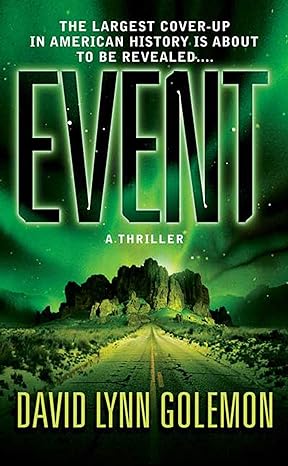
Event: A Novel by David L. Golemon


Borrows heavily from movies and TV, has decent action.

Published in 2006 by Thomas Dunne Books 

Event is not a bad book, per se, but I kept on thinking, "I've seen this before."

The book introduces a secret government agency called the Event Group which investigates historical legends, paranormal activity, UFO sightings, etc. They are sort of an X-Files, Men in Black and Delta Force rolled into one. The Event Group collects items of historical significance and studies them to plan for future disasters. They also keep these items secret.

 Why?

I was never quite clear as to why Noah's Ark, the existence of King Arthur, or the arrival of the Vikings in the Americas in the 800s were state secrets. Plus, comments such as the Event Group not wanting to give King Arthur's body to the Brits because it belongs to "the world" seem silly when the Event Group is just storing Arthur in a vast underground base in Nevada. They are not sharing any of this information with anyone - they are just hording it. The Event Group reminded me of Spielberg's Nazis in "Indiana Jones" that were always searching for relics of power.

There are aliens and their story seems to be a combination of Independence Day, Aliens and Tremors.

The characters were okay and the action was mostly good, but, for me, the story never quite gelled. I kept wondering why Noah's Ark was a state secret and the rest of the story broke down from there. To use a Bible analogy (in honor of Noah and his hidden-away Ark) - that was the story's "feet of clay."

I rate this book 2 stars out of 5.

This book can be found on Amazon.com here: Event: A Novel.


Reviewed on November 9, 2007.

Old Testament Legends being stories out of some of the less-known apochryphal books of the old testament (Kindle) by M.R. James


Sometimes interesting, mostly tedious

Originally Published in 1913  

M.R. James has collected additional stories from the Old Testament era. None of these is included in the canon books. These are not stories from the Apocrypha but even more stories. In times past, some churches actually treated some of these stories as scripture.

According to M.R. James, some of these are quite ancient and some are newer. The stories are arranged chronologically and feature Adam, Eve, Cain, Abraham, Job, Joseph ,Jeremiah and Solomon. A new, non-Biblical character is Ahiker, advisor to the King of the Chaldeans.

The stories about Adam and Eve mostly concern how they deal with being sent from the Garden of Eden. The story of Job is a re-telling of his book in the Bible, but it is more satisfying than the original.

M.R. James (1862-1936)
The story of Solomon is very bizarre. Solomon uses a ring to control demons in order to build the Temple. Abraham gets a lot of attention in these stories and we get to read stories about him as a young man and as an old man. There is a long story about Joseph (the interpreter of dreams) and a young woman that conspires to marry him.

The problem with these stories is the writing. They were written in a style that mimics the King James version, which was the par for the course for Biblical translation when M.R. James wrote this book. But, it's just makes some of these stories even more difficult to enjoy reading.

There is one more issue with this Kindle version. Many times the capital "C" is actually replaced with a capital "G". So we have Gain and Abel and the Gaananites. It's no big deal, especially since I paid nothing for this version, but just be aware of it if you choose to read these stories.

I rate this book 2 stars out of 5.

This book can be found on Amazon.com here: Old Testament Legends.

Reviewed May 29, 2009

Philippians: The Fellowship of the Gospel by R. Kent Hughes


Thorough and interesting


Published in 2007 by Crossway.

St. Paul's letter to the Philippians is not a very big book but it is a treasure trove of spiritual advice, advice about how a congregation should work together, historical information and ultimately, Paul points out how the Christian life should be lived with other Christians.

R. Kent Hughes explains the historical setting of the book. He describes the city of Philippi, Paul's journey to Philippi and how Paul ended up in a prison in Rome when he writes this letter.

Most importantly, Hughes explains Paul's theme that Christian life must be that of fellowship. Not that of coffee and doughnuts on Sunday morning fellowship, but fellowship like that expressed in the books and movies of J.R.R. Tolkien's Fellowship of the Ring), a fellowship based on a shared sense of mission, devotion to one another and the mission (the spreading of the Gospel) and perseverance through hardship.

I rate this book 5 stars out of 5.

This book can be found on Amazon.com here: Philippians: The Fellowship of the Gospel.

Reviewed on May 15, 2010.

Featured Post

<b><i>BAN THIS BOOK (audiobook)</i></b> by Alan Gratz

Published in 2017 by Blackstone Audio, Inc. Read by Bahni Turpin. Duration: 5 hours, 17 minutes. Unabridged. My Synopsis Ban This Book is t...

Popular posts over the last 7 days