Showing posts with label terrorism. Show all posts

SEPTEMBER 11 ATTACKS: A HISTORY from BEGINNING to END (kindle) by Hourly History


Published in 2024 by Hourly History.

Hourly History's telling of the events of September 11, 2001 is surprisingly well-told for a history that is supposed to take a person about an hour to read. 

Is this a complete history? Hardly. Why not? Read the first paragraph again.

But, it gets all of the elements across in broad strokes - the motives of the
 hijackers, the reasons for their targets, and the mass casualties - but not as bad as they could have been thanks to the bravery and professionalism of the NYPD and FDNY.

The book moves on to discuss the aftermath, including tearing down the remains of the buildings, the creation of the Department of Homeland Security, beefed up airport screenings, and the invasion of Afghanistan in order to search for the Osama Bin Laden and other terrorists responsible for the attacks. All of it is tied up neatly in a bite-sized e-book that younger readers (not kids, but younger adults that simply don't remember 9/11) could read to grasp the basics.

I rate this e-book 4 stars out of 5. It can be found on Amazon.com here: September 11 Attacks: A History from Beginning to End.

THEY WANT to KILL AMERICANS: THE MILITIAS, TERRORISTS, and DERANGED IDEOLOGY of the TRUMP INSURGENCY (audiobook) by Malcolm Nance


Read by Ari Fliakos.
Duration: 10 hours, 30 minutes.
Unabridged.


Malcolm Nance served for 20 years in the U.S. Navy in cryptology. His work led him to work in intelligence and counter-terrorism. Since his retirement from the military he has worked an additional 20 years as a consultant to the military, as a college lecturer on the topic of counter-terrorism, and as the head of a think tank.

Nance applied what he knows about terrorism to the January 6 Riot and comes up with a series of disturbing conclusions.

Nance is concerned that the most extreme elements of the MAGA movement have gone beyond rhetoric and casual flirtation with militia movements and have actively engaged with them. This book was published in July of 2022 but yesterday (November 29, 2022) two leaders of the Oath Keepers militia were found guilty of seditious conspiracy for their actions at the U.S. Capitol on January 6, 2021.

Why was a fringe militia group in Washington, D.C. on that date? In the trial it was established that one of the reasons they were there was to provide security for speakers and VIPs at the Trump rally that immediately preceded the attack on the Capitol.

Nance's point would be that it should be a major point of concern when politicians move from official security to armed thugs who are not answerable to official authority. They become a private army.

Roger Stone in a golf cart with his Oathkeeper security forces.
Click on the picture to get a larger image and read the shoulder
patch of the man at the wheel of the cart. Do you want your
President's advisors to hang out with violent, organized gangs?
What does that mean for our political future?
Roger Stone has been a Republican campaign strategist since the days of Richard Nixon. He is an infamous dirty trickster. He was an advisor to former President Trump - close enough that he received an official Presidential pardon from Trump when Stone was convicted of lying to Congress. Roger Stone met with the Oathkeepers and the Proud Boys multiple times before the election. It is well-documented because Stone was participating in a documentary. He was quite open about using violence to overturn the results of the election and he was clearly hanging out taking selfies and posing for photos with two violent militia groups in the days before January 6.

This book provides a handy guide to the militia movement in the United States. He provides recent histories, ideologies, relative strengths, and connections to the GOP establishment. Some of them are shockingly well connected.  It is sobering and more than a little depressing to see how low the GOP has sunk. Can you imagine Ronald Reagan even acknowledging the existence of a group like the Proud Boys, let alone letting them speak with his advisors and telling them to, "Stand back and stand by" in a national televised debate. The Proud Boys were encouraged, not dissuaded

Some might argue that groups like the Proud Boys are really a response to Antifa. It is not an unreasonable argument. Antifa is a real thing and they can be violent street brawlers. The difference is that Antifa is not serving as bodyguards for Democrat politicians. They are not serving as Joe Biden's off-the-books muscle. 

This book is unlikely to change the mind of your hard-core MAGA uncle, but it does offer a sobering analysis of the situation the American republic finds itself in. It is good to have a long and hard look at this side of our political situation. This is a depressing and important work.

I rate this audiobook 5 stars out of 5. It can be found on Amazon.com here: THEY WANT to KILL AMERICANS: THE MILITIAS, TERRORISTS, and DERANGED IDEOLOGY of the TRUMP INSURGENCY (audiobook) by Malcolm Nance.

DESTINY DISRUPTED: A HISTORY of the WORLD through ISLAMIC EYES (audiobook) by Tamim Ansary


Published in 2009 by Blackstone Audio.
Read by the author, Tamim Ansary
Duration: 17 hours, 28 minutes.
Unabridged.


Tamim Ansary has done something that is very hard to do - he has written a long history of a complicated topic without making it boring and after more than 17 hours of discussion, he left me wishing that it was even longer.

Ansary makes the observation that most histories that people in the West (Western Europe and the Americas) read are written from a Western perspective. That makes sense. But, the history of the world is not just the history of Western Civilization. There are multiple civilizations on the planet. Mesoamerica (the Mayas, Aztecs, Toltecs, etc.) is a separate civilization. China is the historic center of another civilization. So is India. And between the West and India and China is another one. Westerners usually refer to it as the Middle East. This book is a history of that civilization from the beginning of recorded history (empires like Bablyon) to 9/11 and the fallout from that terrorist act.

The strength of this book is that it lets the reader see history from another perspective. For example, the Crusades loom large in European history, but they were mostly an irritant to Muslims of the day since Ghenghis Khan was threatening them from Central Asia at the same time. Compared to Ghenghis Khan, the Crusaders were not an existential threat to their civilization. To make an analogy from American history, the Battle of Lexington and Concord looms large in American history textbooks as "The Short Heard 'Round the World", but most English school children have never heard of it.

The audiobook is read by the author and he does a great job. The book is written in approachable, every day language, literally designed to be an introduction to the history of this civilization. He reminds readers of key concepts throughout, showing how older ways of doing things applied to new situations and were adapted. Ansary's reading is excellent.

I rate this audiobook 5 stars out of 5. I highly recommended this audiobook. It can be found on Amazon.com here: DESTINY DISRUPTED: A HISTORY of the WORLD through ISLAMIC EYES by Tamim Ansary.

SOFT TARGET: A THRILLER (Ray Cruz #2) (audiobook) by Stephen Hunter


Published in 2011 by Brilliance Audio.
Read by Phil Gigante.
Duration: 7 hours, 56 minutes.
Unabridged.


The premise of Soft Target is pretty simple: the Bruce Willis movie Die Hard meets Minnesota's The Mall of America, except in this book it is called America: The Mall.

It's Black Friday, the biggest shopping day in the biggest shopping mall in America. Suddenly, Islamic terrorists throw off their disguises, shoot the mall Santa between the eyes and take a thousand people hostage.

Turns out that super tough retired Marine Ray Cruz is shopping in the mall and almost immediately sets out to start taking out the bad guys...

So, if the book had just followed that basic story line, it would have been better. Instead, it moves away from this compelling story (the "thriller" promised in the title). Instead, we get a lot of political wrangling with an up and coming politician-type leader of the Minnesota State Patrol, his subordinates and the FBI. This character, named Obobo, was clearly modeled on President Obama (bi-racial, father is from Kenya, extremely well-spoken, almost no experience for a man in his position) and it's obvious that the author is no fan. That's fine, I wasn't a fan, either. But, wow, this was not subtle. Also, this story line was mostly 2 hours of time-filler in this audibook. It did almost nothing and made no sense.

One last complaint - one of the bad guy's escape plans was so pathetic that I can't believe that anyone who had spent any time in America and witnessed a major media even would have ever considered it. It had no hope of success. He might as well have fired off flare guns while running out of the main entrance of the mall.

Phil Gigante read this audiobook. He is a seasoned audiobook pro and it showed - he did a great job with accents and female voices.

I rate this book 2 stars out of 5. It gets 2 stars because I really liked a character named LaVelva.

This book can be found on Amazon.com here: Soft Target: A Thriller by Stephen Hunter

NIGHT SCHOOL (Jack Reacher #21) (audiobook) by Lee Child


Published by Random House Audio in 2016.

Read by Dick Hill.
Duration: 13 hours, 7 minutes
Unabridged.

Fans of Jack Reacher know that the Lee Child does not write his books in a linear pattern - he bounces around on the Jack Reacher timeline quite a bit. Night School is set in the 1990's when Reacher was still in the military. Reacher has just come off of a secret mission in the Balkans.  He helped find and eliminate war criminals from the fighting that erupted in the wake of the collapse of Yugoslavia. It was the kind of mission that the government was glad to have done, but not glad to acknowledge.

Reacher receives a medal in a private ceremony and then is sent off to an inter-agency training seminar in the suburbs of Washington, D.C. But, it turns out that there are only two other people at this "training" - an FBI agent and a CIA agent that are also fresh off of missions that 
the government was glad to have done, but not glad to acknowledge.

The State Department has gathered them together as a team of go-getters to figure out what is behind a piece of intelligence that they have picked up thanks to an embedded operative - a terror network is offering $100 million for something to a seller in Germany. Reacher and company are being asked to figure out what is for sale and how they can get it before the bad guys do without losing the operative...

This is my fifteenth Jack Reacher book and it was one of the best. It's got some action, but mostly it is a detective story with really big consequences if it is not solved soon.

Dick Hill read this audiobook. He reads most of this series and that is a very, very good thing because Dick Hill has nailed the narration and character voices perfectly.

I rate this audiobook 5 stars out of 5 and it can be found on Amazon.com here: Night School by Lee Child.

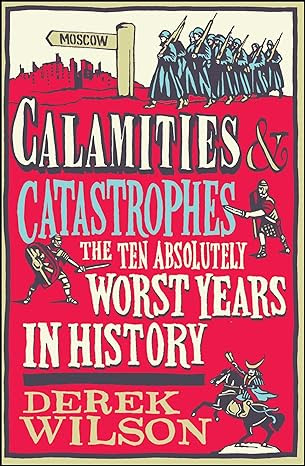
CALAMITIES and CATASTROPHES: THE TEN ABSOLUTELY WORST YEARS in HISTORY by Derek Wilson


Published in 2015 by Marble Arch Press

Going into this book, I knew that I would have a bone to pick with almost every one of the author's choices. After all, there are 5,000 years of recorded history and every last one of them is filled with tragedy. How can you pick and choose the actual worst 10 years?

Wilson, a British historian, focuses in this book on a Western point of view and the earliest date is 541 A.D. So, if you are making a pitch for the 10 worst years in the West in the last 1500 years, his choices are pretty solid.

The years he picks are:

541-542: The first outbreak of the Bubonic Plague weakens the nascent Byzantine Empire and the Persian Empire, killing millions.


1241-1242: The Mongols invade Eastern Europe.

1572: The Spanish Inquisition and everything that came with it.

1631-1632: The worst year of the Thirty Years War.

1709: The Great Freeze

1848: The "Year of Revolutions" in Europe

1865-1866: The assassination of Abraham Lincoln and the failure of the United States to follow through properly with Reconstruction after the Civil War. Also, the rise of terror groups like the KKK.

1942-1943: He almost exclusively focuses on the Russian front - the bloodbaths around Leningrad, Moscow and Stalingrad.


Robert F. Kennedy, Sr. (1925-1968)
1968: The Vietnam War, the assassinations of Martin Luther King and Robert Kennedy, protests around the world.

1994: The Rwandan genocide. There is a lot of focus on how and why the Western powers just watched it happen.

Sometimes, Wilson has a nice turn of phrase in his writing. I especially liked this line from page 151: "Over the centuries, whatever game Europe's nations played, the weakest hand always seemed to be dealt to Poland."

But, there were lots of typos, a weird use of texting-style writing on page 122 and several errors with commas that made me have to re-read passages just to figure out if what Wilson had written was what he really meant to say. Other times, there are factual errors (that may have been editing errors - as I just noted, editing was a real issue in this book). The most egregious error was actually a double error in the same paragraph on page 227. Wilson notes:

 "By the end of 1967 the war had cost the lives of almost 16,000 combat troops and was gobbling up more than $2-3 million per month. What made matters worse was that America's youth had no way of avoiding military service because conscription (the 'draft') still existed."

First: a quick internet search says the Department of Defense spend $168 billion between 1965 and 1972 on military operations in Vietnam. I am sure he meant to say $2-3 billion, not million.

Secondly, there were ways to avoid the draft. Let's look at three recent American presidents. Bill Clinton chose the most popular way to avoid the draft - he went to college. It was no guarantee, but it was a good bet. Many universities grew during the Vietnam War due to increased demand. George W. Bush joined the Air National Guard. Also, it was no guarantee not be sent to Vietnam, but it was not likely. Donald Trump claimed disability (bone spurs in his feet).

I rate this book 3 stars out of 5. The limited focus on the West while claiming to be about all of history was a disappointment. The atrocious editing was also a concern.

This book can be found on Amazon.com here: CALAMITIES and CATASTROPHES: THE TEN ABSOLUTELY WORST YEARS in HISTORY by Derek Wilson.

JOSEPH ANTON: A MEMOIR (audiobook) by Salman Rushdie


Published in 2012 by Random House Audio

Duration: 26 hours, 59 minutes
Read by Sam Dastor
Unabridged

For most people, Salman Rushdie is, and will always be, that author that the Iranians tried to have killed all of those years ago. I freely admit that this is an accurate description of me. Although I am an avid reader, this is the first Salman Rushdie book that I have even contemplated reading. 

Rushdie narrates this autobiography in the third person, which is a little weird and gave me the impression that he is trying to distance himself a bit from his own story.

The biggest chunk of Joseph Anton: A Memoir tells about how Rushdie dealt with the fatwa, or ruling against him and his book The Satanic Verses by the leader of the Iranian Revolution himself, the Ayatollah Khomeini. Khomeini ruled that the author, the publishers and the editors of the book should die for blasphemy and that anyone who died in an attempt to kill them would be considered a martyr. This caused Rushdie to go into hiding and be officially under police protection provided by the British government. Joseph Anton became his code name.

Rushdie the "icon" - the man who came to symbolize the intolerance of government-sponsored religion and offered a real-life preview to the dangers of radical Islam - and Rushdie the actual man are quite different people. I admire iconic Rushdie, but everyday life Rushdie is hard to like sometimes. Rushdie is often brutally honest about his friends and colleagues and their shortcomings - as he saw them. I can only imagine that many of his friends read this book and were horrified at how they were portrayed.

The book ends with a moving account of the 9/11 attacks on New York City, his adopted hometown. It makes a elegant bookend to a book that basically is about Islamic terror aimed at one person that morphs into terror aimed at an entire city.

The reader, Sam Dastor, was excellent. Interestingly, he is also the reader of the audiobook version of The Satanic Verses.

I rate this audiobook 3 stars out of 5. Way too long and too many uncomfortable comments about the author's supposed friends.

This audiobook can be found on Amazon.com here: Joseph Anton: A Memoir by Salman Rushdie. 

THE WALK-IN by Gary Berntsen and Ralph Pezzulo


Published in 2008 by Crown Publishing


Matt Freed is summoned on very short notice to Bucharest to interview a member of Iran's intelligence community. He was unrecruited, meaning that he is a "walk-in" - literally someone who walked into the embassy and offered information that the American government would want.

Freed has been asked to talk to this man because he is an expert on Iranian politics and he speaks the language. He is also an extremely capable intelligence operative. The interview yields valuable and very scary information. Freed starts to act on it and soon discovers that there may be more to this situation than he has been led to believe. He starts his own investigation and becomes convinced that this may be a double cross. His superiors disagree and it becomes a race against time with Freed working against foreign governments and his own...


This is a middle-of-the-road spy novel. The action was good but sometimes the narration needed to be made more clear as the action moved from person to person. The supporting characters were never really fleshed out so they always seemed to be fairly arbitrary in their actions because they were faceless uniforms or suits, depending on the bureaucracies they served. This is a book that would have been much better if it had been expanded.

I rate this novel 3 stars out of 5.

This novel can be found on Amazon.com here: The Walk-In.

A WANTED MAN (Jack Reacher #17) (audiobook) by Lee Child


Published by Random House Audio in 2012
Read by Dick Hill
Duration: 14 hours, 11 minutes
Unabridged


In A Wanted Man, Jack Reacher is stuck in Nebraska. He is hitchhiking his way across the country to Virginia to physically meet the woman he met over the phone in 61 Hours. He has having a hard time getting a ride, though, because his nose is broken and it is taped over with a shiny piece of silver duct tape and it makes his already-menacing look even more menacing. He finally gets picked up by two men and a woman in a sedan and they are off to Chicago on the lonely interstate in the middle of the night.

But, things don't seem right to Reacher. The woman is uncomfortable, he has caught the most talkative man in two obvious lies and they get stopped by two different roadblocks. Something is up.

Meanwhile, the action flashes back to a old small town Sheriff and a young female FBI agent who are trying to coordinate a search for two men who are suspected of killing a person with ties to the State Department and a missing cocktail waitress. So far, the suspects have slipped through two different sets of roadblocks...

I was torn by this book. The opening drama of Reacher being trapped in the car with the bad guys was actually quite interesting. The interplay between the FBI agent and the sheriff was excellent. But, the way Reacher figures it out the exact situation (or, at least close enough for the early part of the book) is stunningly unbelievable. The locale of the climactic scene, when it come to pass (no spoiler, I promise) is a play off of the situation in another book that it makes me wonder if Lee Child had come up with two possibilities for the other book and decided to recycle his previously discarded choice in this book.

On the other hand, Reacher's funny comments are plentiful and spot-on. 
Dick Hill does a great job reading Jack Reacher. He gets the pacing of Lee Child's writing style and does a great job with accents and even gives Reacher a stuffed up nose sound the entire book because of his broken nose.

I rate this audiobook 3 stars out of 5 for too many giant leaps of logic for Reacher and the "recycled" location from an earlier book.


This audiobook can be found on Amazon.com here: A Wanted Man by Lee Child.

OFF the GRID (Joe Pickett #16) by C. J. Box


Published in 2016 by G.P. Putnam's Sons


This installment in the saga of Joe Pickett starts out with a bear encounter in the mountains and ends up in a violent confrontation in Wyoming's Red Desert.

Joe Pickett's special relationship with the Governor is coming to an end in Off the Grid because the Governor's term is coming to an end. But, that doesn't stop him from going on one last special mission to the Red Desert area of Wyoming.

Meanwhile, Nate Romanowski has been approached by men from a secret group of government agents who are worried about national security issues. They know all about Nate and his delicate legal situation and promise to clear all of that up if he goes on a special assignment for them in the Red Desert area of Wyoming.

Also, Joe's daughter Sheridan goes for a weekend camping trip to volunteer to help an unknown activist group in (you guessed it) the Red Desert area of Wyoming.

As you know, if you follow this series, when Nate and Joe and Joe's family get involved in some sort of nefarious activity, there's bound to be plenty of action and drama.

Despite the obvious forced coincidence of having all of these characters show up in the same corner of Wyoming at the same time, the action and spending more time with these characters makes up for it.

I rate this book 4 stars out of 5.

This book can be found on Amazon.com here: Off the Grid by C.J. Box.

DIES IRAE: DAY of WRATH: A Novella by William Forstchen


Published in 2014 by Spectrum Literary Agency

William R. Fortschen notes in his introduction to Dies Irae: Day of Wrath that he felt compelled to write the story after a long discussion with a couple of friends about ISIS and the porous nature of America's southern border. What he came up with is this novella that is jam-packed full of action and very short on things like character development and a real resolution. But, it was written as a warning more than anything else.

The main characters are Bob Peterson and his wife Kathy who live in Maine. Bob is a middle school teacher. ISIS-backed terrorists have invaded America to launch a series of attacks on schools in smaller towns across the country, including Bob's.

Bob breaks school rules and state laws by carrying a pistol on his person in the school, and on this day that is a good thing...

Fortschen's descriptions of the ensuing death and mayhem are over the top but effective. To be honest, this book reminded me of Stephen King's orgies of blood and chaos in books like The Stand and Cell and I think that Fortschen would welcome the comparison.

Is this book a great book? No. It is over-the-top and alarmist.

That said, it is a compelling read, even though this public school teacher is very much against arming teachers in a school setting.

I rate this book 4 stars out of 5.

This book can be found on Amazon.com here: Dies Arae: Day of Wrath.

THE INNOCENT (Will Robie #1) by David Baldacci


Originally published in 2012.

The Innocent introduces Will Robie, a professional hit man who works for the United States government. His hits are usually drug cartel leaders, leaders of terrorist organizations and the like.

Robie gets an assignment close to home, which is a weird thing in and of itself. The first two hits described in the book are out of country hits. The fact that they are out of country hits gives the U.S. government a bit of plausible deniability. This new assignment is in Washington, D.C. and, as far as Robie can ascertain, the target is a fellow member of the intelligence community - but not an important one.

He's willing to follow through with it until he sees that the target is actually a mom with a young son and a baby. He hesitates, tries to figure out what is going on and that's when everything goes topsy-turvy in Robie's already convoluted world...
The White House. Photo by Zach Rudisin


This book was not a particularly great book for a couple of reasons. But, I will start with the good parts. The characters are great. Robie is likable character (for a stone-cold assassin) and his character does grow throughout the book. Also, the two supporting characters are interesting and the interaction between all three of them is well done.

But, the plot holes are not just large, they are magnificent. Robie stumbles into a plot, but you find out that he didn't really stumble into it - it was enlarged to include him as well in a giant cat-and-mouse game that makes no sense when you consider how it puts the original conspiracy at so much risk. Also, I knew who it was from the beginning because of a clue that was dropped that I cannot believe Robie did not pick up on and include in a mission debriefing. If he had, the entire plot of the book could have been avoided.

Also, on a pet peeve note there is this:

I am a Spanish teacher. I notice the Spanish in books and Baldacci includes a mis-translated gem on page 182 that tells me that he can't bother to actually check his dictionary translation with any of the millions upon millions of native speakers of Spanish that live in the United States. It's not that hard. It is a symptom of the lack of follow-through that pervades the book and makes for an iffy plot.


I rate this book 2 stars out of 5.

This book can be found on Amazon.com here: The Innocent by David Baldacci.

RECKLESS (Ty Hauck #3) by Andrew Gross


Slow Going At First.

Published in 2010.

Reckless is all about how quickly the world's stock markets can be played by a few bad actors who don't particularly care about making money so much as they care about wreaking havoc, bit this book takes a very long time to get started.

Hauck is in the suburbs of New York City. He is working for a corporation as a security consultant, meaning he investigates people the company may work with and gets involved with internet breaches and the like. Hauck's company is investigating an big-time investor with a hidden past. But, Hauck has a personal connection to the murders of a Wall Street broker and his family and soon finds a connection to a third murder that ties in all three investigations. But, is his company interested in what he finds? Is anyone?

The book is set in the midst of the Wall Street collapse in 2008 that kicked off the Great Recession. Gross does a great job of folding in his fictional companies with the big names that were at the heart of the mess. He also demonstrates one of the ways our economy is vulnerable to foreign manipulation, an idea laid out very clearly in Kevin Freeman's non-fiction book Secret Weapon.

Unfortunately, this book takes a solid 150 pages to really get moving. Once it gets going it is quite the rocket ship, but those first pages are a bit of a slog.

I rate this book 3 stars out of 5.


This book can be found on Amazon.com here: Reckless.

LETHAL MISCONDUCT (CORPS JUSTICE BOOK #6) (audiobook) by C.G. Cooper


Published by Carlos G. Cooper in January of 2015.
Read by DJ Holte
Duration: 4 hours, 57 minutes
Unabridged.

If you like military-type thrillers, C.G. Cooper's "Corps Justice" series may be of interest to you. This is a self-published series - and everyone who has read much by self-published authors is rolling his or her eyes right now. But, if you have read a lot by self-published authors you also know that while some self-published authors are really deluding themselves, some can really deliver the goods. In this case, C.G. Cooper is one of those that can really do the job.

Now, don't get me wrong, Lethal Misconduct a thriller and that means it is fairly formulaic- like westerns and romance novels, military thrillers seem to have just a few standard plot lines. In this case, this book features an all-star team of experts who are working for a gifted leader with a great moral vision who is also independently wealthy. 
Photo by Niels Noodhoek

This book is a great place to start in the series (it's where I started) because the team has just been assembled and it's clear that the series is moving off in a slightly different direction. In this case, this private, elite squadron is working unofficially for the President of the United States to take care of situations that cannot be officially handled on the books.

Now, normally this would be a problem - depending on your politics, imagine either of the last two presidents with access to an off-the-books elite military unit with almost no operational restraints and then shiver. In fact, the bad guy in this book pretty much operates his own version of the good guy's team. But, this is escapist fiction and it is best to not think about things like that and instead just sit back and enjoy the ride.

And, really, it's a pretty smart ride. Yes, this is a high-tech thriller with all of the stock characters (Gentle giant with an oddly "non-macho" skill? Check. Hacker guy? Check. Leader guy who does it all pretty well? Check.) and the stock plot points like stake outs and firefights but it also has a very tight and smart story. A lot happened in the 4 hours and 57 minutes of this audiobook. It didn't feel rushed (until it got to the end it was much too quick) and it didn't waste my time.

DJ Holte is the narrator and he has a great voice for action stories. It is deep and resonating and makes everything sound dramatic. Also, he created distinctive voices for each of the characters. His voice for the evil Colonel was perfect. It sounded world-weary but menacing, just like his character. A great reader can make it easy for the listener to imagine the character based just on his voice and Holte does that.

This audiobook can be found on Amazon.com here: Lethal Misconduct: Corps Justice, Book 6.

I rate this audiobook 4 stars out of 5.

Note: I received a free digital copy of this audiobook in exchange for an honest review. It really is a fun listen.

NPR FAVORITE DRIVEWAY MOMENTS: RADIO STORIES that WON'T LET YOU GO by NPR


Published in 2012 by HighBridge Audio
Multicast performance
Duration: 2 hours, 16 minutes

This collection was inspired by listeners who wrote NPR and commented on why these stories from their vast treasure trove of stories have stuck with them for so long. Some are funny, some are sad and some are thought-provoking. They are also a mixed bag. Some are great, some are so-so and some had me wondering why they were included at all.

Pretty typical of the collection is a skit called "Complexities of Modern Love in the Digital Age". It features the two voice actors that you most typically hear when you call a big corporation for customer service and they lead you through the phone tree. In this case, they have the two voices talk to one another and date. The idea is sort of cute but the actual skit was not as funny as the idea of the skit.

A Kathy Griffin interview. Eh. 

The Cookie Monster interview was fun.

I loved the story about a stray cat that wandered into a prison yard and was adopted by the prisoners. They feed it, take turns with it and the amount of discord in the yard has dropped because of this one cat.

I also liked the story of the former KKK member who went from harassing his Jewish neighbors to converting to Judaism thanks to a little human kindness.

The story about pets in the Sarajevo during the war among what used to be Yugoslavia was very interesting.

The story of a young couple in China digging through the rubble after an earthquake looking for their only son and his grandparents who were babysitting was gripping and heartbreaking. Easily the best in the collection.

The story that will stick with me was "Growing Up, Aging Out: The End of Foster Care". It was told from a very sympathetic point of view, wondering what a girl was going to do when she turned 21 and was no longer eligible to be part of the foster care system. But, I found it to be very irritating and the longer I listened the angrier I got. This girl was not physically disabled. She still had not finished high school and she was nearly 21 years old. She was making no moves to get a job or even finish high school. Instead, had been conditioned to accept handouts her whole life and to not work. How would she live without a government check? What would she do? What she was doing was sleeping with her drug dealer boyfriend and trying to get pregnant. I listened to it with my high school-aged daughter and I turned it into a cautionary tale.

So, lots of forgettable stories, some so-so stuff, a couple of really good ones and one really disturbing one.


I rate this collection 3 stars out of 5. It can be found on Amazon.com here: NPR FAVORITE DRIVEWAY MOMENTS: RADIO STORIES that WON'T LET YOU GO.

INSURGENT: BOOK 2 of AMERICA'S FUTURE by Charles Sheehan-Miles


Published in 2012 by Cincinnatus Press 

Insurgent is a worthy successor to the original book in this series, Republic: A Novel of America's Future. Book One details how a fictional confrontation between the state of West Virginia and the federal government over the proper role of the Department of Homeland Security eventually leads to a very short war in which West Virginia is quickly defeated. 

Book Two deals with post-war relations between the occupying federal government, its troops and the people of West Virginia and the closely monitored civilian government of West Virginia.

The flag of West Virginia
The parallels between this fictional war and the Iraq War and the multi-year struggle to create a stable environment in Iraq once Sadaam Hussein was removed from power are striking and, I am sure, quite intentional. And, since this is a book about Americans in a situation similar to that experienced by the people of Iraq, the Iraqi reactions are made all the more understandable to an American reader. 

Sheehan-Miles switches from the point of view of a small military unit helping to keep a crucial road clear to the civilians who interact with that unit to the officials in the limited civilian government and keeps multiple story lines going, including the origins of a nascent insurgent group with powerful weapons and even stronger religious beliefs who starts taking on the occupying troops with bombs, assassination attempts and threats against those who collaborate. 

It is a compelling read and, like I said about the last book, it is guaranteed to make you think.

It can be purchased here on Amazon.com: Insurgent: Book 2 of America's Future

I rate this book 5 stars out of 5.

WHERE MEN WIN GLORY: THE ODYSSEY of PAT TILLMAN by Jon Krakauer


This 2009 edition has been updated to reflect new developments and includes new material obtained through the Freedom of Information Act.

I am torn about this book. 

If you are not familiar with Pat Tillman, in the broadest terms, he was an NFL player who quit the NFL to join the army after the 9/11 attacks.

Where Men Win Glory focuses intently about the war in Afghanistan, the ongoing war (when this review was written in 2014) that has been mostly forgotten and ignored. Krakauer's review of the recent history of Afghanistan makes this book worth reading in and of itself. For most people, the reasons that Al Qaeda used Afghanistan as a base of operations is murky at best. The descriptions of how Tillman's unit operated and where they traveled are very vivid.

Krakauer's 2000 Presidential election spin (the Florida recount - he only tells part of the story and does not mention numerous "recounts" by the media had Bush winning - about as many as had Gore winning) was slanted and one-sided against George W. Bush. In fact, every time he mentions Bush throughout the book it is with disdain. There was no particular reason to mention Bush and the election except that Krakauer was building tension to show the inevitability of the Wars in Iraq and Afghanistan so long as Bush was president and as long as those wars were inevitable, Pat Tillman would die. To me, that seemed to be a long way to go to make a point, if that was his intention. Personally, I think Krakauer just wanted to take the opportunity to give Bush a hard time.

The descriptions of Tillman and his life and career left me cold at best. Krakauer's seemingly endless descriptions of the game-by-game performances of Tillman in his college and professional career and the parade of "Pat was just such a great guy" stories made me tired, not of Tillman himself but of the lazy writing style. This is a biography, but there was no need to include all of the exhaustive details of his entire professional life.
Corporal Patrick Tillman.jpg
Pat Tillman (1976-2004)

Pat Tillman's death due to friendly fire was tragic and Krakauer tells the story of the military patrol that ended with the death of Tillman extraordinarily well. The way that his body was treated afterwards was certainly odd and seemed to be covering up something. Krakauer is critical of the way the military handled the whole affair but has no explanation as to what they may have been covering up. If they were covering up the fact that he died due to friendly fire, that was foolish. There has been a steady rate of friendly fire deaths in American wars of about 2% (heck, the famed Confederate General Stonewall Jackson died due to complications from a friendly fire incident). Although I am hardly a firearms expert, my few experiences with archery equipment, target shooting and hunting leave me wondering why the friendly fire rate is not much, much higher.

So, what were they covering up? 

Krakauer does not tell us and I was left wondering how many investigations that Tillman's family was going to be granted and to what purpose? Krakauer's description of the firefight that killed Tillman makes it obvious (to me anyway) that spooked soldiers mistook Tillman and his two companions for the men who had been shooting at them earlier and they thoughtlessly fired on them without verifying their targets. Sad, to be sure, but it sounded like there was no malice behind it, just an awful mistake.

Krakauer's postscript chapter is an odd hodge-podge of stuff. Stories of the continuing chaos in Afghanistan and Pakistan, long quotes from Nietzsche deriding how soft and thoughtful modern man has gotten and then idealizing Tillman as the Ubermensch ideal. Once again, for me, Krakauer's style got in the way of his story-telling. In that way, it was a fitting end for this mixed bag of a book.

I rate this book 3 stars out of 5. This book can be found on Amazon.com here:    WHERE MEN WIN GLORY: THE ODYSSEY of PAT TILLMAN by Jon Krakauer

Reviewed on December 1, 2014.

TRIDENT'S FIRST GLEAMING: A SPECIAL OPERATIONS GROUP THRILLER (audiobook) by Stephen Templin


Published by ListenUp Audiobooks in September of 2014.

Read by Brian Troxell.
Duration: 9 hours, 14 minutes.
Unabridged

In many ways Trident's First Gleaming is a pretty typical special forces book. You've got a terrorist threat from somewhere in the Middle East, you have an elite group of American operatives who are scrambled to eliminate it, they discover it is worse than anyone has imagined and only they can somehow overcome these newer incredibly long odds and save America and the world.

But, in other ways it is different. The main character, Chris Paladin, is more than just a really talented (but retired) operative - he is also an associate pastor of a church in Dallas, Texas. But, when a former colleague reaches out to him and requests his help he returns to his former life, with restrictions.

His former colleague has been assigned to recover a downed Switchblade Whisper, a new type of military drone that can be launched from a submarine. Its wings swing out and lock open when fired out of the submarine, much like a switchblade's blade swings out and locks open.


Unfortunately, it has crashed in Syria and by all indications it was taken down by a genius with an astounding grasp of technology. Also, he is a madman with real issues about his sister and a taste for eating people.

Photo by Niels Nordhoek
Stephen Templin has a talent for writing military thrillers. This book could have been over-the-top in so many ways. The pastor angle could have been overdone with preachy sermons and the like, but it was not. The weapons angle could have been overdone with discussions of guns to the level of a fetish. The bad guy was certainly creepy but he was not the focus because this is not a Hannibal Lechter novel. 

Instead, once this book gets going it becomes part thriller, part "buddy" book, part romance and injected with a real sense of humanity and, from time-to-time, a great gag to relieve the tension.

Don't get me wrong, this is not a "change-your-life" novel and it's not perfect, but for a military thriller this is about as good as it gets.

Narrator Brian Troxell has a great voice for reading these types of books. He makes everything he reads seem very dramatic, very edgy and very macho. I look forward to hearing more of his work.

Note: I received a copy of this audiobook from the publisher in exchange for an honest review.

I rate this book 5 stars out of 5. It can be found on Amazon.com here: Trident's First Gleaming: A Special Operations Group Thriller

Reviewed on November 25, 2014.


LITTLE BROTHER (audiobook) by Cory Doctorow


A Must Read for Early 21st Century America?

Published by Listening Library in 2010
Performed by Kirby Heyborne
Duration: Approximately 12 hours
Unabridged.

I've had Little Brother on my to-be-read list for while. But, it shot to the top of my list when it was pulled as the book in a "one book/one school" project at a Florida high school. I picked up the audiobook and my daughter and I listened as we commuted to school every day (she is a freshman at the school where I teach.

The story is about Marcus, a teenager in San Francisco who is a hacker, skips school and is, generally speaking, a pretty with-it kid. I imagined him as a Ferris Bueller-type kid with a lot more tech at his disposal and in a much more serious situation. Marcus and three of his friends are skipping the end of school when the Bay Bridge and the tunnel underneath it are blown up by terrorists in an event that is even larger than 9/11.
File:Oakland Bay Bridge from Yerba Buena Island.jpg
The Bay Bridge. Photo by Centpacrr.

Marcus and his three friends try to hide in the BART (subway) tunnels but they are in danger of being crushed by the panicking people so they head back up to the surface after one of their group is injured. A passing police van picks them up and they are turned over to the Department of Homeland Security. It is never clear what they did wrong except being out of school on a day when thousands died due to a terrorist attack. The mere fact makes them suspect and they are interrogated thoroughly, including being denied the right to contact a lawyer, sleep deprivation and solitary confinement. 

Marcus knows his rights and insists on a phone call, an attorney, knowing what he is being charged with and more. The DHS insists that it just wants his phone passwords, his passwords to his computer and his online accounts. They inform him that his friends are being similarly punished because he will not cooperate.

After a few days, he breaks and gives DHS his passwords to his computer and his phone. 

He is crushed.

But, when he is released (with just two of his friends - the injured one is not released and is presumed dead) he cannot believe how quickly DHS has swarmed throughout San Francisco,  setting up security checkpoints, monitoring the traffic patterns of cars using toll roads and the traffic patterns of BART riders. His own hand-built laptop has even been physically hacked and tracking machinery has been installed without his parents' knowledge while he was locked up.
Cory Doctorow. Photo by Jonathan Worth. http://JonathanWorth.com

At this point, Marcus regains some of his former swagger and decides to act, even if it is in a small way. As he puts it, Never underestimate the determination of a kid who is time-rich and cash-poor.” Marcus puts his hacker skills to use and decides to fight his own little guerrilla war against the heavy-handed and illegal techniques that DHS is employing. The title Little Brother comes from this - he is not "Big Brother" like the government in the novel 1984. Instead, he is one little person watching the government and documenting what he sees and letting other know what's going on. And, in the process, he becomes one of many people who decide that rights are more important than the illusion of safety and start to take back San Francisco...

One of the beautiful thing about fiction books is that you can discuss important topics in a non-threatening way. In this case, the events in this book are clearly a stand-in for 9/11 and the DHS's reaction is a stand-in for the Patriot Act and some of the heavy-handed tactics used against Muslim communities immediately after 9/11.

I listened to the book with my daughter and we often stopped the audio playback to talk about what was going on in the book (although the 4 or 5 scenes involving sexual activity, even if it wasn't graphicly described, made for uncomfortable father-daughter listening so we usually skipped ahead until it was over). We talked about what your rights were if you were arrested, why your rights are so important and have to be defended in an absolutist manner, why "I don't have anything to hide so I don't care if my rights are violated" is just a cop out and more. We drug this audiobook out so long that took about a month to listen to it. 

I rate this book 5 stars out of 5 despite the fact that at some points the techno-speak overwhelms the book and it becomes about as interesting as reading a router installation manual. But, the positives of the the book overcome these dry areas and make this book just about must-read material for early 21st century America.

Here's a quote I really liked from the book: “I can't go underground for a year, ten years, my whole life, waiting for freedom to be handed to me. Freedom is something you have to take for yourself.” 

This book can be found on Amazon.com here: Little Brother by Cory Doctorow.


Reviewed on November 25, 2014.

Featured Post

<b><i>BAN THIS BOOK (audiobook)</i></b> by Alan Gratz

Published in 2017 by Blackstone Audio, Inc. Read by Bahni Turpin. Duration: 5 hours, 17 minutes. Unabridged. My Synopsis Ban This Book is t...

Popular posts over the last 7 days