Showing posts with label John Quincy Adams. Show all posts

LIFE AFTER POWER: SEVEN PRESIDENTS and THEIR SEARCH for PURPOSE BEYOND the WHITE HOUSE (audiobook) by Jared Cohen


Published by Simon and Schuster Audio in 2024.
Read by Kevin R. Free.
Duration: 14 hours, 4 minutes.
Unabridged.

In Life After Power Presidential historian Jared Cohen looks into the post-Presidential lives of seven Presidents and their quests for some sort of meaning after having one of the most important jobs you can have.

Some Presidents fade away due to health reasons, like Reagan. Others are eager to resume their former lives, like Washington. But, others still feel like they have something more to offer or have unfulfilled goals.

The seven Presidents he looked at are: Thomas Jefferson, John Quincy Adams, Grover Cleveland, William Howard Taft, Herbert Hoover, Jimmy Carter, and George W. Bush.

I have enjoyed hearing about John Quincy Adams' post-Presidential life ever since I first read John F. Kennedy's Profiles in Courage 30+ years ago. I've read more than one book about him and this re-telling is quite good. 

A photo of John Quincy Adams 
taken in 1844.
Jimmy Carter's lengthy post-Presidency is remarkable for how amazingly hard-headed he has been. Carter follows his conscience and lets the political consequences be damned. Cohen notes that Carter did not actually found Habitat for Humanity - he just joined it early on and is easily its most famous and perhaps longest term volunteer.

George W. Bush has done almost the opposite. He lived a very public life for years and has since retreated into more solitary pursuits such as painting. He has said almost nothing about politics in the almost 16 years since he left office.

Each of these men had a different reaction to leaving office. Some left after 2 successful terms, some after experiencing disappointment and 4 of them were defeated after just one term (this is what inspired Cleveland's determination to run again - and win.) I found some to be more interesting than others but, taken a whole, this is a solid set of mini-biographies.

I rate this book 4 stars out of 5. It can be found on Amazon.com here: LIFE AFTER POWER: SEVEN PRESIDENTS and THEIR SEARCH for PURPOSE BEYOND the WHITE HOUSE by Jared Cohen.


FOR LIBERTY and GLORY: WASHINGTON, LAFAYETTE, and THEIR REVOLUTIONS by James R. Gaines


Published in 2007 by W.W. Norton and Company.

First a bit of traditional blogging. I was going through some old receipts because I had plenty of time on my hands thanks to the Coronavirus lockdowns. This pile of receipts was 12 years old. It included some golden oldies like a Blockbuster receipt. I also found a receipt for this book. I had gotten a great deal on For Liberty and Glory - and it sat in my To-Be-Read pile for 12 years.

I had no idea it was in that pile for that long. If you had asked me before I found the receipt, I would guess it had been 4 or 5 years at most. At that moment, this book moved to the top of my To-Be-Read pile. I should have read it long before now - it was an excellent read.

Originally, I picked up this book because I simply didn't know much about Lafayette. I've read plenty of biographies of Washington and histories of the American Revolution. Lafayette always comes into the story somewhere in the middle. There's always a build up, with the Stamp Act, the Boston Massacre, Paul Revere and Patrick Henry and so on and then this kid from France comes over. He and Washington bond, Lafayette makes a good showing and he helps bring the French military in to help fight the English. And, at some point Lafayette goes away and doesn't come back until 1824.

I knew Lafayette was involved with the French Revolution, but my interest in the French Revolution is not strong (to me, it's a story that starts out well and then, all of a sudden, mobs are carrying heads and body parts around screaming for more blood and ends with a dictator that attacks every country in Europe, parts of Africa and even Haiti). So, I simply lost track of him. I asked someone who was a French Revolution buff what happened to Lafayette and the short answer was: "It didn't go well for him" with no elaboration.

So, this book looked like it would answer that question. It is a double biography of Washington and Lafayette as well as a double history of the American Revolution and the French Revolution. It is certainly not the definitive biography of either man or the definitive history of either revolution. But, it is immensely readable. I enjoyed it.

Turns out that I learned a lot about Lafayette. For example, his first name is Gilbert. Yeah, that seems trivial, but I've never heard him referred to as anything but Lafayette or the Marquis de Lafayette (almost like "Marquis" was his first name).

Lafayette was in love with the concept of the American Revolution from the

moment he heard of it. This teenager was so excited by the prospect of assisting in the war that he came here against the orders of the King's advisors - they had ordered all of the potential volunteers to stay in France. But, Lafayette and a few others crossed the border to Spain. Lafayette bought his own ship, sailed to South Carolina and eventually became an American hero - a Founding Father of sorts with more than 400 towns named after him. In my own state (Indiana) we have two cities and one county named after him.

Lafayette returned to France and was caught up in the French Revolution. The phrase "caught up" makes it sound like he was passive. Hardly. He co-wrote the most famous document of the French Revolution - the Declaration of the Rights of Man and of the Citizen. He created the modern French flag by combining the flag of Paris with the flag of the King of France. He helped save Louis XVI's life at one point and ended up languishing in a foreign prison for five years because of his role in the Revolution. He was offered the chance to be dictator at one point, and like his friend and hero George Washington, he turned it down. Bonaparte would not turn it down when he was offered that chance. But, Lafayette had a hand in Bonaparte's political demise in 1815 (after Waterloo). The luster of his name helped to carry the day.

Speaking of Bonaparte, Lafayette knew him personally. He knew so many big names in his life - George Washington, Victor Hugo, Marie Antoinette, Thomas Jefferson, Benjamin Franklin, John Adams, Victor Hugo, Louis XVI, Andrew Jackson, Alexis de Tocqueville, James Monroe, James Madison, Alexander Hamilton, and more.

I rate this book 5 stars out of 5. A must read if you are a student of the American Revolution and the early years of America's independence. Gaines has made this very approachable and writes in a lively manner.

It can be found on Amazon.com here: FOR LIBERTY and GLORY: WASHINGTON, LAFAYETTE, and THEIR REVOLUTIONS by James R. Gaines.

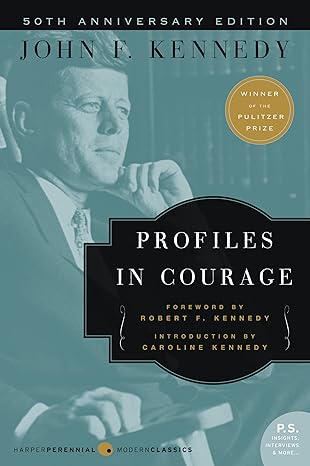
PROFILES in COURAGE (audiobook) by John Fitzgerald Kennedy


A Review of the Audiobook

Winner of the 1957 Pulitzer Prize
Originally Published in 1955

Published by HarperAudio
Duration: 3 hours, 10 minutes
Read by John F. Kennedy, Jr.
Abridged

President John F. Kennedy
(1917-1963)
If you have not read Profiles in Courage, it is comprised of 8 short biographies of Senators that JFK found to be inspirational in some way or another. Those Senators are: John Quincy Adams, Daniel Webster, Thomas Hart Benton, Sam Houston, Edmund G. Ross, Lucius Lamar, George Norris and Robert A. Taft.

Each of these men's stories were very well done, even if some of them, like John Quincy Adams' biography, actually seemed very short compared to what these men actually accomplished. But, then again, this is just a look at one point in time, not a complete list of each man's accomplishments and an abridged version of that short look on top of that.


This audiobook version of JFK's classic work is read by the President's son, John F. Kennedy, Jr. (1960-1999) with an introduction by Caroline Kennedy. The narration was actually quite good. Well worth your time to take a listen or to read.

I rate this audiobook 5 stars out of 5.

This audiobook can be found on Amazon.com here: Profiles in Courage by John Fitzgerald Kennedy

FREEDOM NATIONAL: THE DESTRUCTION of SLAVERY in the UNITED STATES, 1861-1865 (audiobook) by James Oakes


Published by Gildan Media, LLC in 2012
Read by Sean Pratt
Duration: 18 hours, 54 minutes
Unabridged


James Oakes takes a unique look at the Civil War in Freedom National - through the lens of the anti-slavery movement. I have read more than 200 Civil War histories and almost all of them cover this part of the story - but, just in bits and pieces.

Oakes looks at the anti-slavery movement from its roots in the Revolutionary War era and moves forward with the different Abolitionist arguments until they finally stumbled upon the concept of "freedom national". The argument is over the standard, default setting of the slavery issue. Was slavery legal everywhere, except where it was specifically abolished, or was it illegal everywhere, except for where it was specifically made legal? Or, in shorthand - was it "freedom national" or "slavery national"?


This book puts the lie to the idea that the Civil War was over taxes, tariffs or anything else but slavery. This book demonstrates that so much time, energy and effort was expended over how to deal with the slavery issue by both sides that, if it weren't the biggest question of the war, why was there so much constant uproar over it? Slavery was both the carrot and the stick in the Emancipation Proclamation. Slavery would be preserved if the areas in rebellion returned to the fold (the carrot), or it would be the slaves in those areas would be forever free and those slaves could be turned into Union soldiers to use against the Confederacy.

Almost as soon as the war started, it became obvious that the Confederacy's slaves were both an asset and a liability. They were an asset because they were a built-in workforce that would keep the fields in production (and some factories) while the armies were in the field. But, they were a liability because their owners feared an uprising, they were mobile and if they fled to Union lines they could be an invaluable source of military intelligence.


But, Lincoln faced a unique challenge that the Confederacy never faced - how do you free slaves in the Confederacy but maintain slavery in the four loyal slave states? 

I rate this audiobook 5 stars out of 5. 

BRAVE COMPANIONS: PORTRAITS in HISTORY (audiobook) by David MCCullough


Originally published in hardback book form in 1991.
Published by Simon and Schuster Audio.
Read by the author, David McCullough
Duration: 11 hours, 19 minutes
Unabridged

Brave Companions: Portraits in History is a collection of previously published articles and speeches. It's a smattering of this and that - sometimes it's about art, sometimes about scientists, sometimes about politicians and sometimes it's just some musings from McCullough about history. It doesn't matter, almost all of it is interesting and well-told. McCullough understands the value of telling history as a story - as always he is very approachable.

My favorite entry was the story of the railroad that preceded the Panama Canal. It was an amazing story of the power of human will against nature.

McCullough reads this audiobook, which is great because McCullough has a fantastic speaking voice and is well known for his voice work. I envy both his writing ability and his talents as a speaker.

My favorite quote from the book is from President Harry S. Truman: "The only new thing in the world is the history you don't know."


I rate this collection 5 stars out of 5.

This book can be found on Amazon.com here: Brave Companions: Portraits in History by David McCullough

THE AMERICAN SPIRIT: WHO WE ARE and WHAT WE STAND FOR (audiobook) by David McCullough


Published in April of 2017 by Simon and Schuster
Read by the author, David McCullough
Duration: 4 hours, 13 minutes
Unabridged

The American Spirit is a collection of speeches delivered by the two time Pulitzer Prize winning author. The topics vary in length and topic but are all bound by two common themes: American history and the importance of knowing that history.

I listened to this collection as an audiobook over a period of about a week and found it to be quite enjoyable as I walked the dog every evening. The speeches are usually not too long and not too short, informative, interesting.

McCullough has re-recorded these speeches for this audiobook and his voice does show a little age, but it is still a wonderful voice to listen to and his delivery, combined with his words help make this an enjoyable audiobook. 


I rate this audiobook 5 stars out of 5.

This book can be found on Amazon.com here: The American Spirit.

BUNKER HILL: A CITY, A SIEGE, A REVOLUTION (audiobook) by Nathaniel Philbrick


Published in 2013 by Penguin Audio
Read by Chris Sorensen
Duration: 12 hours, 58 minutes
Unabridged

Nathaniel Philbrick's Bunker Hill: A City, A Siege, A Revolution is misnamed. While the battle is in the book, it is only a part of the story. In reality, this book is a history of Boston from the 1750s and 1760s right up to the Declaration of Independence.

In a lot of ways this book is much more of a biography of Dr. Joseph Warren, one of the leaders of the Sons of Liberty movement, along with Samuel Adams, John Adams and John Hancock. Warren is often overlooked nowadays because he died at Bunker Hill (which was really mostly fought on Breed's Hill). The excessive focus on Warren was, in my mind, one of the great weaknesses of the book. Philbrick spent too much time worrying over Warren's alleged personal failures and not enough time getting on with the story. It just bogged things down.
Philbrick does not gloss over the warts of our Founding Fathers, noting that some had mixed motives and some profited from the independence movement. There is plenty of emphasis on the British side of things, something I admire about the book.  

The arrival of Washington in Boston, sent by the Continental Congress to take command and in effect nationalize the militias that surrounded the British troops in Boston, is not explained well. Philbrick does not go much into the goings on of the Continental Congress besides noting that certain people left Boston to attend. Because of this, Washington's arrival comes with very little explanation (much like it may have seemed to some of the militiamen). As the narrative continues, Philbrick does not give Washington much credit for anything around Boston but bad ideas, impatience, a negative attitude and lucky timing.

Chris Sorenson's reading of the audiobook was excellent. 

In short, while there are things to admire about this book, there are problems as well - not problems with the research but problems with choices about what was included (excessive focus on Warren's personal life) and what was left out (the Continental Congress).

I rate this audiobook 3 stars out of 5.

This audiobook can be found on Amazon.com here: Bunker Hill: A City, A Siege, A Revolution.

A DISEASE in the PUBLIC MIND: A NEW UNDERSTANDING of WHY WE FOUGHT the CIVIL WAR (audiobook) by Thomas Fleming


Published in 2013 by Blackstone Audio.
Read by William Hughes
Duration: 11 hours, 42 minutes.
Unabridged

Thomas Fleming readily admits that he mostly writes about the era of the American Revolution (such as his excellent book Liberty! The American Revolution) but he felt compelled to make a long commentary on the origins of the Civil War by writing A Disease in the Public Mind.

Fleming's take on the causes of the war are based on a comment from James Buchanan's that the furor over slavery was a "disease in the public mind."

Fleming is quite confident that this disease was mostly caused by the North. Shelby Foote alludes to this, in a way, in the Ken Burns Civil War documentary when he notes that there was a war "because we failed to do the thing we really have a genius for, which is compromise...our whole government's founded on it and it failed."


An exhibit at the Lincoln Museum in Springfield, Illinois.
Photo by DWD
Foote meant that both sides had to give in to make an agreement. Fleming clearly identifies the North as the side that refuses to compromise and causes the crisis. He compares the North to the Puritans that prosecuted the Salem Witch Trials and Joseph McCarthy. The difference between the Salem Witch Trials and the Abolitionist attacks on slavery is that witchcraft and magic are not real so there were no witches but slavery, slaves and slave masters were all very, very real. 

Fleming excuses the fact that slave families were broken apart on a regular basis through estate sales by pointing out that Washington did not do this sort of thing. He goes on to use Washington as an archetype of what could have been if the Abolitionists had not started pressing the South. If you had to be a slave, being George Washington's slave was about as good as you could hope for. Washington refused to break up families or dump older slaves who couldn't really work. He also freed his slaves when he died.  Fleming writes at length about how Washington was pressed by his own personal abolitionist - his Revolutionary War comrade the Marquis de Lafayette. Lafayette's efforts were worthy and good but, somehow, the efforts of American abolitionists were the equivalent of the Salem Witch Trial.

Fleming tries to defend slave owners against the charge of taking sexual advantage of their female slaves, saying it was very rare. But, as his narrative continues he points out any number of slaves and former slaves who were mixed race. If it was so rare, how did these people exist? He also completely ignores the story of Thomas Jefferson and Sally Hemmings. This "look at this Founding Father as a great example, but not at that one because he doesn't make my argument" type of cherry-picking is pretty typical throughout the book. 

What Fleming does best is point out that there was a genuine paranoia among Southern Whites about the possibility of a race war like Haiti experienced when its African slaves overthrew the French government. When you look at the political cartoons of the era, like this one that decries the evils of the Emancipation Proclamation, you see evil influences upon Lincoln: multiple representations of the devil, a picture of a sainted John Brown and a large painting glorifying the violence in Saint-Domingue (Haiti). Clearly, this was a worry and not without some justification. There were slave revolts from time to time and this was the stated goal of John Brown's raid on the arsenal at Harper's Ferry.

But, Fleming uses this fear to justify every action the South made to defend slavery, such as refusing to let people petition the Congress concerning slavery - a right established in the First Amendment of the Constitution. The First Amendment! Not one of those pesky rights with the bigger numbers that get lost in the jumble. Plus, the governments of the South searched the mail for newspapers that they did not like and destroyed them. Clearly, another violation of the First Amendment. But, he excuses it because the White Southerners were scared of the power of the Abolitionist press on its slave population.

Fleming never really formulates a thesis beyond that the Abolitionists were pushing the Southerners too hard. Many historians try to argue that slavery was on the way out in the South and that slave owners were searching for a way to safely end slavery. Fleming does not even make this argument. He acknowledges that there was an attempt to expand slavery to the territories and to new states, but he denies it was organized. He completely ignores the fact that Southern politicians (and even John Quincy Adams, for a while) openly proposed conquering Cuba for the express reason of making it a slave state to keep the balance of free state/slave state power in the Congress. James Buchanan himself authored a proposal to take over Cuba before he became President and had it as a goal when he became President in 1857. There were also proposals to take parts of Mexico and Central America and make them slave states. William Walker invaded both Mexico and Nicaragua with that goal. The pre-Civil War pro-slavery group Knights of the Golden Circle advocated making more than 25 slave states out of Mexico, Central America and the Caribbean islands.

There is more, but this is enough to demonstrate that this is a deeply flawed book, albeit an interesting one. Fleming's reminder of the deep-seated fear of a race war like the one in Haiti is an important one. Fleming's argument ends up leaving the American slave population in the untenable position of being involved in a never-ending, ever-expanding slave economy that was, as Fleming himself points out, evolving from a plantation-based system to a factory-based system in some areas and showed little sign of ending. But, if you protested this system from the outside you were in the wrong and most certainly caused the Civil War. These are the reasons that I rate this book 2 stars out of 5.


This audiobook was read by William Hughes. He did a great job of reading at a brisk, easy-to-understand pace. 

This book can be found on Amazon.com here: A Disease in the Public Mind.

TAINTED by SUSPICION: THE SECRET DEALS and ELECTORAL CHAOS of DISPUTED PRESIDENTIAL ELECTIONS by Fred Lucas


Published in May of 2016.

The 2016 Presidential election cycle has been wild, to say the least. A rookie politician with an unstoppable mouth and a veteran politician with a long, checkered past are an unlikely pairing. Throw in a couple of strong third party candidates and the fact that these are the two most hated candidates in a generation and you may very well have an election in which no one wins a majority of the votes in the electoral college.

What would happen in no one actually wins, or if it is too close to call?


Aaron Burr (1756-1836)
In Tainted by Suspicion, veteran White House correspondent Fred Lucas gives us some insight as he tells the story of six troubled Presidential elections: 1800, 1824, 1876, 1888, 1960 and 2000.

With each election Lucas describes the political environment of the time, the major players in the election and the reasons why it became a disputed election. He details how it finally worked out and then offers informed speculation as to what would have happened if the other guy had won.

Most of the stories are quite interesting. Even the "what-ifs" are pretty good, with the exception of the "what-if" for Aaron Burr because it just went on for too long. Political junkies will note the definite lean to the right for the discussion of the JFK/Nixon and Bush/Gore elections. It is there, but it is also not inaccurate, in my opinion.

For fans of Presidential politics, this is a must-read. For those that are just curious about what how convoluted American politics can get, this is a worthy introduction.

I rate this book 4 stars out of 5.


This book can be found on Amazon.com here: Tainted by Suspicion.

Mr. Adams's Last Crusade: John Quincy Adams's Extraordinary Post-Presidential Life In Congress by Joseph Wheelan


I have found a new hero from history


Published in 2008.

I've known about John Quincy Adams's post-Presidential career ever since I read Profiles In Courage by JFK many, many years ago. However, what I most remember about that description of him was that that he argued against slavery in the Congress when he could have just coasted along in a comfortable political semi-retirement.

In the well-written Mr. Adams's Last Crusade, Joseph Wheelan does us all a favor by elaborating on John Quincy Adams's amazing career. Wheelan briefly covers John Quincy Adams's early career in the first 65 pages. As a teenager, John Quincy Adams was an assistant to his father while he was an ambassador to Europe during the Revolutionary War. He served as ambassador to several European countries after the War and also as Secretary of State (the Monroe Doctrine is as much his as Monroe's) and finally President.

Oddly enough, that amazing career was only a prelude to his post-Presidential career as a Representative from Massachusetts in the U.S. Congress. He reports to Congress at age 64. Adams was vaguely opposed to slavery but was very much in favor of the rights to free speech and petition. The Congress was avoiding any discussion of the topic of slavery, including ignoring all petitions to end slavery in Washington, D.C. (Congress administers the District of Columbia so it could have outlawed slavery within it by simple passage of a law).

Adams was indignant that a basic part of the Bill of Rights was being ignored so he began to read the petitions on the floor. He was told to stand down but he kept on reading. He was shouted it, threatened and shunned but he kept on reading. He began to investigate slavery, discovered he loathed it and was motivated to read even more petitions. In fact, the conservative "Adams had become the de facto chief spokesman for many of those denied a voice in government - abolitionists silenced by the Gag Rule, slaves, Indians and finally, women." (p. 150)

Finally, after years of these struggles, Adams was censured by Congress for treason for presenting "a petition espousing the dissolution of the United States because of the 'peculiar institution' that the South so desperately wished not to discuss." (p. 196) Adams was previously known to be a poor public speaker but in this cause he found his voice. He was put on trial in the Congress and he defended himself for nine days. He spoke with soaring words, withering sarcasm, humor and anger. Ralph Waldo Emerson described him as a "bruiser" (p. 197) when discussing his political speech-making skills and he was not wrong. The charges were dropped but Adams's speeches destroyed the political careers of some of those who brought the charges of treason against him. He found his voice and he used it to full effect everywhere he went.

A daguerreotype of Adams (1767-1848) taken  in 1843
The unpopular president who could not seem to connect with the common man on any level became a sort of folk hero - the man who stands against the crowd and fights the fight that he knows is right despite the odds - and wins!

Adams's role in the establishment of the Smithsonian is also well-covered in the text as well as plenty of details about his personal life.

Adams was sitting at his seat in the House when he suddenly collapsed. Two days later he died in the Capitol building. His funeral procession was the most elaborate until Lincoln's 17 years later. with his death, most felt that their last living connection with the Revolutionary War era had ended - the youngest of that generation had passed.

Well-written, informative, and inspiring - this book is highly recommended.

I rate this book 5 stars out of 5.

This book can be found on Amazon.com here: Mr. Adams's Last Crusade.

Reviewed on January 16, 2010.

Featured Post

<b><i>BAN THIS BOOK (audiobook)</i></b> by Alan Gratz

Published in 2017 by Blackstone Audio, Inc. Read by Bahni Turpin. Duration: 5 hours, 17 minutes. Unabridged. My Synopsis Ban This Book is t...

Popular posts over the last 7 days