Showing posts with label anti-Semitism. Show all posts

Children of Wrath: A Novel (audiobook) by Paul Grossman


I have rarely been carried into another (horrible) world so thoroughly as I was by this audiobook.


Published by HighBridge Audio in April of 2012.
Read by Kyle Munley.
Duration: 12 hours, 13 minutes.
Unabridged.

Paul Grossman's The Children of Wrath is a dark detective story set in one of the most tragic situations in all of history: The Weimar Republic in the weeks before the rise of the Nazis. A series of murders of boys combined with the impending failure of Germany's experiment with democracy, the collapse of the American stock market and the open street fighting between the Nazis and the Communists makes this tragic piece drip with a sense of the impending descent of Germany into the madness that enveloped it after the Nazis took command.

Willi Kraus is the only Jewish detective in the Berlin police force (and perhaps all of Germany). He is a decorated veteran of World War I but his country treats him with no respect because he is Jewish. His fellow detectives refuse to be his partner. His supervisor gives him insulting jobs. In this story he is re-assigned from a murder case (a burlap bag of bones from a boy with teeth marks on them is found washed up from a sewer line) to investigate an outbreak of Listeria that has killed consumers of pork sausage, with the implied insult of having a Jewish detective investigate a case involving the famously non-Kosher pork product.

But, as Willi digs into his new case he finds hints that the two cases might actually be connected and he starts his own private investigation as more and more boys go missing and more bones are found. While Kraus investigates,  Grossman gives the reader a foreshadowing of the horrors and atrocities that await Germany. The railroad cars that come from Poland filled with hogs and cattle to the butchers in Germany will soon enough come full of people headed for slaughter. Hitler leads small rallies that inflame the passions of many who feel lost. Death camps, human skin used as leather, and science gone wild all make appearances while Goebbels spreads his propaganda in the press.  There are references to "useless mouths" and the incessant prejudice against Jews combine to leave Kraus and his family abandoned by co-workers and neighbors alike.

Grossman notes that this was also a time of a rise of the interest in paganism in Germany and that Hitler built on many of those pagan themes. Christians certainly bear plenty of responsibility for the Nazis, but it was certainly not friendly to traditional Christianity and built on a pagan base as well. At the end of the book Kraus comes across a group of  Hitler Youth who are marching in the street and singing:

"We are the joyous Hitler Youth
Our leader is our savior.
The Pope and rabbit shall be gone
We want to be pagans again."

With that we know that Germany's future is sealed - the young people have bought into what Hitler is selling and the tragedy will continue to unfold.


This is by no means a perfect book. The climactic ending is too cheesy. It is dramatic, but it feels like the end of a Batman movie (and not one of the good ones, either). I don't want to go into specifics, but it does not fit well with the rest of this unique, moody, tragic book.

Nonetheless, I will still rate this book 5 stars out of 5. I have rarely been carried into another world so thoroughly as I was by this audiobook. Between the excellent writing and the dark tones of the reader, Kyle Munley, this book really got into my head. Munley's great character voices, precise pronunciation of German words and phrases, and his ability to carry the story through all of its ups and downs make this an exceptional audiobook experience.

Reviewed on October 20, 2012.

This book can be found on Amazon.com here: The Children of Wrath by Paul Grossman.

Superman Versus the Ku Klux Klan: The True Story of How the Iconic Superhero Battled the Men of Hate by Rick Bowers


A Dual Biography of Sorts


Published by National Geographic in 2012.

Note: This is a YA book aimed at 5th graders and above. This adult enjoyed the book also.

From time to time the dual biography comes back into vogue. Dual biographies are a great way to compare and contrast two people's lives and, in this case, this style is used to compare and contrast two different organizations: The Ku Klux Klan and Superman, Inc. and see how these two radically different groups interacted.

There is, of course, so such thing as Superman, Inc. - I made that up. Superman is owned by D.C. Comics, but there are people who make all sorts of decisions on how to present Superman. What will he stand for and stand against? What will the next comic be like? How about the next movie? Superman Versus the Ku Klux Klan tells the story of the creation of Superman (and the two young Jewish boys from Ohio who created him) and how Superman quickly caught on once a publisher finally took him on in 1938.

By 1946 Superman was an established fixture in American culture. His comics had been sent all over the  world courtesy of American soldiers in World War II, the character was in newspapers, comic books and even had a daily radio show. The producers of the radio show decided, in the aftermath of World War II and the Holocaust that Superman would take a stand against racism.

This was a risk because racism was still a very popular concept, as demonstrated by the other part of the book in which Bowers details the history of the Ku Klux Klan and describes its many manifestations over the years. The producers of the Superman  radio show decided to not have Superman take on the Klan directly. Instead, they create a new hate group called The Clan of the Fiery Cross. This fictional group is modeled on the Klan itself, helped by an double agent insider who was writing a series of articles on how the Klan is organized and makes money.


The trick in writing the radio show was not to make it too preachy. But, if you go too light on the message it may be missed altogether. Plus, this was a change in Superman's style. Everyone is against bank robbers, spies and organized criminals. Would this adventure with a message turn away young listeners?

The radio show aired sixteen 15-minute episodes in June of 1946 that were very well received, by its young audience, media sources and other groups across the country. Ratings actually increased during this storyline.  Bowers is quick to point out that this one little radio show did not end the Ku Klux Klan (although the Klan called for boycotts that just did not materialize), but it was important because it showed a superhero standing  with regular folks against a hate group and it was a financial and critical success. In a way, this was a stand that asked who was more American, Superman or the Ku Klux Klan?

I rate this book 4 stars out of 5.This book can be found on Amazon.com here: Superman Versus the Ku Klux Clan.

Reviewed on August 1, 2012.

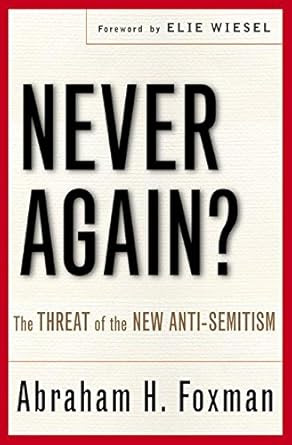
Never Again?:The Threat of the New Anti-Semitism by Abraham H. Foxman


Powerful, important but not perfect. Also - test yourself!


Published in 2003 by HarperOne.

Summary of the book:


In Never Again? Foxman uses the common comment that the world has learned its lesson during World War II and will "never again" let hate do what it did to the Jews in World War II. He uses a question mark because he points to some rather depressing trends in this well-researched book that mark a rise of anti-Semitism throughout the world, even in Japan. (reviewers note: How many Jews actually live in Japan? How many Japanese actually know what the Jewish religion is? I'm assuming this is just a nutball group that hates just about everybody and just threw the Jews in too).

Foxman is the head of the Anti-Defamation League, a group based in New York City that monitors Anti-Semitic activity throughout the world.

My review:

Foxman is a bit too sensitive (something that he admits he is trying to avoid), but he's right, there are terribly disturbing anti-Semitic trends, especially in his chapter 7 concerning very popular Muslim beliefs concerning Jews (he quotes opinion polls and continuing attacks that come from mainstream Muslim newspapers. Unfortunately, from an editing standpoint, he ends up with Chapter 8 - a chapter about anti-Semitism in Hollywood and popular entertainment. It is by far his weakest chapter, a point he virtually concedes because this is where he makes his comments about not wanting to appear too sensitive.

Foxman has an anti-Semitism quiz developed by the Anti-Defamation League. He says you qualify as "most" Anti-Semitic if you agree with six or more of the following:

1) Jews stick together more than other Americans.

2) Jews always like to be at the head of things.

3) Jews are more loyal to Israel than America.

4) Jews have too much power in the U.S. today.

5) Jews have too much control and influence on Wall Street.

6) Jews have too much power in the business world.

7) Jews have a lot of irritating faults.

8) Jews are more willing than others to use shady practices to get what they want.

9) Jewish businesspeople are so shrewd that others don't have a fair chance at competition.

10) Jews don't care what happens to anyone but their own kind.

11) Jews are not just as honest as other businesspeople.

I scored a zero out of 11 on this test. However, Foxman would still consider me an anti-Semite. He has 2 long chapters on Jewish-Christian relations (one for Catholics worldwide and one for American Protestants) and since I am a Christian that believes that Christ is the only way to heaven, I am an anti-Semite.

Oh, well. No matter Foxman's opinion, I will continue to consider myself not anti-Semitic, especially in light of some of the absolutely ignorant comments coming from some of my rural Indiana students. I do believe that I am the only one that has ever confronted some of them. Here's what they were doing: they were using the word Jew and Jewish as an insult term - meaning stupid. So, when someone would say something stupid some others would say, "That's so Jewish!" or "You're such a Jew!". So, anyway, I'd boot their asses out to the hall so fast that their heads would spin and we would have a lo-o-o-o-o-o-o-o-ong talk. I can tolerate a lot of ignorant things but racism is not one of them. I've had this conversation about 5 times in the last two years, but not for the last 5 or 6 months. Maybe it has stopped or maybe it has just stopped around me.

To sum up: This book receives a "4 stars". It would have received a higher grade except for the relatively weak chapter at the end that takes away a lot of its punch. Still, it is an important book.

I rate this book 4 stars out of 5.

This book can be found on Amazon.com here: Never Again?

Reviewed on July 18, 2004.

Featured Post

<b><i>BAN THIS BOOK (audiobook)</i></b> by Alan Gratz

Published in 2017 by Blackstone Audio, Inc. Read by Bahni Turpin. Duration: 5 hours, 17 minutes. Unabridged. My Synopsis Ban This Book is t...

Popular posts over the last 7 days