Showing posts with label alternate history. Show all posts

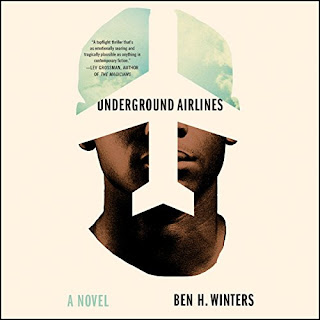
UNDERGROUND AIRLINES (audiobook) by Ben H. Winters


Underground Airlines is set in the year 2015 in an alternate historical timeline. This is a world where the American Civil War almost happened but did not. In the real historical timeline, an amendment to the Constitution called the Crittenden Compromise was proposed in December of 1860 as the first Confederate states were seceding. It preserved slavery, limited its spread and clarified the role of the federal government in returning runaway slaves. The Crittenden Compromise was not taken seriously by most people and it failed.

In this alternate history, the Crittenden Compromise was taken  seriously because President-elect Lincoln was assassinated in Indianapolis as he was traveling to his inauguration in Washington, D.C. The shock of the assassination brought all of the states back together to negotiate and a version of the Crittenden Compromise passed. There was no Civil War and American slavery continues in 4 states on into the 21st century (Louisiana, Mississippi, Alabama and a combined North/South Carolina.

The protagonist of the book is an escaped slave turned into a hunter of escaped slaves. He is working undercover using the name Jim in Indianapolis, Indiana tracking down an escaped slave. He's bothered a bit because the paperwork for this slave is very incomplete and this is rare. Usually, slaves are meticulously tracked, literally tattooed, bar coded and even chipped. 

Jim is nervous because the incomplete file. But, as you can imagine, he's not happy being an escaped slave who hunts down escaped slaves - but he has no choice. He is chipped with a device in his neck that tracks him and, with the flip of a switch, can kill him. It puts him an emotionally painful paradox - in order to maintain his freedom he must catch others.

Jim meets all kinds of people as he searches through Indianapolis - members of the Underground Airlines (the modern successor to the Underground Railroad movement of the 1800s), militant anti-slavers, militant pro-slavers, a white woman searching for the love of her life (an escaped slave), members of the black market that exists in freedman neighborhoods, and more. 

Still, once he finds out what is going on, it involves more than he could ever imagine and makes him go where he never thought he would go...

My review:

I am a fan of:

1) alternate histories,
2) study of the Civil War,
3) my adopted hometown - Indianapolis.

This means I was pretty much perfectly set up to enjoy this book and I did. This was a well-told story. I enjoyed learning about how this alternate world was different and the same. For example, Michael Jackson is a big deal in this alternate world, too.

But, the United States is technologically behind the rest of the world by a few years due to anti-slavery boycotts by the rest of the world and lack of technical innovation coming from America itself. It's about 20 years behind and not really an economic leader in anything except the production of cotton and cotton clothing.  America's big ally is South Africa, with its policy of apartheid.

It's clear that Ben H. Winters knows his way around Indianapolis. Indy is my adopted hometown - I've lived here for 30 years. Every bit of Indianapolis he describes makes sense historically. 

I enjoyed this book. I rate it 5 stars out of 5. It can be found on Amazon.com here: UNDERGROUND AIRLINES by Ben H. Winters.

THE HOUSE of DANIEL: A NOVEL of WILD MAGIC, the GREAT DEPRESSION, and SEMIPRO BALL by Harry Turtledove


Published in 2016 by Tom Doherty Associates (A Tor Book)

Harry Turtledove specializes in alternate histories. Usually, he has a big twist - what if the South won the Civil War? What if Atlantis were a real continent? What if the Colonies lost the Revolutionary War? What if MacArthur actually dropped atomic bombs during the Korean War?

The House of Daniel is a different kind of story, with a twist.

To be perfectly honest, I read the description of this book, with its references to The Great Depression, baseball, "hotshot wizards" and zombies and missed the fact that it was actually referring to actual wizards and zombies, not metaphorical wizards (the whiz kid experts that FDR hired) and zombies (the unemployed masses who are desperate for work). I really thought that Turtledove had just written a straight book about semipro baseball in the Great Depression.

And, basically he has. 85% of this story is about baseball.

Jack Spivey does odd jobs, plays semipro baseball for a few bucks a game and a little muscle work for a local mobster-type named Big Stu in Enid, Oklahoma. He is contracted to go to a neighboring town to give a beating to the sibling of a client that is behind on his payments. When the sibling turns out to be a beautiful young woman, Jack can't do it. Instead, he takes a position with a traveling semipro baseball team called "The House of Daniel" and hits the road.

If you don't like baseball, this book will bore you to tears. Jack tells about his life on the road and about dozens of baseball games - sometimes in great detail, with play by play and even pitch by pitch descriptions. 

But, the world that they live in is a little off from our world. Major League Baseball exists, but none of the names are recognizable. Magic exists - regular magic, dark magic and even religious magic. So do vampires. And zombies. And magic carpets. And mystery creatures like chupacabras. 

I really enjoyed this book, despite my original confusion. 

I rate this book 5 stars out of 5. It can be found on Amazon.com here: THE HOUSE of DANIEL: A NOVEL of WILD MAGIC, the GREAT DEPRESSION, and SEMIPRO BALL by Harry Turtledove.


V-S DAY: A NOVEL of ALTERNATE HISTORY by Allen Steele


Published by Ace in 2014

Alternate histories always deal with a what if...? moment in history and how things might have been. In the case of V-S Day, the moment is what if Nazi Germany decided to throw the resources that it was throwing into a its buzz bomb program into an actual space program led by Wernher von Braun? The Germans are building a a primitive space shuttle like device that can take off from the Reich, circle the globe and drop bombs on New York City from a low earth orbit, far above the reach of America's anti-aircraft guns. And, it can do it again and again with no hope of a defense.

Fans of NASA know that in the real world, Wernher von Braun was brought back to America after World War II and helped develop America's space program. In this world, rocket pioneer Robert Goddard leads a team to develop an American space fighter "plane" to go up and take out the German space bomber.

Most of the book details the space race between the two powers, which was okay, but not nearly as good as the spy story of how the Allies received a set of the German plans. Sometimes the book sails along and sometimes it drags. Sadly, the climax of the book is undercut by the fact that the entire book is told as a flashback from 2013 and the final result is pretty obvious. 

I rate this book 3 stars out of 5.

This book can be found on Amazon.com here: V-S DAY: A NOVEL of ALTERNATE HISTORY.  

UNHOLY NIGHT by Seth Grahame-Smith


Brilliant!

Published in 2012 by Hachette Book Group

Seth Grahame-Smith is, perhaps, most famous for his books Abraham Lincoln: Vampire Hunter and Pride, Prejudice and Zombies, two books that I have never read and probably never will because I care not one wit for vampire or zombie tales. But, this book intrigued me and I am very glad that I read it.

As in the other books I mentioned, Seth Grahame-Smith has a talent to take an existing story and put a twist to it. Unholy Night takes the traditional Christmas nativity story and makes this little change: What if the Three Wise Men were actually not three learned scholars but three criminals posing as three learned scholars?

That's it - that's the heart of the book. But, what a twist!

Here is all anyone really knows about the the Three Wise Men from the Biblical account, from Matthew 2, verses 1-12:


In the time of King Herod, after Jesus was born in Bethlehem of Judea, wise men from the East came to Jerusalem, asking, "Where is the child who has been born king of the Jews? For we observed his star at its rising, and have come to pay him homage." 

A 6th century mosaic of the Three Wise Men
 in Ravenna, Italy
.
When King Herod heard this, he was frightened and all Jerusalem with him; and calling together all the chief priests and scribes of the people, he inquired of them where the Messiah was to be born. They told him, "In Bethlehem of Judea; for so it has been written by the prophet: 'And you, Bethlehem, in the land of Judah, are by no means least among the rulers of Judah; for from you shall come a ruler who is to shepherd my people Israel.'

Then Herod secretly called for the wise men and learned from them the exact time when the star had appeared. Then he sent them to Bethlehem, saying, "Go and search diligently for the child; and when you have found him, bring me word so that I may also go and pay him homage." 


When they had heard the king, they set out; and there, ahead of them, went the star that they had seen at its rising, until it stopped over the place where the child was. When they saw that the star had stopped, they were overwhelmed with joy. On entering the house, they saw the child with Mary his mother; and they knelt down and paid him homage. Then, opening their treasure chests, they offered him gifts of gold, frankincense, and myrrh. And having been warned in a dream not to return to Herod, they left for their own country by another path.

They are mentioned in one other verse in which King Herod is angered because the Wise Men do not report back to him and he proceeds with his plan to slaughter all of the male infants in Bethlehem. That's it. The traditional names (Balthazar, Gaspar and Melchyor) are not named. Their actual number of Wise Men is not named. 

This book covers all of these aspects without skipping a beat - so long as you look at things from a certain point of view.

In Unholy Night, Balthazar is a master thief and pickpocket who has no problem killing Herod's soldiers to stay out of jail. But, he is caught and brought to King Herod in Jerusalem for judgment. While awaiting execution he is held with Gaspar and Melchyor, two violent men awaiting execution for a variety of major crimes. Balthazar engineers a chance for a final meeting with three religious scholars in order to set himself right with God, overwhelms them, switches identities with them and escapes into the night towards Bethlehem with some goods that they managed to steal along the way: gold, frankincense and myrrh. 


Of course, they meet up with Mary, Joseph and the baby Jesus (the three criminals are looking in the stable for fresh mounts) and it does not go well. However, once Herod's men arrive to start slaughtering the infants these three criminals are moved to rescue this clueless family and the real adventure starts.

This book could have gone wrong on so many levels but, somehow, Grahame-Smith manages to change the story but yet maintain the commitment to the religious aspects of the story. I
t does treat faith and religion seriously. The Christmas Star is there. The virgin birth is there.  There are miracles and struggles with the concepts of faith and forgiveness. And, it does not all get wrapped up in a neat little bow in the end and everyone does not live happily ever after. And, I enjoyed it immensely.

Be warned, this book is often violent and gruesome, like the story that it comes from. Let's face it, if you are telling the story of a diseased old tyrant who orders the murder of babies, it's bound to be gruesome. 


I rate this book 5 stars out of 5.

This book can be found on Amazon.com here: Unholy Night by Seth Grahame Smith.

HIS MAJESTY'S DRAGON (Temeriare #1) by Naomi Novak


Originally published in 2006.


Way back when when I got my Kindle 2 in 2009 His Majestys Dragon was one of the first books that I got - it was part of a free promotion and somehow I never read it. I guess I was afraid that it would be too cheesy.

Boy, was I wrong.

The premise of this book is a mashup of How to Train Your Dragon with Master and Commander. It is the middle of the Napoleonic Wars and Napoleon is planning to invade England. All that stands between England and Napoleon's massive army is their far superior navy and a small contingent of dragons. Yes, dragons. It turns out that in this alternate world dragons occur naturally in the wild and have been trained to fight in war, much like horses and dogs occur naturally in the wild and have been trained to fight in war.

Dragons, however, are smart and are able to talk with people. In fact, dragons bond with a human and they become a team. Dragons come in different sizes and jobs, much like an air force's planes or a navy ships. Some are quick and small, some are like giant air-borne battleships. Some spray acid, some just have nasty claws and teeth and can drop big rocks on fortifications, ships, etc,
Napoleon Bonaparte (1769-1821)


Captain Will Laurence's ship captures a weaker French ship that puts up a surprisingly tough fight, Once aboard, the English discover why they fought so hard - they have a dragon's egg in their hold! The English immediately move it to their ship, thrilled that their country will get a much-needed dragon (being severely outnumbered by the France's dragons).

But, the egg starts to hatch and when it does the dragon picks Captain Laurence as the person it will bond with. The Captain steps aside as the Captain of his ship and tries to learn as much as he can about dragons, which is not a lot (think about a fighter pilot becoming a tank commander in our modern armed forces and you get the idea). Together, the reader and Laurence learn about dragon behavior and training and even eventually go into battle against Napoleon's forces.

This book is written in period style and pays careful attention to the attitudes and mores of the time period, making it all the more authentic feeling. The bond between the dragon Temeriare and Will Laurence is as natural as that ideal bond between a K-9 officer and his dog - they are different but they are also partners, roommates and loyal friends. If that police dog could talk, the bond would be even stronger. 

This was a fantastic read. I am sorry that I waited more than four years to finally get it off of my to-be-read list.


I rate this book 5 stars out of 5 and it can be found on Amazon.com here: HIS MAJESTY'S DRAGON (Temeriare #1) by Naomi Novak.

Reviewed on October 18, 2013.

The Plot Against America: A Novel by Philip Roth


Published in 2004 by Houghton Mifflin

In The Plot Against America, Philip Roth creates an alternate history centered around the presidential election of 1940. FDR doesn't run against Wendell Willkie. Instead, Charles Lindbergh enters the contest at the convention as an anti-war candidate and defeats Roosevelt.

In the real world, Lindbergh was  friendly towards the Nazi regime in Germany and made several public anti-Semitic comments so Roth's little twist to history is not out of line. Also, Lindbergh spoke at several "America First" anti-war rallies in 1940 and 1941. The first part of this book is the strongest. The alternate history moves briskly, the introduction to the Roth family and its main character, Philip (I can only assume that this is intended to be an alternate history autobiography) proceeds well.

Lindbergh speaking at an America First rally 
However, after the part of the book about the family trip to Washington, D.C. The Plot Against America just bogs down. The story moves forwards and backwards, sometimes weeks at a time and Roth seems more concerned about creating a sense of the atmosphere of pre-World War II Newark than he is about telling his story. Recently, I watched the movie To Kill A Mockingbird and it occurred to me that Roth was intentionally attempting to mimic the feel of movies like that, except in Newark, New Jersey. If that was intention, he succeeded, but he also succeeded in derailing his story with endless stories of secret bus trips and horses at orphanages. I am not quite sure what the point of all that was, but I know that I grew weary of it.

The end of the book is a mess. Roth tells the political ending long before he tells what happens to the Roth family and the little Jewish community of Newark. When he tells the ending so early, the drama is ruined, completely ruined. Also, the motivating factor given for Lindbergh's pro-German actions is so far-fetched, so ludicrous that I almost threw this book across the room.

So, I end up giving this book 3 stars. Great start, nicely realized (but oftentimes pointless) description of life in Newark, ridiculous ending.

This book can be found on Amazon.com here: The Plot Against America.


Reviewed on February 26, 2013.

The Impeachment of Abraham Lincoln by Stephen L. Carter


I Expected So Much...


Published by Alfred A. Knopf in July of 2012

I love Stephen L. Carter - the essayist. He writes brilliant essays. He makes me think and I learn a lot. I have now determined that I just don't care much for Stephen L. Carter the novelist and I will stick to the essays.

When I saw the topic of this book I was thrilled. Carter is a law professor so he knows all of the legal angles. I am an enthusiastic student of the Civil War so I was already very familiar with all of the politics, legal issues and personalities that would have been involved with an impeachment of Lincoln.

The premise of the story is that Lincoln was not killed by John Wilkes Booth, although he was gravely injured. Vice President Andrew Johnson was killed and Secretary of State William Seward was injured so badly that he has not been seen publicly since the attempt on his life.

Secretary of War Edwin Stanton (1814-1869)
plays a key role in this alternate history novel.
In real life, Vice President Andrew Johnson was the first president to be impeached because he was unable to successfully navigate the rough political waters of post-Civil War America. Lincoln is caught in these same currents and is impeached on a host of different charges. Lincoln's lawyers include a young black woman who has recently graduated from Oberlin College named Abigail Canner. She is learning how to be a lawyer, like an intern. The book is mostly told from her point of view.

As the case against Lincoln moves from the House to the Senate the situation is clouded by multiple murders,  mysterious messages that come and go and witnesses disappearing. Canner and another young "intern" named Jonathan Hilliman team up to follow leads that no one else seems interested in. All the while the impeachment case moves forward.

The book is filled with great characters, the topic is interesting and his portrayal of Lincoln and other historical personages is dead on when compared to everything else I have read. But, this book is slow. The plot is byzantine in nature - so intricate, so many plotters out to get Lincoln and so many anti-plotters out to protect him that I just lost interest and the book just dragged. I found that I was forcing myself to finish a book that I should have been enjoying.

I rate this book 2 stars out of 5.

This book can be found on Amazon.com here: The Impeachment of Abraham Lincoln

Reviewed on November 11, 2012.

City of Dreams: A Novel (!Hero Series #1) by Stephen R. Lawhead and Ross Lawhead


An interesting "What if...?" take on the story of Jesus.


Published in 2003 by Navpress

This may be the most pointless review I have ever written. There is something sad about a stillborn trilogy. In this case, only the first book was published, although co-author Ross Lawhead claimed the 2nd and 3rd books are written in his blog. So, this reminds of an unfinished building - lots of big plans but someone pulled the plug before it was completed.

Nonetheless, here is the review:

The premise is simple. What if Jesus did not come into the world about 2,000 years ago, but instead was born in Bethlehem, Pennsylvania in the here and now. As a history teacher I very much enjoyed reading the alternate history aspect of this book - how would the world be different if Christianity did not eclipse the old religions of Europe? Would the worship of Jupiter, Thor and Diana have continued? Would Europe have developed the same sort of political structures? These topics are hinted at but are not really the main focus of the book.

The book features Special Agent Alex Hunter, an investigator for ICON (International Confederation of Nations), a one world government organization that has been experiencing difficulty with religious groups who want to break free from ICON's iron grip. Hunter is a tarnished agent, having mishandled a standoff with a religious splinter group in the recent past. The standoff went bad and a bloodbath ensued. He has been brought to New York City to investigate a Zionist splinter group (turns out that Judaism survives in this alternate, but still experiences plenty of difficulties).

Intrigue, plots and plots within plots are discovered and Agent Hunter is not sure who to trust - ICON, the local government or perhaps even the group he has infiltrated. Along the way, he meets Washer John, the character that corresponds to John the Baptist and his cousin Joshua, the character that corresponds to Jesus (Jesus is the Greek-ification of Yeshua or Joshua, if you are wondering about the name change).

The first book ends with Agent Hunter making a major decision about who he can trust in a cliffhanger situation designed to make the reader look for the second book. Unfortunately...there is no second book. Too bad, it would have been an interesting read.

I rate this book 4 stars out of 5.

This book can be found on Amazon.com: City of Dreams: A Novel.

Reviewed on December 6, 2011

Marvel 1602 by Neal Gaiman


Didn't do much for me

Marvel 1602 just didn't do much for me, which is surprising since I'm a casual comics fan but a serious reader of history. I figured (correctly) that there'd be no problem taking superheroes into a different time period. But I also figured (incorrectly) that the story would be more interesting and have more of a focus.

Lack of focus is really the problem I have with the series. Is it a spy novel in which the familiar superheroes are involved in a complicated web of deceit and danger? Yes and no. Is there more than that and the entire world (actually every universe) is threatened with destruction and everyone must bring their unique talents to save the day?

Yes. It degenerates into that. Degenerates? Yes. Degenerates. Every character is brought into the fray and the storyline is muddied by bringing everyone in for a token cameo and the whole story becomes an over-the-top "jump the shark" type of plot usually reserved for aging and decrepit series that can't seem to drum up interest unless the stakes are the salvation of the universe itself. Puh-leaze! Gimme a break.

While beautifully drawn, I lost interest as even more characters were brought into the storyline. There was precious little character development after the first 3 parts of this 8 part volume. Plus, what's up with the dinosaurs? Why are dinosaurs wandering around?

I rate this collection 2 stars out of 5 and it can be found on Amazon.com here: Marvel 1602 by Neal Gaiman

Reviewed on December 22, 2008.

Atlantis and Other Places: Stories of Alternate History (audiobook) by Harry Turtledove


Published in 2010 by Tantor audio

Read by Todd McLaren
Duration: 14 hours, 4 minutes.
Unabridged.

Called a “Master of Alternate History” by Publishers Weekly, Harry Turtledove continues on that track in Atlantis and Other Places with a set of 12 short stories. Topics and eras range from pre-history to the Peloponnesian War to the Byzantine Empire to World War II and two stories set in modern times. All of these stories have appeared in other publications.

This collection begins and ends with two stories about Atlantis, a topic he has explored more deeply in a trilogy. “Audubon in Atlantis” is the first story that Turtledove published about Atlantis. The famed 19th century naturalist John James Audubon has traveled to Atlantis to catalog some of its unique wildlife. Turtledove introduces his alternate world, including basics of the history of Atlantis and he introduces the House of Universal Devotion, a religion that is most analogous to the Mormon Church in regular history. Turtledove’s focus on laying down the ground rules for makes the first half of the story a bit tiresome. It does pick up once Audubon is in the field.

Harry Turtledove
The last story, “The Scarlet Band” is chronologically Turtledove’s last story about Atlantis. In the story, Athelstan Helms and Dr. James Walton, the world famous detective duo (modeled after Holmes and Watson), are summoned to Atlantis to investigate a series of murders of prominent citizens who have been openly critical of the House of Universal Devotion. It is a fine ending to the collection, even if the murder is a bit too easily solved.

As in any collection, the quality varies. “Bedfellows” is a tiresome story once the gimmick is understood in the first minute, but it goes on for another 10 minutes. “News From the Front” is an alternate history of World War II told through headlines and snippets of editorials.  Roosevelt is savaged in the press for failing to foresee the attack on Pearl Harbor and America’s will to fight sags so low that it ends up suing for peace, much like the Japanese Empire had hoped in their original plans for the war in our timeline. The premise is interesting, but the headline/editorial format loses its punch and it tends to drag.

On the other hand, “Catcher in the Rhine” and “Someone is Stealing the Great Throne Rooms of the Galaxy” are both quite fun. “Catcher” is a play on J.D. Salinger’s famed character Holden Caulfield. Caulfield is visiting Germany and he gets caught up in a bit of magical time travel. Turtledove captures Caulfield’s voice perfectly. “Throne Rooms” is a pure comic bit of science fiction (and the only story in the collection that is not alternate history – it is set in the future). A giant sentient hamster is sent by the Star Patrol to investigate a series of thefts of throne rooms (and their accompanying antechambers) providing plenty of laugh out loud moments.

“Farmers’ Law” and “The Genetics Lecture” are middle of the road stories. The former is a straightforward murder mystery set in a rural village in the Byzantine Empire and the latter is a Twilight Zone-esque very short story (about 6 minutes long) that, unfortunately, telegraphed its punch line.

“Uncle Alf” is set in France in 1929. But, in this world, the German Empire has won World War I and a 40-year-old Hitler is part of the German army occupying France. He is dedicated to rooting out socialism and in seducing his 21-year-old half-niece through a series of letters. The story is told through those letters. Although the incestual seduction aspect of the story is based on strong historical supposition, that fact does nothing to ease the creepy feeling that pervades the whole story.

Sokrates
The three strongest stories are all quite different from one another. “The Daimon” is set in the Peloponnesian War and the only difference is that Sokrates decides to participate in the invasion of Syracuse. In history, this campaign turned into a disaster, but Sokrates is able to offer advice to Alkibiades, the mercurial fair-haired young general who led the invasion. This advice causes Athens to win the entire war and, in the process lose their democracy to a tyrannical Alkibiades. Sokrates lives long enough to regret his advice as Alkibiades consolidates the Greek city states under his power in order to launch an invasion of Persia like Alexander the Great did nearly a century later. Those who are familiar with the Peloponnesian War will especially appreciate the ironic comments and situations that arise in this story.

“The Horse of Bronze” is a simple story of centaurs discovering men, but it is so much more. If you are a fan of Aristotle or enjoy thinking about the concepts behind his “Theory of Forms” (Turtledove introduces the theory in the earlier story “Daimon”) you will enjoy this story of the arrival of men in a world filled with Centaurs, Nuggies, Satyrs, Sirens and Sphinxes.

“Occupation Duty” is set in modern day Gaza. The story is about troops going on patrol in an armored personnel carrier in a hostile, conquered territory.  However, this is not about Israel and the Palestinians. Instead it is the “Philistinians” and the Moabites. In this history, Goliath beat David and Israel is nothing but a distant, ancient memory. The fight scenes are first rate and the irony of the same fighting going on in the same territory for the same reasons with different nations is quite good. Throw in a solid description of a world with no monotheistic religions and a tantalizing peek at this new world’s politics and I found myself wishing he had fleshed this story out into a novel.

Todd McLaren’s narration of these stories was exceptional. He delivers a variety of voices and tones – everything from American southern accents to a variety of British accents to Hitler’s German accent. He even catches Alkibiades’ famed lisp and you can hear the treachery in his voice as he crushes his opponents. Very impressive and enjoyable work throughout.

I rate this audiobook 4 stars out of 5.

This audiobook can be found on Amazon.com here: Atlantis and Other Places.

Reviewed March 21, 2011.


1942: A Novel by Robert Conroy


Some really good parts but...


Published in 2009 by Ballantine Books

 1942: A Novel follows up on a simple "What if?" from history. What if the Japanese actually invaded and conquered Hawaii rather than simply attacked it on December 7, 1941?

Conroy's book is very strong up until the point where the Japanese invade. The premise of the book is historically strong, the strategies seem logical, the personalities of the real historical figures are consistent with what we know of them nowadays.

But..

Once the invasion happens, Conroy indulges in exploring the depravities of the Japanese secret police with too much vigor. Yes, I know that the Japanese were brutal, cruel, heartless conquerors that literally raped cities like Nanking, China. He shows a similar brutality in the invasion of Hawaii, which is fine and appropriate - there is no reason to assume the Japanese would have acted any better in Hawaii than they did in China, Korea and the Philippines. But, Conroy insists on showing one brutal act after another - multiple rapes, guttings, hands chopped off, heads chopped off, genitalia mutilated and so on.

It becomes a parade of atrocities and, in my opinion, the story starts to drown in it all, which is too bad because it started so well.

I rate this book 3 stars out of 5.

This book can be found on Amazon.com here: 1942: A Novel.

Reviewed on March 27, 2009.

Alternate Gettysburgs by various authors


Published in 2002 by Berkley

It's a collection, and like all collections Alternate Gettysburgs suffers from the fact that it was written by a dozen different authors. Some are very good, most are decent. Two are awful.

The gimmick in this alternative history is, of course, 'What if the Battle of Gettysburg had turned out differently?' It is inspired by this Faulkner quote:

Confederate Major General
George Pickett (1825-1875)
'For every Southern boy fourteen years old, not once but whenever he wants it, there is the instant when it's still not yet two o'clock on that July afternoon in 1863, the brigades are in position behind the rail fence, the guns are laid and ready in the woods and the furled flags are already loosened to break out and Pickett himself with his long oiled ringlets and his hat in one hand probably and his sword in the other looking up the hill waiting for Longstreet to give the word and it's all in the balance, it hasn't happened yet, it hasn't even begun yet, it not only hasn't begun yet but there is still time for it not to begin against that position and those circumstances which made more men than Garnett and Kemper and Armistead and Wilcox look grave yet it's going to begin, we all know that, we have come too far with too much at stake and that moment doesn't need even a fourteen-year-old boy to think This time. Maybe this time with all this much to lose and all this much to gain: Pennsylvania, Maryland, the world, the golden dome of Washington itself to crown with desperate and unbelievable victory the desperate gamble...'

Is it worth reading? If you're a Civil War buff and don't mind 'slumming' by reading an alternative history rather than a normal history book - yes it is worth your time. Personally, I don't think of it is as slumming - I think of it as nice little foray into what-may-have-been. However, alternative histories are often looked down on by more than a few serious readers of history.

I would recommend if you are not very familiar with the facts of the Civil War and general and the Battle of Gettysburg in particular that you read the Appendix (the last section) first - included are the 'Gettysburg Address', three good short histories of the war and the battle and one interesting essay (controversial, but also my favorite) that tells you why the Confederacy never could have won anyway, no matter the outcome of the battle.

I rate this collection 4 stars out of 5.

This book can be found on Amazon.com here: Alternate Gettysburgs.


Reviewed September 19, 2005.

The Two Georges: The Novel of an Alternate America by Richard Dreyfuss and Harry Turtledove


So, what do you get when Oscar Award Winner and a Hugo Award Winner get together?


Published in 1996 by Tor Books

What you get is a pretty good book, actually.

The premise of The Two Georges is that the United States was never formed. The British government dealt fairly with the colonies in the 1760s and the independence movement was stillborn. Instead, what are now the USA and Canada is called the North American Union and are an integral part of the United Kingdom. The UK is a vast world-wide empire led by the King-Emperor. This union is symbolized by the painting "The Two Georges" which depicts colonial representative George Washington bowing before King George III before an assembly of British and American dignitaries. This moment encapsulates the agreements that kept the American colonies a part of the British Empire. At the beginning of the book the painting is stolen in 1996 by The Sons of Liberty, a North American pro-independence movement. The story follows two detectives and an art curator who are searching for the painting before the ransom deadline.

There were a lot of fascinating things about this book. I thoroughly enjoyed the historical premise and the maps of the world and North America that are at the front of the book. The authors conclude that if there were no USA, there would be few independent countries in Africa, Asia and the Americas, since there was no American example to inspire the dismantling of the vast world-wide European empires. Germany never coalesces since France never spawns a Napoleonic Empire (Napoleon was the first to unite most of Germany - before that it never really occurred to the Germans that they could create a powerful country if they untied themselves) since there was no French Revolution since there was no American Revolution to inspire it.

American history is different since the UK outlaws slavery in the 1830s - there was no Civil War. The American map has 2 mostly American Indian states - Iroquois and Cherokee, thanks to British restrictions on white incursions over the Appalachians (one of the reasons for rebellion mentioned in the Declaration of Independence).

Technology is far behind that of our world - American creativity is not challenged due to World Wars, Japan is practically a non-entity and Germany is a bunch of warring principalities.

Enjoyable book, decent mystery, good adventure.

I rate this book 4 stars out of 5.

This book can be found on Amazon.com here: The Two Georges: The Novel of an Alternate America by Richard Dreyfuss and Harry Turtledove.

Reviewed in 2004.

Almost America: From the Colonists to Clinton: a "What If" History of the U.S. by Steve Tally


Very good despite a few little factual errors.


Published in 2000 by William Morrow Paperbacks

Some of these are really thought-provoking and well thought out. I especially enjoyed the one concerning Teddy Roosevelt following through with his plan to ban college football unless they did something to curb the extreme violence (23 young men died in the 1905 season). The consequences were interesting and I thought very plausible.

The book is marred by a few factual errors. They really are not terribly important to the outcome of the author's alternate histories but show a sloppiness in editing. Some examples are placing the Revolutionary War fort of Kaskaskia in present-day Kentucky when it is actually in Illinois and saying that people blamed Lincoln's assassination on people who were wanting to revive the Union cause (obviously the Union cause was in great shape by the point of the war - I assume his editors did not catch it and he meant to say Confederate).

Despite the errors, the book is still a fun read.

I rated this book 5 stars out of 5.

This book can be found on Amazon.com here: Almost America: From the Colonists to Clinton: a "What If" History of the U.S. by Steve Tally.

Reviewed on July 1, 2004.

Featured Post

<b><i>BAN THIS BOOK (audiobook)</i></b> by Alan Gratz

Published in 2017 by Blackstone Audio, Inc. Read by Bahni Turpin. Duration: 5 hours, 17 minutes. Unabridged. My Synopsis Ban This Book is t...

Popular posts over the last 7 days