Showing posts with label Russia. Show all posts

SUPERMAN '78: THE METAL CURTAIN (graphic novel) Robert Venditti


Published by DC Comics in 2024.
Written by Robert Venditti.
Art by Gavin Guidry and Jordan Bellaire.

Synopsis

These are the further adventures of the Christopher Reeve Superman from the movie series that ran from the late 1970s into the 1980s. It has the feel of those movies in the simple and clear art style and the look of many of those characters. Interestingly, Superman looks nothing like Reeves and Clark Kent only looks like him from time to time.

The plot of Superman '78: The Metal Curtain is pretty simple. The Soviet Union has created a super soldier suit powered by a giant hunk if Kryptonite. The suit is pretty much an Iron Man suit (I know, wrong publisher) with the added benefit that it's fuel weakens the Man of Steel.


The Soviet Union is fearful of Superman. They perceive him as a weapon of the United States (because the events of Superman IV haven't happened yet) and plan to use the suit to defeat Superman and America...

My Review

I really liked the clean art style of this graphic novel. The plot is simple, direct, and the circumstances are dire. The only thing I did not like was the way Superman ended up winning - it was too simplistic and too short. It felt like a cheesy movie plot ending, which is exactly the vibe that they were going for. I guess that makes it a success.

I rate this graphic novel 4 stars out of 5. It can be found on Amazon.com here: Superman '78: The Metal Curtain.

CHECHEN WARS: A HISTORY from BEGINNING to END (kindle) by Hourly History


Published in 2023 by Hourly History.

I chose to read this short history about Chechnya in order to be a bit more informed about Putin's wars in Chechnya and then apply that knowledge to the war in Ukraine. What I read does not inspire confidence.

Chechnya is an unfortunate victim of geography - it lies in a buffer zone between traditional great powers - the Russians, the Ottoman Turks, and the Persians. Even worse, they are on a natural land bridge between the Caspian Sea and the Black Sea. Throw in a religious difference between Russia and the Chechens and you have even more trouble.

When the Soviet Union collapsed in 1991, Chechnya made a serious effort at independence that ended up in multiple military incursions by the Russians and decades of on and off irregular warfare (think guerrilla warfare plus outright terrorism).

For their part, the Russians responded with their own forms of irregular warfare - assassinations, possible false flag operations, and more.

As I read this, the tit for tat back and forth actions just sort of blend together and in the end it was hard for this outsider to see which corrupt oligarchy The West should support. 

Back to what I referred to in the first paragraph - what can some knowledge of the Chechen Wars tell us about the war in Ukraine? To me it says that Russia has a very solid sense of what territories it believes legitimately belong to Russia and it will hang on to that territory, even if it comes with tremendous costs.

Considering that Ukraine is much closer in a cultural sense to Russia than Chechnya is, this bodes poorly for Ukraine. I'm not saying Ukraine should be abandoned (far from it!), but this is going to be a very long-term issue.

I rate this e-book 4 stars out of 5. It can be found on Amazon.com here: Chechen Wars: A History from Beginning to End

ELEVEN NUMBERS: A SHORT STORY (kindle) by Lee Child


To be published by Amazon Original Stories in February of 2025.

If you have Amazon Prime, you get to choose from a limited selection of soon-to-be-published e-books every month. I am a big fan of Lee Child's Jack Reacher books, so I jumped at the chance to get this short story by Lee Child.

I believe I have read every book and every short story that Lee Child has written about Jack Reacher, but I don't think I've read anything he's written that didn't feature Reacher. In fact, I didn't know he wrote about any character but Reacher.

This is the story of a mathematician - a college professor. He's kind of a nobody, except that he has a specialty, some would say a gift, in an obscure little corner of mathematics. Not many people have even heard of it, let alone know anything about it. 

Then, one day, he gets a call from the White House...

My review:

This was a quick story. It is well-written and takes several twists and turns that I did not see coming.  It's quite good, just not a Reacher action-fest.

I rate this short story 5 stars out of 5. It can be found on Amazon.com here: Eleven Numbers: A Short Story by Lee Child.

BALKAN WARS: A HISTORY from BEGINNING to END (kindle) by Hourly History


Published in September of 2024 by Hourly History.

I consider myself pretty well-versed in modern history, but I literally knew almost nothing about the wars that ran rampant through the Balkans just prior to World War I. I knew the area was all in an uproar, but I had no idea that the region had seen multiple all out wars rage throughout in just a few years. Those wars set up the scenario that directly led to World War I.

Hourly History specializes in writing histories and biographies that can be read in about an hour. That was enough time for this little history. The reader learns of the decline of the Ottoman Empire and how that created a power vacuum in the Balkans. Then, the reader learns how various ethnic groups in the region fought for their independence and earned it only to fight among themselves over the borders of disputed regions. 

Finally, the reader sees how the intervention of the great powers led more fighting and eventually to World War I.

This is a very readable history, but it is hurt by a lack of maps.

I rate it 4 stars out of 5. It can be found on Amazon.com here: Balkan Wars by Hourly History. 

CRIMEAN WAR: A HISTORY from BEGINNING to END (kindle) by Hourly History


E-book published by Hourly History in 2020.

Hourly History specializes in histories and biographies that take about an hour to read. In the case of the Crimean War (1853-1856), I think that's about right.

The war was the result of European alliance politics. Russia was looking to push into Ottoman territory. The Ottomans were considered to be pretty weak and certainly on the decline after centuries of being a major power. The Austrian Empire was a traditional ally to the Russians, but decided to stay neutral. The Prussians were just starting out so no one really cared what they did. Even though they had been traditional rivals for centuries, England and France decided that they had to intervene on behalf of the Ottoman Empire in order to stop Russia from becoming too powerful. 

The French and the English sent troops all of the way to the Ottoman Empire and then up into the Black Sea and landed troops on the Crimean Peninsula and the war was on.

The war itself is worthy of note for several reasons, including:

1) France and England worked together as allies. It was the beginning of what has mostly been the default position ever since;
2) Florence Nightingale's work as a nurse;
3) The Charge of the Light Brigade and the poem of the same name describing the futility of the attack and the by Alfred, Lord Tennyson featuring the line "Theirs not to reason why, Theirs but to do and die";
4) Exposed the weaknesses of Russia and the Ottoman Empire. Those weaknesses led to revolutions within 70 years;
5) It was demonstrated that rifled weapons were vastly superior to older style weapons;
6) Trench warfare was introduced. This pointed towards what would be the signature fighting style of World War I sixty years later;
7) The media of the day was able to relatively quickly send stories back from the front due to new technologies;
8) Photography brought realistic views of the war back to the English and French public.

This book does a good job of explaining the war, the causes, the military results and the short term and long term results. 

I rate this e-book 5 stars out of 5. It can be found on Amazon.com here: Crimean War: A History from Beginning to End

GRIGORI RASPUTIN: A LIFE from BEGINNING to END (kindle) by Hourly History


Published in 2017 by Hourly History.

I am an avid reader of history, but I have areas of weakness that I am perfectly willing to shore up a bit, but I don't want to invest a ton of time. I want to know a bit more, not become an expert. The Russian Revolution one of those areas for me. I know a lot more than most people, but I can clearly see the that there is a lot that I don't know.

Rasputin is, of course, an iconic, almost mythical personality of the Russian Revolution. This series specializes in short biographies and histories that will take the average reader about an hour to read. There are plenty of people and historic events that I would like to know a little more about, but not necessarily commit to reading a 500 page biography or history. 

Rasputin is one of those people for me - interesting but not really worth that much of an investment of my time.

I've read a few biographies from Hourly History and, without a doubt, this was the best of the lot so far. Rasputin was an immensely interesting personality and this short biography did a very solid job of balancing the early part of his life with his more famous later years. 

I rate this short e-book 5 stars out of 5. It can be found on Amazon.com here: GRIGORI RASPUTIN: A LIFE from BEGINNING to END by Hourly History.


WHEN HITLER TOOK COCAINE and LENIN LOST HIS BRAIN: HISTORY'S UNKNOWN CHAPTERS (audiobook) by Giles Milton


Published in 2016 by Macmillan Audio.

Read by the author, Giles Milton.
Duration: 4 hours, 53 minutes.
Unabridged.

Giles Milton is a prolific British writer of histories and historical fiction. This is a collection of odd stories of history that he has run across doing his research.

Lenin, preserved in his tomb. 
He has gone from being an 
object of reverence to a
tourist attraction.
There are the two stories mentioned in the title - Hitler using stimulants and Lenin's odd burial, but there are a lot more from several different time periods.

The problem is that there were a lot of similar stories and some weren't really from "unknown" chapters. Lots of Nazi-related stories and three separate stories of cannibalism (a plane crash, a sailing ship caught in the duldrums and a prison escape in an isolated area). That's a lot of Nazis and cannibals for a 5 hour audiobook.

I found this stories to be neither great nor bad and often repetitive. I rate it 3 stars out of 5. 

This book can be found on Amazon.com here: WHEN HITLER TOOK COCAINE and LENIN LOST HIS BRAIN: HISTORY'S UNKNOWN CHAPTERS.

THE SECOND KOREAN WAR (audiobook) by Ted Halstead


Published in 2018 by Ted Halstead.
Read by Cody Banning.
Duration: 15 hours, 4 minutes.
Unabridged


Ted Halstead's The Second Korean War is a multi-country thriller in which North Korea tries a desperate gamble to force South Korea to submit to North Korean rule.

The book starts out on an military base on the far eastern part of Russia. North Korea has found out that Russia has a small nuclear "backpack" weapon (a battlefield nuke) dating from the early days of nuclear weapons that has been lost from the inventory over the years. North Korea acquires the weapon so that they can start a two-pronged effort to force South Korea to surrender and force the United States to withdraw from South Korea without fighting.

But, things don't go as smoothly as they hoped, people die and a Russian police detective starts putting things together. The question is, will he put things together fast enough?
The last thing I want to do is write out a bunch of spoilers, so I won't tell how everything breaks down. Some of the twists and turns were nicely done. I especially liked how the Russians were the good guys and honest brokers throughout. There's a lot of technology (radar-eluding planes, submarines) and geo-political intrigue in the vein of Tom Clancy. It's not as good as the best Tom Clancy, but that is a high bar. I found the North Korean plan for South Korea to be exceedingly implausible simply because of their hardheaded insistence on using a specific vehicle. I get it, the stereotype of military dictatorships is that they are ultra-orthodox and inflexible.

I listened to The Second Korean War as an audiobook. It was not a particularly good production. The reader, Cody Banning, has a clear voice - but, his rhythm is just not there. At times, it sounds like he is trying to imitate William Shatner, with odd long pauses at commas. According to my research, this is just his second audiobook, so that explains a few things. There's a lot of potential there.

The audiobook was poorly edited. Multiple times you can hear the reader clear his throat, shake papers and sometimes start over as he botched a line. Botched lines happen - but things like this are supposed to be corrected and the mistakes edited out. Also, the editor/producer should have caught the fact that Banning mis-read the word "emphatically" as "empathically" throughout the book. This is my 467th audiobook review and this one stood out for its rather poor editing. Too bad.

I rate this audiobook 3 stars out of 5, despite the production/editing work. It was a unique take on a potential Korean conflict.

This audiobook can be found on Amazon.com here:
The Second North Korean War
by Ted Halstead
.


Note: I was asked to give an honest review of this audibook by the publisher in exchange for a free download of the audiobook.

A SHORT HISTORY of the WORLD (audiobook) by Christopher Lascelles


Published by Tantor Audio in 2016.
Read by Guy Bethell.
Duration: 7 hours, 20 minutes.
Unabridged.


The entire history of the world is less than 7 and 1/2 hours? Yep, that's what Christopher Lascelles purports to offer in his A Short History of the World. He acknowledges that this is not a complete history - he never intended it to be. Instead, his aim is to connect some of the dots that the average reader may have picked up in history class, movies and History Channel documentaries (and hopefully spark a bit more interest).

Lascelles does succeed in hitting many of the high points and certainly does a better job at not being as Eurocentric as other short world histories have been, such as A Little History of the World by E.H. Gombrich. Lascelles spends quite a bit of time discussing China, Japan, India and Mongolia. All that being said, there are entire civilizations that are ignored or get nothing more than a passing nod. That is always the problem when writing a history of the world - what do you leave in? What do you leave out?

Julius Caesar (100 B.C. to 44 B.C.)
England gets a bit more of the limelight than it deserves, in my opinion. Not way out of proportion, but a bit. That is to be expected, thought, since the author is from London.

Really, the only complaint I have about the book is its size limits it - but that is the entire point of the book - it is a SHORT history after all.

Guy Bethell read the audiobook and he did a good job. I blew right through the audiobook in 2 days. It was put together in an interesting and logical way.

I rate this audiobook 5 stars out of 5 and it can be found in multiple formats on Amazon.com here: A SHORT HISTORY of the WORLD by Christopher Lascelles.

WHAT WOULD SHE DO? 25 TRUE STORIES of TRAILBLAZING REBEL WOMEN by Kay Woodward


Published by Scholastic in 2018

What Would She Do? is collection of very readable short biographies of women - which, after being factually correct, is the most important thing. As David McCullough said, "No harm's done to history by making it something someone would want to read." 

Woodward writes in an informal, approachable style that I enjoyed quite a bit. Each biography is accompanied by a full page illustration of the woman and a little chart with basic biographical information. There is also a large pullout quote from or about her. For example, for Emma Watson there is this quote: "The saddest thing for a girl to do is to dumb herself down for a guy."


Generally, I did not like the "What Would _____ Do?" section that was included at the end of each biography. The author was clearly trying to make a connection between the women in the book and the typical American student with typical American student problems. But, trying to connect Cleopatra to a student who is being laughed at for their fashion choices or Rosa Parks to a girl being left out of group texts was just too far of a stretch for me.

Otherwise, though, this is a strong book. I am gladly handing it over to my 6th grade daughter to read and then we are going to pass it on to her teacher for her classroom library.

The publisher recommends this book for ages 8-12. I would say ages 10-15.


I rate this book 4 stars out of 5.

This book can be purchased on Amazon.com here: WHAT WOULD SHE DO? 25 TRUE STORIES of TRAILBLAZING REBEL WOMEN by Kay Woodward.


Note: I received a free review copy of this book as part of the Amazon Vine program in exchange for an honest review.

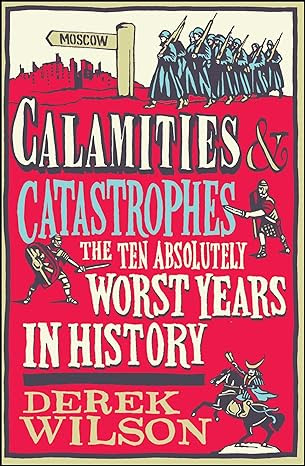
CALAMITIES and CATASTROPHES: THE TEN ABSOLUTELY WORST YEARS in HISTORY by Derek Wilson


Published in 2015 by Marble Arch Press

Going into this book, I knew that I would have a bone to pick with almost every one of the author's choices. After all, there are 5,000 years of recorded history and every last one of them is filled with tragedy. How can you pick and choose the actual worst 10 years?

Wilson, a British historian, focuses in this book on a Western point of view and the earliest date is 541 A.D. So, if you are making a pitch for the 10 worst years in the West in the last 1500 years, his choices are pretty solid.

The years he picks are:

541-542: The first outbreak of the Bubonic Plague weakens the nascent Byzantine Empire and the Persian Empire, killing millions.


1241-1242: The Mongols invade Eastern Europe.

1572: The Spanish Inquisition and everything that came with it.

1631-1632: The worst year of the Thirty Years War.

1709: The Great Freeze

1848: The "Year of Revolutions" in Europe

1865-1866: The assassination of Abraham Lincoln and the failure of the United States to follow through properly with Reconstruction after the Civil War. Also, the rise of terror groups like the KKK.

1942-1943: He almost exclusively focuses on the Russian front - the bloodbaths around Leningrad, Moscow and Stalingrad.


Robert F. Kennedy, Sr. (1925-1968)
1968: The Vietnam War, the assassinations of Martin Luther King and Robert Kennedy, protests around the world.

1994: The Rwandan genocide. There is a lot of focus on how and why the Western powers just watched it happen.

Sometimes, Wilson has a nice turn of phrase in his writing. I especially liked this line from page 151: "Over the centuries, whatever game Europe's nations played, the weakest hand always seemed to be dealt to Poland."

But, there were lots of typos, a weird use of texting-style writing on page 122 and several errors with commas that made me have to re-read passages just to figure out if what Wilson had written was what he really meant to say. Other times, there are factual errors (that may have been editing errors - as I just noted, editing was a real issue in this book). The most egregious error was actually a double error in the same paragraph on page 227. Wilson notes:

 "By the end of 1967 the war had cost the lives of almost 16,000 combat troops and was gobbling up more than $2-3 million per month. What made matters worse was that America's youth had no way of avoiding military service because conscription (the 'draft') still existed."

First: a quick internet search says the Department of Defense spend $168 billion between 1965 and 1972 on military operations in Vietnam. I am sure he meant to say $2-3 billion, not million.

Secondly, there were ways to avoid the draft. Let's look at three recent American presidents. Bill Clinton chose the most popular way to avoid the draft - he went to college. It was no guarantee, but it was a good bet. Many universities grew during the Vietnam War due to increased demand. George W. Bush joined the Air National Guard. Also, it was no guarantee not be sent to Vietnam, but it was not likely. Donald Trump claimed disability (bone spurs in his feet).

I rate this book 3 stars out of 5. The limited focus on the West while claiming to be about all of history was a disappointment. The atrocious editing was also a concern.

This book can be found on Amazon.com here: CALAMITIES and CATASTROPHES: THE TEN ABSOLUTELY WORST YEARS in HISTORY by Derek Wilson.

THE WALK-IN by Gary Berntsen and Ralph Pezzulo


Published in 2008 by Crown Publishing


Matt Freed is summoned on very short notice to Bucharest to interview a member of Iran's intelligence community. He was unrecruited, meaning that he is a "walk-in" - literally someone who walked into the embassy and offered information that the American government would want.

Freed has been asked to talk to this man because he is an expert on Iranian politics and he speaks the language. He is also an extremely capable intelligence operative. The interview yields valuable and very scary information. Freed starts to act on it and soon discovers that there may be more to this situation than he has been led to believe. He starts his own investigation and becomes convinced that this may be a double cross. His superiors disagree and it becomes a race against time with Freed working against foreign governments and his own...


This is a middle-of-the-road spy novel. The action was good but sometimes the narration needed to be made more clear as the action moved from person to person. The supporting characters were never really fleshed out so they always seemed to be fairly arbitrary in their actions because they were faceless uniforms or suits, depending on the bureaucracies they served. This is a book that would have been much better if it had been expanded.

I rate this novel 3 stars out of 5.

This novel can be found on Amazon.com here: The Walk-In.

LAST HOPE ISLAND: BRITAIN, OCCUPIED EUROPE, and the BROTHERHOOD THAT HELPED TURN the TIDE of WAR (audiobook) by Lynne Olson


An Exceedingly Well-Written History


Published in April of 2017 by Random House Audio
Read by Arthur Morey
Duration: 18 hours, 46 minutes
Unabridged

As Europe collapsed before the Nazi onslaught several governments-in-exile retreated to the United Kingdom in an effort to support their struggling underground resistance movements and to remind the world of their plight. Some brought a lot of soldiers (Poland), some brought money, some brought civilian ships and some brought not much more than a loud voice and the will to use it.

This was not an easy alliance. The UK was xenophobic and stunned at the rapid fall of France and many of the governments in exile were being ripped apart from their own internal politics. Misunderstandings, patronizing attitudes and differing agendas make everything more difficult.

When America and the Soviets joined the war the UK shifted its attention away from the governments-in-exile to its new, much more potent allies and those new allies had different agendas. Those new agendas often did not match those of the governments-in-exile. President Roosevelt was surprisingly indifferent to them and the Soviet Union was only interested in gobbling up as many of them as it could.

Olson begins Last Hope Island with the stories of how each country fell to Nazi Germany and their government's reacted. Most fled, but not all did. France did both with both Vichy France and Charles de Gaulle claiming supremacy. These stories are extremely well told and quite gripping.

The middle part of the book deals with Britain's intelligence or outright military operations in the conquered countries. 
Winston Churchill (1874-1965)
 and Charles de Gaulle (1890-1970)
 Interestingly, the UK's intelligence service thought that it was brilliant, but the reality was far from that. If you have seen the old TV show Hogan's Heroes, the reality is that the UK was far more like Colonel Klink than like Colonel Hogan. Truly embarrassing and idiotic mistakes were made for years on end.

The end of the book is very moving as it features the return of the different governments and what happened when they returned. For some, they were hailed as heroes, some were derided and some just disappeared behind the Iron Curtain.

Lynne Olson has a real talent for writing history and the reader, Arthur Morey did an excellent job as well. This was an informative, entertaining and often very moving history.


I rate this audiobook 5 stars out of 5.

This audiobook can be found on Amazon.com here: LAST HOPE ISLAND: BRITAIN, OCCUPIED EUROPE, and the BROTHERHOOD THAT HELPED TURN the TIDE of WAR (audiobook) by Lynne Olson

YOU'VE GONE TOO FAR THIS TIME, SIR! (kindle) by Danny Bent


Published in August of 2014 by Danny bent, Ltd.

It took me a long time to read You've Gone Too Far This Time, Sir. I read it over the course of several months on my Kindle and on my phone's Kindle app. 

The book details the trip of a teacher from the UK who rides his bike from the UK to India in an effort to raise money for charity and to teach his kids something.

I really struggled with the first part of the book because the author seemed so self-absorbed and I never really understood how he was going to raise money for a charity by riding and as a fellow teacher I seriously did not get how this trip was going to do anything for his students besides show them that he could do this outrageous thing. 


So, I struggled through the first half of the book because I kept on coming back to the premise behind his trip and wondering about it (how is he raising this money? Is it by the kilometer? Is it a lump sum and will be donated so long as he makes a solid effort? These are the types of questions my overly-practical mind had).

But, after a couple of months of on and off again halfhearted efforts I basically forgot the school-related aspect of the book and read it as simply the adventures of a skinny Brit riding his bicycle to India because that's the kind of crazy thing that some Brits do from time to time. 

Basically, once Danny Bent enters Russia I thought the book became much more interesting and became more fascinating the further he went. It became a travelogue and a grand adventure and I was glad to go along because I know there is literally almost no chance that I will ever travel to these places and I will certainly not be staying in the places he stayed in. Heck, I have a hard time trying new things on the menu at McDonald's, let alone eating strange, steaming bowls of mystery stew handed to me by toothless old ladies in a hut on the side of a mountain in Pakistan.

But, thank goodness I can get a glimpse of that from adventurers like Danny Bent. The second half of the book is certainly worth your time to read.


I rate this book 4 stars out of 5.

This book can be found on Amazon.com here: You've Gone Too Far This Time, Sir!

HAVOC (Philip Mercer #7) by Jack Du Brul


Published in 2006 by Brilliance Audio, Inc.
Read by J. Charles.
Duration: 12 hours, 43 minutes.
Unabridged audio edition.

Jack Du Brul's Havoc is a techno-thriller that races from the Hindenburg disaster to Africa to Washington, D.C to Atlantic City to Niagara Falls to Russia and back to Africa with hardly any time to take a breath. 

The book features Philip Mercer, a geologist by training that often troubleshoots for the White House. This is the seventh book featuring Mercer, a fact that was not on the audiobook label. However, Du Brul does a great job of catching the reader up on what has been going on - I assumed it was the first book in the series as I was listening to it. 

The Hindenburg disaster on May 6, 1937.
The action starts with a traveler on the infamous Hindenburg as it flies to its fate with destiny in Lakehurst, New Jersey in 1937. A crazed man is hiding a secret in a safe in his room and he is afraid that the Nazis know he has it and are plotting to steal it from him. As this man sits and watches his safe he devises a plan to get it safely off of the airship before it lands in New Jersey - he throws it overboard into a farm field with an attached note for Albert Einstein. The note falls off and the safe gets forgotten in the chaos of the Hindenburg disaster.

Fast forward to modern day in the Central African Republic. Mercer accidentally meets Cali Stowe, a fellow American. Mercer tells her he is here to investigate a geological hunch for someone as a favor. She says that she is there to investigate a village that has an extraordinarily elevated cancer rate. They are both telling half-truths. But, most importantly, this village is in the middle of a civil war and a dangerous warlord is on his way, burning and looting as he comes...

As the story progresses, Stowe and Mercer find that they have a mutual interest in this village and in each other. The more they find out about, the more tense the situation becomes. There are a lot of complicated threads in this book but Du Brul does tie them all together at the end

The story is full of action and adventure - some of it fun, some of it believable, some so outrageous that the story borders on silly. Mercer gets to be too much after a while - he is an expert on the Hindenburg, he knows how to fight, he's an expert with pistols, grenades, rifles, knives, swords and even with bows and arrows. He knows about mines, cave-ins, scuba diving, trains, dinosaur bones, forklifts, helicopters, speed boats and bar tending. But, his heart is in the right place and if you just go with the flow and don't think about it it just might not bother you too much. 

The audiobook was read by J. Charles. Charles did a merely okay job with the variety of accents required by this book. He has a hard time with women's voices and Cali Stowe has a lot of lines in this book. His foreign accents all fell into the category of "not an English language accent". Everyone kind of sounded the same. 

I rate this audiobook 3 stars out of 5. It can be found on Amazon.com here: Havoc (Philip Mercer #7) by Jack Du Brul.

Reviewed on July 22, 2014.

THE GREAT UPHEAVAL: AMERICA and the BIRTH of the MODERN WORLD (audiobook) by Jay Winik


Disappointing


Published by HarperAudio in 2007
Read by Sam Tsoutsouvas
Duration: 12 hours, 56 minutes
Abridged.


Jay Winik's April 1865 is one of my favorite Civil War histories - it holds a very safe place on a shelf that has to be purged on a regular basis to make room for new books because it is a brilliant history. 

Before I go on with this review I must note that I listened to the abridged audiobook version The Great Upheaval. Despite the abridgment, this book still clocks in at nearly 13 hours. Some of my criticisms are undoubtedly due to the abridgment.

Winik's thesis in this book is that the time period from 1788 to 1800 was a time of revolutionary ardor and that most of the great European powers were affected. Victor Hugo wrote: “One can resist the invasion of armies; one cannot resist the invasion of ideas.” Winik looks at how the ideas of America's Founding Fathers and the French philosophes affected three countries: The United States, France and Russia.

In 1788, those three countries had almost nothing in common. The United States was small, almost inconsequential to European politics and in the middle of implementing a new Constitution. Mostly, it was a curiosity. France was the most powerful, most important country in Europe and quite possibly the world. Russia was a massive, largely mysterious backwater that hovered on the fringe of the European political scene.

The execution of Louis XVI (1754-1793) on January 21, 1793
Winik presents three different models of how various countries dealt with the new "invasion of ideas." Russia, in the person of Catherine the Great, entertained them on a philosophical level, but on a practical level she smashed them and dug them out by the root. The French King Louis XVI attempted to compromise with them but, in the end, he could not compromise enough to please Revolutionary France and it cost him his life. Worse, the country spun out of control and began to consume itself. The United States institutionalized the conflict between change and tradition by creating political parties and a system of government that allowed give and take without permitting everything to spin out of control (although the Whiskey Rebellion came close to doing just that - Winik discusses the Rebellion in detail but never says why the Western farmers were so upset about the tax on Whiskey. The answer - they had to convert their corn into whiskey to transport it out to sell. It taxed them but not farmers in the East who could sell regular corn).

John Paul Jones (1745-1792)
For me, the greatest weakness of this book is the inclusion of Russia. The discussion about the Russo-Turkish War (1787-1792) was not particularly interesting (I had to turn it off while I was driving because I found myself so bored with the topic that I began to nod off), with the exception of the brief mention of John Paul Jones.  Catherine the Great's reaction to the implementation of the revolutionary ideas of the time was no different than that of almost all dictators of almost all times and all places - she perceived a threat and she destroyed it as thoroughly as she could. In this book she serves as the opposite example of what happened to Louis XVI. As such, she really was superfluous - she was the norm and could have been described in just a few paragraphs or even sentences (for example, "While Catherine the Great loved to read and discuss these new revolutionary ideas, she never tried to negotiate with those who would take away her power as absolute monarch in the name of those new ideas like Louis XVI did. Instead, she engaged those revolutionaries with military power and hunted them down until they were utterly destroyed, much like successful tyrants like Augustus Caesar, Stalin and Kim Jong Il have done throughout history.")

On the other hand, I found the descriptions of the French Revolution to be fascinating. Winik included the grim details, a decision I agree with because those details demonstrate the degree to which the crowds were moved to act. For example, the simple fact that the crowds taunted the Marie Antoinette with the severed head of one of her friends (after they had its hair made up nice) shows that the French Revolution was out of control. Fortunately, the largest portion of the abridged audiobook deals with the French Revolution. The American Revolution section is also very strong.

The narrator of this audiobook was Sam Tsoutsouvas. He is an experienced audiobook reader and his command of French came in very handy when he read the occasional French word or phrase that pops up in this book. On top of that, when the crowd yelled, he would actually yell too which makes the descriptions even more powerful. His greatest strength, though, is the sense of gravitas he gives to everything he reads. If he read my grocery list it would sound as though the security of the nation depended on the purchase of a 2 liter bottle of Coke Zero and a box of Cheerios.

However, when coupled with Winik's often overwritten text this sense of gravitas becomes overwhelming. Winik has invested in a thesaurus and truly loves using it. He repeats himself in long strings of sentences. He loves to restate things with very similar words. He is verbose, wordy, repetitious and long-winded (yes, I did that on purpose). Winik invests a lot into injecting false drama into the story by asking dramatic questions such as, "What would happen next?" and listing a series of adjectives and using this kind format (sorry, I could not write one down - I listen while I drive and it did not seem prudent): "Coca-Cola. Is it brown? Is it fizzy? Is it wet? It is all of that - and more!"

He also likes to describe things and then use this ending to the description to inject doubt: "If - and it was a big if..." and "Yet - and it was a big yet..." and my favorite "But - and it was a big but..." Yes, he actually made the audiobook reader read the phrase "it was a big butt."

So, match this dramatic reader with an overly dramatic writing style and this book approaches parody in its audiobook form. Maybe this sentence is the epitome of the problem: "A bodyguard, a mere boy, was ruthlessly murdered and dragged into the courtyard half dead, becoming little more than a bleeding trophy." Indeed, the murdered boy was half dead.

Once again, I must point out that I did listen to the audiobook and it was abridged so some of the problems may have occurred because the abridgment. 


I rate this audiobook 3 out of 5 stars. It can be found on Amazon.com here: The Great Upheaval: America and the Birth of the Modern World.

Reviewed on May 24, 2014. 
Updated on January 4, 2025.

The Presidents Club: Inside the World's Most Exclusive Fraternity (audiobook) by Nancy Gibbs and Michael Duffy


Very Interesting History of the Modern Presidency


Published by Simon and Schuster Audio in 2012
Read by Bob Walter
Duration: 22 hours, 1 minute
Unabridged

Nancy Gibbs and Michael Duffy, both editors at Time, have delivered a very listenable, fascinating look at each American president from Harry Truman to Barack Obama. No matter their political persuasion, their life experiences or their qualities as a human being, all 12 of these men share one thing: they were once President. This is an exclusive club and it seems that just about every president has looked to a former president for a shoulder to lean on, advice or even as a personal envoy sent to convey a sense of urgency to the message.

The Presidents Club is told in a rough chronological order starting with Truman. When Truman was President there was only one other member of the Presidents Club: Herbert Hoover. Yes, the same Hoover that Truman and FDR disparaged for 12 years. However, to his credit, Truman sent out feelers and discovered that Hoover was still willing and able to help. Together, they set up the ground rules for this "club." Hoover was tapped by Truman to get food to Europe at the end of World War II (Hoover did this at the end of World War I as well) and to help re-organize the Executive Branch.

Gibbs and Duffy discuss how each President interacted with his predecessor and his successor and even other presidents (for example, Nixon interacted with every President from Truman to Clinton). Gerald Ford had a similar lengthy history. They also discuss how the "Club" grew and shrank over the years. During Bill Clinton's presidency, there were as many as six members (Nixon, Ford, Carter, Reagan, Bush41 and Clinton). At one point in the Nixon years, there was only Nixon.
The current "Presidents Club" membership:
George H.W. Bush (41), 
Barack Obama,
George W. Bush (43), Bill Clinton and Jimmy Carter.

If you are a political junkie or a fan of modern American history, this anecdote-filled book is a must-read. It gives a different feel for the men, their personalities and their legacies. For example, I was surprised at how often Johnson reached out to Eisenhower for advice and reassurance concerning the Vietnam War.  I was even more surprised at how often Johnson was out hustled politically by Richard Nixon. I know Johnson was a world class politician, but Nixon maneuvered him and manipulated him throughout 1968. Johnson fared no better in his post-Presidential years.

Nixon comes off as talented but very deeply flawed. The authors quote longtime advisor to multiple presidents, Brent Scowcroft, calling Nixon a "shit" and former President George H. W. Bush (Bush41) referred to him as "first-rate intellect but also a third-rate person." However, you do have to admire how Nixon calculates how to get to the forefront of American politics again and again and again. Reagan comes off surprisingly cold. Carter, as an enigma. Gerald Ford comes off as principled and maybe even heroic for his decision to pardon Nixon and destroy any chance he had to be elected. The Clinton-Bush41 friendship was a joy to learn about and the source of some of the best stories.

Leadership lessons abound in this book. Every president had his own style in office and some even managed to exert a large influence long after they left office. Some Presidents chart the general path and expect their subordinates to follow it. Others are intimately involved in so many decisions that they are spread too thin. Some are charmers. Some intimidate. Some scheme and plan every move. No matter the president, Gibbs and Duffy take the reader behind the scenes and give a sense of the times and the way their administrations worked.


I found this audiobook to be thoroughly enjoyable. Bob Walter's narration was excellent. He varied his rate, read with a lot of emphasis and made a 22 hour long audiobook fly by. I particularly enjoyed his very slight inflections he put in his quotes. For example, his LBJ quotes had a small amount of Texas twang and his Reagan quotes had his characteristic tone to them (If you were alive during the Reagan Administration, think about his famed "Well...").

I rate this audiobook an enthusiastic 5 stars out of 5.

This book can be found on Amazon.com here: The Presidents Club.

Reviewed on February 1, 2013

Note: This audiobook was provided to me free of charge by the publisher in exchange for an honest review. I honestly thought this was an exceptional audiobook.

The 1940s: A Brief History [Kindle Edition] by Vook


Published in 2011 by Vook.

Vook is a publisher of e-books enhanced with video clips (Video + Book = Vook). This history is short (Amazon estimates it would be about 32 pages on paper) so it is unlikely to satisfy a history purist. It is very lightweight due to its short length but very readable.

The result is about the same as if you read the chapter on World War II and the 1940s in a standard high school world history book. The broadest of outlines are there but if this is all you knew about World War II and the beginnings of the Cold War you would be one un-educated person indeed. At best, this is an introduction to the topic. Considering how long of a shadow World War II and the Cold War have cast, this is too short and too shallow to be of much value.


The Chapter titles are:

-"The Greatest Generation"

-The Cold War
-Boom Times
-Making Military Technology Civil
-Hurray for Hollywood
-Breaking the Race Barrier
-40s Pop Culture
-Everyday People

I rate this kindle book 2 stars out of 5.


This e-book can be found online at Amazon.com here: The 1940s: A Brief History (Enhanced Version)


Reviewed on December 31, 2012.

Exogene (The Subterrene War, Book 2) by T.C. McCarthy


Published by Orbit in March of 2012


I approach this review with some trepidation. This is a hell of a science fiction novel but to call it a sci-fi novel is to undersell it. It is a hell of a war novel, but to call it a war novel is also underselling it. It really is the story of a woman finding out what it is to love, to be loved and to know where one stands with God - in short, to be human, but that seriously undersells this book and makes a violent tale of war, genetic mutation and out-of-controls science sound like some piece of warm and fuzzy chick lit. Exogene is certainly not that.

So, what is Exogene?

First things first - Exogene is the second book in a series by T.C. McCarthy. Read the first book, Germline, for the background necessary for this book. Germline (see my review by clicking here) explores a future war for trace metals in Kazakhstan between the Russians and the Americans. In Germline a group of cloned teenaged female warriors are introduced to the front line (males are not used because they lost control and became too violent). Exogene is the story of one of those warriors.

The clones are supposed to fight for two years and then they begin to break down mentally and physically and are rounded up to be killed. While they are maturing, they are indoctrinated into a culture of violence and death. Their universe is ruled by a god that rewards killing, rewards dying in battle and despises fear and mercy. In short, these teenaged girls are bred and trained to be pitiless fighting machines.
T.C. McCarthy


Except, they are not machines.

Deep down, they are people...and Exogene is the story of Catherine, a clone soldier that decides she does not want to die when her two years have expired. She questions everything - her religion, the orders she receives and especially the expectation that she is to give up and die because her two years are up.

Exogene takes the reader far from the battlefields of Kazakhstan into Russia, into North and South Korea and beyond. The world of Exogene is seriously screwed up - damaged by nuclear war, cloning soldiers, experimenting with human/robot hybrids and through it all Catherine pushes along: experiencing, thinking and learning what it is to be human.

A remarkable novel. I rate it 5 out of 5 stars.

This book can be found on Amazon.com here: Exogene (The Subterrene War)

Reviewed on June 1, 2012.

Featured Post

<b><i>BAN THIS BOOK (audiobook)</i></b> by Alan Gratz

Published in 2017 by Blackstone Audio, Inc. Read by Bahni Turpin. Duration: 5 hours, 17 minutes. Unabridged. My Synopsis Ban This Book is t...

Popular posts over the last 7 days