Showing posts with label JImmy Carter. Show all posts

JIMMY CARTER: A LIFE from BEGINNING to END (Biographies of U.S. Presidents) (kindle) by Hourly History


Published in 2025 by Hourly History.

Hourly History is a publisher that specializes in short histories and biographies in e-book form that are designed to be read in about an hour.

This limited format should have been enough for any other one term President, but with Jimmy Carter there is so much post-Presidential activity to cover that it came up a bit short.

This history spends a lot of time on Carter's early life - too much, in my opinion. Newsweek magazine once called Jimmy Carter the best ex-President ever*, and this book just doesn't tell enough about his 40+ years of being the most active former President of my lifetime. Clinton, W. Bush, and Obama all left the Presidency with enough vim and vigor to go out and be useful, but Carter did more than all of them have combined AFTER he was eighty years old.

The man was an author, a rogue diplomat, helped eradicate a truly gruesome disease, monitored elections around the world, helped build an amazing number of houses with his own hands, and taught Sunday School. I am sure I have left out 20 other things. 

This is a solid 3 star biography, but I would have moved the focus to say much more about post-Presidential years.

This e-book can be found on Amazon.com here: JIMMY CARTER: A LIFE from BEGINNING to END (Biographies of U.S. Presidents) by Hourly History.

*Newsweek may be right about Jimmy Carter
, but I doubt they considered the amazing post-Presidential career of John Quincy Adams. See this book: Mr. Adams's Last Crusade: John Quincy Adams's Extraordinary Post-Presidential Life In Congress by Joseph Wheelan.


LIFE AFTER POWER: SEVEN PRESIDENTS and THEIR SEARCH for PURPOSE BEYOND the WHITE HOUSE (audiobook) by Jared Cohen


Published by Simon and Schuster Audio in 2024.
Read by Kevin R. Free.
Duration: 14 hours, 4 minutes.
Unabridged.

In Life After Power Presidential historian Jared Cohen looks into the post-Presidential lives of seven Presidents and their quests for some sort of meaning after having one of the most important jobs you can have.

Some Presidents fade away due to health reasons, like Reagan. Others are eager to resume their former lives, like Washington. But, others still feel like they have something more to offer or have unfulfilled goals.

The seven Presidents he looked at are: Thomas Jefferson, John Quincy Adams, Grover Cleveland, William Howard Taft, Herbert Hoover, Jimmy Carter, and George W. Bush.

I have enjoyed hearing about John Quincy Adams' post-Presidential life ever since I first read John F. Kennedy's Profiles in Courage 30+ years ago. I've read more than one book about him and this re-telling is quite good. 

A photo of John Quincy Adams 
taken in 1844.
Jimmy Carter's lengthy post-Presidency is remarkable for how amazingly hard-headed he has been. Carter follows his conscience and lets the political consequences be damned. Cohen notes that Carter did not actually found Habitat for Humanity - he just joined it early on and is easily its most famous and perhaps longest term volunteer.

George W. Bush has done almost the opposite. He lived a very public life for years and has since retreated into more solitary pursuits such as painting. He has said almost nothing about politics in the almost 16 years since he left office.

Each of these men had a different reaction to leaving office. Some left after 2 successful terms, some after experiencing disappointment and 4 of them were defeated after just one term (this is what inspired Cleveland's determination to run again - and win.) I found some to be more interesting than others but, taken a whole, this is a solid set of mini-biographies.

I rate this book 4 stars out of 5. It can be found on Amazon.com here: LIFE AFTER POWER: SEVEN PRESIDENTS and THEIR SEARCH for PURPOSE BEYOND the WHITE HOUSE by Jared Cohen.


A CALL to ACTION: WOMEN, RELIGION, VIOLENCE, and POWER (audiobook) by Jimmy Carter


Published in 2014 by Simon and Schuster (AUDIOWORKS)
Read by the author, Jimmy Carter
Duration: 6 hours, 33 minutes

Jimmy Carter and I have a strange relationship. Don't get me wrong, the 39th President and I have never met and are not likely to. I think that his presidency was, on balance, a well-intentioned mess and his post-Presidential career has been a mix of amazing achievements (Habitat for Humanity, for example) combined with annoying commentary and self-intervention into areas where he was not invited (ask Bill Clinton what he thinks of Carter's self-appointed mission to North Korea during the Clinton Administration).

This book only re-affirms my impressions of Jimmy Carter. I admire his religious faith and his intimate knowledge of the scriptures. I also admire his willingness to learn about other faiths and the fact that he teaches in his church's Sunday school. His work through the Carter Center has also been a mixed bag of amazing work against poverty and disease and less-than-helpful self-insertion into international politics. 

As Carter describes it early in his book, A Call to Action was written because so many people asked him to use his position to call attention to the how religion was being used against women around the world. 

The book also looks at the economic and political status of women and often ties religious views into how women and doing economically and politically. This is mostly a look at Christianity and Islam with some commentary on Judaism but almost none on Buddhism, Hinduism, Shintoism or any of the other faiths of the world.

Carter is especially critical of Christian denominations that do not allow women to be pastors or priests. He lays down his arguments here quite well, which is appropriate since he publicly broke with the Southern Baptists over this topic in 2000 and has laid out his reasoning for doing so many times. 

Former President Jimmy Carter signing
 A CALL TO ACTION in April of 2014. 
Photo by Mark Turner
He is less critical of the Islamic world. Don't get me wrong, he is critical, but spends much less time on the topic than he does in criticizing Christianity. He dismisses a lot of the more obvious things like burkas, not letting women go to school and not letting women receive medical treatment as local tradition. This is true, but it is tradition bolstered by certain verses in the Koran or by attitudes that draw on those verses for strength. 

This leads to the heart of my strange relationship with Jimmy Carter. It is not that he did not have a point about any of this stuff, it is that he points his finger at America and the West for so long in comparison to the other religions and countries.  He gushes over the improvement of the conditions for women in China in a section that focuses on China and brushes over the one child policy, forced abortions (he addresses the forced abortions at the end of the book but only as part of a larger movement) and the number of girls in orphanages. He focuses on the positives and brushes over the negative. When discussing America, he brushes over our positives and focuses on the negatives. Note, I am not saying we are perfect, I am saying his focus is often out of balance. 

The book was read by Jimmy Carter. At first, I thought that this was an odd choice considering his age (he was 89 when this book was released). His weaker voice has only deepened his accent and it does take a few minutes to get used to it. But, in the end, Carter's unique voice, especially if you remember his presidency, was the only one that could read this audiobook - his style is all over the text and you would have been imagining it being read in his voice anyway. At times, his emphasis on certain words while reading express his feelings more than the words themselves would have. Every time he says the phrase "female genital cutting" he practically spits out the word "cutting" - his distaste is obvious.

I rate this audiobook 4 stars out of 5. It can be found on Amazon.com here: A CALL to ACTION: WOMEN, RELIGION, VIOLENCE, and POWER (audiobook) by Jimmy Carter.

Reviewed on May 31, 2014.

The Presidents Club: Inside the World's Most Exclusive Fraternity (audiobook) by Nancy Gibbs and Michael Duffy


Very Interesting History of the Modern Presidency


Published by Simon and Schuster Audio in 2012
Read by Bob Walter
Duration: 22 hours, 1 minute
Unabridged

Nancy Gibbs and Michael Duffy, both editors at Time, have delivered a very listenable, fascinating look at each American president from Harry Truman to Barack Obama. No matter their political persuasion, their life experiences or their qualities as a human being, all 12 of these men share one thing: they were once President. This is an exclusive club and it seems that just about every president has looked to a former president for a shoulder to lean on, advice or even as a personal envoy sent to convey a sense of urgency to the message.

The Presidents Club is told in a rough chronological order starting with Truman. When Truman was President there was only one other member of the Presidents Club: Herbert Hoover. Yes, the same Hoover that Truman and FDR disparaged for 12 years. However, to his credit, Truman sent out feelers and discovered that Hoover was still willing and able to help. Together, they set up the ground rules for this "club." Hoover was tapped by Truman to get food to Europe at the end of World War II (Hoover did this at the end of World War I as well) and to help re-organize the Executive Branch.

Gibbs and Duffy discuss how each President interacted with his predecessor and his successor and even other presidents (for example, Nixon interacted with every President from Truman to Clinton). Gerald Ford had a similar lengthy history. They also discuss how the "Club" grew and shrank over the years. During Bill Clinton's presidency, there were as many as six members (Nixon, Ford, Carter, Reagan, Bush41 and Clinton). At one point in the Nixon years, there was only Nixon.
The current "Presidents Club" membership:
George H.W. Bush (41), 
Barack Obama,
George W. Bush (43), Bill Clinton and Jimmy Carter.

If you are a political junkie or a fan of modern American history, this anecdote-filled book is a must-read. It gives a different feel for the men, their personalities and their legacies. For example, I was surprised at how often Johnson reached out to Eisenhower for advice and reassurance concerning the Vietnam War.  I was even more surprised at how often Johnson was out hustled politically by Richard Nixon. I know Johnson was a world class politician, but Nixon maneuvered him and manipulated him throughout 1968. Johnson fared no better in his post-Presidential years.

Nixon comes off as talented but very deeply flawed. The authors quote longtime advisor to multiple presidents, Brent Scowcroft, calling Nixon a "shit" and former President George H. W. Bush (Bush41) referred to him as "first-rate intellect but also a third-rate person." However, you do have to admire how Nixon calculates how to get to the forefront of American politics again and again and again. Reagan comes off surprisingly cold. Carter, as an enigma. Gerald Ford comes off as principled and maybe even heroic for his decision to pardon Nixon and destroy any chance he had to be elected. The Clinton-Bush41 friendship was a joy to learn about and the source of some of the best stories.

Leadership lessons abound in this book. Every president had his own style in office and some even managed to exert a large influence long after they left office. Some Presidents chart the general path and expect their subordinates to follow it. Others are intimately involved in so many decisions that they are spread too thin. Some are charmers. Some intimidate. Some scheme and plan every move. No matter the president, Gibbs and Duffy take the reader behind the scenes and give a sense of the times and the way their administrations worked.


I found this audiobook to be thoroughly enjoyable. Bob Walter's narration was excellent. He varied his rate, read with a lot of emphasis and made a 22 hour long audiobook fly by. I particularly enjoyed his very slight inflections he put in his quotes. For example, his LBJ quotes had a small amount of Texas twang and his Reagan quotes had his characteristic tone to them (If you were alive during the Reagan Administration, think about his famed "Well...").

I rate this audiobook an enthusiastic 5 stars out of 5.

This book can be found on Amazon.com here: The Presidents Club.

Reviewed on February 1, 2013

Note: This audiobook was provided to me free of charge by the publisher in exchange for an honest review. I honestly thought this was an exceptional audiobook.

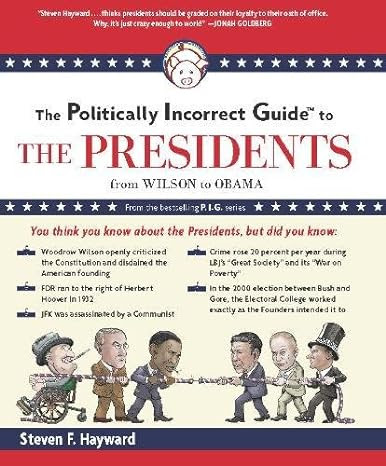
The Politically Incorrect Guide to the Presidents from Wilson to Obama (P.I.G. Series) by Steven F. Hayward


An entertaining read and a great way to rate the presidents

Published in 2012 by Regnery Publishing, Inc.

First and foremost, the latest entry in the P.I.G. series is a great read. Steven Hayward is to be commended for making what could have been a very stale read into an entertaining read - he has a light touch.

Secondly, how sad is it that grading presidents by how well they "preserve, protect, and defend" the constitution is a unique idea?

Hayward begins The Politically Incorrect Guide to the Presidents with a look at what the founders wrote about the office of the president and compares that to the modern presidency. He then looks at the presidency in the 19th century and how most presidents took the restrictions of the Constitution very seriously.

As Hayward proceeds to grade the 17 presidents we have had from 1913 until the 2012 (from Wilson to Obama) on an A to F scale (just like in school) he gives a thumbnail sketch of each president with the major issues of the election and/or his time in office, where he diverged from the Constitution (or supported it) and how the Supreme Court justices he appointed fared by way of the Constitution as well.

Each president gets about 8-12 pages per term in office and the text includes sidebar boxes with recommended readings, great quotes and interesting factoids. The overall grade is presented on the first page of each president's particular chapter and the last page explains how it was arrived at.

Richard Nixon, president from 1969-1974
So, what did I think? I agreed with the great majority of the grades given, although there were some I would have been a little tougher on or a little easier on (a C+ vs. a C- type of thing). I very much disagreed with the C+ for Richard Nixon - and not because of Watergate (although Hayward largely excuses it with the "the other guys did it, too!" defense) . The growth of the regulatory bureaucracy under Nixon was incredible - according to a factoid on page 173 it grew by 121% under Nixon. Throw in federal wage and price controls and I don't see how you can give Nixon the C+ that Hayward does.

But, that is just one grade out of 17 (and even that chapter was interesting). This is a book that I am going to keep handy for those great online political debates. Nothing like a great Warren G. Harding quote like this one: "There is not a menace in the world today like that of growing public indebtedness and mounting public expenditure" to get a little discussion going in this election year, huh?

Note: I would love to see an expanded re-issue of this book with 2 co-authors. One co-author would be a presidential historian who would provide a lot of the heavy lifting for the section detailing the history of each president's administration. The third co-author would be someone from the left politically. This would be a much larger book, but also a much more comprehensive and accurate book. 

I rate this book 5 stars out of 5.

This book can be found on Amazon.com here: The Politically Incorrect Guide to the Presidents from Wilson to Obama.

Reviewed on March 23, 2012.

The Hornet's Nest: A Novel of the Revolutionary War by Jimmy Carter


Published in 2003 by Simon and Schuster

Regardless of your views on Jimmy Carter the politician, he is also Jimmy Carter the author. A good reviewer should separate his opinions, be they pro or con, about the politician from a politician's works of fiction. I will endeavor to do so here.

Carter's interest in his native state of Georgia has led him to write, The Hornet's Nest: A Novel of the Revolutionary War, a historical novel about the Revolutionary War in Georgia, the Carolinas and Florida. Admittedly, this is an area that is often ignored in favor of Boston, Valley Forge and Philadelphia so there is room for quality fiction in this area.

The problem with Carter's work is not a lack of attention to historical detail - it is too much attention to historical detail to the detriment of an actual story about fictional characters. Carter's storyline shifts from being a piece of historical fiction to being a rather dry local history throughout the work.

Carter's passion for historical detail often drowns out the narrative. The reader is treated to dry facts about the intricacies of the British command in Florida ad nauseum. We are repeatedly told some of the some details over and over again - sometimes multiple times on the same page!

Jimmy Carter
What makes it worse is Carter's insistence on using the labels 'Tories' and 'Whigs', rather than the more common 'Patriots' and 'Loyalists'. True enough that most Loyalists were of one party and most Patriots were of the other, but it is often inaccurate as well. It would be akin to a Civil War writer labeling the Confederates 'Democrats' and the Northerners 'Republicans.'

At least once, Carter makes a major historical mistake. He states that Britain's African slave trade policy was very different than the America's policy during the Revolutionary War. Officially, Britain did not adopt a different stance until 1807, the year before America's Constitution outlawed the importation of new slaves.

Carter is an experienced author of non-fiction works, with at least a dozen works to his credit. He can be an interesting public speaker, especially when discussing history. If I had been his publisher, I would have recommended to Carter that he team up with a veteran fiction writer (like fellow Georgia politician Newt Gingrich has done with his Civil War books). Carter could have directed the story while the other author could have smoothed out the rough spots and made it flow. As it is, however, I can only recommend this book to the most hardcore enthusiasts of the Revolutionary War and/or the history of Georgia.

To be honest, I would not have finished it if it were not for the fact that I borrowed it from a relative who spoke highly of it. Read the Revolutionary War novels by Shaara instead.

I rate this book 2 stars out of 5.


This book can be found on Amazon.com here: The Hornet's Nest: A Novel of the Revolutionary War

Reviewed on February 23, 2006.

Character Above All: Ten Presidents from FDR to George Bush edited by Robert A. Wilson


Fascinating! Informative!


Published in 1996.

As the title implies, Character Above All: Ten Presidents from FDR to George Bush is a collection of biographical essays on each of the 10 presidents from FDR to George H.W. Bush (Bush 41) by 10 different authors who are either expert historians or knew the President while in office. The thing that ties them all together is that each essay is supposed to look at each man as president and find that one part of his character that made him the type of president he was. Each essay is about 30 pages and it makes for interesting reading.

A good sample would come from Doris Kearns Goodwin's look at Franklin Delano Roosevelt. She asserts that the most valuable component of his personality was his self-confidence. I thought this quote from FDR makes the point wonderfully: "I'll tell you...at night when I lay my head on my pillow, and it is often pretty late, and I think of the things that have come before me during the day and the decisions that I have made, I say to myself - well, I have done the best that I could, and turn over and go to sleep."

The essays are wonderful - some inspiring, such as Gerald Ford's, some disturbing such as JFK's. However, all are well-written and this is a fantastic collection.

This book can be found on Amazon here: Character Above All: Ten Presidents from FDR to George Bush   

I rate this book 5 stars out of a possible 5 stars.
 
Reviewed on February 11, 2005.

Featured Post

<b><i>BAN THIS BOOK (audiobook)</i></b> by Alan Gratz

Published in 2017 by Blackstone Audio, Inc. Read by Bahni Turpin. Duration: 5 hours, 17 minutes. Unabridged. My Synopsis Ban This Book is t...

Popular posts over the last 7 days