Showing posts with label hispanic. Show all posts

THE HOUSE on MANGO STREET (audiobook) by Sandra Cisneros

Originally Published in 1983.
Read by the author, Sandra Cisneros.
Duration: 2 hours, 18 minutes.
Unabridged

The House on Mango Street is the story of a Hispanic girl named Esperanza who grows up in a little house in a poor neighborhood in Chicago. Her story is told in a series of unrelated vignettes (44 in all) that tell some sort of story about her family life or the neighborhood itself. In some, the main character clearly has no idea of the more adult themes that occur around her, while in others she is very astute and understands the larger implications. 

At first, Esperanza's family intends that the house is going to be a temporary stop on their climb towards economic success in America. But, they never quite are able to move out of this troubled neighborhood and the reader is able to see how the neighborhood affects the lives of everyone around Esperanza as she grows up.

To be fair, the neighborhood is not all bad, but it is a tough place for children to grow up and keep their innocence. Some kids run away, some get married early and try to build some stability (one gets married extremely early.) Esperanza is determined to work her way out of the neighborhood and then come back and help others get out.

I read this book for two reasons:
1) It has a tremendous reputation. 
2) It has been placed on multiple book ban lists and I like to read those books to form my own opinion (unlike a lot of people who ban them.)

My review:

The author, Sandra Cisneros
I found that this book's biggest issue was that it was just boring. It's a 2 hours audiobook and I found myself wanting to listen to anything else at times. I simply could not get into this story. 

I certainly wouldn't ban this book. It has a lot of adult themes, but I think too many sheltered adults don't realize that a lot of kids live very unsheltered lives. This book will come off as very real to a lot of those kids, assuming that they can get past the back that it is a very, very tedious read. This 30+ year teacher would put it in a classroom library or in a school library and support any student wanting to read it. 

Here are two stories about districts that have banned this book - one based in Texas and one based in Florida.

I rate this book 2 stars out of 5. It can be found on Amazon.com here: 
THE HOUSE on MANGO STREET by Sandra Cisneros.


FORGET the ALAMO: THE RISE and FALL of an AMERICAN MYTH (audiobook) by Bryan Burrough, Chris Tomlinson and Jason Stanford


Published in June of 2021 by Penguin Audio.

Read by Fred Sanders.
Duration: 12 hours, 15 minutes.
Unabridged.


Forget the Alamo is the second book that I have read because a governor took steps to keep people from hearing about the book. The story of the first is detailed here

In the case of this book, the Governor and especially the Lt. Governor of Texas had an event featuring a discussion of this book removed from the Bullock Texas State History Museum in Austin, Texas. They acted in early July of 2021 because they were not happy about how it questioned the way the history of the Alamo (in San Antonio, Texas) is traditionally taught at the Alamo itself and in textbooks, classrooms, movies and books. Here is the text of the Lt. Governor's Tweet from July 2, 2021: "As a member of the Preservation Board, I told staff to cancel this event as soon as I found out about it. Like efforts to move the Cenotaph, which I also stopped, this fact-free rewriting of TX history has no place @BullockMuseum"

The Cenotaph the Lt. Governor refers to is an empty tomb for the defenders of the Alamo since their bodies were never recovered (they were burned by the Mexican Army). There was a plan to move the Cenotaph to be more integrated with the rest of the Alamo site while rehabbing it and updating the list of Alamo defenders. This topic is also discussed in the book.

Speaking of the book, I must thank these two gentlemen because without them I never would have listened to this very entertaining and very informative audiobook. 

Roughly the first half of the book is about the settlement of Texas by Spain, Mexico and American who moved in and agreed to become Mexican citizens. They talk about how slavery became a major point of contention after the Mexican War of Independence (1810-1821) because Mexico had every intent to outlaw slavery.

The authors detail how Stephen Austin went to Mexico City for more than a year to lobby for Texas to have special rights. The authors emphasize how he receeived special concessions for Texas and its slaves. This was critical because so many Americans moved into Texas after this point with slaves. The American states neighboring Texas were being filled up with cotton plantations that had to be worked by slaves to be profitable (at least that was the common belief) and Texas showed great promise as a cotton-growing state.

Mexico formally abolished slavery in 1831. 

When the Mexican dictator Santa Anna led an army to Texas to stop the Texas Revolution (1835-1836), he announced that he would stop Texas' attempt to secede and he would also free its slaves.  

The authors linger on the slavery point for a while and I think they give solid historical reasons for doing so. They do not make the point that I will make now - Texas seceded from 2 different countries in 26 years in an attempt to protect slavery (1835 and 1861). 

Their description of the battle itself is very good. By the way, the church that makes up most of the focus of the current Alamo site was not a part of the battle. 

The authors switch gears for the rest of the book and focus on the place of the Alamo in national memory and how it has been honored and taught over the years. Their look at how movies and books have told the story of the Alamo was very interesting.

They are particularly critical of the fact that, over time, the contributions of non-white people to the Texas Revolution and the defense of the Alamo have been dropped out of the story and the whole thing has become a story of only white people fighting back against an army of non-whites. There were "Tejanos" or native Mexicans that fought against Santa Anna for a variety of reasons, but it is rarely taught this way. They quote several book and, even more importantly, textbooks and official state curriculum guides. 

The politics of managing the Alamo as a historical site gets a lot of attention in the book as well. There have been a lot of arguments about how to do that and that continues up to this day (see the Tweet quoted above). 

The book ends with a look at the Alamo-related collection of Phil Collins. Yes, Phil Collins the English singer. Collins has an impressive collection of legitimate items from the Alamo and the Texas Revolution. He has an even more impressive collection of items that have been doctored or copies of items that he believes are the real thing. Collins wants to donate all of it to a museum dedicated to his collection - if Texas politicians can get their act together.

Ironically, the controversy caused by the Governor and the Lt. Governor would have fit in perfectly with the theme of this book and I hope that they offer an updated edition in the future with their book included. 

Once again, I seriously want to thank the Governor and the Lt. Governor for leting me know about this book. It was excellent.

I rate this audiobook 5 stars out of 5. It can be found on Amazon.com here: 
 
FORGET the ALAMO: THE RISE and FALL of an AMERICAN MYTH by Bryan Burrough, Chris Tomlinson and Jason Stanford.

SIMON BOLIVAR: THE GREAT LIBERATOR (World Landmark Series) by Arnold Whitridge


Published in 1954 by Random House.

In the 1950's and 1960's Random House created an extraordinary history series for children called Landmark Books. There were 122 books in the American history series and 63 in the World Landmark series. A very solid description of the series can be found here: link. When I was a kid my little hometown library had what seemed like an endless shelf of these books. I loved these books - I even remember where it was in the library nearly 40 years later! Undoubtedly, these books are part of the reason I am a history teacher.
Simon Bolivar (1783-1830)

This book is part of a subset of the Landmark Books series. If the book took place outside of the United States the book belonged to the World Landmark Books series.

Simon Bolivar was born in the Spanish colony that is now Venezuela. He was educated in Spain but was keenly aware that the government of Spain considered the colonies to be inferior to Spain and incapable of self-government. He doubtless shared that belief until he began to spend time with the children of the Spanish ruling class (including the future King of Spain) and discovered that they weren't all that impressive. Once Napoleon conquered Spain and put his brother on the throne, Bolivar pushed for a revolt. Some, like Bolivar, were pushing for independence no matter who was on the throne, but others who joined him simply wanted to revolt as a part of a general resistance to Napoleonic rule.

Regardless of the initial motivations, Bolivar soon led a multi-colony revolt that went on for 11 years. Eventually, Bolivar helped to liberate the colonies that make up the modern countries of Venezuela, Colombia, Ecuador, Bolivia and Peru.

Many have compared Bolivar to George Washington, including Arnold Whitridge, the author of this book. There are surface similarities, but Bolivar's fight was much longer and (I would say) much more of a geographical challenge. Bolivar crossed the Andes range multiple times with armies that suffered horrific losses simply from the geography. In fact, while doing a bit of research on Bolivar while writing this review, I found that the Wikipedia page for Bolivar does a much better job of stating the sheer monumental scope of his accomplishments than this book did. For example, he fought in 79 major battles, traveled 10 times the distance of Hannibal, 3 times the distance of Napoleon and twice the distance of Alexander the Great. If you can be can be compared favorably to that crowd, you are truly a military genius. In this respect, Washington certainly comes up short.

Sadly, Bolivar was not a political genius and he could never figure out a way to unite the former Spanish colonies into one large country that he wanted to call Gran Colombia. This is where Washington's strengths come into play. Not only was he able to win the military fight, he was able to help establish the concept that the colonies were going to become one country and the military would not lead that country.

This book is aimed at students from 3rd to 8th grade. It is a simple read with line drawings. It could use a few more maps. To be fair, it was merely an "okay" introduction to Simon Bolivar and his accomplishments (see above about the Wikipedia page).

I rate this book 3 stars out of 5. It can be found on Amazon.com here: 
SIMON BOLIVAR: THE GREAT LIBERATOR (World Landmark Series) by Arnold Whitridge.

WALKING the AMERICAS: 1,800 MILES, EIGHT COUNTRIES, and ONE INCREDIBLE JOURNEY from MEXICO to COLOMBIA (audiobook) by Levison Wood


Published by Tantor Audio in 2018.
Read by Barnaby Edwards.
Duration: 8 hours, 34 minutes.
Unabridged.

Levison Wood is a British explorer/journalist. He has gone on two other hiking expeditions (one to walk the length of the Nile, the other to walk the length of the Himalayas) before this trip. In Walking the Americas he was joined by a Mexican photographer friend from Merida, in the Yucatan Peninsula. Together, they started walking south to Belize, then on to Guatemala, Honduras, Nicaragua, Costa Rica, Panama and finally Colombia.

The author, Levison Wood
Along the way, they encounter hidden Mayan ruins, a city overwhelmed by drug gangs, poverty, the aftermath of a hurricane, welcoming people, a few unfriendly people, Native Indians, a horrible rainstorm, mansions, a couple of difficult horses and the remains of a lost colony founded by Scotland in the 1700's.

This was a surprisingly short book considering it spans eight countries. It was an entertaining book with some poignant moments, but not the deepest read. Sometimes Wood is too quick to characterize whole countries as having good or bad character (not a fan of Guatemala, but he really likes neighboring Honduras). It is a fun story of two friends going on an adventure.

I really enjoyed Barnaby Edwards' reading, despite his horrendous pronunciation of Spanish throughout.

I rate this audiobook 4 stars out of 5. It can be found on Amazon.com here: WALKING the AMERICAS: 1,800 MILES, EIGHT COUNTRIES, and ONE INCREDIBLE JOURNEY from MEXICO to COLOMBIA.

THE WAR on KIDS: HOW AMERICAN JUVENILE JUSTICE LOST ITS WAY by Cara H. Drinan


Published by Oxford University Press in November of 2017.

Cara H. Drinan is a law professor at The Catholic University of America in Washington, D.C. Her book The War on Kids: How American Juvenile Justice Lost Its Way deals primarily with the changes to the justice system over the last 30 years and the mostly unforeseen consequences of those changes.

Drinan discusses how in the late 1980's and early 1990's the United States was experiencing a crime wave, including "the nation's peak murder rate" (p. 156) and a number of these criminals were minors. Lawmakers responded by making it easier to move cases involving juvenile offenders into adult court. Juvenile court, although imperfect, at least made some attempt to accommodate itself to the specific needs of youth offenders and offered opportunities to rehabilitate themselves. It also recognized the fact that young people's brains just work differently than adult brains - a point Drinan brings up often throughout the book,

Early in the book, Drinan offers a powerful set of facts about the effects of poverty on youth and the truly dreadful conditions that some young people grow up in. Chapter 2's detailed description of Terrence Graham's childhood is tough reading. He was failed by nearly every adult relative in his life and was clearly failed by the social workers that knew the conditions he lived in and did nothing to remove him from a home filled with drugs, hunger, violence, chaos and deprivation. I wouldn't have let a dog stay in that house, let alone a human child.

Drinan also describes how defendants in the justice system often have to depend on understaffed public defender offices that clearly don't have the time to do much more than process their clients and hope for the best. The book Rights at Risk: The Limits of Liberty in America by David K. Shipler also covers this topic very well. Minors moved up into adult court become a part of an already over-burdened system. 

Not that the juvenile courts are doing much better. On pages 58 and 59 Drinan details a litany of failings, including statistics that show more than half of the minors held in juvenile detention don't even have an attorney. Public defenders that deal in juvenile law are overwhelmed. The industry standard is no more than 200 cases per defense attorney. Some have caseloads with more than 1,500 clients. There is no way they can do any sort of quality work with that sort of caseload. To make matters worse, many are not even trained in juvenile law. 

Drinan argues that there need to be a whole series of safety nets in place to help young people like Terrence Graham from getting into the justice system in the first place, but she offers precious few specifics. She also argues for rehabilitative programming in juvenile detention but only offers one detailed description - a program in Missouri that does sound promising. It is so promising that it makes me wonder why the other states haven't adopted it as well.

The second half of this slim book is a tough read. Not due to the content, but due to a lot of legalese. She makes a series of recommendations that sound all right, but I really can't say for sure because I am not an attorney. It's almost like she forgot who her intended audience was at the halfway point of the book and lapsed into jargon and started talking to the attorneys reading the book.

There are times when Drinan comes off as more than a little naive. She often reminds the reader that youth are often impulsive and their brains don't work like an adult human's brain. True enough. At times, though, she sounds like she would excuse nearly any crime simply because the perpetrator was a youth and youth can be more easily rehabilitated than adults. One case study involved a young man that lured another to a car wash so he could "talk" about an issue they were having. Instead, he ambushed him and shot him three times with a rifle. This is different than a young person who is serving time because he was the driver waiting outside in the car during a robbery in a store that resulted in someone being shot.


The closing is an unsatisfying mish-mash that takes way too many shots at Donald Trump. I am not a fan of the President. Despite all of his faults though, he is a political newbie and had nothing to do with the current state of the juvenile justice system.

Read the first half of this book to find out the depth of the problems with our juvenile justice system. It is powerful reading.

I rate this book 3 stars out of 5.


This book can be found on Amazon.com here: THE WAR on KIDS: HOW AMERICAN JUVENILE JUSTICE LOST ITS WAY by Cara H. Drinan.

Note: I received an advance uncorrected proof of this book for free so that I could write an honest review as a part of the Amazon Vine Program.

FAMOUS LATIN-AMERICAN LIBERATORS by Bernadine Bailey


Published in 1960 by Dodd, Mead and Company 
Part of the "Famous Biographies for Young People" series

In the 1950s and 1960s, it was common for the children's section of the library to have scads of biographies like this one. Most of them were about 100 pages of a simple biography of a single person, featuring a lot about that person's childhood. They must have been effective because I remember enthusiastically plowing through them and learning about Daniel Boone, Abraham Lincoln and other historical figures. Now, I am a history teacher.

This series is a variation on that theme. Rather than a single biography, it features approximately 12 page biographies (they vary in length) starting with a line drawing. All of the biographies are very readable, if not particularly compelling. But, in the days before the internet, books like this were gold if you were a young scholar assigned a write a report about a historical figure.

Other books in this extensive series include: Famous American Poets, Famous Pioneers for Young People, Famous Engineers and Famous Modern American Women Writers.

I rate this book 3 stars out of 5.

This book can be found on Amazon.com here: FAMOUS LATIN-AMERICAN LIBERATORS by Bernadine Bailey.

Chicano Visions: American Painters on the Verge by Cheech Marin


A great collection, a terrific exhibition


Published in 2002 by Bullfinch.
160 pages

I caught this exhibition at the Indiana State Museum while it was on a nationwide tour. It was so interesting that I took full advantage of my museum membership and came back and saw it several times while it was here in Indianapolis. I picked up the book Chicano Visions as the exhibit was winding down but only recently read the well-written introductory essays that make up the first 35 pages or so of the book.

Cheech Marin has created a high-quality full color text of this travelling show which is mostly comprised of pieces from his own personal collection. Marin's taste tends to run towards political art, but there is plenty that speaks of life for artists who are both Chicano and American, as the exhibition title (also the book title) imply.

Artists that grabbed my attention include:

Carlos Almaraz - his car crash paintings were gigantic attention getters in the gallaries. His other works are great as well.

David Botello - his Monet-like style is fascinating.

One of the best paintings may well be "Janine at 39, Mother of Twins" by Margaret Garcia. Cheech Marin's comment on page 67 hits it on the head: "If there is a visual definition of the lushness, the strength, and the beauty of women, this painting is it."

Cesar Martinez's "Hombre que le Gustan las Mujeres (The Man who Loves Women)" is funny and a sadly realistic portrayal of the ways that men see women.

Patssi Valdez's "Room on the Verge"
Patssi Valdez was the painter that stole the show in Indianapolis, at least from the comments I heard. Her pictures are so bright and have the power to make the viewer feel as though he or she is being drawn in to the canvas, especially with works like "Room on the Verge." Another painting of hers graces the cover of the book.

I did not care for the works of a couple of established artists: Gronk and Mel Casas. The Casas pieces in this show seemed less like a work of art and more like very large, not very clever political cartoons. That being said, it was entirely appropriate to include their works considering their standing in the Chicano art movement.

I rate this book 5 stars out of 5.

This book can be found on Amazon.com here: Chicano Visions: American Painters on the Verge.

Reviewed on February 17, 2008

Be the People: A Call to Reclaim America's Faith and Promise by Carol M. Swain, PhD


Sometimes incredibly strong, sometimes deeply flawed.

Published in 2011 by Thomas Nelson, Inc.

Carol M. Swain's Be the People: A Call to Reclaim America's Faith and Promise is a look at several broad areas of concern in American policy, including the high divorce rate, abortion, gay marriage, illegal immigration, race relations in America, HIV, school prayer, and the high unemployment among those with lower levels of education.

First, the positives:

-Swain's personal story is inspirational and she shares it as she writes about these issues.
-Swain provides a humane 15 point plan to deal with illegal immigration.

-Her commentary on race and racism are quite interesting and well thought out. I teach in a multi-racial school with a near even mix of whites and blacks and a great number of Hispanics as well. It can be tricky and Swain accurately describes many of the issues that I have encountered.

-Swain's section on abortion is also rock solid. There are profound arguments for why it is immoral and should be illegal from a number of sources, including from babies that survived and grew up, mothers that regret the decision (Swain is one of those mothers), medical evidence for increased cancer rates and solid philosophical and legal arguments.

Weaknesses:

-There are times when the text is confusing, almost like it was not proofread, merely spell-checked. For example, on page 123 she paraphrases a CDC report "....estimated that as many as one-third of black men were HIV positive..." but two sentences later notes that Washington, D.C. has the "highest rate of infections in the country, with an estimated...7 percent of its black men infected." Which is it, 33% or 7%? 

Another example: on page 134 she is discussing the National Council of La Raza and claims that La Raza is Latin for "the race." It is Spanish, not Latin - a fact that she gets correct in her end notes on page 289. On page 42 she is upset that the Obama administration correctly followed American flag protocol by allowing the Chinese flag ("signaling to the world that China was on equal footing with the United States") to fly alongside the American flag at a state dinner. The American flag flies higher than state flags, but at the same level as those of other countries. This is not an insult to America, it is international flag protocol.

-Sometimes it seems as though she is mystified that people who move here do not completely abandon their religious beliefs and immediately become Christians upon entering the country. On page 168, she notes that the Sabbath rules in Israel apply to the whole country, not just to the Jews. She then laments that newcomers to America sue to have their customs respected. My first thought was that Islam's Sabbath day is Friday and every Muslim student I have had came to school on their Sabbath and only one has made a stink about wanting time out of class to pray at the proscribed time.

-She wants prayer returned to school  (pgs 34-35). I teach in a public school and I am a devout Christian - I only miss services 2 or 3 times per year. I have taught Sunday school, worked with the youth group, worked in more Vacation Bible Schools than I care to remember, have been a member of a small group Bible study for more than 15 years and I come from a line of Lutherans that probably knew Martin Luther (the man who started The Reformation) personally. I do not want prayers in public school. 

Why not? 

Whose prayers do we use? A generic multi-faith prayer that means nothing? A rotating prayer that includes some Hindu prayer, some Muslim prayers, some Christian prayers, some Wiccan prayers and so on? I have taught with Muslim, Hindu and Jewish teachers. Are they going to be forced to recite a Christian prayer? Would I want to be forced to recite a prayer from outside of my faith by my employer?

It is my understanding that Swain is a frequent guest on the Sean Hannity show. The parts of the book that I disliked were exactly the parts that appeal to the scream and yell "debate" with outrage gotcha type shows, like Hannity's. The other parts were well thought out - too bad the other stuff was not equally well considered and argued.

I received this book for free from Thomas Nelson's Booksneeze review program. They made no demands on the type of review I wrote, but I am forced to disclose this arrangement due to federal regulations.

I rate this book 2 stars out of 5.

This book can be found on Amazon.com here: Be the People: A Call to Reclaim America's Faith and Promise.

Reviewed on June 15, 2011.

Illegals: The Unacceptable Cost of America's Failure to Control Its Borders by Darrell Ankarlo


A thorough discussion of the topic, from a stop-the-bleeding perspective

Published in 2010 by Thomas Nelson.

Mark Twain once noted that, "Everyone complains about the weather, but no one does anything about it. I was reminded of this quote while reading Darrell Ankarlo's Illegals: The Unacceptable Cost of America's Failure to Control Its Borders. Everyone has an opinion about illegal immigration, but precious few people have even seen the border, let alone know anything about the high cost of illegal immigration, the physical danger it creates, how it is done and the long-term damage it does to the United States.

This is an eye-opening, scary look at the world of illegal immigrants - the dangers of crossing the border, the coyotes who guide them across, the drug gangs, and the U.S. Border Patrol. The first half of the  book is a powerful and consuming introduction to how immigrants cross the border, how the Border Patrol pursues its policy of "catch and release" and the extreme poverty of parts of Mexico that induces so many to try to come to El Norte.

Ankarlo is not anti-Mexican or anti-Hispanic. He is anti-illegal immigrant. He correctly notes that several of the 9/11 hijackers were a different kind of illegal alien - the kind that comes on a work or student visa (or something of that nature) and just does not leave. Ankarlo claims that 40% of all illegal aliens are that type.

Darrell Ankarlo
The first half of the book is just riveting, which overcomes the rat-a-tat writing style. The second half bogs down in too many statistics interspersed with long word-for-word interviews with immigration experts and both of Arizona's senators, John Kyl and John McCain. Neither Kyl nor McCain have much to say and the point of the interviews was to show that the whole topic is being dodged by politicians, I suppose. Everyone knows that already - most are too scared of being called "racist" or "nativist", the rest think it's good for business to have a steady stream of cheap labor.

True life tales, first-hand experiences and an eye onto a world unknown by most of us make the book worth your time to read, no matter your views on immigration. Combine this book with Geraldo Rivera's The Great Progression: How Hispanics Will Lead America to a New Era of Prosperity and you might get a fairly balanced view of the issue (even though Geraldo's book is not nearly as well-researched or thought-out)

Note: this book appears to be a re-working of another Ankarlo book: Another Man's Sombrero: A Conservative Broadcaster's Undercover Journey Across the Mexican Border.

Disclosure of Material Connection: I received this book free from the publisher through the BookSneeze.com book review bloggers program. I was not required to write a positive review. The opinions I have expressed are my own. I am disclosing this in accordance with the Federal Trade Commission’s 16 CFR, Part 255.

I rate this book 4 stars out of 5.

This book can be found on Amazon.com here: Illegals.

Reviewed on November 5, 2010.

Note: More than 14 years later and I have to note that the politics of Trump/MAGA has really skewed all discussion on this topic. There is no discussion of people coming legally on a work or student visa and then staying illegally are about 40% of the illegal immigrants. If you listened to MAGA you'd think they were all in immigrant caravans. I don't know if I still agree with this author's points as much as I did before (probably not), but at least there is some nuance. We've lost nuance in our politics.
DWD. January 15, 2025.

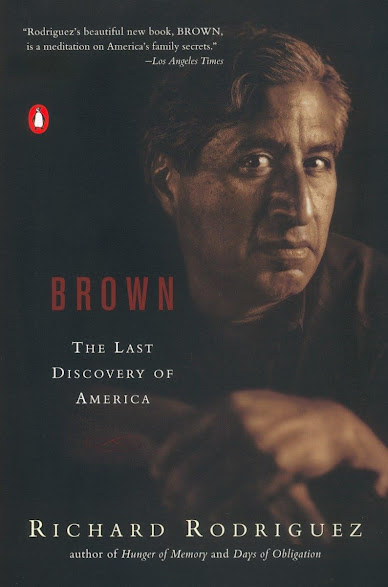
Brown: The Last Discovery of America by Richard Rodriguez


Great. Thought-provoking.

Originally Published in 2002.

Richard Rodriguez is a San Francisco-based writer who was asked to write a book about being Hispanic in America. I doubt Brown: The Last Discovery of America was the book that the publisher had in mind when they asked. Rodriguez is a true political maverick whose thesis is that America is becoming "Brown" - a mixture of Anglo, Hispanic, Black, Asian and whatever else you want to throw in. America can embrace this future (and probably will) or it can reject it and deny the reality that surrounds us all (and does it matter if you deny reality - it is still there).

I first heard of Rodriguez on C-Span. He was giving a speech at the Texas Book Fair created by Laura Bush. His speech was truly wonderful and I just had to find his book. I could go into detail on his observations, but you would much prefer if you would read it the way he put them in his book - his writing style is so fluid that he sneaks major concepts into your thoughts before you even realize that they are there.

I seriously enjoyed this book - at the risk of sounding like the back of a book cover - here are some thoughts that crossed my mind while reading it - important, poignant, personal and filled with insights.

I rate this book 5 stars out of 5 stars.

This book can be found on Amazon.com here: Brown: The Last Discovery of America.

Reviewed in 2004.

Featured Post

<b><i>BAN THIS BOOK (audiobook)</i></b> by Alan Gratz

Published in 2017 by Blackstone Audio, Inc. Read by Bahni Turpin. Duration: 5 hours, 17 minutes. Unabridged. My Synopsis Ban This Book is t...

Popular posts over the last 7 days