Showing posts with label world war II. Show all posts

WHEN BOOKS WENT to WAR: THE STORIES THAT HELPED US WIN WORLD WAR II (Audiobook) by Molly Guptill Manning


Published by Blackstone Audio in 2014.
Read by Bernadette Dunne
Duration: 6 hours, 49 minutes.
Unabridged.

When Books Went to War looks at the deliberate effort by the government of the United States to put books in the hands of its soldiers as they went off to fight in World War II. 

There were multiple reasons behind this idea. The first was simple: Reading books is a practical way to help soldiers pass the time. "Hurry up and wait" is a common refrain from soldiers of all eras and books helped fill the time.

Another reason was to remind the soldiers of what they were fighting for. Being on the front has a way of making life seem cheap and disposable, but reading a good story might help keep soldiers attached to the good things from back home. This may seem corny, but so many letters from the soldiers and sailors were written to the authors of these books that emphasized this very point.

Betty Smith, the author of A Tree Grows in Brooklyn wrote and spoke about all of the letters she got from soldiers that told them how her book reminded them of their home in any big city in America - Cleveland, Chicago, Boston, or wherever. She said she received 10 times more mail from soldiers than from civilians. 

One of the most important reasons to put books in the hands of soldiers was that being anti-book was a trait of the Nazis. They were infamous for holding massive book burnings and emptying libraries of books they disagreed with. The American program to put books in the hands of soldiers was the opposite - and it was intentionally designed to be that way. The bad guys take books away from you - the good guys want you to read and think for yourself and give you books to do just that.

Note: This philosophy contrasts strongly with the Trump Adminsitration's choice to ban nearly 400 books from the libraries of the various military academies. For example, here is an article from April of 2025 about 385 books banned from the Naval Academy. 

These books were designed to be as small and lightweight as possible. They were intended to go along with a soldier no matter where he went. The print was tiny, the margins were almost non-existent and they were usually stapled together. They could slide into a pack, a pocket, or in the nooks and crannies of any vehicle. They could bend to the counters of a pack.

Men read and re-read them. When books were handed out, men would be strategic about their choices in order to guarantee a wide variety of reading choices. Men from different units traded and some units created portable libraries in crates that went right along with the unit no matter where they went. Men were assigned to be the caretakers of the books.

Their was a lot of debate about the books they picked. They weren't policed too much when it came to content. Southerners were irritated at books that were critical of their Jim Crow laws. Steinbeck's Grapes of Wrath made the cut and it is hardly politically conservative. Some were strictly educational - books that explained science or math or philosophy. A great many were Westerns and there were a number of murder mysteries. By the time it was over, the U.S. government had printed 1,225 different titles and had given away 122 million books to its armed forces for free!

Here is a list of every book they printed.

This audiobook was interesting from beginning to end. As a book lover, it was inspiring to hear about men reading to their buddies in foxholes and men discovering that they actually liked reading. As a person that always has a book on hand, I understood completely.

I rate this audiobook 5 stars out of 5. It can be found on Amazon.com here: When Books Went to War: The Stories That Helped Us Win World War II

JAILBIRD by Kurt Vonnegut


Originally published in 1979.


Synopsis

Jailbird is the fictional story of William F. Starbuck, the least important member of the Watergate conspiracy to go to prison. 

The story begins with the day that Starbuck is released from a makeshift federal prison (and very cushy, for a prison) on a Georgia military base. He has no idea what he is going to do and he doesn't have a lot of money, but he figures that he will be okay - after all, he has a degree from Harvard and he learned how to be a bartender in a correspondence class while he was in prison.

What follows is a wild tale of good and bad coincidences that take Starbuck to a broken-down residential motel in New York City. Like the hotel, Starbuck is a broken man in many ways - he is an ex-con, his wife of many years has passed away, he never speaks to his son, and he feels shame for accidentally ruining the career of one of his friends due to an offhand comment he made during a anti-Communist Congressional hearing lead by then-Congressman Richard Nixon.

But, in just a few hours everything changes...

My Review

In many ways Jailbird is considered to be a comeback novel for Vonnegut (1922-2007). After the overwhelming success of Slaughter-House 5, Vonnegut struggled to "do it again."

He struggled to write Breakfast of Champions. His next book, Slapstick, was too personal and too weird to be a bestseller. Jailbird reminds me more of Mother Night and God Bless You, Mr. Rosewater than the three science fiction books that he published from 1969 to 1976.

World War II looms large in each of those books - the main characters are struggling to deal with what they saw and did (also a massive theme in Slaughter-House 5)

William F. Starbuck worked as a part of the prosecution team during the Nuremberg Trials. If it hadn't been for the war, he wouldn't have met his wife. The war made him, and everything about it was accidental - he met his wife on by sheer luck. He was assigned to the the trials because he happened to be around and ht happened to be around because of the education he was given by an old millionaire who was a recluse because someone unknown strikebreaker mistakenly pulled the trigger during a tense moment in a strike when the millionaire was a child.

One unrelated thing leads to another and leads to another like a thread of random events that led us to where we are now. Vonnegut spent a lot of time thinking about this idea. In his science fiction books he often explores it through time travel. This book relies heavily on flashbacks.
Vonnegut's report card for his own books.

Jailbird often looks at the plight of the regular working stiff - restaurant managers, chauffeurs, receptionists, the least important guy in the Nixon Administration, down and out authors, affable guards in a minimum security prison, and so on. There is a lengthy introduction about a real-life event in Vonnegut's life that blends into a fictional story about a strike at an Ohio factory that ended in a bloody massacre.

Vonnegut famously graded his own books in the essay collection Palm Sunday. He gave Jailbird an A. I disagree a bit. I rate it 4 stars out of 5, which I would consider to be a B.

Jailbird can be found on Amazon.com here: Jailbird by Kurt Vonnegut.

SONGS of AMERICA: PATRIOTISM, PROTEST, and the MUSIC THAT MADE a NATION (audiobook) by Jon Meacham and Tim McGraw


Published in 2019 by Random House Audio.

Read by the authors, Jon Meacham and Tim McGraw.

Duration: 7 hours, 40 minutes.

Unabridged.

It turn out that historian Jon Meacham and country music star Tim McGraw are neighbors. They decided to work together on Songs of America, a book that looks at the role of music in American politics.

They start with songs of the Revolution and work their way forward, hitting songs you've heard of such as The National Anthem (War of 1812) and The Battle Hymn of the Republic (Civil War) and songs you've most likely never heard of. 

Not every song is war related. For example, the anti-lynching song Strange Fruit by Billie Holiday. There is a nicely done section comparing two still-popular songs from the 1980s - Born in the USA by Bruce Springsteen and Proud to Be an American by Lee Greenwood. 

I particularly liked the juxtaposition of two Vietnam era songs: The Ballad of the Green Berets by Sgt Barry Sadler (1966) and Fortunate Son by Creedence Clearwater Revival (1969) show how public perception of the war changed in three short years.

Despite the book having been released during the first Trump Administration, there is literally no mention of Donald Trump in the book.

Jon Meacham provided the bulk of the material for this book. He provided the historical context and the story behind how the song came into being. In the first 1/3 of the book, McGraw had practically no input except for reading the lyrics in a completely uninspired way. In the later sections, with more contemporary songs, McGraw's input was not only more frequent, but often more insightful.

But, the book dragged at times, especially early on. I was disappointed that there were only one or two actual pieces of music in an audiobook about music. Tim McGraw knows his way around many styles of music and I assumed that he would be at least playing the tune of the older songs. Sadly, he does not.

I rate this audiobook 3 stars out of 5. It can be found on Amazon.com here: Songs of America: Patriotism, Protest, and the Music That Made a Nation.

SLAUGHTERHOUSE-FIVE: THE GRAPHIC NOVEL by Kurt Vonnegut and Ryan North.


Adapted by Ryan North.
Illustrated by Albert Monteys.

Graphic novel published in 2020 by Archaia. 
Original novel published in 1969.

This is my third review of Slaughterhouse-Five. I've reviewed the audiobook, the written novel, and now the graphic novel. 

All are different, of course. I've given 5 out of 5 stars to every version, but the graphic novel is the weakest of the three. It's a good graphic novel, but it seemed a little thin when compared to the novel. It's good for its medium.

I'm not going to review the plot of one of the most famous anti-war books of the last century - it's too well-known for that. Vonnegut can be weird, but he's always approachable. He writes in an friendly, easy to follow style, no matter if it is the audiobook, the written novel, or this graphic novel.

But, if the very idea of reading this book intimidates you, read the graphic novel. It hits the main plot points and it would certainly support you if you went ahead and read the novel at some points afterwards.

I very much enjoyed the style of the art in this graphic novel. I think Albert Monteys did an exceptionally good job of making the art clear, clean, and easy to follow. Let's face it, the story goes all over the place - the art did not need to add to the confusion. I really liked the way he drew the Tralfamadorians.

I rate this book 5 stars out of 5. It can be found on Amazon.com here: Slaughterhouse-Five: The Graphic Novel.

Note: This book has been challenged multiple times over the last 50 years for sexual content, foul language and teaching principles contrary to the Bible. Amazingly, it has stayed on "banned books" lists for more than 50 years. The graphic novel is no different. It made a banned book list in Florida and in Missouri and other places as well (Texas, Utah, and Iowa - to name a few.)

Note: This book was put on book ban lists in Tennessee in multiple counties in 2025. The article has a searchable database because the list has more than 1,100 unique titles

To its credit, the Vonnegut Museum in Indianapolis has a history of sending free copies of Slaughterhouse-Five to students at schools where the book has been banned.

CHESTER NIMITZ: A LIFE from BEGINNING to END (kindle) by Hourly History


Published in 2024 by Hourly History.

Hourly History publishes short histories biographies and histories that are designed to be read in about an hour. Most are pretty good, but this one came up as a middling biography for me.

Chester Nimitz was the Admiral of the Pacific Fleet during World War II. He was appointed to the position just 10 days after the Japanese bombing of Pearl Harbor and he led the Navy throughout. 

This biography is excellent when it comes to personal details of his early life and even details of his early career. That is great, but this book is too sparse when it comes to the controversies and strategies of World War II. He was there for all of the important decisions and events from 10 days after Pearl Harbor until the signing of Japan's formal surrender on one of his ships and this book just gives the bare facts details that anyone can find on Wikipedia. They aren't incorrect, but they don't tell any sort of compelling story.

I rate this e-book 3 stars out of 5. It can be found on Amazon.com here: Chester Nimitz: A Life from Beginning to End

MALAYAN CAMPAIGN: A HISTORY from BEGINNING to END (kindle) by Hourly History


Published by Hourly History in 2021.

Hourly History writes short histories and biographies that take the average reader about an hour to read. Sometimes they try to explain too much in a short book (such as the Mayan Civilization, for example.) But, an hour is plenty of time to explain the basics of a military campaign that lasted 2 months and 8 days.

When the Japanese Navy attacked the American naval forces at Pearl Harbor in Hawaii on December 7, 1941 it was actually part of a much larger, highly coordinated push against all Western forces in the Pacific and in East Asia. American forces were also attacked in the Philippines, for example.

This push also included the British-held Malay Peninsula and Singapore that started on December 8.

Britain had not provided much of a defense for this area, which was understandable considering the dire threat Britain itself faced from Nazi forces in Europe.

The Japanese landed with a slightly smaller force than the British had, but the British were completely surprised by the attack and the Japanese pushed hard towards Singapore and never stopped pushing. This did not allow the British to coordinate their forces and led to a quicker defeat.

British forces in this area did not have top shelf equipment, unlike the Japanese. The most surprising piece of military equipment in the campaign was something no one really expected - bicycles. The Japanese utilized bicycles to move their infantry quickly down the peninsula, despite the rugged terrain.

For a reader that is looking to fill in a few blank spots in their knowledge of World War II, this series would be a good place to start. 

I rate this e-book 4 stars out of 5. It can be found on Amazon.com here: Malayan Campaign: A History from Beginning to End.

LYNDON B. JOHNSON: A LIFE from BEGINNING to END (BIOGRAPHIES of U.S. PRESIDENTS) (kindle) by Hourly History


Published by Hourly History in March of 2024.

Hourly History publishes an extensive line of histories and biographies that are intended to be read in about an hour. With that limit, none of these are the definitive biographies, but most of them  give the average reader a good sense of who the person was and why they were important. 

Lyndon Baines Johnson (LBJ) was the 36th President of the United States. One thing I particularly like about this biography is that it tells about his formative experiences in Texas as a young man, especially his short stint as a public school teacher in a very poor area of rural Texas. Getting to know those students really gave him the desire to want to create government programs to help alleviate poverty. 

This biography is a little skewed towards Johnson's early life, but it's not particularly hard to find information about LBJ's time as President and the series offers books on the big events of his administration like the Vietnam War and the Civil Rights movement if you would like to read more.

I rate this e-book 4 stars out of 5. It can be found on Amazon.com here: Lyndon B. Johnson: A Life from Beginning to End

SLAUGHTERHOUSE-FIVE by Kurt Vonnegut

The first edition cover


Published with the alternate title "The Children's Crusade: A Duty Dance with Death."
Originally published in 1969.

Listed in Time Magazine's 100 Best Novels Since 1923.


Slaughterhouse-Five is the most famous, most celebrated, and most controversial novel of Kurt Vonnegut (1922-2007.) 

My synopsis:

The book serves as a memoir to Vonnegut's horrific experiences as a prisoner of war in World War II and as a sci-fi exploration of the concept of time travel. 

Vonnegut's very green unit was rotated to the front in December of 1944 in order to give experienced combat troops a break. The weather was bad, the terrain was bad, and the Germans had been retreating regularly. It was presumed that the Germans would be content to settle in to winter quarters, rest, refit, and pick up the fighting in 1945. 

Instead, the Germans launched a surprise offensive and what followed was the Battle of the Bulge. Lots of Americans were captured and taken back to Germany to be prisoners of war, including Kurt Vonnegut. Eventually, Vonnegut was taken to Dresden to work. The main character of this novel, Billy Pilgrim, was also captured and eventually taken to Dresden.

At Dresden, in February of 1945, Billy Pilgrim and Vonnegut were firebombed along with the rest of the city. The prisoners of war survived because they were being housed in partially underground slaughterhouse for hogs (the hogs had long ago been consumed.) They were in slaughterhouse number 5. 

Where Pilgrim and Vonnegut's stories separate is the sci-fi portion. At the beginning of the book we are told that "Billy Pilgrim has come unstuck in time." 

Pilgrim is sliding back in forth in time along his own timeline. He can do nothing to change events, he just keeps sliding back and forth. 

My review:

Vonnegut graded his own books in his book
Palm Sunday. I agree with his assessment of 
Slaughterhouse-Five.
This is the second time I've read this book. This time around I really paid attention to the non-science fiction parts of the book and looked for the connections to Vonnegut's own life. Chapter One practically screams for the reader to do so, but I did not the first time around.

This time, I could really see that Vonnegut was working through his wartime experiences through the story of Billy Pilgrim and his own story as the narrator. 

I was struck by the passage describing the condition of the American prisoners of war as their overloaded train car waited on the tracks for a turn on the tracks:

"Even though Billy's train wasn't moving, its boxcars were kept locked tight. Nobody was to get off until its final destination. To the guards who walked up and down outside, each car became a single organism which ate and drank and excreted through its ventilators. It talked or sometimes yelled through its ventilators, too. In went water and loaves of black-bread and sausage and cheese, and out came shit and piss and language.

Human beings in there were excreting into steel helmets which were passed to the people at the ventilators, who dumped them. Billy was a dumper. The human beings also passed canteens, which guards would fill with water. When food came in, the human beings were quiet and trusting and beautiful. They shared."

Vonnegut in 1965.
What struck me was that there in the middle of the most destructive war in human history, enemies were taking care of their enemies like decent people. Later in his career Vonnegut would make the same point with this comment in his book A Man Without a Country"A saint is a person who behaves decently in a shocking indecent country."

Vonnegut's trademark humor and clever new ways of saying the same old things abound in this book. Here is his commentary on a female character: "She was a dull person, but a sensational invitation to make babies. Men looked at her and wanted to fill her up with babies right away."

And there it is in a nutshell. This is Vonnegut's masterpiece. It is profoundly sad. It is funny. It is a memoir. It is sci-fi. And so it goes.

I rate this book 5 stars out of 5. It can be found on Amazon.com here: Slaughterhouse-Five by Kurt Vonnegut

Note: This book has been challenged multiple times over the last 50 years for sexual content, foul language and teaching principles contrary to the Bible. Amazingly, it has stayed on "banned books" lists for more than 50 years. At one point, it was referred to a prosecutor to see if the school was distributing pornography to students. The prosecutor said that it was "not in violation of criminal laws." See this site for more information.

Note: This book was put on book ban lists in Tennessee in multiple counties in 2025. The article has a searchable database because the list has more than 1,100 unique titles

To its credit, the Vonnegut Museum in Indianapolis has a history of sending free copies of Slaughterhouse-Five to students at schools where the book has been banned.

THEY CALLED US ENEMY (graphic novel) by George Takei, Justin Eisinger, and Steven Scott


Published in 2019 by Top Shelf Productions.
Illustrated by Harmony Becker.

Winner of the 2020 Eisner Award for Best Reality-Based Work.

Winner of the 2020 American Book Award.


George Takei is most famous for his part in the the original Star Trek series and the subsequent movies. But, over the last 20 years or so, Takei has been on a personal crusade to make sure that the Japanese Internment Camps are not forgotten. 

President Franklin D. Roosevelt issued an executive order in February of 1942 to place all of the Japanese on the west coast of the United States into camps because they could not be trusted not to help the Empire of Japan. This order applied to all Japanese, even if there was absolutely no reason to suspect them of doing anything at all to help Japan. Takei's family was included in this round up and this graphic novel is that story.

The graphic novel format is ideal for the story of a young man caught up in a situation he cannot possibly understand. Takei does a good job of going back and forth from his childhood perspective to multiple adult perspectives (Takei at various points in his life) in order to explain things better.

I rate this graphic novel 5 stars out of 5. It can be found on Amazon.com here: THEY CALLED US ENEMY (graphic novel) by George Takei, Justin Eisinger, and Steven Scott.

Note: This book has been listed on multiple book ban lists - in Tennessee (use the searchable database because the list has more than 1,100 unique titles) in 2025 and in Pennsylvania right after it was published. I suppose that people are scared of learning America's history.

THE GOLEM'S VOICE (graphic novel) by David G. Klein


Published in 2015 by
Now What Media, LLC

Synopsis:

Set in Czechoslovakia during World War II, The Golem's Voice is the story of a young Jewish mom and her two sons trying to escape relocation by the Nazis. This was in the time when the Nazis were still telling Jews that they were relocating them to alternate settlements rather than just taking them to work and death camps.

As they are being loaded onto trains, the mom gets a bad feeling and tells her boys (Yoakim and Yakov) to just run. She does not join them because they are much faster than her and she just wants them to escape and live. Her boys run under the trains and, at first, things look good. But, soon enough, Nazi soldiers are in full pursuit and Yoakim is shot providing cover for his little brother.

Yakov continues to run to the only place the knows - the Jewish ghetto neighborhood that he just came from. He hears a voice in his head calling him to the home of a long-dead rabbi named Yudah Loew. Legend has it that Loew was much more than a prolific author, philosopher and academic - he was also the creator of a golem. 

Loew was supposed to have studied so much that he worked out how to create a man in clay and bring it to life. This creature is not truly a man and could not speak for itself because only God can do that. But, it is alive and follows the orders of the one who created it. Medieval legend said that if things got bad enough for the Jews, a golem could be created to defend them.

Yakov is led by the voice to a hidden room in the house and discovers everything one would need to create a golem - and if there were ever a time that the Jewish people could used a golem to defend them, this was it...

My review:

I think this book was well done. The art is moody, as it should be when discussing the dark and dangerous days of the Holocaust. I was curious to see if the book would fall into the temptation of straying into the complete fantasy of having the golem wreak havoc on the Nazis to the point of being able to march to Berlin and take out Adolph Hitler himself (Rest assured, this does not happen.)

There is a very clever angle taken by the author. The idea of a Golem is partially explained by texts found by Yakov and his memory of children's tales. But it is also explained through the Nazi officer who is hunting Yakov. That officer takes the legends seriously even though he hates the Jewish people. He wants to use the knowledge to create Golems to create an army that the Nazis can control. There is a "debate" of sorts between this officer and a spirit (is is Loew or is it God? I think it is God.) that fills in a lot of details.

I rate this graphic novel 4 stars out of 5. It can be found on Amazon.com here: The Golem's Voice by David G. Klein.

See a good sample of the book on the publisher's site here.

MOTHER NIGHT by Kurt Vonnegut


Originally published in 1962
Mother Night is one of Kurt Vonnegut's (1922-2007) early novels (his third) and the first that is not a work of science fiction. 

The book features Howard W. Campbell, a defendant awaiting trial in Israel for war crimes in Israel. He is wanted for being a well-known voice for the Nazis on broadcasts that he made during World War II. 

Campbell freely admits that he did what they say he did, but he does have a defense - he was working as a double agent for the Americans and was passing secret messages during those broadcasts. 

The book sets itself up to be a legal thriller - will the hero of the book be saved? Can he prove what he says is true?

But, there's none of that in this book. Campbell probably would have been the voice of the Nazis in the broadcasts no matter if he was recruited as a spy or not? He is just a self-absorbed author of plays that was way more concerned about bedding his German wife than politics or any "trivial" things like a World War or the mass murder of millions of people. 

Most of the book is about the last few months of Campbell's life and how he was found hiding in plain sight in New York City where he had been living in a tiny apartment. We get to meet a cast of freaks and creeps that loathe or worship Campbell for his part in the war while Vonnegut demonstrates that patriotism, duty, and racism/race loyalty are all illusory constructs at best. 

Self-portrait by the author
The book starts out with these themes by having Campbell introduce his prison guards. One of them is too young to really remember the war, one doesn't care and one worked in a death camp - he helped lead his fellow Jews to the gas chambers by telling them it was just a de-lousing. Then, he would help loot their bodies and bury them. He did this to save his own life - but he still gets to guard a man who literally didn't do anything to hurt anyone in the war except talk.

Vonnegut revels in pointing out that life is contradictory and complicated and no one is who they act like they are.

Good quotes:

"We are what we pretend to be, so we must be careful what we pretend to be." 

"Say what you will about the sweet miracle of unquestioning faith, I consider a capacity for it terrifying and absolutely vile."


I rate this audiobook 5 stars out of 5. It can be found on Amazon.com here: MOTHER NIGHT by Kurt Vonnegut.

FIGHTER PILOT: THE WORLD WAR II CAREER of ALEX VRACIU by Roy E. Boomhower


Published in 2010 by Indiana Historical Society Press.

Alex Vraciu (1918-2015) was a World War II flying ace, ranking fourth in the U.S. Navy in World War II. He destroyed 19 Japanese planes in the air and 21 on the ground. 

This short book is very approachable and tells the story of Vraciu's childhood during the Great Depression in Northwest Indiana (now commonly known as "The Region") and his college years at DePauw University in Greencastle, Indiana. 

Vraciu took advantage of a U.S. government program that trained civilians to be pilots with the understanding that if the U.S. went to war those pilots would become military pilots. He trained in Muncie, Indiana and immediately joined the U.S. Navy after the Japanese attack on Pearl Harbor on December 7, 1941.

Vraciu had a remarkable military career over the next 23 years. Besides destroying 40 Japanese planes, he lost multiple planes, including being shot down over the Philippines and leading a group of guerrilla fighters against the Japanese, he became a test pilot, he led squadrons after they navy transitioned to jets and scored the highest in the predecessor to the Navy's "Top Gun" training program in a jet 12 years after the end of World War II. 

The book is very readable and full of interesting photographs. It would be good for a well-read student of World War II or an interested newbie. I rate it 5 stars out of 5. It can be found on Amazon.com here: FIGHTER PILOT: THE WORLD WAR II CAREER of ALEX VRACIU by Roy E. Boomhower.

THE COMPLETE MAUS (graphic novel) by Art Spiegelman


Originally published in serial form in Raw magazine from 1980-1991.
Originally published in book form in 1991 by Pantheon Books.

Winner of the Pulitzer Prize in 1992.

Years ago, the high school where I used to teach had a daily silent reading time. We were encouraged to build a classroom library and I had a great one. Two stand alone shelves (one tall, one short) and a little rug in the corner with a chair. I had a lot of books from a lot of different genres but the star books were Of Mice and Men and the two volume paperback version of Maus. Kids kept on stealing Of Mice and Men (If a kid likes it so much that he doesn't want to return it - fine by me) but so many students read Maus that the paperback binding broke and the pages fell out. It was held together with binder clips and big rubber bands. 

What I remember about that book is that every student reverently took off that ridiculous clip and the big rubber band, spread the pages out and just read. Students who "hated to read" read that book. Afterwards, they carefully put it back together again - in order - when they were done. These two books had power and painful truth. They knew it and they respected it.

I'd forgotten all about Maus, the binder clips, and the big rubber bands until I heard about a school board in Tennessee dropping this book from their curriculum due to rough language, nudity and a suicide. Funny how war, genocide and untreated PTSD from having almost all of your family and friends systematically murdered leads to a bit of cursing.

Missouri joined in as well. School districts banned the book because they think it fits the definition of "explicit sexual material." State law would punish them for exposing minors to "explicit sexual material" even though state law also mandates the teaching of the Holocaust. T
here is nudity, but it is rare and it is certainly not racy stuff.

The arrival at Auschwitz
The book is the story of the author's father during World War II. He was a recently married Jewish businessman in Poland before World War II. He had a young son. Their community is forced to move, go into urban ghettos and eventually into the death camp at
Auschwitz. Some hide, some run but they almost all end up in the camps. Most of his father's family and friends die, including his little boy - the older brother that the author never knew.

Spiegelman illustrates his father's story as a series of flashbacks. You can see that his father is miserable and his mother killed herself years earlier. 

There are no "people" in the book. The Jews are mice, the Nazis are cats, the Poles are pigs, the French are frogs and the Americans are dogs. I like the last bit since Hitler regularly referred to Americans as a mongrel people.

This is a powerful book - it is also a tough book. The war still reverberates through our world. We can recognize it and educate our children or we can ignore it.

I rate this graphic novel 5 stars out of 5. It can be found on Amazon.com here: THE COMPLETE MAUS (graphic novel) by Art Spiegelman.

ANNE FRANK'S DIARY: THE GRAPHIC ADAPTATION (graphic novel) by Anne Frank (author), Ari Folman, and David Polonsky (illustrator)


Originally published as a book in 1947.
Graphic novel e-book edition published in 2018 by Pantheon.
Adapted into a graphic novel by Ari Folman.

The Diary of Anne Frank is certainly one of the most famous pieces of literature published in the last 100 years. The book the true diary of a young teen Jewish girl that was written as her family lived in a hidden apartment with two other families in an attempt to hide from the Nazi genocide. Before the war ended someone betrayed the families and Anne and almost everyone else in the apartment died in concentration camps shortly before the Nazi surrender.

A page where Anne compares herself
unfavorably to her sister.
Ari Folman adapted the diary into a graphic novel. In the afterword he notes that this was harder than one might expect. This graphic novel is 160 pages, but if he had simply illustrated the entire text of the diary it would have ended up being more than 3,000 pages! The challenge was to maintain the spirit of the print book while editing it down.

I think the book is beautifully illustrated. The moods, emotions, and simple displays of teen attitude come through loud and clear - and make her come to life.

The graphic novel is excellent, which is why it is too bad that it is on a lot of banned book lists. In Florida, Moms for Liberty asked for the book to be banned because of two scenes described like this by Katie Couric in an article: 
it features two “sexually explicit” scenes. In the first, Frank walks along a series of nude statues, and in another, she asks a friend if they want to show each other their breasts." The Moms argue that the book does not accurately teach about the Holocaust because of these pages - as if Nazi hatred were only aimed at Jews.

Anne Frank's diary has always been edited to make the story flow better, but it also was edited to take out some embarrassing details about the family. Those edits included Anne Frank's passing thoughts about possibly being interested in women as well as men. In the 1950s this might have been a deal breaker with potential publishers so it was left out. This is ironic considering that gays and lesbians were sent to the camps by the Nazis with just as much enthusiasm as Jews - but, that was the politics of the day.

It turns out that it also the politics of now. A teacher in Texas was fired because those pages were read aloud in her class. 

It must be noted that even if Anne Frank were not Jewish, she would have been sent to the camps for being bisexual.

I rate this graphic novel 5 stars out of 5. It can be found on Amazon.com here: 
ANNE FRANK'S DIARY: THE GRAPHIC ADAPTATION (graphic novel) by Anne Frank (author), Ari Folman, and David Polonsky (illustrator).

BOMBS AWAY (audiobook) by John Steinbeck


Originally published in 1942.
Published in 2016 by Penguin Audio.
Read by Scott Aiello.
Duration: 4 hours, 36 minutes.
Unabridged.


1942 was a rough year for America in World War II, especially in the early months. The Pacific Fleet was devastated and American troops were barely involved in the European Theater.

As part of a total war effort, every resource had to be tapped, including pulling in famous authors like John Steinbeck to write books that assured the American public that the Army Air Corps/Air Force (he uses both terms interchangeably) had a plan, was implementing the plan, and it was going to be a successful plan. 

Steinbeck was a bold choice to write what is basically a piece of American propaganda. His novels Of Mice and Men and Grapes of Wrath caused quite an uproar just a few years earlier with their criticism of the American capitalism. I think the reasoning was that if Steinbeck approves of what the Army Air Corps/Air Force was doing, it must be okay.

A B-17 (left) and a B-24 (right)
Steinbeck starts with an overview of the history of airplanes in the U.S. military. Then, he looks at 2 kinds of bombers - the B-17 and the B-24 and discusses the jobs of the men that flew those planes. Finally, he looks at a pretend recruit class and follows a crew through their individual training. Finally, he puts them all together in a plane and the reader gets to see them finish their training. The book ends with the crew on the runway. The crew opens their orders to an undisclosed location, the navigator lays in a course and they fly off to join the fighting.

Generally speaking, this book does not feel like a Steinbeck book. It spends a lot of time talking about the unique characteristics of America and Americans that will help them win the war. It has an element of truth, of course, but it also is very, very obvious.

The book does have the Steinbeck characteristic of being about regular people. There are few high level officers in the book and they have few lines. There are no big shots - no quotes from FDR, not sweeping pronouncements from MacArthur. Just young men from regular, almost boring, places being trained to go off and do extraordinary things.

I cannot say that this was a good book. It's too obvious and doesn't really have a plot. But, it is an outstanding record of how America trained its bomber crews in a palatable form. 

I rate this audibook 3 stars out of 5. It can be found on Amazon.com here: Bomb's Away by John Steinbeck.

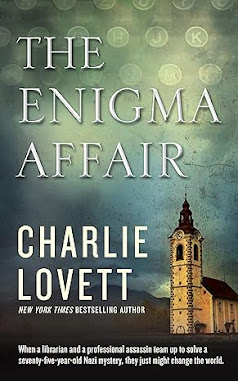
THE ENIGMA AFFAIR: A NOVEL (audiobook) by Charlie Lovett


Read by Nicole Zanzerella.
Duration: 12 hours, 6 minutes.
Unabridged.


Synopsis:

An Enigma Machine from World
War II.
Patton Harcourt is a very small town librarian in North Carolina. One morning, while cooking in the kitchen, a sniper round comes through her window and nearly hits her. She reacts well (thanks to her previous career in the military) and finds a stranger at her door. 

He is not the sniper, but he is an assassin that was hired to kill another person in town. Against her better judgment, she joins with the assassin to elude the sniper team.

All of that happens in the first 10 minutes or so of this audiobook.

From there, they discover a handmade copy of World War II Enigma machine (the British machine that broke the German secret codes) and are off to confront modern-day Neo-Nazis...

My Review:

This book was certainly action-packed, extremely fast-paced ,and had some good moments. But, it also had some practical issues that just didn't jive with reality. For example, one of the main plot points is that they cannot access the internet because they will be detected and tracked down. This completely ignores the existence of proxy servers. A professional assassin should have been familiar with this technology as a way to hide his location when communicating with clients.

Later, the characters are speaking German and passing off as native speakers (this is a vitally important point more than once). Granted, it is not complicated German, but very few untrained people can pass themselves off as native speakers in a second language. I've been speaking Spanish as a second language for years and I would never be confused for a native speaker.

This is not a bad book. The quick pace was fun, the bad guys are truly bad, and the flashbacks to World War II were well-done. But, the end result was 3 stars out of 5.

This book can be found on Amazon.com here: THE ENIGMA AFFAIR: A NOVEL by Charlie Lovett.

IF THIS ISN'T NICE, WHAT IS? (EVEN MORE) EXPANDED THIRD EDITION: THE GRADUATION SPEECHES and OTHER WORDS to LIVE BY by Kurt Vonnegut


Published in 2020 by Seven Stories Press.
Edited by Dan Wakefield.
Introduction by Dan Wakefield.


Many of the well-known quotes from Kurt Vonnegut (1922-2007) were not actually in his novels - they came from speeches he gave (mostly) in the latter half of his career. Vonnegut became quite a popular deliverer of graduation speeches. And why not? He was witty, irreverent and sometimes came up with a great quote like this one: "Another flaw in the human character is that everybody wants to build and nobody want to maintain it." (p. 230)

The title of this book comes from a story that Vonnegut has included in other essays. Vonnegut had two uncles who responded very differently to his World War II experiences. His Uncle Dan congratulated Vonnegut for having gone to war as a boy and come back as a man. 

His Uncle Alex was a different sort of man. The kind of man who encouraged everyone to notice the good things of life as they happen around us. "...when life was most agreeable - and it could be just a pitcher of lemonade in the shade - he would say, 'If this isn't nice, what is?'" He goes on to note, "If he hadn't said that so regularly, maybe five or six times a month we might not have paused to notice how rewarding life can be sometimes." (p. 135)

An illustration from the book
and the inspiration for the cover.
The book has several of Vonnegut's unique illustrations with their own distinctive Vonnegut style. The book is printed with multiple colors and is literally one of the most attractive looking paperback books I have held in my hands. 

The quality of speeches is all over the place. If you read a lot of Vonnegut, you are used to him rambling along in a seemingly pointless way with any number of weird observations and then he suddenly he drops a profound thought. Some of these are very much that way. Some are strong throughout and some are kind of weak. Having said that, this collection could serve as a fine introduction to a reader who is starting to read Vonnegut's essays. 

I rate this collection 4 stars out of 5. It can be found on Amazon.com here: IF THIS ISN'T NICE, WHAT IS? (EVEN MORE) EXPANDED THIRD EDITION: THE GRADUATION SPEECHES and OTHER WORDS to LIVE BY by Kurt Vonnegut.
 

STRENGTH for the FIGHT: THE LIFE and FAITH of JACKIE ROBINSON (Library of Religious Biography) (audiobook) by Gary Scott Smith


Jackie Robinson. 

He is an icon of sports. And politics. And American history.

All fans of baseball know at least the broad strokes of the story of Jackie Robinson (1919-1972) and how he integrated baseball. This book offers a detailed re-telling of that story with a twist - a look at how Jackie Robinson's faith led him to this path and helped sustain him.

Robinson's early life, his time in service during World War II and his college sports career and his relationship with his wife are all covered. The biggest single part of the book is, appropriately, the story of how he and Branch Rickey (the head of the Brooklyn Dodgers) worked together to integrate Major League Baseball in 1947. The book also looks at how Rickey's faith led him to act to make the world a more just place by acting in such a symbolic manner.


Jackie Robinson stealing home.
I am not going to go through all of the details of Robinson's life - that's what the book is for. This book covers it all pretty thoroughly right up until his death in 1972. Sometimes, it was a little slow and repetitive about how Robinson demonstrated his faith. On the whole, though, it was a good listen.

The audiobook was read by Shamaan Casey. He had a perfect voice deep solemn voice for narrating this book. The only complaint I had was that he mispronounced several people's names, including singer/civil rights activist Harry Belafonte and baseball players Orel Hershiser and Derek Jeter. I don't look at this as necessarily the fault of the reader - if you don't know the name, you don't know the name. In my mind, the producer or director of the audiobook should have caught and corrected the mistakes. 

I rate this audiobook 4 stars out of 5. It can be found on Amazon.com here: STRENGTH for the FIGHT: THE LIFE and FAITH of JACKIE ROBINSON (Library of Religious Biography) (audiobook) by Gary Scott Smith.

Featured Post

<b><i>BAN THIS BOOK (audiobook)</i></b> by Alan Gratz

Published in 2017 by Blackstone Audio, Inc. Read by Bahni Turpin. Duration: 5 hours, 17 minutes. Unabridged. My Synopsis Ban This Book is t...

Popular posts over the last 7 days