Showing posts with label Vietnam. Show all posts

SONGS of AMERICA: PATRIOTISM, PROTEST, and the MUSIC THAT MADE a NATION (audiobook) by Jon Meacham and Tim McGraw


Published in 2019 by Random House Audio.

Read by the authors, Jon Meacham and Tim McGraw.

Duration: 7 hours, 40 minutes.

Unabridged.

It turn out that historian Jon Meacham and country music star Tim McGraw are neighbors. They decided to work together on Songs of America, a book that looks at the role of music in American politics.

They start with songs of the Revolution and work their way forward, hitting songs you've heard of such as The National Anthem (War of 1812) and The Battle Hymn of the Republic (Civil War) and songs you've most likely never heard of. 

Not every song is war related. For example, the anti-lynching song Strange Fruit by Billie Holiday. There is a nicely done section comparing two still-popular songs from the 1980s - Born in the USA by Bruce Springsteen and Proud to Be an American by Lee Greenwood. 

I particularly liked the juxtaposition of two Vietnam era songs: The Ballad of the Green Berets by Sgt Barry Sadler (1966) and Fortunate Son by Creedence Clearwater Revival (1969) show how public perception of the war changed in three short years.

Despite the book having been released during the first Trump Administration, there is literally no mention of Donald Trump in the book.

Jon Meacham provided the bulk of the material for this book. He provided the historical context and the story behind how the song came into being. In the first 1/3 of the book, McGraw had practically no input except for reading the lyrics in a completely uninspired way. In the later sections, with more contemporary songs, McGraw's input was not only more frequent, but often more insightful.

But, the book dragged at times, especially early on. I was disappointed that there were only one or two actual pieces of music in an audiobook about music. Tim McGraw knows his way around many styles of music and I assumed that he would be at least playing the tune of the older songs. Sadly, he does not.

I rate this audiobook 3 stars out of 5. It can be found on Amazon.com here: Songs of America: Patriotism, Protest, and the Music That Made a Nation.

IN the PRESENCE of MINE ENEMIES: SEVEN YEARS as a POW in NORTH VIETNAM by Howard and Phyllis Rutledge


Originally published in 1973.

Published in 1977 by Commission Press
.

Co-written with Mel and Lyla White

In the Presence of Mine Enemies is, in reality, two kinds of books. It is a biography of Captain Howard Rutledge's (1928-1984) time in the prisoner of war camp nicknamed Hanoi Hilton by its prisoners in North Vietnam from 1965-1973. It is also a faith tract.

The book gets right to the point - Rutledge is shot down in the fifth paragraph and captured by the sixth page. The book rarely gets bogged down in technical details and is very approachable by any reader. More on this in a moment.

The descriptions of his captivity, such as the food, how the prisoners managed to communicate with one another, how they mapped out the prison despite no one ever managing to see all of it, the physical torture, the difficulty of solitary confinement, and the joy of finally being able to be with another prisoner are all told in sufficient - but not grotesque - detail.

If you are looking for any discussion of the war and whether or not it was a worthy effort - there is none. 

An addendum to Howard Rutledge's story is the tale of his wife, Phyllis. The Rutledges had four children and it was suddenly her duty to be the only parent for all of them. As she said on page 124, "It's hard to be the head of a household with no real preparation."

I noted in the first paragraph that this book is actually two kinds of books. It is also a religious tract designed to show the reader how Christians can dig deep into their faith to go through difficult times. I wasn't bothered by this aspect of the book - it was actually interesting,  but I didn't read it for this testimony. This is still, primarily, a recounting of the way the Hanoi Hilton worked and the conditions in the prison.

This book has a rather convoluted publishing history and slightly different titles due to its extensive use as a faith tract. My copy has a little reminder of the way books used to be sold in the pre-Amazon days. There are 4 pages of ads for joining book clubs or ordering books from an order form that you cut out of the book. That's the way it used to be done in the pre-internet days, boys and girls.

I rate this book 4 stars out of 5. It can be found on Amazon.com here: In the Presence of Mine Enemies: Seven Years as a POW in North Vietnam.

LYNDON B. JOHNSON: A LIFE from BEGINNING to END (BIOGRAPHIES of U.S. PRESIDENTS) (kindle) by Hourly History


Published by Hourly History in March of 2024.

Hourly History publishes an extensive line of histories and biographies that are intended to be read in about an hour. With that limit, none of these are the definitive biographies, but most of them  give the average reader a good sense of who the person was and why they were important. 

Lyndon Baines Johnson (LBJ) was the 36th President of the United States. One thing I particularly like about this biography is that it tells about his formative experiences in Texas as a young man, especially his short stint as a public school teacher in a very poor area of rural Texas. Getting to know those students really gave him the desire to want to create government programs to help alleviate poverty. 

This biography is a little skewed towards Johnson's early life, but it's not particularly hard to find information about LBJ's time as President and the series offers books on the big events of his administration like the Vietnam War and the Civil Rights movement if you would like to read more.

I rate this e-book 4 stars out of 5. It can be found on Amazon.com here: Lyndon B. Johnson: A Life from Beginning to End

RUN: BOOK ONE (graphic novel) by John Lewis and Andrew Aydin


Illustrated by L. Fury and Nate Powell.
Published by Harry N. Abrams in 2021.


This spring I read the MARCH, the three volume graphic novel series about Congressman John Lewis (1940-2020) and the Civil Rights movement. When I finished the series, I thought to myself that it would be interesting to see how John Lewis ran for Congress and the struggles he encountered in an era where the KKK still openly marched.

My Synopsis:

The graphic novel RUN picks up right where MARCH trilogy left off. At the end of the MARCH trilogy, there was a celebration of the passage of the Civil Rights bills - a moment of success. There was also the murder of a volunteer who was helping with the celebration by anti-Civil Rights forces.

RUN explores what happened after the Student Non-Violent Coordinating Committee (SNCC) had it first taste of success. 
At the end of MARCH, there was a celebration of the passage of the Civil Rights bills. With that, a long-term goal achieved there was a lot of discussion about where to go next. there were a lot of things to consider, including the beginnings of the Vietnam War.

The discussions soon became arguments and those arguments led people to leave the SNCC and for the movement to fragment. Some pushed for more of the same strategies due to a belief in the power of non-violence and for the simple reason that they had been effective up to this point. 

Others, led by Stokely Carmichael, wanted to pursue separatist strategies. Eventually, this leads John Lewis to leave the SNCC and run for political office.

My Review:

As I look over what I wrote in my synopsis of the book, it sounds boring. It really was not. You normally don't hear much about the Civil Rights movement after the passage of the Voting Rights Act and the Civil Rights Act in 1964 and 1965, so I found it interesting.

Sadly, Lewis died before this book was finished and I doubt there will be more in this series. 

I rate this graphic novel 5 stars out of 5. It can be found on Amazon.com here: RUN by John Lewis and Andrew Aydin.

THE FREE FALL of WEBSTER CUMMINGS (audiobook) by Tom Bodett


Originally published in 1995 by Brilliance Audio.
Read by the author, Tom Bodett.
Duration: 15 hours, 43 minutes.
Unabridged.


The author and narrator.
I think Tom Bodett's End of the Road series of short stories is just one of the best audiobook experiences out there. Technically, this book is part of that series even though almost none of it takes places in that oddball community of End of the Road, Alaska (it earned its name by being, well, the place where the road ends.)

Bodett is well-known as a frequent panelist on the NPR show Wait Wait...Don't Tell Me! but he is most well-known for his voiceovers for Motel 6 in which he promised in his folksy way, "We'll leave the light on for you."

I say all of this just to say that this book was a major disappointment. 

Everything about this book seems like it should work. It has a grounding in his Alaska stories. It consists of a series of short stories - his area of expertise.

But, there is just way too much going on in this book. There are way too many plotlines going on and Bodett tries to weave them together so they all tie up in a couple of nice little knots at the end and he just doesn't get it done.

There are two plotlines from Alaska, two plotlines from Seattle (one is mysteriously dropped about 1/3 into the book), a cross country plotline from New York City and Los Angeles, a family from Ohio that heads west in stages to find themselves (one finds that Indiana may be far enough west), supernatural forces, PTSD, memory loss, mysticism and a man named Webster Cummings who fell more than a mile from a commercial jet plane over New England and survived. Webster near death experience inspired him to find his biological parents. 

Just too much and I just ended up wanting it to end.

I rate this audiobook 2 stars out of 5. It can be found on Amazon.com here: THE FREE FALL of WEBSTER CUMMINGS (audiobook) by Tom Bodett.
.

FOR the COMMON DEFENSE: A MILITARY HISTORY of the UNITED STATES of AMERICA by Allan R. Millett and Peter Maslowski


Originally published in 1984 by The Free Press.

Note: This is a review of the original version of this book, published in 1984 and ending with the first Reagan administration. It has been expanded and updated to include events up to 2012.

Way back in my undergrad days at Indiana University I took a class called American Military History. It was taught by a visiting professor from West Point and FOR the COMMON DEFENSE: A MILITARY HISTORY of the UNITED STATES of AMERICA was an excellent choice for the text for the class.

For 30+ years I have carried this book around with me - through 5 different moves and who knows how many book shelves this book was the anchor of my history section because it is quite beefy. But, I decided it was time to clear out some books. Technically, this book was a re-read but I didn't really remember anything from all of those years ago so...

The book starts with colonial defense and moves along with the same format up through the early 1980's. There is a chapter about a war or conflict followed by a chapter on the interwar years followed by a chapter on the next war or conflict. 
Soldiers in the Korean War in 1950.
Each chapter is about 30 pages with a bibliography, with the exception of World War II and the Civil War - they are each covered by two chapters. 

Generally speaking, the war chapters are more interesting than the interwar chapters. The interwar chapters can get bogged down in detailed discussion of the upper level command structure of the military (Joint Chiefs of Staff, the role of the Secretary of War/Defense, etc.) , but I found the interwar chapter that covered Reconstruction and the Gilded Age to be one of the best in the book. 


It is striking to read how American defense policy changed radically after World War II and the book provides little discussion of those changes, it just notes that they happened.

I rate this book 4 stars out of 5. It can be found on Amazon.com here: FOR the COMMON DEFENSE: A MILITARY HISTORY of the UNITED STATES of AMERICA by Allan R. Millett and Peter Maslowski.

TRIPWIRE (Jack Reacher #3) by Lee Child


First published in 1999.

Tripwire is the third book in publishing order in the Jack Reacher series (the sixth in chronological order - as of right now).

Jack Reacher starts out in the Florida Keys. He is digging swimming pools by hand during the day, working as a bouncer in a strip club at night and drinking lots of bottled water. It is mindless work, but he is getting enjoying that aspect of it. Then, a man from New York City comes to the bar where he is drinking a bottled water and asks if anyone knows Jack Reacher.

Reacher lies and says he never heard of the guy.

Composition with Red Blue and Yellow 
by Piet Mondrian. Reacher's favorite piece of art,
according to this novel.


Two more guys from New York City find Reacher at the strip club. They are different than the first guy - pushier and rougher.  Reacher has to get physical with them. When he finds the first guy dead on the street, he decides to head off to New York City to see if he can figure out who is looking for him.

What he finds, surprises him and takes him back in time in more than one way...

This is an early Reacher novel and it doesn't have the normal rhythms that you find later on (as of today there are 24 books and 18 short stories in the series). It's a good action novel, but it feels a little different than the rest of the series.

I rate this book 4 stars out of 5. This book can be found on Amazon.com here: Tripwire by Lee Child

LEADERSHIP: IN TURBULENT TIMES (audiobook) by Doris Kearns Goodwin


Published in 2018 by Simon and Schuster Audio

Read by Beau Bridges. David Morse, Richard Thomas, Jay O. Sanders and the author.

Duration: 18 hours, 5 minutes.

Unabridged.


Doris Kearns Goodwin often is labeled with the title "presidential historian" and, really, that is a pretty accurate term for her. As a young historian, she worked personally with Lyndon Johnson on his presidential memoirs. She has written about both Theodore Roosevelt and Franklin Delano Roosevelt. Her book Team of Rivals is a modern classic and has redefined the popular image of the Lincoln administration.

In Leadership: In Turbulent Times, she looks at various qualities of leadership that each of these very different men exhibited. She begins with interesting pre-presidential biographies of each of these men. She focuses on Lincoln's expressed desire to become a person that was worthy of the esteem of his community. Theodore Roosevelt's ceaseless energy and desire to experience new things led him to meet all sorts of people and learn about their concerns. FDR's efforts to recover from polio were above and beyond. Also, she focuses on his habit of hiding his own problems from the people around him. LBJ's relentless push to put connect himself to people in power is interesting - a road map to power, if you will. But, it is not particularly inspiring (that comes later on for LBJ).

The author, Doris Kearns Goodwin
If the book were just those early biographies, it would be an impressive book. But, it goes on to look at an individual theme (in the case of Theodore Roosevelt, a single crisis) that developed in each man's presidency.

With Lincoln, the theme is the end of slavery. With Theodore Roosevelt, the crisis is a national coal strike (May - October 1902) that threatened to literally freeze millions of people. With FDR, the crisis is the Great Depression and his willingness to try and discard and try again in order to alleviate the suffering. For LBJ, the focus is on his push to pass Civil Rights legislation in wake of President Kennedy's assassination and the political cost he suffered in doing so. She also comments on the Vietnam War being the tragic result of his singular focus on domestic policy.

She identifies individual leadership lessons as she goes along. I have no idea how many there are because I listened to it as an audiobook and was not able to write them down as I went along.

Speaking of the audiobook version, this audiobook is read by five different readers. The author reads the opening and closing. The sections on the Presidents are each read by a different award-winning actor. Beau Bridges was absolutely excellent as the reader for the LBJ section. I wish he'd read more audiobooks.

I rate this audiobook 5 stars out of 5. It can be found on Amazon.com here: LEADERSHIP: IN TURBULENT TIMES by Doris Kearns Goodwin.

A PEOPLE'S HISTORY of the UNITED STATES by Howard Zinn

Originally published in 1980 by HarperCollins. 
Multiple updated editions have been printed.

Howard Zinn's (1922-2010) A People's History of the United States is perhaps the most famous and most controversial history book in publication today. 

I read this book because the former governor of my home state of Indiana and current President of Purdue University, Mitch Daniels, repeatedly criticized it and actually advocated blocking its use in public schools in Indiana, including Indiana University. Governor Daniels used to be a frequent guest on a local newstalk radio station in Indianapolis and this book came up enough times in the conversations that I became aware of it. Before that I had never heard of it - but he certainly put it on my radar. That's not really what he had intended, I am sure.

I found my copy of A People's History of the United States in a local thrift shop on a half price day, which made this book a true bargain at $1. I decided that, as a good and loyal American I absolutely had to read the book that my state government's former chief executive had decided was "truly execrable" and tried to remove from Indiana University classrooms and see for myself if he was right.

Zinn has a theme that he hits consistently throughout his book and it is that the "haves" are continually using and abusing the "have-nots" throughout American history although, sometimes, the "haves" give in a bit and let some of the "have-nots" get a little more because it ensures their survival at the top. He argues that this was the case during the American Revolution. He would have been a big promoter of the idea of the 1% vs. the 99% that has come into vogue lately.

He also argues that the elites stoke class envy and racial animosities to create internal rivalries among the lower classes so that they fight among themselves and fail to see who their true enemy is. Throughout the entire book, the details change but this is the basic story.

As a history book, this book succeeds fabulously at hitting that one note over and over and over and over ad nauseam. Is he right? Sure - to a point he is right throughout the book. For example, he is right that the founders envisioned limited participation from the common man in the early American republic. But, other arguments sound hollow. 


For example, on page 37 of my 1990 edition he argues that racial animosities were practically created by the elites as a way to control the slaves. It is a clever argument and it is the culmination of a long argument that he had been making in the previous pages concerning the presence of anti-miscegenation laws in the new world. His presumption that, if left to themselves, the lower classes would have not had any racial issues because the passing of these laws shows that the elites were bothered by interracial romance and conspired to stop it before the lower class united and overthrew them. This sounds too organized for my tastes. Also, I have less faith in human nature than Zinn does - the same base thoughts that he despises in the upper class exist across all of the classes.

Strengths:

-The discussion of Andrew Jackson and Indian Removal.


-The discussion of the labor movement during the Gilded Age/Robber Baron era was particularly well-written and flowed well.

-He covers the governmental overreach during World War I well.

Weaknesses:


-He wrote this book as an antidote to the "hero" version of history - the version that teaches about George Washington's battlefield exploits but overlooks the fact that he held slaves. Sadly, in his zeal to set the record straight, he often overlooks the good (or even great) points about heroes that he is out to debunk. 


-The Andrew Jackson section says literally nothing about Jackson's strongest political fight - his fight against the National Bank. I would have appreciated a look at how the defeat of this bank and the subsequent "panic" (economic recession/depression) affected regular Americans.

-Sadly, he often ignores the "people" and creates a new set of heroes to replace the ones he has debunked. But, he does little to debunk his new heroes so the reader is left with, essentially, the same problem. Also, this does not make it a true "people's" history since people like Frederick Douglass and Emma Goldman are so extraordinary that they are, by definition, not stand-ins for the "everyman".

-The sections on the Vietnam War and the 1970's suffer from just being written too close to when the book was originally printed (1980). I think he was so close to the events that he had a hard time determining what was truly important and what was trivia. This made the book bog down with things like his stories of community newspapers printed on ditto machines as a sign that media was changing. When compared to the tsunami of change that the internet brought to media just a few years later, these little stories are quaint and irrelevant. 

-During the Cold War sections, he never addresses what the other side in this Cold War was doing and at least acknowledging that America and its allies had reasons to be wary of the USSR and its allies.

************

As I stated above, Zinn hits one note throughout the book. This note does appear in most mainstream history books, but not in great quantity. So, the book has value in that it does bring that part of American to the forefront. But, since it does not waver from its obsessive focus, it becomes a tool of limited value. To quote Abraham Maslow: 
  "I suppose it is tempting, if the only tool you have is a hammer, to treat everything as if it were a nail."

Now, to go back to the beginning of my review - would I outlaw this book from being used in a classroom? No, of course not. But, I do not think it should be the only text used in a class. Individual chapters are sold as smaller books and I think that would be appropriate. If it were a year-long class I might have students read the whole thing so long as they were reading lots of other works.

I don't see what the big fuss is on either side, to be honest.

I rate this book 3 stars out of 5.

This book can be found on Amazon.com here: 
A People's History of the United States.

NOTE:
Mitch Daniels, the Indiana governor that wanted to literally outlaw the use of this book in any school in Indiana, was appointed President of Purdue University when his term as governor ended by the Purdue Board of Trustees. He appointed most of those members and is widely considered to have appointed himself through that board. In my opinion, this attempt to stifle academic freedom should have made him ineligible to hold any position at a university, let alone be president of one.

WHAT WOULD SHE DO? 25 TRUE STORIES of TRAILBLAZING REBEL WOMEN by Kay Woodward


Published by Scholastic in 2018

What Would She Do? is collection of very readable short biographies of women - which, after being factually correct, is the most important thing. As David McCullough said, "No harm's done to history by making it something someone would want to read." 

Woodward writes in an informal, approachable style that I enjoyed quite a bit. Each biography is accompanied by a full page illustration of the woman and a little chart with basic biographical information. There is also a large pullout quote from or about her. For example, for Emma Watson there is this quote: "The saddest thing for a girl to do is to dumb herself down for a guy."


Generally, I did not like the "What Would _____ Do?" section that was included at the end of each biography. The author was clearly trying to make a connection between the women in the book and the typical American student with typical American student problems. But, trying to connect Cleopatra to a student who is being laughed at for their fashion choices or Rosa Parks to a girl being left out of group texts was just too far of a stretch for me.

Otherwise, though, this is a strong book. I am gladly handing it over to my 6th grade daughter to read and then we are going to pass it on to her teacher for her classroom library.

The publisher recommends this book for ages 8-12. I would say ages 10-15.


I rate this book 4 stars out of 5.

This book can be purchased on Amazon.com here: WHAT WOULD SHE DO? 25 TRUE STORIES of TRAILBLAZING REBEL WOMEN by Kay Woodward.


Note: I received a free review copy of this book as part of the Amazon Vine program in exchange for an honest review.

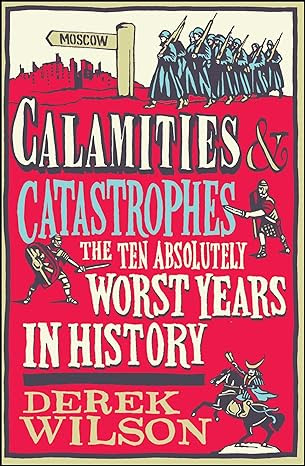
CALAMITIES and CATASTROPHES: THE TEN ABSOLUTELY WORST YEARS in HISTORY by Derek Wilson


Published in 2015 by Marble Arch Press

Going into this book, I knew that I would have a bone to pick with almost every one of the author's choices. After all, there are 5,000 years of recorded history and every last one of them is filled with tragedy. How can you pick and choose the actual worst 10 years?

Wilson, a British historian, focuses in this book on a Western point of view and the earliest date is 541 A.D. So, if you are making a pitch for the 10 worst years in the West in the last 1500 years, his choices are pretty solid.

The years he picks are:

541-542: The first outbreak of the Bubonic Plague weakens the nascent Byzantine Empire and the Persian Empire, killing millions.


1241-1242: The Mongols invade Eastern Europe.

1572: The Spanish Inquisition and everything that came with it.

1631-1632: The worst year of the Thirty Years War.

1709: The Great Freeze

1848: The "Year of Revolutions" in Europe

1865-1866: The assassination of Abraham Lincoln and the failure of the United States to follow through properly with Reconstruction after the Civil War. Also, the rise of terror groups like the KKK.

1942-1943: He almost exclusively focuses on the Russian front - the bloodbaths around Leningrad, Moscow and Stalingrad.


Robert F. Kennedy, Sr. (1925-1968)
1968: The Vietnam War, the assassinations of Martin Luther King and Robert Kennedy, protests around the world.

1994: The Rwandan genocide. There is a lot of focus on how and why the Western powers just watched it happen.

Sometimes, Wilson has a nice turn of phrase in his writing. I especially liked this line from page 151: "Over the centuries, whatever game Europe's nations played, the weakest hand always seemed to be dealt to Poland."

But, there were lots of typos, a weird use of texting-style writing on page 122 and several errors with commas that made me have to re-read passages just to figure out if what Wilson had written was what he really meant to say. Other times, there are factual errors (that may have been editing errors - as I just noted, editing was a real issue in this book). The most egregious error was actually a double error in the same paragraph on page 227. Wilson notes:

 "By the end of 1967 the war had cost the lives of almost 16,000 combat troops and was gobbling up more than $2-3 million per month. What made matters worse was that America's youth had no way of avoiding military service because conscription (the 'draft') still existed."

First: a quick internet search says the Department of Defense spend $168 billion between 1965 and 1972 on military operations in Vietnam. I am sure he meant to say $2-3 billion, not million.

Secondly, there were ways to avoid the draft. Let's look at three recent American presidents. Bill Clinton chose the most popular way to avoid the draft - he went to college. It was no guarantee, but it was a good bet. Many universities grew during the Vietnam War due to increased demand. George W. Bush joined the Air National Guard. Also, it was no guarantee not be sent to Vietnam, but it was not likely. Donald Trump claimed disability (bone spurs in his feet).

I rate this book 3 stars out of 5. The limited focus on the West while claiming to be about all of history was a disappointment. The atrocious editing was also a concern.

This book can be found on Amazon.com here: CALAMITIES and CATASTROPHES: THE TEN ABSOLUTELY WORST YEARS in HISTORY by Derek Wilson.

SOLDIER! DISCOVER 15 WARRIORS THROUGHOUT HISTORY by Paul Beck


Published in 2015 by Scholastic 

Paul Beck's SOLDIER! looks at 15 examples of soldiers throughout history, starting with Imperial Roman infantry and ending with a U.S. Navy Seal. It is composed of 48 8.5 x 11 inch pages and includes a full-color tear-out poster of every soldier. 

Most descriptions are 4 pages, including a map where the soldiers would have operated. It also includes a full page drawing of the soldier with notes about the weight and length of their weapon(s). The third and fourth pages include more information about optional weapons, training or tools. 

The only complaint I have about the book is that it could have included a little more diversity. 12 of the 15 soldiers came from Europe or America. For example, the Aztec warriors that confronted Cortes had unique weapons and armor and would have been a great addition. 

That being said, the book was well-done. The pictures were interesting as were the factoids. This would be a good book for students from 4th to 8th grade.

This book can be found on Amazon.com here: SOLDIER! DISCOVER 15 WARRIORS THROUGHOUT HISTORY by Paul Beck.

THREE CENTS a MILE (audibook) by Mark Mooney


Published in October of 2016 by Mark Mooney
Read by the author, Mark Mooney
Duration: 5 hours, 57 minutes
Unabridged

CNN Money editor Mark Mooney's Three Cents a Mile tells the story of his 2 year trek across the world as a vagabond traveler more than 35 years ago. He left New York City and headed east, visiting Ireland, England, France, North Africa, Greece, Turkey, Iran, Pakistan, India, Thailand and even more destinations with nothing more than a few dollars in his pocket and a typewriter and a notebook to compose travelogue articles that he sold to newspapers back in America.

Along the way he met playwrights, authors, poets, star-crossed lovers, thieves, hippies, drug burnouts, farmers, beggars, mystics, and he turned down the chance to meet Mother Theresa. He slept on beaches, in flophouses, on buses, above a bookstore with other aspiring writers, in an apartment building filled with strippers/prostitutes and in a barn. He traveled by plane, by ferry, by bicycle, by bus and, of course, by foot and barely made it out of Iran before Ayatollah Khomeini's revolution took completely took hold of the country. His story of the buses having to carry the right picture (the Shah or his opponent the Ayatollah) in order to be granted safe passage was both scary and funny.

Interspersed with the travel adventures are remembrances of a troubles childhood, especially his relationship with his father, a difficult man. This tense relationship is most likely the reason why Mooney took off on his world-spanning trek in the first place.

I listened to this story as an audiobook. It is read by the author, Mark Mooney, who does not have the typical voice of an audiobook reader. At first I was turned off by his reading style and the fact that I could hear papers rustling from time to time. It was clear to me that he did not put as much into the audio production as the books that I generally listen to. But, his personal style grew on me and there are times when the reader can hear that he is genuinely moved by having to actually speak the words of difficult passages and that adds to the story in a way that a professional reader could not.

I rate this audiobook 4 stars out of 5.

Note: I was sent a copy of this audiobook for free in exchange for an honest review.

This audiobook can be found on Amazon.com here: Three Cents a Mile.

THE PRICE THEY PAID: ENDURING WOUNDS of WAR by Michael Putzel


Published in 2015 by Michael Putzel.

Michael Putzel has written a sort of unit history of C Troop 2/17th Cavalry 101st Airborne Division in Vietnam, also known as the Condors. The tales of combat in Vietnam and Laos are exceedingly well-told, riveting and harrowing. They tell of bravery, loyalty and loss and gave me a picture of a part of the war that I really knew very little about before.

But, as good as those stories are, the real strength of the story is the story about what comes after the war. The title, The Price They Paid, is more than just story of who was injured and who died in the war. Certainly, they paid the highest price. But, the men who were injured, the men who lost their friends, even the men who went through unscathed - those men who survived to go home also paid a price and that is what I found most compelling.

The book focuses on Jim Newman, a  man who started as a private in the army, worked his way to becoming an officer. In Vietnam he led his men in the Air Cavalry (helicopters, if you are not familiar with it) with daring skill. He was an officer who knew what it was like to be an enlisted man. He loved to fly helicopters and he was good at it. He didn't waste his men's lives but he knew when to take risks and his men admired him. He was on a career path to become a general before he self-destructed after the war. From a distance, he seemed successful, but he was deeply troubled in his personal life with multiple divorces, estranged children and even a charge of bigamy - none of it is explained.

Putzel writes about others who served with Newman. Some have lingering physical ailments. Some have new ailments such as cancer, thought to be from exposure to Agent Orange. Many of them have PTSD to some extent - some have paranoia, some anger at a government that would not live up to its promises and some just never really got their lives on any sort of track after the war. It was all part of The Price They Paid.


I rate this book 5 stars out of 5.

Note: I received a review copy of this book from a publicist so that I could write an honest review. 

This book can be found here on Amazon: The Price They Paid: Enduring Wounds Of War.

SHADOW WARRIOR: WILLIAM EGAN COLBY and the CIA (audiobook) by Randall B. Woods


I have rarely been so glad to have been done with an audiobook as I was with this one.


Published in 2013 by Post Hypnotic Press
Narrated by Michael Puttonen
Duration: 21 hours, 56 minutes.
Unabridged.

William Egan Colby was present at the beginnings of the CIA and served as an inserted commando with the Office of Strategic Services (OSS) in both France and Norway during World War II, pioneering the kind of action he advocated for during his years in the CIA.

The beginning of Shadow Warrior is excellent as it details Colby's life and his World War II exploits. But, as it transitions from World War II to the early years of the Cold War to the Vietnam War the book becomes bogged down, especially in the endless detail about the politics of South Vietnam. Clearly, the Vietnam War was a pivot point for America and for Colby so it should be stressed. However, hours and hours of details about the governing elite of the doomed country were simply tedious.

Colby moves back to America and into the halls of power in the CIA just as the Watergate Crisis is starting to break. America's faith in government was at a low point and people were starting to ask if the CIA should be restrained. Colby had worked his way up to be the Director of the CIA. Colby was as honest as he could be and still keep the CIA open and running as an effective intelligence and counter-intelligence unit. But, once again, the forward momentum of the book is swamped with details. 

Look, I am a high school history teacher. I love history. But, I have rarely been so glad to have done with an audiobook as I was with this one.  
William Colby
(1920-1996)
Making it worse, the reader, Michael Puttonnen insisted on reading quotes from different politicians of the 1960s and 1970s with in an impersonated voice. His LBJ was subtle, but his Nixon and Kissinger voices were not very good and I found them to be distracting
.

I rate this audiobook 2 stars out of 5. I cannot rate it 1 star because I did learn a few things along the way.

Note: I was sent a free copy of the mp3 CD audiobook by the publisher in exchange for a fair review.

It can be found on Amazon.com here: Shadow Warrior: William Egan Colby and the CIA.

NPR DRIVEWAY MOMENTS: ALL ABOUT ANIMALS (audiobook)


My daughters and I give it 5 stars


Published in 2007 by HighBridge Company
Multicast performance
Duration: approximately 1.5 hours

NPR has a series of audiobooks published through HighBridge Company called Driveway Moments with the added thought that these are "radio stories that won't let you go." These are designed to be the types of stories that you sit in the car in your driveway and continue to listen to after you've arrived home.

In this collection the stories are about animals. We've got cats, dogs, raising baby hummingbirds and letting them go (it brings a tear to the eye), a giant turtle in Vietnam, a drive through pig semen store, a parrot that talks with the voice of the storyteller's deceased mother's voice, and a farm for retired racehorses. There is also a long story about how pets made it through the chaos of Hurricane Katrina in New Orleans. This is a tough story with lots of sad stories and great stories of re-uniting people and their animals. 

The collection ends with a touching tribute by frequent NPR contributor Daniel Pinkwater to his recently deceased dog. It is so touching that I have gotten a catch in my throat both times I have tried to describe it to my wife.

I listened to this collection with my two daughters (3rd and 9th grade) and it generated a pretty good discussion over the Hurricane Katrina story. The pig semen story went over the little one's head and the last story by Daniel Pinkwater touched us all.

The audio quality is very good since these stories were all broadcast over NPR. My kids did not appreciate NPR's offbeat musical interludes between stories, but all three of us rated this collection 5 stars out of 5.

This audiobook can be found on Amazon.com here: NPR DRIVEWAY MOMENTS: ALL ABOUT ANIMALS.


Reviewed on October 27, 2014.

Rendezvous (audiobook) by Nelson DeMille


Published by HighBridge Audio in May of 2013

Read by Scott Brick
Duration: 1 hour, 2 minutes

Nelson DeMille's gripping short story Rendezvous is set in the Vietnam War and made more authentic by DeMille's own real-life experiences during the war.

A group of 10 American soldiers are on patrol in a no-man's land near the Vietnam-Laotian border. They are supposed to be make contact with the enemy, radio in what they find and move on to one of three rendezvous locations where they will be evacuated by helicopter. Everyone on the patrol is a little more than 30 days from being rotated out of Vietnam. This is important because the group has lots of experience but everyone has a sense of foreboding because this is their last patrol (there is a tradition of not sending guys out with less than one month to go).

While on patrol they encounter a female sniper who shoots the radio man and both radios. As the patrol decides to head out for the first of three pre-determined rendezvous locations with the helicopters the sniper takes out the patrol one person at a time. Usually, the officers and non-commissioned officers would be the first targets, but they are mysteriously left un-harmed.

The worst thing about this story is its length. This story is an hour long and it had me involved he entire hour. I would have welcomed a longer story.

Narrator Scott Brick does a great job of conveying the world-weary fatigue of a man with a horrible story to tell and the story rolls along with no slow spots. The ending was totally appropriate but a little anti-climactic. Still, this is a solid hour of audiobook listening.


I rate this audiobook 4 stars out of 5 and it can be found on Amazon.com here: Rendezvous

Reviewed on June 3, 2013

American Chronicles: The Vietnam War (audiobook) by NPR


Published in 2013 by HighBridge Audio
Multicast performance
Duration: 3 hours, 40 minutes

In American Chronicles: The Vietnam War, NPR has collected 24 stories that were originally broadcast over their radio network concerning the Vietnam War. All of the stories are high quality productions. Some are quite moving. All are informative.

The collection starts with a look at the Vietnam War Memorial in Washington, D.C. followed by a story about a Washington, D.C. anti-war protest that was broadcast on NPR’s very first day (May 3, 1971). As the collection goes along the listener is treated to stories of Red Cross workers, orphans of the war, the analyst that leaked “The Pentagon Papers”, two stories by Walter Cronkite, actual tapes of Lyndon Johnson discussing how to present the war to the American people, the My Lai Massacre, refugees who fled the North Vietnamese conquest of South Vietnam, pilots and sailors that saved those refugees, the Kent State shootings and so much more.

South Vietnamese helicopter being pushed
 off the deck of the USS Okinawa to make
room for incoming refugees during

the evacuation of Saigon
The collection has a weak spot, however. There is little discussion as to the beginnings of the war and almost nothing said about the rationale behind it. There are multiple stories about protesters and not much about why the war started in the first place.

However, the last CD of this three CD set is very moving. It focuses on the end of the war, including audio spliced in from “letters” that were sent home on audiotape describing the chaos of the evacuation of Saigon as the South Vietnam collapsed in the face of the final push by North Vietnam. Some of the stories are depressing. One is a great testament to the U.S. Navy and its commitment to help as many of the refugees as possible. Perhaps the most moving of these audio letters is from the man whose name is the last name on the Vietnam War Memorial – the literal last man to die in the war (and its little side wars in neighboring countries).

I rate this book 4 stars out of 5 and it can be found on Amazon.com here: American Chronicles: The Vietnam War.

Reviewed on February 12, 2013

Note: This audiobook was provided to me free of charge by the publisher in exchange for an honest review. 

North S*A*R: A Novel of Navy Combat Pilots in Vietnam by Gerry Carrol


Published in 1991 by Pocket Books

North S*A*R is the first novel by a high school friend of Tom Clancy concerns two U.S. Navy pilots named Mike Santy and Tim Boyle who are best friends serving during the late stages of the Vietnam War. They serve off of the coast of North Vietnam. Santy is a pilot of an A-7 Corsair attack bomber and regularly flies bombing missions over North Vietnam. Boyle flies a Sikorsky HH-3A Sea King Combat SAR helicopter. His job is to rescue downed pilots, both in the water and in North Vietnam.

The book is a pretty typical war story novel featuring pilots reminding me quite a bit of Stephen Coonts' earlier novel Flight of the Intruder. The story is solid. There is plenty of detail and jargon but not so much that the reader is overwhelmed. The story is paced a bit slow at first, but the end is very strong, assuming that the reader can overlook the overwhelming coincidence the brings the two buddies together at the climax of the story.

Sikorsky HH-3A Sea King Combat SAR
helicopter during the 
Vietnam War
Tom Clancy put a blurb on the front of this book saying that "this is the best first novel I have ever read." That's an overstatement, considering how many fantastic first novels there have been, such as The Hobbit or One Flew Over the Cuckoo's Nest or The Big Sleep or Frankenstein.

So, how do I rate this first novel?

I was going to rate this book 3 stars out of 5 but when I realized that I read through the final big moments of the book and nearly made myself late to work I had to bump it up to 4 stars. After all, it drug me into another world and wouldn't let me go - isn't that what a good book does?

This book can be found on Amazon.com here: North SAR: A Novel of Navy Combat Pilots in Vietnam

Reviewed on February 4, 2013.

Featured Post

<b><i>BAN THIS BOOK (audiobook)</i></b> by Alan Gratz

Published in 2017 by Blackstone Audio, Inc. Read by Bahni Turpin. Duration: 5 hours, 17 minutes. Unabridged. My Synopsis Ban This Book is t...

Popular posts over the last 7 days