Showing posts with label Germany. Show all posts

THE HINDENBURG DISASTER: A HISTORY from BEGINNING to END (kindle) by Hourly History


Published in July of 2025 by Hourly History.


Hourly History specializes in little histories that take about an hour to read. For me, an hour of reading about the Hindenburg is about right. 

The Hindenburg Disaster is a short history that details the beginnings of zeppelins/blimps through the tragedy of the complete destruction of the German zeppelin Hindenburg in just 32 seconds in New Jersey in 1937. 

Germany was a focal point for building blimps/zeppelins during World War I and before World War II. The blimps went from being potential military airships to being experimental ways to travel. One has to remember that airplanes were even more experimental way to travel.

Any sort of air travel was going to be prohibitively expensive - only the richest of the rich could afford it. Blimps/zeppelins offered a stately, luxurious ride - planes were seen as a noisy and cramped and inferior alternative.

This short history chronicles the struggles of the blimp/zeppelin industry during the 1920's. When the Nazis took control of Germany, they saw zeppelins as a way to demonstrate German technical excellence and as a way to flout restrictions on German airships. One can see now that the idea of taking a blimp into a World War II fighter plan dogfight would be suicidal, but that was not always clear in the early 1930's.

Eventually, the German government decided that zeppelins were a great propaganda machine inside and outside of Germany. They are attention-getting, massive, and the Nazis slapped a big Nazi swastika on the side of them to generate publicity.

This history does a good job of describing the technical reasons for the Hindenburg disaster - including the surprisingly small number of deaths for such a massive fireball. But, it does a rather poor job of telling the story of blimps/zeppelins after the Hindenburg. This disaster practically destroyed the idea of luxury travel in zeppelins and the book gives the impression that that disaster sort of wiped out the entire concept.

But, any American sports fan knows that this is simply not true - the Goodyear Blimp shows up at every major sporting event and provides "aerial coverage." It used to be accompanied by the Fuji Film Blimp, although I haven't seen that one in a while.

The fact that this history spent so much time detailing the history of zeppelins prior to the disaster and tells almost nothing about them after the disaster is a major oversight.

Fun fact that I discovered while writing this review: A successor company to the company that operated the Hindenburg operates the Goodyear Blimp in Europe. Mentioning this fact would have been a great way to end this short history. 

This history can be found on Amazon.com here: The Hindenburg Disaster: A History from Beginning to End by Hourly History.


SLAUGHTERHOUSE-FIVE: THE GRAPHIC NOVEL by Kurt Vonnegut and Ryan North.


Adapted by Ryan North.
Illustrated by Albert Monteys.

Graphic novel published in 2020 by Archaia. 
Original novel published in 1969.

This is my third review of Slaughterhouse-Five. I've reviewed the audiobook, the written novel, and now the graphic novel. 

All are different, of course. I've given 5 out of 5 stars to every version, but the graphic novel is the weakest of the three. It's a good graphic novel, but it seemed a little thin when compared to the novel. It's good for its medium.

I'm not going to review the plot of one of the most famous anti-war books of the last century - it's too well-known for that. Vonnegut can be weird, but he's always approachable. He writes in an friendly, easy to follow style, no matter if it is the audiobook, the written novel, or this graphic novel.

But, if the very idea of reading this book intimidates you, read the graphic novel. It hits the main plot points and it would certainly support you if you went ahead and read the novel at some points afterwards.

I very much enjoyed the style of the art in this graphic novel. I think Albert Monteys did an exceptionally good job of making the art clear, clean, and easy to follow. Let's face it, the story goes all over the place - the art did not need to add to the confusion. I really liked the way he drew the Tralfamadorians.

I rate this book 5 stars out of 5. It can be found on Amazon.com here: Slaughterhouse-Five: The Graphic Novel.

Note: This book has been challenged multiple times over the last 50 years for sexual content, foul language and teaching principles contrary to the Bible. Amazingly, it has stayed on "banned books" lists for more than 50 years. The graphic novel is no different. It made a banned book list in Florida and in Missouri and other places as well (Texas, Utah, and Iowa - to name a few.)

Note: This book was put on book ban lists in Tennessee in multiple counties in 2025. The article has a searchable database because the list has more than 1,100 unique titles

To its credit, the Vonnegut Museum in Indianapolis has a history of sending free copies of Slaughterhouse-Five to students at schools where the book has been banned.

SLAUGHTERHOUSE-FIVE by Kurt Vonnegut

The first edition cover


Published with the alternate title "The Children's Crusade: A Duty Dance with Death."
Originally published in 1969.

Listed in Time Magazine's 100 Best Novels Since 1923.


Slaughterhouse-Five is the most famous, most celebrated, and most controversial novel of Kurt Vonnegut (1922-2007.) 

My synopsis:

The book serves as a memoir to Vonnegut's horrific experiences as a prisoner of war in World War II and as a sci-fi exploration of the concept of time travel. 

Vonnegut's very green unit was rotated to the front in December of 1944 in order to give experienced combat troops a break. The weather was bad, the terrain was bad, and the Germans had been retreating regularly. It was presumed that the Germans would be content to settle in to winter quarters, rest, refit, and pick up the fighting in 1945. 

Instead, the Germans launched a surprise offensive and what followed was the Battle of the Bulge. Lots of Americans were captured and taken back to Germany to be prisoners of war, including Kurt Vonnegut. Eventually, Vonnegut was taken to Dresden to work. The main character of this novel, Billy Pilgrim, was also captured and eventually taken to Dresden.

At Dresden, in February of 1945, Billy Pilgrim and Vonnegut were firebombed along with the rest of the city. The prisoners of war survived because they were being housed in partially underground slaughterhouse for hogs (the hogs had long ago been consumed.) They were in slaughterhouse number 5. 

Where Pilgrim and Vonnegut's stories separate is the sci-fi portion. At the beginning of the book we are told that "Billy Pilgrim has come unstuck in time." 

Pilgrim is sliding back in forth in time along his own timeline. He can do nothing to change events, he just keeps sliding back and forth. 

My review:

Vonnegut graded his own books in his book
Palm Sunday. I agree with his assessment of 
Slaughterhouse-Five.
This is the second time I've read this book. This time around I really paid attention to the non-science fiction parts of the book and looked for the connections to Vonnegut's own life. Chapter One practically screams for the reader to do so, but I did not the first time around.

This time, I could really see that Vonnegut was working through his wartime experiences through the story of Billy Pilgrim and his own story as the narrator. 

I was struck by the passage describing the condition of the American prisoners of war as their overloaded train car waited on the tracks for a turn on the tracks:

"Even though Billy's train wasn't moving, its boxcars were kept locked tight. Nobody was to get off until its final destination. To the guards who walked up and down outside, each car became a single organism which ate and drank and excreted through its ventilators. It talked or sometimes yelled through its ventilators, too. In went water and loaves of black-bread and sausage and cheese, and out came shit and piss and language.

Human beings in there were excreting into steel helmets which were passed to the people at the ventilators, who dumped them. Billy was a dumper. The human beings also passed canteens, which guards would fill with water. When food came in, the human beings were quiet and trusting and beautiful. They shared."

Vonnegut in 1965.
What struck me was that there in the middle of the most destructive war in human history, enemies were taking care of their enemies like decent people. Later in his career Vonnegut would make the same point with this comment in his book A Man Without a Country"A saint is a person who behaves decently in a shocking indecent country."

Vonnegut's trademark humor and clever new ways of saying the same old things abound in this book. Here is his commentary on a female character: "She was a dull person, but a sensational invitation to make babies. Men looked at her and wanted to fill her up with babies right away."

And there it is in a nutshell. This is Vonnegut's masterpiece. It is profoundly sad. It is funny. It is a memoir. It is sci-fi. And so it goes.

I rate this book 5 stars out of 5. It can be found on Amazon.com here: Slaughterhouse-Five by Kurt Vonnegut

Note: This book has been challenged multiple times over the last 50 years for sexual content, foul language and teaching principles contrary to the Bible. Amazingly, it has stayed on "banned books" lists for more than 50 years. At one point, it was referred to a prosecutor to see if the school was distributing pornography to students. The prosecutor said that it was "not in violation of criminal laws." See this site for more information.

Note: This book was put on book ban lists in Tennessee in multiple counties in 2025. The article has a searchable database because the list has more than 1,100 unique titles

To its credit, the Vonnegut Museum in Indianapolis has a history of sending free copies of Slaughterhouse-Five to students at schools where the book has been banned.

MOTHER NIGHT by Kurt Vonnegut


Originally published in 1962
Mother Night is one of Kurt Vonnegut's (1922-2007) early novels (his third) and the first that is not a work of science fiction. 

The book features Howard W. Campbell, a defendant awaiting trial in Israel for war crimes in Israel. He is wanted for being a well-known voice for the Nazis on broadcasts that he made during World War II. 

Campbell freely admits that he did what they say he did, but he does have a defense - he was working as a double agent for the Americans and was passing secret messages during those broadcasts. 

The book sets itself up to be a legal thriller - will the hero of the book be saved? Can he prove what he says is true?

But, there's none of that in this book. Campbell probably would have been the voice of the Nazis in the broadcasts no matter if he was recruited as a spy or not? He is just a self-absorbed author of plays that was way more concerned about bedding his German wife than politics or any "trivial" things like a World War or the mass murder of millions of people. 

Most of the book is about the last few months of Campbell's life and how he was found hiding in plain sight in New York City where he had been living in a tiny apartment. We get to meet a cast of freaks and creeps that loathe or worship Campbell for his part in the war while Vonnegut demonstrates that patriotism, duty, and racism/race loyalty are all illusory constructs at best. 

Self-portrait by the author
The book starts out with these themes by having Campbell introduce his prison guards. One of them is too young to really remember the war, one doesn't care and one worked in a death camp - he helped lead his fellow Jews to the gas chambers by telling them it was just a de-lousing. Then, he would help loot their bodies and bury them. He did this to save his own life - but he still gets to guard a man who literally didn't do anything to hurt anyone in the war except talk.

Vonnegut revels in pointing out that life is contradictory and complicated and no one is who they act like they are.

Good quotes:

"We are what we pretend to be, so we must be careful what we pretend to be." 

"Say what you will about the sweet miracle of unquestioning faith, I consider a capacity for it terrifying and absolutely vile."


I rate this audiobook 5 stars out of 5. It can be found on Amazon.com here: MOTHER NIGHT by Kurt Vonnegut.

THE COMPLETE MAUS (graphic novel) by Art Spiegelman


Originally published in serial form in Raw magazine from 1980-1991.
Originally published in book form in 1991 by Pantheon Books.

Winner of the Pulitzer Prize in 1992.

Years ago, the high school where I used to teach had a daily silent reading time. We were encouraged to build a classroom library and I had a great one. Two stand alone shelves (one tall, one short) and a little rug in the corner with a chair. I had a lot of books from a lot of different genres but the star books were Of Mice and Men and the two volume paperback version of Maus. Kids kept on stealing Of Mice and Men (If a kid likes it so much that he doesn't want to return it - fine by me) but so many students read Maus that the paperback binding broke and the pages fell out. It was held together with binder clips and big rubber bands. 

What I remember about that book is that every student reverently took off that ridiculous clip and the big rubber band, spread the pages out and just read. Students who "hated to read" read that book. Afterwards, they carefully put it back together again - in order - when they were done. These two books had power and painful truth. They knew it and they respected it.

I'd forgotten all about Maus, the binder clips, and the big rubber bands until I heard about a school board in Tennessee dropping this book from their curriculum due to rough language, nudity and a suicide. Funny how war, genocide and untreated PTSD from having almost all of your family and friends systematically murdered leads to a bit of cursing.

Missouri joined in as well. School districts banned the book because they think it fits the definition of "explicit sexual material." State law would punish them for exposing minors to "explicit sexual material" even though state law also mandates the teaching of the Holocaust. T
here is nudity, but it is rare and it is certainly not racy stuff.

The arrival at Auschwitz
The book is the story of the author's father during World War II. He was a recently married Jewish businessman in Poland before World War II. He had a young son. Their community is forced to move, go into urban ghettos and eventually into the death camp at
Auschwitz. Some hide, some run but they almost all end up in the camps. Most of his father's family and friends die, including his little boy - the older brother that the author never knew.

Spiegelman illustrates his father's story as a series of flashbacks. You can see that his father is miserable and his mother killed herself years earlier. 

There are no "people" in the book. The Jews are mice, the Nazis are cats, the Poles are pigs, the French are frogs and the Americans are dogs. I like the last bit since Hitler regularly referred to Americans as a mongrel people.

This is a powerful book - it is also a tough book. The war still reverberates through our world. We can recognize it and educate our children or we can ignore it.

I rate this graphic novel 5 stars out of 5. It can be found on Amazon.com here: THE COMPLETE MAUS (graphic novel) by Art Spiegelman.

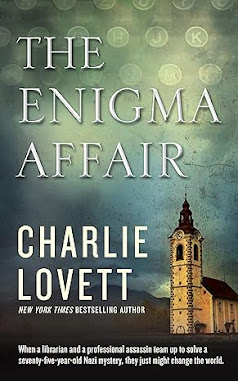
THE ENIGMA AFFAIR: A NOVEL (audiobook) by Charlie Lovett


Read by Nicole Zanzerella.
Duration: 12 hours, 6 minutes.
Unabridged.


Synopsis:

An Enigma Machine from World
War II.
Patton Harcourt is a very small town librarian in North Carolina. One morning, while cooking in the kitchen, a sniper round comes through her window and nearly hits her. She reacts well (thanks to her previous career in the military) and finds a stranger at her door. 

He is not the sniper, but he is an assassin that was hired to kill another person in town. Against her better judgment, she joins with the assassin to elude the sniper team.

All of that happens in the first 10 minutes or so of this audiobook.

From there, they discover a handmade copy of World War II Enigma machine (the British machine that broke the German secret codes) and are off to confront modern-day Neo-Nazis...

My Review:

This book was certainly action-packed, extremely fast-paced ,and had some good moments. But, it also had some practical issues that just didn't jive with reality. For example, one of the main plot points is that they cannot access the internet because they will be detected and tracked down. This completely ignores the existence of proxy servers. A professional assassin should have been familiar with this technology as a way to hide his location when communicating with clients.

Later, the characters are speaking German and passing off as native speakers (this is a vitally important point more than once). Granted, it is not complicated German, but very few untrained people can pass themselves off as native speakers in a second language. I've been speaking Spanish as a second language for years and I would never be confused for a native speaker.

This is not a bad book. The quick pace was fun, the bad guys are truly bad, and the flashbacks to World War II were well-done. But, the end result was 3 stars out of 5.

This book can be found on Amazon.com here: THE ENIGMA AFFAIR: A NOVEL by Charlie Lovett.

THE BOMBER MAFIA: A DREAM, A TEMPTATION and the LONGEST NIGHT of the SECOND WORLD WAR (audiobook) by Malcolm Gladwell


Published in 2021 by Pushkin Industries.
Read by the author, Malcolm Gladwell.
Duration: 5 hours, 14 minutes.
Unabridged.


Before there was a U.S. Air Force, there was the U.S. Army Air Corps. Before the Army Air Corps (re-organized as the U.S. Army Air Forces in 1942) built the largest collection of flying fighting machines to relentlessly bomb the Axis Powers in World War II, they had a tiny budget and a few air bases. One of these was Maxwell Field, a training facility in Alabama. That facility became the intellectual home of a group of pilots who espoused the concept of precision bombing. They were known as The Bomber Mafia.

Precision bombing is the theory that teaches that you don't have to blow an enemy's entire military to pieces, you can just hit certain key industries and choke out their ability to produce more weapons/feed their people/move soldiers and so on. This was intended to be a more humane way to wage war - an antidote to the mass slaughter the world saw in World War I. Precision bombing could end wars before they got to that point by simply forcing an opponent to stand down. The invention of the Norden Bomb Sight convinced them that bombers could fly as high as they wanted over the enemy and could still drop bombs precisely where they wanted them

The other argument when it comes to bombing is strategic bombing. Strategic bombing, in simple terms, is brute force bombing. It is simply dropping bombs on enemy territory to inflict maximum mayhem and damage with the goal of breaking the morale of the enemy. Think of it as something like Sherman's infamous March to the Sea from the Civil War, but delivered from the air.

In the European Theater, the U.K.'s Royal Air Force followed a policy of strategic bombing. They flew at night in order to give their pilots cover and they indiscriminately dropped bombs on German cities. The Americans flew during the day and used the daylight to try to hit certain high value targets as part of a precision bombing strategy. 

This audiobook is about the debate over the two points of view, specifically in the Pacific Theater. For months, the United States tried precision bombing, but a combination of things made it difficult, including factors like the weather was much more erratic and the manufacturing base was more diffuse (a lot of parts were actually made by small-time family-based manufacturers).

US Navy Grumman TBF Avenger aircraft dropping
bombs on 
Hakodate during July 1945
When Curtis LeMay arrived in the Pacific Theater, he brought a different plan. He had personally flown and led precision bombing missions and was not impressed. He brought massive fire bombing campaigns to Japan and leveled city after city.

Gladwell comes up with a mixed bag of conclusions. He gives the impression that strategic bombing was the obvious choice, but it clearly wasn't that simple. LeMay leveled huge chunks of 66 Japanese cities and the Japanese kept on fighting. Tokyo was hit so hard that it was actually removed from the official target list. 

Imagine of the situation was reversed and America was subject to such attacks. New York City would be hit so hard that it was effectively gone and so would the next 65 cities by population. That would include Chicago, Los Angeles and Dallas, of course. But that would also include the destruction of such smaller cities as Indianapolis, Albuquerque, Milwaukee, Cleveland, Fresno, San Juan (Puerto Rico), Tulsa, Corpus Christi, Tampa and Cincinnati.  Would we have kept fighting?

I say we would have kept right on fighting. Strategic bombing was used against England at the beginning of the war and, in the end, it seems to have made England all the more determined to fight and inflict as much strategic bombing as possible on Germany. One could argue that the Germans and Japanese surrenders owed more to fear of Soviet occupation than a desire to end the firebombings. 

Gladwell brings the discussion into the modern world with discussions of cruise missiles that can hit specific GPS locations and drones that can target individual people. He gives the impression that precision bombing is actually the way to go. 

But, did our targeted "Shock and Awe" campaign in the Iraq in 2003 make the Iraqi people decide to just go along with America's plans? Did the Taliban just quit even though we killed who knows how many of them with drone attacks that demonstrated we have the ability to sift through all of the data, figure out who they are and find them no matter where they hide?

What were are left with is an unresolved question even though Gladwell gives the impression that he did provide them.

But, the discussion was interesting.

This audiobook was produced by Gladwell's podcasting company. He includes special effects and audio from the time period and interviews that were conducted after the war. It was a really slick production.

I rate this audiobook 4 stars out of 5. It can be found on Amazon.com here: THE BOMBER MAFIA: A DREAM, A TEMPTATION and the LONGEST NIGHT of the SECOND WORLD WAR (audiobook) by Malcolm Gladwell.

SUBHAS CHANDRA BOSE: A LIFE from BEGINNING to END (kindle) by Hourly History


Published by Hourly History in 2020.


I am an avid reader of history, but I have areas of weakness that I am perfectly willing to shore up a bit, but I don't want to invest a ton of time in. The long history of India is just one of those areas for me. I know more than most people, but I can see the glaringly empty areas of ignorance.

Subhas Chandra Bose was one of those people for me. I had heard of him, but only described as sort of an "anti-Ghandi". He wanted independence as much as Ghandi did, but thought the non-violent protests were a waste of time. Subhas Chandra Bose was not only willing to fight - he thought it was the only way India would be free of English rule.

Bose was born in India but formally educated in England. He was poised to take his place in the bureaucracy of colonial India. But, he rejected that offer and became active in the independence movement. 

As World War II loomed, Bose saw it as an opportunity to free India. He approached the Fascist powers for support. Germany and Italy poo-pooed him but Japan saw the potential and financed a army of Indian nationals - but waited too late to make a difference. 

The beauty and the weakness of this book series is the brevity of each book. They are designed to be read in about an hour, which means I can explore a whole new area or person with little time commitment. But, I always end up with questions. In this book, I found myself wondering how much faith the Japanese really had in Bose and his army and why they waited so long to fund it.

I rate this book 4 stars out of 5. It can be found on Amazon.com here:  SUBHA CHANDRA BOSE:  A LIFE from BEGINNING to END (kindle) by Hourly History.

MISSION: JIMMY STEWART and the FIGHT for EUROPE (audiobook) by Robert Matzen


Published in 2017 by Blackstone Audio.

Read by Peter Berkrot.
Duration: 11 hours, 45 minutes.
Unabridged.

Just a few months after the bombing of Pearl Harbor, Hollywood actor Jimmy Stewart was a new recruit in the U.S. Army angling for the chance to fly a bomber in combat. At the time, he was the reigning male actor in Hollywood, having recently received the Oscar for Best Actor.

But, deep down, Jimmy Stewart wanted to continue the family tradition of military service. The Army tried to divert Stewart to a non-combat role, aided by some string-pulling by his movie studio. But, Stewart pulled some strings of his own and eventually found himself training to fly bombers, despite the fact that he was easily at least ten years older than all of the other trainees.

Stewart and his men flew their bombers to England and joined the massive collection of planes involved in the bombing campaign in November of 1943. Stewart's age and extensive pre-war flying experience played a part in him becoming an leader of his squadron of B-24 Liberators. He felt the profound weight of the immense responsibility of leading his men. He was all too aware that a simple mistake on his part could kill dozens of men, including himself.

Maybe it was that sense of responsibility, maybe it was just dumb luck, but Stewart's men did much better than average when it came to getting there and back successfully, although it took a profound toll on Stewart. He visibly aged during those 16 months. He felt like he was losing even his nerve as the mission (and the close calls) added up. Despite his concern, he led larger and larger missions up to the end of the war.
The chief mechanic of the B-24 Liberator
"Nine Yanks and a Jerk" sticking his head out of the hole
blown through the cockpit by a piece of unexploded
ordinance. Jimmy Stewart was in that cockpit on that flight.


Robert Matzen's three-pronged look at World War II in Europe mostly focuses on the early life and military service of famed Hollywood actor, but it also tells the story of German civilians that ended up being near a site bombed by Stewart and the story of another airman that went briefly interacted with Stewart on a shake-down run. His story, though, is used to show what could have happened to Jimmy Stewart since that airman is shot down over Europe and eventually is captured.

This was an interesting audiobook. Peter Berkrot was the narrator and when it comes to narrating the danger and drama of a bombing run of Nazi Germany, there is literally no one better. Berkrot's pacing and dramatic delivery are perfect. But, the problem is that Berkrot never turns that dramatic style of reading down - everything is equally dramatic, including very mundane things like the descriptions of Stewart's childhood. So, it becomes sort of a mixed bag.

I rate this audiobook 4 stars out of 5 and it can be found on Amazon.com here: MISSION: JIMMY STEWART and the FIGHT for EUROPE by Robert Matzen.
 

NIGHT SCHOOL (Jack Reacher #21) (audiobook) by Lee Child


Published by Random House Audio in 2016.

Read by Dick Hill.
Duration: 13 hours, 7 minutes
Unabridged.

Fans of Jack Reacher know that the Lee Child does not write his books in a linear pattern - he bounces around on the Jack Reacher timeline quite a bit. Night School is set in the 1990's when Reacher was still in the military. Reacher has just come off of a secret mission in the Balkans.  He helped find and eliminate war criminals from the fighting that erupted in the wake of the collapse of Yugoslavia. It was the kind of mission that the government was glad to have done, but not glad to acknowledge.

Reacher receives a medal in a private ceremony and then is sent off to an inter-agency training seminar in the suburbs of Washington, D.C. But, it turns out that there are only two other people at this "training" - an FBI agent and a CIA agent that are also fresh off of missions that 
the government was glad to have done, but not glad to acknowledge.

The State Department has gathered them together as a team of go-getters to figure out what is behind a piece of intelligence that they have picked up thanks to an embedded operative - a terror network is offering $100 million for something to a seller in Germany. Reacher and company are being asked to figure out what is for sale and how they can get it before the bad guys do without losing the operative...

This is my fifteenth Jack Reacher book and it was one of the best. It's got some action, but mostly it is a detective story with really big consequences if it is not solved soon.

Dick Hill read this audiobook. He reads most of this series and that is a very, very good thing because Dick Hill has nailed the narration and character voices perfectly.

I rate this audiobook 5 stars out of 5 and it can be found on Amazon.com here: Night School by Lee Child.

NPR AMERICAN CHRONICLES: WORLD WAR I (audiobook) by NPR


Multicast performance
Duration: 3 hours, 25 minutes

National Public Radio (NPR) has gone through its archives and pulled out almost thirty stories about World War I in honor of the 100th anniversary of the start of the war. The stories include interviews with soldiers and historians and various authors. 
File:Eddie Rickenbacker.gif
World War I flying ace Eddie
Rickenbacker (1890-1973) in his Spad
plane in October of 1918.

Topics include a look at pre-World War I Europe, a look at the creator of the Sopwith Camel, discussions of several battles, hand-created masks for men whose faces were damaged in the war, a mini-biography of America's famed flying ace Eddie Rickenbacker, a look at the post-war Bonus Army during the Great Depression and audio visits to several World War I museums, including one that recognizes Herbert Hoover's efforts to feed Belgium during the war (mostly forgotten in America).

The audio quality of all of these stories is excellent since they were all originally broadcast on the NPR network. They are told in a logical manner and make for an interesting look at this oft-overlooked war.

I rate this audiobook 5 stars out of 5 and it can be found on Amazon.com here: NPR American Chronicles: World War I by NPR

Children of Wrath: A Novel (audiobook) by Paul Grossman


I have rarely been carried into another (horrible) world so thoroughly as I was by this audiobook.


Published by HighBridge Audio in April of 2012.
Read by Kyle Munley.
Duration: 12 hours, 13 minutes.
Unabridged.

Paul Grossman's The Children of Wrath is a dark detective story set in one of the most tragic situations in all of history: The Weimar Republic in the weeks before the rise of the Nazis. A series of murders of boys combined with the impending failure of Germany's experiment with democracy, the collapse of the American stock market and the open street fighting between the Nazis and the Communists makes this tragic piece drip with a sense of the impending descent of Germany into the madness that enveloped it after the Nazis took command.

Willi Kraus is the only Jewish detective in the Berlin police force (and perhaps all of Germany). He is a decorated veteran of World War I but his country treats him with no respect because he is Jewish. His fellow detectives refuse to be his partner. His supervisor gives him insulting jobs. In this story he is re-assigned from a murder case (a burlap bag of bones from a boy with teeth marks on them is found washed up from a sewer line) to investigate an outbreak of Listeria that has killed consumers of pork sausage, with the implied insult of having a Jewish detective investigate a case involving the famously non-Kosher pork product.

But, as Willi digs into his new case he finds hints that the two cases might actually be connected and he starts his own private investigation as more and more boys go missing and more bones are found. While Kraus investigates,  Grossman gives the reader a foreshadowing of the horrors and atrocities that await Germany. The railroad cars that come from Poland filled with hogs and cattle to the butchers in Germany will soon enough come full of people headed for slaughter. Hitler leads small rallies that inflame the passions of many who feel lost. Death camps, human skin used as leather, and science gone wild all make appearances while Goebbels spreads his propaganda in the press.  There are references to "useless mouths" and the incessant prejudice against Jews combine to leave Kraus and his family abandoned by co-workers and neighbors alike.

Grossman notes that this was also a time of a rise of the interest in paganism in Germany and that Hitler built on many of those pagan themes. Christians certainly bear plenty of responsibility for the Nazis, but it was certainly not friendly to traditional Christianity and built on a pagan base as well. At the end of the book Kraus comes across a group of  Hitler Youth who are marching in the street and singing:

"We are the joyous Hitler Youth
Our leader is our savior.
The Pope and rabbit shall be gone
We want to be pagans again."

With that we know that Germany's future is sealed - the young people have bought into what Hitler is selling and the tragedy will continue to unfold.


This is by no means a perfect book. The climactic ending is too cheesy. It is dramatic, but it feels like the end of a Batman movie (and not one of the good ones, either). I don't want to go into specifics, but it does not fit well with the rest of this unique, moody, tragic book.

Nonetheless, I will still rate this book 5 stars out of 5. I have rarely been carried into another world so thoroughly as I was by this audiobook. Between the excellent writing and the dark tones of the reader, Kyle Munley, this book really got into my head. Munley's great character voices, precise pronunciation of German words and phrases, and his ability to carry the story through all of its ups and downs make this an exceptional audiobook experience.

Reviewed on October 20, 2012.

This book can be found on Amazon.com here: The Children of Wrath by Paul Grossman.

The Economic Naturalist: In Search of Explanations for Everyday Enigmas by Robert H. Frank


Entertaining but of questionable value


Published in 2007 by Basic Books.

I have read Freakonomics and Naked Economics in the past 6 months and thoroughly enjoyed them. I was hoping to get more of the same with The Economic Naturalist: In Search of Explanations for Everyday Enigmas. It caught my eye because it is nearly the exact same color as Naked Economics (Hmmm, I wonder if the economic naturalists would care to speculate on products that intentionally look similar to better-known products...) and I was hoping to get some more economic enlightenment.

Sadly, the book reads a lot more like an extended session with Yahoo! Answers than anything else. It's interesting, but there are times when you have to wonder why anyone would be wondering these things and there are times when you have to wonder if he actually ran these answers by anyone else in another department at Cornell to see if the economic answer was right or if another answer was correct.

For example, he talks about Germany having a high unemployment rate as compared to the U.S. He mentions the fact that Germany has better unemployment benefits as the only factor for Germany's higher unemployment rate.

Historically, there are two reasons for the higher unemployment:

#1) Germany is still in the midst of absorbing East Germany which has a higher unemployment rate than the former West Germany.

Worthless Weimar Republic currency
just left on the streets
#2) Macroeconomics teaches that, in the short run, you can avoid a higher rate of inflation by holding back GDP growth in a variety of ways that tend to cause more unemployment (sorry economists of the world, but that's the easiest way I can explain it without causing eyes to glaze over for non-econ-minded folks). Germany is deathly afraid of high rates of inflation since runaway inflation occurred during the Weimar Republic in the Post-World War I Germany and that is seen as having been one of the things that brought Hitler to power.

I'm sure great unemployment benefits help, but that is not the only cause for the problem.

**********

It's a quick read, often light and breezy. But, there are better reads out there that do it better.

To learn more about offbeat topics and how economics applies to them, I suggest Naked Economics: Undressing the Dismal Science (Fully Revised and Updated)  by Charles Wheelan.

To learn more about basic economics, I suggest Freakonomics: A Rogue Economist Explores the Hidden Side of Everything by Steven D. Levitt and Stephen J. Dubner.

I rate this book 3 stars out of 5.

This book can be found on Amazon.com here: 
The Economic Naturalist: In Search of Explanations for Everyday Enigmas


Reviewed on June 15, 2008.

Spy for the Night Riders: Martin Luther (Trailblazer Books #3) by Dave Jackson


Good history - for 4th to 8th graders


I am reviewing this as a high school world history teacher who is looking for high-quality historical fiction of all skill levels that I can add to my classroom library.

While Spy for the Night Riders: Martin Luther is too easy for the average high school student, it would be a good fit for the 'reluctant reader' or the student interested in the Reformation. The plot moves along pretty quickly and does a good job of telling about Martin Luther's big moment at the Diet of Worms and his travels immediately before and after his hearing.


Some previous knowledge of the Reformation would be helpful.


I give this one 4 stars out of 5.


This book can be found on Amazon here: Spy for the Night Riders (Trailblazer Books Book 3)


Reviewed on May 6, 2006.

Patton: The Pursuit of Destiny by Agostino Von Hassell and Ed Breslin


Gives a solid background on one of America's iconic generals


Published in 2010 by Thomas Nelson

There have been thousands of generals that have served in the United States Military. Very few officers ever get "name" recognition. Washington, Grant, Pershing, MacArthur, Eisenhower. Patton stands right there with them, unique in the group of generals that I named because he was the only one that was always a subordinate officer, meaning that he was never in charge of an entire theater of war.

But, Patton inspires images of a general of action - impulsive, moving, always pushing, leading from the field. Modern tank warfare may have been perfected by Patton in the sense that he truly understood the need to coordinate air, naval, armor and GI's. He did more than understand it in theory - he actually did it on the ground in real life.

Patton: The Pursuit of Destiny is an attempt to dig behind the image to find out a little about the real Patton - a romantic family man (also a philanderer), the little boy that dreamed of the battlefield, the frustrations that accompanied his slow climb up the officer ranks (but helped by excellent connections), his fear of being afraid.

Von Hassell and Breslin are mostly successful in their attempt, although they are often repetitious in some of their points. For example, they tell the reader multiple times in the section on World War II that Patton's reputation as a glory hound was mitigated by the fact that he shared the glory so well with his men.

At times, the facts are written to make them seem more dramatic. For example, on page 117 they note that the U.S. army "had captured or killed more than 100,000 enemy troops"(p. 117) in the Sicily campaign (Operation Husky). Technically true but the numbers are 29,000 dead, missing or wounded Axis troops and 140,000 captured soldiers. Yes, it is common to include the captured in with the figures for the casualties, but this statistic seems written to inflate the death total.

At another point they just get facts wrong - not facts about Patton but about another general. They were trying to make the point that Patton did not squander his men, even while he was pushing them forward as fast as possible. The compare him to " 'Butcher Joe' Hooker, the Union general who to be relieved of command by President Lincoln early in the Civil War due to the appalling losses of life and limb incurred under his leadership." (p. xiii). Hooker's nickname was "Fighting Joe" and, ironically, he was dismissed due to tentative fighting in the latter part of the Battle of Chancellorsville and his lack of desire to chase down Robert E. Lee's army that was invading Pennsylvania and on its way to Gettysburg. Lincoln might well have excused a "Butcher Joe" on the grounds that at least he confronted the enemy. Ulysses S. Grant was the general with the nickname "Butcher". 

In many ways, Patton: The Pursuit of Destiny apologizes for Patton by denigrating his colleagues. Many times the reader is told that Montgomery and Eisenhower were too tentative in Patton's eyes. What we don't get is an historian's unbiased view about Patton's opinions. Were they? In Citizen Soldiers: The U.S. Army from the Normandy Beaches to the Bulge to the Surrender of Germany, June 7 1944-May 7, 1945 Ambrose asserts that Patton's tanks were out of gas, his men were low on supplies while he was advocating pushing forward into Germany - this might have created a "bulge" into Germany with the same results the Germans experienced with their bulge. A discussion of all sides would have been appropriate.

The book has many pictures of Patton, ranging from his childhood all the way through his World War II years. What the book also needed was maps - describing a map is so much less effective than just showing the reader why, for example, why the Battle of the Bulge was such a threat to the allies.

In sum, a good overview of the his life, but do not let this book be your only source about the complicated European Theater in World War II.

I rate this book 3 stars out of 5. It can be found on Amazon.com here: Patton: The Pursuit of Destiny by Agostino Von Hassell and Ed Breslin.

Reviewed on August 12, 2010.

I reviewed this book in conjunction with Thomas Nelson's BookSneeze program. I was not compensated for this review. The opinions expressed are mine.

Featured Post

<b><i>BAN THIS BOOK (audiobook)</i></b> by Alan Gratz

Published in 2017 by Blackstone Audio, Inc. Read by Bahni Turpin. Duration: 5 hours, 17 minutes. Unabridged. My Synopsis Ban This Book is t...

Popular posts over the last 7 days