Published by Recorded Books in 2015.
Read by Jonathan Davis.
Duration: 13 hours, 7 minutes.
Unabridged.
In the mid-1400s Portugal was poised to be a major world power, despite being a backwater of Europe in so many ways. Portugal sits at the western extreme of Europe, destined to be a minor player in European politics most of the time. All of Portugal's border touches Spain, so if Portugal wanted to interact with anyone but Spain they had to take to the sea.
IThe Portugese developed a new type of little wooden ship called the caravel, armed them with cannons, filled them with food, water, sailors, and stone monuments to mark the areas they explored. They pushed down the coast of Africa, hoping to find a way to the spices of Asia.
They were looking to trade, especially for spices because the Muslim countries had established a stranglehold on the spice trade with the decline and eventual fall on the Byzantine Empire in 1453. They were also looking to link up with the fabled African Christian king Prester John, join up to defeat the Muslims, spread Christianity, and make a lot of money along the way.
And, with the exception of the Prester John part of the plan, that's basically what happened. Prester John turned out to be the Christian kingdom of Ethiopia. It was real, but not nearly as powerful as the Portugese believed - and it wasn't very interested in attacking the Muslims in a religious war.
Conquerors: How Portugal Forged the First Global Empire is a pretty thorough look at the Portugese conquistadores and their escapades in the Indian Ocean. From the first, Portugal came with guns a-blazin'. They laid waste to cities, took slaves, took hostages, burnt ships, and were confrontational with almost everyone.
Then, they headed home and made plans to return with even more ships. They made annual trips and made plans to make permanent posts from Africa to India.
At this point, this history bogs down. It's not that it isn't accurate - it just becomes a litany of outrageous attacks by the Portugese, a minor setback, and then an even more audacious attack. It all kind of blurred together for me because Crowley didn't take a moment to pull away from the history to do a bit of analysis.
He didn't even step away to look at what the Portugese were doing in other parts of the world, such as Brazil and west Africa and put the Portugese efforts in the Indian Ocean into a larger context until the literal last three or four minutes of the audiobook. The title says it is a book about Portugal's empire and it ignores a lot of their empire.
The audiobook reader was Jonathan Davis. He is a very good reader and has a flair for accentuating the dramatic moments. But, he is also very slow. I rarely do this, but I set the audiobook player to play at 120% and he was still a bit slow at times.
I rate this audiobook 3 stars out of 5. It can be found on Amazon.com here: CONQUERORS: HOW PORTUGAL FORGED the FIRST GLOBAL EMPIRE by Roger Crowley.
More than 2000 reviews over the last 25 years.
CONQUERORS: HOW PORTUGAL FORGED the FIRST GLOBAL EMPIRE (audiobook) by Roger Crowley
THE RED DRAGON (Action Adventures Short Stories Collection #10) by L. Ron Hubbard
Originally published in 1935 by the magazine "Five Novels"
Re-published in 2013 by Galaxy Press.
Long before L. Ron Hubbard (1911-1986) became the creator of Scientology, he was a pulp fiction writer. He did this for nearly 20 years, with his first writing credit coming in 1932. The Red Dragon was originally written for a monthly publication called Five Novels.
Synopsis
The Red Dragon starts out very much like an Indiana Jones movie - an American damsel in distress is in China looking for the archaeological find her father had told her about. He has left clues to its location and she is seeking someone to help her. The site is located in Manchuria - a disputed zone under Japanese control in what would eventually become the beginnings of World War II in Asia (unknown to Hubbard at the time because Pearl Harbor attack was more than six years away).
The mysterious Michael Stuart has stepped up to help. His nickname is The Red Dragon because he is audacious and because he had red hair. He is disreputable in both the Japanese and Chinese controlled areas for reasons never made clear in this 92 page novella.
So, Stuart and the damsel in distress head off into Manchuria with assassins following and the Japanese Army waiting...
My Review
This adventure story has a little bit of everything - car chases, pistol fights in hotel rooms, a pistol fight on the Great Wall of China, love, daring escapes, clever disguises. But, the story sort of peters out at about two-thirds of the way through.
Be aware that this story is 90 years old and it shows its age when it comes to racial stereotypes.
For me, the funniest scene in the book is completely unintentional. At one point The Red Dragon steals the uniform of a Japanese officer and sneaks into a hut/pub to get some information. He blacked his hair with cooking grease, rubbed yellow dust all over his skin to give it a different color (not kidding), and taped back his eyes to make them look more Asian. With all of these questionable tricks, he is concerned that the locals will notice his gray eyes - not the tape on the eyes!
I rate this novella 3 stars out of 5. It can be found on Amazon.com here: The Red Dragon by L. Ron Hubbard.
TIGER CHAIR: A SHORT STORY (kindle) by Max Brooks
Published in 2024 by Amazon Original Stories.
The premise of Tiger Chair is that it is a frank letter from a mid-level Chinese officer to a friend back home. World War III has been going on for a while. It started over the invasion of Taiwan and has now spread around the world. Chinese forces are active on many fronts, including India.
China has also attacked the United States in the mistaken belief that America's racial diversity and political animosities would cause American resolve to crumble and it would be a short war.
This has turned out to be wrong and the invasion has turned into occupation duty and occupation duty has always been terrible.
I think Brooks has an actual agenda with this book and it is a warning. It is not a warning about China. It is a warning about over-dependence on technology and the foolishness of war. On top of that, it is so easy for one country to think that they have a realistic take on another country's internal politics and culture when they really have no idea at all.
![]() |
| Max Brooks |
It is an easy thing to observe in recent history. Americans have seen it in Iraq and Afghanistan. In both situations, their governments were deposed and it was assumed that new governments would be formed and the political differences would be worked out. Instead, the different rivalries fought one another with amazing ferocity. But, they also fought the Americans because there was one thing they all agreed on - they didn't want a bunch of outsiders telling them what to do.
It is the same in this story. I'd say that it's been this way forever.
I rate this short story 5 stars out of 5. It can be found on Amazon.com here: TIGER CHAIR: A SHORT STORY by Max Brooks.
CHINESE CIVIL WAR: A HISTORY from BEGINNING to END (Chinese History) (kindle) by Hourly History
Published in 2022 by Hourly History.
Hourly History is a series of histories and biographies that a reader can read in about an hour. Sometimes, that works out quite well. Sometimes, the topic is just too big to cover in an hour.
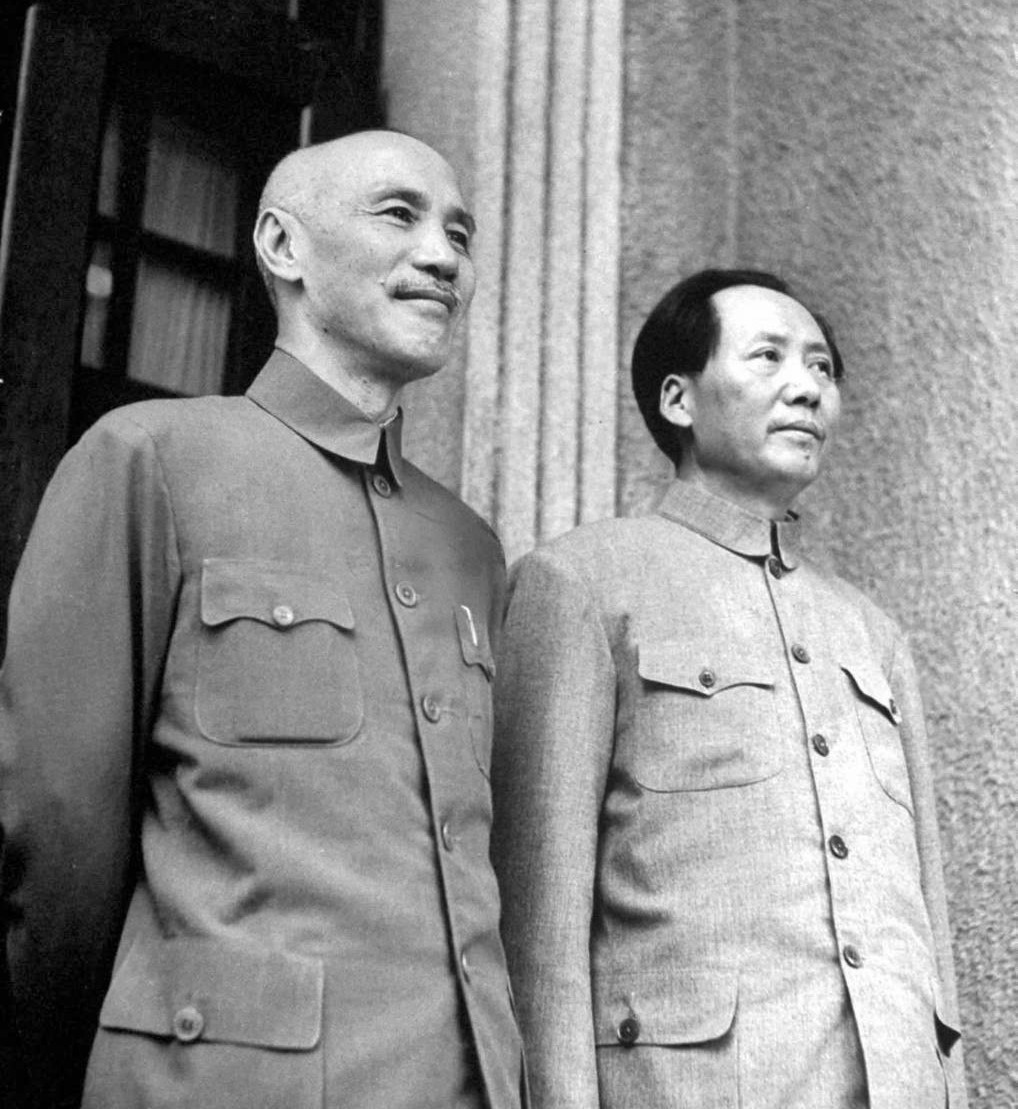
From 1927-1937, Chaing Kai-shek's Nationalist government and Mao Zedong's Communist government fought a civil war. When Japan invaded China, the civil war was suspended (sort of) and a united front was formed. Soon after the end of the war, the civil war resumed and the communist faction won, with the exception of the island of Taiwan.
![]() |
| Chiang Kai-shek (1887-1975) and Mao Zedong (1893-1976) |
The book also suffers from an abundance of clunky writing. For example, this is from a paragraph about 2/3 of the way through the book: "...the next stages of the Chinese Civil War would commence. This state of civil war would last for more than three years, sending China into a state of warfare once more."
I rate this audiobook 3 stars out of 5. It can be found at Amazon.com here: CHINESE CIVIL WAR: A HISTORY from BEGINNING to END by Hourly History.
FINDING GOBI: A LITTLE DOG with a VERY BIG HEART by Dion Leonard
Read by Simon Bubb.
Duration: 6 hours, 36 minutes.
He was running a multi-day race in the Gobi Desert in China when he met a scruffy little dog as he was lining up to start day two of the race. To be accurate, the little dog was attracted to him - it wouldn't leave him alone!
When the race started, Leonard assumed that the dog would follow for a while and then return home, wherever that was. But, the dog followed him every step of the way - 23 miles. That night, the dog stayed with Leonard in his tent and went with him again on the 3rd stage of the race. As they headed into the desert, Leonard worried that the dog could be hurt by the higher temperature more brutal landscape. So, he arranged for the dog to be carried on to the end of the next stage and eventually to the end of the race.
Turns out that he was right, the next stage was dangerous and the desert nearly killed Leonard and many other runners.
By this time, Leonard had named the dog (Gobi) and had decided to bring the dog back to his home in the UK.
And that's where things got complicated...
This is a pretty good story, but a little slow-paced. Really, the story has three focuses:
c) The extraordinarily complicated story of how Gobi left China.
Sometimes, the book seems like it is trying to stretch things out to actually fill a book. When you get down to it, it is the story of a guy who finds a dog when he's out on a run and brings it home. Personally, I found the story of the race and how Leonard first met Gobi the best part of the book.
I rate this audiobook 4 stars out of 5. It can be found on Amazon.com here: FINDING GOBI: A LITTLE DOG with a VERY BIG HEART by Dion Leonard.
ARCHAEOLOGY: AN INTRODUCTION to the WORLD'S GREATEST SITES (audiobook) by Eric H. Cline
Published in 2016 by The Great Courses.
Read by the author, Eric H. Cline.Unabridged.
Turns out that Cline is also a very likable guy who does a good job of explaining archaeological techniques. He tells about a number of sites that he worked on and some of the most famous digs in history (King Tut's tomb, Troy) in the first half of the book. It was a bit frustrating for me because they were all within 100 miles of the Mediterranean Sea.
In the second half of the book, Cline tells about other digs around the world - Machu Pichu, the Terracotta soldiers, Teotihuacan and more.
On the whole, this was a pleasant if not particularly riveting listen as an audiobook. I rate it 4 stars out of 5.
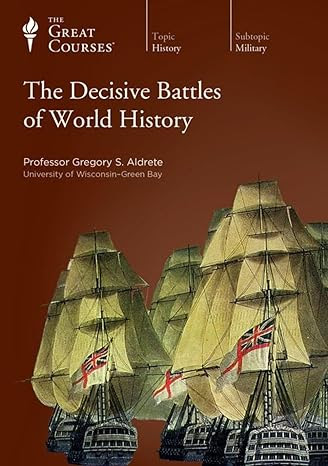
THE DECISIVE BATTLES of WORLD HISTORY (The Great Courses) (Audiobook) by Gregory S. Adlrete
Lectures delivered by the author, Gregory S. Aldrete.
Duration: 18 hours, 29 minutes.
As long as there has been war, there has been discussions about which battles were the most important, the most pivotal. This takes some analysis, since the temptation might be to simply discuss the battle that finally ended a long conflict, like Appomattox was the functional end to the American Civil War.
The temptation might also be to collect a list of the biggest battles of history, but that would exclude Aldrete's tiniest choice - the Battle of San Jacinto. While that battle had less than 2,500 soldiers, he persuasively argues that the battle not only made Texas independent from Mexico, it also set off a chain of events that led directly the the American Civil War, Reconstruction and more.
In The Decisive Battles of World History, Adlrete presents the battles in chronological order and spends at least as much time on the background information of each battle as he does on the battles themselves. A few of the entries are not battles, but are entire campaigns.
![]() |
| The Battle of San Jacinto |
I rate this audiobook 4 stars out of 5. It can be found on Amazon.com here: THE DECISIVE BATTLES of WORLD HISTORY (The Great Courses) (Audiobook) by Gregory S. Adlrete.
GOD IS NOT ONE: THE EIGHT RIVAL RELIGIONS THAT RUN the WORLD - and WHY THEIR DIFFERENCES MATTER (audiobook) by Stephen Prothero
Published in 2010 by HarperAudio.
Read by Paul Boehmer.
Duration: 14 hours, 37 minutes.
Unabridged.
Stephen Prothero is a professor of religion at Boston University. The purpose of God Is Not One is to inform the reader of the eight greatest world religions, their philosophies and their way of looking at the world.
Prothero is very aware that choosing just eight religions is fraught with problems. How do you choose? Is it based on influence? Number of adherents? Importance of the countries it is in? He went through all of those questions again once again when he chose the order he would present the religions he picked.
The religions he profiled are: Islam, Christianity, Buddhism, Hinduism, Confucianism, Judaism, Yoruba religion, and Daoism. He spends about 90 minutes discussing each religion and includes nearly an hour on Atheism at the end, on the theory that militant Atheism (Richard Dawkins, Christopher Hitchens) behaves much like a religion, complete with evangelistic movements and a coherent worldview.
Prothero takes great pains to point out that these religions do not approach the world in the same way. He is pretty irritated at the "all religions are basically the same - they answer the same questions in different ways" view of religion. He thinks it is intellectually lazy. For example, Christianity teaches that the main problem with the world is sin. Daoism doesn't even have that concept - they think the main problem is society polluting people and making them unhappy by making them take on roles that go against their nature. Confucianism thinks the biggest problem is people not knowing their place in society - embrace the role given you and you will be happy. Yoruba religion is all about power, including spiritual power and leveraging it to your advantage. Atheism think religion itself is the problem - but they are usually most vocal against the three monotheistic religions (Islam, Judaism and Christianity). They might be okay with Daoist and Confucian philosophy and some Buddhist sects. Of course, all of those summaries are super-simplistic.
Prothero is not making this point in order to say that the religions of the world can't get along. Rather, he is making this point in order to say that if we are going to get along, we actually have to know what the other religions are saying and where they are coming from.
Prothero's explanations include Western cultural references to movies and books. If you are a well-read person these can be quite helpful.
I rate this audiobook 5 stars out of 5. It can be found on Amazon.com here: GOD IS NOT ONE: THE EIGHT RIVAL RELIGIONS THAT RUN the WORLD - and WHY THEIR DIFFERENCES MATTER by Stephen Prothero.
THE SECOND KOREAN WAR (audiobook) by Ted Halstead
Published in 2018 by Ted Halstead.
Read by Cody Banning.
Duration: 15 hours, 4 minutes.
Unabridged
Ted Halstead's The Second Korean War is a multi-country thriller in which North Korea tries a desperate gamble to force South Korea to submit to North Korean rule.
The book starts out on an military base on the far eastern part of Russia. North Korea has found out that Russia has a small nuclear "backpack" weapon (a battlefield nuke) dating from the early days of nuclear weapons that has been lost from the inventory over the years. North Korea acquires the weapon so that they can start a two-pronged effort to force South Korea to surrender and force the United States to withdraw from South Korea without fighting.
But, things don't go as smoothly as they hoped, people die and a Russian police detective starts putting things together. The question is, will he put things together fast enough?
The last thing I want to do is write out a bunch of spoilers, so I won't tell how everything breaks down. Some of the twists and turns were nicely done. I especially liked how the Russians were the good guys and honest brokers throughout. There's a lot of technology (radar-eluding planes, submarines) and geo-political intrigue in the vein of Tom Clancy. It's not as good as the best Tom Clancy, but that is a high bar. I found the North Korean plan for South Korea to be exceedingly implausible simply because of their hardheaded insistence on using a specific vehicle. I get it, the stereotype of military dictatorships is that they are ultra-orthodox and inflexible.
I listened to The Second Korean War as an audiobook. It was not a particularly good production. The reader, Cody Banning, has a clear voice - but, his rhythm is just not there. At times, it sounds like he is trying to imitate William Shatner, with odd long pauses at commas. According to my research, this is just his second audiobook, so that explains a few things. There's a lot of potential there.
The audiobook was poorly edited. Multiple times you can hear the reader clear his throat, shake papers and sometimes start over as he botched a line. Botched lines happen - but things like this are supposed to be corrected and the mistakes edited out. Also, the editor/producer should have caught the fact that Banning mis-read the word "emphatically" as "empathically" throughout the book. This is my 467th audiobook review and this one stood out for its rather poor editing. Too bad.
I rate this audiobook 3 stars out of 5, despite the production/editing work. It was a unique take on a potential Korean conflict.
This audiobook can be found on Amazon.com here:
The Second North Korean War by Ted Halstead.
Note: I was asked to give an honest review of this audibook by the publisher in exchange for a free download of the audiobook.
LANDS of LOST BORDERS: A JOURNEY on the SILK ROAD by Kate Harris
Kate Harris and her childhood friend Mel decided to go on a bicycle adventure that approximates Marco Polo's trip along the Silk Road from Turkey to China. This is not a trip taken on a whim. Harris has read about explorers and dreamed about being an explorer all of her life. She's a scientist by training but she can't stand to be in a lab - she has to get out and see the world.
Actually, she started out wanting to go to Mars and actually went so far as to participate in a Mars simulation complete with spacesuits out in the Utah desert. The simulation told her one important thing - being in a space suit denied her the tactile experience of exploration such as the wind in your hair and the smells.
So, rather than Mars, she decides to go to one of the most remote areas of the world, for a couple of Canadians - Central Asia. It has vast deserts, literally the tallest mountains in the world and arcane bureaucracies that sometimes make it about as challenging as a trip to Mars.
My favorite, though, took place in Tajikistan. A family let them stay the night in their home rather than camp out. The mother fed them dinner and insisted that she share cell phone numbers with Kate and Mel even though the woman lived in a cell phone dead zone and they didn't understand a word the other said. But, she just couldn't let those two women head off down the road without a friend to call on. It was sweet and a very human moment.
This was a fantastic read and I rate it an enthusiastic 5 stars out of 5. It can be found on Amazon.com here: LANDS of LOST BORDERS: A JOURNEY on the SILK ROAD by Kate Harris.
A SHORT HISTORY of the WORLD (audiobook) by Christopher Lascelles
Duration: 7 hours, 20 minutes.
Unabridged.
The entire history of the world is less than 7 and 1/2 hours? Yep, that's what Christopher Lascelles purports to offer in his A Short History of the World. He acknowledges that this is not a complete history - he never intended it to be. Instead, his aim is to connect some of the dots that the average reader may have picked up in history class, movies and History Channel documentaries (and hopefully spark a bit more interest).
Lascelles does succeed in hitting many of the high points and certainly does a better job at not being as Eurocentric as other short world histories have been, such as A Little History of the World by E.H. Gombrich. Lascelles spends quite a bit of time discussing China, Japan, India and Mongolia. All that being said, there are entire civilizations that are ignored or get nothing more than a passing nod. That is always the problem when writing a history of the world - what do you leave in? What do you leave out?
![]() |
| Julius Caesar (100 B.C. to 44 B.C.) |
Really, the only complaint I have about the book is its size limits it - but that is the entire point of the book - it is a SHORT history after all.
Guy Bethell read the audiobook and he did a good job. I blew right through the audiobook in 2 days. It was put together in an interesting and logical way.
I rate this audiobook 5 stars out of 5 and it can be found in multiple formats on Amazon.com here: A SHORT HISTORY of the WORLD by Christopher Lascelles.
ASIANS and PACIFIC ISLANDERS and the CIVIL WAR by the National Park Service
Published in 2015 by Eastern National
A year and a half ago I visited the Lincoln home at Springfield, Illinois (a great place, by the way) and in the visitors center I found this book. I was intrigued for three reasons: 1) the Park Service books are always beautifully put together, like a National Geographic with lots of color pictures; 2) I knew nothing about any Asian participation in the Civil War - I figured there had to be some because the war was so vast and involved so many people - but I knew nothing about them; 3) This was the physically largest book in the series - even bigger than the books on the Underground Railroad and American Indians in the Civil War - two areas that are well documented.
This book continues in the tradition of being beautiful visually. It is written as a series of articles, each telling a part of the overall story and each article is illustrated with high quality photos. However, the articles are often overlapping, with mentions of some of the same men in multiple articles, sometimes repeating the same information.
I did learn a few things, though. I had never heard of the "Pacific Pig Trade" before this book. It was an attempt to circumvent the official international prohibition on trade in African slaves by bringing in contract labor from China. Many of them went to Cuba. However, many of these laborers did not voluntarily sign these labor contracts and they were bought and sold like the African slaves were. Many were tied up for their trip in the same nets that were used to haul pigs, thus the name Pacific Pig Trade.
There was also a lot of confusion as to how to classify the Asian volunteers that stepped forward. This was a world that categorized everyone by race and nationality, sometimes even measuring people down to 1/64 of African blood in order to properly classify people. Were Asians to be considered people of color, forced to serve in segregated units? Where they white? Did it matter? Turns out, there was no official policy, most likely because there weren't enough Asian volunteers to force the government to make one. So, it depended on the local recruiting officer and the men that the Asian volunteer would serve with.
For me, the most interesting story was that of Chang and Eng Bunker (1811-1874). These brothers were the origin of the term Siamese Twins. After touring the country in an exhibition, they settled in Mount Airy, North Carolina (later it served as the inspiration for Andy Griffith's fictional Mayberry) They married, bought plantations and had lots of children - two of whom served in the Civil War as Confederate soldiers. Between them, the brothers had 33 slaves and were outspoken supporters of the Confederacy.
The main issue that I have with the book is that it is very repetitive. There were simply is not enough original material to fill a book of this size so the articles tend to overlap, as I already noted above. This book would have been well-served to have an editor put together articles and make the book tighter.
I rate this book 3 stars out of 5. It can be found on Amazon.com here: Asians and Pacific Islanders and the Civil War.
THE TRUTH ABOUT ANIMALS: STONED SLOTHS, LOVELORN HIPPOS, and OTHER TALES from the WILD SIDE of WILDLIFE by Lucy Cooke
Zoologist Lucy Cooke explores some of the offbeat bits of the animal world in The Truth About Animals - a book that shows us that most of us think we know a lot about the animal world, but we really don't. None of the animals featured are obscure - they are all well-known, with the possible exception of the eel (at least in the United States).
The animals featured in the book are: eels, beavers, sloths, hyenas, vultures, bats, frogs, storks, hippos, moose, pandas, penguins and chimpanzees.
Cooke usually begins with a look at the animal in question in historical texts so that we can see that these misunderstandings have been going on for hundreds, if not thousands, of years. For example, bats have been misunderstood and mis-classified since...well, forever. The struggle to figure out how exactly bats travel at night was especially gruesome, featuring scientists blinding live bats, plugging up their noses and coating their bodies with lacquer in an effort to determine exactly how they can fly so well in the dark.
All too often, these animals are associated with an human-introduced invasive species of some sort. Sometimes, they are the victims of that species (frogs) and sometimes they are that species, as in the case of hippos. Did you know that there is a colony of hippos in Colombia? Four of them were introduced by the drug lord Pablo Escobar as a part of a personal zoo but they escaped when his drug empire fell. Now, there are more than 40.
![]() |
| A surprising example of an invasive species - wild hippos thriving in Colombia thanks to Pablo Escobar. |
Every animal description has a long description of the sex life of the animal. Ironically, this usually comes after a withering commentary about how Victorian or medieval writers were overly concerned about the sex lives of animals. Sometimes it is interesting and has a larger point (as in the story of the eels), other times it is simply presented in a vulgar manner that detracts from the book.
For example, when Cooke is discussing Hyenas she spends a lot of time talking about the fact that the genitalia of a female hyena look a great deal like those of a male - so much so that they are often confused for males without benefit of a very close inspection (which would be dangerous for most people). This setup makes it difficult for them to mate and makes giving birth a highly dangerous activity. All of that is interesting information. But, calling them "the original chicks with dicks" (p. 73) is unnecessarily crude and that type of thing occurs throughout the book.
I learned a lot with this book. I learned how storks are making a comeback and how they they were the species that taught us about bird migration. In the section on eels, I learned that we are still uncovering mysteries about common animals - even animals that are eaten by the millions. I learned that the female hyena is a mighty animals and she may be the leader of a very large pack with an exceedingly complex social order and a large territory. I learned all about how the sloth is perfectly adapted to his environment and his slow-moving ways are actually an immense advantage. But I was bothered by its too-crude tone when discussing the breeding habits of the animals. For that, I deducted a star.
I rate this book 4 stars out of 5.
This book can be found on Amazon.com here: THE TRUTH ABOUT ANIMALS: STONED SLOTHS, LOVELORN HIPPOS, and OTHER TALES from the WILD SIDE of WILDLIFE.
Note: I received a pre-publication copy of this book as a part of the Amazon Vine program in exchange for an honest review.
BLOOD LETTERS: THE UNTOLD STORY of LIN ZHAO, a MARTYR in MAO'S CHINA by Lian Xi
Published by Basic Books on March 20, 2018
Lin Zhao was a political prisoner in China during the reign of Mao, from 1960 until her execution in 1968. She was imprisoned for criticizing the Communist Party for, among other things, causing an immense amount of suffering for the rural poor during the Great Leap Forward campaign.
Lin Zhao's early life is a series of contradictions. Her family worked with the Nationalist (anti-Communist) government for a time, but switched sides. She attended a Christian school for a while and seemed devout in her faith, but then ran away from home to join the Communists. Throughout her life, she was a headstrong woman who developed a habit of speaking her mind no matter the consequences. She was a talented writer and often wrote highly symbolic poems that were critical of the Chinese Communist Party, in addition to letters, articles and essays.
When she was actively encouraged to offer constructive criticism of the Communist Party as part of the Hundred Flowers Movement, she did so. Sadly, those criticisms served as the basis of her arrest in 1960.
While she was in prison she was often beaten and treated roughly by her captors. She also returned to her Christian faith. Her criticisms of the party became much more pointed - often calling out Mao himself in letters that were never sent out of the prison. While she usually had access to ink, Lin Zhao often chose to write her letters with her own blood. She developed a way to squeeze out a little blood at a time and write with it before it coagulated.
![]() |
| Lin Zhao (1932-1968) |
Her letters were collected by her guards and kept in a file as evidence of her crimes. Later, years after her death, her writings were smuggled to her family. Many of them are now kept in Stanford University.
This was a challenging book to read - and not because of the topic. This book was often a dense, tedious read. If I hadn't had a couple of classes in college 30 years ago, I would have had little background as to the delicate situation that Lin Zao's family was trying to negotiate by going back and forth between the Nationalist and Communist governments. The book assumes that the reader has a solid handle on Chinese history from the 1930's through the 1960's.
Other times, the book seems to make random stabs into obscure corners in an attempt to give the book some context but it mostly fails. I left the book feeling like I got a glimpse of what was going on but, on the whole, it was mostly a missed opportunity.
I rate this book 2 stars out of 5.
This book can be found on Amazon.com here: BLOOD LETTERS: THE UNTOLD STORY of LIN ZHAO, a MARTYR in MAO'S CHINA.
Note: I received a preview copy of this book through the Amazon Vine Program in order to write an honest review.
STIFF: THE CURIOUS LIVES of HUMAN CADAVERS by Mary Roach
Read by Shelly Frasier
Duration: 8 hours, 5 minutes
Unabridged
One fact about life on this planet - we are all going to die. Mary Roach takes a look at what happens once we're dead in Stiff: The Curious Life of Human Cadavers and asks what happens next? She's not exploring the afterlife - she is looking, literally, at what happens to our bodies when we "shuffle off this mortal coil."
Roach explores what happens when you donate your body to science - everything from a medical school to a once-living crash test dummy. Or, you can donate your body to a mortuary school so prospective morticians can practice their future craft.
Maybe you don't want to donate your entire body. What happens if you just donate some of your organs?
What if you are not donating anything. What happens when you have a traditional funeral? How about if you are cremated? There are new ways to dispose of a body as well, including one that pretty much cooks the meat off of your bones and one that breaks you up and then mulches you into the earth.

This was a fascinating, entertaining, informative and often very funny book. Let's face it - being dead is sort of ridiculous. The reader, Shelly Frasier, is a natural. She read it so perfectly, with such an ironic tone, that I honestly thought that the author had read the book until I wrote this review.
I rate this audiobook 5 stars out of 5.
This audiobook can be found on Amazon.com here: STIFF: THE CURIOUS LIVES of HUMAN CADAVERS by Mary Roach.
KILL YUAN (audiobook) by Peter Nealen
Published in May of 2017 by Peter Nealen, LLC
Read by Cody Parcell
Duration: 12 hours, 23 minutes
Unabridged
The Yuan in the title Kill Yuan is a Chinese Navy captain who has stolen his frigate and its crew and become a pirate leader in the South China Sea. For some reason, the government of China is not acting against him and the other governments in the area are not strong enough to move against a true military ship the size of a frigate (in the pirate world a frigate is much larger than most of their re-purposed ships). The United States has ignored this new pirate leader because its forces in the area are busy playing cat-and-mouse war games with the Chinese Navy.
Cut to Dan Tackett. He is a former member of the U.S. military who has done some independent work as well. But, he has stopped all of that because his wife has died in a car crash and he has to raise their two children. But, making the money he needs while repairing motorcycles is tough and he has to make it up with lots and lots of overtime, meaning that he is not actually raising his own children - he is leaving that up to the day care providers and he hates it. In the evening he is drowning the pain of the loss of his wife in plenty of alcohol.
Out of desperation Tackett looks online for some independent military contractor work and finds an offer that looks to good to be true: $50,000 per month! He decides to go for it, leaves his children with their grandparents and goes off in search of a fortune that will pay off his house and leave him able to raise his children.
Tackett arrives at the training facility in Florida with a number of recruits and discovers that it's training pace is unbelievably grueling, even though it's purpose is hidden. His true employer is also hidden and this might just be a problem once they are deployed...
I listened to the audiobook version of this book read by Cody Parcell. Parcell did a fine job of reading the book despite his consistent mispronunciation of the word "redoubt." His pacing was good and he did a great job with the Chinese accents.
While I like a good action book, I freely admit I am not really an avid reader of pure military adventures so this one was a little out of my normal reading zone. The section on training was excellent. The middle part of the book (when they are deployed) was also excellent. The last third of the book got a little too full of jargon for my tastes. When the author started to refer to weapons by the letter number combinations (like M16 and AK47 but different number combinations I had never heard of because I have never served in the military) I just assumed they were rifles of some sort and went on with the experience. On the whole, though, this was an enjoyable listen. I listened to it very quickly, which is a great sign.
I rate this audiobook 4 stars out of 5.
This audiobook can be found on Amazon.com here: Kill Yuan by Peter Nealen.
THE GENERALS: PATTON, MACARTHUR, MARSHALL and the WINNING of WORLD WAR II (audiobook) by Winston Groom
Read by Robertson Dean
Duration: 16 hours, 2 minutes
Unabridged
Winston Groom, forever associated with his iconic character Forrest Gump, has written an interesting and solid history of three equally iconic World War II generals: George Patton, Douglas MacArthur and George Marshall.
The histories of these men during peacetime only served to reinforce my impression that both of these men were eccentric, sometimes to the point of being bizarre - especially Patton. But, in wartime these men all shined, despite some controversies. I never had much of a positive opinion about MacArthur. He always seemed to me to more of a strutting peacock than he was a competent general - more good PR than real talent. But, this book has changed my opinion of the man's talents as a general. Still a strutting peacock, though...
This was an enjoyable and informative read. Winston Groom weaves the three biographies together in an interesting way, generally using their parallel lives to reinforce each other's stories. The reader, Robertson Dean, gave distinctive voices to each of the three generals and his reading enhanced an already strong text.
I rate this audiobook 5 stars out of 5.
This audiobook can be found on Amazon.com here: The Generals: Patton, MacArthur, Marshall and the Winning of World War II.
A LITTLE HISTORY of the WORLD (audiobook) by E.H. Gombrich
Translated by Caroline Mustill and E.H. Gombrich
Narrated by Ralph Cosham
Duration: 9 hours, 14 minutes
Unabridged
As the title states A Little History of the World is a small history of, well, everything. Sort of.
This history was originally written in 1935. The author was an unemployed art historian and was asked to write a history of the world for children for an Austrian publisher. The first edition was written in six weeks and it sold well and has sold consistently ever since. Gombrich retained the rights and after World War II set out to keep it updated and translated it into multiple languages. He was working on translating it into English when he died in 2001 at the age of 92. The work was finished by others and no one is quite sure how exactly he was planning on ending it.
The chapter on early man is quite memorable in that it gives early men and women a lot of credit for figuring out a lot of important things like agriculture, cooking with fire, stone tools and so on. Think about it - it really is quite remarkable.
The history is told in a kid-friendly, patronizing, but not annoying way. It is definitely a Eurocentric history, especially after the Mesopotamian Empires (Sumeria, Babylon, etc.) are discussed.
India is mentioned, but mostly as an introduction to Hinduism and Buddhism. China gets a lot more attention, but not much more. The Americas, including the United States are barely mentioned. The Native American civilizations (Mayas, Aztecs, Incas) are only mentioned in the context of being conquered by the Spanish and being brutalized. Africa may not have been mentioned again after Ancient Egypt.
![]() |
| E.H. Gombrich (1909-2001) |
I rate this audiobook 4 stars out of 5. It is a limited history and I would never make this the only history book that I handed to my child (it has some popularity among home-school parents), but it is readable and interesting. A good place to start.
This audiobook can be found on Amazon.com here: A Little History of the World.
YOU'VE GONE TOO FAR THIS TIME, SIR! (kindle) by Danny Bent
It took me a long time to read You've Gone Too Far This Time, Sir. I read it over the course of several months on my Kindle and on my phone's Kindle app.
The book details the trip of a teacher from the UK who rides his bike from the UK to India in an effort to raise money for charity and to teach his kids something.
I really struggled with the first part of the book because the author seemed so self-absorbed and I never really understood how he was going to raise money for a charity by riding and as a fellow teacher I seriously did not get how this trip was going to do anything for his students besides show them that he could do this outrageous thing.
So, I struggled through the first half of the book because I kept on coming back to the premise behind his trip and wondering about it (how is he raising this money? Is it by the kilometer? Is it a lump sum and will be donated so long as he makes a solid effort? These are the types of questions my overly-practical mind had).
But, after a couple of months of on and off again halfhearted efforts I basically forgot the school-related aspect of the book and read it as simply the adventures of a skinny Brit riding his bicycle to India because that's the kind of crazy thing that some Brits do from time to time.
Basically, once Danny Bent enters Russia I thought the book became much more interesting and became more fascinating the further he went. It became a travelogue and a grand adventure and I was glad to go along because I know there is literally almost no chance that I will ever travel to these places and I will certainly not be staying in the places he stayed in. Heck, I have a hard time trying new things on the menu at McDonald's, let alone eating strange, steaming bowls of mystery stew handed to me by toothless old ladies in a hut on the side of a mountain in Pakistan.
But, thank goodness I can get a glimpse of that from adventurers like Danny Bent. The second half of the book is certainly worth your time to read.
I rate this book 4 stars out of 5.
This book can be found on Amazon.com here: You've Gone Too Far This Time, Sir!
A THOUSAND MILES to FREEDOM: MY ESCAPE from NORTH KOREA by Eunsun Kim with Sebastien Falleti. Translated by David Tian
To be published in the United States on July 21, 2015.
I received an "Advance Reading Copy"
Eunsun Kim's tale of her escape from North Korea, along with her mother and her older sister is remarkably easy to read, remarkable engrossing and just a remarkable tale in general.
When Eunsun Kim was 11 years old her mother determined that they could no longer live in North Korea. Eunsun's grandparents were dead, her father was dead, almost everything in the house was sold for money to buy food but there was almost no food to be had because North Korea was in the middle of its Great Famine (1994-1998). Depending on whose statistics you use, the estimates range anywhere from 250,000 to 3,500,000 people starved to death or died from starvation-related causes. Of course, it is hard to say for sure because North Korea is such a closed off society.
Eunsun Kim and her family lived in the northernmost part of North Korea and they decided to cross the Tumen River into China and live as illegal aliens. They would have no promise of safety, no guarantee of work and risked being shot by the border guards on both sides of the border. But, at least they would have chance to eat.
She details several botched attempts at escape and I was pleased to see that at least one border guard was a decent human being. He could see they were starving and desperate and he took pity on them and let them go with a warning - twice! But, he couldn't feed them because there was no food to be had so this small family eventually makes it to China. The family tries to stay together but when Eunsun Kim's mother is sold into sexual slavery (she calls it an unofficial marriage, but the entire purpose of the marriage was to produce a son for her "husband" and no one recognized the marriage as legitimate) the family splits up. The daughters have a better time of it, but it is not easy.
As you can tell by the title, eventually Eunsun Kim makes it to freedom. Their last push to make it to South Korea is tension-filled and her story of how she adjusts to life in South Korea is interesting in and of itself. Now, she lives in South Korea and has lived and travelled all over the world studying (making up for lost years when she had to work to collect wood rather than go to school so they could get food) and promoting her book.
Ironically, A Thousand Miles to Freedom is late to be translated into English (it was published in French in 2012). I say ironically because the United States has had so much involvement with North and South Korea over the last 60+ years. This translation is very good (I teach Spanish and I know how hard it can be to make foreign text sound smooth in a different language). The text flows easily and makes it sound like Eunsun Kim is sitting with you telling her story in everyday, conversational language over a cup of tea.
Last two lines of the book: "The Kim dynasty has so successfully isolated my country that it would be easy for the rest of the world to forget about us. If my memoir can even play a small part in raising global awareness about our suffering and about the tragedies taking place at the hands of this regime, then all that I have endured will not have been in vain."
It can be purchased at Amazon here: A Thousand Miles to Freedom: My Escape from North Korea
I rate this book 5 stars out of 5.
Featured Post
<b><i>BAN THIS BOOK (audiobook)</i></b> by Alan Gratz
Published in 2017 by Blackstone Audio, Inc. Read by Bahni Turpin. Duration: 5 hours, 17 minutes. Unabridged. My Synopsis Ban This Book is t...
Popular posts over the last 7 days
-
Published by Hourly History in 2025. Hourly History specializes in histories and biographies that take a reader about an hour to read. It s...
-
Would Serve as an Excellent Introduction to the Civil War Originally published in 1981. Bruce Catton (1899-1978) was the top Civil War histo...
-
Published in 2016 by Top Shelf Productions Written by John Lewis and Andrew Aydin. Illustrated by Nate Powell. 2016 National Book Award Wi...
-
Originally published in 1973. Breakfast of Champions , to me, is the second most well-known Vonnegut novel after Slaughterhouse-Five . The ...
-
Published in May of 2016 by HarperAudio. Read by Kaleo Griffith Duration: 5 hours, 44 minutes Unabridged Besides being a Law Professor ...
-
Published in 2019 by Recorded Books. Read by Luis Moreno. Duration: 17 hours, 25 minutes. Unabridged. If I asked you to think of a map of ...
-
Published in 2013 by Top Shelf Productions. Written by John Lewis and Andrew Aydin. Illustrated by Nate Powell. Congressman John Lewis (19...
-
Published in 2022 by Brilliance Audio. Read by Luke Daniels. Duration: 7 hours, 55 minutes. Unabridged. Synopsis In Racing the Light , pri...
-
If you like the Mission Impossible movies, you'll like The Demeter Code Published in 2014. Normally, I don't review two books at ...
-
Published in 2015 by Michael Putzel. Michael Putzel has written a sort of unit history of C Troop 2/17th Cavalry 101st Airborne Division ...