Showing posts with label race relations. Show all posts

DEADWOOD: A HISTORY from the BEGINNNG to PRESENT (Old West) (kindle) by Hourly History


Published in 2025 by Hourly History.

There are a few towns whose names are synonymous with the Old West, such as Dodge City, Kansas and Tombstone, Arizona. Deadwood, South Dakota is one of those names. It keeps on coming up in novels and movies. It brings to mind smoke-filled bars with poker games, gold rushes, Calamity Jane and Wild Bill Hickok. 

This was Deadwood's wild and turbulent beginning and this short e-book covers that well. But, it also covers the part that no one ever mentions - what does a small, out of the way city do when the gold rush is over and the saloons and casinos have moved on?

To be honest, I hadn't really thought much about post-gold rush Old West cities. But, I have seen the same problem back in the Midwest where I live. Instead of gold mines that petered we had a manufacturing boom that has been in steady decline for 60 years. Factories close, the supporting businesses follow, and a dying town is left in their wake.

What happened to Deadwood is not all that much different than what happened to Detroit, Michigan, Janesville, Wisconsin, or Anderson, Indiana.

The steps that South Dakota has take to revitalize Deadwood have largely been along the lines of leaning in to the Old West past. They brought back gambling and they really pushed the idea of making Deadwood a destination for people interested in Old West historical tourism.

All of this sounds kind of boring, but I thought it was presented quite well. 

I rate this e-book 4 stars out of 5. It can be found on Amazon.com here: Deadwood: A History from the Beginning to Present

WE LIVE HERE: DETROIT EVICTION DEFENSE and the BATTLE for HOUSING JUSTICE (graphic novel) by Jeffrey Wilson and Bambi Kramer


Published in 2024 by Seven Stories Press.

The 2008 Financial Crisis and the Great Recession that followed led to a myriad number of local problems all over the United States. In some places, major projects slowed or stopped. In others, manufacturing came almost to a halt. In others, there were so many subprime mortgages issued in that area that the housing market practically collapsed.

Detroit is famously home to tons of auto-related factories and they all slowed dramatically. It was so bad during the Great Recession that the American auto industry had to be bailed out by the federal government. Those job losses left the Detroit economy in a shambles.

On top of that, Detroit was one of the places with simply too many subprime mortgages. It wouldn't have been a problem if Detroit's economy didn't have any hiccups. The problem is that the Great Recession was much, much more than a hiccup - it was like a financial bomb went off in the city.

This graphic novel details the financial troubles that Detroit faced and how many of the subprime loan programs worked, including government supports that simply dried up when the property tax started to dry up. All of these led to an eviction of foreclosure crisis that snowballed across the city.

The best part of the book are the stories of neighbors banding together to prevent foreclosures. They literally blocked streets and called banks day and night urging them to negotiate with their mortgage customers. This should have been a no-brainer - the banks already had a glut of homes in the same neighborhoods. When too many homes are for sale, the prices are driven down so low that the banks may never get their money back. 

I do like the idea behind this book - using the graphic novel format to preserve local history. It was a lot more interesting than reading an article about the topic. It was quite effective in telling the story of neighbors that defended their homes because, as the title says, "We live here!"

I did have one complaint - the simple pencil illustrations are fine, but some of the characters look the same and it was hard to tell whose story we were reading about.

I rate this graphic novel 4 stars out of 5. It can be found on Amazon.com here: WE LIVE HERE: DETROIT EVICTION DEFENSE and the BATTLE for HOUSING JUSTICE by Jeffrey Wilson and Bambi Kramer.

UNCOMMON VALOR: A STORY of RACE, PATRIOTISM, and GLORY in the FINAL BATTLES of the CIVIL WAR by Melvin Claxton and Mark Puls


Published in 2005 by John Wiley and Sons, Inc.

The Emancipation Proclamation was effective on January 1, 1863 - it included a provision that former slaves were to "be received into the armed service of the United States". The Union Army was a little slow to enact this provision, but by 1864 there were plenty of African American Union soldiers ready to go into the field. Uncommon Valor follows one of those units during the Petersburg campaign of 1864-1865.

This history primarily follows Christian Fleetwood, an African American Baltimore clerk. Fleetwood was born free, but living in a slave state was a constant reminder of his second class status. He had been considering joining the army for a long while, trying to determine if it would be a blow for freedom, or just choosing to support one oppressive regime in order to fight an even more oppressive regime. If that was the case, he might as well sit it out and let both sides clobber one another.

Sgt. Major Christian Fleetwood (1840-1914)
in the year 1900. 
After eight months of indecision, Fleetwood joined up. Using Fleetwood's autobiography, the authors tell the story of his training, his concerns about unequal pay, and his frustrations with inconsequential assignments. He was frustrated with their lack of action - he was sure it was because the higher-ups feared that they would not fight well. 

Eventually, though, they were given more and more assignments, including probes into the outer defenses of the capital of the Confederacy itself. 

In the summer of 1864, General Grant determined that he would push Lee's army continuously until he destroyed it or Lee surrendered. Lee had to defend Richmond at all costs, so it was starting to become a static line, almost like a World War I line of trenches. 

Grant ordered a quick attack on Petersburg, a large train junction town more than 20 miles south of Richmond. The theory was that if the Union took Petersburg and stop the trains bringing in supplies, it could quickly starve out Lee's army. 

Fleetwood wanted action - now he had it. He would serve in multiple engagements and eventually earn the Congressional Medal of Honor for his part in the Battle of New Market Heights.

All of these battles and maneuvers are pretty well-described, but maps, even poor ones, would have been helpful. I am always a fan of lots of maps in my Civil War histories - it just helps the reader understand things so much better.

Besides the maps, this book really needed a section that discussed what the main people mentioned in the book did after the war. It didn't need a lot of detail, but something would have been nice.

I rate this history 4 stars out of 5. It can be found on Amazon.com here: UNCOMMON VALOR: A STORY of RACE, PATRIOTISM, and GLORY in the FINAL BATTLES of the CIVIL WAR by Melvin Claxton and Mark Puls.

MONEY, LIES, and GOD: INSIDE the MOVEMENT to DESTROY AMERICAN DEMOCRACY (audiobook) by Katherine Stewart


Published in 2025 by Bloomsbury Publishing.
Read by Patricia Rodriguez.
Duration: 11 hours, 36 minutes.
Unabridged.

In Money, Lies, and GodKatherine Stewart takes a hard look at the intertwined worlds of MAGA, Christian Nationalists, big money backers (old money and new tech money), the Claremont Institute, White Replacement Theory folks, militias, and groups like Moms for Liberty. 

It looks like a lot to connect but, in reality, it's not too hard. Think of your stereotypical Christian Nationalist mega-church. They're going to be MAGA voters. They are exposed to materials produced by think tanks like the Claremont Institute or Focus on the Family that are financially supported by big money backers. Moms for Liberty will already be there, hyping up the dangers of public schools and certain reading materials. Some megachurches host faith and freedom conferences that are strong on the politics and feature a bit of Christianity.

The author, Katherine Stewart
I was distressed by the sheer quantity of Christian Nationalists out there. I am a lifelong Christian and this movement scares me. It is pseudo-Christian at best and it tarnishes the Christian faith.

What is a Christian Nationalist? It's not simply a patriotic Christian. It's a belief that it is not possible to be a good American unless you are a Christian. The federal government should declare the United States a Christian Nation and the federal government should actively advocate explicitly Christian values. Under all of this is the belief that the success of the United States is part of God’s plan (as though the USA is literally mentioned in the Bible).

Throw in a media and social media environment that reinforce the whole thing and you've got the recipe that makes your uncle sound like a crazy person at the Thanksgiving table. The key is, in his world he doesn't sound crazy - you do.

This is a powerful book. She weaves it all together wonderfully.

This was also a depressing book for me. My faith is being subverted by Christian Nationalism. My fellow Americans believe nonsense like children are relieving themselves in giant kitty litter boxes and they vote for people that agree with them.

Sigh.

I rate this audiobook 5 stars out of 5. It can be found on Amazon.com here: 
MONEY, LIES, and GOD: INSIDE the MOVEMENT to DESTROY AMERICAN DEMOCRACY by Katherine Stewart.

THE FEARLESS BENJAMIN LAY: THE QUAKER DWARF WHO BECAME the FIRST REVOLUTIONARY ABOLITIONIST (audiobook) by Marcus Rediker


Published in 2017 by Brilliance Audio.
Read by Cornell Womack.
Duration: 7 hours, 2 minutes.
Unabridged.

As the title states, Benjamin Lay (1682-1759) was indeed a Quaker and a dwarf. He grew up in the Quaker faith in England, learned how to spin cloth and sew gloves and then took those skills to see and became a sailor. Eventually, he settled in Barbados and became a merchant. Barbados was a plantation colony and Lay got to know several of the slaves and their owners and the experience turned him into an abolitionist, a concept that was nearly unknown in a world where slavery was commonplace.

Lay moved to Philadelphia and naturally joined the local Quakers. Lay had always been an agitator back in England and was often in trouble with local church officials for questioning what they were teaching. Now, he ramped things up considerably in the hopes of convincing the Quakers that slavery was an evil that should not be tolerated in their midst.

He published an anti-slavery book that was published by Benjamin Franklin - a fact that Franklin kept secret because being anti-slavery was a radical idea. Later, Franklin himself became a public face for anti-slavery but Lay was far ahead of him.

Lay also protested physically and verbally at every Quaker meeting (service) that he attended. He called out the slave owners by name and was often punished for it.

He ended up living in a little hut on the edge of Philadelphia where he refined his beliefs ever further and became a vegan because he did not want to harm any living creature.

This bare bones outline of his life seems radical and interesting, but the presentation in the book was not. This is one of those biographies that seeks to include every detail of its subject's life and in doing so becomes his or her definitive biography. It's a worthy goal, but the first 2-3 hours of this book featured a whole lot of citations of church paperwork about whether or not Benjamin Lay was in good standing or not and what he would have to do to return to good standing. It was tedious. 

The reading by Cornell Womack was subpar. He has a distinctive voice, but he often reads mundane things (like lists) as if they are dramatic moments. It got old, especially when combined with the excessive detail.

I rate this audiobook 3 stars out of 5. It can be found on Amazon.com here: The Fearless Benjamin Lay: The Quaker Dwarf Who Became the First Revolutionary Abolitionist.


INCA EMPIRE: A HISTORY from BEGINNING to END (kindle) by Hourly History


Published in October 2024 by Hourly History.

Hourly History has published a large catalog of short histories and biographies. The idea is that each book can be read in about an hour. That's not enough to make the reader an expert, but it is enough to make the reader more knowledgeable than most people and it lets the reader know if this is a topic they want to delve into more deeply.

I thought I was pretty well-informed on the topic of the Incas when I started Inca Empire: A History from Beginning to End. I am a Spanish and a history teacher, so I know way more than most people. However, that's not saying much. Let's face it, the average American hasn't heard of the Incas and the ones that have are likely to confuse them with the Aztecs or the Maya.

A short history is not much of a problem when it comes to the Incas. Their Empire existed for only about 95 years before the Spanish Conquistadores arrived in 1532. The Spanish arrived with small numbers (less than 200 soldiers) but superior technology, including horses, a cannon, firearms, and armor. 

A strength of the Incan Empire also led to its downfall. The Inca understood the value of a dependable highway system to move goods, information, and troops. Unfortunately, European diseases spread to the heart of the empire before the Spanish even arrived. The emperor and his designated heir probably died from diseases brought from Europe, kicking off a brutal civil war that meant the empire was ill-equipped to meet a foreign threat, even a tiny one.

Until I read this short history, I was completely unaware that a rump Incan state survived the original conquest and continued on for another 35 years on the Eastern slopes of the Andes and into the Amazon basin.

Map by QQuantum
My review:

This e-book was in serious need of MAPS. It kept of referring to pre-Colombian locations and civilizations I had never heard of and that meant that I had no real idea of the geography of the relative locations. They might as well have been telling me that Group A took over Group B, Group B rebelled and then Group A destroyed Group B city and Group B stopped fighting. 

A MAP would have helped. 5 or 6 MAPS would have been very enlightening. I have included a helpful map that I lifted from Wikipedia. Just seeing the growth of the empire on this map gives the reader a better idea of the extent of the Incan Empire and how quickly it grew. Kindle can easily handle pictures, so not including a map is inexcusable.

The lack of any sort of map is why I rate this e-book 3 stars out of 5. It can be found on Amazon.com here: Inca Empire: A History from Beginning to End.

WILD BILL HICKOK: A LIFE from BEGINNING to END (kindle) by Hourly History


Published by Hourly History in November of 2024.

Hourly History offers free e-books every week. Each of the books take about an hour to read and the smaller topics are really quite good. The series is good for things you want to know more about, but you don't want to read a 400 page book on the topic.

There is probably a large book about Wild Bill Hickock (1839-1876), but I don't want to read it. This length made for a perfectly enjoyable and interesting read.

Hickock started out fighting in the pre-Civil War Bleeding Kansas conflict on the anti-slavery side, worked as a guide, a hunter, a sheriff, and eventually ended up being shut in the back of the head while playing poker in Deadwood in the Dakota Territory by a man who was too afraid to fight Hickock in a duel.

I rate this audiobook 5 stars out of 5. It can be found on Amazon.com here: Wild Bill Hickock: A Life from Beginning to End

THE HARLEM HELLFIGHTERS (graphic novel) by Max Brooks.


Published by Del Rey in 2014.

Illustrated by Caanan White.

Synopsis:

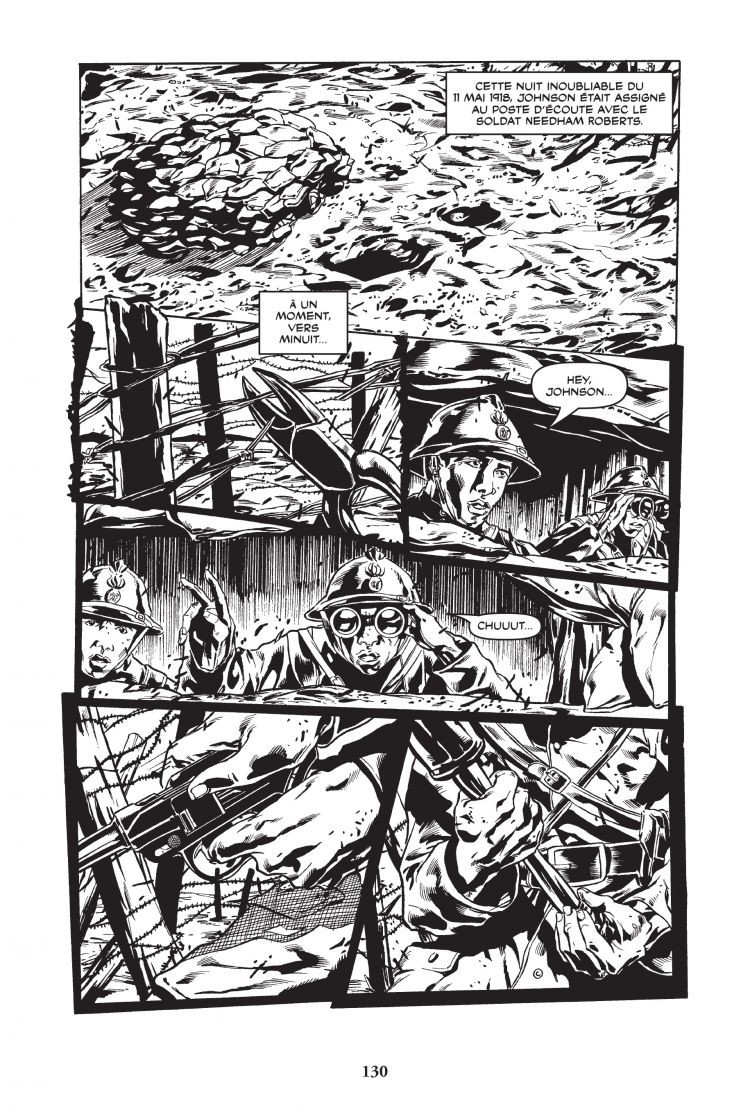
The Harlem Hellfighters is Max Brooks' history of an all African American unit (the 369th Infantry) that fought on the Western Front alongside French units. They mostly came from New York.

This unit was allowed to fight precisely because they were assigned to a mostly French army. The American army would not let African Americans fight and had originally used the 369th as laborers, alongside civilian laborers.

The French were in need of immediate manpower. French white soldiers already had experience fight alongside regiments of soldiers from their African colonies and were eager to bring American troops to the front, no matter their color.

The 369th spent more time than almost any other American unit on the front lines. They may have spent the most time on the front lines. They were the first Allied unit to reach the Rhine River. 

Legend has it that the nickname "The Harlem Hellfighters" was given to the unit by their German foes.

They were among the first units to return to the United States and were given the honor of marching in a tickertape parade in New York City.

My Review:

The story that Max Brooks tells in this graphic novel is a little herky jerky. He tells the story with plenty of emphasis on individual soldiers, the terrible conditions on the front, and the racism they experienced. But, the overall plot of the war is rather poorly told.


The biggest reason that I am giving this book a rating of 3 stars is the illustrations. I truly dislike the art style. I found it distracting and hard to follow. There were details that are included that just filled the page and often made it difficult for me to figure out what I was supposed to be looking at. I bought this graphic novel from an online source without having seen the art. I hated it so much that I didn't read this graphic novel for nearly 7 months. 

Note: The publisher says that this book is aimed at children 8-12 years old. I believe that all of those ages are too young. It has graphic depictions of the violence of trench warfare. There are bullets blasting though heads, spraying bloods and brains across the page. There is a depiction of a bayonet going into someone's mouth and coming out the back of his skull. 

To be clear, I DON'T have a problem with showing the war as it really was. I DO have a problem with showing an eight year old a soldier being vaporized by an artillery shell. I would give this book a PG-13 rating.

This graphic novel can be found on Amazon.com here: The Harlem Hellfighters by Max Brooks.

SING DOWN the MOON by Scott O'Dell


Originally published in 1970.

Named a Newberry Honor Book in 1971.

Set in the New Mexico and Arizona territories in 1863-1865, Sing Down the Moon is the story of a teenaged Navajo girl named Bright Morning. 

Despite the fact that the American Civil War is raging in the East, this is a tough time for the Navajo. There are pressures from the people they call Spaniards who raid the Navajo and other Native Americans in search of slaves (undoubtedly the "Spaniards" were Spanish-speaking Mexicans that were living in the territory before Mexico lost it to the United States at the end of the Mexican War in 1848.)

But, that's not the worst of it. In 1864, the U.S. military under Kit Carson (called Long Knives in this book) rounded up all of the Navajo and put them in a concentration camp called Bosque Redondo. The Navajo in the book are unsure as to why they were forced to come to the camp, but the ongoing threat of Confederate raids into Arizona and New Mexico had a lot to do with it. There were fears that the Confederates might combine with the Navajo or both groups could simply start independent attacks at the same time.

Or, they just wanted the land.

No matter the reasoning, this act was devastating to the real-life Navajo and to the Navajo characters in this book.

This book was a re-read for me. I read this book when I was in 4th or 5th grade and for the last 45+ years it has stayed with me. It's not like I was constantly thinking of the book, but when I saw a related movie or TV show or visited a historical site, flashes from the book would come to me. Recently, I had the chance to get a copy of the book and I snatched it up, hoping it would be as good as I remembered.

This book is a stark, quick book. It is very much a "just the facts" style book. There's not a lot of character development and the chaos visited upon the Navajo just keeps on coming. 

This is not an upbeat, happy book. Bright Morning is captured as a slave and later is forced to march to Bosque Redondo. But, it is a book about not giving up - no matter the situation. Bright Morning and the boy she loves, Tall Boy, are admirable characters. 

I rate this book 4 stars out of 5. It can be found on Amazon.com here: Sing Down the Moon by Scott O'Dell.

SUPERMAN SMASHES the KLAN (graphic novel) by Gene Luen Yang and Gurihiru


Winner of Will Eisner Comic Industry Award, 2021.
Winner of Harvey Award for Best Children or Young Adult Book.

Published by DC Comics in 2020.
Story by Gene Luen Yang.
Art by Gurihiru.

Superman Smashes the Klan is a graphic novel interpretation of a story arc from the old Superman radio show. At that time, Superman was the most popular radio show for children in the United States and the show's writers wanted to address racism with their young listeners. They wrote six 15 minute episodes with Superman opposing the racists of the Clan of the Fiery Cross.

This was a big risk. They were worried that it would turn off their fans since 1946 America was a very racist place. The actual Klan was experiencing a moment of resurgence. Superman had only been published for 8 years at the time - he was very new and his young fans and their families could reject this move into current day politics.

Turns out that the kids loved it. Ratings increased! Follow this link for another review on this topic.

This graphic novel adaptation is not a completely faithful re-telling of the radio drama. It has a whole layer of Superman still learning to accept all of his powers and his alien roots that runs along in tandem with white families in Metropolis learning to accept their new Chinese neighbors who have moved in from Metropolis' Chinatown neighborhood (and vice-versa.)

I really liked the clean art style in this graphic novel. There was no attempt to hide the art in shadows or make things overly-stylized. That being said, there are tons of dramatic angles to the drawings. Let's face it, Superman often brings a lot of drama, with all of the breaking through walls, leaping over tall buildings, and picking up cars. 

This was a fun graphic novel. I rate it 5 stars out of 5. It can be found on Amazon.com here: Superman Smashes the Klan.

LYNDON B. JOHNSON: A LIFE from BEGINNING to END (BIOGRAPHIES of U.S. PRESIDENTS) (kindle) by Hourly History


Published by Hourly History in March of 2024.

Hourly History publishes an extensive line of histories and biographies that are intended to be read in about an hour. With that limit, none of these are the definitive biographies, but most of them  give the average reader a good sense of who the person was and why they were important. 

Lyndon Baines Johnson (LBJ) was the 36th President of the United States. One thing I particularly like about this biography is that it tells about his formative experiences in Texas as a young man, especially his short stint as a public school teacher in a very poor area of rural Texas. Getting to know those students really gave him the desire to want to create government programs to help alleviate poverty. 

This biography is a little skewed towards Johnson's early life, but it's not particularly hard to find information about LBJ's time as President and the series offers books on the big events of his administration like the Vietnam War and the Civil Rights movement if you would like to read more.

I rate this e-book 4 stars out of 5. It can be found on Amazon.com here: Lyndon B. Johnson: A Life from Beginning to End

RUN: BOOK ONE (graphic novel) by John Lewis and Andrew Aydin


Illustrated by L. Fury and Nate Powell.
Published by Harry N. Abrams in 2021.


This spring I read the MARCH, the three volume graphic novel series about Congressman John Lewis (1940-2020) and the Civil Rights movement. When I finished the series, I thought to myself that it would be interesting to see how John Lewis ran for Congress and the struggles he encountered in an era where the KKK still openly marched.

My Synopsis:

The graphic novel RUN picks up right where MARCH trilogy left off. At the end of the MARCH trilogy, there was a celebration of the passage of the Civil Rights bills - a moment of success. There was also the murder of a volunteer who was helping with the celebration by anti-Civil Rights forces.

RUN explores what happened after the Student Non-Violent Coordinating Committee (SNCC) had it first taste of success. 
At the end of MARCH, there was a celebration of the passage of the Civil Rights bills. With that, a long-term goal achieved there was a lot of discussion about where to go next. there were a lot of things to consider, including the beginnings of the Vietnam War.

The discussions soon became arguments and those arguments led people to leave the SNCC and for the movement to fragment. Some pushed for more of the same strategies due to a belief in the power of non-violence and for the simple reason that they had been effective up to this point. 

Others, led by Stokely Carmichael, wanted to pursue separatist strategies. Eventually, this leads John Lewis to leave the SNCC and run for political office.

My Review:

As I look over what I wrote in my synopsis of the book, it sounds boring. It really was not. You normally don't hear much about the Civil Rights movement after the passage of the Voting Rights Act and the Civil Rights Act in 1964 and 1965, so I found it interesting.

Sadly, Lewis died before this book was finished and I doubt there will be more in this series. 

I rate this graphic novel 5 stars out of 5. It can be found on Amazon.com here: RUN by John Lewis and Andrew Aydin.

THE MOMENT: THOUGHTS on the RACE RECKONING THAT WASN'T and HOW WE CAN ALL MOVE FORWARD NOW (audiobook) by Bakari Sellers


Published in 2024 by HarperAudio.
Read by the author, Bakari Sellers.
Duration: 4 hours, 33 minutes.
Unabridged.


The Moment that Bakari Sellers refers to in his book is the so-called moment of racial reckoning that came with the murder of George Floyd and the protests all around the country that followed.

Sellers discusses a lot of relevant things that lead up to this moment including the murder of 9 African Americans by a young White supremacist in Charleston in 2015 and Covid-19. But, events like the Buffalo shooting of 2022, continued questionable acts of  and media and political-types discussing the Great Replacement Theory from 2017 until the present day have shown that moment of reckoning was not a big a moment that people supposed it was. Or, it demonstrates that the racist elements in America are pushing back hard.

I have run across Sellers as a guest on a couple of different podcasts that I follow and have always found him to be thoughtful and engaging. I have to admit, however, that I was a little disappointed in this book.

To me this book felt like two different books. I think there was too much time spent discussing the effects of Covid-19 on African American churches. Similarly, Sellers spent a lot of time discussing a police shooting case with an African American that he was involved in as an attorney. It is a sad commentary that I can say that I was only vaguely familiar with the case - and I'm not even sure if the case he referred to was the one I was thinking of because there are just so many.

The author
On the other hand, the other half of the book was compelling. He talked about the hope he had (and still has) after the George Floyd protests, his family, and some successes he has seen. 

Because of this wide variation, I am going to rate this audiobook 3 stars out of 5. This book can be found on Amazon.com here: THE MOMENT: THOUGHTS on the RACE RECKONING THAT WASN'T and HOW WE CAN ALL MOVE FORWARD NOW by Bakari Sellers

ATTUCKS! OSCAR ROBERTSON and the BASKETBALL TEAM THAT AWAKENED A CITY by Phillip Hoose


Published in 2018 by Farrar, Straus and Giroux (BYR)

NOTE: Also published under the title UNBEATABLE!

Attucks! appears to be just a story about a 1950's era basketball team, but it is much more than that.

it is the story of Jim Crow style racism in a northern state. It is the story of an underdog school getting its chance to compete at the highest level. It is the story of one amazing player, a great coach, and Indiana's famous single class basketball system.

First - the single class basketball system. Back in the 1900's, Indiana had a single class basketball system. This means that every team was in the same playoff system together - no matter how big or how small. This was highlighted in the based-on-a-true-story movie Hoosiers. The true story had Milan High School (161 students) beating Muncie Central (1600+ students) in 1954. Usually, it wasn't that dramatic of a disparity, but small town schools did very well from 1911-1954. The biggest city in the state, Indianapolis, won zero championships during that time.

This is where the story of Crispus Attucks High School comes in. Attucks was an all African-American segregated high school smack dab in the middle of the city of Indianapolis. Indianapolis was a late arrival to the Jim Crow practice of segregated education (Attucks opened in 1927.) The school was named for the Crispus Attucks, an African-American and the first person to die in the Boston Massacre and possibly the American Revolution.

Attucks vs. Tech - a massive rivalry. Attucks is wearing the darker jerseys.

Attucks was prohibited from playing in the high school tournament until 1942 because...well, there really was no legal reason so we can just chalk that up to racism.

The book focuses on the development of the Attucks basketball program until it became a powerhouse in the 1950's. It's not just that though. This was the first really good team to come out of Indianapolis. It was all African-American in a highly segregated city. It had style, class, and pride in its underdog status. It had perhaps the best player to come out of Indianapolis ever - Oscar Robertson (no kidding - he was astoundingly good.) They won 45 games in a row and won back-to-back state championships in 1955 and 1956. 

How good was this team? The author tells the story of a game that Attucks won 123-59. A player on the losing team was crying after the embarrassing loss. His father told him, "You might as well stop that crying. Because can't nobody beat them. You ought to be glad you ever played against them." (p. 152)

I rate this book 5 stars out of 5. It is very readable and told the human side of the story very well. It can be found on Amazon.com here: ATTUCKS! OSCAR ROBERTSON and the BASKETBALL TEAM THAT AWAKENED A CITY by Phillip Hoose.


MARCH: BOOK THREE (graphic novel) by by John Lewis and Andrew Aydin


Published in 2016 by Top Shelf Productions

Written by John Lewis and Andrew Aydin.

Illustrated by Nate Powell.

2016 National Book Award Winner for Young People's Literature

2017 Printz Award Winner

2017 Coretta Scott King Author Award Winner

2017 Sibert Medal Winner

2017 YALSA Award for Excellence in Nonfiction Winner

2017 Walter Award Winner

Congressman John Lewis (1940-2020) continues his life story in book three of the March series, focusing on his struggles in the Civil Rights Movement. The book starts with the 16th Street Birmingham Church Bombing in September of 1963 and ends with the signing of the Voting Rights Act in August of 1965.

These were, by any account, much like the famous Charles Dickens line from A Tale of Two Cities: "It was the best of times, it was the worst of times, it was the age of wisdom, it was the age of foolishness, it was the epoch of belief, it was the epoch of incredulity, it was the season of light, it was the season of darkness, it was the spring of hope, it was the winter of despair..."

It was the best of times in that the Civil Rights Act of 1964 and the Voting Rights Act of 1965 were passed. It was the worst of times because of these landmark laws were passed due to great sacrifices. As noted on page 91, in the state of Mississippi in the summer of 1964 during an attempt to mobilize and register black voters there were "more than 1,000 arrests, 80 beatings, 35 church burnings, and 30 bombings."

A theme that runs throughout the trilogy is that every success is soured by a violent response. I was particularly struck by an act of pointless violence at the end of the book. When the march from Selma, Alabama to Montgomery, Alabama finally happens (it had been turned back on other attempts by violence and by court order) there is a rally, there are speeches, and a concert given by an amazingly diverse crowd of artists - diverse in race and in musical styles. What should have been a beautiful moment is marred by the murder of a volunteer driver named Viola Luzzo from Detroit. She was shuttling people back to Selma. She was heading back to Montgomery to pick up more people when a car pulled alongside. A single shot was fired and she was killed (see picture.)

This is an excellent trilogy and an excellent way to tell this history. I rate this book and the entire trilogy 5 stars out of 5. 

This book can be found on Amazon.com here: MARCH: BOOK THREE (graphic novel) by by John Lewis and Andrew Aydin.

Click here for March: Book One.

Click here for March: Book Two.

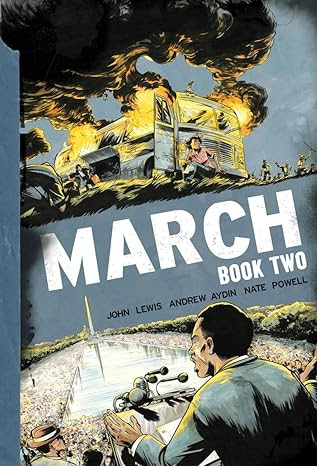
MARCH: BOOK TWO (graphic novel) by by John Lewis and Andrew Aydin


Published in 2013 by Top Shelf Productions.

Written by John Lewis and Andrew Aydin.

Illustrated by Nate Powell.

Congressman John Lewis (1940-2020) continues his life story in book two of the March series, focusing on his struggles in the Civil Rights Movement. The book starts in November of 1960 and ends with the 16th Street Birmingham Church Bombing in September of 1963.


The story includes some very harsh responses to attempts to integrate restaurants in Tennessee, the freedom riders (young African Americans were attempting to desegregate bus lines after a court ordered them to be desegregated), and the bus boycott campaign in Birmingham. 

The violent response is horrible and shocking

Infamous segregationist lawman Bull Connor of Birmingham figures prominently throughout the middle of the book. I am pretty well-versed in the major points of the Civil Rights Movement but I was still moved by the portrayal of the Children's Crusade.

The book includes all of the negotiations, concerns, and demands before the famed March on Washington. Lewis spoke at the march, followed by the world-famous "I Have a Dream" speech by Martin Luther King. 

And, as often happens in this history, a giant step forward is followed by tragedy. In this case, the book ends with the death of 4 girls in the terrorist bombing of a church in Birmingham. 

I rate this book 5 stars out of 5. It can be found at Amazon.com here: MARCH: BOOK TWO (graphic novel) by by John Lewis and Andrew Aydin.

Click here to see my review of March: Book One.

Click here to see my review of March: Book Three.

HOW the SOUTH WON the CIVIL WAR: OLIGARCHY, DEMOCRACY, and the CONTINUING FIGHT for the SOUL of AMERICA by Heather Cox Richardson


Originally Published in 2020.
Published by Oxford Press in 2022.


Historian Heather Cox Richardson has made herself into a name brand historian with her near-daily first drafts of history in which she writes up the day's political news and ties in similar historic themes or long-running trends. 

How the South Won the Civil War follows along those lines. 

The book looks at two long-standing trends in American points of view in American history that are in constant tension with one another.

This quote from page xv of the introduction gets the thesis of the book pretty well:

America began with a great paradox: the same men who came up with the radical idea of constructing a nation on the principle of equality also owned slaves, thought Indians were savages, and considered women inferior. This apparent contradiction was not a flaw, though; it was a key feature of the new democratic republic. For the Founders, the concept that "all men are created equal" depended on the idea that the ringing phrase "all men" did not actually include everyone."

She continues: "So long as these lesser people played no role in the body politic, everyone within it could be equal. In the Founders' minds, then, the principle of equality depended on inequality."

That is the heart of the thesis - some think that everyone should be able to participate, others think that only the best people should participate because some people cannot handle the responsibility (or just want to do all of the wrong things with the power.)

Richardson goes through history and shows how this has played out over the decades. A big theme is that, in general, the South has believed that not everyone should participate. The North has gone back and forth, but consistently more on the side on equality than the South. 

The Civil War was obviously a major flare up in this ongoing struggle and seemed to end the paradox once and for all. But, the same issues migrated west and the Western states generally joined the South as time went on, especially as the Democrats stopped being the conservative party when it came to race relations after the elections of 1964, 1968, and 1972. Movement Conservatives discovered that racists liked it when they said things like letting states keep their own rules about who gets to vote and being able to create special public schools so that they stay segregated.

Not every Republican followed this line of thought and the mainstream Republican Party denied that this line of thought even had a popular foothold. But, the Tea Party Movement followed by MAGA and Christian Nationalism has pushed the radicals (the old John Birch Society types) into the forefront. Trump didn't create it, but he found it and exploited it.

The MAGA movement and Christian Nationalism continues this cementing of the West and the South and the belief that some people should not have a say. Nowadays, it is not slavery or Jim Crow or forcing people to be IN the closet, but MAGA shows spend an inordinate amount of time on gay marriage, trans people, and the bogeyman of CRT. It's not the same old thing (well, it oftentimes is for the LGBTQ+ folks, especially for trans people) but it certainly rhymes.

The only complaint I have about the book is that the author fails to see that the same type of elitism exists in both parties.  Examples include FDR and his brain trust, a center-left media that laid out a certain world view for 40 years and still tries to (I mostly agree with that view, but I also acknowledge that it existed and still exists in a much weakened state.)

I rate this book 4 stars out of 5. It can be found on Amazon.com here: HOW the SOUTH WON the CIVIL WAR by Heather Cox Richardson.

MARCH: BOOK ONE (graphic novel) by John Lewis and Andrew Aydin


Published in 2013 by Top Shelf Productions.
Written by John Lewis and Andrew Aydin.
Illustrated by Nate Powell.

Winner: National Book Award

Winner: Will Eisner Comic Industry Award

Winner: Coretta Scott King Book Award

Winner: ALA Notable Books

Winner: Reader's Digest Graphic Novels Every Grown-Up Should Read

Congressman John Lewis (1940-2020) tells his life story in this graphic novel, focusing on his struggles in the Civil Rights Movement. This is the first book in a trilogy, covering the first 20 years of his life.

Lewis is interested in three things as a young man - education, preaching, and the Civil Rights movement. Lewis listens to the traditional African American leaders and he hears talk of moderation (or, even worse, nothing at all about Civil Rights.) He doesn't know what to do, but he knows this is not the way forward. 

Lewis's growing frustration and the moment when Lewis hears MLK.
One day, he hears Martin Luther King, Jr. speak over the radio and he knows the way to go: non-violent resistance.

The last half of the book goes into the effort to integrate lunch counters in several department stores in Nashville, Tennessee. He details the training, the cat and mouse tactics and the way the movement grew and grew to the point that it simply overwhelmed the legal system. 

So, the legal system withdrew and let vigilantes try to deter them. Anyone who has studied the time period knows about the violence and how it ended up in the end, but that doesn't stop the reader from being drawn in. 

This graphic novel can be found on Amazon here: MARCH: BOOK ONE (graphic novel) by John Lewis and Andrew Aydin.

Click here for my review of March: Book Two

BASS REEVES: TALES of the TALENTED TENTH, no. 1 by Joel Christian Gill


 Published by Fulcrum Publishing in 2014.

Artist and author Joel Christian Gill is writing and illustrating a series of graphic novels that look into the lives of lesser known, exceptional African Americans. His inspiration is this quote from W.E.B. DuBois: "The Talented Tenth rises and pulls all that are worth saving up to their vantage ground." In other words, some will rise up and inspire/lead the rest. This is Gill's way of providing inspiration.

Bass Reeves was a legendary lawman in the Old West. He was a Deputy U.S. Marshal that chased down bad guys who would flee into Indian Territory (Oklahoma and Kansas) to hide from law enforcement in the neighboring states. If you've seen either of the two versions of the movie True Grit, that is the exact situation. The character Rooster Cogburn would have been real-life Bass Reeves' co-worker if Cogburn were a real person.

The graphic novel tells about Reeves' childhood as a slave in Arkansas, how he escaped during the Civil War (he was brought along to work as a body servant for a Confederate officer) and eventually lived for a while with Indians in the Oklahoma and Kansas Territories. He was hired to help deal Marshals deal with Indians and eventually he was deemed to be so helpful and so good at his job that the local federal judge went against all of the normal conventions and made Bass Reeves a marshal.

It turns out that Marshal Bass Reeves was very, very good at his job - maybe the best.

The book addresses racial issues in a couple of clever ways. Whenever the word n***** is used, a stylized caricature of a man in "blackface" is inserted. Secondly, whenever Reeves is confronted by racists, they are partially or completely illustrated as crows with angry red eyes. There are crows fleeing the law, crows in court, etc.

The problem with this story is that although Reeves lived an interesting and amazing life, the book is kind of flat. 

I rate this graphic novel 3 stars out of 5. It can be found on Amazon.com here: 
BASS REEVES: TALES of the TALENTED TENTH, no. 1 by Joel Christian Gill.

See my review for a different book in this series HERE.

THE HOUSE on MANGO STREET (audiobook) by Sandra Cisneros

Originally Published in 1983.
Read by the author, Sandra Cisneros.
Duration: 2 hours, 18 minutes.
Unabridged

The House on Mango Street is the story of a Hispanic girl named Esperanza who grows up in a little house in a poor neighborhood in Chicago. Her story is told in a series of unrelated vignettes (44 in all) that tell some sort of story about her family life or the neighborhood itself. In some, the main character clearly has no idea of the more adult themes that occur around her, while in others she is very astute and understands the larger implications. 

At first, Esperanza's family intends that the house is going to be a temporary stop on their climb towards economic success in America. But, they never quite are able to move out of this troubled neighborhood and the reader is able to see how the neighborhood affects the lives of everyone around Esperanza as she grows up.

To be fair, the neighborhood is not all bad, but it is a tough place for children to grow up and keep their innocence. Some kids run away, some get married early and try to build some stability (one gets married extremely early.) Esperanza is determined to work her way out of the neighborhood and then come back and help others get out.

I read this book for two reasons:
1) It has a tremendous reputation. 
2) It has been placed on multiple book ban lists and I like to read those books to form my own opinion (unlike a lot of people who ban them.)

My review:

The author, Sandra Cisneros
I found that this book's biggest issue was that it was just boring. It's a 2 hours audiobook and I found myself wanting to listen to anything else at times. I simply could not get into this story. 

I certainly wouldn't ban this book. It has a lot of adult themes, but I think too many sheltered adults don't realize that a lot of kids live very unsheltered lives. This book will come off as very real to a lot of those kids, assuming that they can get past the back that it is a very, very tedious read. This 30+ year teacher would put it in a classroom library or in a school library and support any student wanting to read it. 

Here are two stories about districts that have banned this book - one based in Texas and one based in Florida.

I rate this book 2 stars out of 5. It can be found on Amazon.com here: 
THE HOUSE on MANGO STREET by Sandra Cisneros.


Featured Post

<b><i>BAN THIS BOOK (audiobook)</i></b> by Alan Gratz

Published in 2017 by Blackstone Audio, Inc. Read by Bahni Turpin. Duration: 5 hours, 17 minutes. Unabridged. My Synopsis Ban This Book is t...

Popular posts over the last 7 days