Showing posts with label Arkansas. Show all posts

VICKSBURG, 1863 by Winston Groom


Originally published by Knopf in 2009.

Winston Groom will always be best known as the author of Forrest Gump, but he should be equally well known as the author of a series of well-told American histories. Included in those histories is a trilogy of Civil War histories that focus on the Western Theater of the war.

Vicksburg 1863 is the second book in the trilogy, but it can be easily read as a stand-alone history. After a short introduction to the war itself, it follows Grant's campaign to take the Mississippi River away from the Confederacy, beginning with a mess of a battle in Missouri that proved nothing of any importance except that Grant was game to fight and push forward, even if the conditions were not perfect.

That, it turns out, was pretty much the key to Grant's eventual success in this campaign and in the war.

From there, we follow Grant through Kentucky, into Tennessee and the terrible Battle of Shiloh. Although ultimately successful, this marked a low point for Grant because he nearly lost his army. His immediate superior came to Shiloh to supervise him and killed most of the momentum of the campaign

Eventually, Grant regained his command (his superior officer was promoted to a desk position in the Eastern Theater) and began his campaign to remove the last major obstacle for Union control of the Mississippi River - Vicksburg, Mississippi.

Vicksburg was a challenge due to its location on an imposing cliff on a massive bend in the Mississippi River. The Confederate military placed cannons on the cliff that threatened any ship that dared to try to pass by. This book details the many efforts he made to bypass Vicksburg, including attempts to build a canal to reroute the Mississippi and an attempt to go through the swamps around Vicksburg. Eventually, he crossed the river south Mississippi and quickly moved his army to cut off Vicksburg, lay siege to it while also engaging and driving away any Confederate troops that could have helped to lift the siege.

Some people will argue with Groom's assertion that Grant did have bouts of drunkenness during the campaign. He describes a rather wild bender featuring Grant cruising through the swampy rivers north of Vicksburg during a lull during the siege, switching boats, and looking for more and more booze. Grant's defenders will deny it all, Grant's detractors will claim it was probably even worse. I go with the simple knowledge that addiction is powerful and Grant often brought along people that kept him accountable. If those people weren't around, I can easily imagine him falling off the wagon. Whether it was a wild run through the swamps or a binge drunk in the corner of a cabin...well, that depends on who told the story back then and who is writing the story now.

I rate this history 5 stars out of 5. It reads as easy as a novel. It can be found on Amazon.com here: Vicksburg, 1863 by Winston Groom.

See my review of Groom's Shiloh, 1862 here. 

THEY CALLED US ENEMY (graphic novel) by George Takei, Justin Eisinger, and Steven Scott


Published in 2019 by Top Shelf Productions.
Illustrated by Harmony Becker.

Winner of the 2020 Eisner Award for Best Reality-Based Work.

Winner of the 2020 American Book Award.


George Takei is most famous for his part in the the original Star Trek series and the subsequent movies. But, over the last 20 years or so, Takei has been on a personal crusade to make sure that the Japanese Internment Camps are not forgotten. 

President Franklin D. Roosevelt issued an executive order in February of 1942 to place all of the Japanese on the west coast of the United States into camps because they could not be trusted not to help the Empire of Japan. This order applied to all Japanese, even if there was absolutely no reason to suspect them of doing anything at all to help Japan. Takei's family was included in this round up and this graphic novel is that story.

The graphic novel format is ideal for the story of a young man caught up in a situation he cannot possibly understand. Takei does a good job of going back and forth from his childhood perspective to multiple adult perspectives (Takei at various points in his life) in order to explain things better.

I rate this graphic novel 5 stars out of 5. It can be found on Amazon.com here: THEY CALLED US ENEMY (graphic novel) by George Takei, Justin Eisinger, and Steven Scott.

Note: This book has been listed on multiple book ban lists - in Tennessee (use the searchable database because the list has more than 1,100 unique titles) in 2025 and in Pennsylvania right after it was published. I suppose that people are scared of learning America's history.

BASS REEVES: TALES of the TALENTED TENTH, no. 1 by Joel Christian Gill


 Published by Fulcrum Publishing in 2014.

Artist and author Joel Christian Gill is writing and illustrating a series of graphic novels that look into the lives of lesser known, exceptional African Americans. His inspiration is this quote from W.E.B. DuBois: "The Talented Tenth rises and pulls all that are worth saving up to their vantage ground." In other words, some will rise up and inspire/lead the rest. This is Gill's way of providing inspiration.

Bass Reeves was a legendary lawman in the Old West. He was a Deputy U.S. Marshal that chased down bad guys who would flee into Indian Territory (Oklahoma and Kansas) to hide from law enforcement in the neighboring states. If you've seen either of the two versions of the movie True Grit, that is the exact situation. The character Rooster Cogburn would have been real-life Bass Reeves' co-worker if Cogburn were a real person.

The graphic novel tells about Reeves' childhood as a slave in Arkansas, how he escaped during the Civil War (he was brought along to work as a body servant for a Confederate officer) and eventually lived for a while with Indians in the Oklahoma and Kansas Territories. He was hired to help deal Marshals deal with Indians and eventually he was deemed to be so helpful and so good at his job that the local federal judge went against all of the normal conventions and made Bass Reeves a marshal.

It turns out that Marshal Bass Reeves was very, very good at his job - maybe the best.

The book addresses racial issues in a couple of clever ways. Whenever the word n***** is used, a stylized caricature of a man in "blackface" is inserted. Secondly, whenever Reeves is confronted by racists, they are partially or completely illustrated as crows with angry red eyes. There are crows fleeing the law, crows in court, etc.

The problem with this story is that although Reeves lived an interesting and amazing life, the book is kind of flat. 

I rate this graphic novel 3 stars out of 5. It can be found on Amazon.com here: 
BASS REEVES: TALES of the TALENTED TENTH, no. 1 by Joel Christian Gill.

See my review for a different book in this series HERE.

OZARK DOGS (audiobook) by Eli Cranor


Published by Recorded Books in April of 2023.
Read by the author, Eli Cranor.
Duration: 7 hours, 29 minutes.
Unabridged.


I first heard  this book at an indie book store in a very hip part of the city. If you are an avid reader it is not hard to find more books than you should (or can) buy at one time - so I made a list.

This book was on the list and I really wish that it was half as good as I hoped it would be.

Synopsis:

Jeremiah Fitzjurls owns a junkyard at the edge of a dying Arkansas town. His son is in prison and he is raising his granddaughter. He is a grumpy old curmudgeon and she is an all around great kid. She works at an animal shelter. She is a cheerleader. She is smart. 

She is also sneaking away from the high school dance with the starting quarterback after homecoming...

Things don't end so well and she decides to walk back to the school rather than spend another minute with her boyfriend. That's when she is abducted by strangers...

My review:

This brooding book was a collection of regional tropes about the South,

1. Dying small town? Check.
2. The KKK? Check.
3. Meth? Check.
4. A sheriff from a family of sheriffs? Check.
5. A veteran with PTSD? Check.
6. Two families feuding? Check.
7. Family secrets that everyone in town seems to know about? Check.

Throw in an impossible number of over the top plot twists (including two at the end that were really simply TOO much) and you have a formulaic novel that seemed like it was looking for ways to keep the reader interested by including more and more plot twists. I was reminded of an improv group that I follow that said that they would kill scenes if they go too slow and were advised to add a "birth, death, or a major religious experience" to scenes to make them interesting.  That's great advice for an off-the-cuff improv scene but there's not really an excuse for that when it is a planned out book. 

The one real positive of the audiobook experience was that it was read by the author. He is very good at creating voices and putting emotion into his readings.

I rate this audiobook 2 stars out of 5. It can be found on Amazon.com here: OZARK DOGS by Eli Cranor.

THE ADVENTURES of HUCKLEBERRY FINN (audiobook) by Mark Twain


Originally published in 1884 (U.K.) and 1885 (U.S.)
This audiobook version published in 2008 by Tantor Audio.
Read by William Dufris.
Duration: 9 hours, 44 minutes.
Unabridged.


I would feel silly writing a synopsis of this book. This is the book that Ernest Hemingway said is the source of all modern American literature. It is almost universally recognized as not only "a" Great American Novel, but is oftentimes acclaimed as "THE" Great American Novel.

So, I will skip all of that discussion and just move on to a review of the audiobook presentation and what I thought of the book.

The audiobook reader was William Dufris (1958-2020),  a celebrated voice over actor and the reader of dozens and dozens of audiobooks. He did a fantastic job of creating voice after voice after voice. It was quite impressive.

An original illustration by E.W. Kemble
from the 1884 printing of this book
As for the novel, well that was less impressive than I remembered. I read this book in elementary school and almost all of the satire and character growth went right over my head. I re-read it in high school for an AP Literature class. We had to write a lengthy paper that we literally worked months on. We even took a trip to a university library to dig through the stacks to find literary criticisms and cite them. It was, by far, more complicated and longer than any other paper I wrote in my college career.

All of that work writing about the same book soured me on re-reading the book until now, 38 years later. 

So, what did I think?

I was surprised at how many of the plot points I had forgotten. For example, Tom Sawyer is in this book a lot more than I remembered and he is really annoying. I know that is intentionally built in as a part of the book for thematic reasons - Huck is on his way to being a man and Tom is still a boy in many ways - but I still felt that it was tough going when Tom is in the story.

It took me quite a while to get through this audiobook. I could only go for 20 minutes or so at a time and then I had to leave it for a while. In comparison, I listened to a different audiobook today for more than 4 hours. Maybe it was because it was told in first person, I am not sure. 

Despite the importance of this novel, I honestly can't rate it any more than 3 stars out of 5.

This book can be found on Amazon.com here: THE ADVENTURES of HUCKLEBERRY FINN by Mark Twain.

CIVIL WAR in the INDIAN TERRITORY by Steve Cottrell


Originally published in 1995.
Published in 1998 by Pelican Publishing Company.

The answer to one of the more popular Civil War trivia questions is: Stand Watie. The question is: Who was the last Confederate General to surrender at the end of the Civil War?

Stand Watie is unique because he is the only Native American to become a general during the Civil War. The Cherokee and other Indian Nations living in Oklahoma were drawn into the Civil War and fought in more than 30 engagements - some relatively small and some quite large. 

Slavery was a factor (Watie had slaves and a plantation), but there were also local political issues that were probably more influential. 

Like most of the fighting in the West, the battles were not large by Civil War standards, but the fighting was usually pretty personal. Villages were burned out, refugees fled by the thousands and it was not uncommon for soldiers to know the people they were fighting personally. Also, this front was one of the first to have African American soldiers fight. 

As a history, this book was very readable as an introduction. It is big on the action of the war and doesn't get much into the thoughts and motivations of the regular soldiers. For example, it would have been interesting to read about what white soldiers from Texas, Arkansas, Kansas and Wisconsin (a Wisconsin unit is mentioned throughout the book) thought about fighting alongside and/or against Native American and African American soldiers.

Also, there were a few times when Cottrell's text was over the top. For example, on page 76:
Stand Watie (1806-1871)
"Holding their rifles and cartridge boxes above their heads to keep their powder dry, the dauntless African-Americans sloshed through the waist-deep water to the opposite shore as bullets and buckshot flew around them. With warm adrenaline flowing through their veins, the former slaves followed their Anglo-Saxon colonel into the brush, overrunning the enemy rifle pits in a mad, fearless dash through the timber." 


I rate this book 3 stars out of 5. It can be found on Amazon.com here: CIVIL WAR in the INDIAN TERRITORY by Steve Cottrell.

RESERVOIR ROAD by John M. Spafford


Published in 2009 CreateSpace.


I picked this novel because I am a sucker for books set in my adopted hometown - Indianapolis. The author is a resident (or, he was when he wrote the book) and you can really tell that he knows his way around the East Side of Indianapolis (I am a West Sider but I get all over town).

Reservoir Road starts with a lovely couple who buy a fixer-upper on Indianapolis' East Side (Irvington) and he starts a career as a teacher. They have a baby and then he loses his wife and son in an unexplained double murder in Covington, Kentucky. The surviving husband doesn't even know why they were in Covington and the murder is never solved.


He cannot deal with this and tries to solve the murder himself. He just cannot. But, he is moved to do something. While on the Crime Stoppers website (If you are not familiar with Crime Stoppers, they offer reward money for tips that lead to arrests and convictions) he realizes that there are so many victims like him - and decides that if he cannot solve his own case he will solve another.

So, he prepares himself and heads off to Little Rock, Arkansas to solve a mystery...
A store front in historic Irvngton


(Note: I keep saying "he" because, for the life of me, I cannot find the protagonist's name in the book. I believe that he is unnamed.)

With the exception of the very clunky treatment of the murder of his wife, this book is well done. I realize that the murder of his wife is supposed to be jarring, but this was just confusing. But, I very much enjoyed the rest of the book, including the little details about how he prepared himself, rented his apartment in Little Rock and generally began his re-entry back into society as he hunted for a murderer in Little Rock.

Quote from the book:


"His summer project had suddenly turned very dangerous. This was not the world that he was used to. He was a stranger in this culture of robbery, torture, threats, and murder. Now he was dealing directly with men who were prepared and experienced with using guns in their everyday pursuits. Men who did not hesitate to use deadly force to get what they wanted.

"Men like the ones who had already destroyed his life."

I rate this novel 4 stars out of 5.

This novel can be found on Amazon here: Reservoir Road

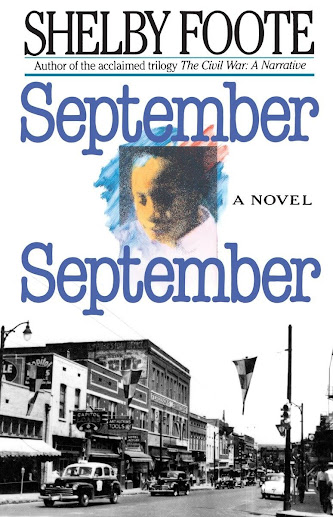
September September by Shelby Foote


Sex and kidnapping in 1957 Memphis

Originally published in 1978.

Shelby Foote is most famous for his massive history of the Civil War (The Civil War: A Narrative), but he was also an author of fiction. I have read several of them and they mostly qualify as Southern gothic - moody, dark and full of tragedy. September September fits that description perfectly, although it takes place later than his other novels.

Set against the backdrop of the racial integration of Little Rock Central High School in September of 1957, the novel features two white men and a white woman who kidnap the grandson of a wealthy black Memphis businessman. They use the Little Rock incident as their cover to blame the kidnapping on racial strife when it is really a brazen attempt to get $60,000 from a man who will not expect much cooperation from the police.

Shelby Foote (1916-2005)
The problem is summed up in a line from one of the kidnappers: "Truth is, we're not very smart, those of us who go in for crime." A sexual triangle forms between the three kidnappers. Anger and jealousy start to take precedence over "the plan" with tragic results.

Foote does a great job of creating characters with a past that feels real and his dialogue is first rate. The most interesting character to me was Theo, the grandfather who pays the ransom. His story would have been worthy of another book.

A surprising part of the book was the frequent and open discussion of sex. Racial tension is the topic of the book - racial strife in Little Rock, as the purported excuse for the kidnapping, as the source of anger in Eben's (the kidnap victim's father) burgeoning racial consciousness - but that is really a veneer. The real topic is sex and how it can strengthen, confuse and even weaken the bonds between men and women. There are quite a few graphic scenes, much more than I remember in his other novels.

I rate this book 4 stars out of 5.

Reviewed on July 15, 2011.

This book can be found on Amazon.com here: September September by Shelby Foote.

A Painted House by John Grisham


The unabridged audiobook is excellent


Published by Bantam Doubleday Audio in 2001
Duration: 12 hours, 7 minutes
Read by David Lansbury
Unabridged

I am not a giant fan of Grisham's latest legal thrillers but I am becoming a fan of his non-lawyer books, such as Bleachers and A Painted House. Grisham's non-legal novels are wonderful "slice of life" views of rural/small town America.

A Painted House is a rite of passage novel about a 7 year old boy (Luke Chandler) growing up on an Arkansas cotton farm in 1952 with his parents and grandparents. His uncle is off fighting the war in Korea.

It is the beginning of the two month long picking season and his family hires some hired hands to help pick the cotton. They hire a combination of "hill people" (poor whites from up in the Arkansas hills) and Mexicans who are literally trucked into Arkansas in the trailer of a semi as if they were cattle.

Luke learns a lot during this season, including about love, baseball, violence, cruelty, sacrifice, bravery, family pride, television, hard work, floods and failure. If you have worked on a family farm at any time this book will bring back a flood of memories. I was reminded of my grandparents, the massive Sunday meals, putting up hay, shoveling soybeans, riding on the tractor and plenty more. I doubt Mr. Grisham will ever read this, but I'd still like to thank him for refreshing those memories.

The author, John Grisham
The audiobook is about 12 hours in length and is read very well by David Lansbury who gives distinct and realistic voices to everyone. I especially enjoyed the grandmother's voice - it reminded me of plenty of the older ladies' voices at my church as I was growing up.


Kudos all around.

I rate this audiobook 5 stars out of 5.

This book can be found on Amazon.com here: A Painted House by John Grisham.

Reviewed March 27, 2009.

Featured Post

<b><i>BAN THIS BOOK (audiobook)</i></b> by Alan Gratz

Published in 2017 by Blackstone Audio, Inc. Read by Bahni Turpin. Duration: 5 hours, 17 minutes. Unabridged. My Synopsis Ban This Book is t...

Popular posts over the last 7 days