Showing posts with label revolutionary. Show all posts

PANCHO VILLA: A LIFE from BEGINNING to END by Hourly History


Published by Hourly History in 2021.

I think this is the third book I've read in the last few years that is at least partially about the Mexican Revolutionary Pancho Villa (1878-1923). I read two that were basically about American responses to Villa's cross-border excursions  (and near misses) into the United States for money and supplies.

Each entry in the Hourly History series is, by definition, a short book. Each entry is supposed to be read in about an hour.

This biography was neither bad nor good. It did tell the basically outlines of his life without giving the reader much a sense of the man. Even worse, Villa will forever be associated with the Mexican Revolution but this book did a pretty poor job of explaining the complicated politics that Villa tried to navigate. It seemed that he was an insider one week, on the outs the next week, and running for his life the week after that and I had no understanding as to why that was.

A good basic intro, but nothing more.

I rate this e-book 3 stars out of 5. It can be found on Amazon.com here: Pancho Villa: A Life from Beginning to End by Hourly History.

AGE of REVOLUTIONS: PROGRESS and BACKLASH from 1600 to the PRESENT (audiobook) by Fareed Zakaria


Published by Simon and Schuster Audio in 2024.

Read by the author, Fareed Zakaria
Duration: 13 hours, 2 minutes.
Unabridged.

Fareed Zakaria's Age of Revolutions: Progress and Backlash from 1600 to the Present is exactly what the title says it is.

Zakaria writes about the beginnings of capitalism, multi-cultural societies, globalism, democracy, the industrial revolution, the French Revolution, the Russian Revolution, Fascism, the failed Arab Spring, LGBTQ+ rights, and the rise illiberal democracy and the return on authoritarianism and the forces that pushed back (or overturned) them.

The author
Zakaria has clearly done his research and writes in such a way that it flows from one topic to another almost as if they entire book was just one big story (which it is, if you look at it as the story of humanity, especially The West.)

If you find yourself wondering how we got here, this is a good place to start. Zakaria breaks down complex movements and ideas and makes them understandable.

I rate this audiobook 4 stars out of 5. It can be found on Amazon.com here: Age of Revolutions: Progress and Backlash from 1600 to the Present by Fareed Zakaria

SIMON BOLIVAR: THE GREAT LIBERATOR (World Landmark Series) by Arnold Whitridge


Published in 1954 by Random House.

In the 1950's and 1960's Random House created an extraordinary history series for children called Landmark Books. There were 122 books in the American history series and 63 in the World Landmark series. A very solid description of the series can be found here: link. When I was a kid my little hometown library had what seemed like an endless shelf of these books. I loved these books - I even remember where it was in the library nearly 40 years later! Undoubtedly, these books are part of the reason I am a history teacher.
Simon Bolivar (1783-1830)

This book is part of a subset of the Landmark Books series. If the book took place outside of the United States the book belonged to the World Landmark Books series.

Simon Bolivar was born in the Spanish colony that is now Venezuela. He was educated in Spain but was keenly aware that the government of Spain considered the colonies to be inferior to Spain and incapable of self-government. He doubtless shared that belief until he began to spend time with the children of the Spanish ruling class (including the future King of Spain) and discovered that they weren't all that impressive. Once Napoleon conquered Spain and put his brother on the throne, Bolivar pushed for a revolt. Some, like Bolivar, were pushing for independence no matter who was on the throne, but others who joined him simply wanted to revolt as a part of a general resistance to Napoleonic rule.

Regardless of the initial motivations, Bolivar soon led a multi-colony revolt that went on for 11 years. Eventually, Bolivar helped to liberate the colonies that make up the modern countries of Venezuela, Colombia, Ecuador, Bolivia and Peru.

Many have compared Bolivar to George Washington, including Arnold Whitridge, the author of this book. There are surface similarities, but Bolivar's fight was much longer and (I would say) much more of a geographical challenge. Bolivar crossed the Andes range multiple times with armies that suffered horrific losses simply from the geography. In fact, while doing a bit of research on Bolivar while writing this review, I found that the Wikipedia page for Bolivar does a much better job of stating the sheer monumental scope of his accomplishments than this book did. For example, he fought in 79 major battles, traveled 10 times the distance of Hannibal, 3 times the distance of Napoleon and twice the distance of Alexander the Great. If you can be can be compared favorably to that crowd, you are truly a military genius. In this respect, Washington certainly comes up short.

Sadly, Bolivar was not a political genius and he could never figure out a way to unite the former Spanish colonies into one large country that he wanted to call Gran Colombia. This is where Washington's strengths come into play. Not only was he able to win the military fight, he was able to help establish the concept that the colonies were going to become one country and the military would not lead that country.

This book is aimed at students from 3rd to 8th grade. It is a simple read with line drawings. It could use a few more maps. To be fair, it was merely an "okay" introduction to Simon Bolivar and his accomplishments (see above about the Wikipedia page).

I rate this book 3 stars out of 5. It can be found on Amazon.com here: 
SIMON BOLIVAR: THE GREAT LIBERATOR (World Landmark Series) by Arnold Whitridge.

FAMOUS LATIN-AMERICAN LIBERATORS by Bernadine Bailey


Published in 1960 by Dodd, Mead and Company 
Part of the "Famous Biographies for Young People" series

In the 1950s and 1960s, it was common for the children's section of the library to have scads of biographies like this one. Most of them were about 100 pages of a simple biography of a single person, featuring a lot about that person's childhood. They must have been effective because I remember enthusiastically plowing through them and learning about Daniel Boone, Abraham Lincoln and other historical figures. Now, I am a history teacher.

This series is a variation on that theme. Rather than a single biography, it features approximately 12 page biographies (they vary in length) starting with a line drawing. All of the biographies are very readable, if not particularly compelling. But, in the days before the internet, books like this were gold if you were a young scholar assigned a write a report about a historical figure.

Other books in this extensive series include: Famous American Poets, Famous Pioneers for Young People, Famous Engineers and Famous Modern American Women Writers.

I rate this book 3 stars out of 5.

This book can be found on Amazon.com here: FAMOUS LATIN-AMERICAN LIBERATORS by Bernadine Bailey.

Founding Father: Rediscovering George Washington by Richard Brookhiser


An interesting biography, a valuable perspective


Published in 1997.

Founding Father: Rediscovering George Washington is not a long biography (199 pages), but it is an interesting piece of writing. It is split into 3 areas - about one-half of the book is straight biography, about one-third is an analysis of the character of our first president and the balance is an analysis of what it means to be a founding father, how Washington measures up to that ideal and what kind of "father" he was.

The biography section is great - straightforward and written in an engaging and lively style. The character portion bogs down quite a bit and the founding father section is interesting (it asserts that he was the kind of father who was most concerned with preparing his children for life outside of his home - life on their own. He encourage other people to step into leadership roles to fill the vacuum that would be there when he walked away from the national spotlight.)

One quote, above all, highlights the best parts of Washington. It comes from Napoleon, who comments in a moment of self-pity after Waterloo, "They wanted me to be another Washington." Think of it - Washington was handed the power to be a dictator and he turned it down. In fact, this book mentions that in all of Washington's letters, he only gets truly angry at one man, and immediately writes a rough letter to a colleague who suggests that Washington make himself king when the Articles of Confederation government begins to founder.

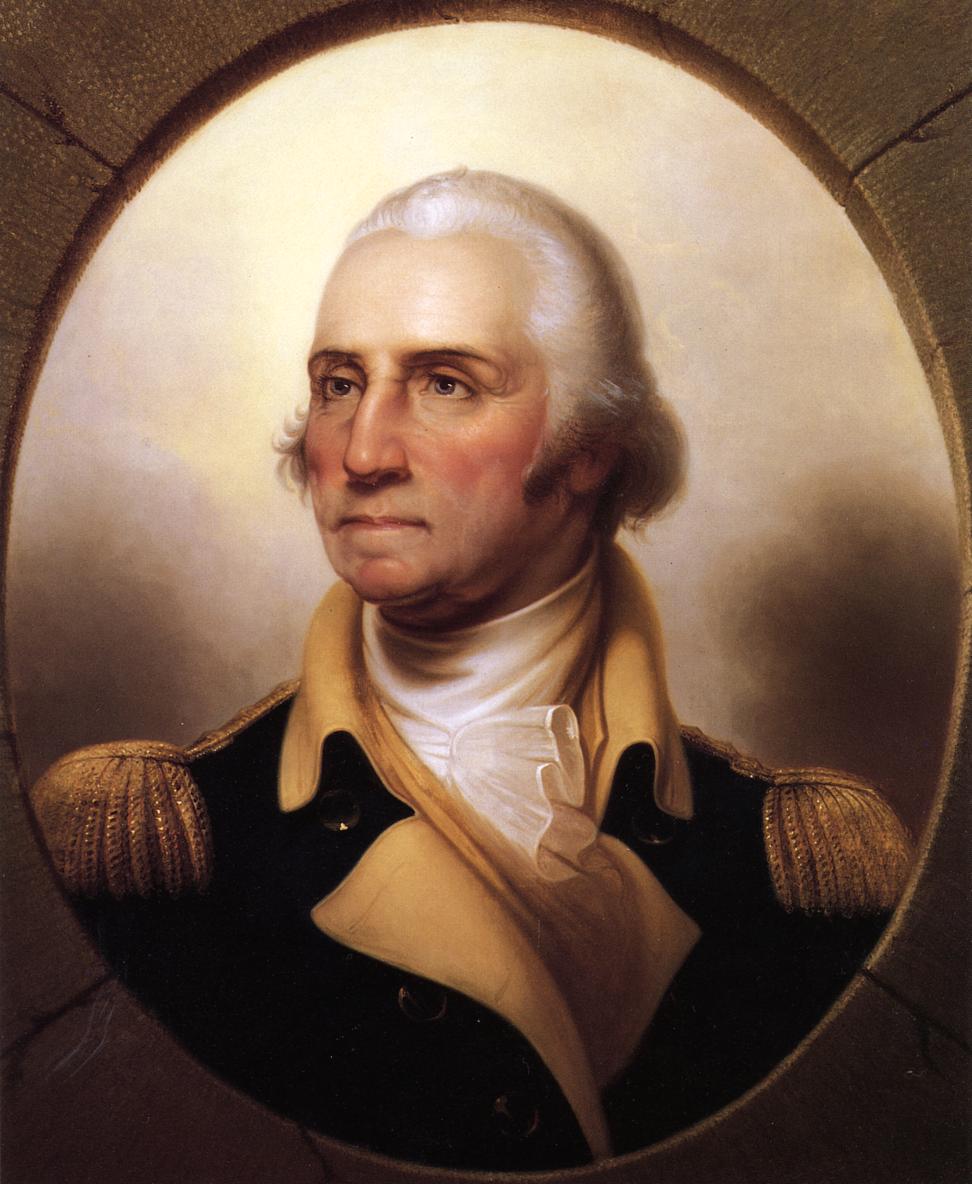
George Washington
(1732-1799)
Brookhiser makes an interesting observation about Washington's impact on American politics by pointing out the length of time he was nationally prominent in comparison with other American leaders. For example, FDR was president for 12 years, Reagan was only politically important for the 8 years of his presidency, Eisenhower was important for the 8 years of his presidency plus his time as a general in WWII (12 years total). Lincoln - 7 years if you count from the time of the famed Lincoln-Douglas debates in 1858. Washington, in comparison was a national figure for 24 years - 17 of them as the leader of the country (you've got to count him as de facto leader of the country while he was leading the Continental Army since everybody knew that if he failed the whole Revolution would fail).

Brookhiser focuses on Washington and slavery in the character portion of the biography and, while Washington does not live up to modern standards on this issue, he was remarkably progressive for his time. He refused to sell any of his slaves since that would tear apart families. He is the only American president who freed his slaves upon his death. Washington seems to have dealt with the contradictions of "All men are created equal..." and slavery by mostly ignoring it.

So, to sum up, there are 3 sections to the book and I found the middle section to be a bit tedious.

I rate this book 4 stars out of 5.

This book can be found on Amazon.com here: Founding Father: Rediscovering George Washington.

Reviewed in August of 2004.

Featured Post

<b><i>BAN THIS BOOK (audiobook)</i></b> by Alan Gratz

Published in 2017 by Blackstone Audio, Inc. Read by Bahni Turpin. Duration: 5 hours, 17 minutes. Unabridged. My Synopsis Ban This Book is t...

Popular posts over the last 7 days