Showing posts with label World War I. Show all posts

THE HINDENBURG DISASTER: A HISTORY from BEGINNING to END (kindle) by Hourly History


Published in July of 2025 by Hourly History.


Hourly History specializes in little histories that take about an hour to read. For me, an hour of reading about the Hindenburg is about right. 

The Hindenburg Disaster is a short history that details the beginnings of zeppelins/blimps through the tragedy of the complete destruction of the German zeppelin Hindenburg in just 32 seconds in New Jersey in 1937. 

Germany was a focal point for building blimps/zeppelins during World War I and before World War II. The blimps went from being potential military airships to being experimental ways to travel. One has to remember that airplanes were even more experimental way to travel.

Any sort of air travel was going to be prohibitively expensive - only the richest of the rich could afford it. Blimps/zeppelins offered a stately, luxurious ride - planes were seen as a noisy and cramped and inferior alternative.

This short history chronicles the struggles of the blimp/zeppelin industry during the 1920's. When the Nazis took control of Germany, they saw zeppelins as a way to demonstrate German technical excellence and as a way to flout restrictions on German airships. One can see now that the idea of taking a blimp into a World War II fighter plan dogfight would be suicidal, but that was not always clear in the early 1930's.

Eventually, the German government decided that zeppelins were a great propaganda machine inside and outside of Germany. They are attention-getting, massive, and the Nazis slapped a big Nazi swastika on the side of them to generate publicity.

This history does a good job of describing the technical reasons for the Hindenburg disaster - including the surprisingly small number of deaths for such a massive fireball. But, it does a rather poor job of telling the story of blimps/zeppelins after the Hindenburg. This disaster practically destroyed the idea of luxury travel in zeppelins and the book gives the impression that that disaster sort of wiped out the entire concept.

But, any American sports fan knows that this is simply not true - the Goodyear Blimp shows up at every major sporting event and provides "aerial coverage." It used to be accompanied by the Fuji Film Blimp, although I haven't seen that one in a while.

The fact that this history spent so much time detailing the history of zeppelins prior to the disaster and tells almost nothing about them after the disaster is a major oversight.

Fun fact that I discovered while writing this review: A successor company to the company that operated the Hindenburg operates the Goodyear Blimp in Europe. Mentioning this fact would have been a great way to end this short history. 

This history can be found on Amazon.com here: The Hindenburg Disaster: A History from Beginning to End by Hourly History.


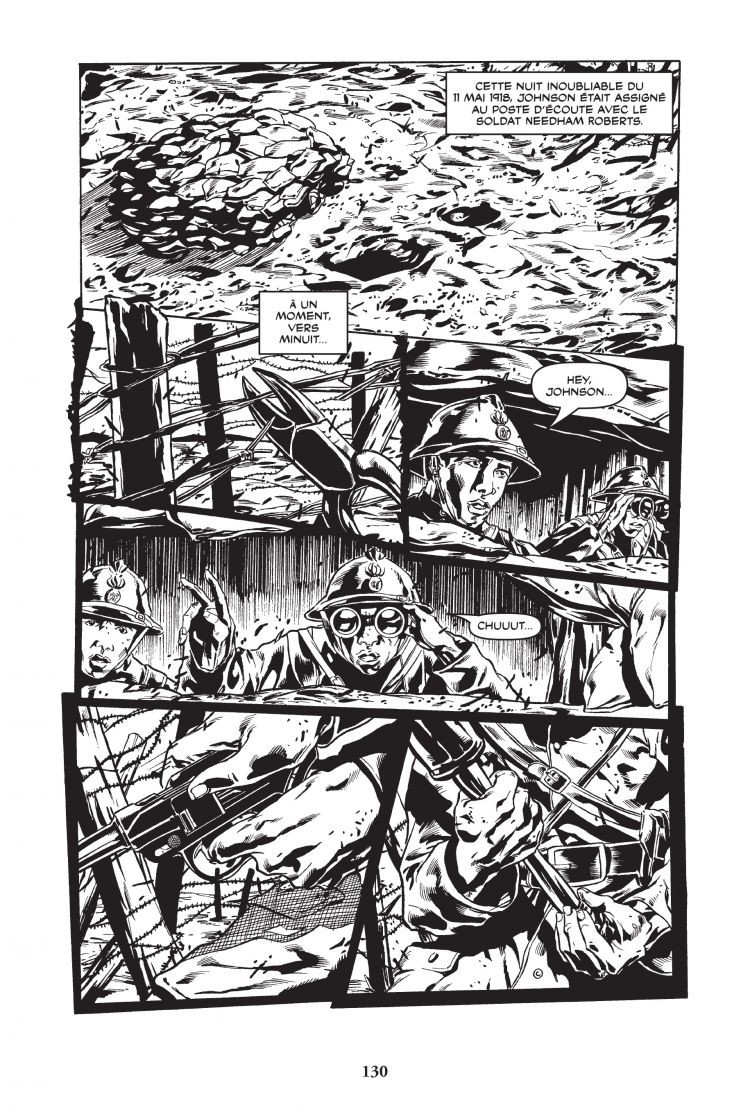
THE HARLEM HELLFIGHTERS (graphic novel) by Max Brooks.


Published by Del Rey in 2014.

Illustrated by Caanan White.

Synopsis:

The Harlem Hellfighters is Max Brooks' history of an all African American unit (the 369th Infantry) that fought on the Western Front alongside French units. They mostly came from New York.

This unit was allowed to fight precisely because they were assigned to a mostly French army. The American army would not let African Americans fight and had originally used the 369th as laborers, alongside civilian laborers.

The French were in need of immediate manpower. French white soldiers already had experience fight alongside regiments of soldiers from their African colonies and were eager to bring American troops to the front, no matter their color.

The 369th spent more time than almost any other American unit on the front lines. They may have spent the most time on the front lines. They were the first Allied unit to reach the Rhine River. 

Legend has it that the nickname "The Harlem Hellfighters" was given to the unit by their German foes.

They were among the first units to return to the United States and were given the honor of marching in a tickertape parade in New York City.

My Review:

The story that Max Brooks tells in this graphic novel is a little herky jerky. He tells the story with plenty of emphasis on individual soldiers, the terrible conditions on the front, and the racism they experienced. But, the overall plot of the war is rather poorly told.


The biggest reason that I am giving this book a rating of 3 stars is the illustrations. I truly dislike the art style. I found it distracting and hard to follow. There were details that are included that just filled the page and often made it difficult for me to figure out what I was supposed to be looking at. I bought this graphic novel from an online source without having seen the art. I hated it so much that I didn't read this graphic novel for nearly 7 months. 

Note: The publisher says that this book is aimed at children 8-12 years old. I believe that all of those ages are too young. It has graphic depictions of the violence of trench warfare. There are bullets blasting though heads, spraying bloods and brains across the page. There is a depiction of a bayonet going into someone's mouth and coming out the back of his skull. 

To be clear, I DON'T have a problem with showing the war as it really was. I DO have a problem with showing an eight year old a soldier being vaporized by an artillery shell. I would give this book a PG-13 rating.

This graphic novel can be found on Amazon.com here: The Harlem Hellfighters by Max Brooks.

BALKAN WARS: A HISTORY from BEGINNING to END (kindle) by Hourly History


Published in September of 2024 by Hourly History.

I consider myself pretty well-versed in modern history, but I literally knew almost nothing about the wars that ran rampant through the Balkans just prior to World War I. I knew the area was all in an uproar, but I had no idea that the region had seen multiple all out wars rage throughout in just a few years. Those wars set up the scenario that directly led to World War I.

Hourly History specializes in writing histories and biographies that can be read in about an hour. That was enough time for this little history. The reader learns of the decline of the Ottoman Empire and how that created a power vacuum in the Balkans. Then, the reader learns how various ethnic groups in the region fought for their independence and earned it only to fight among themselves over the borders of disputed regions. 

Finally, the reader sees how the intervention of the great powers led more fighting and eventually to World War I.

This is a very readable history, but it is hurt by a lack of maps.

I rate it 4 stars out of 5. It can be found on Amazon.com here: Balkan Wars by Hourly History. 

GALLIPOLI CAMPAIGN: A HISTORY from BEGINNING to END (kindle) by Hourly History


Published by Hourly History in December of 2022.

The short histories produced by Hourly History are designed to read in about an hour. In some cases the size limit makes for a very incomplete history. In this case, I thought that topic and the size limit matched up pretty well.

The Gallipoli Campaign was an unmitigated disaster during World War I. Winston Churchill (yes, the famous one from World War II) was the head of British navy and thought up a plan to do three things:

1) relieve the pressure on Russia from the Germans and the Ottomans;
2) possibly knock the Ottoman Empire out of the war;
3) encourage the Germans to divert more troops away from the French front to support the Ottoman Empire.

The plan Churchill came up with was to land thousands of soldiers from France, Britain, Australia and New Zealand on the Gallipoli Peninsula at the edge of the Aegean Sea in a quick and bold attack.

Troops from Australia and New Zealand landing at 
Gallipoli - April 25, 1915.
What actually happened was bold, but certainly not quick. The attack was disjointed and so poorly planned that the Ottomans were entirely prepared for the invasion...

Normally, I really don't care much for studying up on World War I - it was started for rather silly reasons in my opinion and the United States had little reason to get involved (Yes, I know that the Gallipoli campaign was before the U.S. got involved.) 

That being said, I was glad to learn more about the campaign that is always referred to in the histories I have read, but never explored in any sort of depth. This book gave me enough information to fill in this gap in my knowledge to my satisfaction.

I rate this book 4 stars out of 5. It can be found on Amazon.com here: GALLIPOLI CAMPAIGN: A HISTORY from BEGINNING to END (kindle) by Hourly History.


WAR on the BORDER: VILLA, PERSHING, the TEXAS RANGERS, and an AMERICAN INVASION (audiobook) by Jeff Guinn


Published in 2021 by Simon and Schuster Audio.
Read by Timothy Andres Pabon.
Duration: 10 hours, 10 minutes.
Unabridged.


Synopsis:

The famous expedition into Mexico led by "Black Jack" Pershing to punish Pancho Villa in 1916 and 1917 is the stated topic of this book. However, this book is much more than that. It is a look at the Mexican Revolution (1910-1920) and World War I (1914-1918) and America's rather aggressive foreign policy in Latin America.

Within most Americans' living memory the United States had taken on the responsibilities of empire by defeating Spain in the Spanish-American War in 1898. The United States took the Philippines, Guam, Cuba and Puerto Rico and immediately got involved in a fight against Filipino insurgents and independence movements that lasted more than a decade. The concept of foreign intervention was not a new one and the impulse to intervene remained strong.

With war in Europe looming, the Mexican Revolution made America nervous. An unstable Mexico looked like an invitation for European intervention. America directly intervened multiple times, including the well-known punitive mission led by Pershing to capture or kill Pancho Villa. 

Villa led one of the many revolutionary armies that was trying to change the government in Mexico. Sometimes they worked together, sometimes they fought each other as much as they fought the government. Villa was on the decline, having been beaten multiple times and reneging on several promises to him men. 

But, Villa understood "media" as it was then. He had been the subject of a Hollywood movie, including actual footage of his men "in action". He got his name and his image in the newspapers regularly - always with the same exciting look - a big sombrero, a big mustache and bandoleers full of ammunition.

Villa decided to shake things up. He needed money, he needed attention, financial support and volunteers to join him and an attack on the United States itself might just do it. He attacked Columbus, New Mexico. He needed the loot but more importantly, he needed to look like he had no fear of Mexico's neighbor. He also figured (correctly) that America would intervene and the Mexican people would reflexively come to his aid with money and volunteers (not really). 

*******

My review:

This book is a big sprawling book and it is mis-titled in my opinion. The actual punitive mission by Pershing mentioned in the title takes up maybe 1/3 of the book. It's not that the other information wasn't relative, there was just so much of it and I did not think it was not organized particularly well. It's like the author just kept collecting tons of relevant information and somehow couldn't cull it down to the original theme of the book - Pershing vs. Villa and couldn't organize it in a compelling way. 

Some critics have gone after the author for pointing out that the border situation simply seethed in racial tension and the Texas Rangers were far from the noble heroes you see in Chuck Norris' TV show Walker: Texas Ranger. I literally have no issue with the facts that he presented. I have an issue with the presentation of the facts.

I rate this audiobook 3 stars out of 5. It can be found on Amazon.com here: WAR on the BORDER: VILLA, PERSHING, the TEXAS RANGERS, and an AMERICAN INVASION by Jeff Guinn.

PABLO PICASSO: A LIFE from BEGINNING to END (Biographies of Painters #5) by Hourly History


Published in 2020 by Hourly History.

Despite me having talked extensively about Pablo Picasso (1881-1973) in my recent review of an e-book about Francisco Franco, I am not an expert on Picasso, but I know way more than the average person. He has some paintings that I really like, but I am mostly not a fan. 

This short biography hit the spot in that it covered the details of his life without focusing too much on one particular part. This covered his 70+ year career in an even manner and included his personal life well.
Pablo Picasso in 1962

The real weakness of this e-book was the fact that they couldn't license his paintings and insert them into the book. But, since I read this on my cell phone it was pretty easy to switch to the browser and search the piece of art that was being discussed and take a look at it.

I wasn't much of a fan of Picasso as a person before I read this book and my impression was not changed one bit.

I rate this e-book 4 stars out of 5. It can be found on Amazon.com here: PABLO PICASSO: A LIFE from BEGINNING to END (Biographies of Painters #5) by Hourly History.

GRIGORI RASPUTIN: A LIFE from BEGINNING to END (kindle) by Hourly History


Published in 2017 by Hourly History.

I am an avid reader of history, but I have areas of weakness that I am perfectly willing to shore up a bit, but I don't want to invest a ton of time. I want to know a bit more, not become an expert. The Russian Revolution one of those areas for me. I know a lot more than most people, but I can clearly see the that there is a lot that I don't know.

Rasputin is, of course, an iconic, almost mythical personality of the Russian Revolution. This series specializes in short biographies and histories that will take the average reader about an hour to read. There are plenty of people and historic events that I would like to know a little more about, but not necessarily commit to reading a 500 page biography or history. 

Rasputin is one of those people for me - interesting but not really worth that much of an investment of my time.

I've read a few biographies from Hourly History and, without a doubt, this was the best of the lot so far. Rasputin was an immensely interesting personality and this short biography did a very solid job of balancing the early part of his life with his more famous later years. 

I rate this short e-book 5 stars out of 5. It can be found on Amazon.com here: GRIGORI RASPUTIN: A LIFE from BEGINNING to END by Hourly History.


HOW to HIDE an EMPIRE: A HISTORY of the GREATER UNITED STATES (audiobook) by Daniel Immerwahr


Published in 2019 by Recorded Books.
Read by Luis Moreno.
Duration: 17 hours, 25 minutes.
Unabridged.

If I asked you to think of a map of the United States you would almost certainly imagine the contiguous 48 states and maybe imagine the little inset maps of Alaska and Hawaii. 

But, you probably would not imagine other areas like American Samoa being a part of that map. How about Guam or the U.S. Virgin Islands even though the people who live there are American citizens? How about Puerto Rico? Puerto Ricans are citizens and Puerto Rico has a population bigger than at least 15 states.

How to Hide an Empire is about how America has maintained an empire of sorts from the very beginning. At first, it was by continually moving out of the official states into Indian territory, Mexico, Spanish territory and English territory. The United States took several strategic "guano" islands that were not claimed by anyone in the late 1800s. The United States has held a traditional empire since the Spanish-American War in 1898 when it took the Philippines, Guam, Puerto Rico and Cuba. It went on the acquire other properties by trading and conquering during the World Wars (the World War II section of this book is excellent).

Nowadays, the United States maintains a hybrid empire. It has kept some territories and turned others into states (Hawaii and Alaska) but it has also tried something new. 

The United States seems to have learned a lesson with its experience in the Philippines. The United States spent a lot of time, treasure and blood pacifying the Philippines only to have it become a liability during World War II - the Japanese attacked it within hours of the attack on Pearl Harbor. The U.S. quickly granted the Philippines its independence and changed its "business model".

Rather than conquer and hold other countries, the United States has maintained an immense series of bases and installations across the world. The most famous is probably Guantanamo Bay in Cuba, but others include Ramstein Air Base in Germany with 53,000 people.

On the other end of the spectrum there are also tiny little properties that house radio listening stations or broadcasting stations.   According to this article by the Libertarian think tank the Cato Institute, the United States has about 750 foreign military installations around the world - 
 three times as many installations as all other countries combined. Note the article is an opinion piece and the Cato Institute is generally of the opinion that the U.S. military should pull back. They always write with a political point in mind, but I don't usually find the Cato Institute to be untruthful.

This was an interesting look at American history. Some of it is shameful - such as the medical experimentation that has done on unsuspecting Puerto Ricans. Some of it is amazing - such as the immense supply chain that the U.S. used to supply Chinese forces and help keep the Japanese bogged down in China throughout the war. The supply line flew through 4 continents, over two oceans, the world's largest desert and over the world's tallest mountain range. It supplied the model for the base system the United States uses now. 

I rate this book 5 stars out of 5. It can be found on Amazon.com here: HOW to HIDE an EMPIRE: A HISTORY of the GREATER UNITED STATES by Daniel Immerwahr

1914 by Jean Echenoz (translated by LInda Coverdale)


Published in 2014 by The New Press

Synopsis:

It is 1914 and World War I is starting. This story is about 5 young men who live in a small town in France leave together to join the fight. 

If you have studied this war, you know that this war was a meat grinder from one end of it to the other, but the beginning of any war is especially rough. The technologies have changed but the techniques have not kept up. Men die and get maimed out of ignorance. This war is no different.

My Review:

I have no problem with the depiction of anything in this book. But, I do have a problem with the book's lack of passion. No one is particularly excited about life before the war, during the war and definitely not after the war. Everything is stated matter of factly. I lnow it's a style thing but it served to push me away from the story rather than draw me in. If the characters can't muster enough interest to care, why should I?

I rate this book 2 stars out of 5. It can be found on Amazon.com here: 1914 by Jean Echenoz (translated by LInda Coverdale).

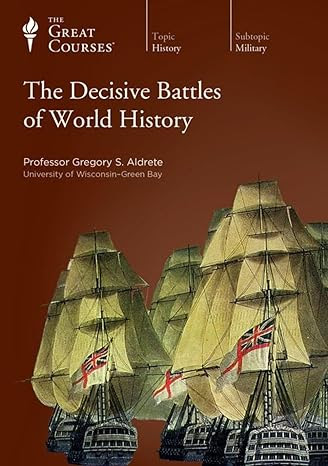
THE DECISIVE BATTLES of WORLD HISTORY (The Great Courses) (Audiobook) by Gregory S. Adlrete


Published by The Great Courses in 2014.
Lectures delivered by the author, Gregory S. Aldrete.
Duration: 18 hours, 29 minutes.
Unabridged.

As long as there has been war, there has been discussions about which battles were the most important, the most pivotal. This takes some analysis, since the temptation might be to simply discuss the battle that finally ended a long conflict, like Appomattox was the functional end to the American Civil War. 

The temptation might also be to collect a list of the biggest battles of history, but that would exclude Aldrete's tiniest choice - the Battle of San Jacinto. While that battle had less than 2,500 soldiers, he persuasively argues that the battle not only made Texas independent from Mexico, it also set off a chain of events that led directly the the American Civil War, Reconstruction and more.

In The Decisive Battles of World History, Adlrete presents the battles in chronological order and spends at least as much time on the background information of each battle as he does on the battles themselves. A few of the entries are not battles, but are entire campaigns.
The Battle of San Jacinto

Almost all of these lectures are informative and entertaining, but I did find the one set in Medieval Japan to be very hard to follow. I found that to be surprising since I took two classes on this topic back in college. 

I rate this audiobook 4 stars out of 5. It can be found on Amazon.com here: THE DECISIVE BATTLES of WORLD HISTORY (The Great Courses) (Audiobook) by Gregory S. Adlrete.

A HOBBIT, A WARDROBE and a GREAT WAR: HOW J.R.R. TOLKIEN and C.S. LEWIS REDISCOVERED FAITH, FRIENDSHIP and HEROISM in the CATACLYSM of 1914-1918 (audiobook) by Joseph Laconte


Published in 2015 by Thomas Nelson.
Read by Dave Hoffman.
Duration: 6 hours, 38 minutes.
Unabridged


A Hobbit, a Wardrobe and a Great War is a decent introductory history of World War I from the point of view of the common English soldier, a decent (but incomplete) look at the philosophical and religious trends of the West before and after World War I, decent introductory biographies of C.S. Lewis and J.R.R. Tolkien and really kind of a pleasant mess of a book.

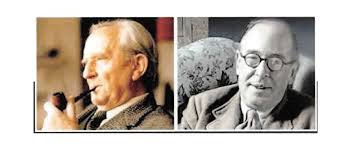
Tolkien (1892-1973) and Lewis (1898-1963)
All of these topics are thrown into the mix in a willy nilly. If that concept bugs you, this is not your book. I found it to be a pleasant enough listen, even if not particularly deep. 

I think the author makes his best points about the complete and utter waste and despair of a World War I battlefield when he compares it to the waste and desolation of Tolkien's Middle Earth battlefields and its heroes. The heroes are not generally the big leaders - they are flawed. They refuse to fight, have preconditions, are misinformed or are so full of their own agendas that the war becomes secondary.

Instead, the true heroes are people like Faramir, the younger brother of the "chosen one" hero whose pride and greed almost ruins the venture from the start. Or, it is 2 little hobbits who no one expects anything from. They literally have no power and yet they convince the very trees of the forest to stride out and destroy one of the enemies' strongholds. Of course, Sam Gamgee stands as the greatest hero of them all in my mind. He is the modeled from the stereotypical British World War I common foot soldier who heads off to fight in the war because it is his duty and keeps slogging all the way through to the end because his friends need him and it is simply the right thing to do. No pretense, just heart.

The connections with C.S. Lewis' fiction were a little less strong for me because I am not as familiar with his work. 

I rate this audiobook 4 stars out of 5. It can be found on Amazon.com here: A HOBBIT, A WARDROBE and a GREAT WAR: HOW J.R.R. TOLKIEN and C.S. LEWIS REDISCOVERED FAITH, FRIENDSHIP and HEROISM in the CATACLYSM of 1914-1918 by Joseph Laconte.

FOR the COMMON DEFENSE: A MILITARY HISTORY of the UNITED STATES of AMERICA by Allan R. Millett and Peter Maslowski


Originally published in 1984 by The Free Press.

Note: This is a review of the original version of this book, published in 1984 and ending with the first Reagan administration. It has been expanded and updated to include events up to 2012.

Way back in my undergrad days at Indiana University I took a class called American Military History. It was taught by a visiting professor from West Point and FOR the COMMON DEFENSE: A MILITARY HISTORY of the UNITED STATES of AMERICA was an excellent choice for the text for the class.

For 30+ years I have carried this book around with me - through 5 different moves and who knows how many book shelves this book was the anchor of my history section because it is quite beefy. But, I decided it was time to clear out some books. Technically, this book was a re-read but I didn't really remember anything from all of those years ago so...

The book starts with colonial defense and moves along with the same format up through the early 1980's. There is a chapter about a war or conflict followed by a chapter on the interwar years followed by a chapter on the next war or conflict. 
Soldiers in the Korean War in 1950.
Each chapter is about 30 pages with a bibliography, with the exception of World War II and the Civil War - they are each covered by two chapters. 

Generally speaking, the war chapters are more interesting than the interwar chapters. The interwar chapters can get bogged down in detailed discussion of the upper level command structure of the military (Joint Chiefs of Staff, the role of the Secretary of War/Defense, etc.) , but I found the interwar chapter that covered Reconstruction and the Gilded Age to be one of the best in the book. 


It is striking to read how American defense policy changed radically after World War II and the book provides little discussion of those changes, it just notes that they happened.

I rate this book 4 stars out of 5. It can be found on Amazon.com here: FOR the COMMON DEFENSE: A MILITARY HISTORY of the UNITED STATES of AMERICA by Allan R. Millett and Peter Maslowski.

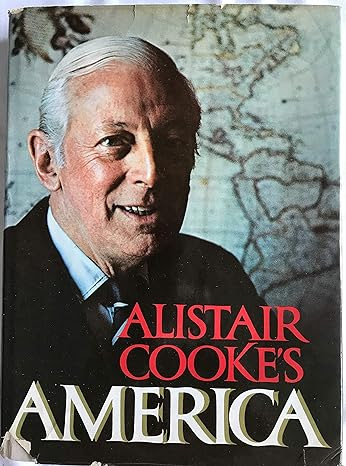
ALISTAIR COOKE'S AMERICA by Alistair Cooke


Published in 1973.

In 1973, undoubtedly to prepare for the upcoming 1976 bicentennial of the American Declaration of Independence, BBC reporter and author Alistair Cooke released a book and a television mini-series telling the history of the United States to the U.K. The book and the series came to America as well with the book selling nearly 2 million copies. This massive "coffee table" type book has 393 pages and weighs in at 3 pounds, 9 ounces (compare that to a random paperback book I weighed at just 5 ounces).

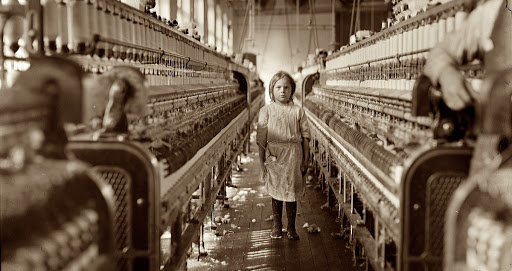
Photo by Lewis Hine
Cooke presents a straight-forward history of America, skimming over lots of details but getting the highlights. This has to be the case when you cover more than nearly 500 years of history in less than 400 pages. He focuses half of the book on the exploration/colonial/Revolutionary War/Constitutional era and it is by far the strongest part of the book.

This book is filled with beautiful, sometimes profound photographs. On pages 312-313 there is a two page spread of a lynching. Cooke claims that "no one knows who took this picture, or exactly when." (p. 311)   It was taken by Lawrence Beitler in Marion, Indiana on August 7, 1930. Beitler sold this photo for 10 days straight to sell as souvenirs of the lynching. Here is a link to a great book on the topic: 
A Lynching in the Heartland: Race and Memory in the Heartland by James H. Madison. Here is a link to the Wikipedia page on this lynching: Lynching of Thomas Shipp and Abram Smith.

The photograph of the girl working in a clothing factory in North Carolina is another great photograph in book full of great paintings and photographs. I have included it in this review.


It is very readable, but clearly a product of its time, and Cooke is a reporter, not an historian. The book has a bit of a racist feel to it. For example, when discussing where the United States lays on the globe (not too hot, not too cold), he notes: "...the United States spans the limits of the climates that white men can live and work in." Cooke mostly skips over the Native American civilizations that inhabited the Americas before Columbus. He spends almost as much time discussing entertaining but mostly nonsensical theories about the Phoenicians settling in the Americas as he does the actual Native American civilizations themselves. Cooke's reasoning is that he is covering a history of the United States itself, so Native Americans get the short end of the stick, except as an impediment to American expansion for the first 2/3 of the book.

Cooke does a similarly poor job dealing with African Americans, a group that he cringingly calls "the blacks" throughout. 
He does, however, clearly observe (in a clunky manner) that slavery and the continuing racial prejudice against African Americans is an ongoing open sore and has never been dealt with properly.

Final rating - 4 stars out of 5, keeping in mind that this history book is clearly old enough to be an historical artifact itself.

It can be found on Amazon.com here: 
ALISTAIR COOKE'S AMERICA by Alistair Cooke.

SERGEANT STUBBY: HOW a STRAY DOG and HIS BEST FRIEND HELP WIN WORLD WAR I and STOLE the HEART of a NATION (audiobook) by Ann Bausum


Published in 2014 by Blackstone Audio.
Read by Pam Ward.
Duration: 5 hours, 12 minutes.
Unabridged.


Sgt. Stubby wearing his medal vest (left), marching in a parade
(upper right) and wearing his special gas mask (lower right).
During the quick basic training for American forces heading for France in World War I, a stray dog found its way into a Connecticut National Guard training camp at Yale University. The unit was sprawled all over the campus and this Boston Terrier mix wandered around making friends all over. His friendly nature guaranteed a lot of table scraps. He marched with the men, learned the commands and blended in as well as a dog can. Somewhere along the way, someone taught him how to salute and hold the salute until it was returned.

When it came time to board a ship and head to France, the soldier that he spent the most time with, Corporal James Robert Conroy, hid him under his coat as others provided a distraction. Once aboard, Stubby ensured he got to stay with his friends by saluting any superior officer that questioned his presence and all resistance melted away.

Stubby stayed with his friends in France. He served several months in the trenches, participated in 17 battles, was wounded by a German hand grenade, was wounded by German poison gas, helped locate wounded soldiers in the "no man's land" between the trenches, single-handedly captured a German spy (he grabbed his pants with his mouth and made a ruckus until human soldiers came) and won admirers everywhere he went.

The title of this book exaggerates the importance of Sgt. Stubby to the war effort. He was immensely important to Conroy and their circle of friends, but the title makes it sound like Sgt. Stubby turned the tide of the war or something.

The book is equal parts a biography of Sgt. Stubby and a history of the era in which he lived. It's also a pretty serviceable history of World War I and includes discussions of movements in American history like the suffragette movement, the anti-alcohol campaigns that resulted in Prohibition and the rise of the FBI.

The audiobook was extremely well read by Pam Ward. I hope to come across other audiobooks read by her.

I rate this audiobook 5 stars out of 5. It can be found on Amazon.com here: SERGEANT STUBBY: HOW a STRAY DOG and HIS BEST FRIEND HELP WIN WORLD WAR I and STOLE the HEART of a NATION.

STRANGE FRUIT, VOLUME II: MORE UNCELEBRATED NARRATIVES from BLACK HISTORY (graphic novel) by Joel Christian Gill


Published in 2018 by Fulcrum Publishing.


In a little more than 100 pages this graphic novel tells the story of eight little-known African Americans who lived trailblazing lives. I had heard of three of them, which made me feel a little more pretty good - a little more informed than the average reader might be.

As Gill tells these stories he confronts racial issues head on. However, he does have a clever way of dealing with the word n*****. Whenever that word is used, a stylized caricature of a man in "blackface" is inserted instead. It makes the point and it shows how out of bounds the word is when a picture is used instead of a word.

The art is simple and interesting and the stories move at a quick pace. This book would be a great addition to a classroom library.

I rate this book 4 stars out of 5. It can be found on Amazon.com here: STRANGE FRUIT, VOLUME II: MORE UNCELEBRATED NARRATIVES from BLACK HISTORY.

A PEOPLE'S HISTORY of the UNITED STATES by Howard Zinn

Originally published in 1980 by HarperCollins. 
Multiple updated editions have been printed.

Howard Zinn's (1922-2010) A People's History of the United States is perhaps the most famous and most controversial history book in publication today. 

I read this book because the former governor of my home state of Indiana and current President of Purdue University, Mitch Daniels, repeatedly criticized it and actually advocated blocking its use in public schools in Indiana, including Indiana University. Governor Daniels used to be a frequent guest on a local newstalk radio station in Indianapolis and this book came up enough times in the conversations that I became aware of it. Before that I had never heard of it - but he certainly put it on my radar. That's not really what he had intended, I am sure.

I found my copy of A People's History of the United States in a local thrift shop on a half price day, which made this book a true bargain at $1. I decided that, as a good and loyal American I absolutely had to read the book that my state government's former chief executive had decided was "truly execrable" and tried to remove from Indiana University classrooms and see for myself if he was right.

Zinn has a theme that he hits consistently throughout his book and it is that the "haves" are continually using and abusing the "have-nots" throughout American history although, sometimes, the "haves" give in a bit and let some of the "have-nots" get a little more because it ensures their survival at the top. He argues that this was the case during the American Revolution. He would have been a big promoter of the idea of the 1% vs. the 99% that has come into vogue lately.

He also argues that the elites stoke class envy and racial animosities to create internal rivalries among the lower classes so that they fight among themselves and fail to see who their true enemy is. Throughout the entire book, the details change but this is the basic story.

As a history book, this book succeeds fabulously at hitting that one note over and over and over and over ad nauseam. Is he right? Sure - to a point he is right throughout the book. For example, he is right that the founders envisioned limited participation from the common man in the early American republic. But, other arguments sound hollow. 


For example, on page 37 of my 1990 edition he argues that racial animosities were practically created by the elites as a way to control the slaves. It is a clever argument and it is the culmination of a long argument that he had been making in the previous pages concerning the presence of anti-miscegenation laws in the new world. His presumption that, if left to themselves, the lower classes would have not had any racial issues because the passing of these laws shows that the elites were bothered by interracial romance and conspired to stop it before the lower class united and overthrew them. This sounds too organized for my tastes. Also, I have less faith in human nature than Zinn does - the same base thoughts that he despises in the upper class exist across all of the classes.

Strengths:

-The discussion of Andrew Jackson and Indian Removal.


-The discussion of the labor movement during the Gilded Age/Robber Baron era was particularly well-written and flowed well.

-He covers the governmental overreach during World War I well.

Weaknesses:


-He wrote this book as an antidote to the "hero" version of history - the version that teaches about George Washington's battlefield exploits but overlooks the fact that he held slaves. Sadly, in his zeal to set the record straight, he often overlooks the good (or even great) points about heroes that he is out to debunk. 


-The Andrew Jackson section says literally nothing about Jackson's strongest political fight - his fight against the National Bank. I would have appreciated a look at how the defeat of this bank and the subsequent "panic" (economic recession/depression) affected regular Americans.

-Sadly, he often ignores the "people" and creates a new set of heroes to replace the ones he has debunked. But, he does little to debunk his new heroes so the reader is left with, essentially, the same problem. Also, this does not make it a true "people's" history since people like Frederick Douglass and Emma Goldman are so extraordinary that they are, by definition, not stand-ins for the "everyman".

-The sections on the Vietnam War and the 1970's suffer from just being written too close to when the book was originally printed (1980). I think he was so close to the events that he had a hard time determining what was truly important and what was trivia. This made the book bog down with things like his stories of community newspapers printed on ditto machines as a sign that media was changing. When compared to the tsunami of change that the internet brought to media just a few years later, these little stories are quaint and irrelevant. 

-During the Cold War sections, he never addresses what the other side in this Cold War was doing and at least acknowledging that America and its allies had reasons to be wary of the USSR and its allies.

************

As I stated above, Zinn hits one note throughout the book. This note does appear in most mainstream history books, but not in great quantity. So, the book has value in that it does bring that part of American to the forefront. But, since it does not waver from its obsessive focus, it becomes a tool of limited value. To quote Abraham Maslow: 
  "I suppose it is tempting, if the only tool you have is a hammer, to treat everything as if it were a nail."

Now, to go back to the beginning of my review - would I outlaw this book from being used in a classroom? No, of course not. But, I do not think it should be the only text used in a class. Individual chapters are sold as smaller books and I think that would be appropriate. If it were a year-long class I might have students read the whole thing so long as they were reading lots of other works.

I don't see what the big fuss is on either side, to be honest.

I rate this book 3 stars out of 5.

This book can be found on Amazon.com here: 
A People's History of the United States.

NOTE:
Mitch Daniels, the Indiana governor that wanted to literally outlaw the use of this book in any school in Indiana, was appointed President of Purdue University when his term as governor ended by the Purdue Board of Trustees. He appointed most of those members and is widely considered to have appointed himself through that board. In my opinion, this attempt to stifle academic freedom should have made him ineligible to hold any position at a university, let alone be president of one.

A SHORT HISTORY of the WORLD (audiobook) by Christopher Lascelles


Published by Tantor Audio in 2016.
Read by Guy Bethell.
Duration: 7 hours, 20 minutes.
Unabridged.


The entire history of the world is less than 7 and 1/2 hours? Yep, that's what Christopher Lascelles purports to offer in his A Short History of the World. He acknowledges that this is not a complete history - he never intended it to be. Instead, his aim is to connect some of the dots that the average reader may have picked up in history class, movies and History Channel documentaries (and hopefully spark a bit more interest).

Lascelles does succeed in hitting many of the high points and certainly does a better job at not being as Eurocentric as other short world histories have been, such as A Little History of the World by E.H. Gombrich. Lascelles spends quite a bit of time discussing China, Japan, India and Mongolia. All that being said, there are entire civilizations that are ignored or get nothing more than a passing nod. That is always the problem when writing a history of the world - what do you leave in? What do you leave out?

Julius Caesar (100 B.C. to 44 B.C.)
England gets a bit more of the limelight than it deserves, in my opinion. Not way out of proportion, but a bit. That is to be expected, thought, since the author is from London.

Really, the only complaint I have about the book is its size limits it - but that is the entire point of the book - it is a SHORT history after all.

Guy Bethell read the audiobook and he did a good job. I blew right through the audiobook in 2 days. It was put together in an interesting and logical way.

I rate this audiobook 5 stars out of 5 and it can be found in multiple formats on Amazon.com here: A SHORT HISTORY of the WORLD by Christopher Lascelles.

BLACK PROFILES in COURAGE: A LEGACY of AFRICAN-AMERICAN ACHIEVEMENT by Kareem Abdul-Jabbar and Alan Steinberg


Originally published in 1996.

With Black Profiles in Courage, Kareem Abdul-Jabbar presents a look at American history through a different lens than you usually see. This book follows from even before the arrival of Columbus through Rosa Parks receiving her just accolades in the 1990's. His underlying theme, as explained in the title, is that African-Americans have been contributing in important ways the entire time, but they are often "whitewashed" from history.

Abdul-Jabbar is best known for his time as a top-level basketball player. But he is not just a jock (if you are a fan, you know he never was JUST a jock.) He is also an amateur historian - and quite a thoughtful one. Clearly, he was inspired by the book Profiles in Courage by John F. Kennedy but this book is not structured in any way like that classic.

The book starts with its weakest proposition from a historical perspective. There are historians that assert that African peoples were heavily involved in Mesoamerican history (Mayas, Aztecs, Olmecs) and Abdul-Jabbar agrees with them. While it is interesting to ponder, I think that, at best, it can be said that there maybe some influence there - or maybe not. We cannot be definitively sure, even if there are tantalizingly suggestive clues, due to the lack of historical records on both sides of the Atlantic and a genetic record that has been muddled by intermixing for the last 500+ years. 

But, the rest of the book is really quite strong. I very much enjoyed his biographical sketches of Crispus Attucks, Harriet Tubman and Frederick Douglass, especially Crispus Attucks. Abdul-Jabbar makes a solid case that the people he discusses should be part of everyone's history books, not just special themed history books.

I rate this book 4 stars out of 5.

This book can be found on Amazon.com here: BLACK PROFILES in COURAGE: A LEGACY of AFRICAN-AMERICAN ACHIEVEMENT by Kareem Abdul-Jabbar and Alan Steinberg.

SOLDIER! DISCOVER 15 WARRIORS THROUGHOUT HISTORY by Paul Beck


Published in 2015 by Scholastic 

Paul Beck's SOLDIER! looks at 15 examples of soldiers throughout history, starting with Imperial Roman infantry and ending with a U.S. Navy Seal. It is composed of 48 8.5 x 11 inch pages and includes a full-color tear-out poster of every soldier. 

Most descriptions are 4 pages, including a map where the soldiers would have operated. It also includes a full page drawing of the soldier with notes about the weight and length of their weapon(s). The third and fourth pages include more information about optional weapons, training or tools. 

The only complaint I have about the book is that it could have included a little more diversity. 12 of the 15 soldiers came from Europe or America. For example, the Aztec warriors that confronted Cortes had unique weapons and armor and would have been a great addition. 

That being said, the book was well-done. The pictures were interesting as were the factoids. This would be a good book for students from 4th to 8th grade.

This book can be found on Amazon.com here: SOLDIER! DISCOVER 15 WARRIORS THROUGHOUT HISTORY by Paul Beck.

THE GENERALS: PATTON, MACARTHUR, MARSHALL and the WINNING of WORLD WAR II (audiobook) by Winston Groom


Published in November of 2015 by Blackstone Audio, Inc.
Read by Robertson Dean
Duration: 16 hours, 2 minutes
Unabridged

Winston Groom, forever associated with his iconic character Forrest Gump, has written an interesting and solid history of three equally iconic World War II generals: George Patton, Douglas MacArthur and George Marshall. 

Groom's triple biography format works quite well as all three of these men's life stories were on parallel tracks once they entered World War I and they all knew one another and had worked with one another in one capacity or another through the years (the story of Patton and MacArthur meeting up and working together on the front lines of World War I is a great one).

The histories of these men during peacetime only served to reinforce my impression that both of these men were eccentric, sometimes to the point of being bizarre - especially Patton. But, in wartime these men all shined, despite some controversies. I never had much of a positive opinion about MacArthur. He always seemed to me to more of a strutting peacock than he was a competent general - more good PR than real talent. But, this book has changed my opinion of the man's talents as a general. Still a strutting peacock, though...

This was an enjoyable and informative read. Winston Groom weaves the three biographies together in an interesting way, generally using their parallel lives to reinforce each other's stories. The reader, Robertson Dean, gave distinctive voices to each of the three generals and his reading enhanced an already strong text. 

I rate this audiobook 5 stars out of 5.

This audiobook can be found on Amazon.com here: The Generals: Patton, MacArthur, Marshall and the Winning of World War II

Featured Post

<b><i>BAN THIS BOOK (audiobook)</i></b> by Alan Gratz

Published in 2017 by Blackstone Audio, Inc. Read by Bahni Turpin. Duration: 5 hours, 17 minutes. Unabridged. My Synopsis Ban This Book is t...

Popular posts over the last 7 days