Showing posts with label Michigan. Show all posts

WE LIVE HERE: DETROIT EVICTION DEFENSE and the BATTLE for HOUSING JUSTICE (graphic novel) by Jeffrey Wilson and Bambi Kramer


Published in 2024 by Seven Stories Press.

The 2008 Financial Crisis and the Great Recession that followed led to a myriad number of local problems all over the United States. In some places, major projects slowed or stopped. In others, manufacturing came almost to a halt. In others, there were so many subprime mortgages issued in that area that the housing market practically collapsed.

Detroit is famously home to tons of auto-related factories and they all slowed dramatically. It was so bad during the Great Recession that the American auto industry had to be bailed out by the federal government. Those job losses left the Detroit economy in a shambles.

On top of that, Detroit was one of the places with simply too many subprime mortgages. It wouldn't have been a problem if Detroit's economy didn't have any hiccups. The problem is that the Great Recession was much, much more than a hiccup - it was like a financial bomb went off in the city.

This graphic novel details the financial troubles that Detroit faced and how many of the subprime loan programs worked, including government supports that simply dried up when the property tax started to dry up. All of these led to an eviction of foreclosure crisis that snowballed across the city.

The best part of the book are the stories of neighbors banding together to prevent foreclosures. They literally blocked streets and called banks day and night urging them to negotiate with their mortgage customers. This should have been a no-brainer - the banks already had a glut of homes in the same neighborhoods. When too many homes are for sale, the prices are driven down so low that the banks may never get their money back. 

I do like the idea behind this book - using the graphic novel format to preserve local history. It was a lot more interesting than reading an article about the topic. It was quite effective in telling the story of neighbors that defended their homes because, as the title says, "We live here!"

I did have one complaint - the simple pencil illustrations are fine, but some of the characters look the same and it was hard to tell whose story we were reading about.

I rate this graphic novel 4 stars out of 5. It can be found on Amazon.com here: WE LIVE HERE: DETROIT EVICTION DEFENSE and the BATTLE for HOUSING JUSTICE by Jeffrey Wilson and Bambi Kramer.

ARETHA FRANKLIN: A LIFE from BEGINNING to END (kindle) by Hourly History


Published in 2023 by Hourly History.

Aretha Franklin (1942-2018) was a true music legend. Nicknamed the Queen of Soul, she dominated the charts in the late 1960s and early 1970s and popped in and out of the charts for the rest of her life. She appeared on television, in movies, and, of course, in concert.

Hourly History specializes in short biographies and histories that most readers can complete in about an hour. The reader is not going to get a super-detailed biography, but the reader will get a decent overview.

Some of these biographies are quite good, some read like a well-written Wikipedia page. This book was much more like the latter than the former. It went through the Franklin's life and told all of the details, but you never get a sense of what she was like as a person. 

I was pleased to see that they mentioned her small but outstanding role in The Blues Brothers. I think it is one of the major highlights in a movie full of highlights.

I rate this e-book 3 stars out of 5. It can be found on Amazon.com here: ARETHA FRANKLIN: A LIFE from BEGINNING to END by Hourly History.

FINISH WHAT WE STARTED: THE MAGA MOVEMENT'S GROUND WAR to END DEMOCRACY (audiobook) by Isaac Arnsdorf


Published in April of 2024 by Little, Brown, and Company.
Read by Will Damron.
Duration: 8 hours, 52 minutes.
Unabridged.

Finish What We Started is a look at the MAGA/Trump movement from a different perspective. There are lots of books about Trump, his children, Roger Stone, Stephen Miller, Bill Barr, Mike Pence, or any of the other big players in the Trump Administration. 

This book is different. It looks at regular people caught up in the movement in official positions and how they reacted. There is a guy who wrote a kindle e-book about the real power of political parties - the local precinct committee person in numbers. The theory is that if you get enough like-minded people in charge of the local precincts, you will control the party.

That author gets the attention of Steve Bannon and his popular podcast and people start buying the book and putting its principles in action. Bannon is the only famous person featured in the book. 

The book chronicles the transition from traditional Republicans to MAGA Republicans and the changes that means for basic retail politics (for example, motivating people to actually go to the polls to vote) and what it means for people who have been working for the Republican party for 20, 30, even 40 years. Some of the stories were compelling.

I rate this audiobook 4 stars out of 5. It can found on Amazon.com here: FINISH WHAT WE STARTED: THE MAGA MOVEMENT'S GROUND WAR to END DEMOCRACY by Isaac Arnsdorf.


THE KINGDOM, the POWER, and THE GLORY: AMERICAN EVANGELICALS in an AGE of EXTREMISM (audiobook) by Tim Alberta


Published by HarperAudio in December of 2023.
Read by the author, Tim Alberta.
Duration: 18 hours, 16 minutes.
Unabridged.


Tim Alberta is a writer for The Atlantic and also an Evangelical. He grew up in the faith, but is very troubled by the tendency towards Christian Nationalism. He was inspired to write this book after an incident at his father's funeral at the church he grew up in. 

Alberta embarked on a cross-country exploration of the intersection of Evangelicals and politics at Christian Nationalism - and how this combination is changing Evangelicals and they way they are perceived.

Alberta does not come at this as an outsider. As I already noted, he grew up in the church - and still belongs to a church. To me, this is important. I read another book with a similar theme (The Power Worshippers: Inside the Dangerous Rise of Religious Nationalism) that just didn't hit the right tone and answer the right questions because the author was coming from the outside. She didn't know the ins and outs and didn't truly understand the people she was writing about.

Russell Moore recently wrote a book (Losing Our Religion: An Altar Call for Evangelical America) that addresses problems among American Evangelicals from the inside, but it's not really a book about politics. The closest book to Alberta's is the excellent Jesus and John Wayne: How White Evangelicals Corrupted a Faith and Fractured a Nation. The two books don't really cover the same territory, but they certainly run in parallel lines and they do not present a pretty picture of contemporary Christianity.

The author, Tim Alberta
Alberta looks at the struggles of his home church, Liberty University and its rise to prominence by promoting politics instead of Christianity, Brian Zahnd's church's struggle when he went out of his way to reject Christian Nationalism, the Southern Baptist Convention's struggles with sexual abuse charges and, of course, the ever-present influence of Trump and Trumpism.

I found this book to be a fascinating look into this dangerous mix of Christianity and politics. I blasted through this 18 hour audiobook in just a few days and I wish it was twice as long.

I highly recommend this book.

5 stars out of 5.

This book can be found on Amazon.com here: THE KINGDOM, the POWER, and THE GLORY: AMERICAN EVANGELICALS in an AGE of EXTREMISM by Tim Alberta.


EVERYTHING I LEARNED, I LEARNED in a CHINESE RESTAURANT: A MEMOIR (audiobook) by Curtis Chin

Published in 2023 by Little, Brown, and Company.
Read by the author, Curtis Chin
Duration: 8 hours, 12 minutes.
Unabridged.

Curtis Chin grew up in the 1980s in and around Detroit, Michigan. His immediate family and his extended family shared ownership in a Chinese restaurant in Detroit's Chinatown. Chin spent a considerable chunk of his early life working, eating, and doing homework in the restaurant.

Chin tells about how his family ended up in Detroit, how his parents met and got married, the sometimes uncomfortable extended family dynamic, and the decline of Chung's Cantonese Cuisine's once vibrant neighborhood.

There is also plenty of discussion about school from kindergarten through a four year degree at the University of Michigan. These parts of the story often discussed the racial dynamics of going to school in Detroit's majority minority school system. Later, when the family joined the white flight to the suburbs, there was a new dynamic of going to a school where there were almost no minority students. On top of that, the family was clearly not welcome in the suburbs because they were not white.

As Chin grew older, he had another issue that had his attention more than the ins and outs of the shifting racial currents - his sexual orientation.

Chin starts this part with an amusing story of how he and a cousin snuck out of the restaurant to go into a store near the restaurant that sold porn magazines to take a look. It's an enlightening story for a couple of reasons. It shows how the neighborhood around the restaurant had declined. But, Chin knows something is different when he is more interested in the magazines featuring men than the ones featuring women.

The family restaurant in 1976
Photo from Detroit News archives.
From that point, the book focuses heavily on Chin's struggles with who he can safely come out to and how to meet a man while constantly being surrounded by a very traditional family. Chin often wonders how his family will react when he finally comes out to them.

I have two big criticisms of the book. The first is that we never find out how his family reacts when he comes out to them. He worries about that throughout the second half of the book and he almost tells them at one point at the very end. The second is that considering the title of the book, I found it disappointing that there is no summary at the end of the book that points out the life lessons he learned in a Chinese restaurant.

Not a bad book, but I was disappointed by the two omissions that I mentioned. I rate this audiobook 3 stars out of 5. It can be found on Amazon.com here:  EVERYTHING I LEARNED, I LEARNED in a CHINESE RESTAURANT: A MEMOIR (audiobook) by Curtis Chin.

CUSTER'S LAST STAND (Landmark Books #20) by Quentin Reynolds


Published in 1951 by Random House.

In the 1950's and 1960's Random House created an extraordinary history series for children called Landmark Books. There were 122 books in the American history series and 63 in the World Landmark series. A very solid description of the series can be found here: link. When I was a kid my little hometown library had what seemed like an endless shelf of these books (I even remember where it was in that little library nearly 40 years later). Undoubtedly, these books are part of the reason I am a history teacher. I have started a collection of these books. When I run across them at library sales and thrift sales I pick them up. Some of the texts have aged well, some have not.

Custer's Last Stand is aimed at students from 3rd to 8th grade. It is a simple read with line drawings. It could use a few more maps. 

The history is basically accurate in the broad strokes, but it is full of "quotes" and scenes that never happened in order to make the story move along. This whole series is like that, though. They are basically like a movie that is "based on a true story."

Brevet Major General George Armstrong Custer 
in 1863. The term "brevet" means it was a 
temporary rank that would be reconsidered
after the war when the Army shrank to
peacetime size. 
This story is easy to read, but comes up short in the story of George Armstrong Custer (called "Autie" throughout the book) of the famous (infamous?) Custer's Last Stand. It really focuses on the time when he was in school, including West Point.  The story of his transition from West Point to the Battle of Bull Run was well told, but the rest of his remarkable career as a Civil War officer was glossed over. 

It barely discusses the reasons for the Civil War and skips most of Autie Custer's impressive Civil War accomplishments. Besides fighting with distinction at First Bull Run, he also checked Jeb Stuart of Gettysburg (a rarity), Sheridan's Shenandoah Valley Campaign and played a prominent role in Lee's surrender. He was the youngest general in American history when he received that rank at the age of 23. 

Even worse, his brother Thomas Custer is giving the short shrift in this book. If all you knew about Thomas Custer was what you read in this book, one would get the idea that Thomas joined up with his more famous brother just to join in his campaigns in the West with no prior military experience.  Thomas Custer fought from almost the beginning of the Civil War, entering as a private at age 16 and leaving as a brevet Lt. Colonel at age 20. Along the way he became the first solider to win two Congressional Medals of Honor.  

This book tries to deal fairly with the situation that the Sioux found themselves in 1876, but it comes off as clunky and cringey 70 years after it was written. The book readily and frequently acknowledges that the United States "made hundreds of promises to the Indians and broke almost all of them." (p. 139)

But, the book tries to walk a fine line compromise position: "Everyone has to judge for himself who was right. Was it the Indians, to whom this land was given? Was it the Americans, who insisted that the country had to grow in the West, and that you needed a railroad to help the country grow? There were good arguments on both sides, but Autie Custer didn't care about arguments. He was a soldier...Soldiers obey orders." (p. 139)

The book mentions over and over that Custer wanted to be a soldier so he coukd be an "Indian fighter" - from age 4 on that was his goal. As a literary device, it works. As history - it makes Custer look like an obsessed nut.

I am sure that the ending of the book was not accurate - with Custer and his brother being the last two of 200+ soldiers to survive, surrounded by dead soldiers and dead horses while bravely fighting on. Very dramatic, highly unlikely.

Some history books hold up well over time. This one is 70 years old and it did not.

I rate this book 2 stars out of 5. It can be found on Amazon.com here: CUSTER'S LAST STAND (Landmark Books #20) by Quentin Reynolds
.

THE GOOD KILLER (audiobook) by Harry Dolan


Published in 2020 by Highbridge, a division of Recorded Books.

Read by James Patrick Cronin.
Duration: 9 hours, 15 minutes.
Unabridged
.

In The Good Killer, Sean Tennant and Molly Winter are living under assumed names around Houston, Texas. They are in hiding (the story eventually lets the reader know why) and live off of the grid as much as possible. 

Tennant is a retired soldier who served a very rough tour in Iraq. He still has the skills that helped him survive: he is hyper-vigilant and always carries a weapon and tourniquet. On a trip to the mall to buy a new pair of boots a man attracts his attention. When he moves away, Tennant is relieved. When the man opens fire in a clothing store, Tennant leaps into action. He kills the shooter and saves a mother's life with his tourniquet. 

And he runs because he knows he will be on the news and the people who desperately want to find Sean and Molly will be coming...

I am a big fan of what I call "the chase book." That is a book where the hero (protagonist) is being chased by evil forces or police who will stop them from achieving some important goal to stop the evil forces.

A critical component of this formula (for me) has to be a likable set of protagonists. In this book, I found Sean and Molly to be nowhere near the most likable characters. I even found one of the bad guys to be more likable than them.

The reader, James Patrick Cronin, has an excellent reading voice even though he struggled with the pronunciation Midwestern place names. That wasn't necessarily his fault - his producers should have caught it and corrected it.

I rate this audiobook 3 stars out of 5. It can be found on Amazon.com here: The Good Killer by Harry Dolan.


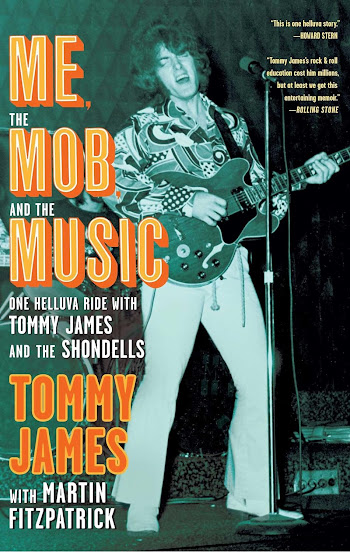
ME, the MOB and the MUSIC: ONE HELLUVA RIDE with TOMMY JAMES and the SHONDELLS (audiobook) by Tommy James and Martin Fitzpatrick


Published by Tantor Audio in 2010.
Read by David Colacci.
Duration: 7 hours, 51 minutes.
Unabridged.


I heard about this book in a memorable interview with Tommy James on the old Dennis Miller radio show when this book came out nearly 10 years ago. It was one of the best radio interviews I have ever heard and I am not even a giant Tommy James and the Shondells fan.

So, when I came across the audiobook I knew I had to listen to it - and I was not disappointed.

For those not familiar with Tommy James, he is responsible for the songs "Hanky Panky", "Mony Mony" and "I Think We're Alone Now". He had two #1 hits and 14 Top 40 hits overall.

He started his music career as a middle school kid in Niles, Michigan performing in bars and fraternity houses and pretending to be old enough to be in bars and fraternity houses. They did a lot of work in South Bend and Lake County in Indiana and eventually got regular work in Chicago. They even released the song "Hanky Panky" and got a local exposure.

And then it all dried up.

Tommy James almost took a job as a store manager but decided to give music one more try. It wasn't going well when James got a call from Pittsburgh saying that "Hanky Panky" was the hottest thing going in that market and he had to come out right away.

He did and went on to become one of the best-selling musicians of his time. The book's title refers to his time with Roulette Records in New York City. Roulette had national reach and extensive mafia connections and that's when things started to get weird...

It's a fascinating look at the music scene of 50 years ago. I really enjoyed it. The reader, David Colacci, was fantastic.

I rate this audiobook 5 stars out of 5. It can be found on Amazon.com here: ME, the MOB and the MUSIC: ONE HELLUVA RIDE with TOMMY JAMES and the SHONDELLS by Tommy James and Martin Fitzpatrick.


THE MIDNIGHT DOG of the REPO MAN (audiobook) by W. Bruce Cameron


Published by Macmillan Audio in 2014.
Read by George K. Wilson.
Duration: 1 hour, 4 minutes.
Unabridged.

This short audiobook is a prequel to the book The Midnight Plan of the Repo Man, a book by W. Bruce Cameron. Cameron is most famous for his book A Dog's Life.

This book is also about a dog, at least it sort of is. Really, it is the story of how Ruddy McCann got his basset hound. Ruddy is a decent man with a checkered past and a grinding sense of shame for what he did in the past. He is also a bar bouncer at his sister's bar at night and a repo man by day. A repo man repossesses cars when people stop making their payments.

Good story, but definitely not a stand-alone story.

I rate this audiobook 4 stars out of 5. It can be found on Amazon.com here: The Midnight Dog of the Repo Man.

THE MIDNIGHT PLAN of the REPO MAN (Ruddy McCann #1) (audiobook) by W. Bruce Cameron


Published in 2014 my Macmillan Audio.
Read by George K. Wilson.

Duration: 11 hours, 15 minutes.
Unabridged.

Ruddy McCann is a former college football star (in the running for the Heisman Trophy) who ended up going to prison rather than the NFL. Now, he is in his early thirties, out of prison and back in his hometown in northern Michigan. He helps his sister run the family business (a dingy old bar) and he works as a repo man. A repo man repossesses cars for lenders when their owners are behind on their payments, usually with a tow truck.

Ruddy has a lot going on in his life right now. He met an interesting woman, he has a difficult repo job and the bar is in serious need of a cash infusion because the creditors are threatening to cut them off. But, most distressing is the voice in his head. This is not a pretend voice, like a conscience - this is a real voice from a guy that says he was shot by two men and buried in the woods not far from Ruddy's hometown. Ruddy believes him, too. He keeps having dreams about being chased down and shot by two men he's never seen before.

So, Ruddy and the voice in his head set off to solve the murder, repo a truck, save the bar and get the girl - and if you think that sounds complicated, you're right.
The Midnight Plan of the Repo Man
is a fun book. Putting together the pieces to figure out the plan behind the murder was interesting. Ruddy's repo cases were often funny and it was quite powerful when the reader learns the reason behind Ruddy's time in prison. None of this would work except for the fact that both Ruddy and the Alan (the voice in his head) are decent guys.

That being said, the book is just a little too busy, a little too crowded for one book. Cameron has another book and a novella in this series. Here is the link to my review of the novella: The Midnight Dog of the Repo Man.

This audiobook was exceptionally read by George K. Wilson. It was the perfect match between reading style and text.

I rate this audiobook 4 stars out of 5 and it can be found on Amazon.com here: 
The Midnight Plan of the Repo Man.

DETROIT: AN AMERICAN AUTOPSY (audiobook) by Charlie LeDuff


Published by HighBridge in 2013.
Read by Eric Martin.
Duration: 7 hours, 21 minutes.
Unabridged.

Detroit: An American Autopsy is one of the best audiobooks I have listened to in a very long time.

It made me laugh, made me think, made me glad I don't live in Detroit, made me worried that I live in another Rust Belt city that has lost a lot of its industrial base, and, over and over again, it shocked me.

Charlie LeDuff grew up in the Detroit area and moved away to do a lot of different things, including being a reporter for the New York Times (where he won a Pulitzer Prize). He came back home to Detroit to work for a newspaper and to be close to family. When you go away from someplace and come home you see things a little more clearly and he was more than a little surprised Detroit was not only every bit as bad off as most of the country believes - it was actually a lot worse.

I recently read the book Janesville: An American Story by Amy Goldstein.  In a lot of ways, it is similar to Detroit: An American Autopsy in that they both detail the stories of a community wrecked by the collapse of the American automobile industry during the Great Recession. Janesville, Wisconsin is a small city that lost its lifeblood - a General Motors truck factory. Janesville lost one factory - Detroit has been losing factory after factory after factory for 50+ years. When Charlie LeDuff was growing up in Detroit, it was dying - but nobody knew it. When he returned it was painfully obvious that Detroit was gone.

The author, Charlie LeDuff
But that's too simple. Detroit is not dead. It has firefighters fighting to save the town from chuckleheads that set fire to abandoned homes just to watch the show when the fire department shows up. It has police that keep plugging away, even though Detroit is regularly known as the "murder capitol" and its leadership seems focused on looking good rather than being good. It has people just trying to make a living even though almost all of the good factory jobs are long gone.

It has its lost people, its thieves and hustlers. It has people that use religion as a tool to fleece the people. Its schools are literally falling down around its children. It has people that just don't care. But it also has Keiara Bell, a middle schooler who scolded a member of Detroit's City Council for being rude during a council meeting (if only Keiara Bell had known the half of it). Bell, it turns out, graduated from a Detroit public school, went on to Wayne State University (in Detroit) and graduated and wants to go into city management. She is featured in this TV story by Charlie LeDuff.

This is a tough book. There is no happy ending. It's a messy discussion of race, class, crime, politics, money and LeDuff's personal life and it is compelling. I blasted through this audiobook, looking for chances to listen a little more. Eric Martin read the audiobook and he was perfect for it. He never hit a wrong note as he read the book. I hope he won some sort of award, but in keeping with the theme - why would he? After all, it is about Detroit.

I rate this audiobook 5 stars out of 5 and it can be found on Amazon.com here: DETROIT: AN AMERICAN AUTOPSY (audiobook) by Charlie LeDuff.

NPR ROAD TRIPS: ROADSIDE ATTRACTIONS (audiobook)


Published in 2009 by HighBridge Audio

Multicast Performance

Duration: about 1 hour.

National Public Radio has combed through its broadcast archives and found 13 different stories about the great American institution - the road trip. But, these aren't just any stories. These are stories that feature another great American institution - the roadside attraction. 

The stories cover a variety of quirky attractions including the Elvis Is Alive Museum, The Velveteria (featuring black velvet paintings of Elvis and lots more!), the world's 2nd biggest ball of twine, a series of backyard folk art exhibits in Michigan and even a couple of more famous attractions like Florida's Cypress Gardens and Seattle's Space Needle. A slightly off topic, but very interesting, story about the famed Burma Shave signs is also included. The stories wind up with the story of an epic musical piece written in the classical style about the trials and tribulations of the family car-based vacation.

The stories are all told with a sense of good-natured fun and some, like the story about the Velveteria and the musical tribute to the family road trip have moments where they are laugh-out-loud funny. The first story was fairly weak. But, taken as a whole, these stories are well worth your time.

I rate this audiobook 4 stars out of 5. It can be found on Amazon.com here: NPR ROAD TRIPS: ROADSIDE ATTRACTIONS

Reviewed on February 21, 2015.

The River Sorrow by Craig Holden


Okay, but not great thriller


At times achingly slow, and at times seemingly in fast forward mode, The River Sorrow is just an "OK" book for me.

I readily admit that I could not really identify much with the reformed drug addict doctor (his behavior is odd at the beginning of the story with regards to the police investigation and moves illogically throughout most of the first half of the book) and this hurt my enjoyment of the book. However, the addict Summer Storm's character gets even more ridiculous as the story moves along (I'll not detail why so as to avoid spoilers.)

On a pet peeve note, on page 243 of my edition Holden perpetuates the silly idea that police must identify themselves when they are undercover if they are asked, "Are you a cop?" Jeez.

Not good, not bad. Just a book.

I rate this book 3 stars out of 5.

This book can be found on Amazon.com here: The River Sorrow by Craig Holden.

Reviewed on February 12, 2009.

Featured Post

<b><i>BAN THIS BOOK (audiobook)</i></b> by Alan Gratz

Published in 2017 by Blackstone Audio, Inc. Read by Bahni Turpin. Duration: 5 hours, 17 minutes. Unabridged. My Synopsis Ban This Book is t...

Popular posts over the last 7 days