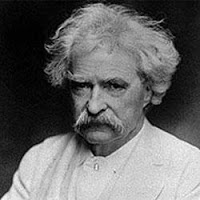
Showing posts with label Mark twain. Show all posts

THE ADVENTURES of HUCKLEBERRY FINN (audiobook) by Mark Twain


Originally published in 1884 (U.K.) and 1885 (U.S.)
This audiobook version published in 2008 by Tantor Audio.
Read by William Dufris.
Duration: 9 hours, 44 minutes.
Unabridged.


I would feel silly writing a synopsis of this book. This is the book that Ernest Hemingway said is the source of all modern American literature. It is almost universally recognized as not only "a" Great American Novel, but is oftentimes acclaimed as "THE" Great American Novel.

So, I will skip all of that discussion and just move on to a review of the audiobook presentation and what I thought of the book.

The audiobook reader was William Dufris (1958-2020),  a celebrated voice over actor and the reader of dozens and dozens of audiobooks. He did a fantastic job of creating voice after voice after voice. It was quite impressive.

An original illustration by E.W. Kemble
from the 1884 printing of this book
As for the novel, well that was less impressive than I remembered. I read this book in elementary school and almost all of the satire and character growth went right over my head. I re-read it in high school for an AP Literature class. We had to write a lengthy paper that we literally worked months on. We even took a trip to a university library to dig through the stacks to find literary criticisms and cite them. It was, by far, more complicated and longer than any other paper I wrote in my college career.

All of that work writing about the same book soured me on re-reading the book until now, 38 years later. 

So, what did I think?

I was surprised at how many of the plot points I had forgotten. For example, Tom Sawyer is in this book a lot more than I remembered and he is really annoying. I know that is intentionally built in as a part of the book for thematic reasons - Huck is on his way to being a man and Tom is still a boy in many ways - but I still felt that it was tough going when Tom is in the story.

It took me quite a while to get through this audiobook. I could only go for 20 minutes or so at a time and then I had to leave it for a while. In comparison, I listened to a different audiobook today for more than 4 hours. Maybe it was because it was told in first person, I am not sure. 

Despite the importance of this novel, I honestly can't rate it any more than 3 stars out of 5.

This book can be found on Amazon.com here: THE ADVENTURES of HUCKLEBERRY FINN by Mark Twain.

A FAREWELL to MARS: AN EVANGELICAL PASTOR'S JOURNEY TOWARDS the BIBLICAL GOSPEL of PEACE (audiobook) by Brian Zahnd


Published by Oasis Audio in 2013.
Read by Dean Gallagher.
Duration: 4 hours, 58 minutes.
Unabridged.


Brian Zahnd is an American pastor of a megachurch in Missouri. I had never heard of him before I ran across this book. I was intrigued by the topic because the election of President Trump has been an interesting experience for this lifelong member of a religiously conservative church.

Over time, Zahnd has become convinced that pacifism is the way that Jesus would have us go. It is not a popular opinion, but Zahnd makes a strong argument for it.


Zahnd's message is essentially that the church is at its best when it acts like the Old Testament prophet Nathan in 2nd Samuel chapter 12. Nathan comes to David to tell him he had done a great wrong and call him on it.

Now, according to Zahnd, t
he church went from being the accuser of wrong-doing - the one that holds it to a high standard - to being the defense attorney of the government. Zahnd describes it as the church is the chaplain for the government. It cheerleads the government and supports it in everything, including going to war, supporting slavery, supporting genocide and more and it has been this way since Constantine the Great co-opted the Church in 313. 

Why is that? Because the government brought the Church into government and made it a stakeholder. The church provides moral cover because it is complicit with the government.  Look at our current political situation and watch religious leaders who are invested in politics use God to promote whatever cause they are involved in.

Here is a great example: In this article, Pat Robertson demanding that we keep troops in Syria. If we don't, President Trump is "in danger of losing the mandate of heaven." Two questions: 

1) Does God crown American Presidents with the mandate of heaven? 
2) Is Jesus a big fan of military action? If so, that puts the American soldier in the position of shooting people for Jesus, which sounds ridiculous when you hear it - but that is what Robertson is advocating.

I was reminded of this skit by a Christian acting duo known as The Skit Guys. The premise is that a boy wants to see a movie with a little bit of nudity in it, even though he knows his family thinks that it is inappropriate for him. His argument is that it is "just a little bit" of unacceptable content. His dad offers him a brownie he has just made and after he bites into it, he tells him that there was some "dog poop" in the brownie batter - but "just a little bit." Governmental and religious entanglement is a lot like having "just a little bit" of dog poop in your brownies. 


The author, Brian Zahnd
Most people think that religion taints the government, but I think that it is the other way around. A little bit of government makes religion act differently. Religion begins to make compromises and promises that it shouldn't make - it begins to say and do things that go against its core beliefs and mission because it is acting in support of governmental policy instead of its religious beliefs. Just a little bit of compromise goes along way to wrecking the entire message.

This book mostly looks at the topic of war and asks if churches should ever support war in any sort of form. Zahnd's own opinion has changed over time. He spends a great deal of time in this short book looking at exactly where he started and where he is at now. He refers to and quotes extensively from this very short Mark Twain story: The War Prayer (Click here to see Twain's story in its entirety). In it, an old man re-states the eloquent prayer for military victory that a church's pastor had just said during a church service - but he uses blunt terminology to show what the pastor and the church were really requesting:

"
O Lord our God, help us tear their soldiers to bloody shreds with our shells; help us to cover their smiling fields with the pale forms of their patriot dead; help us to drown the thunder of the guns with the shrieks of their wounded, writhing in pain; help us to lay waste their humble homes with a hurricane of fire; help us to wring the hearts of their unoffending widows with unavailing grief; help us to turn them out roofless with their little children to wander unfriended in the wastes of their desolated land in rags and hunger and thirst...

...We ask it, in the spirit of love, of Him Who is the Source of Love, and Who is the ever-faithful refuge and friend of all that are sore beset and seek His aid with humble and contrite hearts. Amen."

Zahnd's point is that he cannot imagine Jesus praying the prayer that Mark Twain wrote. But, that is what the church was asking because they had been co-opted into approving everything the country was doing.

This book opens up a lot of intellectual doors but really only looks through a couple of them. It was interesting, though, and I am going to try to check out some more of Zahnd's books.

I rate this audiobook 5 stars out of 5. It can be found on Amazon.com here: 
A FAREWELL to ARMS: AN EVANGELICAL PASTOR'S JOURNEY TOWARDS the BIBLICAL GOSPEL of PEACE (audiobook) by Brian Zahnd.


1601 Conversation as it was by the Social Fireside in the Time of the Tudors (kindle) by Mark Twain


The commentary is actually more interesting than the story


Originally published anonymously in 1880.

Literary critic Edward Wagenknecht called 1601 "the most famous piece of pornography in American literature."


Just to be clear, it's not really pornography, at least not by modern standards. Rather, it's a short story featuring Queen Elizabeth I, Ben Jonson, Beaumont, Shakespeare, the Duchess of Bilgewater, Sir Walter Raleigh, and a few other people all in a closet talking about passing gas and sex.

Sound strange?

Well, it is. And - it's only so-so funny.

Mark Twain (1835-1910)
3/4 of my edition was a fairly interesting commentary on the history of the story and about the characters. We learn that Twain wrote this as a diversion after the publication of Tom Sawyer (while he was working on Huckleberry Finn) during a time of writer's block. Twain showed it to some friends who published a few copies and then it snowballed. Twain's 1601 went "viral" before there was an internet, apparently.


I rate this kindle short story 3 stars out of 5. It can be found on Amazon.com here: 1601 Conversation as it was by the Social Fireside in the Time of the Tudors.

Reviewed on May 20, 2009.

On the Decay of the Art of Lying (kindle) by Mark Twain


Not Twain's best work.


Twain (1835-1910) says that On the Decay of the Art of Lying was an essay written in 1885 for a $30 prize for the "Historical and Antiquarian Club of Hartford". Twain notes that he did not win a prize for this essay.

The essay focuses on the lost art of lying. Twain discusses different kinds of lies, situations in which people lie and why all lies are not bad.

The essay is sometimes funny but mostly sounds like an old stand up routine about good lies and bad lies.

The Kindle version is very short - only 86 locations which equals about 12 regular pages.

I rate this essay 3 stars out of 5.

This book can be found on Amazon.com here: On the Decay of the Art of Lying by Mark Twain.

Reviewed on May 28, 2009.

Some Rambling Notes of an Idle Excursion (Kindle edition) by Mark Twain


Story of a trip by Mark Twain to Bermuda - starts fairly weak and ends strong


First published in 1877 by The Atlantic.

The title of this essay has it right - these are just a series of stories about a trip that Twain (1835-1910) and some friends took to Bermuda from New York City. Twain wrote this for "The Atlantic" in 1877 and his wry style makes him an excellent travel companion.

In reality, Twain's story of the trip is the story of the people he meets along the way. Most of the stories are humorous, some are duds and about an equal number are quite funny. I won't forget the story about the town with the cat situation for quite a while.

Twain on Bermuda:

"We never met a man, or woman, or child anywhere in this sunny island who seemed to be unprosperous, or discontented, or sorry about anything. This sort of monotony became very tiresome presently, and even something worse. The spectacle of an entire nation groveling in contentment is an infuriating thing."

Twain on modern communication:

"The Bermudians are hoping soon to have telegraphic communication with the world. But even after they shall have acquired this curse it will still be a good country to go to for a vacation, for there are charming little islets scattered about the enclosed sea where one could live secure from interruption. The telegraph-boy would have to come in a boat, and one could easily kill him while he was making his landing."

Can you imagine what he'd say about cell phones, text messages and Twitter?

I rate this essay 4 stars out of 5. It can be found on Amazon.com here: Some Rambling Notes of an Idle Excursion by Mark Twain.

Reviewed May 29, 2009.

The Man that Corrupted Hadleyburg by Mark Twain


First Published in Harper's Monthly in 1899.

For being such a short story, I found The Man That Corrupted Hadleyburg to be a slow, fairly tedious morality story that just did not do it for me. This was disappointing because I had just read two Twain essays that I enjoyed thoroughly for their sarcasm and wit. This one was, in the end, just a story with about as much humor and interest for me as The Gift of the Magi by O. Henry. A morality play, nothing more, nothing less.


Mark Twain (1835-1910)
The story is set in the town of Hadleyburg - a town known far and wide for its impeccable honesty. But, a stranger passing through was offended at some point in time by the residents of Hadleyburg and decides to ruin their reputation with an elaborate plot and the promise of a fortune. Hidden truths are exposed as the town falls for the trap.

I rate this short story 3 stars out of a possible 5 stars.

It can be found on Amazon.com here: The Man that Corrupted Hadleyburg.

Reviewed July 12, 2010.

Fenimore Cooper's Literary Offences by Mark Twain


Originally published in 1895 in "North American Review."

Nearly 20 years ago I saw the movie The Last of the Mohicans . I knew it was probably not too much like the books, but I was inspired to read James Fenimore Cooper: The Leatherstocking Tales I; The Pioneers, The Last of the Mohicans, The Prairie , a collection of his work featuring Natty Bumpo (Hawkeye) and I found them to be horrible. Not just bad, but darn near unreadable.

I love books. I hate this author even though I love American history (I am a history teacher), I love frontier stories and I was certainly pre-disposed to like his works. But, I've always kept my opinions to myself, despite the fact that he had one sentence that lasted more than two pages describing a banquet table that featured a near endless string of semi-colons.

James Fenimore Cooper
Until now.

If Mark Twain, the quintessential American writer finds Cooper wordy, clunky and darn near unreadable (to be specific, Twain calls his work "a crime against the English language"), than I can proudly say that I too find James Fenimore Cooper to be a hack.

Of course, Twain says it much better. His sarcasm is laser sharp. He is merciless and I laughed out loud. Twain at his best, especially if you are familiar with Cooper.

I give this short essay 5 stars out of a possible 5 stars. It can be found on Amazon.com here: Fenimore Cooper's Literary Offences.

Reviewed July 13, 2010.

In Defence of Harriet Shelley by Mark Twain


Originally published in 1888.

Before reading this brilliant essay you must be familiar with Percy Bysshe Shelley, a 19th century English poet and perhaps, nowadays, most famous for being married to Mary Wollstonecraft Shelley, the author of Frankenstein. His most famous bit of poetry in modern times is: "My name is Ozymandias, king of kings: Look on my works, ye Mighty, and despair!"


Before reading this essay, read a short online biography about Mr. Shelley so that you can follow along with some knowledge of the basics. Twain's essay is actually a long review of a biography of Shelley by Edward Dowden: Life of Shelley, a book that is extremely dismissive of Harriet Shelley, Percy Shelley's first wife - the one he left pregnant and with a child at home so that he could run away to Europe with Mary.

In no way is Twain's essay fair towards Percy Shelley - it does not try to be and I do not think that it should be. It's hard to defend a man who leaves his pregnant wife for a teenage girl. Twain rips this section of the biography apart bit by bit. Twain's sarcastic bite is on full display here - commentary that is very often laugh out loud funny and very tender towards Harriet Shelley.

5 stars out of a possible 5 stars.

This book essay can be found on Amazon.com here: In Defence of Harriet Shelley

Reviewed July 13, 2010.

Featured Post

<b><i>BAN THIS BOOK (audiobook)</i></b> by Alan Gratz

Published in 2017 by Blackstone Audio, Inc. Read by Bahni Turpin. Duration: 5 hours, 17 minutes. Unabridged. My Synopsis Ban This Book is t...

Popular posts over the last 7 days