Showing posts with label West Virginia. Show all posts

COMMEMORATIVE HISTORY of the GEORGE ROGERS CLARK BICENTENNIAL EXHIBIT by The Indiana State Museum


Published in 1976 by the Indiana State Museum Society.

1976 was the bicentennial celebration of the Declaration of Independence and if you were not alive in 1976, you have no idea how much went into that recognition. Every store had special decorations, every town had commemorations, everyone had red, white, and blue clothing and this went on for a long time - not just on the Fourth of July in 1976.

Part of this ongoing celebration took place in museums. The Indiana State Museum had a 3 year exhibit on Indiana's role in the American Revolution. People remember the original thirteen colonies and correctly note that Indiana was not one of those colonies. None of Indiana's immediate neighbors were, either.

But, the modern states of Kentucky, Ohio, Indiana, Michigan, and Illinois were on the front line of a different kind of war zone during the American Revolution. There were no great ships, no massed armies, and precious few soldiers even wearing an actual uniform - but there were pitched battles. 
Commemorative History of the George Rogers Clark Bicentennial Exhibit tells one of the most dramatic parts of that story.

During the fighting, White towns and settlements were wiped out. Indian villages were burned to the ground. much of the fighting was due to the encouragement and financing of the British government. The British Lt. Governor in Detroit was ordered to finance Indian attacks on white settlements in an effort to start a wide ranging guerrilla war in the Ohio River Valley to distract the American colonies from the main fight on the Atlantic coast.

This was not hard to do since a low grade fight had been going on for more than a decade. In order to keep up their side of the fight, the Indians needed supplies to feed their families and weapons and the British could easily supply those. The supplies were shipped out of Detroit to a network of smaller forts in Illinois and Indiana.

George Rogers Clark figured that the way to shut down this fight was to take those British forts. He did some preliminary reconnaissance and found that they were lightly defended, depending mostly on the vast spaces of friendly Indian territory between them to protect them. He secured funding from Virginia Governor Patrick Henry to buy powder and supplies for 350 frontiersmen to attack two forts in Illinois near the Mississippi and Vincennes on the Wabash.


Clark got together about half the amount of men he thought he would need and launched his attack in 1778. He was so successful that Lt. Governor Hamilton personally led an expedition to retake Vincennes. From there, he planned a reconquest of the Illinois forts.

Clark decided that a bold move had to be taken before Hamilton could bring in more supplies, equipment, and men. Clark led a 180 mile march across southern Illinois in February of 1779 in order to surprise Hamilton. 

If you do not live in the midwest, you may not understand how truly miserable it can be in February. It may not snow much, but it will be very wet and very miserable - and it was in 1779. It wasn't cold enough to freeze, but it rained for days on end and the rivers came out of their banks. Imagine hiking nonstop through a sloppy mudhole in 35 degree weather with no dry land to be found for days on end with no modern clothing to keep you warm.

At one point their drummer boy had to cross a flooded area by using his drum as a flotation device while he kicked with his feet. The expedition ate all of their food because the floods drove away most of the wild game.

There was a reason that Hamilton felt secure in Vincennes - no one was crazy enough to march through this mess!

Clark's 170 man force surprised Hamilton and convinced him they were a much larger force through some trickery. Hamilton to surrender on February 25, 1779.

Clark's surprise attack cemented America's claim to what is now called the Old Northwest and was one of the factors that helped convince France to support the Colonies in the Revolutionary War. Clark described it this way: "Great things have been effected by a few men well conducted."

This book has a lot of photographs of items displayed in the exhibit. It also includes the illustrations commissioned for them. I found the illustrations to be helpful and interesting, although a bit retro. The strength of this small book does not lie in the pictures, however. The text is the real strength of the book. The story of the entire campaign is told in well-paced bite-sized bits. 

I rate this history 5 stars out of 5. It can be found on Amazon.com here: Commemorative History of the George Rogers Clark Bicentennial Exhibit.

A completely horrible scan of this small book can be found here: https://eric.ed.gov/?id=ED139709. The text is legible, and that's about all that can be said for it.

McCLELLAN and FAILURE: A STUDY of CIVIL WAR FEAR, INCOMPETENCE and WORSE by Edward H. Bonekemper, III


Originally published in 2007.
Published in 2010 by McFarland and Company, Inc.


If you are a student of the Civil War, George B. McClellan is a conundrum at best.

After the Frist Battle of Bull Run (Manassas) in July of 1861, the poorly trained Union Army had fled back to Washington, D.C. They were basically a semi-organized mob awaiting someone to take the lead.

Lincoln looked around and felt that the leadership team that lost at Bull Run was not going to provide a credible lead general so he looked around the Eastern Theater for anyone else with the aura of success.

George B. McClellan had a bit of success in Western Virginia and wrote a lot of reports that made him seem an even better General than he was so Lincoln looked to him to retrain and refit the Army of the Potomac (the main Union Army in the East.)

Statue of McClellan outside of the
city hall in Philadelphia. It was 
dedicated in 1894.  I have no idea
why they felt he deserved this honor.
When I have talked with students about McClellan, I like to compare him to a nervous guy who restores cars. He finds a junker with lots of potential, restores it, and then is afraid to take it out and drive it (the entire purpose of a car) because it might get wrecked again. His men loved him for that - they didn't want to go out and fight and die in a pointless battle. But it was up to McClellan to find a way to take the fight to the enemy and the purpose of an army is to fight, to kill people and blow up things, not to drill and drill and drill while the enemy sits just a few miles away in the middle of the war. 

McClellan took over 8 months to rebuild the army before he took it out to fight. It was the largest army of the entire Civil War and was magnificently well-supplied.  His predecessor had only been in charge of the same army for about 6 weeks when he took to the field. 

Bonekemper documents McClellan's excuses, his time wasted on political lobbying, writing political advice to the President, and his constant inflation of the size of Confederate armies. Bonekemper also makes a strong case that McClellan didn't want to push too hard against the Confederacy because he was pro-slavery and that he let another Union Army be defeated at the Second Battle of Bull Run in August of 1862 out of jealousy.

Once again - the most important general in the U.S. Army refused to engage the enemy because he sympathized with their war aims and he let an entire Union army be defeated when he was ordered to provide assistance because he was angry that the other army had an independent command.

Did McClellan make up for that by being a brilliant field general? No. His own men (generals and even privates) noted that he led from far behind the lines and rarely directed the men once the fighting started.

His last battle of any size was Antietam. Have you ever seen a karate movie where the group of bad guys engage the good guy by taking turns so he can defeat them all one at a time? That's how McClellan engaged with Robert E. Lee's much smaller Army of Norther Virginia - one brigade at a time and Lee basically fought them all to a draw - one brigade at a time.

In a modern army, McClellan may have had found a place dealing with logistics and training - procuring supplies and recruiting soldiers, training them and sending them to the front. But, that was not how things worked in the Civil War.

Of course, Bonekemper lays all of this in detail with the original sources and quotes. A lot of historians give McClellan a pass of sorts. To be honest, I don't know why. This book makes it clear that they shouldn't - he was among the worst of the Union generals.

I rate this book 5 stars out of 5. It can be found on Amazon.com here: McCLELLAN and FAILURE: A STUDY of CIVIL WAR FEAR, INCOMPETENCE and WORSE by Edward H. Bonekemper, III.

WILDLAND: THE MAKING of AMERICA'S FURY (audiobook) by Evan Osnos


Published in September of 2021 by Macmillan Audio.

Read by the author, Evan Osnos.
Duration: 17 hours, 7 minutes.
Unabridged.

Evan Osnos is a reporter for The New Yorker. He was inspired to write about the phenomenon of Donald Trump and the 2016 and 2020 elections when he returned from an multi-year assignment in China and noted that politics, journalism and even economics in the United States had changed. He didn't use this analogy, but I will: Parents don't notice their kids changing and growing because they see them every day. But, the aunts and uncles who only see them at the holidays can easily detect the changes.

For Wildland Osnos went to three places that he used to live to investigate: Greenwich, Connecticut; Chicago, Illinois; and Clarksburg, West Virginia. 

In West Virginia, he primarily looks at the changes in journalism such as the loss of local news and small town newspapers. He also looks at government pulling back environmental regulations and business avoiding responsibilities such as living up to pension obligations and cleaning up their messes. The shenanigans from Peabody Energy to avoid pension obligations were especially egregious.

In Connecticut he follows up on the business theme by looking at Greenwich - a town seemingly full of hedge fund managers. Really, it's not, but their wealth and their change of mindset is changing the town. The mindset embraces famed economist Milton Friedman's maxim that the purpose of a corporation is to maximize returns for its shareholders. I grew up in a town with one very large corporation with multiple factories. It provided scholarships, paid for public art and architecture and provided benevolent leadership through boards, committees and generally being engaged with the community that its leadership lived in and provided its labor force. 

In Chicago, he looks at the near-collapse of some communities - the ones that make the news all of the time for the murders. He discusses how the manufacturing base of Chicago left and how that helped lead to the decline of some neighborhoods. which ties into the Greenwich part of the book.

On top of all of this, throw in the Supreme Court case generally known Citizens United. It opened up the flood gates for money in politics. Now millions of dollars could be spent on primary campaigns. In 2020, my state was not really a player in Presidential politics, but we saw almost non-stop ads over 1 race for the House of Representatives. One ad after another from both sides. Those kinds of ad campaigns are the result of the Citizens United decision in 2010.  The Supreme Court held that the First Amendment prohibits the government from restricting independent expenditures for political campaigns by corporations, including non-profit corporations, labor unions, and other associations. With that decision, politics changed.     

Outsiders with a lot of money now had a chance to come in and be effective without having the strong organization and the political contacts of a political party.    

The book takes a long time to develop and I nearly quit several times in the first couple of hours. There was so much talk of hedge fund managers and the new prevailing mercenary quality in big business. Notice that I said "prevailing" - the mercenary quality has always been there but it was restrained by other cultural norms. But, once it moves on to West Virginia and Chicago the book got more interesting to me. I guess it's simply because I don't know ultra-rich hedge fund managers and I don't identify with that lifestyle, but I do know poor black people in a big city and I grew up in a rural area. 

At the halfway point, he starts to tie all of this stuff together and then the book gets good. About 3/4 of the way through the book he starts to tie in the rise of Trumpism. To be honest, I had forgotten that this was the point of the book in the frist place. 
Osnos ties it together. It's not some big nefarious plot, but rather the result of a lot of forces converging - the Citizens United decision, the change in the philosophy of big business, the loss of local news reporting, the loss of good jobs in rural areas and the big cities all come together.

Toss in a great deal of frustration, Osnos makes it seem that the arrival of a person like Donald Trump was inevitable. I contend that it also explains Bernie Sanders. Like Trump, Sanders is truly a political outsider. Sanders isn't even a member of the Democrat party and has not put in a lot of work building the party organization. Still, he almost won their nomination in 2016 and ran very strong in 2020 because this decision lets money make up for not being part of a party and having access to all of the connections and organization that political parties can provide. 

This book doesn't have a lot of answers, but it points out a lot of problems and you have to know what the problems are before solutions can be found.

I rate this audiobook 5 stars out of 5. It can be found on Amazon.com here: WILDLAND: THE MAKING of AMERICA'S FURY by Evan Osnos.

INSURGENT: BOOK 2 of AMERICA'S FUTURE by Charles Sheehan-Miles


Published in 2012 by Cincinnatus Press 

Insurgent is a worthy successor to the original book in this series, Republic: A Novel of America's Future. Book One details how a fictional confrontation between the state of West Virginia and the federal government over the proper role of the Department of Homeland Security eventually leads to a very short war in which West Virginia is quickly defeated. 

Book Two deals with post-war relations between the occupying federal government, its troops and the people of West Virginia and the closely monitored civilian government of West Virginia.

The flag of West Virginia
The parallels between this fictional war and the Iraq War and the multi-year struggle to create a stable environment in Iraq once Sadaam Hussein was removed from power are striking and, I am sure, quite intentional. And, since this is a book about Americans in a situation similar to that experienced by the people of Iraq, the Iraqi reactions are made all the more understandable to an American reader. 

Sheehan-Miles switches from the point of view of a small military unit helping to keep a crucial road clear to the civilians who interact with that unit to the officials in the limited civilian government and keeps multiple story lines going, including the origins of a nascent insurgent group with powerful weapons and even stronger religious beliefs who starts taking on the occupying troops with bombs, assassination attempts and threats against those who collaborate. 

It is a compelling read and, like I said about the last book, it is guaranteed to make you think.

It can be purchased here on Amazon.com: Insurgent: Book 2 of America's Future

I rate this book 5 stars out of 5.

REPUBLIC: A NOVEL of AMERICA'S FUTURE (kindle) by Charles Sheehan-Miles


Very well-written and guaranteed to make you think.

Originally published in 2007.
Approximately 346 pages.

Set in America's near future, Republic is a look at the authority of the federal government run amok in the name of national security. Imagine, if you would, the government's reaction to a series of timed bombings that target the Pentagon and the first responders that come to save as many of the victims as they can (as was common in the Iraq War) but instead of a foreign attacker, the culprit is a domestic terror group. The Department of Homeland Security (DHS) sweeps in and starts to get very nervous about every sort of domestic disturbance.

In this environment a profitable factory closes down in a small West Virginia town that depends on this employer for its very existence. The profitable factory closes because its holding company determined that it can make an even larger profit by relocating to Indonesia. When the newly unemployed American workers trespass and occupy the factory and resume production the DHS is called because, now, even labor disputes are a risk to national security.

When the federal building in West Virginia's capital city is bombed federal agents assume that it must be Muslim terrorists and start rounding up literally all Muslim males above the age of 14 in a neighborhood known as "Little Cairo". They are not arrested, just "detained". The West Virginia National Guard is supposed to assist in locking down the neighborhood but an idealistic officer is shocked at the gestapo tactics of the federal agents, intervenes and a firefight ensues, resulting the in the death of a guardsman and an agent.

More importantly, the tactics of DHS are exposed for all to see and a constitutional crisis starts when the federal government demands that the lead officer of the Guard unit be turned over for prosecution for the death of their agent. West Virginia's governor refuses to turn her over and a grassroots secession movement adds fuel to the fire that only gets bigger as a ham-fisted DHS raid and various federal pronouncements make the situation more and more tense and everyone prepares for a second Civil War...

I picked this book up three years ago on my kindle when it was temporarily offered free of charge but I never got around to reading it. On a whim I started reading it on my phone and I found that this was an absolutely compelling read. The characters are kind of stock characters, but they are clearly drawn out. They really just a means to a larger discussion about the federal government's growing reach in to so many things and the militarization of situations that really just need common sense and some level-headed discussion.

The battle scenes in this book, especially those with the tanks fighting in the mountains in the winter, are strong (they ought to be, he is a Gulf War veteran and served in a tank unit) but the real thing that is impressive is that he works in a discussion of the proper role of DHS and just how much security is too much security and when does it become just another excuse for government to curtail rights throughout the book and it does not seem artificial or forced.

Read my review of Insurgent, book two in this series by clicking here.


I rate this novel 5 stars out of 5. It can be found on Amazon.com here: Republic: A Novel of America's Future.

Reviewed on October 16, 2014

Ain't Nothing But A Man: My Quest to Find the Real John Henry by Scott Reynolds Nelson with Marc Aronson

A Fascinating Investigation into American History


Published 2008 by National Geographic

Scott Reynolds Nelson went on a search to see if there was a real John Henry that inspired the songs and the legend of the man with the hammer who beat the steam drill in a contest.

First and foremost, this is a book written for children, but it was interesting to this grown up as well. The topic was interesting, the pictures are great - lots of real pictures from the past of men on railroad work crews with their equipment. Nelson goes on to explain how the songs were used by work crews not just for entertainment but to keep time while moving tracks and pounding on spikes. Lastly, he explains, step-by-step how he makes his investigation. This could have been extraordinarily boring, but Nelson keeps it interesting. He actually creates a sense of tension as he tracks down his information.

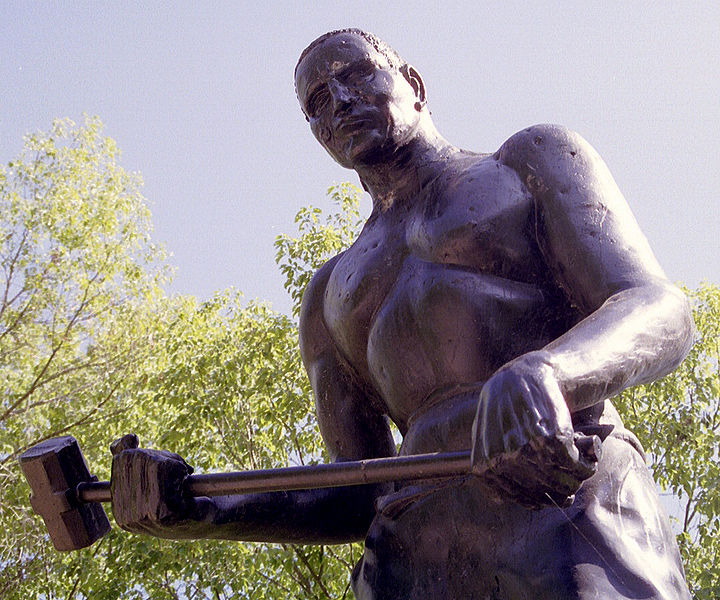
John Henry statue near Talcott, West Virginia
Nelson does come up with a potential source of the legend, provides a ton of internet resources, including websites to hear versions of the John Henry song and other similar songs, as well as other books. Aronson steps in with a easy-to-read short essay with 6 steps on "How to Be a Historian."


Nice book. Should be in every library.

This book can be found on Amazon.com here: Ain't Nothing But A Man.

I rate this book 5 stars out of 5.

Reviewed on November 19, 2011.


Featured Post

<b><i>BAN THIS BOOK (audiobook)</i></b> by Alan Gratz

Published in 2017 by Blackstone Audio, Inc. Read by Bahni Turpin. Duration: 5 hours, 17 minutes. Unabridged. My Synopsis Ban This Book is t...

Popular posts over the last 7 days