Showing posts with label muslims. Show all posts

THIS BOOK WON'T BURN (audiobook) by Samira Ahmed


Published by Little, Brown Young Readers in 2024.
Read by Kauser Mohammed.
Duration: 10 hours, 34 minutes.
Unabridged.

Book summary

Noor Khan is a senior in high school and she is devastated. Her father walked out on her family and moved back to his native England. He gave no warning and the family is reeling.

Noor's mother decides that a change of location would be best. Noor, her little sister (a freshman), and her mom move from their diverse upper middle class Chicago neighborhood to a downstate Illinois small town so that her mom can work at a small college. 

Noor hates it. She misses her friends and the vibrancy of Chicago. She also feels like an oddity because she is Indian and Muslim in a school that is very white and very Christian. 

She determines to gut out this one last semester of high school and then head back to Chicago to go to college. She decides she doesn't need friends or even to enjoy this small town - she just needs to get in, get the diploma and then get out.

But, she finds friends - the only Muslim/Indian boy in the area and his best friend - an proudly out-of-the-closet feisty lesbian. Together, these three comprise the diversity of their high school. They hang out in the school library whenever possible.

The library seems like a refuge until Noor notices that the stacks are missing lots and lots of books. The local chapter of a Moms for Liberty-type group has demanded that dozens and dozens of books be removed due to content. Like most of the large scale book bans across the country, this book ban has focused on books with LGBTQ+ characters, books with black and brown authors, and books that focus on America's troubled racial history. The local school board President is using his support of the high school library's book ban as the springboard to a run for the state legislature.

Can Noor stick to her original plan and just be quiet and graduate? Or, does she speak up in defense of her ideals of free speech and the freedom to read? 

Also, she is very much intrigued by the Indian/Muslim boy. But, she is also strangely attracted to a very nice white boy - he's an athlete, he's polite, and he thinks Noor is great - and his stepdad is the school board member that initiated the book ban...

My Review

The author, Samira Ahmed
The author, Samira Ahmed, has written several books that have been added to the seemingly never-ending book ban lists. She was inspired to write this book when a small town teacher spoke with her about her experience. The teacher was using one of Ahmed's books in her class when the book was banned. The teacher was caught in a bind - small town politics meant that her school administration would not support her and she feared for her job if she pushed to her hard. Her colleagues didn't fight for the books because they were about people who were different than those who lived in their town. They refused to fight for books written by and about people who were unlike themselves (NOTE: I am a public school teacher and I am so unbelievably disappointed that literature teachers would respond to a book challenge like that.)

The author changed that story a bit - instead of a teacher, she created a fiercely independent high school student with a strong sense of right and wrong when it comes to the First Amendment. 

I liked this story a lot. It drew me in - Noor and her friends are great characters. The love triangle aspect of the story works to make the consequences of Noor's actions even more powerful.

The reader was Kausar Mohammed and she did a fantastic job with a wide variety of voices and accents. Excellent work.

I rate this audiobook 5 stars out of 5. It can be found on Amazon.com here: This Book Won't Burn by Samira Ahmed.


DESTINY DISRUPTED: A HISTORY of the WORLD through ISLAMIC EYES (audiobook) by Tamim Ansary


Published in 2009 by Blackstone Audio.
Read by the author, Tamim Ansary
Duration: 17 hours, 28 minutes.
Unabridged.


Tamim Ansary has done something that is very hard to do - he has written a long history of a complicated topic without making it boring and after more than 17 hours of discussion, he left me wishing that it was even longer.

Ansary makes the observation that most histories that people in the West (Western Europe and the Americas) read are written from a Western perspective. That makes sense. But, the history of the world is not just the history of Western Civilization. There are multiple civilizations on the planet. Mesoamerica (the Mayas, Aztecs, Toltecs, etc.) is a separate civilization. China is the historic center of another civilization. So is India. And between the West and India and China is another one. Westerners usually refer to it as the Middle East. This book is a history of that civilization from the beginning of recorded history (empires like Bablyon) to 9/11 and the fallout from that terrorist act.

The strength of this book is that it lets the reader see history from another perspective. For example, the Crusades loom large in European history, but they were mostly an irritant to Muslims of the day since Ghenghis Khan was threatening them from Central Asia at the same time. Compared to Ghenghis Khan, the Crusaders were not an existential threat to their civilization. To make an analogy from American history, the Battle of Lexington and Concord looms large in American history textbooks as "The Short Heard 'Round the World", but most English school children have never heard of it.

The audiobook is read by the author and he does a great job. The book is written in approachable, every day language, literally designed to be an introduction to the history of this civilization. He reminds readers of key concepts throughout, showing how older ways of doing things applied to new situations and were adapted. Ansary's reading is excellent.

I rate this audiobook 5 stars out of 5. I highly recommended this audiobook. It can be found on Amazon.com here: DESTINY DISRUPTED: A HISTORY of the WORLD through ISLAMIC EYES by Tamim Ansary.

JOSEPH ANTON: A MEMOIR (audiobook) by Salman Rushdie


Published in 2012 by Random House Audio

Duration: 26 hours, 59 minutes
Read by Sam Dastor
Unabridged

For most people, Salman Rushdie is, and will always be, that author that the Iranians tried to have killed all of those years ago. I freely admit that this is an accurate description of me. Although I am an avid reader, this is the first Salman Rushdie book that I have even contemplated reading. 

Rushdie narrates this autobiography in the third person, which is a little weird and gave me the impression that he is trying to distance himself a bit from his own story.

The biggest chunk of Joseph Anton: A Memoir tells about how Rushdie dealt with the fatwa, or ruling against him and his book The Satanic Verses by the leader of the Iranian Revolution himself, the Ayatollah Khomeini. Khomeini ruled that the author, the publishers and the editors of the book should die for blasphemy and that anyone who died in an attempt to kill them would be considered a martyr. This caused Rushdie to go into hiding and be officially under police protection provided by the British government. Joseph Anton became his code name.

Rushdie the "icon" - the man who came to symbolize the intolerance of government-sponsored religion and offered a real-life preview to the dangers of radical Islam - and Rushdie the actual man are quite different people. I admire iconic Rushdie, but everyday life Rushdie is hard to like sometimes. Rushdie is often brutally honest about his friends and colleagues and their shortcomings - as he saw them. I can only imagine that many of his friends read this book and were horrified at how they were portrayed.

The book ends with a moving account of the 9/11 attacks on New York City, his adopted hometown. It makes a elegant bookend to a book that basically is about Islamic terror aimed at one person that morphs into terror aimed at an entire city.

The reader, Sam Dastor, was excellent. Interestingly, he is also the reader of the audiobook version of The Satanic Verses.

I rate this audiobook 3 stars out of 5. Way too long and too many uncomfortable comments about the author's supposed friends.

This audiobook can be found on Amazon.com here: Joseph Anton: A Memoir by Salman Rushdie. 

The Aleppo Codex: A True Story of Obsession, Faith, and the Pursuit of an Ancient Bible (audiobook) by Matti Friedman


This story comes to life in the audiobook.

Published by Highbridge in 2012.
Performed by Simon Vance.
Duration: 7 hours, 27 minutes.

"The story of this book...should come as no surprise to any who have read it."

I'm going to be brutally honest here. I picked up The Aleppo Codex on a lark. I thought it sounded like it was going to be interesting but I have a little pile of audiobooks and this one was quickly heading to the bottom of the pile because I was having a serious case of buyer's remorse. It looked like a tedious bit of history and I was imagining a dry, boring lecture about an old book. I literally decided to listen to it just to get it out of the pile so I wouldn't have to dread listening to it any longer.

Happily, I was very wrong about this book.

In its roughest outline this is indeed a book about a very old book but it is much more than that. The story of the Aleppo Codex is told by Matti Friedman, an Israeli journalist through a variety of angles. Sometimes it is a mystery. Sometimes it is told as oral history. Sometimes the Codex itself is the prism used to look at Jewish history under colonial European rule or under Muslim rule in Medieval times or to look at the centrality of the Hebrew Bible, especially the Torah (the first five books) to the Jewish people throughout history.

A page from the Aleppo Codex
The Aleppo Codex is the most perfect copy of the Hebrew Bible that was written by hand. It is not fancy, but it is precise and neat and it was created a thousand years ago. Over the centuries it has traveled here and there, surviving  the sack of Jerusalem in one of the Crusades, re-surfacing in Egypt to be consulted by the famed Jewish scholar Maimonides and eventually working its way to the Jewish community in Aleppo, Syria.  The Aleppo Jews treasured it and locked it away until an anti-Israeli riot broke out in Aleppo in 1947 and the Codex was scattered around the ruins of the synagogue in which it was stored. By the late 1950s the Codex was working its way to Israel and eventually to the Shrine of the Book where it sits on display.

Except, of course, for the fact that is not really there - at least not all of it.  Somehow, about 40% of this ancient manuscript is missing. Friedman starts investigating and finds a lot more questions than answers. People refuse to answer his questions and even threaten him with legal action. Some who have also investigated the mystery have quit in frustration. One may have been murdered to keep the secret.

Friedman peppers his story with interesting people including an old spy, a cantankerous collector, smugglers and refugees. We see the peaceful little world of the Aleppo Jews, the difficult opening days of the state of Israel and ride along with anthropologists fast on the heels of Israeli troops in desperate house to house fighting who are looking for Jewish historical treasures in order to rescue them - even in the middle of a battlefield!

The book was brilliantly read by Simon Vance. His voice lends the whole story an air of gravitas and when combined with Friedman's descriptions created the perfect combination to make a book about a very old book come to life and become a book about betrayal, danger, intrigue, greed, justice, cover-ups and the survival of a nation.

I rate this audiobook 5 stars out of 5.

This book can be found on Amazon.com here: The Aleppo Codex.

Reviewed on August 24, 2012.

Blowback: A Thriller (Scot Horvath #4) by Brad Thor


Based on some dubious assumptions


Originally published in 2005.

Brad Thor's thriller Blowback delivers as far as the international thrills and chills go. Main character Scot Harvath is a counter-terrorism expert on the tail of an Al-Qaeda operative who catches wind of something new - a plague that is being resurrected from the ancient past to be used against all non-Muslims.

Harvath pursues his leads across Europe and the Middle East - that part is lots of fun. I have issues with Thor's treatment of Muslims and his main thesis.

**SPOILER ALERT**

Every Muslim in the book, with the exception of two, is either a brazen hypocrite or a crazed religious fanatic. One of the good Muslim is killed by the virus being spread the fanatics and the other is shot by the hypocrites. There are literally dozens of Muslims in the book - and only two are decent people?

Thor's book rests on the premise that the Ottoman Empire is trying to resurrect itself by using fanatics like Al-Qaeda and the Wahhabis to weaken modern Muslim countries like Saudi Arabia. The problem with that is this: most Muslims openly hated the Ottoman government. Why? The Sultan (head of the secular government) also gave himself the title of Caliph (head of the religious structure). That is a giant no-no in Islam - Islam must not be subservient to a government. Also, there was a bit of ethnic dislike thrown in since the Ottomans were Turks and there has often been a pro-Arab stance in Al-Qaeda and the Wahhabis.

****END OF SPOILERS****

So, great thrills marred by laughable conspiracy and hopeless stereotyping of Muslims.

I give this one 3 stars out of 5. It can be found on Amazon.com here: Blowback: A Thriller by Brad Thor.

Reviewed on February 21, 2007.

Hell's Legionnaire (audiobook) by L. Ron Hubbard


Join the French Foreign Legion for grit, danger and adventure.


Multicast performance  
Published by Galaxy Audio
Duration: 2 hours, 18 minutes

First published in the magazine Mystery Adventures in 1935, Hell's Legionnaire is part of a large series of books and stories that are being re-published by Galaxy Press as part of their Golden Age Stories series. In reality, they are a collection of L. Ron Hubbard's early works that were published in magazines and as pulp fiction books. Hubbard was a prolific writer and he wrote a lot of action stories that translate quite well into the multicast performance audiobook format. The book is performed by several cast members with sound effects and are reminiscent of the old-time radio shows that were popular when the stories were written.


This audiobook consists of three short stories. All of the stories are about the famed French Foreign Legion and their fights with the Berbers in North Africa. The first is the title story. Hell's Legionnaire features a member of the Foreign Legion who has gone AWOL because he has killed an officer in self-defense. As he is fleeing, he stumbles across a Berber camp that has taken a group of American geographers prisoner and has tortured and killed them all, except for one beautiful woman. The escaping Legionnaire must decide if she should save her and possibly lose his own life (to the Berbers or to the French).

The second story, The Barbarians, is the best of the three stories, but also the most gruesome. It features graphic violence and details a torture scene. When the head of a legionnaire is sent to a Legion fort in a box, Captain Jack Harvey is sent out to find Caid Kizigh, the Berber tribal leader who is responsible. Of course, lots of violence and mayhem ensue.

The last story, The Squad That Never Came Back, is a sad commentary on human nature. It is the longest story (at 1 hour, 10 minutes it is longer than the other two stories combined). It tells the story of a corporal who leads an eight man squad out on a patrol only to find that the Berbers are a dangerous enemy, but gold-crazed legionnaires are even worse. It turns out several of his men know where a long-hidden stash of gold and jewels are hidden in an ancient Roman city and some of them are determined to get it  - and get rid of everyone who could claim a share of it.

I rate this audiobook 4 stars out of 5.

This audiobook can be found on Amazon.com here: Hell's Legionnaire.

Reviewed on May 21, 2012.

Twenty Decisive Battles of the World by Lt. Col. Joseph B. Mitchell and Sir Edward Creasy


Interesting collection


Published in 2004 by Konecky and Konecky

Sir Edward Creasy published a book called Fifteen Decisive Battles of the World: from Marathon to Waterloo in 1851. His original work was expanded in 1964 by Lt. Col. Mitchell in order to create Twenty Decisive Battles of the World. In some cases, Mitchell corrected factual errors in Creasy's original work that came to light since it was first written.
The main criteria for picking these twenty battles was that the battle had to have a lasting impact on the war it was a part of and also have a lasting impact on history. For example, the Confederate victory at the battle of Chancellorsville in the American Civil War was not chosen despite the fact that it was brilliantly fought by Robert E. Lee. The Confederacy went on to lose the war and the victory at Chancellorsville may have prolonged the war by a few months at most. On the other hand, Mitchell picked the Vicksburg campaign as a battle that was decisive in the history of the world because it spelled out the doom of the Confederacy in the West and led to the Grant's appointment as leader of all of the Union armies. A weakened United States (without the Confederate States) would not be as big a player in world politics as it is now, so that victory had a lasting impact.

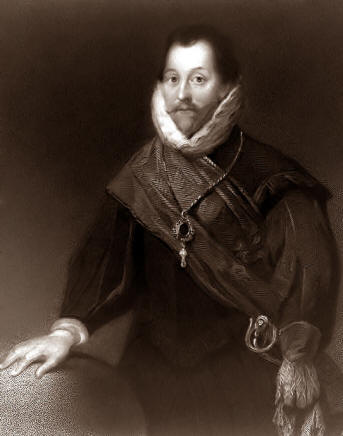
Francis Drake (ca. 1545-1596), 
victor over the Spanish Armada
The battles are:
-Marathon;
-Syracuse;
-Arbela;
-The Metaurus;
-Teutobarger Wald;
-Chalons;
-Tours;
-Hastings;
-Orleans;
-The Spanish Armada;
-Blenheim;
-Poltava;
-Saratoga;
-Valmy;
-Waterloo;
-Vicksburg;
-Sadowa;
-First Marne;
-Midway;
-Stalingrad.

Each chapter describes the situation before and after the battle and tells why this battle was so important, a hinge of history, so to speak. In some cases, there is a lot of detail about the battle itself, in some cases there is only some hazy detail to draw from so there is not much to tell. Clearly, this is a Eurocentric, or at least Western-based series of battles. Nothing from Asia or Africa unless a European/American force is fighting against them. This makes the basis for calling it Twenty Decisive Battles of the World pretty iffy, but these are certainly twenty well chosen battles that created the West.

I rate this history 4 stars out of 5.

This book can be found on Amazon.com here: Twenty Decisive Battles of the World

Reviewed on August 4, 2011.

America Alone: The End of the World as We Know It by Mark Steyn


Important information but not well-presented


Published in 2006

I am a genuine fan of Mark Steyn. I am a frequent reader of National Review and his "Happy Warrior" column is what I read first. I picked this book up as a result of listening to a half-hour interview with him on my local radio station. I picked it up less than 4 hours after hearing him.

The information in America Alone The End of the World as We Know It is important, but the presentation is lacking. Steyn repeats himself so often that, if properly edited, this book would only have about 50 pages. Steyn writes brilliant columns. This book reads like a series of columns that overlap information, commentary and theme and was not up to the standards that I expected.

Steyn has done a lot of research, includes dozens and dozens of quotes and paraphrasing. However, he includes absolutely no endnotes, no footnotes, heck, he doesn't even include a bibliography! C'mon, Mark, I expect my tenth grade students to show their sources. You should do the same.

An interesting side note: A Canadian court tried to ban this book, Mark Steyn and the magazine that printed excerpts from this book due to some sort of 30 year old politically correct hate crimes law (can't write items critical of ethnic groups, etc.). While I'm not fond of the way this book is written, I can't stand the idea of banning a book for PC reasons. Steyn's book describing the trial is Lights Out: Islam, Free Speech and the Twilight of the West. Click here for my review of that book.

This book can be found on Amazon.com here: America Alone: The End of the World As We Know It

I rate this book 3 stars out of 5.

Reviewed on May 2, 2008.

Worlds at War: The 2,500-Year Struggle Between East and West by Anthony Pagden


Disappointed


Published in 2008.

Anthony Pagden's Worlds at War: The 2,500-Year Struggle Between East and West was a book I was really looking forward to reading. It sat on my wish list for months and when I saw it just sitting there at my local library I greedily snatched it up and considered myself lucky to even have found it checked in.

Thank goodness I did not waste my money buying it.

I suppose the problem with a book of this nature is that it is bound to disappoint - some things will be "too" highlighted, some left out. Even worse for this book, niggling factual errors crop up that bother the careful reader and throw into doubt the validity of the more complicated interpretations of the work as a whole.

Positives:

The book is quite readable and you must give a tip of the hat to anyone who undertakes such a large and sweeping history.

Negatives:

The anti-religious comments taint large sections of the book: "...nor have I made any attempt...to disguise the fact that I believe the myths perpetrated by all monotheistic religions - all religions indeed- have caused more lasting harm to the human race that any other set of beliefs..." (p. xix) In my opinion, his anti-religious bias does immeasurable harm to this history because holders of religious belief are held in disdain. This is a history full of religious beliefs, perhaps even based on it. Viewing all of those beliefs as despicable and marginalizing them leads to some of the more simplistic interpretations noted in other reviews of this book.

-The author comments that in this book Christianity "seems to fare slightly better than Islam in this story..." (p. xix) but I really doubt that. At least he spent several pages on the life of Muhammad and the early history of Islam. He doesn't even bother to tell about the life of Jesus (not even a "supposed" version) or a history of St. Paul (whom he refers to in passing several times, but the uninformed reader is left, well, uninformed.) Imagine, a history of the West without even a page devoted to the beginnings of Christianity. The closest we get to an outline of Christ is a brief comparison to Mithraism (pp. 130-1). Christians are often slighted, such as on page 519 when he opines that Christians would like to make Shari'a law for the United States if only they could figure out how.

-Judaism fares even worse. It is rarely mentioned. Even then it has inaccuracies, such as on pages 151-2 when he notes, incorrectly that Moses was only given 10 laws. A passing glance through the book of Deuteronomy would tell the most casual of reader that dozens and dozens of laws were given to Moses.

-The Persian-Roman conflicts. I was looking forward to learning more about the Persian empire(s) that fought Rome to a standstill. Usually in this type of history there is just one paragraph that tells you little more than I've already mentioned - that the Persians fought the Romans to a standstill and an accomodation was made. He includes a fancier explanation, but it is still just the one paragraph. (pp. 175-6) I was hoping for much more - especially since this accounts for roughly 500 years of the 2,500 years of conflict that is discussed in the book.

--Refers to the year 1098 as being a part of the "ninth-century". (p. 231)

Martin Luther (1483-1546)
-Luther's teachings are misstated at times. "Mankind did not need to labor to win God's favor, as the Church had always maintained; it could be vindicated by faith alone. To be justified in the eyes of God, one had only to believe and lead a true and godly life." (p. 297) The part about leading a true and godly life would be the same as laboring to win God's favor. It is not Luther's theology. He stated the godly life would proceed from one's faith, it would not, in and of itself, do anything to get one into heaven.

Some might find the point about Luther trivial, but this is not a small thing. In the last 500 years there have been two large-scale organized religious movements in the West and both were inspired by Martin Luther - the Reformation and the Counter-Reformation (aka the Catholic Reformation). Failing to understand this simple part of Luther's theology means that those two movements are not understood as well. If you were reading a book that mentioned the philosopher Socrates and the author failed to grasp the concept that Socrates wanted people to question everything you'd have to question the author's competence as an authority on the topic. If the author also openly ridiculed philosophers in general and Greek philosophers in particular you'd question why he even bothered to write on the topic in the first place.   

-On page 74 there is a reference to "brothels in Pompey" (p.74). Pompey was one of Julius Caesar's rivals. Pompeii is the standard spelling for the city he is referring to.

-On page 249 he refers to the Afghan War of 1991. 2001, perhaps?

-There is a complete failure to mention the clash between Communism, Fascism and the East. The Ba'ath Party was influenced by the Fascist movements. Afghanistan was nominally Communist when the USSR invaded it to support the floundering government in 1979. He expounds on the murderous history of religious movements but blows off the terrible history of secular movements like Communism with one really long sentence (pp. 533-4) that fails to address the issue or the scope of their own murderous pasts.

-"Soviet Block"? (p. 526). The standard spelling is bloc, not block.

-On page 526 it is claimed that East Germany "took the first steps that would eventually bring down the Communist regimes of eastern Europe." (p. 526) Funny, I remember it being Poland with Lech Walesa and Solidarity being the first. The Wall came down only when Hungary and other countries had already lowered their barriers and made East Germany's Communist rulers irrelevant.

Final thought: Buy something else. Perhaps more specific histories rather than a more general, biased one that demonstrates little respect for the religious traditions of the peoples involved.

I rate this book 2 stars out of 5.

This book can be found on Amazon.com here: Worlds at War: The 2,500-Year Struggle Between East and West.


Reviewed on October 28, 2008.

Islam: The Religion and the People by Bernard Lewis


Outstanding

Published in 2008 by Wharton School Publishing.

Islam: The Religion and the People is, without a doubt, the single best academic introduction to Islam that I have seen. It covers just about every facet of the religion for the non-expert, from what happens in a mosque on Fridays to the split between the Shiites and the Sunnis to how the Muslim world deals with not being able to charge interest to rules concerning food and the question of jihad.

This volume is short, well-written and thorough. It includes a glossary of terms mentioned in the book with more explanation (so the text does not bog down). Sidebars are included throughout the text with humourous notes that further illustrate the issues that are being discussed.

I have not encountered a better book to introduce Islam to the curious Westerner. I highly recommend this one to anyone heading off to a Muslim country, who works with Muslims or who is just curious about this popular, controversial and influential faith.

I rate this book 5 stars out of 5.

This book can be found on Amazon.com here: Islam: The Religion and the People.

Reviewed on November 9, 2008.

Muslims in America: A Short History by Edward E. Curtis IV


A Short, Solid History

Published in 2009 by Oxford University Press.

Muslims in America is the "first single-author history of Muslims in America from colonial times to the present", which is what the back cover proclaims. I have no reason to doubt that this sad statement is true and for that reason this book is a welcome addition to the shelf of any serious student of American history.


That being said, this book is not perfect. Since it tries to cover the entire spread of American history the first pages are about isolated Muslim individuals that were brought over as slaves, continued to follow their faith and were noted for doing so. It turns out that only a few people fit all those criteria so we end up with extended biographies of these people. This is not bad, per se, but it does make the last half of the book seemed rushed in comparison. The slow, extended style is put aside for a quicker, less detailed style.

That less detailed style in the latter half of the book was frustrating for me. I am not a Muslim but I am fairly well read on the religion. I can speak intelligently on the main teachings of mainstream Islam, but I will not claim to be an expert on the topic. Groups like the Nation of Islam fascinate me precisely because some of their teachings have differed radically from any other teachings in the "mainstream" , especially with the Nation of Islam's heavy emphasis on race and different stories about how each racial group was formed. I would have appreciated more discussion of how Muslims outside of the Nation of Islam view the Nation of Islam and their teachings, and vice-versa. I would have also enjoyed a more robust discussion of the origins of these "non-traditional" Muslim groups - which Muslim traditions did they draw from, which did they modify, etc.?
Edward E. Curtis IV

What the book does well is detail how Muslim slaves came into America (although actual numbers will have to remain guesswork) and tell how some completely maintained their faith while others saved just parts of it. Curtis also examines the multiple waves of Muslim immigration that have come into the United States. It is tempting to think that this is a relatively new phenomenon, but it is not. I was especially fascinated by the Muslim settlers in rural North Dakota. Can you imagine a place you would be less likely to find a mosque than in rural North Dakota in the 1880s?

Of course 9/11 and the Wars in Afghanistan and Iraq need to be addressed and Curtis covers them well. He includes a fatwa against terrorism on pages 117-8. He also chronicles the challenges of being Muslim in America in a post-9/11 world and some data on Muslim Americans opinions.

I give this book a four star rating, ignoring the preface, which I will comment on below:

For me the entire book was marred by an unfortunate Preface that was intended to show the level of misunderstanding that the greater American public has about Islam. The controversy cited was the installation of footbaths at the new billion dollar Indianapolis International Airport. These baths cost about $2,000 and Curtis comments on those that protested against it. He notes one pastor was against it because it would forward "Islam's desired goal, which is to thrust the entire world under one single Islamic caliphate under sharia law." (p. x) I do not know about this pastor, but I did pay particular attention to these protests because I live near the airport and I live near the Halal markets and coffee houses these taxi drivers frequent on West Washington Street - their cabs are a constant part of the landscape of my neighborhood.

It seemed to me that most of the protesters were upset that the government was paying to install foot baths to facilitate one religion's practices (although it was noted that anyone can use them, will they? What other group engages in ritual foot bathing?). Indiana has gone through a whole round of lawsuits to prevent prayers at graduations and to remove 10 Commandment displays on public grounds that were installed at no public expense. To many, it seemed mighty two-faced to have a government entity (the Airport Authority) play favorites by accommodating the wishes of one religion while other branches of government frustrate the wishes of others.

Curtis goes on to make comments about the pastor and how his deep prejudices would impair his ability to see his Muslim friends as people or even really knowing them - an ironic comment. Curtis shows his own prejudices in this snarky comment that is so unlike the rest of the book.

This whole preface left a bad taste in my mouth. It really is a pretty good book, but I had to force myself to look past this unfortunate part of the introduction.

I rate this book 4 stars out of 5.

This book can be found on Amazon.com here: Muslims in America: A Short History (Religion in American Life)

Reviewed on March 12, 2010.

Understanding the Koran: A Quick Christian Guide to the Muslim Holy Book by Mateen Elass


Informative, fair and well-written

Published in 2004 by Zondervan

Short summary:

Mateen Elass is uniquely qualified to write a book like Understanding the Koran. His father was a Muslim. He was raised in Saudi Arabia. He is now a Presbyterian minister in the United States. His short, 10 chapter book introduces the reader to the Koran by telling its history and the common touchpoints that it shares with the Bible, Christian tradition and Jewish tradition. Elass also introduces the reader to the proper handling of the Koran and has a balanced discussion on the role of Jihad in Islam, as defined in the Koran. An optional Bible study is located at the back of the book with lots of questions designed for group discussion.

My review:

An absolutely excellent book! The reader is not required to be a Christian to understand the book - but a working knowledge of Christian tradition and the Bible would help. Mateen Elass has produced a wonderful introduction to Islam and the Koran. He is respectful of Islam throughout the book, but it is clear that he is writing from the Christian perspective.

I have but one complaint: he has excellent commentary in his endnotes that complement the text. Unfortunately, I discovered this about halfway through the book. I wish it had been footnotes instead.

I'll be on the lookout for another book by Elass. Might I suggest a book on Islam itself? Or, perhaps Muslim customs and holidays?

I rate this book 5 stars out of 5.

This book can be found on Amazon.com here: Understanding the Koran.

Reviewed on July 21, 2004.

Besa: Muslims Who Saved Jews in World War II by Norman H. Gershman


Published in 2008 by Syracuse University Press.

Besa: Muslims Who Saved Jews in World War II by Norman H. Gershman is full of beautiful stories of people helping people in the face of evil.

In Albania, a country directly located across the Adriatic Sea from the "boot" of Italy, nearly two thousand Jews were saved from Nazi persecution in 1943 and 1944. Albania was fairly unique in that it had been majority Muslim for centuries. While Italy occupied Albania, the Jews were relatively safe, but with the withdrawal of Italy in September 1943, the Nazis assumed control of the country until late 1944. Photographer Norman H. Gershman travelled throughout Albania and neighboring Kosovo gathering family stories of the people who risked their lives and property hiding Jews in the surrounding countryside, in barns, in guest homes and, in many cases, taking them in their own households and claiming they were extended family.

The book's title comes from the Albanian for giving one's word of honor: Besa. This was intricately tied in with the Albanian (and Muslim) principles of giving aid to someone in need of help and defending one's guests. Surviving Jews told tales of Muslim Albanians arguing for the honor of helping their Jewish friends, neighbors and, oftentimes, complete strangers from foreign countries.

Gershman's photographs are all black and white and often include momentos that have been passed down in the family such as a table built by a Jewish refugee for his hosts and the wall where one man's father was nearly shot for refusing to tell where anti-German partisans were hiding in the nearby hills. I was most moved by the family that has been holding three elaborate books written in Hebrew since 1944. The Jewish family was afraid they would be damaged during their flight to Palestine so he asked his Albanian hosts to hold them until he got word. The family received word that they had safely reached Palestine, but were prohibited from sending anything by the Communist government of Albania. So, the Albanian father has passed the books on to his son while they await another letter and he is hoping not have to pass them on to his own son.

Besa, indeed.

Moving quotes:

"All Jewish children will sleep with your children, all will eat the same food, all will live as one family." - Prime Minister Frasheri of Albania. (p. 4)

"There is a saying: We would sooner have our son killed than break our Besa." (p. 20)

"Our father wrote that when he had the opportunity and the privilege to shelter so many Jewish families it gave him joy to put into practice his Islamic faith. To be generous is a virtue." (p. 30)

"Why hide a Jew? We just did it. It was the thing to do." (p. 34)

"As Muslims we welcomed them all. We welcomed them with bread, salt, and our hearts." (p. 42)

"My father said that the Germans would have to kill his family before he would let them kill our Jewish guests." (p. 58)

"I did nothing special. All Jews are our brothers." (p. 96)

I rate this book 5 stars out of 5 stars. It can be found on Amazon.com here: Besa: Muslims Who Saved Jews in World War II by Norman H. Gershman.

Reviewed on June 15, 2010.

Featured Post

<b><i>BAN THIS BOOK (audiobook)</i></b> by Alan Gratz

Published in 2017 by Blackstone Audio, Inc. Read by Bahni Turpin. Duration: 5 hours, 17 minutes. Unabridged. My Synopsis Ban This Book is t...

Popular posts over the last 7 days