Showing posts with label Canada. Show all posts

THE DIRECTOR SHOULD'VE SHOT YOU: MEMOIRS of the FILM TRADE (audiobook) by Alan Dean Foster


Published in 2024 by Tantor Media.
Read by Stephen R. Thorne.
Duration: 7 hours, 1 minute.
Unabridged.


Alan Dean Foster is a prolific sci-fi author. He has written over 50 sc-fi novels, but he is probably most famous for his numerous novelizations of sci-fi movies and TV shows, such as the original Star Wars movie (ghost written for George Lucas), Alien, Star Trek: The Animated Series, Krull, and The Last Starfighter.

The Director Should've Shot You is the story of Foster's experiences as the man who Hollywood turns to to write novelizations of sci-fi movies. He talks about how that system (usually) works, the odd experiences, his interactions with directors, producers, and faceless stuidio executives, and his various thoughts of the strengths and weaknesses of the various projects. 

My experiences with Foster as a young reader start with his two Star Wars books that he wrote when George Lucas  and his team were finishing the original movie.

As I noted, he ghost wrote the novelization of the first movie for George Lucas. He  also wrote the original sequel to the original Star Wars movie - a book called Splinter of the Mind's Eye. George Lucas asked Foster to make Splinter of the Mind's Eye a smaller story when compared to sweeping epic of the original story just in case the first movie turned out to be a bust. Lucas hoped to make a cheaper movie and recycle some of the original props and costumes in order to eke out a little profit. The runaway success of Star Wars made that plan unnecessary. 

We were so starved of Star Wars material back then. 
I must have read the novelization of the original Star Wars movie more than 10 times. This was back in the days when you could only see Star Wars in the movie theaters. It hadn't been played on TV yet and there were no VHS, DVD, or streaming releases. But, we had the books, the collectable cards, the toys to remind us of the story and it was an endless source of conversation.

I remember reading and discussing Splinter of the Mind's Eye until Lucas released the eventual sequel, The Empire Strikes Back. We were searching for any indication of how the stories might continue and we were trying to figure out how the Star Wars universe worked and all we really had were two little paperback books writen by Alan Dean Foster. That cover was excellent.

I must have read all of his novelizations of the Star Trek animated stories because I read everything Star Trek that I could find when I was in high school.

If you are looking for a complete autobiography of Foster, this isn't it. He offers a decent autobiography up to the point where he starts writing the movie novelizations and then it's pretty much all about those novels. That was fine by me - Foster is a critic and a fan at the same time and it was a fun listen.

The book is almost worth reading just to see what 1970s TV show paid him to write a novelization of a very special two episode story arc. It was certainly out of his normal area of expertise.

Now, I am seriously thinking about re-reading Splinter of the Mind's Eye.

I rate this audiobook 5 stars out of 5. It can be found on Amazon.com here: 
THE DIRECTOR SHOULDVE SHOT YOU MEMOIRS of the FILM TRADE by Alan Dean Foster.

BOUND for CANAAN: THE EPIC STORY of the UNDERGROUND RAILROAD, AMERICA'S FIRST CIVIL RIGHTS MOVEMENT (audiobook) by Fergus Bordewich


Published by Harper Audio.

Read by the author, Fergus Bordewich.

Duration: 5 hours, 29 minutes.

Abridged.

The abridged version of Bound for Canaan hits the highlights of the Underground Railroad movement, but leaves quite a bit out. This is a radically abridged audiobook - fourteen hours of a nineteen hour audiobook were cut out - more than 70% of the book. I did not realize how much it had been abridged until I had already listened to it.

What remains is solid, but more of traditional hero study. The reader learns about the Quakers, Levi Coffin and Harriet Tubman and a few other stalwarts of the movement. Frederick Douglass shows up as an example of the Underground Railroad in action. There is a nod to the importance of women in the movement and how that led to the Women's Suffrage movement. 

The book goes off track a bit when it comes to John Brown of Bleeding Kansas fame. Brown did participate in the Underground Railroad movement, but the book follows him to the Kansas and the violence that he committed there as an abolitionist. 
It follows with a detailed re-telling of John Brown's attempt to instigate a slave rebellion by seizing the national armory at Harper's Ferry, Virginia (now West Virginia).

While these are all things that Brown did, he did them separately from the actions of the Underground Railroad. I know that the author was trying to tie the Underground Railroad to the political climate that led to the Civil War and the eventual liberation of the slaves, but this was clunky. I am going to blame it on the extreme abridgment of the book.

What was left after the abridgement wasn't bad, but it wasn't anything that was groundbreaking, either.

I rate this abridged audiobook 3 stars out of 5. It can be found on Amazon.com here: Bound for Canaan: The Epic Story of the Underground Railroad, America's First Civil Rights Movement

THE GIRL from the SEA (graphic novel) (kindle) by Molly Knox Ostertag


Illustrated by the author.
Published in 2021 by Graphix.
Winner of the British Fantasy Award for Best Comic/Graphic Novel (2022)


Synopsis:

Morgan Kwon's parents have recently divorced. 15 year old Morgan, her annoying little brother and her mom have moved away from the city to an island just off of mainland Canada.

Morgan seems to be doing pretty well. After all, she has a great group of friends. But, there are struggles. Her little brother has become extra annoying, she misses her dad and she can't wait to get off of this island and go to college and be her true self. 

You see, Morgan has a secret that she is afraid to share with anyone - she's gay and she's afraid her friends and family will reject her if they find out.

It all comes to a head when she meets a very cute girl while swimming one day. There is a more than a spark of romance, but it turns out that this new girl has a secret that dwarfs Morgan's secret!

My review:

This is an absolutely enjoyable coming-of-age story. The publisher recommends grade 7 and higher and I agree with that recommendation. The book has two main plots - Morgan's secret and the new girl's even bigger secret. But, it also has an environmental subplot, a strong family message and a tiny sweet subplot that is sort of hidden throughout. This book contains no nudity and nothing sexual beyond a few kisses.

I rate this graphic novel 5 stars out of 5. It can be found on Amazon.com here: THE GIRL from the SEA (graphic novel) (kindle) by Molly Knox Ostertag.

NOTE: I only heard of this book because it was listed in an article about a MAGA parent who is challenging 3,600 books in a county school district in Florida in an effort to, as he describes it, "overwhelm" their challenge procedures. The parent was particularly unhappy about The Girl from the Sea and is quite vocal about it.

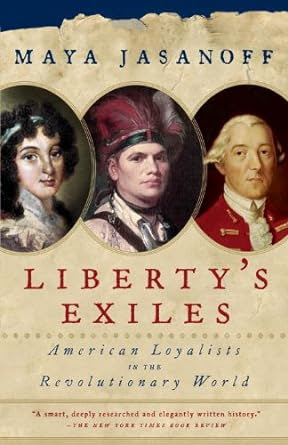
LIBERTY'S EXILES: AMERICAN LOYALISTS in the REVOLUTIONARY WORLD (audiobook) by Maya Jasanoff

Published by Recorded Books in 2012.
Read by L.J. Ganser.
Duration: 16 hours, 10 minutes.
Unabridged.


In 1783, at the end of the Revolutionary War, Loyalists (Americans who opposed the American Revolution and stayed loyal to Britain) had a choice to make - stay and ride out the anti-Loyalist bias in the United States or move somewhere else.

In the two years between the last major engagement (Yorktown) and the official end of the war and withdrawal of British troops the British decided to evacuate any Loyalists that wanted to go to other parts of the British Empire. One of the biggest advocates of this position was Guy Carleton, the British commander in America after Yorktown who later went on to become the Governor-in-Chief of Canada. He had more to do with what happened in this history than any other single person.

Guy Carleton (1724-1808)
The British government made an effort to make things right for these Loyalists. Not many Loyalists were completely reimbursed, but the fact that an effort was made was extraordinary for the day. In some cases, Loyalists were offered large grants of land, in other cases they were offered smaller grants of land and in other cases they were offered pensions and partial reimbursements for lost property. All of these offers were new innovations and a sign that the British government wished to honor the loyalty they had shown.

Some loyalists wanted nothing more than to start over, some looked to just work themselves up the British societal ladder, some wanted to get away from British society and some looked for a chance to get even with the Americans. 

There was a racial component to this as well. The British had offered freedom for any slaves that left their masters and joined their armed forces. The Americans pressured them to return the runaway slaves (including slaves from George Washington and Thomas Jefferson) but the British refused to go back on their deal with the former slaves as a point of honor. However, those former slaves oftentimes were given less money and less land than white Loyalists when they arrived at their new homes.

The British tried to honor the commitments shown by the Native American allies as well, but not nearly as much. 

Loyalists ended up going all over the empire but mostly to Canada. There were several families that went to Bermuda and Jamaica and back to England itself. Several families of African descent moved to Sierra Leone in Africa as part of an experimental colony. A few went even further to India. 

The section on the Canadian settlement was, at first, interesting but it soon got bogged down. It was all relevant detail, but just too much for me. In fact, that's pretty much my review of the entire book.

I rate this audiobook 3 stars out of 5. It can be found on Amazon.com here: LIBERTY'S EXILES: AMERICAN LOYALISTS in the REVOLUTIONARY WORLD (audiobook) by Maya Jasanoff.

A VOYAGE LONG and STRANGE: REDISCOVERING the NEW WORLD (audiobook) by Tony Horwitz


Published in 2008 by Random House Audio.
Read by John H. Mayer.
Duration: 17 hours, 16 minutes.
Unabridged.

In A Voyage Long and Strange Tony Horwitz set out to fill in a big gap in his understanding of American history. He vaguely knew that the Vikings arrived in the New World and did something or other and he knew about Columbus' voyage in 1492 and he knew about the Pilgrims and Plymouth Rock and the First Thanksgiving in 1621, but what happened in between? Also, what about the people that were already here?

Horwitz decided to find out what he didn't know and this book is a combined travelogue and history lesson. He starts with the small failed Viking settlement in Newfoundland, Canada, moves on to the Dominican Republic to learn about Columbus and comes to the United States to look at the first Spanish explorers and settlements in New Mexico and Florida. He also looks at the epic and eventually tragic expeditions of exploration that the Spanish sent out. Finally, he turns toward the early English attempts to explore and build colonies. 

A reconstruction of what a Viking longhouse in
Newfoundland may have looked like.
Typically, Horwitz starts out a section of his book by looking at the geographical area he is visiting as it is nowadays. He finds a variety of different locals to interview and lets them supplement the history he presents. Many times those local experts get very philosophical about how the past has influenced their homes.

Horwitz's roundabout way of discussing the history is almost always interesting - usually extremely interesting. However, the section on the Dominican Republic and a museum he visited there was too long and too repetitive. But, he bounces back from that and does a splendid job from that point forward.

I rate this audiobook 5 stars out of 5. It can be found on Amazon.com here: 

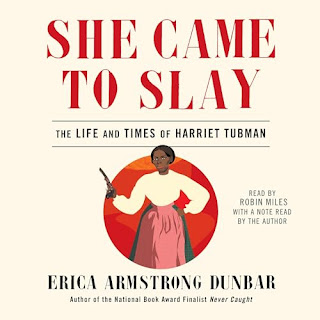
SHE CAME to SLAY: THE LIFE and TIMES of HARRIET TUBMAN (audiobook) by Erica Armstrong Dunbar


Published in 2019 by Simon and Schuster Audio.

Read by Robon Miles.

Duration: 5 hours, 53 minutes.

Unabridged. 

Erica Armstrong Dunbar brings us an accessible biography of one of the true heroes of American history - Harriet Tubman. She Came to Slay is long enough to give a decent picture of her life but short enough that it doesn't intimidate potential readers.

A traveling statue named honoring
Harriet Tubman named "Journey to Freedom"
I am not going to go through the entire biography of her life, but this book covers all of the major points of her life such as: 

-Her escape from slavery; 

-Her multiple trips back to Maryland to free family, friends and anyone that would go;

-Her work in anti-slavery societies where she met and worked with people like Frederick Douglass, William Seward and John Brown;

-The communities she helped start in New York and Canada;

-Her work with women's rights groups and her struggles to get white women to include black women in their fight;

-Her service as a nurse in the Civil War;

-Her service as a spy and a scout in South Carolina in the Civil War and her fight to be recognized for that service.

The book has a lively pace.

I rate this audiobook 5 stars out of 5. It can be found on Amazon.com here:  SHE CAME to SLAY: THE LIFE and TIMES of HARRIET TUBMAN by Erica Armstrong Dunbar.

THE MARROW THIEVES (audiobook) by Cherie Dimaline


Published by Kobo Originals in 2018.
Read by Meegwun Fairweather.
Duration: 7 hours, 11 minutes.
Unabridged.


In The Marrow Thieves, it is the latter half of the 21st century and the world has had a series of literal upheavals. Earthquakes sheared off California, global warming has changed the weather. Droughts occur in former wet spaces and dry places have become swamps. Sea levels have risen and drowned out many cities. Many animal species have died off and others are in severe decline. On top of that, the nations of the world have gone to war and most cities were destroyed, people have fled to the remaining cities. The entire world map has been re-drawn.

In the future there is also another problem. Almost everyone in the world has
The author, Cherie Dimaline.
lost the ability to dream. Everybody except the indigenous population of the Americas - Native Americans. However, their bone marrow can be harvested for a substance that lets other people dream. The government and the Catholic Church have joined together to "recruit" people for this project. That sounds harmless enough in theory, but in practice it means hunting them down, capturing them and taking them off to concentration camps.

Frenchie is a teenager. He and his family fled the city to go north to their people's original homelands. On the way, Frenchie lost everyone in one way or another. Alone, he stumbled into the camp of survivors who were also pushing north. An old woman, a middle-aged man, a smattering of young men and women and a little girl. This is their story.

I liked this book quite a bit. The characters were great and the ups and downs are truly roller coasters for the listener. Meegwun Fairweather did a great job with the reading.

The only problem I had with the book was the reason why the Native American populations were being hunted in the first place. There is no reason giving for almost everyone losing the ability to dream and no explanation for how the government is able to distill a substance from Native Americans, but somehow not able to chemically replicate this substance. This could have been a fatal flaw, but the strength of the characters carried it past this problem.

I rate this audiobook 4 stars out of 5. It can be found on Amazon.com here: THE MARROW THIEVES (audiobook) by Cherie Dimaline.

This book was placed on a massive book ban list in Florida, a place well-known for banning books. Ugh.

FUNNY, YOU DON'T LOOK AUTISTIC (audiobook) by Michael McCreary


Published by Annick Press in 2019.
Read by the author, Michael McCreary.
Duration: 3 hours, 37 minutes.
Unabridged.


Michael McCreary is a pretty unique thing in this world - a stand-up comic who is on the autistic spectrum. He uses the word Asperger's to describe himself in promotional materials.

But, one of McCreary's points in this book and in his shows is that he is not all that unique. People on the autistic spectrum are not necessarily like the Dustin Hoffman character in Rain Man. McCreary cautions his readers not to assume too much and think that everyone is on the autistic spectrum. He has compulsive behaviors that are more than the average person would experience.

McCreary has some genuinely funny moments in Funny, You Don't Look Autistic, but for me I got the most out of this as a teacher. It is not unusual to have students on the spectrum in my classes, and listening to this very self-aware talkative former student talk about his experiences shed a little light on the matter. It's not like I can go up to one of my students and say, "Hey, you're autistic. How's that going for you?"

On the other hand, this memoir felt like it was just too rushed, and that falls right back to McCreary's compulsive behaviors. Once he gets an idea in his head, he pushes forward until he gets it done. I can see him wondering what he could do besides act and perform stand-up and this book idea just popped in his head. After all, comics write books all of the time.

The author, Michael McCreary
The problem is, McCreary isn't even 30 years old. He's not even close to 30 years old. Some of the things that he talks about are interesting and many of his stories would certainly not make the cut or even be considered if a 50 year old Michael McCreary was writing this book. Most are cute, but not compelling. He simply hasn't lived enough of a life to fill a book with compelling stories, even a little 176 page book.

So, in the end, I rate this book 3 stars out of 5. It has its moments, a few funny lines and a tough story towards the end, but it still isn't must-read material. It can be found on Amazon.com here: FUNNY, YOU DON'T LOOK AUTISTIC by Michael McCreary.

Great quote from the book: "Every time a system is changed for the better, it's because of someone saying, 'I have a problem,' loudly enough."

TRESPASSING ACROSS AMERICA: ONE MAN'S EPIC, NEVER-DONE-BEFORE (and SORT of ILLEGAL) HIKE ACROSS the HEARTLAND (audiobook) by Ken Ilgunas


Published by Blackstone Audio in 2016.
Read by Andrew Elden.
Duration: 7 hours, 44 minutes.
Unabridged.


In 2012, Ken Ilgunas embarked on a 1,900 mile hike from the beginning of the proposed Keystone XL pipeline in Alberta, Canada to its terminus on the Gulf Coast of Texas.  He did this because he is opposed to the pipeline and is very concerned about the expanded use of fossil fuels, the environmental damage caused by the mining of oil sands and the potential for spillage from the pipeline. Along the way, he blogs about his experiences with his iPad in the hopes of creating a little buzz about the topic.

He was inspired to do this by a series of conversations he and a friend had during a stint in the kitchen at a Prudhoe Bay oil drilling site. They were going to hike the entire length together, but his friend begged off and fell into a support role, occasionally mailing him food and replacement pieces of equipment and boots (he went through 3 pairs of boots on this hike).

Ilgunas got off to a late start and began hiking as Canada was going into winter, meaning that he faced cold weather and snow almost all of the way through his hike. He tried to follow the path of the pipeline as much as possible in order to save time and to cut back on the amount of miles he would have to walk. The pipeline starts out with a south-east direction and he often walked along its proposed path through pastures and empty fields for miles. The new pipeline will follow a smaller pipeline route that currently exists in many places so it was pretty easy to follow. Other times, he stuck to the roads, especially when the pipeline takes a more due south path in the United States. That is because most roads in Plains states run north-south or east-west, like a giant checkerboard.

He meets a lot of animal life, including moose, coyotes, lots of dogs and cows. Lots and lots and lots of cows. He almost gets killed in a cattle stampede at one point.

Different states have different personalities, it seems. In Canada (yes, I know Canada is not an American state, but just go with it), no one seems to care where he walks. Montana and South Dakota have lots of no trespassing signs, but no one really seems to care much. Ilgunas becomes a mini-celebrity in Nebraska, despite a rough start where he is escorted out of the county (well, almost all of the way) by a deputy on the orders of the sheriff. Those few miles are the only part he didn't walk. He attends an anti-pipeline rally, gets a few local media interviews and for the rest of his hike in Nebraska he is welcomed as the "guy who is hiking the pipeline".

In Kansas, however, his celebrity status evaporates and he gets consistently hassled by the police. He is asked for his ID in Kansas more than he is on the rest of his trip combined.  Oklahoma depresses Ilgunas. It has a massive pipeline junction -  a place that should be well off since everyone says pipelines bring jobs. In his mind, the town where all of the pipelnes meets is the saddest town on his whole hike. 
Keystone Pipeline construction in South Dakota


Along the hike he usually avoids discussions of the topic of global warming since this is a very conservative area that doesn't buy into that theory. As he hikes, he is consistently told that the pipeline will create lots and lots of jobs, but he literally doesn't meet a single employee except at the very end and at the very beginning. But, people across Montana, South Dakota, Nebraska, Kansas, Oklahoma and Texas swear that it will create jobs all along the way.

Ilgunas doesn't really have an answer to the problem of petroleum's ubiquitous role in our society. His tent, his hiking poles, his shoes, and his iPad all have plastic made from petroleum in them. Nor does he address how radically more expensive energy will affect the poor. He talks about how the Ogallala Aquifer is being depleted by its use to make farming on the Great Plains possible. But, he doesn't talk about how that food would be replaced if we didn't farm on the Great Plains.

It's not that I necessarily disagree with any of his points, but the lack of answers, or even suggestions, by Ilgunas is frustrating.

The area he hikes through is certainly part of the Bible belt and Ilgunas finds his anti-Christian bias challenged by the number of people who offer to help him. He points out that only one person evangelized him (a creepy minister in Oklahoma), but the other people of faith shared their food, their homes, their electricity to charge his devices, their wi-fi and their time because they genuinely loved helping others. Ilgunas would arrive in town and search up the local pastor for help in finding a place to pitch his tent. Often, they offered spare rooms, floor space in the church and even once in a loft area in the sanctuary. This made a much more profound impact than the perfunctory hardball Christian sales pitch he received from the minister in Oklahoma.

Andrew Elden read this book and did quite a good job.

When I started listening to this book, I quickly tired of Ilgunas' writing style, which really should be described as an over-writing style. He over-described everything and really tried too hard to create a mood for every scene. Either I got used to it, or he cut back on it. It's not a perfect book, but I do give this book 4 stars out of 5.

This book can be found on Amazon.com here: TRESPASSING ACROSS AMERICA: ONE MAN'S EPIC, NEVER-DONE-BEFORE (and SORT of ILLEGAL) HIKE ACROSS the HEARTLAND  by Ken Ilgunas.


AMERICAN CIVIL WARS: THE UNITED STATES, LATIN AMERICA, EUROPE and the CRISIS of the 1860s (audiobook) by Don H. Doyle


I tried. I really did.

Published in 2017 by Tantor Audio.
Read by Johnny Heller and Jo Anna Perrin.
Duration: 8 hours, 58 minutes.

Unabridged.

The premise of American Civil Wars is interesting. The idea is to place the American Civil War in the context of the currents of the politics of the larger world of the time in order to show how the war changed the politics of other areas (prime examples are the Dominican Republic and Mexico - both were invaded by European powers while the United States was unable to enforce the Monroe Doctrine) and how those outside political forces influenced the Civil War. One of the stated goals is that teachers read this book and try to bring these insights to their students in the classroom.

Don H. Doyle is the editor of this book. I think that it more accurate to say that he "collected" a series of essays by experts in non-American history that focused on how the Civil War affected their regions. I wish he had been a true editor because this book would have been much less repetitive. I estimate that 2 hours or more of judicial editing could be done to this 9 hour audiobook and do nothing but improve it. As I stated above, this book is supposedly aimed at the non-professional historian, but the writing is almost uniformly done in a dry academic style. The sentences are quite lengthy and hard to follow, especially in the audiobook format. It's not like I am unfamiliar with the topic - this is my 101st review of a Civil War-related book since 2001 and I read many more  before I started reviewing regularly. And, it's not like I am not used to audiobooks - this is 458th audiobook review.

The readers were also an issue. There are two. The first is Johnny Heller. I am literally a big fan of Johnny Heller as an audiobook reader, but he was completely miscast when he was hired to read this book. Audiobook readers are essentially actors performing the book. Heller reads very quickly, which is not usually a problem. But, with the length of these sentences (you can hear the semi-colons and parenthetical insertions), it was hard to keep track of what he was saying sometimes. To solve this, I was forced to re-set my phone's playback to 80% of the normal speed.

Jo Anna Perrin's readings, though, were worse. Robotic is the best description. It is full of strange pauses that remind me of a caricature of William Shatner at his worst. I assumed that she was a friend of the editor who persuaded him that she should read half of this audiobook. I was very surprised to see that she reads a lot of audiobooks. Hopefully, this is not her typical work. Oh, and yes, I did re-set my phone to play at normal speed.

I tried to finish it. I made it 6 hours and 58 minutes and then started listening to an essay that was literally covering the same ground as the previous one and just couldn't do it any longer. I literally have no problem with the research that went into the book or the conclusions of the authors. My problem in entirely in the presentation of the facts. I am reminded of this quote: 
"No harm's done to history by making it something someone would want to read." - David McCullough.

I rate this audibook 1 star out of 5. This book can be found on Amazon.com here: 
AMERICAN CIVIL WARS: THE UNITED STATES, LATIN AMERICA, EUROPE and the CRISIS of the 1860s by Don H. Doyle.

STRUGGLE for a CONTINENT: THE WARS of EARLY AMERICA (The American History Series) by John Ferling


Published in 1993 by Harlan Davidson, Inc.

This unique volume looks at the near-constant state of war that existed in one part or another of the English colonies, from the first attempt at colonization in 1585 until the end of the French and Indian War in 1763.

The first quarter of Struggle for a Continent deals with the frequent wars that erupted between the English and the Native Americans that they encountered. Similar patterns emerge as disagreements and misunderstandings become full-fledged brutal and desperate wars of survival in colony after colony, with the exception (at first, at least) of Pennsylvania. 


The rest of the book is devoted to the English struggle against other colonial powers, namely the Spanish and the French. Spain was already a declining power at this point so they posed a minor threat when compared to the ever-growing French Empire. A great part of the book is spent discussing the French threat emanating from Canada towards New England and what is now the states of Michigan, Indiana, Ohio, West Virginia and Western Pennsylvania.

Time and again the colonies are brought into wars that started in Europe. The colonies became a sideshow to the war and many times their hard won gains were given away on the bargaining table in order to make a peace treaty work for Europeans.

Ironically enough, the last of these wars, the French and Indian War, was clearly started by a young colonial soldier named George Washington who stumbled into a group of French soldiers while leading troops in Western Pennsylvania and was forced to surrender them at Fort Necessity. This fight led to the removal of France from Canada and sowed some of the seeds that became the American Revolution.

This is a very informative, concise volume. Well done.

I rate this book 5 stars out of 5 and it can be found on Amazon.com here: STRUGGLE for a CONTINENT: THE WARS of EARLY AMERICA.

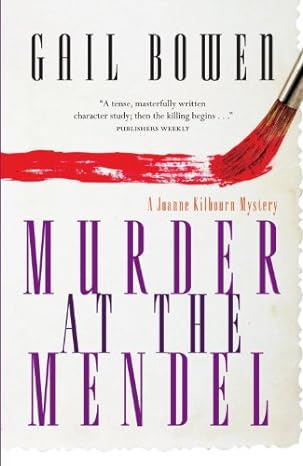
MURDER at the MENDEL(Joanne Kilbourn #2) (audiobook) by Gail Bowen


Published in 2012 by Post Hypnotic Press
Originally published in 1991
Read by Lisa Bunting
Duration: 6 hours, 33 minutes
Unabridged

Gail Bowen's Joanne Kilbourn character carries on into her second book, Murder at the Mendel. Life has changed for her - she has moved her family to Saskatoon in Saskatchewan to be close to her daughter in college and to teach at the same university. 

The local art center was called the Mendel (I say was because it has since been slated to close and move to a new location with a new name) and a childhood friend of Joanne Kilbourne who has since become a controversial artist has an exhibit at the Mendel. The artist, named Sally Love, and Kilbourn used to be very close but after the suicide of Love's father when they were 13 years old, Sally Love moved away.

Kilbourn and Love renew their friendship. Sally Love's exhibition has brought a number of protesters out because of her art. She has a lot of art with overt sexual themes, including a 200 square foot fresco on the wall over 100 penises (and a few vaginas) - paintings of the genitalia of all of her lovers over her lifetime permanently painted to the wall.

As a Kilbourn and Love navigate the protesters and her fans, Love decides to sell a private all-women's art gallery that an emotionally ultra-needy friend has managed for her for years. This unhinges the friend.

Suddenly everything starts to unravel as arson, multiple murders and more ruin Saskatoon's Christmas and New Years...


The Saskatoon skyline. Photo by Thomas Kelley
I did not enjoy this audiobook. It was not the fault of the reader, Lisa Bunting, who did a fantastic job with a variety of people's voices. She exhibited tremendous emotional range with her reading.

The text itself is the problem. Sally Love came off as an arrogant self-absorbed character and Kilbourn seems the same as she accepts Love without criticism, even as she makes cruel comments about other characters, makes plans to remove her daughter from her ex-husband (the only home she's ever known) and even sits and talks about masturbation at the breakfast table in front of Kilbourn's school-aged son before he heads off to school. In fact, Kilbourn's own internal compass is so messed up that I despaired of using her opinions as any kind of barometer to judge any other character and try to figure out who did what to whom.

To make matters worse, the pacing in this book is terrible. The "murder an the Mendel" that the title proclaims does not happen until halfway through the book. Bowen excels at long, rich descriptions of scenes but not at moving a plot along.

This is my third review of a Gail Bowen book or short story and this is my last. In the end, I was just glad to be done with it and I was sort of hoping that more of them had died along the way.

I rate this audiobook 2 stars out of 5.

This audiobook can be found on Amazon here: Murder at the Mendel: A Joanne Kilbourne Mystery, Book 2.

Note:  I received a copy of this audiobook free from the publisher in exchange for an honest review.

LOVE YOU to DEATH (Charlie D #1) (audiobook) by Gail Bowen


Originally Published in 2010.

Post Hypnotic Press audio version published in 2013.
Read by Daniel Mate
Duration: 1 hour, 34 minutes

Canadian author Gail Bowen takes a break from her Joanne Kilbourn series to bring us Love You to Death, featuring Charlie D, a talk radio personality who works the late night shift. This is part of the Rapid Reads series by Orca Books. This is designed to be a set of exciting, short mysteries. On paper this book clocks in at 128 pages.

Charlie D is working the night show on Valentine's Day. His guest is the boss's wife. The boss is an ancient man who has married the young, very elegant and very expensive prostitute he used to frequent. She is now very pregnant and being interviewed about her thoughts on love and relationships. 

Meanwhile, the neighborhood around the station is now awash in threatening newsletters and posters that advocate getting rid of the local prostitutes in any way possible. These vigilantes are inspired by the right wing host on the air just before Charlie D. He is a Bill O'Reilly type of host with discussions of fighting for the preservation of Canadian morality and some of his fans have gone too far - especially when they call Charlie D to show him live video feed of a local prostitute who is awaiting execution at their hands...

I enjoyed the give-and-take between Charlie D and his listeners and the guest. But, the premise of the story - the coalition of bad guys, the frank discussions of prostitution, the "hooker with a heart of gold" scenario played out twice in just an hour and a half just made the book seem less like a story and more like a political screed against the political right ("Watch out for them sexually repressed right wing nutjobs!  They are all twisting the Bible to justify all kind of horrendous things because a radio guy told them to!"). 

I also had a problem with a discussion of sex workers that only included the positives of this kind of work (such as helping people with physical handicaps attain sexual satisfaction and providing sexual and perhaps even emotional comfort to the lonely) but said almost nothing about the downsides, including the spreading sexual diseases, dealing with pimps, human trafficking and the rampant substance abuse that often accompanies this career choice. Despite the politically correct use of the term "sex worker" in an attempt to give prostitution a veneer of respectability, I cannot imagine the day when a parent will be as proud of his or her daughter being a "sex worker" as he or she would be if she were an accountant, a used car salesperson or even a politician.

Daniel Mate's pleasant voice made Charlie D a fairly believable and likable character. The rest of it just fell flat and would have no matter how well Mate had read it.

Note:  I received a copy of this audiobook free from the publisher in exchange for an honest review.

I rate this short story 2 stars out of 5. It can be found on Amazon.com here: Love You to Death (Charlie D #1) by Gail Bowen.

Under the Wire: Bestselling WWII Memoir of an American Spitfire Pilot and Legendary POW Escape-Artist by William Ash and Brendan Foley


Re-published by CreateSpace in November 2012.

Despite the fact that this will be the third posting of the year for me, Under the Wire was actually the first book that I read in 2013 and it may very well be the best book that I will read all year.

95 year old World War II veteran William Ash and his co-author Brendan Foley have created an immensely readable, very enjoyable story. Young Bill Ash was an American who joined the Brits in fighting the Nazis by flying a Spitfire (a fighter plane) before America even joined the war.

Ash begins his story by telling about the difficulties of growing up in the Great Depression in Texas. Somehow, he managed to get a college degree, even though there were no jobs to be found for this new college grad. So, he hit the road, riding trains, traveling the country and living in hobo camps. One day he heard that the Canadians were looking for fighter pilots to send to England and they would even take Americans who renounced their citizenship.

The last operating Spitfire to survive The Battle of Britain.
Photo by Adrian Pingstone in 2008.
Ash's reasons for joining are a rather vague mishmash of looking for adventure, wanting a steady paycheck, wanting to fly and wanting to fight the Nazis, but that's okay. The story has been good so far and it only gets better as Ash talks about the joys of a full belly and learning to fly. Soon enough, he's off to England and set up in a Spitfire, England's hotshot iconic fighter plane of the war.

Ash's description of this plane and the way it handled makes you love it and appreciate the skill of Ash and all of his comrades. Eventually, as indicated by the lengthy title of this book, Ash is shot down over France. The story of how he hides for weeks from the Germans and eventually ends up in a POW camp is told in an entertaining and suspenseful manner.

In fact, the book is quite remarkable - it somehow manages to keep a sense of tension alive throughout the book even though the reader knows how it all ends after reading the three page foreword. Bill Ash survives the war despite being shot out of the sky and being kept in multiple POW camps. He makes an incredible number of escape attempts, trying for a "home run" (a successful run all of the way back to Allied territory). But, Bill's sense of humor shines through and you just keep rooting for this crazy character who starts plotting his next escape as he sits through the solitary confinement he received as punishment for attempting his last escape.

The story can be heartbreaking, often gritty and matter-of-fact about abuses he and his fellow prisoners endured. I was struck by the descriptions of how they dug tunnels under the fence. If you have seen the movie The Great Escape, you know the basics of how it was done but Ash and Foley's re-telling is so vivid and visceral that it caused me to have a claustrophobic panic attack (I suffer from claustrophobia). I had to put the book down and then I picked it up and finished that section so I wouldn't have to go through two panic attacks. It is that good.

But, none of this detail would matter if you just didn't love Bill Ash, his sense of humor and his ever-hopeful personality.

I rate this book 5 stars out of 5.

This book can be found on Amazon.com here: Under the Wire.

Reviewed on January 21, 2013.

Note: I received a copy of this book from one of the authors, Brendan Foley, in exchange for an honest review. Honestly, this is a fantastic read.

Shatner Rules: Your Key to Understanding the Shatnerverse and the World at Large (audiobook) by William Shatner with Chris Regan


Published by Penguin Audio in 2011
Read by the author, William Shatner
Duration: 4 hours, 27 minutes
Non-fiction, biography

If you are a fan of William Shatner, Shatner Rules is a must-read, or a must-listen if you prefer to listen to the audiobook version like I did.

Shatner is unique and if you do not appreciate his odd blend of storytelling, self-promotion and urge to stroke his own ego then please skip this book. But, if you think a little self-promotion (actually, a lot of it) is okay and are willing to tolerate Shatner's ego trips for the sake of a good story than this short audiobook should please.

Most of the book covers the last 5 years or so of his career under the guise of explaining several rules that he  has followed throughout his career. The most important rule and the most consistently followed is his admonition to say yes to opportunity. Throughout the book he talks about the positives that he has had in his career due to his willingness to say yes, including a rather long convoluted story about how his willingness to make the almost universally panned The Transformed Man album in the late 1960's led to his getting the part of Denny Crane and receiving two Emmy Awards in the 2000's.

By and large, though, this book could easily be considered a tongue-in-cheek promo for William Shatner, Inc. He talks about his roles on The Twilight Zone , Star Trek , T.J. Hooker , The Practice , the Star Trek movies, his TekWar books, his current cable shows, his disputes with other members of the Star Trek cast and his part in the Vancouver Winter Olympics closing ceremonies.

I enjoyed it although I could have done without the 5 minutes and 20 seconds of narration in the made up language of Esperanto (he made a movie filmed entirely in Esperanto in 1965). I suggest the audio version so you can get the full Shatner experience.

I rate this audiobook 4 stars out of 5.

This audiobook can be found on Amazon.com here: Shatner Rules.

Reviewed on December 29, 2012.

Deadly Appearances (Joanne Kilbourn #1) (audiobook) by Gail Bowen


Published by Post Hypnotic Press in 2012
Originally Published in 1990
Read by Lisa Bunting
Unabridged
Duration: 8 hours, 43 minutes

There are a dozen or so Joanne Kilbourn mysteries. They are set in Regina, Saskatchewan in Canada. Kilbourn is a middle-aged political party worker. She works behind the scenes helping to craft policy positions, write speeches, plan campaigns and the like.

Deadly Appearances literally starts with the murder of Andy Boychuck, a successful politician. Kilbourn has worked with him for years and he is suddenly dead from a poisoned glass of water he drank from as he began a celebratory speech.

As the book proceeds there is another murder and only Joanne has the key to solving the mystery as she struggles to put together her shattered professional life and deal with her own issues as a recent widow (her own husband died a couple of years earlier).

Lisa Bunting does a great job with the narration. She delivers on all of the emotions of Kilbourn – the frailty, the anger, the tenderness towards her own family. As a plus, Bunting’s accents are excellent.

But, quality narration does not overcome plot holes, the highly telegraphed ending and the poor pacing.

This mystery does not really get started until the book gets halfway done. The first half of the book is spent dealing with the emotions generated by the death of Boychuck and an incredibly long description of his funeral. The book is endlessly descriptive (clothes, hair colors, the weather, furniture, yards, food, drinks) but just fails to generate any sort of steam that propels it forward.

*******Spoiler Alert********

Most unforgivable is the treatment of the minister who is involved in a homosexual love triangle with a married man (the other man is married and involved with two different men at the same time). While it is true that some denominations accept openly gay ministers (and his seems unlikely to be one of those since they are referred to as Fundamentalist and consistently treated as simpletons who have fled the real world by the author), they are not forgiving of ministers who are involved with married men. That is clearly the sin of adultery. In a book that is all about exploring the dimensions of a tragic relationship, this book completely ignores this minister’s flock’s reaction to his choices.

*******End Spoiler Alert*******

Having read a little about this author, the consensus is that this first book is the roughest. I can believe it. If the other books maintain her high quality of development of realistic characters but eliminate the problems mentioned above this series could really be something special.

I rate it 3 out of 5 stars.

Reviewed on December 18, 2012.

Note: I received this audiobook from the publisher at no charge in exchange for an honest review. This book can be found on Amazon.com here: Deadly Appearances (Kilbourn series) 

A Thousand Bayonets by Joel Mark Harris


Published in 2011 by iUniverse


Joel Mark Harris is a young Canadian journalist and new novel writer. The advice always given to writers is to "write what you know" so Harris has done that - the main character of this novel is John Webster, an experienced investigative journalist for a Vancouver newspaper. Webster carries physical and emotional battle scars from covering the wars in Afghanistan and Iraq. He is too old to start a blog to promote his articles and he is definitely too experienced to be playing fast and loose with the mob as the bullets start to fly and the bodies start to fall. But, he does, for reasons he doesn't quite understand his whole life has fallen apart since his horrible experiences in the war zones and he seems driven to push away his son and his ex-wife and take on ever more dangerous assignments at home.


The book begins with Webster listening in on a clandestine meeting of mobster leaders in a barn. The meeting becomes a crime scene as professional assassins shoot everyone. Webster lies still and goes unnoticed but his stories quickly grab the attention of a casino boss, mobsters and the local police (rumor has it some have been bought off) as he tries to figure out who ordered the murders and why before he is arrested or, even worse, killed.

Nice early work by a young author. Great at setting a mood and describing scenes. I have never been to Vancouver but I felt as though I had a sense of its gritty underside.

I rate this book 4 stars out of 5.

This book can be found on Amazon.com here: A Thousand Bayonets by Joel Mark Harris.

Reviewed on June 16, 2012.

I received this book from the publisher as part of a drawing on Goodreads.com. The review is an honest assessment of the book.

The Politically Incorrect Guide to the British Empire (P.I.G. Series) by H. W. Crocker III


A breezy look at a worthy topic


Published in 2011 by Regnery Publishing, Inc.
394 pages including extensive notes and an index.

Generally intended as an antidote to the slanted education that many of us have received, the Politically Incorrect Guide (P.I.G.) series is an entertaining series loosely based on the "Idiots Guide..." and the "Dummies..." books.

The Politically Incorrect Guide to the British Empire is an immensely readable look at the British Empire - it's origins, its ideals, its controversies and its rather abrupt ending after World War II. The format of the book is pretty simple. Crocker picks an area of the British Empire and than gives a brief (15-25 pages) history of the Empire in that part of the world, from beginning to end. Then, he focuses on several of the personalities mentioned in the brief history with biographies that go into greater detail.

Sir Francis Drake (1540-1596)
Those personalities are way more interesting than bland descriptions of policy edicts issued from the Lord such-and-such from the Ministry of This-and-that. The focus on the men that made the Empire makes this an interesting book from one end to the other. I especially enjoyed Sir Francis Drake, Sir Henry Morgan and General Charles George Gordon. Throw in sidebar articles with titles like "Nearly 1,000 Englishman against more than 55,000 soldiers of the nawab of Bengal = advantage England", "Kipling on the American War of Ingratitude - er, Independence" and "Films about British Africa That Anti-Colonialists Don't Want You to See" and you have the recipe for an entertaining, surprisingly breezy book that gives an interesting counter-argument to the crowd that argues that Western colonization ruined the world.

The question is, does the argument succeed? Was the British Empire a positive force for good? Is it like the front cover says: "Three cheers for colonialism!"

Well, yes and no. Did the British Empire spread the ideas of free speech, democracy, rights and responsible government around the world? Certainly. This book champions those notions and makes a series of strong arguments. But, rarely it is asked, "But, at what cost?" I can be certain that if I lived in Africa and if I were going to be colonized by a European power, I would want it to have been the British Empire. By far, they were the most humane, most generous and did their best to impart their ideals to their subjects. The proof is in the relative success of the former British colonies compared to the former colonies of other European powers. But, the caveat here is "If I were going to be colonized..." I would prefer not, thanks just the same.

But, this is a worthy counterpoint to the stuff that is dribbled out in most college classes (I took a few myself - "everything from the West is evil" , blah, blah, blah.) Read that stuff, read this book and you have a more realistic idea of what happened - everything was not evil, nor was it all wonderful. Like most things, Western colonization was a mixed bag. Colonization can be generally listed as a bad thing, but one can be certain that the British colonies, as a group, got a much better deal than the other colonies.

This book can be found on Amazon.com here: The Politically Incorrect Guide to the British Empire.

I rate this book 4 stars out of 5.

Reviewed on January 6, 2012

Featured Post

<b><i>BAN THIS BOOK (audiobook)</i></b> by Alan Gratz

Published in 2017 by Blackstone Audio, Inc. Read by Bahni Turpin. Duration: 5 hours, 17 minutes. Unabridged. My Synopsis Ban This Book is t...

Popular posts over the last 7 days