Showing posts with label Bolivia. Show all posts

INCA EMPIRE: A HISTORY from BEGINNING to END (kindle) by Hourly History


Published in October 2024 by Hourly History.

Hourly History has published a large catalog of short histories and biographies. The idea is that each book can be read in about an hour. That's not enough to make the reader an expert, but it is enough to make the reader more knowledgeable than most people and it lets the reader know if this is a topic they want to delve into more deeply.

I thought I was pretty well-informed on the topic of the Incas when I started Inca Empire: A History from Beginning to End. I am a Spanish and a history teacher, so I know way more than most people. However, that's not saying much. Let's face it, the average American hasn't heard of the Incas and the ones that have are likely to confuse them with the Aztecs or the Maya.

A short history is not much of a problem when it comes to the Incas. Their Empire existed for only about 95 years before the Spanish Conquistadores arrived in 1532. The Spanish arrived with small numbers (less than 200 soldiers) but superior technology, including horses, a cannon, firearms, and armor. 

A strength of the Incan Empire also led to its downfall. The Inca understood the value of a dependable highway system to move goods, information, and troops. Unfortunately, European diseases spread to the heart of the empire before the Spanish even arrived. The emperor and his designated heir probably died from diseases brought from Europe, kicking off a brutal civil war that meant the empire was ill-equipped to meet a foreign threat, even a tiny one.

Until I read this short history, I was completely unaware that a rump Incan state survived the original conquest and continued on for another 35 years on the Eastern slopes of the Andes and into the Amazon basin.

Map by QQuantum
My review:

This e-book was in serious need of MAPS. It kept of referring to pre-Colombian locations and civilizations I had never heard of and that meant that I had no real idea of the geography of the relative locations. They might as well have been telling me that Group A took over Group B, Group B rebelled and then Group A destroyed Group B city and Group B stopped fighting. 

A MAP would have helped. 5 or 6 MAPS would have been very enlightening. I have included a helpful map that I lifted from Wikipedia. Just seeing the growth of the empire on this map gives the reader a better idea of the extent of the Incan Empire and how quickly it grew. Kindle can easily handle pictures, so not including a map is inexcusable.

The lack of any sort of map is why I rate this e-book 3 stars out of 5. It can be found on Amazon.com here: Inca Empire: A History from Beginning to End.

CHE: A REVOLUTIONARY LIFE (graphic novel) by Jon Lee Anderson (author) and Jose Hernandez (illustrator)


Before reading this massive 421 page graphic novel, I knew relatively little about Che Guevara (1928-1967.) I knew that he was from South America, he was famous for his part in the Cuban Revolution and that he died trying to lead a revolution in Bolivia. And, of course, I knew him from the famous picture.

This graphic novel filled in a lot of blanks for me. It is a friendly biography of Che but doesn't glorify him. When I got to the end I was struck by how much of a failure Che actually was after he left Cuba. He tried to replicate the success of the Cuban Revolution but he could not. It's hard to tell if counter-revolutionary measures from the governments he was trying to overthrow (and the U.S.) were simply more successful than Batista had been in Cuba or if they were missing an additional spark like the Castro brothers had provided.

The graphic novel was put together well. It had no confusing arrangements of comic panels (this is more common of a problem than one might think) and the story was told in a straightforward linear manner. 

Well done.

I rate this graphic novel 5 stars out of 5. 

SIMON BOLIVAR: THE GREAT LIBERATOR (World Landmark Series) by Arnold Whitridge


Published in 1954 by Random House.

In the 1950's and 1960's Random House created an extraordinary history series for children called Landmark Books. There were 122 books in the American history series and 63 in the World Landmark series. A very solid description of the series can be found here: link. When I was a kid my little hometown library had what seemed like an endless shelf of these books. I loved these books - I even remember where it was in the library nearly 40 years later! Undoubtedly, these books are part of the reason I am a history teacher.
Simon Bolivar (1783-1830)

This book is part of a subset of the Landmark Books series. If the book took place outside of the United States the book belonged to the World Landmark Books series.

Simon Bolivar was born in the Spanish colony that is now Venezuela. He was educated in Spain but was keenly aware that the government of Spain considered the colonies to be inferior to Spain and incapable of self-government. He doubtless shared that belief until he began to spend time with the children of the Spanish ruling class (including the future King of Spain) and discovered that they weren't all that impressive. Once Napoleon conquered Spain and put his brother on the throne, Bolivar pushed for a revolt. Some, like Bolivar, were pushing for independence no matter who was on the throne, but others who joined him simply wanted to revolt as a part of a general resistance to Napoleonic rule.

Regardless of the initial motivations, Bolivar soon led a multi-colony revolt that went on for 11 years. Eventually, Bolivar helped to liberate the colonies that make up the modern countries of Venezuela, Colombia, Ecuador, Bolivia and Peru.

Many have compared Bolivar to George Washington, including Arnold Whitridge, the author of this book. There are surface similarities, but Bolivar's fight was much longer and (I would say) much more of a geographical challenge. Bolivar crossed the Andes range multiple times with armies that suffered horrific losses simply from the geography. In fact, while doing a bit of research on Bolivar while writing this review, I found that the Wikipedia page for Bolivar does a much better job of stating the sheer monumental scope of his accomplishments than this book did. For example, he fought in 79 major battles, traveled 10 times the distance of Hannibal, 3 times the distance of Napoleon and twice the distance of Alexander the Great. If you can be can be compared favorably to that crowd, you are truly a military genius. In this respect, Washington certainly comes up short.

Sadly, Bolivar was not a political genius and he could never figure out a way to unite the former Spanish colonies into one large country that he wanted to call Gran Colombia. This is where Washington's strengths come into play. Not only was he able to win the military fight, he was able to help establish the concept that the colonies were going to become one country and the military would not lead that country.

This book is aimed at students from 3rd to 8th grade. It is a simple read with line drawings. It could use a few more maps. To be fair, it was merely an "okay" introduction to Simon Bolivar and his accomplishments (see above about the Wikipedia page).

I rate this book 3 stars out of 5. It can be found on Amazon.com here: 
SIMON BOLIVAR: THE GREAT LIBERATOR (World Landmark Series) by Arnold Whitridge.

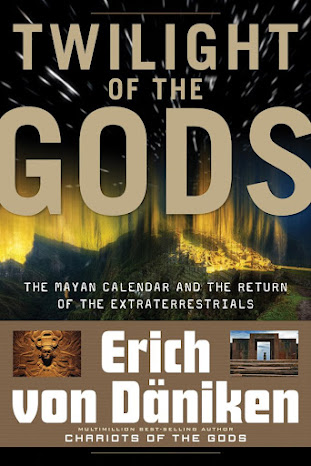
Twilight of the Gods: The Mayan Calender and the Return of the Extraterrestrials by Erich von Daniken


Enthusiastic but disjointed

Published in 2010.

Erich von Daniken is most famous for his 1968 book Chariots of the Gods in which he put forth the theory that civilization was brought to earth by alien space travellers that taught some humans their ways and this is the source of the world's major religions and brought mankind from the caveman era to civilization in places such as Egypt. He believes that this truth is documented in the art and writings of the ancient civilizations. The 1970s documentary In Search of Ancient Astronauts. Just to be fair to those that read this review, I do not espouse von Daniken's beliefs, but I do find him to be interesting and I enjoy reading about the connections that he sees.

Pumu Punku
In  Twilight of the Gods: The Mayan Calendar and the Return of the Extraterrestrials von Daniken expounds upon his theory with a bit with more examples of items that should pique the interest of those that endorse von Daniken's assertions. Although the title implies this is a exhaustive look at the Mayan Calendar and the popular belief that it says the world will end on December 23, 2012, von Daniken does not even address the Mayans until he is two-thirds of the way through the book. Most of his book concerns a pre-Incan site in Bolivia called Puma Punku and the amazing buildings and stonework there.

I do have some argument with von Daniken's history of the Maya. He leads his readers to believe that the Maya were a very healthy civilization before the Spanish began to push into their territory after conquering the Aztecs in 1521. In reality, the classic Maya, the ones that von Daniken is referring to in his book, had collapsed more than 500 years earlier. The Maya that the Spanish conquered were a shell of the classic Maya with a lot of outside influence (if not outright occupation) by such groups as the Toltecs.

Von Daniken implies that the Maya were the earliest civilizations in the area and there is no way that they could have observed some of the older astrological phenomena that they record. He fails to note that the "source" culture for the region is believed to be the Olmec, who existed nearly 2000 years before the Classic Maya.

Interestingly, von Daniken is very derisive of evolution (not of changes in species but in the idea of all life coming from some sort of primordial goo). He uses terminology that reminds me very much of Ken Ham and his Answers in Genesis books. However, von Daniken espouses a theory (I think he does anyway, he throws around a lot of theories at the end of the book) called Panspermia that teaches that an unknown life form shot out its DNA all over the universe, much like one would scatter seeds out of an airplane. Most of it was unsuccessful, but in some places life took hold.

Erich von Daniken
Von Daniken is interesting, as always. However, he is in serious need of an editor to keep him on the topic at hand.  I have already mentioned the complete lack of mention of the Maya in the first half of the book, despite the title. Von Daniken discusses everything from Bolivia's archaeological community to Hitler to climate change in his most disciplined section of the book, the first half.

In the last half of the book he seems to toss out random thoughts about the Mayan predictions about the end of time and then moves on to comment on long distance space travel, alien visitors to Tibet, how ideas spread, SETI, warp drives, the astronomers of the Catholic Church and electrons, among other things, in a conclusion that is most unsatisfying.

Is the book entertaining?

Yes, but it could have been much better organized.

Is there food for thought here?

Sure - it's fun to play with goofy theories like these but, if von Daniken were a chef and not an author, this would be a very sloppy, half-considered meal indeed.

I rate this book 3 stars out of 5. It can be found on Amazon.com here: Twilight of the Gods: The Mayan Calendar and the Return of the Extraterrestrials.

Reviewed on November 8, 2010.

Featured Post

<b><i>BAN THIS BOOK (audiobook)</i></b> by Alan Gratz

Published in 2017 by Blackstone Audio, Inc. Read by Bahni Turpin. Duration: 5 hours, 17 minutes. Unabridged. My Synopsis Ban This Book is t...

Popular posts over the last 7 days