Showing posts with label art. Show all posts

PABLO PICASSO: A LIFE from BEGINNING to END (Biographies of Painters #5) by Hourly History


Published in 2020 by Hourly History.

Despite me having talked extensively about Pablo Picasso (1881-1973) in my recent review of an e-book about Francisco Franco, I am not an expert on Picasso, but I know way more than the average person. He has some paintings that I really like, but I am mostly not a fan. 

This short biography hit the spot in that it covered the details of his life without focusing too much on one particular part. This covered his 70+ year career in an even manner and included his personal life well.
Pablo Picasso in 1962

The real weakness of this e-book was the fact that they couldn't license his paintings and insert them into the book. But, since I read this on my cell phone it was pretty easy to switch to the browser and search the piece of art that was being discussed and take a look at it.

I wasn't much of a fan of Picasso as a person before I read this book and my impression was not changed one bit.

I rate this e-book 4 stars out of 5. It can be found on Amazon.com here: PABLO PICASSO: A LIFE from BEGINNING to END (Biographies of Painters #5) by Hourly History.

BRAVE COMPANIONS: PORTRAITS in HISTORY (audiobook) by David MCCullough


Originally published in hardback book form in 1991.
Published by Simon and Schuster Audio.
Read by the author, David McCullough
Duration: 11 hours, 19 minutes
Unabridged

Brave Companions: Portraits in History is a collection of previously published articles and speeches. It's a smattering of this and that - sometimes it's about art, sometimes about scientists, sometimes about politicians and sometimes it's just some musings from McCullough about history. It doesn't matter, almost all of it is interesting and well-told. McCullough understands the value of telling history as a story - as always he is very approachable.

My favorite entry was the story of the railroad that preceded the Panama Canal. It was an amazing story of the power of human will against nature.

McCullough reads this audiobook, which is great because McCullough has a fantastic speaking voice and is well known for his voice work. I envy both his writing ability and his talents as a speaker.

My favorite quote from the book is from President Harry S. Truman: "The only new thing in the world is the history you don't know."


I rate this collection 5 stars out of 5.

This book can be found on Amazon.com here: Brave Companions: Portraits in History by David McCullough

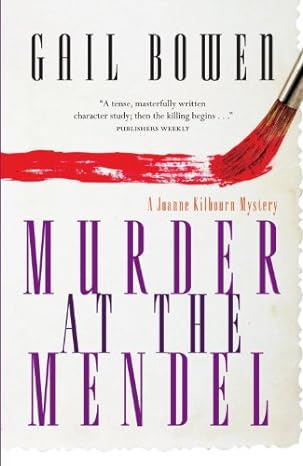
MURDER at the MENDEL(Joanne Kilbourn #2) (audiobook) by Gail Bowen


Published in 2012 by Post Hypnotic Press
Originally published in 1991
Read by Lisa Bunting
Duration: 6 hours, 33 minutes
Unabridged

Gail Bowen's Joanne Kilbourn character carries on into her second book, Murder at the Mendel. Life has changed for her - she has moved her family to Saskatoon in Saskatchewan to be close to her daughter in college and to teach at the same university. 

The local art center was called the Mendel (I say was because it has since been slated to close and move to a new location with a new name) and a childhood friend of Joanne Kilbourne who has since become a controversial artist has an exhibit at the Mendel. The artist, named Sally Love, and Kilbourn used to be very close but after the suicide of Love's father when they were 13 years old, Sally Love moved away.

Kilbourn and Love renew their friendship. Sally Love's exhibition has brought a number of protesters out because of her art. She has a lot of art with overt sexual themes, including a 200 square foot fresco on the wall over 100 penises (and a few vaginas) - paintings of the genitalia of all of her lovers over her lifetime permanently painted to the wall.

As a Kilbourn and Love navigate the protesters and her fans, Love decides to sell a private all-women's art gallery that an emotionally ultra-needy friend has managed for her for years. This unhinges the friend.

Suddenly everything starts to unravel as arson, multiple murders and more ruin Saskatoon's Christmas and New Years...


The Saskatoon skyline. Photo by Thomas Kelley
I did not enjoy this audiobook. It was not the fault of the reader, Lisa Bunting, who did a fantastic job with a variety of people's voices. She exhibited tremendous emotional range with her reading.

The text itself is the problem. Sally Love came off as an arrogant self-absorbed character and Kilbourn seems the same as she accepts Love without criticism, even as she makes cruel comments about other characters, makes plans to remove her daughter from her ex-husband (the only home she's ever known) and even sits and talks about masturbation at the breakfast table in front of Kilbourn's school-aged son before he heads off to school. In fact, Kilbourn's own internal compass is so messed up that I despaired of using her opinions as any kind of barometer to judge any other character and try to figure out who did what to whom.

To make matters worse, the pacing in this book is terrible. The "murder an the Mendel" that the title proclaims does not happen until halfway through the book. Bowen excels at long, rich descriptions of scenes but not at moving a plot along.

This is my third review of a Gail Bowen book or short story and this is my last. In the end, I was just glad to be done with it and I was sort of hoping that more of them had died along the way.

I rate this audiobook 2 stars out of 5.

This audiobook can be found on Amazon here: Murder at the Mendel: A Joanne Kilbourne Mystery, Book 2.

Note:  I received a copy of this audiobook free from the publisher in exchange for an honest review.

NPR FAVORITE DRIVEWAY MOMENTS: RADIO STORIES that WON'T LET YOU GO by NPR


Published in 2012 by HighBridge Audio
Multicast performance
Duration: 2 hours, 16 minutes

This collection was inspired by listeners who wrote NPR and commented on why these stories from their vast treasure trove of stories have stuck with them for so long. Some are funny, some are sad and some are thought-provoking. They are also a mixed bag. Some are great, some are so-so and some had me wondering why they were included at all.

Pretty typical of the collection is a skit called "Complexities of Modern Love in the Digital Age". It features the two voice actors that you most typically hear when you call a big corporation for customer service and they lead you through the phone tree. In this case, they have the two voices talk to one another and date. The idea is sort of cute but the actual skit was not as funny as the idea of the skit.

A Kathy Griffin interview. Eh. 

The Cookie Monster interview was fun.

I loved the story about a stray cat that wandered into a prison yard and was adopted by the prisoners. They feed it, take turns with it and the amount of discord in the yard has dropped because of this one cat.

I also liked the story of the former KKK member who went from harassing his Jewish neighbors to converting to Judaism thanks to a little human kindness.

The story about pets in the Sarajevo during the war among what used to be Yugoslavia was very interesting.

The story of a young couple in China digging through the rubble after an earthquake looking for their only son and his grandparents who were babysitting was gripping and heartbreaking. Easily the best in the collection.

The story that will stick with me was "Growing Up, Aging Out: The End of Foster Care". It was told from a very sympathetic point of view, wondering what a girl was going to do when she turned 21 and was no longer eligible to be part of the foster care system. But, I found it to be very irritating and the longer I listened the angrier I got. This girl was not physically disabled. She still had not finished high school and she was nearly 21 years old. She was making no moves to get a job or even finish high school. Instead, had been conditioned to accept handouts her whole life and to not work. How would she live without a government check? What would she do? What she was doing was sleeping with her drug dealer boyfriend and trying to get pregnant. I listened to it with my high school-aged daughter and I turned it into a cautionary tale.

So, lots of forgettable stories, some so-so stuff, a couple of really good ones and one really disturbing one.


I rate this collection 3 stars out of 5. It can be found on Amazon.com here: NPR FAVORITE DRIVEWAY MOMENTS: RADIO STORIES that WON'T LET YOU GO.

HOW SHOULD WE THEN LIVE: THE RISE and DECLINE of WESTERN THOUGHT and CULTURE (audiobook) by Francis A. Schaeffer


Originally published in 1976
Published by Christianaudio.com
Read by Kate Reading
Duration: 7 hours, 51 minutes

Presbyterian minister and philosopher Francis A. Schaeffer's How Should We Then Live? is a history of the West and a fairly sophisticated bit of Christian apologetics wrapped up in a fairly small package. At times this book rolls along at an enjoyable pace and is quite the listen, other times it is much more difficult. 

Here is a listing of the chapters:
  • Chapter 1: Ancient Rome - Schaeffer compares Roman pagan beliefs with Christian beliefs and blames the pagan beliefs for the collapse of the Empire - they were not inclusive enough and the Greco-Roman gods were little more than bigger people with the same issues that all people have.
  • Chapter 2: The Middle Ages - Despite its reputation, the Middle Ages had positive points. Threads of Classical thought were re-discovered and fused to Christian beliefs.
  • Chapter 3: The Renaissance - Schaeffer offers up the Renaissance and the Reformation as competing thought processes about man and his relationship to God. The Renaissance is essentially the re-birth of Greco-Roman humanist thought with a Christian veneer.
  • Chapter 4: The Reformation - Explores the art and culture of The Reformation and compares them favorably to that of the Renaissance.
  • Chapter 5: The Reformation – Continued - Looks at the philosophy of the Reformation and how even non-Christian thinkers of the time were influenced by Christian thought.
  • Chapter 6: The Enlightenment - Human-centered thought leads directly to the excesses of the French Revolution.
  • Chapter 7: The Rise of Modern Science - Science's foundation came from confidence that God had created an orderly world that we could understand.
  • Chapter 8: The Breakdown in Philosophy and Science - Philosophy and art are symptoms of the thought processes that are now permeating science.
  • Chapter 9: Modern Philosophy and Modern Theology - Humanism creeps into theology.
  • Chapter 10: Modern Art, Music, Literature, and Films - Schaeffer offers commentary on several "modern" works.
  • Chapter 11: Our Society - How the values of personal peace and affluence have worked their way into our society.
  • Chapter 12: Manipulation and the New Elite - Is an authoritarian state ruled by elites coming as a natural result of Humanist values.
  • Chapter 13: The Alternatives - Schaeffer makes the argument for a return to Christian values.
The audiobook is quite enjoyable until Chapter 8. I was not a fan of the discussion of all of the different philosophers. The commentary on current movies, art, music and literature are stilted seeing as how the book was originally published in 1976. There is no discussion of Heavy Metal, rap, hip-hop, Star Wars, the current trend towards super hero movies or celebrity pop culture authors like Stephen King. His discussion of modern science is similarly stilted. It's not his fault, it's just the reality of listening to a re-released book.

So, do I buy into what Schaeffer is arguing?

Yeah, mostly. Once you get past the fact that he is still talking about hippies it's still pretty solid.

Kate Reading's narration was neither good nor bad. She did not hurt the interesting parts and did not make the slower parts better. 

I rate this audiobook 4 stars out of 5. It can be found on Amazon.com here: HOW SHOULD WE THEN LIVE: THE RISE and DECLINE of WESTERN THOUGHT and CULTURE by Francis A. Schaeffer.

Reviewed on November 17, 2014.

QUINN CHECKS IN (Liam Quinn #1) by L.H. Thomson


Originally published in 2013.

From the opening lines of Quinn Checks In I was hooked. Literally, the opening sequence was so cleverly done that I knew I had see what else L.H. Thomson (new to me, but he has a good-sized list of titles) had to offer in this book. 

Liam Quinn is an artist gone bad but then turned back to the good. He used to make money making copies of someone else's art and then selling it as the real thing. But, once he was caught and went to prison he straightened out and now works as an insurance investigator in his hometown of Philadelphia. He does a little bit of everything but he is really on the payroll as the art expert. He is also working off the court-ordered restitution for his criminal past.

But, things are not all wonderful for Liam Quinn. His father was a beat cop and one of his brothers still is. It is hard for a cop to have an ex-con brother. But, Quinn keeps on plugging along.

Quinn gets a big art case that comes with a big reward for him if the insurance company can find the art rather than pay for it. An art gallery was robbed during the middle of an art showing (there was a party, food, people standing around, etc.) and only one piece of art was stolen, which seems odd because you could make even more money if you stole more art.

So, Quinn gets the case and starts investigating and soon enough finds himself being questioned by the police, a local mafia figure and, even worse, he must answer to his mother about missing her Sunday dinner!
The Philadelphia Museum of Art and the
famed Rocky Balboa statue
 Photo by Bobak Ha'Eri

The mystery in this mystery story is just  so-so. But, the characters are so vivid and Quinn and most of his family (and his should-be but isn't girlfriend who works at the Philadelphia Museum of Art) are so likable that you just want to read more. This is a solid book and an especially good start for a new series. This is a self-published effort and that can be a problem sometimes. This book, however, is not one of those times. Thomson has built a very solid foundation to build a series here, and it should be an interesting one.

Nice quote from the book: "You can never undo a wrong; you can only try to do right from there on."

NOTE: I was sent an e-copy of this book in exchange for an honest review.

I rate this book 4 stars out of 5. It can be found on Amazon.com here: QUINN CHECKS IN (Liam Quinn #1) by L.H. Thomson.

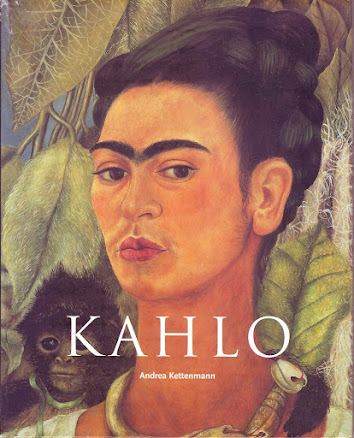
Frida Kahlo: 1907-1954: Pain and Passion by Andrea Kettenmann


A wonderful introduction to Kahlo (a review of the English translation)


Originally published in 1999.

If you saw the Selma Hayek movie on the life of Frida Kahlo and want to know a bit more, this book is a wonderful introduction to her professional life. In fact, the movie and this book complement one another quite nicely, since the movie tended to focus on her personal life.

Andrea Kettenmann's book follows the life of Kahlo and does a great job of explaining the symbolism of Kahlo's work as it pertained to her personal life, her health setbacks and her political beliefs. In my opinion, the intensely personal nature of her work is what makes her such a compelling artist. She was especially good at depicting her pain, both psychic and physical. This book goes a long way to explaining many of her works.

Frida Kahlo with
Diego Rivera in 1932
There are 93 illustrations in this book and most of them are of her paintings. Also includes a couple of photographs of Diego Rivera's works that included images of Kahlo.


This is a small book (less than 100 pages), but it packs a whole lot of punch and is very effective as an introduction to this fascinating artist.

I rate this book 5 stars out of 5.

This book can be found on Amazon.com here: Frida Kahlo: 1907-1954: Pain and Passion.

Reviewed on November 9, 2007.

Glacial Period (Louvre) (graphic novel) by Nicolas de Crecy


"Glacial Period" comes up short despite self-proclaimed greatness.


Published in 2007 by NBM Publishing.
80 pages.

So, what do you get when a hotshot graphic novelist teams up with the Louvre to showcase their works of art with a twist?

Well, you get a short sci-fi book that has a solid start but a contrived, odd end. In short, this is a half-hour read for most and the story was not all that great. It wasn't bad, but it just doesn't live up the self-promotional hype that fills the inside flaps of the front and back covers - such as "Here are the most intelligent comics the world has to offer" and claims that the other is a "mad genius" and his artwork is "breathtaking."

Not really. This one is too sketchy (not the art style, the plot) to be considered great by this reader.

I rate this graphic novel 2 stars out of 5.

This graphic novel can be found on Amazon.com here: Glacial Period

Reviewed on February 7, 2008.

Chicano Visions: American Painters on the Verge by Cheech Marin


A great collection, a terrific exhibition


Published in 2002 by Bullfinch.
160 pages

I caught this exhibition at the Indiana State Museum while it was on a nationwide tour. It was so interesting that I took full advantage of my museum membership and came back and saw it several times while it was here in Indianapolis. I picked up the book Chicano Visions as the exhibit was winding down but only recently read the well-written introductory essays that make up the first 35 pages or so of the book.

Cheech Marin has created a high-quality full color text of this travelling show which is mostly comprised of pieces from his own personal collection. Marin's taste tends to run towards political art, but there is plenty that speaks of life for artists who are both Chicano and American, as the exhibition title (also the book title) imply.

Artists that grabbed my attention include:

Carlos Almaraz - his car crash paintings were gigantic attention getters in the gallaries. His other works are great as well.

David Botello - his Monet-like style is fascinating.

One of the best paintings may well be "Janine at 39, Mother of Twins" by Margaret Garcia. Cheech Marin's comment on page 67 hits it on the head: "If there is a visual definition of the lushness, the strength, and the beauty of women, this painting is it."

Cesar Martinez's "Hombre que le Gustan las Mujeres (The Man who Loves Women)" is funny and a sadly realistic portrayal of the ways that men see women.

Patssi Valdez's "Room on the Verge"
Patssi Valdez was the painter that stole the show in Indianapolis, at least from the comments I heard. Her pictures are so bright and have the power to make the viewer feel as though he or she is being drawn in to the canvas, especially with works like "Room on the Verge." Another painting of hers graces the cover of the book.

I did not care for the works of a couple of established artists: Gronk and Mel Casas. The Casas pieces in this show seemed less like a work of art and more like very large, not very clever political cartoons. That being said, it was entirely appropriate to include their works considering their standing in the Chicano art movement.

I rate this book 5 stars out of 5.

This book can be found on Amazon.com here: Chicano Visions: American Painters on the Verge.

Reviewed on February 17, 2008

The Intellectual Devotional: Modern Culture: Converse Confidently about Society and the Arts by David S. Kidder and Noah D. Oppenheim


Learn a little every day. 


Read by Oliver Wyman and Helen Litchfield
Duration: a little more than 17 hours.
Published in 2008.

The Intellectual Devotional: Modern Culture is designed on the same format as a religious devotional - a small bit of inspiration every day. In this case, it is designed to be a small bit of learning every day. It is not set up with specific dates (Such as Thursday, October 23), but it starts with Monday of Week 1 and works it way through the year. There are 16 CD's in this set, with an estimated length of a little more than 3 minutes for each day and a little more than 17 hours overall. There are Intellectual Devotionals with other themes as well, such as American history.

The topics vary widely. The first CD ranges from Sigmund Freud to Hal Roach (the man behind the Little Rascals). The topics are interesting and I found myself dispensing with the intended one-a-day format and listening to upwards of 20 of them as I putter around the kitchen.

The only complaint I have is that there is no index included to remind the listener of the location of interesting entries. Unlike the book version, I really can't easily go flipping through it until I find the entry I'm looking for.

Nonetheless, this one comes highly recommended by this reviewer.

This audiobook can be found on Amazon.com here: The Intellectual Devotional.

I rate this audiobook 5 stars out of 5.

Reviewed on October 23, 2008.

Featured Post

<b><i>BAN THIS BOOK (audiobook)</i></b> by Alan Gratz

Published in 2017 by Blackstone Audio, Inc. Read by Bahni Turpin. Duration: 5 hours, 17 minutes. Unabridged. My Synopsis Ban This Book is t...

Popular posts over the last 7 days