Showing posts with label Spanish-American War. Show all posts

THE PARANOID STYLE in AMERICAN POLITICS and OTHER ESSAYS by Richard Hofstadter


-Originally published by Harper's Magazine in 1964 and in book form by Alfred A. Knopf in 1965.
-Audiobook published in 2018 by Tantor Audio.
-Read by Keith Sellon-Wright.
-Duration: 10 hours, 44 minutes.
-Unabridged.


Award-winning historian Richard Hofstadter (1916-1970) wrote these essays over a series of years and compiled them into a collection with a loose theme of how American politics is affected by paranoid conspiracies. 

Barry Goldwater (1909-1998)
He starts with the presidential candidacy of Barry Goldwater and the political commentary of groups like the John Birch Society. His descriptions of the Goldwater campaign sound so much like the Trump campaign of 2016 that a reader can almost replace the name Goldwater with the name Trump. The details are, of course, different, but the tone is practically the same. 

The ideological framework of the John Birch Society is replaced with QAnon, the fear of communism is replaced with the fear of immigrants but the tone is practically the same.

That is the main theme of the first half of the book - the near-constant presence of a paranoid fear that some group is trying to overthrow the American way of life. 

 
"The enemy is clearly delineated: a perfect model of malice, a kind of amoral superman -- sinister, ubiquitous, powerful, cruel, sensual, luxury-loving. Unlike the rest of us, the enemy is not caught in the toils of the vast mechanism of history, himself a victim of his past, his desires, his limitations. He wills, indeed, he manufactures, the mechanism of history, or tries to deflect the normal course of history in an evil way. He makes crises, starts runs on banks, causes depressions, manufactures disasters, and then enjoys and profits from the misery he has produced. The paranoid's interpretation of history is distinctly personal: decisive events are not taken as part of the stream of history, but as the consequences of someone's will. Very often, the enemy is held to possess some especially effective source of power: he controls the press; he has unlimited funds; he has a new secret for influencing the mind (brainwashing); he has a special technique for seduction (the Catholic confessional)..."

This paranoid strain is not unique to America, of course. For example, the fear of the Illuminati and English fears of a Catholic revolution. 

The fears of a Catholic revolution spread to America as well, but that was just a part of a whole series of paranoid conspiracies that Hofstadter points out. I decided to come up with my own list. Hofstadter passed away in 1970 so he never heard of the paranoid conspiracy theories that I remember being actively discussed (some quite seriously) in my lifetime.

Here is a list of all paranoid conspiracies that I remember (starting from the early 1980's):
 
-Satan worshipers were killing thousands of children in day cares across the country;
-back masked lyrics were brainwashing people that listened to rock music and making them kill themselves;
-Dungeons and Dragons was causing kids to go crazy (Tom Hanks made a movie about it!); 
-the New World Order was taking over America and flying black helicopters all over America and leaving secret messages for soldiers on the back of interstate road signs;
-FEMA camps. This is one of my personal favorites because the AMTRAK train yard in Beach Grove, Indiana was to be converted into a secret government concentration camp (Beach Grove is a neighborhood in Indianapolis, where I live);
-President Obama was a secret gay Muslim who was selling out America;
-QAnon with all of its weirdness (including a resurgence of the lizard people in some strains);
-crisis actors creating all of the school shootings (Alex Jones);
-Former President Trump's Stop the Steal movement with Italian satellites and Venezuelan vote tabulators conspiring to steal an election.

The rest of the book is not nearly as interesting. It has rather lengthy essays on the Spanish-American War, the Anti-Trust movement and the Free Silver movement. They made the point that the earlier essays did, but not nearly as directly and they weren't nearly as interesting.

The entire collection is written in an academic style that is not particularly welcoming to the reader. The author makes a point that the paranoid style of politics is not exclusively a feature of the Right, but he provides no examples of it from the Left, except maybe with the Free Silver movement. The politics of that movement are convoluted enough that you can't really get a good feel if it is a movement of the Left or the Right.

To sum up, the part of the book that discusses the 1950's and 1960's is great. The rest of rather tedious. The first part is worth listening to if for no other reason than to get the reference when you hear it in a political discussion.

I rate this book 3 stars out of 5. It can be found on Amazon.com here: 
THE PARANOID STYLE in AMERICAN POLITICS and OTHER ESSAYS by Richard Hofstadter.

WEST from APPOMATTOX: THE RECONSTRUCTION of AMERICA after the CIVIL WAR (kindle) by Heather Cox Richardson


Published in 2007.

Heather Cox Richardson is a historian I have only recently discovered because of her prolific social media presence that she developed while under Covid lockdown. She writes a daily news summary of a few paragraphs with a view towards how these events match up with historical events or trends. Plus, she takes questions from people and develops a one hour daily online lecture. They are interesting, sometimes rambling little presentations and this book shares a lot of the same features. 

In West from Appomattox, Richardson is looking at the time right after the Civil War in American History.  In the history books, Reconstruction, the Old West, the Gilded Age and the Spanish-American War are all treated a separate things. Combining all of these typical divisions of American history into one book makes for a more comprehensive study of the time period. 

Teddy Roosevelt (center with glasses) and
the Rough Riders in the Spanish-American War
Traditionally, they are studied separately - in a typical history book they are literally different chapters. Mostly, Richardson does this, too. Mostly - but she is very willing to cross over to the other areas of study. 

For example, it really impossible to understand the Old West without having an understanding of Reconstruction and of the Gilded Age. Reconstruction encouraged a lot of people to move West. The West received attention and governmental support for economic development and the South did not. The economic growth in the Northeast was largely possible because of Federal Government support of resource extraction from the West. Federal support of settlement of the West and Federal support of building a network of privately owned railroads helped spur further economic growth in the Northeast.  

Due to the overlapping nature of the book, there are a lot of overlapping stories and themes. I don't consider it to be a weakness, though. I consider it to be a reminder that the same policies, the same movements and the same rules were affecting the whole country. 

This time period was truly the transition from the old Revolutionary Era politics to our current modern political system because slavery was finally out of the way. Instead of discussing what to do about slavery it became a discussion about when (or even if) government power should be used to intervene in the free market or to help certain people in society. 

In the South, pushing for public schools for poor children was often decried as Socialist because rich people were being taxed to provide a basic education for the children of the poor. It was even more Socialist if it meant funding schools for poor black children. Meanwhile, out in the Western states the government actively intervened in the Free Market by handing out 160 acre parcels of land, providing land grants to fund railroads and breaking treaties with Native Americans and clearing them out of the way to provide access to mineral wealth.

The point about Socialism is interesting. Richardson pointed out something that I have noticed about American political discussions - we throw about the term Socialism and use it with a completely different meaning than the meaning the rest of the world uses. When everyone discusses Socialism, they are talking about the government owning the means of production (factories, farms, mines, etc.). In the United States, it is tossed about when we talk about taxing anyone to pay for community services and we have done that ever since the time period this book covers. I still hear this argument used against the existence of public schools, public libraries and even public roads. In the United States, Socialism is also a term used to describe non-economic things such as Covid mask mandates and gay marriage because the term has consistently been used by the current conservative party (the Dems back in the 1800s and the GOP nowadays) to discredit new concepts. 

I rate this history 5 stars out of 5. It can be found on Amazon.com here:  WEST from APPOMATTOX:  THE RECONSTRUCTION of AMERICA after the CIVIL WAR (kindle) by Heather Cox Richardson.

FOR the COMMON DEFENSE: A MILITARY HISTORY of the UNITED STATES of AMERICA by Allan R. Millett and Peter Maslowski


Originally published in 1984 by The Free Press.

Note: This is a review of the original version of this book, published in 1984 and ending with the first Reagan administration. It has been expanded and updated to include events up to 2012.

Way back in my undergrad days at Indiana University I took a class called American Military History. It was taught by a visiting professor from West Point and FOR the COMMON DEFENSE: A MILITARY HISTORY of the UNITED STATES of AMERICA was an excellent choice for the text for the class.

For 30+ years I have carried this book around with me - through 5 different moves and who knows how many book shelves this book was the anchor of my history section because it is quite beefy. But, I decided it was time to clear out some books. Technically, this book was a re-read but I didn't really remember anything from all of those years ago so...

The book starts with colonial defense and moves along with the same format up through the early 1980's. There is a chapter about a war or conflict followed by a chapter on the interwar years followed by a chapter on the next war or conflict. 
Soldiers in the Korean War in 1950.
Each chapter is about 30 pages with a bibliography, with the exception of World War II and the Civil War - they are each covered by two chapters. 

Generally speaking, the war chapters are more interesting than the interwar chapters. The interwar chapters can get bogged down in detailed discussion of the upper level command structure of the military (Joint Chiefs of Staff, the role of the Secretary of War/Defense, etc.) , but I found the interwar chapter that covered Reconstruction and the Gilded Age to be one of the best in the book. 


It is striking to read how American defense policy changed radically after World War II and the book provides little discussion of those changes, it just notes that they happened.

I rate this book 4 stars out of 5. It can be found on Amazon.com here: FOR the COMMON DEFENSE: A MILITARY HISTORY of the UNITED STATES of AMERICA by Allan R. Millett and Peter Maslowski.

LEADERSHIP: IN TURBULENT TIMES (audiobook) by Doris Kearns Goodwin


Published in 2018 by Simon and Schuster Audio

Read by Beau Bridges. David Morse, Richard Thomas, Jay O. Sanders and the author.

Duration: 18 hours, 5 minutes.

Unabridged.


Doris Kearns Goodwin often is labeled with the title "presidential historian" and, really, that is a pretty accurate term for her. As a young historian, she worked personally with Lyndon Johnson on his presidential memoirs. She has written about both Theodore Roosevelt and Franklin Delano Roosevelt. Her book Team of Rivals is a modern classic and has redefined the popular image of the Lincoln administration.

In Leadership: In Turbulent Times, she looks at various qualities of leadership that each of these very different men exhibited. She begins with interesting pre-presidential biographies of each of these men. She focuses on Lincoln's expressed desire to become a person that was worthy of the esteem of his community. Theodore Roosevelt's ceaseless energy and desire to experience new things led him to meet all sorts of people and learn about their concerns. FDR's efforts to recover from polio were above and beyond. Also, she focuses on his habit of hiding his own problems from the people around him. LBJ's relentless push to put connect himself to people in power is interesting - a road map to power, if you will. But, it is not particularly inspiring (that comes later on for LBJ).

The author, Doris Kearns Goodwin
If the book were just those early biographies, it would be an impressive book. But, it goes on to look at an individual theme (in the case of Theodore Roosevelt, a single crisis) that developed in each man's presidency.

With Lincoln, the theme is the end of slavery. With Theodore Roosevelt, the crisis is a national coal strike (May - October 1902) that threatened to literally freeze millions of people. With FDR, the crisis is the Great Depression and his willingness to try and discard and try again in order to alleviate the suffering. For LBJ, the focus is on his push to pass Civil Rights legislation in wake of President Kennedy's assassination and the political cost he suffered in doing so. She also comments on the Vietnam War being the tragic result of his singular focus on domestic policy.

She identifies individual leadership lessons as she goes along. I have no idea how many there are because I listened to it as an audiobook and was not able to write them down as I went along.

Speaking of the audiobook version, this audiobook is read by five different readers. The author reads the opening and closing. The sections on the Presidents are each read by a different award-winning actor. Beau Bridges was absolutely excellent as the reader for the LBJ section. I wish he'd read more audiobooks.

I rate this audiobook 5 stars out of 5. It can be found on Amazon.com here: LEADERSHIP: IN TURBULENT TIMES by Doris Kearns Goodwin.

A PEOPLE'S HISTORY of the UNITED STATES by Howard Zinn

Originally published in 1980 by HarperCollins. 
Multiple updated editions have been printed.

Howard Zinn's (1922-2010) A People's History of the United States is perhaps the most famous and most controversial history book in publication today. 

I read this book because the former governor of my home state of Indiana and current President of Purdue University, Mitch Daniels, repeatedly criticized it and actually advocated blocking its use in public schools in Indiana, including Indiana University. Governor Daniels used to be a frequent guest on a local newstalk radio station in Indianapolis and this book came up enough times in the conversations that I became aware of it. Before that I had never heard of it - but he certainly put it on my radar. That's not really what he had intended, I am sure.

I found my copy of A People's History of the United States in a local thrift shop on a half price day, which made this book a true bargain at $1. I decided that, as a good and loyal American I absolutely had to read the book that my state government's former chief executive had decided was "truly execrable" and tried to remove from Indiana University classrooms and see for myself if he was right.

Zinn has a theme that he hits consistently throughout his book and it is that the "haves" are continually using and abusing the "have-nots" throughout American history although, sometimes, the "haves" give in a bit and let some of the "have-nots" get a little more because it ensures their survival at the top. He argues that this was the case during the American Revolution. He would have been a big promoter of the idea of the 1% vs. the 99% that has come into vogue lately.

He also argues that the elites stoke class envy and racial animosities to create internal rivalries among the lower classes so that they fight among themselves and fail to see who their true enemy is. Throughout the entire book, the details change but this is the basic story.

As a history book, this book succeeds fabulously at hitting that one note over and over and over and over ad nauseam. Is he right? Sure - to a point he is right throughout the book. For example, he is right that the founders envisioned limited participation from the common man in the early American republic. But, other arguments sound hollow. 


For example, on page 37 of my 1990 edition he argues that racial animosities were practically created by the elites as a way to control the slaves. It is a clever argument and it is the culmination of a long argument that he had been making in the previous pages concerning the presence of anti-miscegenation laws in the new world. His presumption that, if left to themselves, the lower classes would have not had any racial issues because the passing of these laws shows that the elites were bothered by interracial romance and conspired to stop it before the lower class united and overthrew them. This sounds too organized for my tastes. Also, I have less faith in human nature than Zinn does - the same base thoughts that he despises in the upper class exist across all of the classes.

Strengths:

-The discussion of Andrew Jackson and Indian Removal.


-The discussion of the labor movement during the Gilded Age/Robber Baron era was particularly well-written and flowed well.

-He covers the governmental overreach during World War I well.

Weaknesses:


-He wrote this book as an antidote to the "hero" version of history - the version that teaches about George Washington's battlefield exploits but overlooks the fact that he held slaves. Sadly, in his zeal to set the record straight, he often overlooks the good (or even great) points about heroes that he is out to debunk. 


-The Andrew Jackson section says literally nothing about Jackson's strongest political fight - his fight against the National Bank. I would have appreciated a look at how the defeat of this bank and the subsequent "panic" (economic recession/depression) affected regular Americans.

-Sadly, he often ignores the "people" and creates a new set of heroes to replace the ones he has debunked. But, he does little to debunk his new heroes so the reader is left with, essentially, the same problem. Also, this does not make it a true "people's" history since people like Frederick Douglass and Emma Goldman are so extraordinary that they are, by definition, not stand-ins for the "everyman".

-The sections on the Vietnam War and the 1970's suffer from just being written too close to when the book was originally printed (1980). I think he was so close to the events that he had a hard time determining what was truly important and what was trivia. This made the book bog down with things like his stories of community newspapers printed on ditto machines as a sign that media was changing. When compared to the tsunami of change that the internet brought to media just a few years later, these little stories are quaint and irrelevant. 

-During the Cold War sections, he never addresses what the other side in this Cold War was doing and at least acknowledging that America and its allies had reasons to be wary of the USSR and its allies.

************

As I stated above, Zinn hits one note throughout the book. This note does appear in most mainstream history books, but not in great quantity. So, the book has value in that it does bring that part of American to the forefront. But, since it does not waver from its obsessive focus, it becomes a tool of limited value. To quote Abraham Maslow: 
  "I suppose it is tempting, if the only tool you have is a hammer, to treat everything as if it were a nail."

Now, to go back to the beginning of my review - would I outlaw this book from being used in a classroom? No, of course not. But, I do not think it should be the only text used in a class. Individual chapters are sold as smaller books and I think that would be appropriate. If it were a year-long class I might have students read the whole thing so long as they were reading lots of other works.

I don't see what the big fuss is on either side, to be honest.

I rate this book 3 stars out of 5.

This book can be found on Amazon.com here: 
A People's History of the United States.

NOTE:
Mitch Daniels, the Indiana governor that wanted to literally outlaw the use of this book in any school in Indiana, was appointed President of Purdue University when his term as governor ended by the Purdue Board of Trustees. He appointed most of those members and is widely considered to have appointed himself through that board. In my opinion, this attempt to stifle academic freedom should have made him ineligible to hold any position at a university, let alone be president of one.

THE NOT-QUITE STATES of AMERICA: DISPATCHES from the TERRITORIES and OTHER FAR-FLUNG OUTPOSTS of the USA (audiobook) by Doug Mack


Published by HighBridge, a Division of Recorded Books in February of 2017.

Read by Jonathan Yen

Duration: 10 hours, 24 minutes

Unabridged

In The Not-Quite States of America, Doug Mack takes his readers on a sometimes serious, sometimes humorous tour of America's territories: the U.S. Virgin Islands, American Samoa, Guam, the Northern Mariana Islands and Puerto Rico (in that order).

Mack goes into a little history of each territory and sets off to experience a more in-depth tour than the typical tourist might normally take. He meets with local leaders, well-known personalities, mainland Americans who have moved to the territory and goes out of his way to meet talkative locals who are willing to discuss the relationship between that territory and the United States government (which is usually riddled with strange rules that cause all sorts of unintended consequences).

Along the way Mack visits a restaurant that allows its guests to feed beer to pigs in the U.S. Virgin Islands, goes on a deep hike in the jungles of Samoa, visits a bio-luminescent bay in Puerto Rico, solemn World War II memorials in the Northern Marianas and delves into the hyper-commercialized version of America that is hawked to foreign visitors in Guam. The discussion of Puerto Rico's future is especially well-done, but overshadowed by the tragic disaster of Hurricane Maria that occurred about 7 months after the publication of the book.


The reader, Jonathan Yen, did a solid job. There were times that the book dragged, especially at the beginning, but that was not the the narrator's fault. Most of the time he kept the reading lively and well-paced.

I rate this book 4 stars out of 5. 

Note: I received a free copy of this audiobook from the publisher in order to write an honest review.

Bully! The Life and Times of Theodore Roosevelt by Rick Marschall


Easily the best biography I read this year.

Published in 2011 by Regnery History.

Bully! The Life and Times of Theodore Roosevelt is exactly the kind of book that will ensure that printed books will always have a place, no matter how many e-readers are sold. This is an absolutely beautiful book. It has a satisfying heft, it is printed on high quality paper (think coffee table book quality) and is chock full of political cartoons from an era when many political cartoons would have been full color and the size of an entire newspaper page. This book inspires the reader to flip through the pages, browse a bit, admire the art and do a little reading.


A larger, better reproduction of this cartoon appears in the book. 
I included it as a sample of the beautiful artwork.
Fortunately, Rick Marschall's text is every bit as accessible and enjoyable as the cartoons he has chosen to illustrate the hyperactive, hyper-productive, hyper-successful life of Theodore Roosevelt, the 26th President of the United States. Marschall covers it all rom his very early entry to the world of politics (much of this was addressed in political cartoons as well), to his ranching days, his work in the Navy Department, to the Battle of San Juan Hill, his political climb from Governor of New York to Vice President to the Presidency. Not only that, we are treated to his trip to Africa, a European tour, the rain forests of Brazil, the Bull Moose Party controversy and, most of all, his vitality. Roosevelt was a force of nature. All of it was delicious material for the nation's prolific newspapers and their cartoonists and the story is much enriched by their inclusion. It gives the reader a great feel for how Roosevelt was actually viewed by the American public.

This book has completely reformed me from my wayward and youthful outlook on Theodore Roosevelt, a point of view discussed by the author on pages 400 and 401 in the "Acknowledgements" section. He notes that Roosevelt has become symbolic of all that is considered evil today on many of America's college campuses: "Hence, he became a virtual devil in much of academia, especially contrasted to Woodrow Wilson, who was painted as a dreamy internationalist and idealist who, if he had not been thwarted by Neanderthals at home and abroad, would have delivered heaven on earth." That was how I was taught. I was sure that Wilson was not what he had at first seemed (the more I learn, the more I am repulsed) but now I see TR in a new light as well.

My next book on the to-be-read pile was also a biography. Out of fairness to that biography, I am going to have to put it back into the pile and read something else in a different genre- this biography is so strong that I am quite sure that the other one will suffer unfairly in comparison.

I rate this biography 5 stars out of 5.

This book is available on Amazon.com here: Bully! The Life and Times of Theodore Roosevelt.

Reviewed on December 27, 2011.

Pershing: Commander of the Great War by John Perry


An interesting, well-written biography


Published: 2011 by Thomas Nelson

I've read several of the biographies in Thomas Nelson's "The Generals" series and found Pershing: Commander of the Great War to be the best of the bunch so far. The book is well-written, flows nicely and really gives the reader a feel for the bristly personality of "Black Jack" Pershing.

Perry introduces us to Pershing, a man who wanted to be a teacher, maybe a lawyer,  but accepted an appointment to West Point because he could not afford to pay for school himself. Pershing was not particularly interesting in being a soldier, but found that the lifestyle suited him. Pershing's early service in Cuba during the Spanish-American War taught him plenty of lessons about the need for proper supply lines that he took with when he commanded the American army in Europe in World War I.

World War I General 
John J. "Black Jack" Pershing
Pershing also served as an observer in the Russo-Japanese War, the Philippines and, of course, was in charge of the expedition that fruitlessly chased Pancho Villa in Mexico. For his time, Pershing was surprisingly open to different cultures, which probably explains his willingness to lead all black units in the segregated army (and is the source of his nickname "Black Jack"). But, he is most famous for commanding the American forces in World War I. Perry covers all of these events well and keeps it interesting. Perry is especially good at discussing Pershing's personal life and the tragic fire that took most of his family.

 I received this book from the publisher, Thomas Nelson, in an exchange for an honest review.

I rate this biography 5 stars out of 5.

This book can be found on Amazon.com here: Pershing: Commander of the Great War.

Reviewed on December 4, 2011.

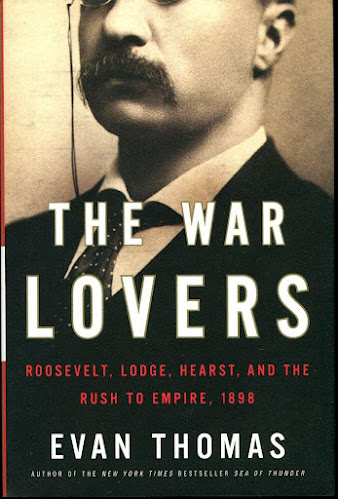
The War Lovers: Roosevelt, Lodge, Hearst, and the Rush to Empire, 1898 by Evan Thomas


Well done

Published in 2010 by Little, Brown, and Company.

Before this book, I had not had the pleasure of reading one of Evan Thomas' books. I picked The War Lovers up despite these fawning comments by Thomas in June 2009 ("I mean in a way Obama's standing above the country, above - above the world, he's sort of God.") My original thoughts were if this guy can't be any more unbiased in his observations than that, do I really want to read his stab at history?

Well, I am happy to say that I was pleasantly surprised. This is a solid history that is told well. The book flows along nicely and the reader is both entertained and informed.

Theodore Roosevelt (1858-1919) 
with his men in Cuba
The book's focus is the build-up of public support for the Spanish-American War (1898). As the title notes, Theodore Roosevelt, Henry Cabot Lodge and William Randolph Hearst are the main subjects in the book but other people round out the story, including Harvard professor and philosopher William James (Pragmatism and Other Writings ), his brother and fellow author Henry James (Henry James: Complete Stories, 1892-1898), Speaker of the House Thomas Brackett Read, various surviving family members of deceased Civil War hero Robert Gould Shaw (Glory) and great-grandson and grandson of presidents, Henry Adams (The Education of Henry Adams).

The War Lovers gives the reader a vivid portrait of life among the Eastern Elite in the late 19th century - a world so far removed from my experience that I may have well as been reading about a foreign country. But, in a way, the book was full of plenty of people that I have been reading about all of my life. Thomas takes those empty names and fleshes them out with personality, histories and makes them become much more real. On top of that, it is an entertaining read!

Highly recommended.

I rate this book 5 stars out of 5 stars and it can be found on Amazon.com here: The War Lovers: Roosevelt, Lodge, Hearst, and the Rush to Empire, 1898 by Evan Thomas.

Reviewed on March 18, 2010.

Featured Post

<b><i>BAN THIS BOOK (audiobook)</i></b> by Alan Gratz

Published in 2017 by Blackstone Audio, Inc. Read by Bahni Turpin. Duration: 5 hours, 17 minutes. Unabridged. My Synopsis Ban This Book is t...

Popular posts over the last 7 days