Showing posts with label Nazis. Show all posts

WHEN BOOKS WENT to WAR: THE STORIES THAT HELPED US WIN WORLD WAR II (Audiobook) by Molly Guptill Manning


Published by Blackstone Audio in 2014.
Read by Bernadette Dunne
Duration: 6 hours, 49 minutes.
Unabridged.

When Books Went to War looks at the deliberate effort by the government of the United States to put books in the hands of its soldiers as they went off to fight in World War II. 

There were multiple reasons behind this idea. The first was simple: Reading books is a practical way to help soldiers pass the time. "Hurry up and wait" is a common refrain from soldiers of all eras and books helped fill the time.

Another reason was to remind the soldiers of what they were fighting for. Being on the front has a way of making life seem cheap and disposable, but reading a good story might help keep soldiers attached to the good things from back home. This may seem corny, but so many letters from the soldiers and sailors were written to the authors of these books that emphasized this very point.

Betty Smith, the author of A Tree Grows in Brooklyn wrote and spoke about all of the letters she got from soldiers that told them how her book reminded them of their home in any big city in America - Cleveland, Chicago, Boston, or wherever. She said she received 10 times more mail from soldiers than from civilians. 

One of the most important reasons to put books in the hands of soldiers was that being anti-book was a trait of the Nazis. They were infamous for holding massive book burnings and emptying libraries of books they disagreed with. The American program to put books in the hands of soldiers was the opposite - and it was intentionally designed to be that way. The bad guys take books away from you - the good guys want you to read and think for yourself and give you books to do just that.

Note: This philosophy contrasts strongly with the Trump Adminsitration's choice to ban nearly 400 books from the libraries of the various military academies. For example, here is an article from April of 2025 about 385 books banned from the Naval Academy. 

These books were designed to be as small and lightweight as possible. They were intended to go along with a soldier no matter where he went. The print was tiny, the margins were almost non-existent and they were usually stapled together. They could slide into a pack, a pocket, or in the nooks and crannies of any vehicle. They could bend to the counters of a pack.

Men read and re-read them. When books were handed out, men would be strategic about their choices in order to guarantee a wide variety of reading choices. Men from different units traded and some units created portable libraries in crates that went right along with the unit no matter where they went. Men were assigned to be the caretakers of the books.

Their was a lot of debate about the books they picked. They weren't policed too much when it came to content. Southerners were irritated at books that were critical of their Jim Crow laws. Steinbeck's Grapes of Wrath made the cut and it is hardly politically conservative. Some were strictly educational - books that explained science or math or philosophy. A great many were Westerns and there were a number of murder mysteries. By the time it was over, the U.S. government had printed 1,225 different titles and had given away 122 million books to its armed forces for free!

Here is a list of every book they printed.

This audiobook was interesting from beginning to end. As a book lover, it was inspiring to hear about men reading to their buddies in foxholes and men discovering that they actually liked reading. As a person that always has a book on hand, I understood completely.

I rate this audiobook 5 stars out of 5. It can be found on Amazon.com here: When Books Went to War: The Stories That Helped Us Win World War II

THE HINDENBURG DISASTER: A HISTORY from BEGINNING to END (kindle) by Hourly History


Published in July of 2025 by Hourly History.


Hourly History specializes in little histories that take about an hour to read. For me, an hour of reading about the Hindenburg is about right. 

The Hindenburg Disaster is a short history that details the beginnings of zeppelins/blimps through the tragedy of the complete destruction of the German zeppelin Hindenburg in just 32 seconds in New Jersey in 1937. 

Germany was a focal point for building blimps/zeppelins during World War I and before World War II. The blimps went from being potential military airships to being experimental ways to travel. One has to remember that airplanes were even more experimental way to travel.

Any sort of air travel was going to be prohibitively expensive - only the richest of the rich could afford it. Blimps/zeppelins offered a stately, luxurious ride - planes were seen as a noisy and cramped and inferior alternative.

This short history chronicles the struggles of the blimp/zeppelin industry during the 1920's. When the Nazis took control of Germany, they saw zeppelins as a way to demonstrate German technical excellence and as a way to flout restrictions on German airships. One can see now that the idea of taking a blimp into a World War II fighter plan dogfight would be suicidal, but that was not always clear in the early 1930's.

Eventually, the German government decided that zeppelins were a great propaganda machine inside and outside of Germany. They are attention-getting, massive, and the Nazis slapped a big Nazi swastika on the side of them to generate publicity.

This history does a good job of describing the technical reasons for the Hindenburg disaster - including the surprisingly small number of deaths for such a massive fireball. But, it does a rather poor job of telling the story of blimps/zeppelins after the Hindenburg. This disaster practically destroyed the idea of luxury travel in zeppelins and the book gives the impression that that disaster sort of wiped out the entire concept.

But, any American sports fan knows that this is simply not true - the Goodyear Blimp shows up at every major sporting event and provides "aerial coverage." It used to be accompanied by the Fuji Film Blimp, although I haven't seen that one in a while.

The fact that this history spent so much time detailing the history of zeppelins prior to the disaster and tells almost nothing about them after the disaster is a major oversight.

Fun fact that I discovered while writing this review: A successor company to the company that operated the Hindenburg operates the Goodyear Blimp in Europe. Mentioning this fact would have been a great way to end this short history. 

This history can be found on Amazon.com here: The Hindenburg Disaster: A History from Beginning to End by Hourly History.


THE GOLEM'S VOICE (graphic novel) by David G. Klein


Published in 2015 by
Now What Media, LLC

Synopsis:

Set in Czechoslovakia during World War II, The Golem's Voice is the story of a young Jewish mom and her two sons trying to escape relocation by the Nazis. This was in the time when the Nazis were still telling Jews that they were relocating them to alternate settlements rather than just taking them to work and death camps.

As they are being loaded onto trains, the mom gets a bad feeling and tells her boys (Yoakim and Yakov) to just run. She does not join them because they are much faster than her and she just wants them to escape and live. Her boys run under the trains and, at first, things look good. But, soon enough, Nazi soldiers are in full pursuit and Yoakim is shot providing cover for his little brother.

Yakov continues to run to the only place the knows - the Jewish ghetto neighborhood that he just came from. He hears a voice in his head calling him to the home of a long-dead rabbi named Yudah Loew. Legend has it that Loew was much more than a prolific author, philosopher and academic - he was also the creator of a golem. 

Loew was supposed to have studied so much that he worked out how to create a man in clay and bring it to life. This creature is not truly a man and could not speak for itself because only God can do that. But, it is alive and follows the orders of the one who created it. Medieval legend said that if things got bad enough for the Jews, a golem could be created to defend them.

Yakov is led by the voice to a hidden room in the house and discovers everything one would need to create a golem - and if there were ever a time that the Jewish people could used a golem to defend them, this was it...

My review:

I think this book was well done. The art is moody, as it should be when discussing the dark and dangerous days of the Holocaust. I was curious to see if the book would fall into the temptation of straying into the complete fantasy of having the golem wreak havoc on the Nazis to the point of being able to march to Berlin and take out Adolph Hitler himself (Rest assured, this does not happen.)

There is a very clever angle taken by the author. The idea of a Golem is partially explained by texts found by Yakov and his memory of children's tales. But it is also explained through the Nazi officer who is hunting Yakov. That officer takes the legends seriously even though he hates the Jewish people. He wants to use the knowledge to create Golems to create an army that the Nazis can control. There is a "debate" of sorts between this officer and a spirit (is is Loew or is it God? I think it is God.) that fills in a lot of details.

I rate this graphic novel 4 stars out of 5. It can be found on Amazon.com here: The Golem's Voice by David G. Klein.

See a good sample of the book on the publisher's site here.

MOTHER NIGHT by Kurt Vonnegut


Originally published in 1962
Mother Night is one of Kurt Vonnegut's (1922-2007) early novels (his third) and the first that is not a work of science fiction. 

The book features Howard W. Campbell, a defendant awaiting trial in Israel for war crimes in Israel. He is wanted for being a well-known voice for the Nazis on broadcasts that he made during World War II. 

Campbell freely admits that he did what they say he did, but he does have a defense - he was working as a double agent for the Americans and was passing secret messages during those broadcasts. 

The book sets itself up to be a legal thriller - will the hero of the book be saved? Can he prove what he says is true?

But, there's none of that in this book. Campbell probably would have been the voice of the Nazis in the broadcasts no matter if he was recruited as a spy or not? He is just a self-absorbed author of plays that was way more concerned about bedding his German wife than politics or any "trivial" things like a World War or the mass murder of millions of people. 

Most of the book is about the last few months of Campbell's life and how he was found hiding in plain sight in New York City where he had been living in a tiny apartment. We get to meet a cast of freaks and creeps that loathe or worship Campbell for his part in the war while Vonnegut demonstrates that patriotism, duty, and racism/race loyalty are all illusory constructs at best. 

Self-portrait by the author
The book starts out with these themes by having Campbell introduce his prison guards. One of them is too young to really remember the war, one doesn't care and one worked in a death camp - he helped lead his fellow Jews to the gas chambers by telling them it was just a de-lousing. Then, he would help loot their bodies and bury them. He did this to save his own life - but he still gets to guard a man who literally didn't do anything to hurt anyone in the war except talk.

Vonnegut revels in pointing out that life is contradictory and complicated and no one is who they act like they are.

Good quotes:

"We are what we pretend to be, so we must be careful what we pretend to be." 

"Say what you will about the sweet miracle of unquestioning faith, I consider a capacity for it terrifying and absolutely vile."


I rate this audiobook 5 stars out of 5. It can be found on Amazon.com here: MOTHER NIGHT by Kurt Vonnegut.

THE COMPLETE MAUS (graphic novel) by Art Spiegelman


Originally published in serial form in Raw magazine from 1980-1991.
Originally published in book form in 1991 by Pantheon Books.

Winner of the Pulitzer Prize in 1992.

Years ago, the high school where I used to teach had a daily silent reading time. We were encouraged to build a classroom library and I had a great one. Two stand alone shelves (one tall, one short) and a little rug in the corner with a chair. I had a lot of books from a lot of different genres but the star books were Of Mice and Men and the two volume paperback version of Maus. Kids kept on stealing Of Mice and Men (If a kid likes it so much that he doesn't want to return it - fine by me) but so many students read Maus that the paperback binding broke and the pages fell out. It was held together with binder clips and big rubber bands. 

What I remember about that book is that every student reverently took off that ridiculous clip and the big rubber band, spread the pages out and just read. Students who "hated to read" read that book. Afterwards, they carefully put it back together again - in order - when they were done. These two books had power and painful truth. They knew it and they respected it.

I'd forgotten all about Maus, the binder clips, and the big rubber bands until I heard about a school board in Tennessee dropping this book from their curriculum due to rough language, nudity and a suicide. Funny how war, genocide and untreated PTSD from having almost all of your family and friends systematically murdered leads to a bit of cursing.

Missouri joined in as well. School districts banned the book because they think it fits the definition of "explicit sexual material." State law would punish them for exposing minors to "explicit sexual material" even though state law also mandates the teaching of the Holocaust. T
here is nudity, but it is rare and it is certainly not racy stuff.

The arrival at Auschwitz
The book is the story of the author's father during World War II. He was a recently married Jewish businessman in Poland before World War II. He had a young son. Their community is forced to move, go into urban ghettos and eventually into the death camp at
Auschwitz. Some hide, some run but they almost all end up in the camps. Most of his father's family and friends die, including his little boy - the older brother that the author never knew.

Spiegelman illustrates his father's story as a series of flashbacks. You can see that his father is miserable and his mother killed herself years earlier. 

There are no "people" in the book. The Jews are mice, the Nazis are cats, the Poles are pigs, the French are frogs and the Americans are dogs. I like the last bit since Hitler regularly referred to Americans as a mongrel people.

This is a powerful book - it is also a tough book. The war still reverberates through our world. We can recognize it and educate our children or we can ignore it.

I rate this graphic novel 5 stars out of 5. It can be found on Amazon.com here: THE COMPLETE MAUS (graphic novel) by Art Spiegelman.

ANNE FRANK'S DIARY: THE GRAPHIC ADAPTATION (graphic novel) by Anne Frank (author), Ari Folman, and David Polonsky (illustrator)


Originally published as a book in 1947.
Graphic novel e-book edition published in 2018 by Pantheon.
Adapted into a graphic novel by Ari Folman.

The Diary of Anne Frank is certainly one of the most famous pieces of literature published in the last 100 years. The book the true diary of a young teen Jewish girl that was written as her family lived in a hidden apartment with two other families in an attempt to hide from the Nazi genocide. Before the war ended someone betrayed the families and Anne and almost everyone else in the apartment died in concentration camps shortly before the Nazi surrender.

A page where Anne compares herself
unfavorably to her sister.
Ari Folman adapted the diary into a graphic novel. In the afterword he notes that this was harder than one might expect. This graphic novel is 160 pages, but if he had simply illustrated the entire text of the diary it would have ended up being more than 3,000 pages! The challenge was to maintain the spirit of the print book while editing it down.

I think the book is beautifully illustrated. The moods, emotions, and simple displays of teen attitude come through loud and clear - and make her come to life.

The graphic novel is excellent, which is why it is too bad that it is on a lot of banned book lists. In Florida, Moms for Liberty asked for the book to be banned because of two scenes described like this by Katie Couric in an article: 
it features two “sexually explicit” scenes. In the first, Frank walks along a series of nude statues, and in another, she asks a friend if they want to show each other their breasts." The Moms argue that the book does not accurately teach about the Holocaust because of these pages - as if Nazi hatred were only aimed at Jews.

Anne Frank's diary has always been edited to make the story flow better, but it also was edited to take out some embarrassing details about the family. Those edits included Anne Frank's passing thoughts about possibly being interested in women as well as men. In the 1950s this might have been a deal breaker with potential publishers so it was left out. This is ironic considering that gays and lesbians were sent to the camps by the Nazis with just as much enthusiasm as Jews - but, that was the politics of the day.

It turns out that it also the politics of now. A teacher in Texas was fired because those pages were read aloud in her class. 

It must be noted that even if Anne Frank were not Jewish, she would have been sent to the camps for being bisexual.

I rate this graphic novel 5 stars out of 5. It can be found on Amazon.com here: 
ANNE FRANK'S DIARY: THE GRAPHIC ADAPTATION (graphic novel) by Anne Frank (author), Ari Folman, and David Polonsky (illustrator).

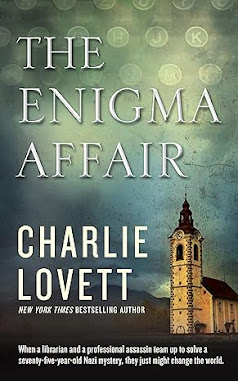
THE ENIGMA AFFAIR: A NOVEL (audiobook) by Charlie Lovett


Read by Nicole Zanzerella.
Duration: 12 hours, 6 minutes.
Unabridged.


Synopsis:

An Enigma Machine from World
War II.
Patton Harcourt is a very small town librarian in North Carolina. One morning, while cooking in the kitchen, a sniper round comes through her window and nearly hits her. She reacts well (thanks to her previous career in the military) and finds a stranger at her door. 

He is not the sniper, but he is an assassin that was hired to kill another person in town. Against her better judgment, she joins with the assassin to elude the sniper team.

All of that happens in the first 10 minutes or so of this audiobook.

From there, they discover a handmade copy of World War II Enigma machine (the British machine that broke the German secret codes) and are off to confront modern-day Neo-Nazis...

My Review:

This book was certainly action-packed, extremely fast-paced ,and had some good moments. But, it also had some practical issues that just didn't jive with reality. For example, one of the main plot points is that they cannot access the internet because they will be detected and tracked down. This completely ignores the existence of proxy servers. A professional assassin should have been familiar with this technology as a way to hide his location when communicating with clients.

Later, the characters are speaking German and passing off as native speakers (this is a vitally important point more than once). Granted, it is not complicated German, but very few untrained people can pass themselves off as native speakers in a second language. I've been speaking Spanish as a second language for years and I would never be confused for a native speaker.

This is not a bad book. The quick pace was fun, the bad guys are truly bad, and the flashbacks to World War II were well-done. But, the end result was 3 stars out of 5.

This book can be found on Amazon.com here: THE ENIGMA AFFAIR: A NOVEL by Charlie Lovett.

GANGSTERS vs. NAZIS: HOW JEWISH MOBSTERS BATTLED NAZIS in WARTIME AMERICA (audiobook) by Michael Benson


Highly Recommended

Published in 2022 by Tantor Audio.
Read by Gabriel Vaughan.
Duration: 8 hours, 53 minutes.
Unabridged.


Flag of the German American Bund
In the United States in the 1930's there was a small, loud, enthusiastic, and growing group of Americans that were great fans of Hitler and the Nazi party. They were largely ethnic Germans and formed organizations that sported Nazi symbols and mimicked the big rallies that Hitler had in Germany. They also mimicked the overt antisemitic speech exhibited by the Nazis. The most successful of these was the German American Bund (German American Federation).

There were a lot of small groups but there were two larger organizations with a different take than the Bund. The Silver Legion of America (Silver Shirts) had a spiritualist take on hate. Father Coughlin was a literal Catholic priest who brought a "Catholic" view on antisemitic hate and anti-interventionism from Detroit. He had a massive radio audience that was so enthusiastic that his church superiors were afraid to muzzle him.

Officially, Nazi Germany did not support these groups, but there were plenty of unofficial connections.

The national government could officially do nothing to stop them quickly (although the age-old tactic of looking for things like tax violations did work to slow some of them down over time.)

There was also very little that local governments could do to stop these meetings. Some localities, like New York City, outlawed wearing some of their Nazi-style outfits (dubious legality). Others just buckled down and over-scrutinized all of their rental applications for meeting halls, applications for parades, and so on. If there was a misspelling, or any similar type of mistake it was denied. 

But, that kind of thing only lasts so long. Eventually these American Nazis learned to double check their paperwork and take advantage of America's wide open freedom of speech rules to advocate for actions that would kill those very same freedoms.

A judge from New York City named Nathan Perlman decided that if the American antisemites were going to have paramilitary organizations, American Jews needed one to literally punch back. Turns out he knew a whole bunch of tough Jewish guys that paraded through his court room on a regular basis - Jewish mafia gangsters. People like Mickey Cohen, Meyer Lansky, Davie "the Jew" Berman*, and Bugsy Siegel were talked to in an unofficial way. 

The deal was simple - no killing, lots of roughing up (but not too rough), try to disappear afterwards, no overt help from the judge, avoid the press. In return, there would be lots of backroom maneuvers to get them out of jail if needed. The judge appealed to their sense of ethnic loyalty and it worked. These men were not good Jews in any kind of moral way. Most had long since stopped going to temple. However, most had had enough of a connection to the larger Jewish community to have had a Bar Mitzvah and they all understood that if people were going after harmless rabbis and little old ladies that go to temple, they would certainly go after Jewish mobsters.

Mugshots of Meyer Lansky (1902-1983)
Meyer Lansky said this about their involvement: 
"The stage was decorated with a swastika and a picture of Adolf Hitler. The speakers started ranting. There were only fifteen of us, but we went into action. We threw some of them out the windows. Most of the Nazis panicked and ran out. We chased them and beat them up. We wanted to show them that Jews would not always sit back and accept insults"

This Nazi-Gangster fight did not go on for too long - a couple of years at longest. The German American Bund began to fizzle out during 1939 when everyone was starting to get a real sense of what Nazi Germany was all about. Pearl Harbor pretty much brought an end to the pro-fascist meetings thanks to Italy and Germany declaring war on the United States to express their solidarity with Imperial Japan. 

Are there thorny free speech issues in this scenario? Well, it looks bad when a judge is recruiting a crew of guys to beat people up for expressing their political thoughts. But, when you consider the record of Nazis before and during the war it's pretty hard not to enjoy hearing about the mobsters beating the crap out of a bunch of loud-mouthed racist bullies.

I recommend the audiobook version because of the reading of Gabriel Vaughan. The book is written is written in a lively and engaging manner and uses words or phrases from movies or newsreels from the time period, using slang like "heaters" (guns) and "whacked" (mafia ordered murder). Vaughan doubles down on this theme by reading with a mild accent reminiscent of newsreel narrators of the time.

I rate this audiobook 5 stars out of 5. It can be found on Amazon.com here: GANGSTERS vs. NAZIS: HOW JEWISH MOBSTERS BATTLED NAZIS in WARTIME AMERICA (audiobook) by Michael Benson

*Note on Davie "the Jew" Berman. Mobster nicknames are almost always colorful. Berman has to have the least imaginative nickname of all the mobsters of this era. That's most likely due to the fact that he was operating out of Minneapolis and Iowa City - places not known for large Jewish populations.

THE FAITHFUL SPY: DIETRICH BONHOEFFER and the PLOT to KILL HITLER by John Hendrix


Dietrich Bonhoeffer is well-known as one of the few ministers who stood up to the Nazis and kept his ministry completely independent of the totalitarian regime. Eventually, his principled stand led to his death in prison. Along that path there was a point where he closed down his ministry and used his connections to get a position in military intelligence.

At first, this sounds like he totally gave in to the Nazis. However, it turns out that the military intelligence and the Nazi intelligence departments were completely separate entities and they did not get along very well. Bonhoeffer used that mistrust and friction to his advantage - he sent intelligence to the Allied powers, he helped with plans to sneak Jews out of Germany.

These were easy actions on a moral level - if you believe the regime in charge of your country is evil, you will work against it. But, the more Bonhoeffer thought about it, the more he considered taking more decisive action - action that would end in the sin of murder. He joined a plot to assassinate Hitler...

This biography was very well done. The book is sort of a regular biography combined with a heavy dose of graphic novel. The pictures are sometimes accurate and sometimes heavily symbolic, like the wolf picture posted above (pages 60-61).

I rate this biography 5 stars out of 5. It can be found on Amazon.com here: THE FAITHFUL SPY: DIETRICH BONHOEFFER and the PLOT to KILL HITLER by John Hendrix.

THE LAST BATTLE: WHEN U.S. and GERMAN SOLDIERS JOINED FORCES in the WANING HOURS of WORLD WAR II in EUROPE (audiobook) by Stephen Harding


Published in 2013 by Blackstone Audio.

Read by Joe Barrett.
Duration: 7 hours, 11 minutes.
Unabridged.


At the very end of World War II there was an extraordinary pairing of German soldiers and American soldiers to protect French dignitaries and celebrities being held in an Austrian castle prison.

How late was it in the war? Hitler was already dead. The Allies were well into Germany and Americans had pushed all of the way into Austria. 

But, that does not mean that the German military was without power. They had fantastic equipment and there were still plenty of "true believer" SS troops insisting that the war wasn't over - or it it was over, the Allies should pay for every inch of territory until the last German soldier fell.

The unlikely alliance happens when a Austrian-born German officer comes to an agreement with the leaders of the local anti-Nazi resistance movement in Austria. Technically, Austria was a part of Germany but it had only been a part of Germany for 7 years when Germany absorbed independent Austria. It seemed like a popular move at the time, but World War II started about a year and a half later and it had brought disaster and ruin to Austria.

Germany had converted a castle in the Austrian Alps into a prison under the supervision of the Dachau concentration camp. Multiple VIPs from France ended up at Dachau and the German supervisors realized that they couldn't just keep those VIPs in the middle of a death camp. So, they moved them to the castle. 

And, some members of the German military thought that killing off these VIPs would be a fantastic way to deliver one more bit of cruelty in an obviously lost cause. 

****

This audiobook has some issues. 

The production is fine, although I am not a big fan of the reader, Joe Barrett.

The biggest thing is the very slow pacing of the book. The title of the book is "The Last Battle" and the actual fighting is really just a few minutes of a 7 hour audiobook. I did not measure it, but my impression is that the author spent more time describing the history of the castle and various facelifts, upgrades remodels and repurposing that had been done over the years than the time he spent describing the actual fighting.

It felt like he was packing the book with filler to make it longer, like a freshman college student might do to make sure his essay is exactly a certain number of pages in length. My favorite example of this filler is the fact that the author actually took the time to note that handrails were installed on a certain staircase during a remodel in the early 1900s. That struck me as odd when I heard it (because who actually cares?) so I listened carefully for a time when the handrails might become a part of the story. I had imagined that the VIPs might have removed the handrails and used them to barricade a door or something. No luck. It was just filler.

There were long biographies of each of the French VIPs. There was no particular reason to do this. They could have been edited down because they were not important to the story except that they were the people to be rescued. Saying that they were former members of the French government and various other celebrities, including a world famous tennis star would have been enough. I guarantee that the American officers that decided to save them had less information than the author gives and those officers decided to go join forces with a German unit and go out of their way to save them.

So, I rate this audiobook 2 stars out of 5 because it really should have been nothing more than a very long article in a history magazine or a chapter in a book called "Improbable Stories of World War II". 

WHEN HITLER TOOK COCAINE and LENIN LOST HIS BRAIN: HISTORY'S UNKNOWN CHAPTERS (audiobook) by Giles Milton


Published in 2016 by Macmillan Audio.

Read by the author, Giles Milton.
Duration: 4 hours, 53 minutes.
Unabridged.

Giles Milton is a prolific British writer of histories and historical fiction. This is a collection of odd stories of history that he has run across doing his research.

Lenin, preserved in his tomb. 
He has gone from being an 
object of reverence to a
tourist attraction.
There are the two stories mentioned in the title - Hitler using stimulants and Lenin's odd burial, but there are a lot more from several different time periods.

The problem is that there were a lot of similar stories and some weren't really from "unknown" chapters. Lots of Nazi-related stories and three separate stories of cannibalism (a plane crash, a sailing ship caught in the duldrums and a prison escape in an isolated area). That's a lot of Nazis and cannibals for a 5 hour audiobook.

I found this stories to be neither great nor bad and often repetitive. I rate it 3 stars out of 5. 

This book can be found on Amazon.com here: WHEN HITLER TOOK COCAINE and LENIN LOST HIS BRAIN: HISTORY'S UNKNOWN CHAPTERS.

HOLOCAUST: THE EVENTS and THEIR IMPACT on REAL PEOPLE by Angela Gluck Wood


Published in 2015 by DK Publishing. Originally published in 2008. 

DK Publishing consistently publishes strong "coffee table" type books. Holocaust: The Events and Their Impact on Real People covers a more serious topic than most of their books, but it is immensely readable and compelling.

The text tells the basic history of how the Nazi party took control of Germany, started to implement their anti-Semitic agenda and eventually invaded their neighbors to start World War II. It also tells the story of a series individual Jewish victims as the timeline unfolds.


The book doesn't just cover the Jewish victims of the Holocaust, but goes out of its way to include the other victims as well.

The liberation of Dachau in April of 1945. This picture appears
as a two-page spread in the book. 
The pictures are excellent, the text mostly consists of captions for the pictures or a couple of paragraphs that go with the theme of the page. Considering how disjointed this approach usually is in these sorts of books, this book kept a surprisingly coherent narrative.

There is a foreword by Steven Spielberg of just three paragraphs. It adds little to the book, but it is advertised on the front cover.

I rate this book 5 stars out of 5. It can be found on Amazon.com here: HOLOCAUST: THE EVENTS and THEIR IMPACT on REAL PEOPLE by Angela Cluck Wood.

BROTHERS in ARMS: THE EPIC STORY of the 761st TANK BATTALION, WWII's FORGOTTEN HEROES (audiobook) by Kareem Abdul-Jabbar and Anthony Walton


Published in 2004 by Books on Tape.
Read by Richard Allen.
Duration: 9 hours, 39 minutes.
Unabridged.

Kareem Abdul-Jabbar is most famous as a basketball player - in high school his team won 71 games in a row. He won three national championships in the three seasons he was allowed to play in college (freshmen had to play on a freshman team back then so his first season doesn't count). No one scored more career points in the NBA than Abdul-Jabbar. He is arguably the best basketball player ever.

Turns out that he is also a thoughtful, active man with an interest in social justice and history. That's where this book comes in. The 761st Tank Battalion was brought to his attention because, it turns out, he knew one of its members growing up - he just didn't know his story.

The problem is, no one really knew the story of these young men - and they should. That is why Kareem Abdul-Jabbar wrote Brothers In Arms: The Epic Story of the 761st Tank Battalion, WWII's Forgotten Heroes.

The 761st Tank Battalion was one of the lead elements of General Patton's push into Germany during the last months of World War II. They were sort of a hybrid unit that was spread out among infantry units, designed to work with infantry. This simple fact would have hurt their unit's fame if they had been an all-white unit - their actions were just tossed in with other unit's statistics they fought with for just a few days. But, when you toss in the obvious racism of the day (multiple citations were sent up the chain of command, only to be tossed in the trash or ignored. This was corrected in the 1990's by an independent commission), you can see why no one heard of these soldiers.

Abdul-Jabbar focuses on just a few soldiers in this unit in this history. Many of these men wanted to be fighter pilots when they joined up, but were told that African-Americans were not allowed to fly. But, they could be in tank units. So, an all African-American tank unit was created. Eventually, the unit ended up in Camp Hood (now Fort Hood) in Texas. They were trained and then never sent to either front. Instead, they became the decoy team that other units trained against. They pretended to be the Germans in practice maneuvers - over and over and over again for nearly TWO YEARS - much longer than white units.

After D-Day, Generals Patton, Bradley and Montgomery pushed the Germans across France and approached Alsace-Lorraine in France near the German border. It was tough on the tank units, though. Experienced, intact tank battalions were at a premium. They sent for the 761st and they fit the bill perfectly, even though Patton had no confidence in African-Americans as soldiers. He kept those thoughts to himself, though, and actually visited the 761st and spoke with them, saying:


"Men, you're the first Negro tankers to ever fight in the American Army. I would never have asked for you if you weren't good. I have nothing but the best in my Army. I don't care what color you are as long as you go up there and kill those Kraut sonsofbitches. Everyone has their eyes on you and is expecting great things from you. Most of all your race is looking forward to your success. Don't let them down and damn you, don't let me down! They say it is patriotic to die for your country. Well, let’s see how many patriots we can make out of those German sonsofbitches."

The rest, as they say, is history.

This is an entertaining history, designed for the regular reader. The only real complaint I have with it is the audiobook reader, Richard Allen.  He mispronounces many military terms. There are many German and French cities and towns are named throughout the book and, to be honest, I have no idea how to say most of them. But, I do know some, and when the reader mispronounces the commonly known German and French name places, such as the Danube River, I know that there have to be lots of other problems.

To be fair to Richard Allen, it isn't his fault. 
Allen has since passed away, but he was a multiple award winning audiobook reader. He was brought in to read, not for his knowledge of foreign languages. The production team in the booth in the recording studio should have brought in someone to coach him how to say these place names. It's not that hard to find a French speaker and a German speaker - almost every local high school has teachers of both that could have coached him.

I rate this audiobook 4 stars out of 5. It can be found on Amazon.com here: BROTHERS in ARMS: THE EPIC STORY of the 761st TANK BATALLION, WWII's FORGOTTEN HEROES (audiobook) by Kareem Abdul-Jabbar and Anthony Walton.


NIGHT (audiobook) by Elie Wiesel. Translation by Marion Wiesel.


Originally published in 1960.
New translation published in 2006.
Read by George Guidall.
Duration: 4 hours, 17 minutes.

Unabridged.

Nobel Peace Prize winner Elie Wiesel's famed book Night is a standard, perhaps THE standard, that all Holocaust literature is judged by. Originally, this was written as an immense memoir in Yiddish, but during the process of translating the book to French, it was pared down to about one-fifth of its original size. The paring down resulted in a more literary work - a work that feels almost fictional because it is so selective as it tells the true story of how Elie Wiesel's childhood, his family, his community and his religious faith was destroyed by the Nazis.

Slave Laborers liberated by U.S. Army soldiers under the command
of General Patton. Photo taken by Private H. Miller.
Wiesel is in the picture. He is on the second row from the floor,
the seventh prisoner from the left (by the post)
The book begins with his little Jewish neighborhood in Romania that had been relatively unaffected by the war. But, as the Germans are retreating from the Soviets, they implement their Final Solution and start liquidating all of the Jewish communities while they still can. The Jews in Wiesel's neighborhood are divided into groups and loaded onto trains over the course of several days.

The trip, in cattle cars, is horrific. The camps are no better, of course. Wiesel and his father are separated from the women in his family at Auschwitz. They never see each other again. Wiesel and his father go from one work detail to another in different camps, slowly retreating away from the Soviet advance. Their only hope is to stay healthy enough to work so that they might be allowed to live until the end of the war...

I read this book because it is read by students in one of the English classes at the high school where I teach. I have never heard a student speak poorly of the book, which is itself a solid endorsement.

The audiobook was read by George Guidall, one of the most experienced audiobook readers of all time. Not only has he won two Audie Awards (the Oscar for audiobook readers), he has also read more than 1,200 audiobooks. Guidall, of course, was quite good in this presentation.

I rate this audiobook 5 stars out of 5. It can be found on Amazon.com here: NIGHT by Elie Wiesel.

THE JOURNEY that SAVED CURIOUS GEORGE: THE TRUE WARTIME ESCAPE of MARGARET and H.A. REY by Louise Borden


Originally Published in 2005.

Published in 2016 by HMH Books for Young Readers.

This book is really three stories all wrapped up in one.

#1) It is the early biography of two authors and how they got started.

#2) It is also the story of how Curious George, the iconic children's book character came to be.

#3) And, most importantly, it is the story of how these authors and this character were almost snuffed out at the beginning of World War II because of their religion.

This edition of the book is designed to be used in a classroom. Not only is is wonderfully illustrated with both photographs and original drawings reminiscent of H.A. Rey's work, it also includes assignments and discussion questions at the end of the book.

I rate this book 4 stars out of 5. It can be found on Amazon.com here: The Journey that Saved Curious George.


THE VICTORS: EISENHOWER and HIS BOYS: THE MEN of WORLD WAR II (abridged audiobook) by Stephen E. Ambrose


Originally published by Simon and Schuster Audio in 1998.
Read by Cotter Smith.
Duration: 4 hours, 20 minutes.
Abridged.


I don't know how many books historian Stephen E. Ambrose (1936-2002) wrote about the D-Day Invasion, but they all a little different and they are all quite enjoyable to read. Ambrose is perhaps most famous for writing the history that inspired HBO's excellent Band of Brothers, which was also based on the same theme.

Ambrose had a gift for writing histories that were informative, entertaining and, at times, quite moving - and this one was no exception. The focus was on the D-Day invasion, the immediate aftermath, the Battle of the Bulge and the final push into Germany. There is no discussion of how the war started and little of how it ended, but almost everyone who would read this book knows all of that anyway.

The audiobook was read by Cotter Smith who did a nice job.

I rate this audiobook 4 stars out of 5 and it can be found on Amazon.com here: THE VICTORS: EISENHOWER and HIS BOYS: THE MEN of WORLD WAR II (abridged).

IS SCIENCE RACIST? (DEBATING RACE) by Jonathan Marks


Published by Polity in March of 2017.

If you have ever had the misfortune to run across one of the alt-right's pseudo-scientific webpages that discuss the genetics of race and how science proves one race is smarter/better/nicer/whatever than other races you will see the need for Jonathan Marks' book Is Science Racist?

Sadly, an author I used to Tweet back and forth with a little re-Tweeted some posts from one of these alt-right sites and I got my fill of them during one long evening. They are the internet's version of those young men marching in Charlottesville with the white polo shirts and khaki pants. Like those men, on the surface these sites were pleasant enough until you actually start to pay attention to what was being said.

They wrap themselves in pseudoscience that, unfortunately, is twisted around to sound reasonable. It is these types of people that Jonathan Marks is talking about when he notes:

"Every science has had its own set of ethical issues - chemistry and poison gas; physical anthropology and grave-robbing - but there is one question that only scientists working in human genetics and race have to grapple with. And that is: 'What is it about me that the Nazis like so much?'" (p. 25)
The racists at Charlottesville,
Virginia in 2017.

Marks explores the relationship between science and politics and how scientists have to be careful to guard that their work is not perverted into something evil. Of course, some scientists don't care about where their funding comes from just so long as the checks cash. Others are duped. As noted by the author, "Scientists think like everybody else, and are beset by the same kinds of aspirations, insecurities and disappointments as everybody else." (p. 66) In some cases, scientists with latent racial biases are themselves are victims of confirmation bias - "their presuppositions adversely affect the framing of the research, the collection and analyzing of the data, and the interpretation of the results." (p. 22)

To Marks' credit, he works very hard to make this book accessible to the layman, making reference to popular works such as Frankenstein and Jurassic Park to warn of the dangers of science unfettered by morality. His discussion of genetics wandered a little deeper into the deep end than I preferred a couple of times but, on the whole, this was a surprisingly brisk and informative read.

I rate this book 5 stars out of 5.

This book can be found on Amazon.com here: Is Science Racist by Jonathan Marks.

Note: I received a free copy of this book in order to write an honest review through the Amazon Vine Program.

V-S DAY: A NOVEL of ALTERNATE HISTORY by Allen Steele


Published by Ace in 2014

Alternate histories always deal with a what if...? moment in history and how things might have been. In the case of V-S Day, the moment is what if Nazi Germany decided to throw the resources that it was throwing into a its buzz bomb program into an actual space program led by Wernher von Braun? The Germans are building a a primitive space shuttle like device that can take off from the Reich, circle the globe and drop bombs on New York City from a low earth orbit, far above the reach of America's anti-aircraft guns. And, it can do it again and again with no hope of a defense.

Fans of NASA know that in the real world, Wernher von Braun was brought back to America after World War II and helped develop America's space program. In this world, rocket pioneer Robert Goddard leads a team to develop an American space fighter "plane" to go up and take out the German space bomber.

Most of the book details the space race between the two powers, which was okay, but not nearly as good as the spy story of how the Allies received a set of the German plans. Sometimes the book sails along and sometimes it drags. Sadly, the climax of the book is undercut by the fact that the entire book is told as a flashback from 2013 and the final result is pretty obvious. 

I rate this book 3 stars out of 5.

This book can be found on Amazon.com here: V-S DAY: A NOVEL of ALTERNATE HISTORY.  

Featured Post

<b><i>BAN THIS BOOK (audiobook)</i></b> by Alan Gratz

Published in 2017 by Blackstone Audio, Inc. Read by Bahni Turpin. Duration: 5 hours, 17 minutes. Unabridged. My Synopsis Ban This Book is t...

Popular posts over the last 7 days