Showing posts with label islam. Show all posts

CONQUERORS: HOW PORTUGAL FORGED the FIRST GLOBAL EMPIRE (audiobook) by Roger Crowley


Published by Recorded Books in 2015.
Read by Jonathan Davis.
Duration: 13 hours, 7 minutes.
Unabridged.


In the mid-1400s Portugal was poised to be a major world power, despite being a backwater of Europe in so many ways. Portugal sits at the western extreme of Europe, destined to be a minor player in European politics most of the time. All of Portugal's border touches Spain, so if Portugal wanted to interact with anyone but Spain they had to take to the sea.

IThe Portugese developed a new type of little wooden ship called the caravel, armed them with cannons, filled them with food, water, sailors, and stone monuments to mark the areas they explored. They pushed down the coast of Africa, hoping to find a way to the spices of Asia.

They were looking to trade, especially for spices because the Muslim countries had established a stranglehold on the spice trade with the decline and eventual fall on the Byzantine Empire in 1453.  They were also looking to link up with the fabled African Christian king Prester John, join up to defeat the Muslims, spread Christianity, and make a lot of money along the way.

And, with the exception of the Prester John part of the plan, that's basically what happened. Prester John turned out to be the Christian kingdom of Ethiopia. It was real, but not nearly as powerful as the Portugese believed - and it wasn't very interested in attacking the Muslims in a religious war. 

Conquerors: How Portugal Forged the First Global Empire is a pretty thorough look at the Portugese conquistadores and their escapades in the Indian Ocean. From the first, Portugal came with guns a-blazin'. They laid waste to cities, took slaves, took hostages, burnt ships, and were confrontational with almost everyone. 

Then, they headed home and made plans to return with even more ships. They made annual trips and made plans to make permanent posts from Africa to India. 

At this point, this history bogs down. It's not that it isn't accurate - it just becomes a litany of outrageous attacks by the Portugese, a minor setback, and then an even more audacious attack. It all kind of blurred together for me because Crowley didn't take a moment to pull away from the history to do a bit of analysis.

He didn't even step away to look at what the Portugese were doing in other parts of the world, such as Brazil and west Africa and put the Portugese efforts in the Indian Ocean into a larger context until the literal last three or four minutes of the audiobook. The title says it is a book about Portugal's empire and it ignores a lot of their empire.

The audiobook reader was Jonathan Davis. He is a very good reader and has a flair for accentuating the dramatic moments. But, he is also very slow. I rarely do this, but I set the audiobook player to play at 120% and he was still a bit slow at times.

I rate this audiobook 3 stars out of 5. It can be found on Amazon.com here: CONQUERORS: HOW PORTUGAL FORGED the FIRST GLOBAL EMPIRE by Roger Crowley.

THE EARLY MIDDLE AGES (The Great Courses) (audiobook) by Philip Daileader


Published in 2013 by The Great Courses.
Lectures delivered by the author, Philip Daileader.
Duration: 12 hours, 32 minutes.
Unabridged.

The idea behind The Great Courses is that anybody can have access to high quality college instructors who are truly experts in their fields. In this course the focus is the Early Middle Ages (roughly 300 CE to 1000 CE). 

Daileader starts with the start of the decline of the Roman Empire, somewhere around the year 300 CE. He looks at the trends of the late Roman Empire and how they led to the fall of the Roman Empire in the West (Rome, not Constantinople) and how those trends led to the political and economic systems that typify the time period we know as the Middle Ages.

There is a heavy focus on what is now France, which is well-deserved since Charlemagne is one of the biggest historical figures of this era. But, other areas get a fair amount of attention, like Ireland, Spain, and the Islamic world. The sudden appearance of the Vikings contributed a lot as well. The Byzantine Empire

Church doctrine and politics play a prominent role throughout.

I found this series of half hour lectures to be interesting, but not riveting. The section on the political machinations that eventually led to the rise of Charlemagne's empire was slow - necessary but tedious until it finally pays off and you just sit and wonder how it all worked out the way it did. 

I rate this audiobook 4 stars out of 5. It can be found on Amazon.com here: The Early Middle Ages (The Great Courses) by Philip Daileader.  

CHECHEN WARS: A HISTORY from BEGINNING to END (kindle) by Hourly History


Published in 2023 by Hourly History.

I chose to read this short history about Chechnya in order to be a bit more informed about Putin's wars in Chechnya and then apply that knowledge to the war in Ukraine. What I read does not inspire confidence.

Chechnya is an unfortunate victim of geography - it lies in a buffer zone between traditional great powers - the Russians, the Ottoman Turks, and the Persians. Even worse, they are on a natural land bridge between the Caspian Sea and the Black Sea. Throw in a religious difference between Russia and the Chechens and you have even more trouble.

When the Soviet Union collapsed in 1991, Chechnya made a serious effort at independence that ended up in multiple military incursions by the Russians and decades of on and off irregular warfare (think guerrilla warfare plus outright terrorism).

For their part, the Russians responded with their own forms of irregular warfare - assassinations, possible false flag operations, and more.

As I read this, the tit for tat back and forth actions just sort of blend together and in the end it was hard for this outsider to see which corrupt oligarchy The West should support. 

Back to what I referred to in the first paragraph - what can some knowledge of the Chechen Wars tell us about the war in Ukraine? To me it says that Russia has a very solid sense of what territories it believes legitimately belong to Russia and it will hang on to that territory, even if it comes with tremendous costs.

Considering that Ukraine is much closer in a cultural sense to Russia than Chechnya is, this bodes poorly for Ukraine. I'm not saying Ukraine should be abandoned (far from it!), but this is going to be a very long-term issue.

I rate this e-book 4 stars out of 5. It can be found on Amazon.com here: Chechen Wars: A History from Beginning to End

SEPTEMBER 11 ATTACKS: A HISTORY from BEGINNING to END (kindle) by Hourly History


Published in 2024 by Hourly History.

Hourly History's telling of the events of September 11, 2001 is surprisingly well-told for a history that is supposed to take a person about an hour to read. 

Is this a complete history? Hardly. Why not? Read the first paragraph again.

But, it gets all of the elements across in broad strokes - the motives of the
 hijackers, the reasons for their targets, and the mass casualties - but not as bad as they could have been thanks to the bravery and professionalism of the NYPD and FDNY.

The book moves on to discuss the aftermath, including tearing down the remains of the buildings, the creation of the Department of Homeland Security, beefed up airport screenings, and the invasion of Afghanistan in order to search for the Osama Bin Laden and other terrorists responsible for the attacks. All of it is tied up neatly in a bite-sized e-book that younger readers (not kids, but younger adults that simply don't remember 9/11) could read to grasp the basics.

I rate this e-book 4 stars out of 5. It can be found on Amazon.com here: September 11 Attacks: A History from Beginning to End.

WHAT DOES ISRAEL FEAR from PALESTINE? (audiobook) by Raja Shehadeh


Published by Tantor Audio in June of 2024.
Read by Khalid Abdalla.
Duration: 2 hours, 26 minutes.
Unabridged.


Raja Shehadeh is a Palestinian lawyer, human right advocate, and author. Shehadeh grew up as a Christian and Palestine has been occupied his entire life. This short book is an extended essay of sorts on the state of Palestinian/Israeli relations. 

The book is often critical of Israeli policy and actions, especially under Benjamin Netanyahu, but it is hardly a justification of the October 7 attacks.

Shehadeh does question the sincerity of Israel's attempts to work out something with Palestine - be it a two state solution, a common government with Israeli and Palestinian representatives, or some other system. Ignoring the situation does not make it go away. There are more than 5 million Palestinian refugees and they are not going anywhere - mostly because they are not really allowed to.

It was an interesting listen, providing a lot to think about. It was read very well by Khalid Abdalla.

I rate this audiobook 4 stars out of 5. It can be found on Amazon.com here: What Does Israel Fear from Palestine?

THE OTHER SIDE of the WALL: A PALESTINIAN CHRISTIAN NARRATIVE of LAMENT and HOPE (audiobook) by Munther Isaac.


Published in 2020 by ChristianAudio.
Read by Neil Shah.
Duration: 8 hours, 5 minutes.
Unabridged.


I heard about The Other Side of the Wall on The Holy Post podcast. I knew that there were Palestinian Christians in Gaza, but I hadn't given it much thought. Generally, I find the Palestinian/Israeli conflict too intractable to think about. It's not that I don't care, it's that simple solutions (or even insanely complicated solutions) don't even seem to be on the horizon at all and in a world with so many problems close at hand, it's easy not to think about problems half a world away. My bandwidth is just not that big.

But, the interview was good - it came from an unexpected source in this conflict. The podcast host interviewed Munther Isaac, a Lutheran pastor and teacher. He is also a Palestinian from Gaza. There has been a continual Christian presence in Gaza as long as anyone can tell, although it is dwindling as Palestinian Christians opt out of the conflict zone by moving away. 

Isaac brings a long list of observations and complaints. He has reasonable complaints, like his family's farm and home being grabbed by the Israeli government to make space for Israeli settlements. But, he is also bothered by fellow Christians who refuse to let him speak at conferences because he offers a different point of view than the standard American Christian (pro-Israeli government) point of view.

The author
The author is not anti-Jewish, but he is against so much that the conservative Netanyahu government has done over his long time as Prime Minister.

The book was obviously written before the brutal Hamas-led terrorist attacks on Israel on October 7, 2023. Many of the places he mentions in his book were headlines in the Hamas-Israel War as I was listening to the audiobook. Some might say that the book is outdated since those terrorist attacks were a profound pivot point, but I think the book still has tremendous value, especially with his discussions about the applications of Jesus' teachings in a world in a continuing cycle of violence and retribution.

A tough listen, but a very good one.

I rate this audiobook 5 stars out of 5. It can be found on Amazon.com here: The Other Side of the Wall: A Palestinian Christian Narrative of Lament and Hope by Munther Isaac.

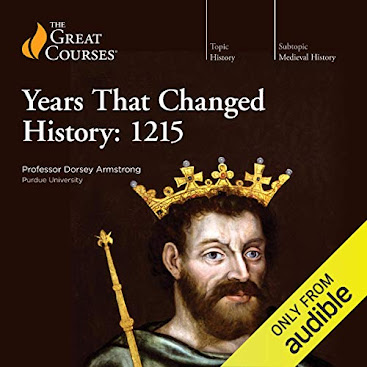
YEARS THAT CHANGED HISTORY: 1215 (The Great Courses)(audiobook) by Dorsey Armstrong


Published in 2019 by The Great Courses.
Lectures by Dorsey Armstrong.
Duration: 12 hours, 29 minutes.
Unabridged.


The Great Courses offers a lecture series by college professors that the average person can listen to on their own time. 

In this case, Purdue University history professor Dorsey Armstrong is focusing on the year 1215 as a pivotal year. 

1215 is well-known to Americans as the year of the Magna Carta, but it is also the year of the Fourth Lateran Council of the Catholic Church. The rest of the lecture series is about general things that were going on around 1215. These include the crusades, a brief look at the Americas, a look at the Islamic world, Japan, and an extended look at Genghis Khan and the Mongol Empire.

This is a lecture series that could have used a bit of editing. If two hours were removed, that would have been good. Three hours would have been great. This was especially true in the section about Genghis Khan. Armstrong admitted that she was excited about this topic and she really just laid on the details - way too many details for even this history teacher. It just got bogged down in the early details of his life and scooted through the height of the Mongol Empire and its eventual collapse.

I rate this audiobook 3 stars out of 5. I don't really blame Armstrong for this - this series tends to like 20+ half hour lectures and I don't think this was a rich enough vein of information for her to mine.

This audiobook can be found on Amazon.com here: YEARS THAT CHANGED HISTORY: 1215 (The Great Courses) by Dorsey Armstrong.

PATHOGENESIS: A HISTORY of the WORLD in EIGHT PLAGUES (audiobook) by Jonathan Kennedy


Duration: 9 hours, 23 minutes.
Unabridged.


Kennedy presents a compelling argument that disease has had a profound impact on world history by just telling a history of Europe from the days of cavemen up until now.

The first 45 minutes or so of this audiobook seemed to be wandering around and not going anywhere, but Kennedy was laying a strong foundation for the rest of the book.

The book makes it painfully obvious that humanity has bounced from one biological disaster to another. Humanity has adapted (either by behavior - like building sanitation systems to deal with body waste to control cholera) or biologically by simply having a large body count until those with immunity can rebuild (the Black Plague is a prime example.)

Kennedy persuasively argues that infection and disease helped the rise of Christianity, the rise of Islam, the end of feudalism, the rise of capitalism, and the European conquest of the Americas. Infection and disease helped create the system of African slavery in the New World and also prevented the European colonization of African until the late 1800s.

This is a very good book. I rate it 5 stars out of 5. It can be found on Amazon.com here: PATHOGENESIS: A HISTORY of the WORLD in EIGHT PLAGUES by Jonathan Kennedy.

GOD IS NOT ONE: THE EIGHT RIVAL RELIGIONS THAT RUN the WORLD - and WHY THEIR DIFFERENCES MATTER (audiobook) by Stephen Prothero


Published in 2010 by HarperAudio.
Read by Paul Boehmer.
Duration: 14 hours, 37 minutes.
Unabridged.


Stephen Prothero is a professor of religion at Boston University. The purpose of God Is Not One is to inform the reader of the eight greatest world religions, their philosophies and their way of looking at the world.

Prothero is very aware that choosing just eight religions is fraught with problems. How do you choose? Is it based on influence? Number of adherents? Importance of the countries it is in? He went through all of those questions again once again when he chose the order he would present the religions he picked.

The religions he profiled are: Islam, Christianity, Buddhism, Hinduism, Confucianism, Judaism, Yoruba religion, and Daoism. He spends about 90 minutes discussing each religion and includes nearly an hour on Atheism at the end, on the theory that militant Atheism (Richard Dawkins, Christopher Hitchens) behaves much like a religion, complete with evangelistic movements and a coherent worldview.
Prothero takes great pains to point out that these religions do not approach the world in the same way. He is pretty irritated at the "all religions are basically the same - they answer the same questions in different ways" view of religion. He thinks it is intellectually lazy. For example, Christianity teaches that the main problem with the world is sin. Daoism doesn't even have that concept - they think the main problem is society polluting people and making them unhappy by making them take on roles that go against their nature. Confucianism thinks the biggest problem is people not knowing their place in society - embrace the role given you and you will be happy. Yoruba religion is all about power, including spiritual power and leveraging it to your advantage. Atheism think religion itself is the problem - but they are usually most vocal against the three monotheistic religions (Islam, Judaism and Christianity). They might be okay with Daoist and Confucian philosophy and some Buddhist sects. Of course, all of those summaries are super-simplistic.

Prothero is not making this point in order to say that the religions of the world can't get along. Rather, he is making this point in order to say that if we are going to get along, we actually have to know what the other religions are saying and where they are coming from.

Prothero's explanations include Western cultural references to movies and books. If you are a well-read person these can be quite helpful.

I rate this audiobook 5 stars out of 5. It can be found on Amazon.com here: GOD IS NOT ONE: THE EIGHT RIVAL RELIGIONS THAT RUN the WORLD - and WHY THEIR DIFFERENCES MATTER by Stephen Prothero.

DESTINY DISRUPTED: A HISTORY of the WORLD through ISLAMIC EYES (audiobook) by Tamim Ansary


Published in 2009 by Blackstone Audio.
Read by the author, Tamim Ansary
Duration: 17 hours, 28 minutes.
Unabridged.


Tamim Ansary has done something that is very hard to do - he has written a long history of a complicated topic without making it boring and after more than 17 hours of discussion, he left me wishing that it was even longer.

Ansary makes the observation that most histories that people in the West (Western Europe and the Americas) read are written from a Western perspective. That makes sense. But, the history of the world is not just the history of Western Civilization. There are multiple civilizations on the planet. Mesoamerica (the Mayas, Aztecs, Toltecs, etc.) is a separate civilization. China is the historic center of another civilization. So is India. And between the West and India and China is another one. Westerners usually refer to it as the Middle East. This book is a history of that civilization from the beginning of recorded history (empires like Bablyon) to 9/11 and the fallout from that terrorist act.

The strength of this book is that it lets the reader see history from another perspective. For example, the Crusades loom large in European history, but they were mostly an irritant to Muslims of the day since Ghenghis Khan was threatening them from Central Asia at the same time. Compared to Ghenghis Khan, the Crusaders were not an existential threat to their civilization. To make an analogy from American history, the Battle of Lexington and Concord looms large in American history textbooks as "The Short Heard 'Round the World", but most English school children have never heard of it.

The audiobook is read by the author and he does a great job. The book is written in approachable, every day language, literally designed to be an introduction to the history of this civilization. He reminds readers of key concepts throughout, showing how older ways of doing things applied to new situations and were adapted. Ansary's reading is excellent.

I rate this audiobook 5 stars out of 5. I highly recommended this audiobook. It can be found on Amazon.com here: DESTINY DISRUPTED: A HISTORY of the WORLD through ISLAMIC EYES by Tamim Ansary.

LANDS of LOST BORDERS: A JOURNEY on the SILK ROAD by Kate Harris


Published in 2018 in the United States by Dey Street Books.

Kate Harris and her childhood friend Mel decided to go on a bicycle adventure that approximates Marco Polo's trip along the Silk Road from Turkey to China. This is not a trip taken on a whim. Harris has read about explorers and dreamed about being an explorer all of her life. She's a scientist by training but she can't stand to be in a lab - she has to get out and see the world.

Actually, she started out wanting to go to Mars and actually went so far as to participate in a Mars simulation complete with spacesuits out in the Utah desert.  The simulation told her one important thing - being in a space suit denied her the tactile experience of exploration such as the wind in your hair and the smells.

So, rather than Mars, she decides to go to one of the most remote areas of the world, for a couple of Canadians - Central Asia. It has vast deserts, literally the tallest mountains in the world and arcane bureaucracies that sometimes make it about as challenging as a trip to Mars.

Kate Harris is a talented writer and her descriptions of her trip in Lands of Lost Borders are a joy to read. The people, the weather, the animals, the troubles getting permission to cross one border after another - especially the troubles with the border into China-controlled Tibet.  The real fun, though, is with little details that she pops into the story that made me want to go tell my family all about them such as the fact that there is a word in Georgia that says, "I accidentally ate the whole thing." 


My favorite, though, took place in Tajikistan. A family let them stay the night in their home rather than camp out. The mother fed them dinner and insisted that she share cell phone numbers with Kate and Mel even though the woman lived in a cell phone dead zone and they didn't understand a word the other said. But, she just couldn't let those two women head off down the road without a friend to call on. It was sweet and a very human moment.

This was a fantastic read and I rate it an enthusiastic 5 stars out of 5. It can be found on Amazon.com here: LANDS of LOST BORDERS: A JOURNEY on the SILK ROAD by Kate Harris.

A SHORT HISTORY of the WORLD (audiobook) by Christopher Lascelles


Published by Tantor Audio in 2016.
Read by Guy Bethell.
Duration: 7 hours, 20 minutes.
Unabridged.


The entire history of the world is less than 7 and 1/2 hours? Yep, that's what Christopher Lascelles purports to offer in his A Short History of the World. He acknowledges that this is not a complete history - he never intended it to be. Instead, his aim is to connect some of the dots that the average reader may have picked up in history class, movies and History Channel documentaries (and hopefully spark a bit more interest).

Lascelles does succeed in hitting many of the high points and certainly does a better job at not being as Eurocentric as other short world histories have been, such as A Little History of the World by E.H. Gombrich. Lascelles spends quite a bit of time discussing China, Japan, India and Mongolia. All that being said, there are entire civilizations that are ignored or get nothing more than a passing nod. That is always the problem when writing a history of the world - what do you leave in? What do you leave out?

Julius Caesar (100 B.C. to 44 B.C.)
England gets a bit more of the limelight than it deserves, in my opinion. Not way out of proportion, but a bit. That is to be expected, thought, since the author is from London.

Really, the only complaint I have about the book is its size limits it - but that is the entire point of the book - it is a SHORT history after all.

Guy Bethell read the audiobook and he did a good job. I blew right through the audiobook in 2 days. It was put together in an interesting and logical way.

I rate this audiobook 5 stars out of 5 and it can be found in multiple formats on Amazon.com here: A SHORT HISTORY of the WORLD by Christopher Lascelles.

JOSEPH ANTON: A MEMOIR (audiobook) by Salman Rushdie


Published in 2012 by Random House Audio

Duration: 26 hours, 59 minutes
Read by Sam Dastor
Unabridged

For most people, Salman Rushdie is, and will always be, that author that the Iranians tried to have killed all of those years ago. I freely admit that this is an accurate description of me. Although I am an avid reader, this is the first Salman Rushdie book that I have even contemplated reading. 

Rushdie narrates this autobiography in the third person, which is a little weird and gave me the impression that he is trying to distance himself a bit from his own story.

The biggest chunk of Joseph Anton: A Memoir tells about how Rushdie dealt with the fatwa, or ruling against him and his book The Satanic Verses by the leader of the Iranian Revolution himself, the Ayatollah Khomeini. Khomeini ruled that the author, the publishers and the editors of the book should die for blasphemy and that anyone who died in an attempt to kill them would be considered a martyr. This caused Rushdie to go into hiding and be officially under police protection provided by the British government. Joseph Anton became his code name.

Rushdie the "icon" - the man who came to symbolize the intolerance of government-sponsored religion and offered a real-life preview to the dangers of radical Islam - and Rushdie the actual man are quite different people. I admire iconic Rushdie, but everyday life Rushdie is hard to like sometimes. Rushdie is often brutally honest about his friends and colleagues and their shortcomings - as he saw them. I can only imagine that many of his friends read this book and were horrified at how they were portrayed.

The book ends with a moving account of the 9/11 attacks on New York City, his adopted hometown. It makes a elegant bookend to a book that basically is about Islamic terror aimed at one person that morphs into terror aimed at an entire city.

The reader, Sam Dastor, was excellent. Interestingly, he is also the reader of the audiobook version of The Satanic Verses.

I rate this audiobook 3 stars out of 5. Way too long and too many uncomfortable comments about the author's supposed friends.

This audiobook can be found on Amazon.com here: Joseph Anton: A Memoir by Salman Rushdie. 

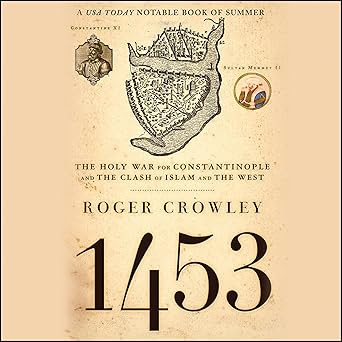
1453: THE HOLY WAR for CONSTANTINOPLE and the CLASH of ISLAM and the WEST (audiobook) by Roger Crowley


EXCELLENT!


Unabridged Audio Edition 
Published in 2016 by Hachette Audio and Blackstone Audio
Read by Simon Prebble
Duration: 10 Hours, 56 Minutes

When Rome was at its height, it split itself in half and created a second capital for the eastern half in Constantinople (modern day Istanbul). The eastern half survived the official "Fall of Rome" in 476 AD and continued on for nearly 1,000 more years until it succumbed to the Ottoman Turks in 1453. It was the seat of the Orthodox Christian Church and oftentimes stood as the bulwark against Muslim military advances into Eastern Europe.

From the time of the first formal attack against Constantinople in 674 AD until it finally fell in 1453, the capture of this city was, at the least, on every Muslim leader in this region's "to do" list, if not an active goal.


Once the Ottoman Turks arrive on the scene the Byzantine Empire is clearly on its last legs. The city is still defended by one of the most elaborate set of walls ever built and its history and architecture are truly amazing. But, its glory days are long gone. The city has sold a lot of its treasures to defend itself. Its territorial holdings, at one point, included a majority of the territory of the Roman Empire. By 1453 it only held a part of modern Greece and the territory immediately around the walled city.

The Ottomans, in contrast, were an Empire on the rise and they understood that the capture of Constantinople offered great strategic, economic and symbolic value. 


1453: The Holy War for Constantinople and the Clash of Islam and the West is a book that could have truly been horrible. We've all had that professor or teacher or book that takes the most exciting parts of history and drains all of the joy from the learning experience and leaves behind a dry, lifeless exercise in tedium. 

This book had all of the hallmarks of that experience. 

1. Medieval battle? Check.

2. The Byzantine Empire, whose very name is literally synonymous in English with being unnecessarily complicated? Check.

3. Multiple religious traditions that most American readers know little about? Check (Islam) and check (Orthodox Christianity).

Constantine XI (1405-1453)
However, Roger Crowley's history is almost always highly entertaining and informative. He paints vivid word pictures of the battles and they come off much more like the epic struggles depicted in a Tolkien novel than the a dry recitation of facts. He introduces new historical figures and makes them feel like real people.

Constantine XI, the Byzantine Emperor comes to life as an honorable and brave warrior who refused to escape and leave his city even when there was no hope. He was an experienced soldier who actively led his men throughout the siege. Legend has it that he dressed as a regular soldier in his last moments and led his men in a hopeless last-ditch defense of the city. His body was never definitively identified.

Mehmed II was the hard-headed and often difficult young Ottoman emperor. He spoke multiple languages, survived the brutal family dynamics of the Ottoman leadership and embraced new technologies, like cannon. He was rewarded for this flexibility when he took the city that many considered impossible to take.


Simon Prebble's reading of this book was excellent. It was like listening to an amazing English history professor give one of the most interesting history lectures you have ever heard. Perfect combination of voice and text.

I rate this audiobook 5 stars out of 5,

This book can be found on Amazon.com here: 1453: THE HOLY WAR for CONSTANTINOPLE and the CLASH of ISLAM and the WEST by Roger Crowley.


A LITTLE HISTORY of the WORLD (audiobook) by E.H. Gombrich


Published by Blackstone Audio in 2006
Translated by Caroline Mustill and E.H. Gombrich
Narrated by Ralph Cosham
Duration: 9 hours, 14 minutes
Unabridged

As the title states A Little History of the World is a small history of, well, everything. Sort of.

This history was originally written in 1935. The author was an unemployed art historian and was asked to write a history of the world for children for an Austrian publisher. The first edition was written in six weeks and it sold well and has sold consistently ever since. Gombrich retained the rights and after World War II set out to keep it updated and translated it into multiple languages. He was working on translating it into English when he died in 2001 at the age of 92. The work was finished by others and no one is quite sure how exactly he was planning on ending it.

The chapter on early man is quite memorable in that it gives early men and women a lot of credit for figuring out a lot of important things like agriculture, cooking with fire, stone tools and so on. Think about it - it really is quite remarkable.

The history is told in a kid-friendly, patronizing, but not annoying way. It is definitely a Eurocentric history, especially after the Mesopotamian Empires (Sumeria, Babylon, etc.) are discussed.
India is mentioned, but mostly as an introduction to Hinduism and Buddhism. China gets a lot more attention, but not much more. The Americas, including the United States are barely mentioned. The Native American civilizations (Mayas, Aztecs, Incas) are only mentioned in the context of being conquered by the Spanish and being brutalized. Africa may not have been mentioned again after Ancient Egypt.

E.H. Gombrich (1909-2001)
However, keeping in mind this bias, this is a pretty solid history of Europe. The reader, Ralph Cosham, sounds like a welcoming old grandfather who is telling the story of the world as he knows it to the little ones. It is easy to imagine him in a chair on a cold winter's night with the little ones gathered around and the fireplace ablaze. And, in a way, this translation was exactly that - a 92 year old man telling the story of the world the best he could.

I  rate this audiobook 4 stars out of 5. It is a limited history and I would never make this the only history book that I handed to my child (it has some popularity among home-school parents), but it is readable and interesting. A good place to start.


This audiobook can be found on Amazon.com here: A Little History of the World.

YOU'VE GONE TOO FAR THIS TIME, SIR! (kindle) by Danny Bent


Published in August of 2014 by Danny bent, Ltd.

It took me a long time to read You've Gone Too Far This Time, Sir. I read it over the course of several months on my Kindle and on my phone's Kindle app. 

The book details the trip of a teacher from the UK who rides his bike from the UK to India in an effort to raise money for charity and to teach his kids something.

I really struggled with the first part of the book because the author seemed so self-absorbed and I never really understood how he was going to raise money for a charity by riding and as a fellow teacher I seriously did not get how this trip was going to do anything for his students besides show them that he could do this outrageous thing. 


So, I struggled through the first half of the book because I kept on coming back to the premise behind his trip and wondering about it (how is he raising this money? Is it by the kilometer? Is it a lump sum and will be donated so long as he makes a solid effort? These are the types of questions my overly-practical mind had).

But, after a couple of months of on and off again halfhearted efforts I basically forgot the school-related aspect of the book and read it as simply the adventures of a skinny Brit riding his bicycle to India because that's the kind of crazy thing that some Brits do from time to time. 

Basically, once Danny Bent enters Russia I thought the book became much more interesting and became more fascinating the further he went. It became a travelogue and a grand adventure and I was glad to go along because I know there is literally almost no chance that I will ever travel to these places and I will certainly not be staying in the places he stayed in. Heck, I have a hard time trying new things on the menu at McDonald's, let alone eating strange, steaming bowls of mystery stew handed to me by toothless old ladies in a hut on the side of a mountain in Pakistan.

But, thank goodness I can get a glimpse of that from adventurers like Danny Bent. The second half of the book is certainly worth your time to read.


I rate this book 4 stars out of 5.

This book can be found on Amazon.com here: You've Gone Too Far This Time, Sir!

CHINESE TURKESTAN: A PHOTOGRAPHIC JOURNEY THROUGH an ANCIENT CIVILIZATION by Ryan Pyle


Published by Ryan Pyle Productions in 2014

Photographer Ryan Pyle has traveled extensively throughout China and India, Luckily, he brings his camera along and takes plenty of pictures. 

His book Chinese Turkestan focuses on the Xinjiang Uyghur Autonomous Region, the most trackless part of the old Silk Road that has connected Europe and China off and on for well more than 2,000 years. The Uyghur are Muslim and their large but sparsely populated homeland lie at the crossroads of Islam and secular Communist China. Their territory touches Tibet, Pakistan, Kyrgyzstan, Kazakhstan and Mongolia.

What Pyle calls Chinese Turkestan is often at odds with the rest of China. The Uyghur are Muslim while China actively promotes secularism. China seems bent on modernizing as quickly as possible but the Uyghur sometimes seemed locked in the past. As Pyle notes in his introduction, "There were many occasions when I stood in a crowded marketplace, enveloped in the early morning haze of coal smoke amidst the cacophony of livestock traders, noodle, bread, and dumpling makers, blacksmiths, knife and carpet sellers, feeling like a time-traveler transported to some bygone era."

Pyle does note the modern world's encroachment with many of his pictures. The first picture in the main body of the book is that of a family playing in one of those grotesque plazas with statues extolling some virtue of an idealized and devoted citizen who is all-too-happy to live for the state that Communist countries excel at creating. 

But, most of the pictures have a National Geographic-type feel to them. They show regular people doing regular jobs pretty much they way that they have been done as long as anybody can remember. Pyle has chosen to shoot all of his pictures in black and white. Black and white can be powerful and it often is in this collection. But, I found myself wishing for just one color photo of the landscape so that I could get a better feel for their environment.

The book can be found here on Amazon.com:  
Chinese Turkestan: A Photographic Journey Through an Ancient Civilization

I rate this book 4 stars out of 5.

Note: I received a copy of this book for free in exchange for an honest review.

LION of BABYLON (Marc Royce #1) (audiobook) by Davis Bunn


Published in August of 2011 by Christian Audio

Read by Paul Boehmer
Duration: 10 hours, 40 minutes
Unabridged

Veteran writer Davis Bunn (also known as T. Davis Bunn) is known for writing Christian historical fiction and Christian thrillers. Lion of Babylon is a Christian thriller centered on an intelligence operative named Marc Royce. 

Royce is one of the best of the best but he has recently been forced to retire due to the petty whims of his boss, a well-connected adviser to presidents of both parties. But, one Sunday after church Royce is picked up and offered the chance to return to his job in order to investigate the disappearance of one of his closest friends who was on assignment in Iraq. Even though Royce knows almost nothing about the Middle East he is sent to Iraq to solve this mystery.

Once there, Royce is immersed into a world of intrigue and double-dealing. Royce discovers that his friend is involved in a lot more than anyone ever suspected and all sorts of people do not want him to be found including staff members the American embassy and the ruling elite of Iraq. 

As Royce begins to investigate he quickly develops a reputation as a straight-talking man who tells the truth, has no hidden agendas and is simply too tough to be killed. Once he finds an Iraqi Christian man named Sameh el-Jacobi with a similar reputation for telling the truth and searching for truth and justice they begin to find out what was really going on and discover a religious and political movement that no one could have predicted...

I have to rate this audiobook 3 stars out of 5. It takes far too long to get up and running, the "precocious" and perceptive niece of el-Jacobi was far more irritating that she was endearing. The religious movement that begins to make over Iraq in this novel sounded like an incredible fairy tale when contrasted with the real-life religious atrocities (beheadings, crucifixions, mass murders to name a few) that were occurring under the banner of ISIS as I was listening to this audiobook. While I would hope that this book could be a signpost to a possible future of Iraq, realistically, I have to doubt that any of it could ever happen. Sadly, I think the way of ISIS is a much more likely future.

Paul Boehmer's reading of the book, including a good grasp of accents and the ability to differentiate a great number of characters, was solid but did little to assuage the underlying weaknesses of the book.

I rate this audiobook 3 stars out of 5. It can be found on Amazon.com here: LION of BABYLON (Marc Royce #1) by Davis Bunn.

Reviewed on September 12, 2014


A CALL to ACTION: WOMEN, RELIGION, VIOLENCE, and POWER (audiobook) by Jimmy Carter


Published in 2014 by Simon and Schuster (AUDIOWORKS)
Read by the author, Jimmy Carter
Duration: 6 hours, 33 minutes

Jimmy Carter and I have a strange relationship. Don't get me wrong, the 39th President and I have never met and are not likely to. I think that his presidency was, on balance, a well-intentioned mess and his post-Presidential career has been a mix of amazing achievements (Habitat for Humanity, for example) combined with annoying commentary and self-intervention into areas where he was not invited (ask Bill Clinton what he thinks of Carter's self-appointed mission to North Korea during the Clinton Administration).

This book only re-affirms my impressions of Jimmy Carter. I admire his religious faith and his intimate knowledge of the scriptures. I also admire his willingness to learn about other faiths and the fact that he teaches in his church's Sunday school. His work through the Carter Center has also been a mixed bag of amazing work against poverty and disease and less-than-helpful self-insertion into international politics. 

As Carter describes it early in his book, A Call to Action was written because so many people asked him to use his position to call attention to the how religion was being used against women around the world. 

The book also looks at the economic and political status of women and often ties religious views into how women and doing economically and politically. This is mostly a look at Christianity and Islam with some commentary on Judaism but almost none on Buddhism, Hinduism, Shintoism or any of the other faiths of the world.

Carter is especially critical of Christian denominations that do not allow women to be pastors or priests. He lays down his arguments here quite well, which is appropriate since he publicly broke with the Southern Baptists over this topic in 2000 and has laid out his reasoning for doing so many times. 

Former President Jimmy Carter signing
 A CALL TO ACTION in April of 2014. 
Photo by Mark Turner
He is less critical of the Islamic world. Don't get me wrong, he is critical, but spends much less time on the topic than he does in criticizing Christianity. He dismisses a lot of the more obvious things like burkas, not letting women go to school and not letting women receive medical treatment as local tradition. This is true, but it is tradition bolstered by certain verses in the Koran or by attitudes that draw on those verses for strength. 

This leads to the heart of my strange relationship with Jimmy Carter. It is not that he did not have a point about any of this stuff, it is that he points his finger at America and the West for so long in comparison to the other religions and countries.  He gushes over the improvement of the conditions for women in China in a section that focuses on China and brushes over the one child policy, forced abortions (he addresses the forced abortions at the end of the book but only as part of a larger movement) and the number of girls in orphanages. He focuses on the positives and brushes over the negative. When discussing America, he brushes over our positives and focuses on the negatives. Note, I am not saying we are perfect, I am saying his focus is often out of balance. 

The book was read by Jimmy Carter. At first, I thought that this was an odd choice considering his age (he was 89 when this book was released). His weaker voice has only deepened his accent and it does take a few minutes to get used to it. But, in the end, Carter's unique voice, especially if you remember his presidency, was the only one that could read this audiobook - his style is all over the text and you would have been imagining it being read in his voice anyway. At times, his emphasis on certain words while reading express his feelings more than the words themselves would have. Every time he says the phrase "female genital cutting" he practically spits out the word "cutting" - his distaste is obvious.

I rate this audiobook 4 stars out of 5. It can be found on Amazon.com here: A CALL to ACTION: WOMEN, RELIGION, VIOLENCE, and POWER (audiobook) by Jimmy Carter.

Reviewed on May 31, 2014.

SNIPER ELITE: ONE WAY TRIP (audiobook) by Scott McEwen with Thomas Kolonair


Published by Simon and Schuster Audio in 2013.

Read by Brian Hutchinson.
Duration: 10 hours, 8 minutes.
Unabridged.

Author Scott McEwen co-wrote American Sniper, the autobiography of famed SEAL Chris Kyle and from those contacts and the stories he heard he was inspired to write this fictional story of American special forces in Iran and Afghanistan.

Sniper Elite: One Way Trip is about three separate operations deftly told as three separate stories with overlapping characters and a little overlap when they get back to base. The first operation is the insertion of a lone operative into Iran to kill a weapons designer. McEwen uses this fairly straightforward story to introduce the weapons and other equipment that will be used throughout the book.

The second and third operations deal with a captured American female helicopter pilot in Afghanistan. She is part of a unit that inserts and extracts special forces all of the time so the men feel a real connection to her. When a video is released showing her being raped by one of her captors the men of multiple special forces units decided to act, even when their orders tell them to stand down and let the diplomats try to free her.
The insignia of the Navy SEALs


The action is first rate, although I can honestly say that I have no idea how realistic it was at all. Nonetheless, it was very entertaining. There were interesting questions raised but not dealt with very well, such as the uniquely weird position of the Afghani translators - they are forever between their own people and a foreign military - part of both at the same time.

If you are easily offended by curse words I suggest skipping this book because men in combat tend to curse and F$@% is used at least one hundred times in the first couple of hours. After that, it was just part of the story.

Brian Hutchinson read this story and did a great job with different accents and depicting the men in different situations. This book was not read, it was performed as he whispered, shouted, threatened and made smart-aleck comments as the characters died in the middle of a firefight - all without making it seem hokey (this book had that potential if read incorrectly).

Very enjoyable.

NOTE: This book was provided to me at no charge by the publisher in exchange for an honest review.

I rate this audiobook 5 stars out of 5 and it can be found on Amazon.com here: SNIPER ELITE: ONE WAY TRIP.

Reviewed on October 13, 2013.


Featured Post

<b><i>BAN THIS BOOK (audiobook)</i></b> by Alan Gratz

Published in 2017 by Blackstone Audio, Inc. Read by Bahni Turpin. Duration: 5 hours, 17 minutes. Unabridged. My Synopsis Ban This Book is t...

Popular posts over the last 7 days