Showing posts with label Reconstruction. Show all posts

AMERICAN HERITAGE NEW ILLUSTRATED HISTORY OF THE UNITED STATES: VOLUME 8: THE CIVIL WAR by Robert G. Athearn


Published in 1971 by Fawcett Publications, Inc.

This book was part of a series intended to be a supplement to a history curriculum as part of a classroom library or in a school library. It is part of a multi-volume series. When I was a kid, I would see books like this used for extra credit (outline chapter X, etc.) when I was a kid.

Positives:

The pictures are great. The book title says it is illustrated and it does not lie. There are pictures on almost every page and many of them are the most famous photos, paintings, and drawings of the war.

There is an "Encyclopedic Section" at the end of the book. It has biographies of prominent people of the war and explanations of some of the big ideas, and events of the war. Before the internet, these little encyclopedias about a dedicated topic were extremely helpful.

There is an essay from Bruce Catton between the regular text and the Encyclopedic Section. It is excellent.

Negatives:

There is literally no explanation of the events that led to the Civil War. The first sentence of the book is: "The Confederate bombardment of Fort Sumter sparked a great military conflagration that was to blaze in America for four bitter, bloody years." Then, it proceeds to talk about the post-Sumter military build-up. Page 2 discusses Bull Run and page 3 talks about Fort Donelson. Iti is almost like the war just happened. 

Slavery is almost entirely ignored. Because of this, I would describe this book is a "Lost Cause" lite history. The facts that are presented are accurate, but when you ignore the role slavery played in the Civil War, you are slanting things towards the Confederacy. It's not advocating "Lost Cause" points, but it lends itself towards that interpretation. This is not surprising for a book written in 1971.

The Reconstruction section is also tilted to the side of the former Confederates. 

I rate this mixed bag of a book three stars out of 5. It can be found on Amazon.com here: 
AMERICAN HERITAGE NEW ILLUSTRATED HISTORY OF THE UNITED STATES: VOLUME 8: THE CIVIL WAR by Robert G. Athearn.

THE GILDED AGE: A HISTORY from BEGINNING to END (kindle) by Hourly History


Published in 2019 by Hourly History.

What is popularly known as The Gilded Age (roughly from 1870 to 1900) was more than just an era of ostentatious wealth contrasted with crushing poverty. It was mostly a time if immense cultural and technological change and could easily be considered the beginnings of the modern world.

This short e-book does a first-rate job of giving the broad strokes of the amazing breadth of changes - changes to communication with the telephone, to transportation with the increased number of trains, but also with the invention of the automobile. Steel became a common construction material and the first skyscraper was built. 

None of this industrialization came smoothly, though. The United States went from being an overwhelmingly agrarian society where people worked on family farms or plantations (free, slave, or sharecropper) to being mostly working at paid positions in factories, stores, etc. 

On top of that, a record amount of immigrants came to the United States, among them millions of people from areas of Europe that Americans weren't used to hearing or seeing with different religions. Meanwhile, out in the western states it was the time commonly known as the Old West. The Indians were being rounded up and forced on reservations so that farmers and ranchers could use the land.

The point of this book series is to provide a history that you can read in about an hour. This one packs a lot of information in one tiny volume.

I rate this e-book 4 stars out of 5. It can be found on Amazon.com here: The Gilded Age: A History from Beginning to End.

SLAVERY, RESISTANCE, FREEDOM (Gettysburg Civil War Institute Books collection) edited by Gabor Boritt and Scott Hancock.


Published in 2007 by Oxford University Press.

The book consists of six essays about the experience of African Americans from the early American period through Reconstruction. 

They are arranged in chronological order and, as is the way with all collections, of varying quality. I did not enjoy either of the two essays by one of the editors, Scott Hancock. I did enjoy reading two of them quite a bit.

There are two strong essays that read more like small chapters from a Civil War history  about the United States Colored Troops (USCT) - the segregated units of black soldiers led by white officers. 

The last essay was by Reconstruction expert Eric Foner. It was a bit tedious to read, but it ruthlessly lays to rest that old Confederate and neo-Confederate lie that Black Reconstruction (when Blacks could actually vote and the old leaders of the Confederacy were not allowed to run for office) just elected illiterate field hands to the highest offices. The men Foner describes were mostly (80% plus) educated to at least the level of the average state legislators in the North and some were highly educated and exceptional men.

I rate this collection 3 stars out of 5. It can be found on Amazon.com here: SLAVERY, RESISTANCE, FREEDOM (Gettysburg Civil War Institute Books collection) edited by Gabor Boritt and Scott Hancock.

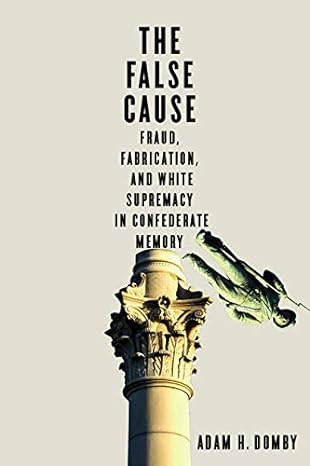
THE FALSE CAUSE: FRAUD, FABRICATION, and WHITE SUPREMACY in CONFEDERATE MEMORY (audiobook) by Adam H. Domby


Published by Blackstone Publishing in 2022.
Unabridged.

The cover of the book and the short description offered by my library app gives the impression that this book is pretty much about the "Silent Sam" Confederate memorial that stood at the University of North Carolina from 1913-2018.

This book is much more than that, though. It uses Silent Sam as an entry point into a larger discussion of how North Carolina chose to remember how it performed in the Civil War (more than 10% of Civil War soldiers from North Carolina actually fought for the Union.)

He also discusses how White men lied about their service to get Confederate pensions and the government turned a blind eye in the name affirming White unity and White Supremacy. Whites that fought for the Union (but couldn't qualify for a Union pension) or actively fought the Confederate draft with violence or by simply going AWOL at every point possible were given pensions. 
The idea is that by the late 1800s and early 1900s the idea was to deny that any Whites had ever disagreed with the Confederacy in the first place. If a little graft and fraud had to be tolerated to achieve the illusion of White Unity than that was a reasonable price to pay.
A billboard during the height of the 
Silent Sam controversy

A large chunk of the book is devoted to making the point of the previous paragraph. It is convincing and a little tedious. Much more profound is the text of the speech that was given by a Confederate veteran and political bigwig at the 1913 dedication. Julian Carr was a political moderate when it came to African Americans in North Carolina, but he makes it abundantly clear that the Silent Sam statue is there as a visible reminder to everyone of the "good old days" when all Whites stood together against the North and all Blacks knew their place. 

Interestingly, that is exactly what the modern day anti-monument protesters claimed and exactly what the Neo-Confederates denied. 

The book patiently lays out all of its arguments (there are a lot more than I have laid out here) and proves its points - just not always in the most compelling manner. 

I rate this audiobook 4 stars out of 5. It can be found on Amazon.com here: 
THE FALSE CAUSE: FRAUD, FABRICATION, and WHITE SUPREMACY in CONFEDERATE MEMORY by Adam H. Domby.

NO COMMON GROUND: CONFEDERATE MONUMENTS and the ONGOING FIGHT for RACIAL JUSTICE (audiobook) by Karen L. Cox


Published in 2021 by Tantor Audio.

At it's core, this book is a history of Confederate monuments and what they mean(t) to all of the people who live and work around them.

These monuments are tied in with the "Lost Cause" view of history that teaches that the Confederate cause was a just one, that the war had nothing to do with slavery and that the Confederate cause is only suppressed, but not dead.

These monuments are a vivid reminder about the "not dead" part. When the first big waves of monuments were out up (late 1800's) the Jim Crow laws were becoming standardized. During this time period, the Supreme Court decided in favor of racial segregation in the case Plessy v Ferguson (1896) and that project continued in earnest throughout the South. 

The monuments did honor the Confederate veterans, but they were also placed in symbolic areas like courthouses and town squares told African-Americans that they were not in charge and would never be in charge. The statue of the guy that fought to keep them enslaved in front of the halls of justice is a constant reminder. The author found multiple references to African Americans who stated they never entered the court house on the side where the statue was as a way of refusing to be intimidated. 

The book details some more current struggles over Confederate monuments, including monuments that some people are still trying to put up even today(!) The arguments for them are pretty much the same as they were 100 years ago and they were pretty weak and tone deaf arguments back then.  How were they tone deaf? People argue that the monument is to honor the region's culture and it is really just to honor a bunch of white guys from the region who fought to keep the region's black people in slavery. If you cannot imagine why the region's black people don't want to honor those soldiers...well, you are more than a little slow on the uptake (or racist - take your pick). 

I rate this audiobook 4 stars. It can be found on Amazon.com here: NO COMMON GROUND: CONFEDERATE MONUMENTS and the ONGOING FIGHT for RACIAL JUSTICE (audiobook) by Karen L. Cox.

This book is good, but not quite as good as a book that covered the same topic that I read about 18 months ago: 
DOWN ALONG with THAT DEVIL'S BONES: A RECKONING with MONUMENTS, MEMORY, and the LEGACY of WHITE SUPREMACY (audiobook) by Connor Towne O'Neill.


THE 1619 PROJECT: A NEW ORIGIN STORY by Nikole Hannah-Jones and others.


Published in November of 2021 by Random House Audio.
Multicast Performance
Duration: 18 hours, 57 minutes.
Unabridged.


I have developed a new hobby as of late - I read books that politicians tell people they should not read. The former governor of Indiana (and later the President of Purdue University) tried to prohibit Indiana University (or anyone else) to use a well-known history book to teach anyone anywhere. I read it. The Lt. Governor of Texas cancelled a book reading about the Alamo because it was not a hero worship book. There's a politician in Texas that posted a list of 850 books that he wants to ban across the state that has provided a lot of potential reading. 

But, in the last couple of years nothing, absolutely nothing, has compared to the 1619 Project and the controversy it has generated.

If you have not heard of the original 1619 Project, you have not been paying attention to America's culture wars. President Trump hated it so much he created a commission to counter its assertions. Local school boards are assailed with parents that demand it not be used in classrooms and several state legislatures have literally outlawed its use in classrooms by name.

The 1619 Project started out as a 100 page edition of The New York Times Magazine with a theme of looking at United States history through the lens of the African American experience. This book is an expanded version of the original magazine. 

All of that controversy and I can almost 100% guarantee that no more than a handful of the people who complain and pass laws have actually read the original magazine articles.

To be fair, I didn't read the original magazine articles, either. But, I jumped at the chance to hear this audiobook.

As I stated before, it is a history of the United States told through the perspective of typical African Americans. It is not a parade of famous African Americans, like you might see during Black History Month. 

One of the complaints that many politicians make is that it is critical of America. This is a ridiculous complaint. How much of American history has been a real positive time for African Americans? I am going to address that in a ridiculous way:

1619. First Africans arrive in Virginia. They are sold as slaves.
1620. Still enslaved.
1621. Still enslaved.
1622. Still enslaved.
1623. Still enslaved.
1624. First child born to the enslaved Africans. He is the first African American. He is born enslaved.
1702. African Americans are still enslaved.
1776. Thomas Jefferson wrote: "We hold these truths to be self-evident, that all men are created equal..." But, not African Americans, almost all of whom are still enslaved.
1892. African Americans are no longer enslaved. But, they have few civil rights in most states. They cannot vote in most states, they cannot sit on juries in most states. They can't even own guns in some states. Most live in a state of peonage to white landowners.

You get the idea.

This was never going to be an upbeat book. Let's face it - African Americans have gotten the short end of the stick in just about every way there has been to get the short end of the stick in American history right up to and including now. Is it better than it was in 1619? Certainly. Has America delivered on its declaration that all men are created equal? Not yet. That enduring fact is worth of comment. After all, if we don't recognize our shortcomings as a country, how can they be addressed?

My review:

The history in here is very solid. There are political complaints that it is riddled with errors and slanted. 

Here's a little secret from a history geek - all histories are slanted and riddled with errors because all historians interpret history. You can't write a complete history of, let's say, the Civil War because you can't literally include everything. You can't tell about every general, every division, every squad, every soldier and every bullet fired in every battle. There were 10,500 military engagements. You can't cover all of those in a book. Who would read a book that big? There were 50 major battles, but most histories don't even cover all of them.

Once you start cutting out parts from a history, you are interpreting it. When you decide that something is important enough to keep and other things are going to be cut from a history, you are slanting it and you are committing an error because the history is not complete. For example, everyone knows about Gettysburg - the only battle to be fought on non-slave state soil in the Civil War, right? It is in every history of the Civil War and rightly so. But, there was another battle fought on non-slave state soil 5 days after Gettysburg in Corydon, Indiana. The Confederate general was a famous one - John Hunt Morgan of Morgan's raiders. I have never read a Civil War history (I've reviewed 138 books that I've tagged "Civil War") that mentions this battle by name, even though the raid is often mentioned.  Are those histories slanted against the brave civilian militia from Indiana that tried to stop Morgan's men? No, of course not.

The 1619 Project is a history of African Americans. The traditional American heroes are not going to be heroes in this book. How can George Washington be a hero in this book when he owned African Americans and forced them to work for him under the threat of violence? How can Thomas Jefferson be a hero when he says that "all men are created equal" in the Declaration of Independence (1776) and then complains in the same document that the British were arming escaped slaves and using them as soldiers (starting in 1775) and this made the other slaves hard to control - "He has excited domestic insurrections among us...". If all men were created equal in Jefferson's eyes, he should have been freeing and arming his own slaves. 

A frequent complaint is that The 1619 Project makes too big a deal of a British court decision that essentially outlawed slavery in the British Isles right before the tensions that created the Revolutionary War. I am sure that the colonists were aware of this case, but considering that so many of the colonists' complaints were about how the colonies were treated differently than their fellow citizens back in Britain, they must have assumed that the case simply did not and would not apply to them. It would have been a minor concern at best. But, after 1775 (see previous paragraph), it is certainly correct to say that slave owners could be worried about their slaves being taken away by British soldiers and to say that slaveowners would have been motivated to fight the British to keep their slaves.

My question is not why the court case in Britain was included in this history. It is  why haven't I heard of this case before. I have 51 books that I tagged "Revolutionary War" and this is the first I am hearing of it? It does point towards the beginnings a general trend that eventually resulted in Great Britain outlawing slavery, though.

Each chapter of the book is separated by a short work of fiction that accentuates the themes that are being explored. I literally have no problem with using fiction to accentuate history. When I taught history, I used to have my students pick out  a piece of historical fiction to read. Historical fiction can be so immersive that it makes the history seemingly come to life. But, I did not enjoy many of these interludes. There was a lot of poetry and I rarely enjoy poetry. Nothing wrong with the idea itself, but It fell very flat with me. If I had been reading a physical book, I would have skipped those sections entirely. But, I was listening to an audiobook and I had to keep listening.

I am still going to give this work a 5 star rating, though. Highly recommended, especially for those that are immediately against it because a politician or a talking head on a news channel told you it was wrong. Go to your library and read it for yourself if you are concerned about financially supporting the authors. It's okay to see history through the eyes of another culture.

This book can be found on Amazon.com here: THE 1619 PROJECT:  A NEW ORIGIN STORY by Nikole Hannah-Jones and others.

A SHORT HISTORY of RECONSTRUCTION: 1863-1877 (audiobook) by Eric Foner


Originally published in book form in 1990.
Published in 2017 by Blackstone Audio.
Read by Paul Heitsch.
Duration: 12 hours, 33 minutes.
Unabridged (see below)

Clocking in at 12 and one-half hours, A Short History of Reconstruction: 1863-1877 is an abridgment of a larger work about Reconstruction that Foner published in 1988.  Still, it is plenty long enough to reveal the scope of the tragedy that was the post-Civil War Reconstruction.

Abraham Lincoln often thought about the conditions necessary to bring the seceded states back into the Union. He called that plan Reconstruction because the separate state governments would be rebuilt and then the Union itself would be reformed.

There were certain ground rules, including not letting power players in the Confederate and seceded state governments return to power. Most importantly, slavery had to be ended in the areas under the authority of the Emancipation Proclamation that was effective on January 1, 1863.

When Lincoln was assassinated, Vice President Andrew Johnson was forced to take the lead in Reconstruction. However, he was not nearly the politician that Abraham Lincoln was and soon enough, the Congress took the lead in Reconstruction. Their disagreements over Reconstruction was one of the reasons Johnson was impeached.

But, there were still promising results. African Americans voted and started schools and their own churches and went to Congress and became sheriffs and city council members and more.

Grant's eight years as President were a mixed bag. The KKK flared up again only to be squashed by outright military intervention. But, the North was tired of dealing with the South and its issues. If you start counting at the start of the Civil War, by the time the election of 1877 came along, they had been dealing with the those issues for 17 straight years. To get a contemporary 21st century analogy - think about how strong the American public feels about the war in Afghanistan in the year 2020. So, when the election of 1876 was too close to call, a deal was made and Reconstruction came to an end under Rutherford B. Hayes.

Foner details how almost everything fell apart and so many fell into the near-serfdom of sharecropping and Jim Crow laws. Interestingly, the GDP of the South was the same in 1900 as it was in 1880 - absolutely no economic growth at all over 20 years.
President Andrew Johnson (1808-1875)


Foner does point out that things weren't a whole lot better for African Americans in the North and that organized labor of any sort in general struggled in the North (and was practically non-existent in the South).

The audiobook was read by Paul Heitsch whose reading style reminded me (too often) of the automated voice you get when you call a bank or an airline. Also, he mispronounced several words. For example, he consistently mispronounced the word "lien" (used throughout the sharecropper section) lee-un.

This was not a pleasant book - no one likes to hear about the almost complete failure of the country to protect the civil rights of its people. But, this is an important piece of our history.

I rate this audiobook 4 stars out of 5. It can be found on Amazon.com here: A Short History of Reconstruction: 1863-1877.


CALAMITIES and CATASTROPHES: THE TEN ABSOLUTELY WORST YEARS in HISTORY by Derek Wilson


Published in 2015 by Marble Arch Press

Going into this book, I knew that I would have a bone to pick with almost every one of the author's choices. After all, there are 5,000 years of recorded history and every last one of them is filled with tragedy. How can you pick and choose the actual worst 10 years?

Wilson, a British historian, focuses in this book on a Western point of view and the earliest date is 541 A.D. So, if you are making a pitch for the 10 worst years in the West in the last 1500 years, his choices are pretty solid.

The years he picks are:

541-542: The first outbreak of the Bubonic Plague weakens the nascent Byzantine Empire and the Persian Empire, killing millions.


1241-1242: The Mongols invade Eastern Europe.

1572: The Spanish Inquisition and everything that came with it.

1631-1632: The worst year of the Thirty Years War.

1709: The Great Freeze

1848: The "Year of Revolutions" in Europe

1865-1866: The assassination of Abraham Lincoln and the failure of the United States to follow through properly with Reconstruction after the Civil War. Also, the rise of terror groups like the KKK.

1942-1943: He almost exclusively focuses on the Russian front - the bloodbaths around Leningrad, Moscow and Stalingrad.


Robert F. Kennedy, Sr. (1925-1968)
1968: The Vietnam War, the assassinations of Martin Luther King and Robert Kennedy, protests around the world.

1994: The Rwandan genocide. There is a lot of focus on how and why the Western powers just watched it happen.

Sometimes, Wilson has a nice turn of phrase in his writing. I especially liked this line from page 151: "Over the centuries, whatever game Europe's nations played, the weakest hand always seemed to be dealt to Poland."

But, there were lots of typos, a weird use of texting-style writing on page 122 and several errors with commas that made me have to re-read passages just to figure out if what Wilson had written was what he really meant to say. Other times, there are factual errors (that may have been editing errors - as I just noted, editing was a real issue in this book). The most egregious error was actually a double error in the same paragraph on page 227. Wilson notes:

 "By the end of 1967 the war had cost the lives of almost 16,000 combat troops and was gobbling up more than $2-3 million per month. What made matters worse was that America's youth had no way of avoiding military service because conscription (the 'draft') still existed."

First: a quick internet search says the Department of Defense spend $168 billion between 1965 and 1972 on military operations in Vietnam. I am sure he meant to say $2-3 billion, not million.

Secondly, there were ways to avoid the draft. Let's look at three recent American presidents. Bill Clinton chose the most popular way to avoid the draft - he went to college. It was no guarantee, but it was a good bet. Many universities grew during the Vietnam War due to increased demand. George W. Bush joined the Air National Guard. Also, it was no guarantee not be sent to Vietnam, but it was not likely. Donald Trump claimed disability (bone spurs in his feet).

I rate this book 3 stars out of 5. The limited focus on the West while claiming to be about all of history was a disappointment. The atrocious editing was also a concern.

This book can be found on Amazon.com here: CALAMITIES and CATASTROPHES: THE TEN ABSOLUTELY WORST YEARS in HISTORY by Derek Wilson.

Featured Post

<b><i>BAN THIS BOOK (audiobook)</i></b> by Alan Gratz

Published in 2017 by Blackstone Audio, Inc. Read by Bahni Turpin. Duration: 5 hours, 17 minutes. Unabridged. My Synopsis Ban This Book is t...

Popular posts over the last 7 days