Showing posts with label self-perception. Show all posts

HOW to THINK: A SURVIVAL GUIDE for a WORLD at ODDS by Alan Jacobs


Published in 2017 by Random House Audio.

Read by P.J. Ochlan.
Duration: 4 hours, 21 minutes.
Unabridged.

Alan Jacobs is a professor and expert on the human mind. This short work is essentially a treatise on how to keep an open mind and not get stuck in a mental rut - meaning not simply rejecting new ideas out of hand. He also addresses the concept of how to reach out to people to make new ideas more appealing to them.
Alan Jacobs

Jacobs fills the book with a lot of anecdotes - they were usually interesting in and of themselves, but not particularly enlightening. For me the last part of that sentence pretty much describes the book. It was pleasant enough but it really didn't teach me anything and a lot of the time I was wondering where the author was going with yet another story.

I rate this audiobook 3 stars out of 5. It can be found on Amazon.com here: HOW to THINK: A SURVIVAL GUIDE for a WORLD at ODDS by Alan Jacobs.

THE SUBTLE ART of NOT GIVING A F*CK: A COUNTERINTUITIVE APPROACH to LIVING a GOOD LIFE (audiobook) by Mark Manson


Published in 2016 by HarperAudio.
Read by Roger Wayne.
Duration: 5 hours, 17 minutes.
Unabridged.

Two things before we start:

1) I am not a reader of self-help books - I can't think of the last one I read. 

The author, Mark Manson
2) You simply cannot read this book if coarse language bothers you. I will follow the style of this book in this review.

Manson makes many points in the book, but two stuck out to me. He posits that many people are unhappy because they simply try to focus on too many things and can't do any of them well. In short, he says that you have to stop giving a f*ck about everything and figure out the very few things that you actually give a f*ck about and make them your priority.

One of his other points is similar, but worthy of mention. He points out that no matter where you go, there's a 500 pound bag of sh*t problems waiting for you. If you move to a new city, there will be a 500 pound bag of sh*t of problems. If you quit your job because you can't stand the 500 bag of sh*t in that place, you will find a different 500 pound bag of sh*t at your new job. If you break up with your girlfriend because you can't stand her sh*t, there will be another big bag of sh*t with your new girlfriend.

The secret to it all is that you find the 500 pound bag of sh*t you can deal with and stay there. Everyone has different sh*t that they can tolerate.

The book was well read by Roger Wayne. He sounded so confident and authentic in his reading that I actually assumed that the audiobook was read by the author.

So, I rate this book 4 stars out of 5. There is a little too much filler for a full 5 stars, especially for a 5 hour audiobook. But, this is a worthy read.

This book can be found on Amazon.com here: THE SUBTLE ART of NOT GIVING A F*CK by Mark Manson.

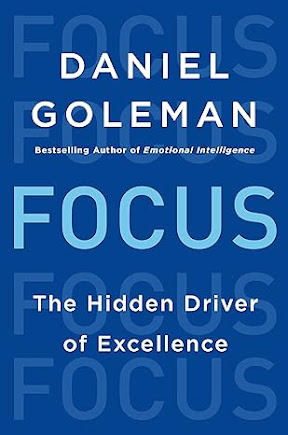
FOCUS: THE HIDDEN DRIVER of EXCELLENCE (audiobook) by Daniel Goleman


"Focus" lacks focus


Published in 2013 by HarperCollins.
Read by the author, Daniel Goleman.
Duration: 8 hours, 8 minutes.
Unabridged

Dr. Daniel Goleman is best known as the author of Emotional Intelligence. In many ways this book is less of a book about the importance of focus and more of a sequel to Emotional Intelligence. It is also a anti-global warming manifesto, an education reform book, a self-help book for business leaders who want to be the real leaders in their offices and there is a little bit about how people are able to focus their attentions a bit more and get better results.

That, of course, is the problem with the book called Focus. The primary topic should be the ability of people to focus and some hints to help you focus better. The book starts out with exactly this...well, focus. We learn how a store detective is able to focus on a crowded room full of bustling and sort out the normal shopping behaviors from the actions of a shoplifter. Goleman discusses how the give-it-to-me-now world of Tweets, Instagram, instant video makes our attention span short (I knew this already - I teach high school and my kids are on their phones all day long and I see the results).


But, then Goleman leaves this area of personal focus largely unexplored and veers into the focus of whole groups of people and uses global warming as his "focus" for this section. I listened to this as an audiobook on CDs and this lasted for more than a CD - well more than an hour of discussion about a topic that is basically off topic. He throws in a suggestion that schools adopt a global warming science project that probably would not hit most state's standards, goes on about carbon footprints, promotes websites that track your carbon footprint, tells how various companies have shrunk their carbon footprints. None of this, not one bit, not one iota, not one word is described in the blurb on the back of the audiobook. I got bored and started skipping whole chunks of text. To his credit, Goleman does point out that the concept of a zero-emission car is a misnomer since electric cars are charged up by an electric grid that is powered largely by coal and coal plants do have emissions (and if you get your electric car charged by a solar panel, there are emissions associated with the manufacture of those panels).  


Then we veer into the world of corporate leadership and the book becomes an extended discussion of what makes a good leader. Turn out it is mostly paying attention the the feelings and needs of those that are following you - this is where the book becomes a sequel to his book Emotional Intelligence with a special focus on CEOs. I felt like I was not the intended reader (or listener, in my case).


Speaking of being a listener, the audio portion of this experience needs to be discussed. The author, Daniel Goleman, read his own book. I am always leery of this because sometimes the author may have a perfectly fine speaking voice but just should not read an audiobook. It is more than a reading, it has to be a performance. Goleman does a lot of public speaking (his website has a place to contact his agent to schedule Dr. Goleman to speak to our corporate gig about leadership, emotional intelligence or maybe even global warming) but public speaking is not the same as reading an audiobook. I cannot hear gestures or hear the fact that the speaker moved across the stage or stood up to put more emphasis on a point in an audiobook. It all has to be done with your voice. Goleman's voice is okay, but not great. He does not quite drone, but it is not really lively either. It definitely took on a nagging tone during the extended global warming discussion. Even worse, there was a bass reverb echo while he spoke that I could not get rid of no matter how much I fiddled with the bass in my car. It sounded like that echo sound you hear when someone is speaking to you on the phone in a small, enclosed room. A professional audiobook should not have this problem. 


Note: This book was sent to me by the publisher in exchange for an honest review.


I rate this audiobook 1 star out of 5. I was so relieved to finish this thing and it took me forever to listen to it.


If you want to give this audiobook a try for yourself you can find it on Amazon.com here: Focus: The Hidden Driver of Excellence.

Reviewed on January 25, 2014.

Quest, Inc. by Justin Cohen


Published by Telemachus Press, LLC (March 19, 2012)

Quest, Inc. features an all-star cast of self-improvement experts who have joined together to offer the complete  package for those seeking self-improvement. There is an expert on fitness, a psychotherapist with a focus on relationships, a financial expert, a therapist who deals with addictions and a body language and image consultant.

The book starts out with Robert Rivera, the fitness expert, He has become fat and completely unmotivated. He has lost his home and his wife and fails at an attempt to kill himself. The other four experts know him from a presidential commission that they all served on and they re-unite to save Rivera and their own reputations (his failure throws doubt on all of their advice).

Once Rivera has his life back on track (roughly the first half of the book), the five of them start Quest, Inc. and promote themselves as the Worlds #1 Personal Development Agency. The rest of the book features a reporter for the Huffington Post who is determined to torpedo their venture because she despises the self-help "industry" and a series of clients. 


I had no problem with the book per se, but it just did not have a real ending. Instead, this felt like the novelization of the first two episodes of a television show, a show like ER that deals with self-help clients rather than medical issues. The first episode (the first half of the book) introduces all of the specialists and demonstrates that they are vulnerable people just like their clients. The second episode (the second half of the book) starts us on our "clients of the week." The reader gets to hear about interesting problems and how they might be helped while the main characters' individual plot lines continue moving forward at a glacial pace. The book screams to be the first in a series.


I found the book to be a little slow-moving. The clients were interesting but were so numerous that they were really just a device to introduce interesting ideas and cause the main characters to interact. I quickly lost interest in all of the experts (and their hang-ups) except for Robert Rivera. He was the only one that was developed in any way but as the story progressed he became less and a part of the story.


I rate this book 3 stars out of 5 and it can be found on Amazon.com here: Quest, Inc. by Justin Cohen.


Reviewed on March 25, 2013.

The Art of Procrastination: A Guide to Effective Dawdling, Lollygagging and Postponing (audiobook) by John Perry


Published by HighBridge Audio in 2012
Read by Brian Holsopple
Duration: 1 hour, 48 minutes
Unabridged.

Are you the kind of person who has the best of intentions but continually puts important projects aside to do other things? Is your work environment organized horizontally (stuff spread all over the desk, open chairs and any other flat surface) rather than vertically (in a filing cabinet)? Do you find that even though you put things off you still get a whole lot of stuff done - just not the stuff that you were supposed to get done? If any of these descriptions sound like you than you should check out this audiobook.

I have to admit, all of those descriptions describe me. Right now I am writing a review of a fun audiobook rather than writing one of a book I read three weeks ago that was not a particularly well done book. But, I am writing and that means one more book review will be checked off of my "to-do" list.

John Perry is a philosophy professor at Stanford. What started out as a fun little essay he wrote when he was supposed to be doing something else has blossomed into a movement (see the essay by clicking here) which goes to prove what Perry has purported for years - Procrastination is not as bad as it is cracked up to be. 


In this audiobook Perry discusses "structured procrastination" ("All procrastinators put off things they have to do. Structured procrastination is the art of making this negative trait work for you. The key idea is that procrastination does not mean doing absolutely nothing."), the value of "To-Do" lists and how to make them work for the structured procrastinator, fringe benefits of procrastination and how to work with non-procrastinators among other topics.


This is a fun audiobook - guaranteed to make fellow procrastinators chuckle and laugh throughout it relatively short run time. By the way, it took John Perry 16 years to turn his essay into a book and it may well have been worth the wait.


I rate this audiobook 5 stars out of 5.


This book can be found on Amazon.com here: The Art of Procrastination: A Guide to Effective Dawdling, Lollygagging, and Postponing, or, Getting Things Done by Putting Them Off

Reviewed on October 5, 2012.

The Invisible Gorilla: And Other Ways Our Intuitions Deceive Us by Christopher Chabris and Daniel Simons


Are you sure you saw what you think you saw?


Published in 2010 by Harmony.

In this fascinating, humorous and insightful book Chabris and Simons point to the research that shows that you really don't know what you think you know. Why not? Because you're simply not paying attention. Or, maybe you've convinced yourself that they way you think it happened is the way it happened. Or, maybe you are just a horrible judge of your own capabilities. Whichever the cause, we really don't know what we think we know.

Chabris and Simons look at research (such as their famous "gorilla" experiment - click here to see it on youtube), well known events (such as the infamous Neil Reed/Bobby Knight "choking" incident), popular fallacies (such as eyewitnesses being infallible and subliminal messages in movies and TV), continuity errors in movies (and real life experiments that explain why we don't notice them in movies) and faulty conclusions that are promoted by other authors (they are especially tough on Malcolm Gladwell, a personal favorite of mine).

As a teacher, I was especially fascinated by a discussion about self-perception and skill level. They note that those with the least amount of skill are most likely to overrate their abilities and experience an "illusion of confidence." As we approach final exams I note, once again, that the students who need to study the most claim they have it under control.

A quick and fun read, it is also a great conversation starter. Highly recommended.

I rate this book 5 stars out of 5.

This book can be found here: The Invisible Gorilla.

Reviewed May 20, 2010.

Featured Post

<b><i>BAN THIS BOOK (audiobook)</i></b> by Alan Gratz

Published in 2017 by Blackstone Audio, Inc. Read by Bahni Turpin. Duration: 5 hours, 17 minutes. Unabridged. My Synopsis Ban This Book is t...

Popular posts over the last 7 days