Showing posts with label harriet tubman. Show all posts

BOUND for CANAAN: THE EPIC STORY of the UNDERGROUND RAILROAD, AMERICA'S FIRST CIVIL RIGHTS MOVEMENT (audiobook) by Fergus Bordewich


Published by Harper Audio.

Read by the author, Fergus Bordewich.

Duration: 5 hours, 29 minutes.

Abridged.

The abridged version of Bound for Canaan hits the highlights of the Underground Railroad movement, but leaves quite a bit out. This is a radically abridged audiobook - fourteen hours of a nineteen hour audiobook were cut out - more than 70% of the book. I did not realize how much it had been abridged until I had already listened to it.

What remains is solid, but more of traditional hero study. The reader learns about the Quakers, Levi Coffin and Harriet Tubman and a few other stalwarts of the movement. Frederick Douglass shows up as an example of the Underground Railroad in action. There is a nod to the importance of women in the movement and how that led to the Women's Suffrage movement. 

The book goes off track a bit when it comes to John Brown of Bleeding Kansas fame. Brown did participate in the Underground Railroad movement, but the book follows him to the Kansas and the violence that he committed there as an abolitionist. 
It follows with a detailed re-telling of John Brown's attempt to instigate a slave rebellion by seizing the national armory at Harper's Ferry, Virginia (now West Virginia).

While these are all things that Brown did, he did them separately from the actions of the Underground Railroad. I know that the author was trying to tie the Underground Railroad to the political climate that led to the Civil War and the eventual liberation of the slaves, but this was clunky. I am going to blame it on the extreme abridgment of the book.

What was left after the abridgement wasn't bad, but it wasn't anything that was groundbreaking, either.

I rate this abridged audiobook 3 stars out of 5. It can be found on Amazon.com here: Bound for Canaan: The Epic Story of the Underground Railroad, America's First Civil Rights Movement

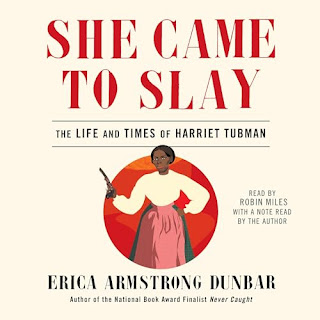
SHE CAME to SLAY: THE LIFE and TIMES of HARRIET TUBMAN (audiobook) by Erica Armstrong Dunbar


Published in 2019 by Simon and Schuster Audio.

Read by Robon Miles.

Duration: 5 hours, 53 minutes.

Unabridged. 

Erica Armstrong Dunbar brings us an accessible biography of one of the true heroes of American history - Harriet Tubman. She Came to Slay is long enough to give a decent picture of her life but short enough that it doesn't intimidate potential readers.

A traveling statue named honoring
Harriet Tubman named "Journey to Freedom"
I am not going to go through the entire biography of her life, but this book covers all of the major points of her life such as: 

-Her escape from slavery; 

-Her multiple trips back to Maryland to free family, friends and anyone that would go;

-Her work in anti-slavery societies where she met and worked with people like Frederick Douglass, William Seward and John Brown;

-The communities she helped start in New York and Canada;

-Her work with women's rights groups and her struggles to get white women to include black women in their fight;

-Her service as a nurse in the Civil War;

-Her service as a spy and a scout in South Carolina in the Civil War and her fight to be recognized for that service.

The book has a lively pace.

I rate this audiobook 5 stars out of 5. It can be found on Amazon.com here:  SHE CAME to SLAY: THE LIFE and TIMES of HARRIET TUBMAN by Erica Armstrong Dunbar.

GET on BOARD: THE STORY of the UNDERGROUND RAILROAD by Jim Haskins


Published in 1993 by Scholastic.

Get on Board is an introduction to the Underground Railroad aimed at grades 4-7. It is a solid little history of the origins of the abolitionist movement, the Underground Railroad and slavery. It mostly focuses on the heroes of the abolitionist movement, but it does its best to try to work in a lot of individual stories of the Underground Railroad.

For example, I enjoyed the letter that Jermain Wesley Loguen wrote to his former owner (he had run away) when she demanded that he pay for himself. It was the perfect blend of snark and indignant refusal.

The longest biography in the book goes to Harriet Tubman with Frederick Douglass coming in a close second. That is appropriate since their stories are extraordinary. Haskins does a real solid job of introducing the two real-life people that the most famous African American characters in Uncle Tom's Cabin are based on and then reminding the reader of them when he discusses the novel and its impact.

However, it is not a perfect book. The pictures are, on the whole, very poor - much like a poor photocopy of a photo.

The Levi Coffin House in Fountain City, Indiana
There is a problem when Haskins discusses Levi Coffin, who is sometimes called the President of the Underground Railroad as a testament to his commitment to the cause and the number of runaway slaves that he helped. Haskins makes it sound like Coffin's home is near Cincinnati (on the East Fork of the Ohio River - which doesn't exist, according to Google) but he discusses and shows a picture of his home in Fountain City. I have been to the Levi Coffin house many times in the last few years (they have a tour and a visitor's center -it's worth your time to visit) and I know that the Coffin family lived near Cincinnati at one point in time but then moved to Fountain City, Indiana. Google tells me that it is 79 miles from Cincinnati, which means that Haskins has confused the two locations.

But, on the whole, this is a nifty introduction to the Underground Railroad.

I rate this book 4 stars out of 5. It can be found on Amazon.com here: GET on BOARD: THE STORY of the UNDERGROUND RAILROAD by Jim Haskins.

BLACK PROFILES in COURAGE: A LEGACY of AFRICAN-AMERICAN ACHIEVEMENT by Kareem Abdul-Jabbar and Alan Steinberg


Originally published in 1996.

With Black Profiles in Courage, Kareem Abdul-Jabbar presents a look at American history through a different lens than you usually see. This book follows from even before the arrival of Columbus through Rosa Parks receiving her just accolades in the 1990's. His underlying theme, as explained in the title, is that African-Americans have been contributing in important ways the entire time, but they are often "whitewashed" from history.

Abdul-Jabbar is best known for his time as a top-level basketball player. But he is not just a jock (if you are a fan, you know he never was JUST a jock.) He is also an amateur historian - and quite a thoughtful one. Clearly, he was inspired by the book Profiles in Courage by John F. Kennedy but this book is not structured in any way like that classic.

The book starts with its weakest proposition from a historical perspective. There are historians that assert that African peoples were heavily involved in Mesoamerican history (Mayas, Aztecs, Olmecs) and Abdul-Jabbar agrees with them. While it is interesting to ponder, I think that, at best, it can be said that there maybe some influence there - or maybe not. We cannot be definitively sure, even if there are tantalizingly suggestive clues, due to the lack of historical records on both sides of the Atlantic and a genetic record that has been muddled by intermixing for the last 500+ years. 

But, the rest of the book is really quite strong. I very much enjoyed his biographical sketches of Crispus Attucks, Harriet Tubman and Frederick Douglass, especially Crispus Attucks. Abdul-Jabbar makes a solid case that the people he discusses should be part of everyone's history books, not just special themed history books.

I rate this book 4 stars out of 5.

This book can be found on Amazon.com here: BLACK PROFILES in COURAGE: A LEGACY of AFRICAN-AMERICAN ACHIEVEMENT by Kareem Abdul-Jabbar and Alan Steinberg.

WHAT WOULD SHE DO? 25 TRUE STORIES of TRAILBLAZING REBEL WOMEN by Kay Woodward


Published by Scholastic in 2018

What Would She Do? is collection of very readable short biographies of women - which, after being factually correct, is the most important thing. As David McCullough said, "No harm's done to history by making it something someone would want to read." 

Woodward writes in an informal, approachable style that I enjoyed quite a bit. Each biography is accompanied by a full page illustration of the woman and a little chart with basic biographical information. There is also a large pullout quote from or about her. For example, for Emma Watson there is this quote: "The saddest thing for a girl to do is to dumb herself down for a guy."


Generally, I did not like the "What Would _____ Do?" section that was included at the end of each biography. The author was clearly trying to make a connection between the women in the book and the typical American student with typical American student problems. But, trying to connect Cleopatra to a student who is being laughed at for their fashion choices or Rosa Parks to a girl being left out of group texts was just too far of a stretch for me.

Otherwise, though, this is a strong book. I am gladly handing it over to my 6th grade daughter to read and then we are going to pass it on to her teacher for her classroom library.

The publisher recommends this book for ages 8-12. I would say ages 10-15.


I rate this book 4 stars out of 5.

This book can be purchased on Amazon.com here: WHAT WOULD SHE DO? 25 TRUE STORIES of TRAILBLAZING REBEL WOMEN by Kay Woodward.


Note: I received a free review copy of this book as part of the Amazon Vine program in exchange for an honest review.

UNDERGROUND RAILROAD: OFFICIAL NATIONAL PARK HANDBOOK


Published by the National Park Service in 1996


The format of this small book  (88 pages) is much like a small old-style National Geographic with three wide-ranging informative essays by Larry Gara, Brenda E. Stevenson and C. Peter Ripley. The pictures are excellent in that they are reproduced wonderfully and well-shot.

Most importantly, these three essays are an excellent introduction to the topics of slavery, the slave trade (not just to the United States but also to the Caribbean and Brazil) and the contradictions of some of the Founding Fathers fighting for their personal freedom while owning other people.

But, the heart of the book is the fight against slavery - both political and practical. After all, it is one thing to say you are against slavery and it quite another to help a runaway slave that comes to your door and help her move on to another safe place.

A notice from 1851.
The book documents the different strains of Abolitionism (Do you help fund the fight in Kansas? Do you lobby Congress? Do you advocate for secession from the slave states?) and the Southern responses to them as well as telling a good number of individual stories of escaping slaves.

Really, the only complaint that I have is the book's treatment of the Fugitive Slave Law of 1850. It assumes that the reader is familiar with the law and how radical of a change it was in federal policy towards runaway slaves. On the whole, it is a great introduction to the topic of slavery in the United States and the struggle against it. 


I rate this book 5 out of 5 stars.

This book can be found on Amazon.com here: Underground Railroad.


Midnight Rising: John Brown and the Raid That Sparked the Civil War (audiobook) by Tony Horwitz


A compelling look into one of America's (misunderstood?) icons


Published in October 2011 by Macmillan Audio
Read by Daniel Oreskes
Duration: 11 hours, 9 minutes

John Brown is one of those well-known yet elusive figures in history. He is literally in all of the American history books, but most people know almost nothing about him except for a few headline snippets like "Bleeding Kansas" and "Harper's Ferry" and "Slave Revolt." More knowledgeable readers may remember he used a sword to kill pro-slavery settlers in Kansas and worked with several prominent anti-slavery figures before his raid into Harpers Ferry, including Frederick Douglass and Harriet Tubman and that his raid on the Federal armory at Harpers Ferry was an utter failure and undoubtedly proved that he was insane.

Or, was he? And, was the raid really a failure?

Tony Horwitz's Midnight Rising is an excellent biography of John Brown as well a well-rounded look at the politics of slavery in the United States in the 1840s and 1850s. I have studied the Civil War for years (and I must recommend Horwitz's Confederates in the Attic as well) and Brown always gets a cursory look (if any look at all) in most Civil War histories. If nothing else, Horwitz has shone a light on a most interesting life - the life of a man unwilling to bend on the issue of the inherent evil of slavery.

John Brown (1800-1859)
But, Horwitz has done more than that - he has also shone a light on the fragile nature of the political compromises that were brokered to paper over the cracks in America's political foundation - a foundation that John Brown completely shattered when his men stormed into Harpers Ferry on October 16, 1859.

Clearly Brown's attempt to spark a slave revolt totally failed. Most of his raiders were shot or executed. Brown's hurried trial was a farce (he had 6 different defense attorneys in 5 days of trial!), but Horwitz demonstrates that that time in prison awaiting trial, sentencing and execution allowed John Brown the legendary opponent of slavery to become John Brown the monster throughout the south or John Brown the martyr in some parts of the north. He became the focal point of public opinion. For example, here is a prophetic poem written in 1859 by Herman Melville called The Portent:

Hanging from the beam,
Slowly swaying (such the law),
Gaunt the shadow on your green,
Shenandoah!
The cut is on the crown
(Lo John Brown)
And the stabs shall heal no more.

Hidden in the cap
Is the anguish none can draw;
So your future veils its face,
Shenandoah!
But the streaming beard is shown
(Weird John Brown),
The meteor of the war.


Whether John Brown really intended to become "The meteor of the war" by allowing himself to be caught and put to death or if it just turned out that way...we will never know. Horwitz is not sure, either - he flirts with both possibilities. But, we can be certain that this event does not deserve the short shrift it often gets.

I was fascinated by the number of well-known personalities that ended up being involved with John Brown in one way or another. Brown knew Henry David Thoreau, Ralph Waldo Emerson, Frederick Douglass and Harriet Tubman. He tried to get Douglass and Tubman to participate in his raid. A number of famous personalities participated in the trial or the capture of John Brown, including Robert E. Lee, Thomas (soon to be) "Stonewall" Jackson, J.E.B. Stuart, John Wilkes Booth, and Edmund Ruffin (widely credited with having fired the first shot at Fort Sumter). Any man that is the nexus of so many interesting people is bound to have an interesting story and Horwitz tells Brown's story very well.

The audiobook is very well read by Daniel Oreskes whose deep, resonant voice adds a feeling of somberness and importance to this history. Oreskes actually developed different voices to read the various direct quotes in this history. Horwitz often lets the historical figures speak for themselves and this is enhanced by Oreskes.

On a lighter note, the audiobook begins and ends with a bit of music from the Battle Hymn of the Republic - here are some lyrics as a reminder: 
Mine eyes have seen the glory of the coming of the Lord:
He is trampling out the vintage where the grapes of wrath are stored;
He hath loosed the fateful lightning of His terrible swift sword:
His truth is marching on. 
This song was more famous during the Civil War for these lyrics:
John Brown's body lies a-mouldering in the grave; (3X)
His soul is marching on!
(Chorus)
Glory, glory, hallelujah! Glory, glory, hallelujah!
Glory, glory, hallelujah! his soul's marching on!
He's gone to be a soldier in the army of the Lord! (3X)
His soul is marching on!
Somebody has a sense of humor at Macmillan Audio.

I rate this audiobook 5 stars out of 5.

Reviewed on January 21, 2012.

This audiobook can be found on Amazon.com here: Midnight Rising.

Harriet Tubman: Conductor on the Underground Railroad by Ann Lane Petry


Well-written biography of a true American hero


Originally published in 1955.

Harriet Tubman: Conductor on the Underground Railroad is a fantastic little biography of Harriet Tubman (1820-1913). Tubman has always been one of my personal heroes and this book does her story justice.

I would say this book can be easily enjoyed by 4th graders and up. It also could serve as a great starting point for adults that don't know much about slavery and the American Abolitionist movement. While telling the story of Tubman's life, Petry also includes at the end of nearly every chapter historical tidbits about the slavery and the Abolitionist movement at the national level.

The discussion of her service in the Civil War as a scout in the coastal areas of South Carolina spurred me to do some further research. Her commanding officer in the raids was Colonel James M. Montgomery, the nutty commander in the movie Glory with this memorable line: "You see sesesh has to be cleared away by the hand of God like the Jews of old. Now I will have to burn this town." Interestingly, Montgomery also served with John Brown in Kansas. Harriet Tubman also knew John Brown although she was not comfortable with his violent tactics.

I rate this biography 5 stars out of 5.

This book can be found on Amazon.com here: Harriet Tubman: Conductor on the Underground Railroad

Reviewed April 8, 2009.

Bound for the North Star: True Stories of Fugitive Slaves by Dennis Brindell Fradin

An excellent introduction to the topics of slavery and the Underground Railroad.


While Bound for the North Star: True Stories of Fugitive Slaves is obviously aimed for the "young adult" crowd, it would serve as an excellent primer for ANYONE interested in learning more about that sad, sad topic in America's history: slavery.
Harriet Tubman

The author includes 12 stories about slaves who escaped north, mostly with the help of the Underground Railroad. Each story describes a different type of escape or incident - varying from the case of Solomon Northrup - a free black man who was drugged and sold into slavery while he was working in Washington, D.C. to John "Fed" Brown, a field slave who traveled a roundabout trip to freedom covering thousands of miles to John Price - an escaped slave who was captured in Ohio, but was eventually freed thanks to the near-riot of the Oberlin College community. The book ends up with the most famous member of the Underground Railroad, Harriet Tubman, and details a number of her exploits as a Conductor and as a Union Spy during the Civil War.

As a reader, I appreciated the variety of types of escape stories - it did not get stale reading about the same type of escape and the variety of escape plans really was a wonderful testament to human creativity in the face of hardship.

I rate this book 5 stars out of 5.

This book can be found on Amazon.com here: Bound for the North Star: True Stories of Fugitive Slaves

Reviewed on September 1, 2004.

Featured Post

<b><i>BAN THIS BOOK (audiobook)</i></b> by Alan Gratz

Published in 2017 by Blackstone Audio, Inc. Read by Bahni Turpin. Duration: 5 hours, 17 minutes. Unabridged. My Synopsis Ban This Book is t...

Popular posts over the last 7 days