Showing posts with label ancient history. Show all posts

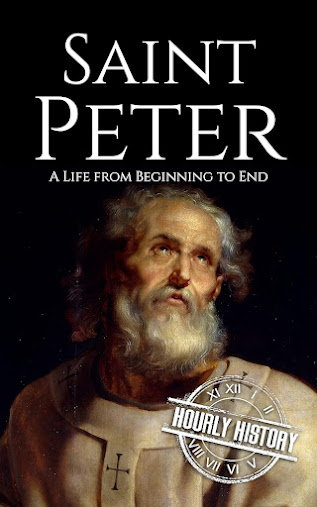
SAINT PETER: A LIFE from BEGINNING to END (kindle) by Hourly History


Published in 2021 by Hourly History.

Hourly History has a series of short histories and biographies. As the name implies, they are designed to be read in about an hour.

Some of the best offerings in this series are the biographies and this biography of Saint Peter was no exception.

Saint Peter, of course, is one of the main figures in the New Testament, probably tied with Saint Paul for the second most important after Jesus himself. But, he's kind of a mystery in many ways because the references to Peter are scattered.

This biography gathers together all of those scattered references and puts them in a narrative format so that it reads like a traditional biography. It takes care to note when stories are from the Bible and when they come from tradition (the description of how Peter was executed comes to mind.)

The general outlines of Peter's life are laid out with only a token discussion of the implications of his theology, such as the decision to not require converts to Christianity to undertake the requirements that a convert to Judaism would have to make, such as circumcision.) 

I rate this biography 4 stars out of 5. It can be found on Amazon.com here: Saint Peter: A Life from Beginning to End.


PATHOGENESIS: A HISTORY of the WORLD in EIGHT PLAGUES (audiobook) by Jonathan Kennedy


Duration: 9 hours, 23 minutes.
Unabridged.


Kennedy presents a compelling argument that disease has had a profound impact on world history by just telling a history of Europe from the days of cavemen up until now.

The first 45 minutes or so of this audiobook seemed to be wandering around and not going anywhere, but Kennedy was laying a strong foundation for the rest of the book.

The book makes it painfully obvious that humanity has bounced from one biological disaster to another. Humanity has adapted (either by behavior - like building sanitation systems to deal with body waste to control cholera) or biologically by simply having a large body count until those with immunity can rebuild (the Black Plague is a prime example.)

Kennedy persuasively argues that infection and disease helped the rise of Christianity, the rise of Islam, the end of feudalism, the rise of capitalism, and the European conquest of the Americas. Infection and disease helped create the system of African slavery in the New World and also prevented the European colonization of African until the late 1800s.

This is a very good book. I rate it 5 stars out of 5. It can be found on Amazon.com here: PATHOGENESIS: A HISTORY of the WORLD in EIGHT PLAGUES by Jonathan Kennedy.

THE DAWN of EVERYTHING: A NEW HISTORY of HUMANITY (audiobook) by David Graeber and David Wengrow


Published by Macmillan Audio in 2021.

Read by Mark Williams.
Duration: 24 hours, 2 minutes.
Unabridged
.

In my professional life I am a high school history teacher. I don't teach it now (I teach another subject), but in the past when I taught world history I taught that the origins of civilization in the traditional way and it always goes something like this:

-At first there were wandering groups of people, probably based around 1 or 2 families. Things were fairly democratic because these groups had to talk things out to make decisions.

-Somebody along the way figured out how to domesticate a few animals.

-Somebody along the way figured out how to domesticate plants. Some small fields were started and left mostly on their own while the wandering continued with scheduled returns to the fields.

-Eventually, the fields were so productive that it made no sense to leave them.

-Populations grew, towns were developed and simple authoritarian government led by almost always by a man who served as an all-powerful king of some sort always sprang up to manage the resources, resolve property disputes, etc.

-With the exception of Athens and a few other Greek city-states, democracy was non-existent. 

The classic case for this was Egypt. The way we taught it is that it has always gone this way, pretty much without fail - like it was a law of human behavior.

In The Dawn of Everything, these authors come at this with a different perspective. They've done a lot of research and have come to the conclusion that what happened in Egypt was not only not the norm but may have been a fairly unique exception. 

The authors look at the roots for our the official history of how it had to have happened (we really have no idea how, when you think about it). They then proceed to take a long look at why it is wrong to say that all or even most civilizations followed that pattern when they adopted agriculture. 

The authors spend 24 hours of audiobook telling us something that we all should have known to begin with without being told - there is no law to human behavior in any area. Human beings continue to come up with a multitude of familial, work, governmental and religious arrangements. Is that a feature of modern man or has that been the situation all along? My vote goes to "all along."

Monks Mound at Cahokia in Illinois. It is the largest
pyramid structure in the Americas north of Mexico
and one of the largest pyramids in the world.
This audiobook is interesting and makes a serious, well-considered argument. It looks at ancient Egypt, Crete, ancient Pakistan, Turkey, Stonehenge, Ukraine, China, Japan, Cahokia near the Mississippi River in Illinois, Poverty Point, the Aztecs, the Mayas, the Inca and more. Sometimes it gets a little too detailed, especially in the first one-third of the book, but it did bring a different perspective to my view of ancient history and was well worth listening to.

I rate this audiobook 4 stars out of 5. It can be found on Amazon.com here: THE DAWN of EVERYTHING: A NEW HISTORY of HUMANITY (audiobook) by David Graeber and David Wengrow.


ARCHAEOLOGY: AN INTRODUCTION to the WORLD'S GREATEST SITES (audiobook) by Eric H. Cline


Published in 2016 by The Great Courses.

Read by the author, Eric H. Cline.
Duration: 12 hours, 37 minutes.
Unabridged.

Eric H. Cline is a well-respected and highly experienced archaeologist who is a professor at George Washington University. He has excavated at several sites for a total of 30 seasons, doing everything from being an inexperienced newbie to being Co-Director of well-established sites.

Turns out that Cline is also a very likable guy who does a good job of explaining archaeological techniques. He tells about a number of sites that he worked on and some of the most famous digs in history (King Tut's tomb, Troy) in the first half of the book. It was a bit frustrating for me because they were all within 100 miles of the Mediterranean Sea. 

In the second half of the book, Cline tells about other digs around the world - Machu Pichu, the Terracotta soldiers, Teotihuacan and more. 

On the whole, this was a pleasant if not particularly riveting listen as an audiobook. I rate it 4 stars out of 5.

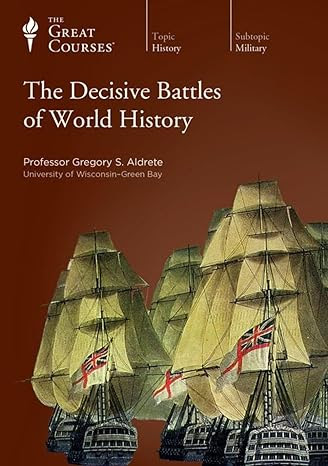
THE DECISIVE BATTLES of WORLD HISTORY (The Great Courses) (Audiobook) by Gregory S. Adlrete


Published by The Great Courses in 2014.
Lectures delivered by the author, Gregory S. Aldrete.
Duration: 18 hours, 29 minutes.
Unabridged.

As long as there has been war, there has been discussions about which battles were the most important, the most pivotal. This takes some analysis, since the temptation might be to simply discuss the battle that finally ended a long conflict, like Appomattox was the functional end to the American Civil War. 

The temptation might also be to collect a list of the biggest battles of history, but that would exclude Aldrete's tiniest choice - the Battle of San Jacinto. While that battle had less than 2,500 soldiers, he persuasively argues that the battle not only made Texas independent from Mexico, it also set off a chain of events that led directly the the American Civil War, Reconstruction and more.

In The Decisive Battles of World History, Adlrete presents the battles in chronological order and spends at least as much time on the background information of each battle as he does on the battles themselves. A few of the entries are not battles, but are entire campaigns.
The Battle of San Jacinto

Almost all of these lectures are informative and entertaining, but I did find the one set in Medieval Japan to be very hard to follow. I found that to be surprising since I took two classes on this topic back in college. 

I rate this audiobook 4 stars out of 5. It can be found on Amazon.com here: THE DECISIVE BATTLES of WORLD HISTORY (The Great Courses) (Audiobook) by Gregory S. Adlrete.

CITIES of the ANCIENT WORLD (The Great Courses) by Steven L. Tuck


Published in 2014 by The Great Courses.

Read by the author, Steven L. Tuck
Duration: 11 hours, 48 minutes.
Unabridged.

The publishers of The Great Courses offer college level lecture classes (100 or 200 level) as audiobooks and/or videos. 

Cities of the Ancient Word begins with a discussion of the earliest cities and then moves on to significant cities that came along later. To be a significant city it had to start a new pattern - cities built on rivers, cities built on defensive hills, cities built to take advantage of sea trade, cities with a clear plan, cities built with a plan to mix to allow people of different ethnicities to live together (separately) and so on.
The Roman Colosseum

I very much enjoyed the first part of these lectures. But, once we got to Tuck's specific areas of expertise (Greek, Hellenistic, Roman) the audiobook got bogged down. His last lecture about some of the lessons of ancient cities that have been adopted by modern cities or are becoming popular again was interesting.

My primary problem of the book was that its title says it is about "cities of the ancient world" but it only includes cities in the Mediterranean basin and the Near East - the farthest away is on the border of India and Pakistan.  T

The youngest city he discusses is Constantinople and he discusses it through the 500's A.D. That is late enough that he could have easily have included cities from Asia, the Americas or Africa and I find it odd that he did not considering that he was discussing universal concepts that transcend all cities. Rather than dealing with cities that were influencing each other (a point that he makes over and over again), he could have skipped to an entirely new region of the world and shown that these principles truly are universal.

I rate this audiobook 3 stars out of 5. It can be found on Amazon.com here: CITIES of the ANCIENT WORLD (The Great Courses) by Steven L. Tuck.


ANCIENT CIVILIZATIONS of NORTH AMERICA (The Great Courses) by Edwin Barnhart


Published in 2018 by The Great Courses.

Lectures by Edwin Barnhart.
Duration: 12 hours, 19 minutes.
Unabridged.

The idea behind The Great Courses is a simple one - take a college lecture course given by an expert that knows how to give an interesting lecture and package it up as an audiobook that anyone can listen to.

Edwin Barnhart is an archaeologist working out of University of Texas - Austin. This course is the completion of a trilogy of courses on Native American civilizations (South America, Mesoamerica, North America). Barnhart's area of true expertise is Mesoamerica, but he has a wealth of practical experience on digs throughout the Southwest. He also clear has a love for the various mound builder civilizations that arose in North America. 

Barnhart takes both chronological and regional approach to this history. The early history section generally is chronological because it is the most unclear. It is also the most technical section of the book, with long discussions of the pros and cons of various techniques to date artifacts. This part was pretty dry, to be honest.

 Monks Mound at Cahokia, easily the largest mound in North
America and one of the larger pyramids in the world.
The rest of the book moves from one region of the country to the next looking at the distinctive features and accomplishments of the various peoples. That part was very interesting to me. I have been to a few of them (most recently, Cahokia) and took a few notes of some great sites that I had never heard of. 

This is my fourth or fifth Great Courses audiobook. It was the first one where I felt that the presenter was actually presenting for a video course rather than an audio course. I kept thinking that I was missing some slides or visual aides as he was speaking. Turns out, this course is also available on DVD and streaming video. I enjoyed the audio presentation, but it might be better as a video. 

I rate this audiobook 4 stars out of 5. It can be found on Amazon.com here: ANCIENT CIVILIZATIONS of NORTH AMERICA (The Great Courses) by Edwin Barnhart.

THE GIFTS of the JEWS: HOW a TRIBE of DESERT NOMADS CHANGED the WAY EVERYONE THINKS and FEELS (The Hinges of History Series #2) by Thomas Cahill


Originally published in 1998 by Nan A. Talese/Anchor Books in 1998.

The Gifts of the Jews is the second book in The Hinges of History Series by Thomas Cahill. It is a series of histories that look at important long term movements in history that helped create Western Civilization. 

I read this book when it was first published and I placed it on my shelf and did not touch it for more than 20 years. Over time, I remembered it as 
remembered it as a dense tome and continued to keep it on my shelf as more of a trophy to my ability to read through difficult books than for any desire to go back and consult it or even re-read it. That changed when we stuck at home during the pandemic quarantine and we came to realize that our extensive bookshelves were overwhelmed and a purge was in order. This book was "purged" from the shelves, but went in to my to-be-read pile after I leafed though it.

I don't know why I remembered this book as hard to read. Cahill has a real gift for writing. This book was usually interesting (often immensely interesting), easy to read and offered challenging takes on the Old Testament. 


Cahill starts with a look at religious worship and religious belief in ancient Mesopotamia and Egypt. He emphasizes that everything was viewed as an unchanging cycle. This makes sense when you look at nature - the seasons, the lunar cycle, menstrual cycles, the unending cycle of birth and death and more birth and so on. The individual is not particularly important to society (everyone has a place and stays in their place and does what is expected) and the big gods don't particularly care about the individual (sacrifices are done by professionals to the bigger gods). Household gods do care about the individual, but they are limited in power and are prone to capricious behavior. Think about the Greek myths or even the famed literary character Conan the Barbarian who worships Crom - a god who does little to encourage or discourage his followers and mostly just watches over things in a generally disapproving way. 

Cahill asserts that the Old Testament is a change in that pattern. He is not unique in this thought - I have heard it at my church on a pretty regular basis. The argument is that Abraham changes the mold by stepping away from Ur, a Mesopotamian city state at the behest of God. Abraham leaves the faceless masses and becomes a known personality. The cycle stops and instead becomes a timeline following Abraham and his descendants and a relationship between a deity and his people. 

Cahill builds on this theme and shows that, over time, it becomes more than a relationship between a whole people and God and becomes more of relationship between God and individual people in that group (as typified by David).

During the exile in Babylon, the relationship changed again. Judaism had been forced to return to its roots in Mesopotamia and had to come up with a new paradigm or whither away. 
The temple and its sacrifices were literally gone. 

He dates the book of Ruth as being written in post-exile times (even though it describes pre-kingdom times) and notes that it is a story of regular people trusting in God and doing what is right. Even more importantly, Ruth - the title character - is not even Jewish. It is an effort towards inclusion. One does not have to be a literal child of Abraham to join his people. Judaism is no longer about blood or the location of a temple or even having a temple.

Cahill notes: If their identity as a nation was gone (or at least fundamentally altered), "what more could he possibly want from them? It was in the midst of this conundrum that the unheeded words of the prophets came back to them. God wanted something other than blood and smoke, buildings and citadels. He wanted justice, mercy and humility. He wanted what was invisible. He wanted their hearts - not the outside, but the inside." (p. 226)

I enjoyed this book, but I think Cahill oversold some aspects. There are certainly cycles to Judaism. For example, the Torah is read in worship in a cycle and the annual religious holidays are a cycle. But, maybe I am nitpicking.

There are parts of this book that dragged, especially in the first quarter. But, the rest of it was well worth my time to read. Turns out that I also had the third installment of this series on my shelf so I will be reading it soon. The lesson? Sometimes, it's a good idea to clear off the old book shelves and re-read a book you haven't looked it in a while.

I rate this book 4 stars out of 5. It can be found on Amazon.com here: THE GIFTS of the JEWS: HOW a TRIBE of DESERT NOMADS CHANGED the WAY EVERYONE THINKS and FEELS (The Hinges of History Series #2) by Thomas Cahill.

THE OTHER SIDE of HISTORY: DAILY LIFE in the ANCIENT WORLD (The Great Courses) by Robert Garland


Published by The Great Courses in 2013.

Read by the author, Robert Garland.
Duration: 24 hours, 28 minutes.
Unabridged.

Robert Garland
Robert Garland gives his listeners a look at the "other side of history" - meaning from the point of view of the lower and middle classes, slaves, regular soldiers, women and children from the Stone Age through Medieval Europe. Occasionally, he looks at the rich, but not quite famous as well. He also explores how religion worked in every day life, family life, marriage ceremonies, how many jobs were performed and funeral rites in Mesopotamia, Ancient Egypt, Ancient Greece, the Persian Empire, the Roman Empire and Medieval Europe, particularly England.

Garland is a lecturer at Colgate University in New York State so he delivers this information through a series of 48 half-hour lectures. Asking for all 48 lectures to be 5 star quality is asking too much, but I found this to be an enjoyable and educational listen.

Highly recommended.

I rate this audiobook 5 stars out of 5. It can be found on Amazon.com here: THE OTHER SIDE of HISTORY: DAILY LIFE in the ANCIENT WORLD (The Great Courses) by Robert Garland.

HERODOTUS: ON the WAR for GREEK FREEDOM. Translated by Samuel Shirley and James Romm. Edited by James Romm.


Published in 2003.

Originally published about 440 B.C.


Herodotus, if you don't know, is widely considered to be the West's first historian. He investigated and wrote about the rise of the Persian Empire and the Greco-Persian wars that came as a result of a struggle over Hellenic city-states on the Mediterranean coast of modern-day Turkey. Persia took them over and Athens inspired them to rebel, only to be re-conquered. After that Persia led three separate invasions of modern-day Greece by land and by sea, taking Athens twice but eventually being defeated all three times.
Herodotus (484-425 B.C.)


There are many familiar stories in Herodotus: On the War for Greek Freedom, including the Battle of Marathon (the inspiration of our modern marathon run because a soldier ran the 26.2 miles from the battle to Athens to tell the results of the battle and then died) and the Battle of Thermopylae where the 300 Spartans held off a massive Persian army.

Herodotus also attempts ethnographic studies of several cultures in from Egypt all of the way to the Black Sea. Some are pretty accurate from what we know nowadays, some are clearly quite ridiculous.

The editor, James Romm, edited Herodotus' nine volume set of histories to include just the background for the Greco-Persian wars, the three invasions and a little of the aftermath. Often, he includes a well-written summary to bridge together the pieces. It is intended as an introduction to Herodotus.

I am rating this book 4 stars out of 5. I found Herodotus' style to be a little stilted, much like reading the historical books of the Old Testament, like 1st and 2nd Kings. Sometimes, the stories have real zing, sometimes they're tedious description. Nonetheless, the sheer importance of Herodotus (his name came included in my spell check) and his work makes me raise my rating to 4 stars.

This book can be found at Amazon.com here: HERODOTUS: ON the WAR for GREEK FREEDOM.

CARTHAGE MUST BE DESTROYED: THE RISE and FALL of an ANCIENT CIVILIZATION (audiobook) by Richard Miles


Published in 2011 by Gildan Media, LLC.
Read by Grover Gardner.
Duration: 14 hours, 9 minutes.
Unabridged.


Carthage has forever been relegated to the second fiddle of the Ancient Mediterranean world - the last power to offer the Roman Republic any sort of serious threat. The also-ran that could have been what Rome became...if only.

But, unlike Rome, no one seems to know much about Carthage except for that they were a sea power, they had battle elephants and Hannibal crossed the Alps leading them in a war against Rome.

Dr. Miles' effort in Carthage Must Be Destroyed is a bit hamstrung from the lack of original sources from Carthage itself - it was looted and destroyed at the end of the Third Punic War. But, he is able to reconstruct a history based on the writings of other countries, including such sources as the Bible, Greek and Roman histories, temples, changes in religious thought architecture and coinage. 
I do appreciate how difficult this must have been, but this book often gets bogged down in multiple long discussions of the coinage (what is on the heads side, what is on the tails side, where the coins were minted, what their exact metallic content was) and other topics that are meant to be supporting of the main story but not the main story itself. I mean, it was like clockwork - 45 minutes has passed, it's time for another extended coinage discussion.

To be frank, the problem with this book is that it simply had no flow. It was often sidetracked into areas that padded its length without adding any additional understanding. It read like an academic text - like one of those textbooks that you HAD to read in school, not like a book that made you want to keep on reading it. I learned a lot, but it was a chore. Too bad, because I picked this one up because I was truly intrigued by the topic.

Award winning audiobook reader Grover Gardner read this audiobook. I generally like Gardner's work, but I was not fond of his folksy style with the academic style of the text. It clearly wasn't a deal breaker since I finished all 14 hours of the book, but I don't think it was a great editorial choice by the producer(s) of the audiobook.

I rate this audiobook 2 stars out of 5. It can be found on Amazon.com here: CARTHAGE MUST BE DESTROYED: THE RISE and FALL of an ANCIENT CIVILIZATION by Richard Miles.

A SHORT HISTORY of the WORLD (audiobook) by Christopher Lascelles


Published by Tantor Audio in 2016.
Read by Guy Bethell.
Duration: 7 hours, 20 minutes.
Unabridged.


The entire history of the world is less than 7 and 1/2 hours? Yep, that's what Christopher Lascelles purports to offer in his A Short History of the World. He acknowledges that this is not a complete history - he never intended it to be. Instead, his aim is to connect some of the dots that the average reader may have picked up in history class, movies and History Channel documentaries (and hopefully spark a bit more interest).

Lascelles does succeed in hitting many of the high points and certainly does a better job at not being as Eurocentric as other short world histories have been, such as A Little History of the World by E.H. Gombrich. Lascelles spends quite a bit of time discussing China, Japan, India and Mongolia. All that being said, there are entire civilizations that are ignored or get nothing more than a passing nod. That is always the problem when writing a history of the world - what do you leave in? What do you leave out?

Julius Caesar (100 B.C. to 44 B.C.)
England gets a bit more of the limelight than it deserves, in my opinion. Not way out of proportion, but a bit. That is to be expected, thought, since the author is from London.

Really, the only complaint I have about the book is its size limits it - but that is the entire point of the book - it is a SHORT history after all.

Guy Bethell read the audiobook and he did a good job. I blew right through the audiobook in 2 days. It was put together in an interesting and logical way.

I rate this audiobook 5 stars out of 5 and it can be found in multiple formats on Amazon.com here: A SHORT HISTORY of the WORLD by Christopher Lascelles.

A LITTLE HISTORY of the WORLD (audiobook) by E.H. Gombrich


Published by Blackstone Audio in 2006
Translated by Caroline Mustill and E.H. Gombrich
Narrated by Ralph Cosham
Duration: 9 hours, 14 minutes
Unabridged

As the title states A Little History of the World is a small history of, well, everything. Sort of.

This history was originally written in 1935. The author was an unemployed art historian and was asked to write a history of the world for children for an Austrian publisher. The first edition was written in six weeks and it sold well and has sold consistently ever since. Gombrich retained the rights and after World War II set out to keep it updated and translated it into multiple languages. He was working on translating it into English when he died in 2001 at the age of 92. The work was finished by others and no one is quite sure how exactly he was planning on ending it.

The chapter on early man is quite memorable in that it gives early men and women a lot of credit for figuring out a lot of important things like agriculture, cooking with fire, stone tools and so on. Think about it - it really is quite remarkable.

The history is told in a kid-friendly, patronizing, but not annoying way. It is definitely a Eurocentric history, especially after the Mesopotamian Empires (Sumeria, Babylon, etc.) are discussed.
India is mentioned, but mostly as an introduction to Hinduism and Buddhism. China gets a lot more attention, but not much more. The Americas, including the United States are barely mentioned. The Native American civilizations (Mayas, Aztecs, Incas) are only mentioned in the context of being conquered by the Spanish and being brutalized. Africa may not have been mentioned again after Ancient Egypt.

E.H. Gombrich (1909-2001)
However, keeping in mind this bias, this is a pretty solid history of Europe. The reader, Ralph Cosham, sounds like a welcoming old grandfather who is telling the story of the world as he knows it to the little ones. It is easy to imagine him in a chair on a cold winter's night with the little ones gathered around and the fireplace ablaze. And, in a way, this translation was exactly that - a 92 year old man telling the story of the world the best he could.

I  rate this audiobook 4 stars out of 5. It is a limited history and I would never make this the only history book that I handed to my child (it has some popularity among home-school parents), but it is readable and interesting. A good place to start.


This audiobook can be found on Amazon.com here: A Little History of the World.

THE SAVIOR GENERALS: HOW FIVE GREAT COMMANDERS SAVED WARS THAT WERE LOST - FROM ANCIENT GREECE to IRAQ by Victor Davis Hanson


Published in 2013 by Bloomsbury Press

Victor Davis Hanson, best known for his works on Ancient Greece, looks at five different generals from five different time periods and discusses how these generals became what he calls "Savior Generals". This book is very similar in structure to his 2003 book Ripples of Battle.

Hanson picked five generals to discuss in The Savior Generals: How Five Great Commanders Saved Wars That Were Lost - From Ancient Greece to Iraq.  All are from the West and he notes that this is not an all-inclusive list. They are not even particularly spread out well over history. One is from Ancient Greece, one from the early Byzantine Empire and three of them are American generals. In my opinion, not all of them fit the mold perfectly. In fact, I think only two of them do.

To be a Savior General you have to have been on the outs with the establishment and then, when everything has fallen apart and the situation is about as dire as possible, the establishment command structure looks to you to come in with your unorthodox ways and save the day. You also have to have an odd sense of how people work - a sense that makes you approach the crisis at hand in a different way than everyone else. Once the victory is won, the "Savior General" is removed in some way.

Themistocles (524-459 B.C.)

Hanson starts out with Themistocles, the general turned admiral who almost single-handedly created the Athenian navy in order to prepare for a repeat Persian invasion after the Athenians defeated the Persians at the Battle of Marathon. While most Athenians assumed that the Persians were not going to return after their defeat at Marathon, Themistocles understood the true size and scope of the Persian military and knew that the military losses at Marathon were a drop in the bucket compared to their true potential. When the Persians returned it was with "the largest amphibious invasion of Europe until the 1944 Normandy landing more than 2,400 years later." (p.23)


While the Sparta's famed 300 soldiers and their king slowed the Persian advance  for a few days at Thermopylae, the Athenians fled their city state using the navy that Themistocles had pushed for so hard between invasions. Hanson goes into detail about how Themistocles argued, cajoled, harangued and demagogued this fleet into existence and then repeated his performance all over again with the Greek allied leaders as they tried to figure out if they should even engage the Persians or if they should simply surrender. Luck, skill, sleight of hand, superior knowledge of the waters around Athens all contributed to a victory when defeat seemed so sure.

No general in this book was so far behind the 8 ball as Themistocles. His country (the Athenian city-state) was lost. It had been looted and burned and occupied. Thousands of foot soldiers were lost. For all practical purposes all that was left was the navy. but, Themistocles had prepared his country for exactly this moment and, even they they were heavily outnumbered (366 Greek ships against more than 600 Persian ships), the plan worked. Despite the great victory, Themistocles died in exile.

Belisarius (500-565 A.D.)

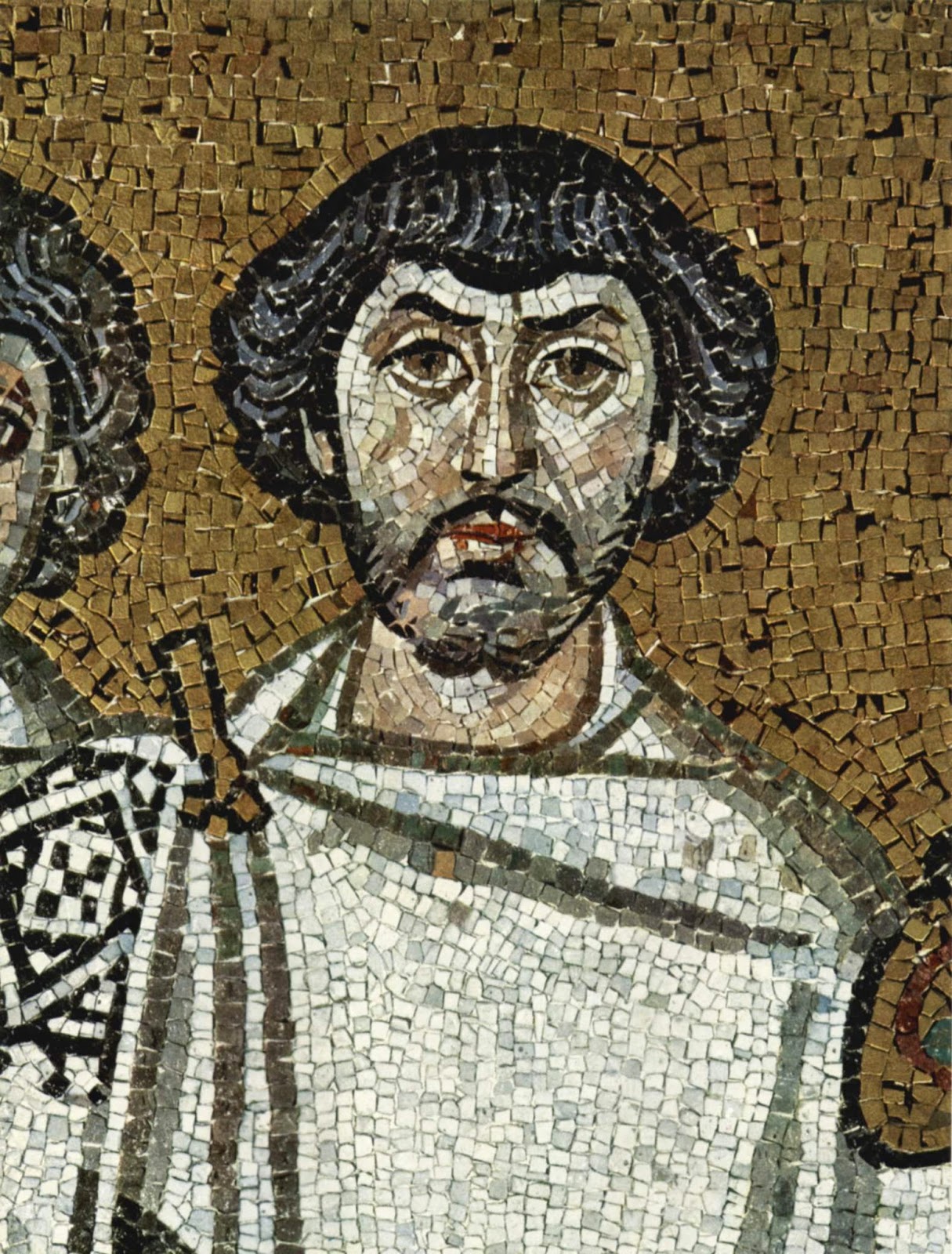
By comparison to Themistocles, Belisarius's story is not nearly so dramatic. He mostly fought on the Byzantine frontier - only once was the Empire itself at stake and even then, it probably could have been recovered easily enough if some troops had been recalled. He was a soldier always, rarely dabbling in court politics, unlike Themistocles who was a gifted politician for far longer than he was in actual combat.

The only known portrait
of Belisarius. 
But, the career of Belisarius is remarkable in that he went from one lost cause to another and made the Byzantine Empire (really the Eastern Roman Empire) grow to the point where it nearly re-captured most of the combined Eastern and Western Roman Empires. His Emperor, the famed Justinian, never quite trusted Belisarius and deprived him of resources, men or clear orders necessary to finish the jobs properly. As I was reading, I found myself wondering if Justinian was a genius in his own right who was depriving a potential rival of the resources he needed to overthrown him, or a twit that was depriving a talented general of the resources he needed to complete his mission. Was he a brazen leader who was expanding his empire with a minimum of resources because that's all that was available or was he timid and just refused to completely commit to a military course of action. I decided that the answer to all of these questions was YES. Yes, he knew Belisarius was a potential rival and he was a twit for depriving him. He wanted to grow the Empire while the opportunity was there but he was all too aware of the risks of sending too many soldiers abroad. 

Despite his years of loyal service and saving the Emperor from a revolt and an attempted invasion of his capital, Belisarius was forcibly retired and brought back to the capital so the Emperor and his spies could keep an eye on him. 

William Tecumseh Sherman (1820-1891)

In a way, the story of Sherman is the story of two Savior Generals. Sherman fought in the first major battle of the American Civil War and even earned an important command and then had a nervous breakdown. Up-and-coming general Ulysses S. Grant discovered Sherman and brought him along with him. When Grant earned promotions, Sherman did, too. 

When Grant was promoted to be the head of the Union Army and headed to Washington, D.C. to confront Robert E. Lee, Sherman took over Grant's forces in the West and began to move on Atlanta.This is where Sherman does the atypical thing. Rather than seeking battle or blindly making a dash for the city, Sherman tries to outmaneuver his opponent in order to take the city with a minimum of losses.

Grant struggled with Lee and offered a demoralizing series of battles with massive casualties as Grant and Lee's armies grappled all over northern Virginia, rarely separating more than a few days before re-engaging and generating thousands of more Union casualties. 

Most historians believe that Lincoln's re-election was far from assured in 1864 and that Sherman's taking of Atlanta right before the election certainly helped. This is the crux of Hanson's argument for Sherman being a Savior General. Sherman helped ensure the re-election of Lincoln and Lincoln's re-election helped ensure the defeat of the Confederacy. 
1864 Portrait of Sherman
by Matthew Brady
.

On top of that, Hanson argues that Sherman's infamous March to the Sea was a revolution in warfare - a war on the property used to wage war rather than on the people that were fighting in the war. He argues that this revolution was more merciful than what was typical in most Civil War campaigns because it mostly avoided casualties with the focus on property.

Hanson has an amazing grasp of the Civil War for an historian that focuses on Ancient Greece. I enjoyed his analysis of Sherman but was frustrated with his dismissal of Grant as a Savior General as well. Before Grant arrived in the East the call was always, "On to Richmond!" with little concern about the Confederate army in the field except the degree that it kept the Union Army out of the Confederate capital. However, Grant re-focused the army on Lee, knowing that eventually Lee would simply run out of men and supplies. Grant's relentless effort ensured that Sherman would never have to face reinforcing units detached from Lee's army.

Sherman deviates from the mold of Savior General in his post-war career. Unlike most of the generals he profiled, Sherman had a successful post-war career.

Matthew Ridgway (1895-1993)

When Ridgway arrived in what remained of South Korea in December of 1950 the war in Korea had already been lost, won and lost again - in just six months.

Ridgway with his characteristic grenade
on his right strap and a first aid kit on
the left.
Ridgway was unpopular with the brass because he had plenty of opinions and never failed to share them. But, in just 100 days he moved the United Nations forces from a defensive (if not outright retreating) posture to an offensive footing and began pushing the North Korean and Chinese forces back across the pre-war border. 

His style of being with the fighting men and seeing what was really going on rather than being told through intermediaries re-invigorated a largely defeated army. He brought enthusiasm, proper supplies for the winter and an argument as to why this war in this place was important and he shared them all freely with his men. He also recognized the American advantages in this war (superior air power, having occupied Japan nearby as a source of men and supplies among other). He also limited the war aims to simply restoring the pre-war border rather than conquering North Korea. By doing that, he helped make the current truce that has largely held for 60+ years possible. 

Sadly, the Korean War is often referred to as "the forgotten war" and Ridgway's amazing success is often forgotten.

David Patraeus (born 1952)

Perhaps the most controversial Savior General to be added to Hanson's list is David Patraeus. 

This book was written before his disgrace over his mistress/biographer and her access to sensitive documents and information.

No matter his personal failings and his failure in Afghanistan, Patreus had success in Iraq with George W. Bush's unpopular "Surge" from January of 2007 to May of 2008. Hanson details how Patreus had been removed from the Iraq theater earlier and then brought in to implement the Surge strategy that he had been advocating to calm the fighting in the unpopular Iraq War.

This strategy seemed almost counter-intuitive. Embrace the very communities that are attacking the American army. Move among them, become a part of those communities. And, once trust is earned, convince those communities that they should turn on Al-Qaeda and embrace the new government. It cost more lives lost at first because the trust had not yet been earned and the American soldiers were more exposed. 

Reading about the real progress made with the Surge was bittersweet considering the current problems in Iraq with ISIS and all of the beheadings, murder, mayhem and chaos as well as Patreus's fall from grace. 

I rate this collection 4 stars out of 5. 

More information on this book can be found here: The Savior Generals

Reviewed on January 20, 2104.

HAVOC (Philip Mercer #7) by Jack Du Brul


Published in 2006 by Brilliance Audio, Inc.
Read by J. Charles.
Duration: 12 hours, 43 minutes.
Unabridged audio edition.

Jack Du Brul's Havoc is a techno-thriller that races from the Hindenburg disaster to Africa to Washington, D.C to Atlantic City to Niagara Falls to Russia and back to Africa with hardly any time to take a breath. 

The book features Philip Mercer, a geologist by training that often troubleshoots for the White House. This is the seventh book featuring Mercer, a fact that was not on the audiobook label. However, Du Brul does a great job of catching the reader up on what has been going on - I assumed it was the first book in the series as I was listening to it. 

The Hindenburg disaster on May 6, 1937.
The action starts with a traveler on the infamous Hindenburg as it flies to its fate with destiny in Lakehurst, New Jersey in 1937. A crazed man is hiding a secret in a safe in his room and he is afraid that the Nazis know he has it and are plotting to steal it from him. As this man sits and watches his safe he devises a plan to get it safely off of the airship before it lands in New Jersey - he throws it overboard into a farm field with an attached note for Albert Einstein. The note falls off and the safe gets forgotten in the chaos of the Hindenburg disaster.

Fast forward to modern day in the Central African Republic. Mercer accidentally meets Cali Stowe, a fellow American. Mercer tells her he is here to investigate a geological hunch for someone as a favor. She says that she is there to investigate a village that has an extraordinarily elevated cancer rate. They are both telling half-truths. But, most importantly, this village is in the middle of a civil war and a dangerous warlord is on his way, burning and looting as he comes...

As the story progresses, Stowe and Mercer find that they have a mutual interest in this village and in each other. The more they find out about, the more tense the situation becomes. There are a lot of complicated threads in this book but Du Brul does tie them all together at the end

The story is full of action and adventure - some of it fun, some of it believable, some so outrageous that the story borders on silly. Mercer gets to be too much after a while - he is an expert on the Hindenburg, he knows how to fight, he's an expert with pistols, grenades, rifles, knives, swords and even with bows and arrows. He knows about mines, cave-ins, scuba diving, trains, dinosaur bones, forklifts, helicopters, speed boats and bar tending. But, his heart is in the right place and if you just go with the flow and don't think about it it just might not bother you too much. 

The audiobook was read by J. Charles. Charles did a merely okay job with the variety of accents required by this book. He has a hard time with women's voices and Cali Stowe has a lot of lines in this book. His foreign accents all fell into the category of "not an English language accent". Everyone kind of sounded the same. 

I rate this audiobook 3 stars out of 5. It can be found on Amazon.com here: Havoc (Philip Mercer #7) by Jack Du Brul.

Reviewed on July 22, 2014.

RIPPLES of BATTLE: HOW WARS of the PAST STILL DETERMINE HOW WE FIGHT, HOW WE LIVE, and HOW WE THINK by Victor Davis Hanson


Excellent and Quite Enjoyable.


Originally published in 2003 by Doubleday

We all understand that wars can profoundly change the world. History is full of wars that brought giant transformations, such as Alexander's conquest of Persia (and just about everything else he saw) and the spread of Hellenistic culture, the Spanish conquistadors in Mexico and Peru and the Cold War stand off that shaped the world after World War II. If you have ever heard the phrase "In a post-9/11 world..." that tells you that the world has been changed by the War on Terror. 

The simple idea behind Ripples of Battle is that it's not just wars but oftentimes single battles that change things. And, sometimes, it's not the battle that everyone knows, but a lesser-known battle that causes the most change. He uses the familiar image of a rock tossed into a lake with the outgoing ripples from the point of impact being the change. And, he does a pretty thorough job of showing that these ripples can go on and on for a very long time.

Hanson uses three battles in his formal discussion: Okinawa in World War II (April 1-July 2, 1945, Shiloh in the American Civil War (April 6-7, 1862) and Delium in the Peloponnesian War (November, 424 B.C.). He also draws similar conclusions about the 9/11 attacks in his introduction and epilogue.

Okinawa
Damage to the flight deck of the USS Bunker Hill
by a kamikaze near Okinawa on May 11, 1945.
 

He begins with Okinawa in World War II. In many ways this is personal because his father's cousin and undoubtedly the author's namesake, Victor Hanson, was killed in battle at Okinawa. This was the first battle on an island that was truly considered to be Japanese and the Americans needed it to continue their aerial assault on the Japanese main islands. The 110,000 Japanese soldiers on the island were dug in and determined to make the conquest of the island so difficult that the Americans would be convinced that an invasion of the rest of Japan would be impossible.
The Americans came with an initial invasion force bigger than that used in Normandy the year before with 1,600 ships and 500,000 American fighting men and the potential use of up to 12,000 combat aircraft. These Americans fought against kamikaze aircraft attacks (a harbinger of the suicide bomber and the 9/11 attacks) and against foot soldiers that were ordered to fight to the death, no matter how terrible the odds. The Americans responded with the flamethrower (literally burning out Japanese defensive positions) and by bombing kamikaze airbases before they could even get the planes in the air. Cold and calculating military measures that were effective and preserved American lives.

And, in the end, they came to the conclusion that the Japanese wanted them to reach - the Japanese main islands could not be conquered by traditional means. So, they decided to use nuclear weapons instead. A cold and calculated measure to preserve American lives. A ripple generated by this battle is the belief that America ought to come at its enemies with unimaginable military force to overwhelm them and prevent long, ugly battles like Okinawa. We tried to bomb North Vietnam into submission (with quantity strikes rather than quality strikes), we called the start of the Iraq War "Shock and Awe" in order to demonstrate we could hit our enemies where we wanted when we wanted.

Shiloh

The second battle is Shiloh. This is my favorite section of the book because I am a giant student of the Civil War. Hanson has not written much on the Civil War, which is too bad because he has an amazing grasp on the issues and personalities of the war. 

Shiloh begins with a sneak attack on Ulysses S. Grant's army camped at Pittsburg Landing on the Tennessee River, a few miles north of the Tennessee-Mississippi state line on April 6. For months, Grant and Don Carlos Buell had been defeating and out-maneuvering Confederate armies and had pushed through Kentucky and almost through Tennessee. Buell and Grant were poised to combine their separate armies and there was no way that the combined Confederate defenders could stop it. So, they combined without anyone's knowledge and, using a P.G.T. Beauregard plan and led by Albert Sidney Johnston, they completely surprised Grant's army before Buell could arrive.

On paper, it was a master stroke and for the first few hours it looked to be a complete victory. It would have been but for the rise of William Tecumseh Sherman. Before Shiloh Sherman was largely discredited (he'd had a mental breakdown) and he bears more blame than most for the success of the sneak attack itself. But, he rallied the men, calmly rallying them and turning a rout into an orderly retreat. In the melee he was shot through the hand, he had multiple horses shot out from under him and his coat was riddled with bullet holes. When Grant met up with him during the battle he realized that Sherman had things well in hand (as well as they could be, in any case) and focused on other areas of the field.

This is the moment that Sherman became Sherman - the general that became Grant's trusted second for the rest of the war. It is also the last large-scale pitched battle that Sherman fought in, a fact that I had not realized until Hanson pointed it out. When Sherman fought on his own in the Atlanta campaign and the March to the Sea he avoided the large pitched battle in favor of maneuvering his opponent out of position and forcing a retreat. Not that there was no fighting, but there were no more Shilohs. For Sherman, the war would not be won when the South's armies were vanquished but when it's ability to maintain those armies was destroyed. He invented total war on a large scale and he gutted the Confederacy while hardly losing a soldier, especially when compared to the battles that Grant was waging against Lee in Virginia.


It is also the moment when Albert Sidney Johnston died and the Myth of the Lost Cause came to life (within days of the battle). Whether Johnston would have been able to lead the Confederates to victory in the West is a subject to debate. Johnston's skills as a leader are unclear based on what he achieved before he died. He lost giant chunks of the West and any chance to have Kentucky join the Confederacy due to poor initial troop placements. His skill at making his orders clear in battle was excellent but could the Confederates have overwhelmed Grant's men if Johnston had lived?
Confederate General Nathan
Bedford Forrest (1821-1877)

One Confederate general who comes into his own in this battle is Nathan Bedford Forrest - arguably the South's foremost cavalry man. He was truly a self-taught talent. This battle made his reputation, especially his famed escape after being the last man to be wounded after the battle. His reputation as a scrapper and master of guerrilla war tactics served him well as the first leader of the Ku Klux Klan after the war. He was probably the only man with the enough stature, enough venom and enough anger to have led that Klan to any level of success.

Perhaps most interesting is the case of Lew Wallace, the general who arrived late with the Union reinforcements and paid for it (unfairly, in his mind) with his career. But, he used that sense of being wronged as an inspiration to write Ben-Hur, the story of a man who is wrongly accused and loses everything. Ben-Hur was a publishing phenomenon, much like Harry Potter and Twilight have been nowadays. But, this one was one of the first.

Delium

You have probably never heard of Delium. I know I did not know it by name. I knew of two things that happened at the battle before I read this book, but I did not know the name of the battle itself. I knew that Socrates had almost been killed in a battle but was saved by Alcibiades. And, I knew that Athens lost that same battle. 

This battle was part of the Peloponnessian War - the war between Athens and its allies and Sparta and its allies that lasted almost thirty years. Fifty thousand men fought in it, but no great generals were involved. No Spartans were involved. Instead, this was a sloppy attempt by Athens to defeat a confederation of city states under the leadership of Thebes so that Athens could focus on its more powerful enemies in Sparta.

But, in this battle Socrates lived, rather than died. Alcibiades made his reputation and the birth of Western battle tactics may have been born.

Hanson ends with the discussion of tactics, but it is almost an afterthought to the chapter. In this battle, the army that faced the Athenians was considered to be the equivalent of Ancient Greek rustics - unrefined and definitely not the equal of the Athenians in culture. But, in this battle they did more than the traditional giant scrum match of interlocking shields that made up most hoplite battles. Instead, the held troops in reserve and moved them around during the battle. Basics to us, nowadays, but revolutionary at the time.

Socrates (470/469-399 B.C.)

This change in tactics caused the Athenian line to crumble. Socrates was in that line and he nearly died. Pre-Delium Socratic thought was not the philosophy that he is famous for. His best work came after this brush with death and it is that thought that inspired Plato and through Plato inspired Aristotle. What would Western thought have been without Socrates, Plato and Aristotle?

Alcibiades made his reputation as a cavalry officer in this battle. He was already marked to be a future leader of Athens. His beauty, his attitude, his intelligence and his ability to sway the crowd guaranteed that. But, this battle thrust him to the forefront.  If only he had died...

Alcibiades' career defies explanation. He conceived of and led the Athenian attack on Sicily, widely considered to have been a military disaster of the first order for Athens. However, he defected to Sparta rather than face a tribunal in Athens for defacing religious statues. He led Spartan troops against Athens and was successful until he fled Sparta (he had an affair with the king's wife) and joined with the traditional enemy of the Greeks, the Persians.  After advising the Persians, he went back to Athens and served as a highly successful military leader, then went back to the Persians and was then assassinated.  

Of the three battles, this chapter is the one in most need of a bit of editing, in my opinion. It goes on a little too long, but that is to be expected - Ancient Greece is Hanson's bread and butter.

So, does Hanson prove his point with these three battles? Of course he does. But, he does more than that. He tells three interesting stories of history and demonstrates that no action has occurs in an historical vacuum, especially not battles because so much rides on the outcomes and the sheer chance and chaos of it all. 

I rate this book 5 stars out of 5. This book can be found on Amazon.com here: RIPPLES of BATTLE: HOW WARS of the PAST STILL DETERMINE HOW WE FIGHT, HOW WE LIVE, and HOW WE THINK by Victor Davis Hanson.

Reviewed on July 4, 2014.


Featured Post

<b><i>BAN THIS BOOK (audiobook)</i></b> by Alan Gratz

Published in 2017 by Blackstone Audio, Inc. Read by Bahni Turpin. Duration: 5 hours, 17 minutes. Unabridged. My Synopsis Ban This Book is t...

Popular posts over the last 7 days