Showing posts with label Maryland. Show all posts

BOUND for CANAAN: THE EPIC STORY of the UNDERGROUND RAILROAD, AMERICA'S FIRST CIVIL RIGHTS MOVEMENT (audiobook) by Fergus Bordewich


Published by Harper Audio.

Read by the author, Fergus Bordewich.

Duration: 5 hours, 29 minutes.

Abridged.

The abridged version of Bound for Canaan hits the highlights of the Underground Railroad movement, but leaves quite a bit out. This is a radically abridged audiobook - fourteen hours of a nineteen hour audiobook were cut out - more than 70% of the book. I did not realize how much it had been abridged until I had already listened to it.

What remains is solid, but more of traditional hero study. The reader learns about the Quakers, Levi Coffin and Harriet Tubman and a few other stalwarts of the movement. Frederick Douglass shows up as an example of the Underground Railroad in action. There is a nod to the importance of women in the movement and how that led to the Women's Suffrage movement. 

The book goes off track a bit when it comes to John Brown of Bleeding Kansas fame. Brown did participate in the Underground Railroad movement, but the book follows him to the Kansas and the violence that he committed there as an abolitionist. 
It follows with a detailed re-telling of John Brown's attempt to instigate a slave rebellion by seizing the national armory at Harper's Ferry, Virginia (now West Virginia).

While these are all things that Brown did, he did them separately from the actions of the Underground Railroad. I know that the author was trying to tie the Underground Railroad to the political climate that led to the Civil War and the eventual liberation of the slaves, but this was clunky. I am going to blame it on the extreme abridgment of the book.

What was left after the abridgement wasn't bad, but it wasn't anything that was groundbreaking, either.

I rate this abridged audiobook 3 stars out of 5. It can be found on Amazon.com here: Bound for Canaan: The Epic Story of the Underground Railroad, America's First Civil Rights Movement

UNCOMMON VALOR: A STORY of RACE, PATRIOTISM, and GLORY in the FINAL BATTLES of the CIVIL WAR by Melvin Claxton and Mark Puls


Published in 2005 by John Wiley and Sons, Inc.

The Emancipation Proclamation was effective on January 1, 1863 - it included a provision that former slaves were to "be received into the armed service of the United States". The Union Army was a little slow to enact this provision, but by 1864 there were plenty of African American Union soldiers ready to go into the field. Uncommon Valor follows one of those units during the Petersburg campaign of 1864-1865.

This history primarily follows Christian Fleetwood, an African American Baltimore clerk. Fleetwood was born free, but living in a slave state was a constant reminder of his second class status. He had been considering joining the army for a long while, trying to determine if it would be a blow for freedom, or just choosing to support one oppressive regime in order to fight an even more oppressive regime. If that was the case, he might as well sit it out and let both sides clobber one another.

Sgt. Major Christian Fleetwood (1840-1914)
in the year 1900. 
After eight months of indecision, Fleetwood joined up. Using Fleetwood's autobiography, the authors tell the story of his training, his concerns about unequal pay, and his frustrations with inconsequential assignments. He was frustrated with their lack of action - he was sure it was because the higher-ups feared that they would not fight well. 

Eventually, though, they were given more and more assignments, including probes into the outer defenses of the capital of the Confederacy itself. 

In the summer of 1864, General Grant determined that he would push Lee's army continuously until he destroyed it or Lee surrendered. Lee had to defend Richmond at all costs, so it was starting to become a static line, almost like a World War I line of trenches. 

Grant ordered a quick attack on Petersburg, a large train junction town more than 20 miles south of Richmond. The theory was that if the Union took Petersburg and stop the trains bringing in supplies, it could quickly starve out Lee's army. 

Fleetwood wanted action - now he had it. He would serve in multiple engagements and eventually earn the Congressional Medal of Honor for his part in the Battle of New Market Heights.

All of these battles and maneuvers are pretty well-described, but maps, even poor ones, would have been helpful. I am always a fan of lots of maps in my Civil War histories - it just helps the reader understand things so much better.

Besides the maps, this book really needed a section that discussed what the main people mentioned in the book did after the war. It didn't need a lot of detail, but something would have been nice.

I rate this history 4 stars out of 5. It can be found on Amazon.com here: UNCOMMON VALOR: A STORY of RACE, PATRIOTISM, and GLORY in the FINAL BATTLES of the CIVIL WAR by Melvin Claxton and Mark Puls.

ELEVEN NUMBERS: A SHORT STORY (kindle) by Lee Child


To be published by Amazon Original Stories in February of 2025.

If you have Amazon Prime, you get to choose from a limited selection of soon-to-be-published e-books every month. I am a big fan of Lee Child's Jack Reacher books, so I jumped at the chance to get this short story by Lee Child.

I believe I have read every book and every short story that Lee Child has written about Jack Reacher, but I don't think I've read anything he's written that didn't feature Reacher. In fact, I didn't know he wrote about any character but Reacher.

This is the story of a mathematician - a college professor. He's kind of a nobody, except that he has a specialty, some would say a gift, in an obscure little corner of mathematics. Not many people have even heard of it, let alone know anything about it. 

Then, one day, he gets a call from the White House...

My review:

This was a quick story. It is well-written and takes several twists and turns that I did not see coming.  It's quite good, just not a Reacher action-fest.

I rate this short story 5 stars out of 5. It can be found on Amazon.com here: Eleven Numbers: A Short Story by Lee Child.

THE WILD ONE (Peter Ash series #5) (audiobook) by Nick Petrie


Read by Stephen Mendel.
Duration: 9 hours, 59 minutes.
Unabridged.

Synopsis:

Peter Ash is a veteran of the Iraq and Afghanistan Wars. He served with the Marines and even though he is back at home - he is not. He wanders because he can't stay indoors due to PTSD manifesting as claustrophobia. As he wanders, he finds good people in trouble and he tries to get them out of trouble. 

In the past he's been in Milwaukee, Oregon and Washington State, Colorado and Memphis. This time he's in Iceland. 

Ash has been hired by a rich grandmother to find her son-in-law and her grandson. Police in Maryland believe that her son-in-law killed her daughter, kidnapped her grandson, and took him to his home country - Iceland.

So, Peter Ash somehow braves an airplane trip and arrives in Iceland only to find that this case is way more complicated than he ever imagined...

My Review:

Despite the obvious plot hole of a man with SEVERE claustrophobia riding on a jet airplane across North America and halfway to Europe, this book is actually quite good. The action drives the story at a very quick pace and the author keeps adding new bits of mystery.

For my review of the fourth book in this series I wrote:

The series also has a formula that I happen to like. It would be wise of Petrie to shake it up a bit, but it is a formula that is working for me.

This book certainly shook up the formula. Good for Nick Petrie.

The reader, Stephen Mendel, did a fantastic job with a wide variety of accents.

I rate this audiobook 5 stars out of 5. It can be found on Amazon.com here: THE WILD ONE (Peter Ash series #5) by Nick Petrie.

McCLELLAN and FAILURE: A STUDY of CIVIL WAR FEAR, INCOMPETENCE and WORSE by Edward H. Bonekemper, III


Originally published in 2007.
Published in 2010 by McFarland and Company, Inc.


If you are a student of the Civil War, George B. McClellan is a conundrum at best.

After the Frist Battle of Bull Run (Manassas) in July of 1861, the poorly trained Union Army had fled back to Washington, D.C. They were basically a semi-organized mob awaiting someone to take the lead.

Lincoln looked around and felt that the leadership team that lost at Bull Run was not going to provide a credible lead general so he looked around the Eastern Theater for anyone else with the aura of success.

George B. McClellan had a bit of success in Western Virginia and wrote a lot of reports that made him seem an even better General than he was so Lincoln looked to him to retrain and refit the Army of the Potomac (the main Union Army in the East.)

Statue of McClellan outside of the
city hall in Philadelphia. It was 
dedicated in 1894.  I have no idea
why they felt he deserved this honor.
When I have talked with students about McClellan, I like to compare him to a nervous guy who restores cars. He finds a junker with lots of potential, restores it, and then is afraid to take it out and drive it (the entire purpose of a car) because it might get wrecked again. His men loved him for that - they didn't want to go out and fight and die in a pointless battle. But it was up to McClellan to find a way to take the fight to the enemy and the purpose of an army is to fight, to kill people and blow up things, not to drill and drill and drill while the enemy sits just a few miles away in the middle of the war. 

McClellan took over 8 months to rebuild the army before he took it out to fight. It was the largest army of the entire Civil War and was magnificently well-supplied.  His predecessor had only been in charge of the same army for about 6 weeks when he took to the field. 

Bonekemper documents McClellan's excuses, his time wasted on political lobbying, writing political advice to the President, and his constant inflation of the size of Confederate armies. Bonekemper also makes a strong case that McClellan didn't want to push too hard against the Confederacy because he was pro-slavery and that he let another Union Army be defeated at the Second Battle of Bull Run in August of 1862 out of jealousy.

Once again - the most important general in the U.S. Army refused to engage the enemy because he sympathized with their war aims and he let an entire Union army be defeated when he was ordered to provide assistance because he was angry that the other army had an independent command.

Did McClellan make up for that by being a brilliant field general? No. His own men (generals and even privates) noted that he led from far behind the lines and rarely directed the men once the fighting started.

His last battle of any size was Antietam. Have you ever seen a karate movie where the group of bad guys engage the good guy by taking turns so he can defeat them all one at a time? That's how McClellan engaged with Robert E. Lee's much smaller Army of Norther Virginia - one brigade at a time and Lee basically fought them all to a draw - one brigade at a time.

In a modern army, McClellan may have had found a place dealing with logistics and training - procuring supplies and recruiting soldiers, training them and sending them to the front. But, that was not how things worked in the Civil War.

Of course, Bonekemper lays all of this in detail with the original sources and quotes. A lot of historians give McClellan a pass of sorts. To be honest, I don't know why. This book makes it clear that they shouldn't - he was among the worst of the Union generals.

I rate this book 5 stars out of 5. It can be found on Amazon.com here: McCLELLAN and FAILURE: A STUDY of CIVIL WAR FEAR, INCOMPETENCE and WORSE by Edward H. Bonekemper, III.

DEEP SLEEP (Devin Gray Book 1) (audiobook) by Steven Konkoly


Published in February of 2022 by Brilliance Audio.
Read by Seth Podowitz.
Duration: 10 hours, 18 minutes.
Unabridged.


Synopsis:

Devin Gray is a retired military operator working for a high-end private security contractor. He is on assignment that goes a little sideways in the D.C. metro area and he is sent away to let things cool off.

While packing up to go, he is contacted about his mother. She is estranged from the rest of the family because she is always off researching a conspiracy theory, which is kind of ironic because she works in a government intelligence agency that looks for conspiracies. She is dead after some short of shoot out in Tennessee and everyone is keeping it quiet.

Gray discovers a note from his mother to him with instructions. It turns out to lead to her evidence that proves the conspiracy and he finds it to be plausible enough to reach out to others. Once they start digging, they find more than it is worse than they ever imagined...

My review: 

I was excited about this book. I really enjoyed the first two book of an his unfinished Rogue State series (link to review of the first book here: Fractured State.) That series is full of non-stop and, frankly, ridiculous action - but it is fun and demands your attention.

This book had a complicated conspiracy that you know in your head is simply too complicated to work, but your gut says, "Oh crap! This could really happen!" I had no problem with the premise of the book.

I had problems with the pacing of the book and the proliferation of characters. Konkoly decided to make characters out of some of the bad guys in an effort to confuse the reader at first. It worked and it was kind of a good choice except that he keeps on adding character after character after character and this audiobook reader got confused as to who exactly was who. I just decided to ignore character names and label them "good guy" and "bad guy" in my head. That totally defeated the purpose of creating a named character with lines and a personality, but I couldn't keep up. When one of them goes down in a gun fight, I didn't care a whole lot - I just kept a little running tally in my head to see if any of the good guys were going to survive.

For an action story, this book has an awful lot of sitting around and talking. Sitting around and talking in a restaurant, in a car, in a secret hideout, in another car, in an SUV, in a rented house, in another SUV, in a hotel, in a mansion, in a helicopter, in another hotel.

So many of these conversations were repeats of other conversations. The conspiracy is discovered and then explained to another person. That person explains it to a small group. That group explains and discusses with another group and by that point I felt like I could have stepped in and gave the explanation myself.

So, to sum up - too many characters makes the story hard to follow. Too much repeat conversations stretched the story out for no real reason.

On a pet peeve note: Konkoly is from Indianapolis and lives in Indianapolis. So do I. I was pleased to see part of the book took place in an Indianapolis suburb that he described perfectly (Carmel.) However, the audiobook reader mispronounced it. It is pronounced the way many people mispronounce the candy "caramel." He pronounced it like the California city "Carmel by the Sea." This was not important to the story and people who do not live in Indiana would have no idea but considering that the author lives here...

I rate this audiobook 2 stars out of 5. I will not be moving on to book two in this series. This book can be found on Amazon.com here:  DEEP SLEEP (Devin Gray Book 1) (audiobook) by Steven Konkoly.

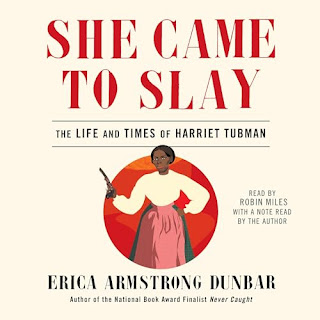
SHE CAME to SLAY: THE LIFE and TIMES of HARRIET TUBMAN (audiobook) by Erica Armstrong Dunbar


Published in 2019 by Simon and Schuster Audio.

Read by Robon Miles.

Duration: 5 hours, 53 minutes.

Unabridged. 

Erica Armstrong Dunbar brings us an accessible biography of one of the true heroes of American history - Harriet Tubman. She Came to Slay is long enough to give a decent picture of her life but short enough that it doesn't intimidate potential readers.

A traveling statue named honoring
Harriet Tubman named "Journey to Freedom"
I am not going to go through the entire biography of her life, but this book covers all of the major points of her life such as: 

-Her escape from slavery; 

-Her multiple trips back to Maryland to free family, friends and anyone that would go;

-Her work in anti-slavery societies where she met and worked with people like Frederick Douglass, William Seward and John Brown;

-The communities she helped start in New York and Canada;

-Her work with women's rights groups and her struggles to get white women to include black women in their fight;

-Her service as a nurse in the Civil War;

-Her service as a spy and a scout in South Carolina in the Civil War and her fight to be recognized for that service.

The book has a lively pace.

I rate this audiobook 5 stars out of 5. It can be found on Amazon.com here:  SHE CAME to SLAY: THE LIFE and TIMES of HARRIET TUBMAN by Erica Armstrong Dunbar.

HOW ROBERT E. LEE LOST THE CIVIL WAR by Edward H. Bonekemper, III


Published in 1998 by Sergeant Kirkland's Museum and Historical Society, Inc.

Bonekemper lived the dream of most students of the Civil War - once he retired as an attorney, he created a second career as a Civil War author, college lecturer and a frequent guest on C-SPAN to talk about leadership in the Civil War. He also gave 10 lectures at the Smithsonian!

Bonekemper is an unabashed fan of the Union side in the war, especially General Grant. I reviewed a book he wrote about Grant here. As Bonekemper loves to point out, only 4 armies were captured during the Civil War and Grant captured 3 of them Grant's subordinate Sherman captured the fourth after Lee had already surrendered his army to Grant. The only general on the Confederate side that can compare to Grant is, of Course, Robert E. Lee. Lee is generally celebrated as the best general in the war and Bonekemper dedicates How Robert E. Lee Lost the Civil War to proving that wrong. 

Bonekemper ignores the easiest place to go after the iconic image Lee - his betrayal of his oath as an officer of the U.S. Army to go fight for the Confederacy. Literally, no human being is responsible for more deaths of American soldiers than Robert E. Lee. Instead, he goes after Lee's record as a general on the battlefield - the part that is supposed to be unassailable. 

Bonekemper doesn't argue that Lee's tactical skills on the battlefield weren't formidable and sometimes even brilliant. 

Instead, Bonekemper argues that Lee was a failure when it came to national military strategy for the Confederacy. Lee spent most of the war as CSA President Jefferson Davis's main military advisor - oftentimes the only one Davis took seriously. At the end of the war he commanded every soldier in the entire Confederacy.

Yet, he never left the Army of Northern Virginia to see what else was happening. He never demonstrated that he understood the value of any army other than his own except that they might send him extra troops (which they did on a regular basis. The exception was when he loaned out a chunk of his army with Longstreet for a few months to Braxton Bragg in Tennessee and Georgia. Within a few weeks Lee was lobbying to have them returned)

All Lee had to do was not lose. This sounds obvious, but it is much easier than the North's goal. The North had to actually conquer the South - defeat all of its armies, stop it from operating as a government and take away its ability to keep on fighting. Lee's model should have been George Washington in the Revolutionary War. Washington hung around long enough that the British home front got sick of the war and agreed to terms.

Lee's surrender at Appomattox in April of 1865.
But, instead of fighting for time and playing defense, Lee acted like he was trying to conquer the North. Twice he invaded the North (Antietam and Gettysburg) and twice he was defeated and came back to Virginia with nothing to show for it except the worst losses he suffered in the war. After Gettysburg he never was able to gather enough troops to go on the offense in any meaningful way again. 

The Battle of Chanecellorsville is symptomatic of the problem with Lee. Lee was outnumbered by more than 2 to 1 and still won the battle with a combination of speed, daring and confidence. It is an impressive victory by any standard. But it came at a massive cost. The Union had 17,000 casualties out of 130,000 (13%) that were replaced within weeks. Lee had 12,000 casualties out of 60,000 (20%) that were only replaced by pulling troops away from other fronts and causing them to lose. 

If it costs you a greater percentage of your force to win battles and you have the smaller army you cannot win. Almost every battle Lee fought in could be described in that way. 

Bonekemper argues that Lee ground his army to dust, refused to consider the needs of other theaters and kept fighting for months after it had become obvious that he had no hope of winning the war, costing the lives of tens of thousands of soldiers on both sides.

The research is impeccable and the facts become overwhelming as the pages go rolling along. It almost becomes tedious - another battle, another costly win (usually) that bled away irreplaceable men for a win that did little to further the war effort. Meanwhile, Generals Grant, Sherman and Thomas chewed up every army in the West, conquered or cut off every state except for Virginia and North Carolina until Lee finally surrendered.

Ironically, if Lee had stayed with the Union, the rumor was that he would have been offered the command of Union forces. He would have been the general that that army desperately needed - not afraid to attack, not afraid to strike the enemy to win the war and he would have had the extra men and resources that his fighting style required. It might have been a short war.

5 stars out of 5 because it proves a long-needed point.

This book can be found on Amazon.com here: 
HOW ROBERT E. LEE LOST THE CIVIL WAR by Edward H. Bonekemper, III.

APOSTLES of DISUNION: SOUTHERN SECESSION COMMISSIONERS and the CAUSES of the CIVIL WAR (A NATION DIVIDED: STUDIES in the CIVIL WAR ERA) by Charles B. Dew


Originally published in 2001.


The greatest argument among people who study the Civil War isn't who was the best general or what would have happened if Lincoln hadn't have been assassinated or even what would have happened if the Union had lost at Gettysburg.

No, the greatest argument is this: What caused the Civil War?

For the better part of the last century, the argument has been that the Confederacy seceded in order to protect "their rights". The counter-argument has always been to protect "the right to do what?"

For me, the answer has always been a simple one - they fought for their right to own people and to keep African Americans at the bottom of the heap in Southern society. For the Confederate States of America, slavery was the reason to fight. For the Union army, maintaining the Union, with or without slavery, was the reason to fight - a goal claimed many times by Lincoln himself. 


There will be arguments that claim that Confederate states seceded over differences in culture and differences in attitude and the disagreement over federal tax policy. If you think so, I encourage you to read the Ordinances of Secession (basically Declarations of Independence) from Georgia, Texas, Mississippi, South Carolina and Virginia. They are full of all sorts of reasons to secede, but they keep coming back to slavery-related issues. These are wonderful resources because they are frozen in time, before the loss of the war by the Confederacy. Many post-Civil War authors who fought for the South obscure the importance of slavery, perhaps realizing it was a great moral wrong, or perhaps simply being cognizant that slavery had become politically incorrect and it would hurt their overall argument. Let's face it - many Union soldiers became proud of their role in ending slavery long after the war ended, being indifferent to or even mildly pro-slavery during the war.

 Several of the seceding states did more than issue their own Declarations of Independence. Some of these states sent out ambassadors from their newly independent states to try to convince the other slave states to join them. They were generally referred to as Southern Secession Commissioners. The title of this book, Apostles of Disunion refers to them. The Apostles of Jesus were sent out to teach about Jesus. These apostles were sent out by several secessionist states to to convince the other slave states to join them. Just the fact that they were only sent to slave states should serve as a major clue as to what caused the Civil War.

The texts of their letters and speeches make it very clear that their main arguments were these: fear of the abolition of slavery by "Black Republicans", fear of slave revolt, the loss of the investment of money in their slaves, fear of former slaves having the power to vote and the fear of race mixing. William L. Harris, the Commissioner from Mississippi sent to reach out to the state of Georgia said on December, 17, 1860: "Mississippi is firmly convinced that there us but one alternative: This new union with Lincoln Black Republicans and free negroes, without slavery; or, slavery under old constitutional bond of union, without Lincoln Black Republicans, or free negroes either, to molest us. If we take the former, then submission to negro equality is our fate." (p. 87)


He followed up with a comment about how Mississippi would "...rather see the last of her race, men, women and children, immolated in one common funeral pile, than see them subjected to the degradation of civil, political and social equality with the negro race." (p. 89)

Stephen F. Hale (1816-1862. He served Alabama
as a Secession Commissioner and as a Lt. Colonel
in the 11th Alabama. He died of wounds sustained
during the Battle of Gaines' Mill in 1862.
Hale County, Alabama is named for him
.
Stephen F. Hale of Alabama sent a letter to the Governor of Kentucky to convince him to push for secession. In the letter he calls Lincoln's election "...nothing less than an open declaration of war, for the triumph of this new theory of government destroys the property of the South, lays waste her fields, and inaugurates all the horrors of a San Domingo servile insurrection, consigning her citizens to assassination and her wives and daughters to pollution and violation to gratify the lust of half-civilized Africans."

He continued: "What Southern man, be he a slave-holder or non-slave-holder, can without indignation and horror contemplate the triumph of negro equality, and see his own sons and daughters in the not distant future associating with free negroes upon terms of political and social equality, and the white stripped by the heaven-daring had of fanaticism of that title to superiority over the black race which God himself has bestowed?" (p. 98)

The author of Apostles of Disunion included plenty of similar quotes throughout the book and also includes the entire text of the Harris speech and the Hale letter. He found snippets of speeches and letters from the other Commissioners in newspaper articles and journals and found similar comments to the ones in the complete texts. Combine these texts with ambassadors hand-picked by the newly-seceded states and the Ordinances of Secession and you have the answer to why the Civil War started.


I rate this book 5 stars out of 5. It can be found on Amazon.com here: APOSTLES of DISUNION: SOUTHERN SECESSION COMMISSIONERS and the CAUSES of the CIVIL WAR (A NATION DIVIDED: STUDIES in the CIVIL WAR ERA) by Charles B. Dew.

GET on BOARD: THE STORY of the UNDERGROUND RAILROAD by Jim Haskins


Published in 1993 by Scholastic.

Get on Board is an introduction to the Underground Railroad aimed at grades 4-7. It is a solid little history of the origins of the abolitionist movement, the Underground Railroad and slavery. It mostly focuses on the heroes of the abolitionist movement, but it does its best to try to work in a lot of individual stories of the Underground Railroad.

For example, I enjoyed the letter that Jermain Wesley Loguen wrote to his former owner (he had run away) when she demanded that he pay for himself. It was the perfect blend of snark and indignant refusal.

The longest biography in the book goes to Harriet Tubman with Frederick Douglass coming in a close second. That is appropriate since their stories are extraordinary. Haskins does a real solid job of introducing the two real-life people that the most famous African American characters in Uncle Tom's Cabin are based on and then reminding the reader of them when he discusses the novel and its impact.

However, it is not a perfect book. The pictures are, on the whole, very poor - much like a poor photocopy of a photo.

The Levi Coffin House in Fountain City, Indiana
There is a problem when Haskins discusses Levi Coffin, who is sometimes called the President of the Underground Railroad as a testament to his commitment to the cause and the number of runaway slaves that he helped. Haskins makes it sound like Coffin's home is near Cincinnati (on the East Fork of the Ohio River - which doesn't exist, according to Google) but he discusses and shows a picture of his home in Fountain City. I have been to the Levi Coffin house many times in the last few years (they have a tour and a visitor's center -it's worth your time to visit) and I know that the Coffin family lived near Cincinnati at one point in time but then moved to Fountain City, Indiana. Google tells me that it is 79 miles from Cincinnati, which means that Haskins has confused the two locations.

But, on the whole, this is a nifty introduction to the Underground Railroad.

I rate this book 4 stars out of 5. It can be found on Amazon.com here: GET on BOARD: THE STORY of the UNDERGROUND RAILROAD by Jim Haskins.

ECHOES of WAR DRUMS: THE CIVIL WAR in MOUNTAIN MARYLAND by James Rada, Jr.


Published in November of 2013 Legacy Publishing

Echoes of War Drums: The Civil War in Mountain Maryland is a collection of newspaper and magazine articles written by the author. This sort of collection is, like most things, a good thing and a bad thing. What's good about it is the short format makes it an easy to book to pick up and read for a few minutes with the knowledge that you can walk away for a while and not have to remember any important people or plot points. But, there is a lot of overlap among the articles so the book can be repetitive if you are reading it straight through.

I am not a native of Maryland. In fact, I'm pretty sure that I've never been to the region of Maryland that is featured in this book. But, I am an avid student of the Civil War so I read it to find out about an area of the country that had a front-row seat to many of the major battles of the Eastern Theater.

It turns out this area had more value than just proximity. It was also a major source of coal and contained vital railroad and canal routes that were a constant target of Confederate raiders.

My favorite story by far was "A Pair of Generals Give the Confederates an Ace in the Hole". This tells the story of how two Union generals were kidnapped by Confederate rangers. I have read this story in just about every history of the Eastern Theater but never in this detail. I had no idea how audacious this plan was until you see it spelled out step-by-step.

"Teenage Rebellion, Civil War Style" the story of a female teenage spy who was caught delivering messages to Confederate forces gives the reader the feel for how fluid the border between the North and the South really was and how family connections often crisscrossed that border.
Union General Benjamin F. Kelley (1807-1891).
He features prominently in many of the stories in 

this collection, including the story of how he was
kidnapped by Confederate rangers in a daring raid
.


"Who is 'Genl. Scofield'?" is the touching story of a family that has adopted the grave marker of this unknown soldier. I say that he is unknown because there were only two generals named Scofield in the war and neither died anywhere near western Maryland and they have no connection to the area so this grave is unlikely to be theirs.

Collections like this one fill local book shops across the country and are a great source of additional information that remind the reader that the Civil War is more than the Emancipation Proclamation, Pickett's Charge and memorable lines like, "Damn the Torpedoes! Full Speed Ahead!" It is also about an almost infinite number of smaller events like nuns traveling across Ohio to tend to the wounded for weeks and months in a strange town and families being forced out of their homes for failing to sign a loyalty oath and soldiers guarding a railroad track in a small fort they helped build a long way from home.


This book can be found on Amazon.com here: Echoes of War Drums by James Rada, Jr.

Note: I was sent a free review copy of this book by the author in exchange for an honest review. I have not met the author and received nothing except for a copy of the book, which I was not obligated to review.

The Most Dangerous Thing (audiobook) by Laura Lippman


A different kind of book


Read by Linda Emond
Duration: 10 hours, 45 minutes
Published by Harper Audio.
Unabridged.

Laura Lippman's The Most Dangerous Thing is a superbly deep character study that looks into the lives of 5 suburban children in the 1970s and follows them into the present. These kids are the best of friends for a couple of summers. They consist of three brothers, a beautiful tomboy and a chubby girl who blossoms. They come from three different families, go to three different schools but all live in the suburban neighborhood of Dickeyville, near Baltimore. They spend hours exploring the woods near their neighborhood and what they find there becomes part of a secret that eventually drives the least stable member of their quintet to commit suicide as an adult decades later.

Laura Lippman
As the friends gather for the funeral the secret is slowly drawn out for the reader through a series of flashbacks (through the eyes of all five of the friends and their parents) and current time discussions. The characters are developed in extraordinary detail, which can be frustrating because the book seems to go nowhere, but eventually it does pay off - family secrets are exposed and the true faces of some characters finally come to light. Along the way, Lippman delivers some interesting observations about family life, relationships between men and women and careers. Well worth your time.

Narrator Linda Emond did a great job with a variety of different accents, ages and characters, including the same characters decades apart.

I rate this audiobook 4 stars out of 5.

This audiobook can be found on Amazon.com here: The Most Dangerous Thing by Laura Lippman.


Reviewed on October 20, 2011.


Crossroads of Freedom: Antietam 1862 (audiobook) by James McPherson


Does a brilliant job of looking at the meaning of the battle of Antietam


Published in 2002 by Recorded Books.
Read by Nelson Runger.
Duration: 5 hours, 48 minutes.

Unabridged

I have nearly 90 books that cover the Civil War on my bookshelf. Most books that cover the Civil War compartmentalize the battles into little chapters with titles like "Chancellorsville", "Antietam" and "Shiloh". The battles are thoroughly covered but the feel for the larger flow of the war is sacrificed.

In Crossroads of Freedom: Antietam 1862, McPherson dramatically sweeps the reader along and I was left with a renewed sense of amazement and respect for the fact that Lee's Army of Northern Virginia was able to fight, let alone go on the offensive against two separate armies and fight multiple, large battles from June through September of 1862.


McPherson does an extraordinary job of tying in many of the political and military threads of this war to demonstrate that Antietam was the day that determined the outcome of the war, and not the more popular belief that it was July 4, 1863 with the dual losses for the Confederacy at Vicksburg and Gettysburg.
George B. McClellan, the victor
of the Battle of Antietam despite
his many mistakes

McPherson provides multiple quotations from those involved in the political and military events of the time. In fact, at times the story is told mostly through choice quotes from generals, ambassadors and prominent private citizens such as Frederick Douglass and Horace Greeley.

The audiobook was well read by Nelson Runger. The audiobook lasts about 5 hours and 45 minutes and was a joy to listen to.
 
I rate this audiobook 5 stars out of 5.

This audiobook can be found on Amazon.com here: Crossroads of Freedom: Antietam (Pivotal Moments in American History)  


Reviewed on September 26, 2008.

To Make Men Free: A Novel of the Battle of Antietam by Richard Croker


This Civil War buff thoroughly enjoyed it

Originally Published in 2004 by William Morrow

To Make Men Free, like an epic feature from the 1950s, features a cast of thousands which is both its strength and weakness.

A lot of reviewers complain about the lack of depth in the characters, which is fair to say about the book. Unlike Shaara's The Killer Angels, the gold standard of Civil War fiction, there is not much character development. But, to be fair, Shaara focuses on precious few personalities of the War while Croker includes Lincoln, many cabinet members, Lee, McClellan and at least a dozen of the generals, not to mention colonels, sergeants and even a couple of privates.

George B. McClellan
 (1826-1885)
The inclusion of so many characters does contribute to a lack of character exploration but it also contributes to a wide view of the mayhem of the battlefield. Croker also delves into political intrigues that went hand in hand with this bloodiest day in American history.


Croker's writing style is quite enjoyable - he flows effortlessly from one character to another while moving the story along at a quick pace. There's enough detail to give the Civil War novice a good grounding in the basics and enough focus on small parts of the battle to keep a serious student of the war like me interested. Humor and tragedy often go hand in hand in this book - none illustrates this more than page 301 of my paperback version. I chuckled out loud at a neat turn of phrase and then felt as though I'd been kicked in the gut four paragraphs later. I was so moved that I had to close the book and do something else.

Croker noted that he researched this book for three years. He includes many antecdotes that are left out of most histories. As a born and bred Hoosier I was proud of determination demonstrated by the story of the Hoosier soldier who was shot in the belly early in the battle - a fatal injury in those days. He was ordered back to the medics but he refused, saying, "Well, I guess I'm hurt about as bad as I can be. I believe I'll go back and give 'em some more." (p. 267)

Robert E. Lee (1807-1870)
Croker has another novel about the Civil War entitled No Greater Courage: A Novel of the Battle of Fredericksburg. They are stand alone novels (I read them out of order) but they would probably be more enjoyable in the order that they actually happened. I hope that Croker is working on a Chancellorsville novel. Croker's command of the Union political situation is very strong and these three battles are, in reality, intricately related to each other. Chancellorsville's bold maneuvers are a response to the mindless forward attacks of Fredericksburg which were a response to the hesitancy of Antietam. I would love to see Croker get into the head of Hooker at Chancellorsville.

Highly recommended.

Pet Peeve note: On page 136 of my paperback edition Croker refers to "Indianians." There have never been and never will be Indianians. We are Hoosiers. Always have been, always will be.

I rate this book 5 stars out of 5.

This book can be found on Amazon.com here: To Make Men Free: A Novel of the Battle of Antietam.

Reviewed on April 6, 2009.

Harriet Tubman: Conductor on the Underground Railroad by Ann Lane Petry


Well-written biography of a true American hero


Originally published in 1955.

Harriet Tubman: Conductor on the Underground Railroad is a fantastic little biography of Harriet Tubman (1820-1913). Tubman has always been one of my personal heroes and this book does her story justice.

I would say this book can be easily enjoyed by 4th graders and up. It also could serve as a great starting point for adults that don't know much about slavery and the American Abolitionist movement. While telling the story of Tubman's life, Petry also includes at the end of nearly every chapter historical tidbits about the slavery and the Abolitionist movement at the national level.

The discussion of her service in the Civil War as a scout in the coastal areas of South Carolina spurred me to do some further research. Her commanding officer in the raids was Colonel James M. Montgomery, the nutty commander in the movie Glory with this memorable line: "You see sesesh has to be cleared away by the hand of God like the Jews of old. Now I will have to burn this town." Interestingly, Montgomery also served with John Brown in Kansas. Harriet Tubman also knew John Brown although she was not comfortable with his violent tactics.

I rate this biography 5 stars out of 5.

This book can be found on Amazon.com here: Harriet Tubman: Conductor on the Underground Railroad

Reviewed April 8, 2009.

Coal Black Horse by Robert Olmstead


"It is a tale ... full of sound and fury; signifying nothing." -Shakespeare

Published in 2007 by Algonquin Books

The above quote tells quite a bit about Olmstead's Coal Black Horse. It is garnish and flair, it is pretty words and gruesome descriptions of the horrors of war, but it is a story without a point, except to say that life is without value and, eventually, someone will end yours and it will all be over.

Olmstead borrows heavily from the styles of Howard Bahr and Stephen Crane to create this book. From The Red Badge of Courage he borrows the stylistic device of never quite letting the reader what battlefields or locations the book is set in - that is until he suddenly tells you that it's in Gettysburg. How Robey avoids tens of thousands Confederate soldiers stacked up along the Potomac River (they massed there for days waiting for flood waters to go down) is a mystery to me. Why Olmstead decides to tell the reader the battlefield at that moment is a mystery as well.

Civil War dead scattered on a battlefield
From Bahr he borrows many of the same style of battlefield descriptions - the chaotic glimpses of a battle that remind me of quick movie cuts. The poetic descriptions of awful destruction, brutality and inhumanity are powerful, and reminiscent of Bahr. But, Olmstead lacks Bahr's ability to tell a story. Coal Black Horse plods along and eventually becomes a dark, depressing novel. It starts with death and ends with 2 murders and two attempted murders and no one seems to care about any of it. No love. No joy. Just dreary existence.


I note in the back cover that Olmstead received an NEA (National Endowment for the Arts) grant to write this book. If this is what we are paying for with government-provided grants, than I suggest we stop. Certainly he can write this stuff on his own. Others write much better works and without government assistance.

I rate this book 2 stars out of 5.

Reviewed on May 26, 2009.

This book can be found on Amazon.com here: Coal Black Horse.

Bound for the North Star: True Stories of Fugitive Slaves by Dennis Brindell Fradin

An excellent introduction to the topics of slavery and the Underground Railroad.


While Bound for the North Star: True Stories of Fugitive Slaves is obviously aimed for the "young adult" crowd, it would serve as an excellent primer for ANYONE interested in learning more about that sad, sad topic in America's history: slavery.
Harriet Tubman

The author includes 12 stories about slaves who escaped north, mostly with the help of the Underground Railroad. Each story describes a different type of escape or incident - varying from the case of Solomon Northrup - a free black man who was drugged and sold into slavery while he was working in Washington, D.C. to John "Fed" Brown, a field slave who traveled a roundabout trip to freedom covering thousands of miles to John Price - an escaped slave who was captured in Ohio, but was eventually freed thanks to the near-riot of the Oberlin College community. The book ends up with the most famous member of the Underground Railroad, Harriet Tubman, and details a number of her exploits as a Conductor and as a Union Spy during the Civil War.

As a reader, I appreciated the variety of types of escape stories - it did not get stale reading about the same type of escape and the variety of escape plans really was a wonderful testament to human creativity in the face of hardship.

I rate this book 5 stars out of 5.

This book can be found on Amazon.com here: Bound for the North Star: True Stories of Fugitive Slaves

Reviewed on September 1, 2004.

Featured Post

<b><i>BAN THIS BOOK (audiobook)</i></b> by Alan Gratz

Published in 2017 by Blackstone Audio, Inc. Read by Bahni Turpin. Duration: 5 hours, 17 minutes. Unabridged. My Synopsis Ban This Book is t...

Popular posts over the last 7 days