Showing posts with label mexico. Show all posts

ZACHARY TAYLOR: A LIFE from BEGINNING to END (Biographies of U.S. Presidents)(kindle) by Hourly History


Published by Hourly History in 2025.

Hourly History specializes in histories and biographies that take a reader about an hour to read. It seems appropriate length for Zachary Taylor, the President with the third shortest time in office (just 16 months).

Taylor had a short and rather vague political career, but his military career was rather lengthy. He fought against the Shawnee under future President William Hentry Harrison on the frontier in the War of 1812 in Indiana, Illinois, and Michigan. 

He fought in the Black Hawk War and served in what would later become Minnesota and Wisconsin establishing and upgrading a series of forts. Later, he fought the Seminoles in Florida and served as the overall commander of American troops in the War. 

He is most famous for his service as one of the two main generals that led the invasion of Mexico in the Mexican War. Taylor crossed from Texas into Northern Mexico, fighting a series of battles, eventually winning the Battle of Buena Vista in February of 1847. That battle cemented his reputation in the American mind and catapulted him to the Presidency in 1848, despite never having voted before and not really having political opinions that alligned strongly with any political party at the time.

On a personal note - one thing Taylor did have going for him was a working knowledge of the what was the American frontier at the time, having served or lived in Texas, Arkansas, Indiana, Michigan, Illinois, Minnesota, Wisconsin, Kentucky, Louisiana, and Mississippi. Taylor was a slave holder but was against the expansion of slavery into the territories taken from Mexico. he knew from personal experience that the climate of those areas were completely incompatible with the plantation style of slavery he practiced at his plantation in Mississippi. 

As I already noted, Taylor took ill in the summer of 1850 and died, probably due to some sort of food poisoning or a form of cholera. This book doesn't look much into the "what ifs" of a longer Presidency for Taylor who was pro-slavery, strongly anti-seccession, and against the spread of slavery. Could he have been the political figure that worked out a great compromise that would have prevented the Civil War?

I rate this short e-book 4 stars out of 5. It's pretty good, considering how short it is. It can be found on Amazon.com here: ZACHARY TAYLOR: A LIFE from BEGINNING to END by Hourly History.

GRANT and LEE: VICTORIOUS AMERICAN and VANQUISHED VIRGINIAN by Edward H. Bonekemper III


Originally published in 2007.

Edward Bonekemper was a Civil War historian who came to the game kind of late in life - after he retired as an attorney for the federal government. 

However, he brings his skills as an attorney to this book. Imagine a regulatory attorney bringing all of his research to bear in order to win a case by simply  overwhelming the other side with binder after binder of evidence. In this case, the evidence is almost 200 pages of appendices, endnotes, and a bibliography. 

Bonekemper makes an argument in this book that Grant was undoubtedly the superior general when compared to Lee. In fact, he makes the arguments that Grant was the best general in the Civil War by far and Lee squandered his soldiers and his resources by going on the offense almost all of the time.

Being the best general does not mean Grant made no mistakes. It does not mean Grant was perfect. Bonekemper acknowledges mistakes by Grant in every campaign and gives Lee his due from time to time. 

Grant and Lee is really a dual history of these two generals, comparing their pre-war careers and then various stages of the war itself. For example, there is a chapter called May-July 1863 where the Vicksburg campaign is compared to the Chancellorsville/Gettysburg campaigns. 

A constant refrain is that Lee's biggest weakness is that he did not conserve his resources by falling back on the defensive. His argument is that Lee did not grasp the strategic fact that the North had to literally conquer the South while the South just had to stay alive until popular support collapsed in the North and the Europeans recognized the Confederate government. 

Instead of building a series of fortifications and compelling the Union forces to destroy themselves in useless attacks, Lee kept lashing out at Union forces and invaded the North twice only to lose both times and discourage European intervention after both failures.

Lee rarely lost more soldiers than the Union forces he fought, but he did not have a constant supply of new soldiers coming to the front - and the North did. Not only did the North replace soldiers at an amazing rate, they also managed to create all new armies when needed.

I found that I basically agreed with Bonekemper. Grant was the better general. Lee was too focused on Virginia and too eager to go on the offense. He did not save his resources and did not share the ones he had with other theaters of the war.

I rate this book 5 stars out of 5. It can be found on Amazon.com here: GRANT and LEE: VICTORIOUS AMERICAN and VANQUISHED VIRGINIAN by Edward H. Bonekemper III.

FRANKLIN PIERCE: A LIFE from BEGINNING to END (Biographies of U.S. Presidents) (kindle) by Hourly History


Published in 2025 by Hourly History.

Hourly History's biography of Franklin Pierce offers a concise but comprehensive telling of Pierce's life. He was a politician, but his wife hated Washington, D.C. and spent as much time away from the capital as possible. 

He had two major foreign policy successes - the Gadsden Purchase from Mexico and opening Japan to foreign trade, but I was really interested in his policies that helped lead to the Civil War.

Franklin Pierce is one of that group of 8 Presidents in a row from Van Buren to Buchanan that did not serve more than one term (two died in office) leading up to the Civil War. Some were stronger than others, but, as a group, these Presidents didn't show the kind of leadership needed to push the nation away from Civil War. 

Pierce was a New England Democrat that vociferously took the side of Southern Democrat slaveholders. His working theory was that there needed to be unity in the country and uniting behind slavery was a way to be unified. 

This was unpopular with his New England neighbors and didn't really generate trust among Southern Democrats because they saw the pushback, especially in Kansas. The fighting grew so severe among pro- and anti-slavery forces that it became known as "Bleeding Kansas."

I rate this e-book 4 stars out of 5. It can be found on Amazon.com here: FRANKLIN PIERCE: A LIFE from BEGINNING to END (Biographies of U.S. Presidents).

BATMAN - ONE BAD DAY: BANE (graphic novel) by Joshua Williamson


Published by D.C. Comics in 2023.

Written by Joshua Williamson

Art by Howard Porter and Tomeu Morey

Synopsis

The One Bad Day series looks at individual top level Batman villains (If you are a fan of Johnny Karaoke, sorry) and gives them a comic that focuses on just that villain. 

In Batman - One Bad Day: Bane we find Bane working as a professional wrestler in Mexico where he reenacts the moment where be broke Batman's back in match after match to the cheers of adoring crowds. Bane has wealth and fame, but he is broken inside. This graphic novel is the story that explains that brokenness...

My Review


Up until the halfway point of this graphic novel, I was sure that this edition of the One Bad Day tales was a dud. It was initially very confusing and the drawings seemed to be all overdone muscles, veiny arms, and monstrous faces.


The moment that changed the book was a moment of great sacrifice. It changes the arc of Bane's life and makes this a surprisingly hopeful (and grisly) story. I still hated the art, but the story was quite good.

I rate this graphic novel 4 stars out of 5. It can be found on Amazon.com here: Batman - One Bad Day: Bane

SIN MIEDO: LECCIONES de REBELDES (en espaƱol) by Jorge Ramos)


Published by Celebra in 2016.


In Sin Miedo: Lecciones de Rebeldes, Jorge Ramos brings us stories of people that he has interviewed over the years that he considers to be rebels with lessons to offer to all of us.

The title can be translated as Fearless: Lessons from Rebels. Some really are literal rebels, some are rebels that became dictators (he has 4 of these), and some are people that really aren't rebels, but are very successful in areas where people like them are not normally successful.

If you don't know who Jorge Ramos is, you probably don't watch Univision TV very much. Univision is a Spanish language channel based in Miami and Ramos is their most recognizable news anchor. 

The interviewees range all over the place, including Barack Obama, Bill Gates, Fidel Castro, Barbara Walters, George W. Bush, Daniel Ortega, former Presidents of Mexico, two Venezuelan dictators, a Mexican revolutionary leader, Spike Lee, and Richard Branson.

Some of the interviews are pretty compelling with lots of details. Some are skimpy, but fleshed out with some background research (you couldn't really corner Fidel Castro and pressure him to give you a long interview so you make do with the time you were given.)

The result was a mixed bag. I was touched by the patriotism of Venezuelan refugees that kept on fighting the Chavez/Maduro dictatorships in the face of overwhelming obstacles, but the interview with Bill Gates was standard boiler plate profile of his admirable work to fight disease in the Third World.

I skipped the dual interviews with Israeli Prime Minister Benjamin Netanyahu and a Palestine Authority leader, figuring that anything said in that interview was superseded by the October 7 Attack and the Gaza War that followed.

The edition I read was in Spanish. It's been a few years since I read a book in Spanish. The last one was also a Jorge Ramos book. I enjoy his clear, concise style. I guess that makes Ramos my favorite Spanish language author! The English translation of this book is called Take a Stand: Lessons from Rebels.

I rate this collection of interviews 3 stars out of 5. It can be found on Amazon.com here: Sin Miedo Lecciones de Rebeldes by Jorge Ramos.

PANCHO VILLA: A LIFE from BEGINNING to END by Hourly History


Published by Hourly History in 2021.

I think this is the third book I've read in the last few years that is at least partially about the Mexican Revolutionary Pancho Villa (1878-1923). I read two that were basically about American responses to Villa's cross-border excursions  (and near misses) into the United States for money and supplies.

Each entry in the Hourly History series is, by definition, a short book. Each entry is supposed to be read in about an hour.

This biography was neither bad nor good. It did tell the basically outlines of his life without giving the reader much a sense of the man. Even worse, Villa will forever be associated with the Mexican Revolution but this book did a pretty poor job of explaining the complicated politics that Villa tried to navigate. It seemed that he was an insider one week, on the outs the next week, and running for his life the week after that and I had no understanding as to why that was.

A good basic intro, but nothing more.

I rate this e-book 3 stars out of 5. It can be found on Amazon.com here: Pancho Villa: A Life from Beginning to End by Hourly History.

MAYA CIVILIZATION: A HISTORY from BEGINNING to END (MESOAMERICAN HISTORY) (kindle) by Henry Freeman (Hourly History)


Published in 2020 by Hourly History.

Hourly History specializes in e-book biographies and histories that take most readers about an hour to read. In some cases, an hour to cover a topic seems about right. For example, I really enjoyed their book on the Cuban Missile Crisis

Of course there is a massive difference in the time involved with the Cuban Missile Crisis and the Mayan Civilization - one lasted for weeks, the other for centuries. That makes a big difference with what can be dealt with the series' self-imposed one hour time constraint and that difference really hurt this e-book.

I have zero problems with the facts presented in this book, but I do have a problem with the way they were presented. 
I found this book to be oddly written. My pet theory as I was reading it was that it was an early experiment with an AI author program - but there is an actual name attached to my kindle e-book - Henry Freeman. Oddly, the Amazon website does not list Freeman as the author. 

I rate this e-book 2 stars out of 5. It can be found on Amazon.com here: 
Maya Civilization: A History from Begnning to End (Mesoamerican History.

I AM NOT YOUR YOUR PERFECT MEXICAN DAUGHTER (audiobook) by Erika L. SƔnchez


Finalist for the National Book Award for Young People's Literature.
Named to Time Magazine's 100 Best YA Books of All Time.

Published by Listening Library in 2017.

Read by Kyla Garcia.
Duration: 9 hours, 41 minutes.
Unabridged.

Synopsis:

Julia is the daughter of Mexican immigrants to the United States. They live in pretty run down neighborhood in Chicago. She is in high school. Her family doesn't really understand her (basic YA fare) and she really loves writing. She is looking forward to moving on to college - like so many kids she wants nothing more than to get far, far away from where she grew up.

There is one presence that looms over everything - her dead sister Olga. Olga was older than Julia and has recently died in a bizarre accident - she stepped off of a city bus and was hit by a semi-truck. Her family is traumatized, of course. To make matters worse, Julia is constantly being compared to Olga - the perfect daughter who only gets more perfect in memory.

Julia digs around in her sister's bedroom (untouched since the day she died) and finds a few things that just seem out of character for Olga. Suddenly, there's a mystery and Julia just has to follow the clues...

My review:

At first, I found myself really liking this book. I was intrigued about the mystery element.

But, suddenly we are going from one YA (and Latino) stereotype to another. It got so ridiculous that I starting listing them. If only the author had just settled for 2 or 3 of them (instead of 15 or so.)

*****

This book is a frequent flyer on lists of books that MAGA parents turn in to be banned from local public libraries and school libraries. Here is a ban attempt from South Carolina and here is one from Texas, for example. It's not a book I would want to teach in my classroom (there are things that I would not particularly want to discuss in class) and I didn't particularly enjoy it, but I would be more than happy to have it in a classroom library.

I rate this book 2 stars out of 5. It can be found on Amazon.com here: I AM NOT YOUR YOUR PERFECT MEXICAN DAUGHTER (audiobook) by Erika L. SĆ”nchez

BEARSKIN: A NOVEL (audiobook) by James A. McLaughlin


Published in 2018 by HarperAudio.
Read by MacLeod Andrews.
Duration: 9 hours, 49 minutes.
Unabridged.


Synopsis:

Bearskin features Rice Moore as the caretaker of a piece of Appalachian Virginia wilderness for a foundation. His job includes is walking the property, cataloging what he finds, remodeling the house on the property, and keeping poachers out. 


He's also hiding. A few years back he was caught smuggling drugs across the border from Mexico and ended up serving time in a Mexican prison. In the prison, Moore killed a man who was highly connected to a Mexican cartel and now he has taken on an assumed identity in the middle of nowhere in Virginia. 

When someone starts killing bears on the foundation property just to harvest organs to sell in Asia, Rice knows that he has to do something, even if it risks blowing his cover...

My Review:

This book sounds interesting and exciting. I found it underwhelming in so many ways. 

The book started out with tons of description. That's not unusual, especially early on. The book continued that way every time Moore entered a new scene - even if he has been in that setting a dozen times already. It just bogged things down to describe the same things over and over again in hyper-detail.

There were so many threads of a plot that started and were never acted upon. I understand that there are red herrings in stories, but these felt more like the author was exploring some ideas and then just walked away from them.  I don't want to provide spoilers, but at least half of the book is dedicated to plot lines that have no resolution.

The ending was just that - an ending. Three was no resolution to the main plot points. The book just ended with so many unresolved threads. A lot like real life, but not very satisfying in a novel. It's like the author just got tired of the whole thing and said, "Screw it!" and sent the manuscript off to the publisher. 

I rate this book 2 stars out of 5. It can be found on Amazon.com here: Bearskin: A Novel by James McLaughlin.

ESPERANZA RISING (audiobook) by Pam MuƱoz Ryan


Duration: 4 hours, 42 minutes.
Unabridged.


Synopsis:

Esperanza is the main character in a fictionalized version of the author's grandmother's adolescence. 

In Mexico, Esperanza is the daughter of a wealthy landowner in Aguascalientes. On this ranch, life is wonderful. She has servants and attends a private school. But, life in Mexico in 1930 is fraught with danger. It is only 10 years after the 10 year long Mexican Revolution and armed bands still roam the countryside. One of these groups kills Esperanza's father and her conniving uncles take the ranch and burn the house down to make sure they keep the land. 

The author, Pam MuƱoz Ryan
Esperanza and her mother join a family of their servants (the ranch manager, the household manager, and their son) and flee to America (California) with false paperwork. They hope to work on American farms and re-establish themselves.
However, America is in the beginnings of the Great Depression...

My Review:

The book has a slow start (probably the first 1/3), but once the family makes it to the American border the book truly gets steadily better as it goes along. The migrant labor camps in this book tie in very well with a much older book that is set a little later in the Great Depression in California, The Grapes of Wrath. By the end of the book, I was pretty invested in seeing how it turned out.

For all of the people that act as though the immigration crisis at the border is a new thing that one political candidate discovered just a few years ago, this book feels like it could be easily updated to 2023 with a few technological changes. It is set 93 years in the past, but it involves criminal violence forcing people north to America, migrant camps, illegal border crossings, forged paperwork, low wages, border patrol agents, homelessness, families separated by the border, racial prejudice, and more.

I rate this book 4 stars out of 5. It can be found on Amazon.com here: ESPERANZA RISING by Pam MuƱoz Ryan.

CHE: A REVOLUTIONARY LIFE (graphic novel) by Jon Lee Anderson (author) and Jose Hernandez (illustrator)


Before reading this massive 421 page graphic novel, I knew relatively little about Che Guevara (1928-1967.) I knew that he was from South America, he was famous for his part in the Cuban Revolution and that he died trying to lead a revolution in Bolivia. And, of course, I knew him from the famous picture.

This graphic novel filled in a lot of blanks for me. It is a friendly biography of Che but doesn't glorify him. When I got to the end I was struck by how much of a failure Che actually was after he left Cuba. He tried to replicate the success of the Cuban Revolution but he could not. It's hard to tell if counter-revolutionary measures from the governments he was trying to overthrow (and the U.S.) were simply more successful than Batista had been in Cuba or if they were missing an additional spark like the Castro brothers had provided.

The graphic novel was put together well. It had no confusing arrangements of comic panels (this is more common of a problem than one might think) and the story was told in a straightforward linear manner. 

Well done.

I rate this graphic novel 5 stars out of 5. 

GERONIMO: A LIFE from BEGINNING to END (kindle) by Hourly History


Geronimo (1829-1909) is the Apache leader that is famous for having fought just about everybody that encroached on his people's land. Later on, when he had surrendered he was shipped all over the place to different reservations.

That was pretty much the facts that I knew about Geronimo and I thought that I really needed to add more to that. After all, he is one of the few Native Americans that everyone has heard of. 

Hourly History publishes histories and biographies that you can read in about an hour. That can be a tough job for big topics in history like "The Industrial Revolution" or "The Roman Empire" but it is just about right for a short biography. 

Geronimo may have fought with the United States and was eventually captured by the U.S. Army (many, many times) but he was really angry with Mexicans. Mexico was his primary enemy because Mexican soldiers killed his family and friends while he was on a trip to a Mexican town to get supplies. 

From that point on, as the United States and Mexico encroached on traditional Apache territories, Geronimo fought both groups - but he focused on Mexico whenever he could.

The book comes up short with his years in captivity, except to note that, depending on the time period, the security went from severe to very, very lax.

I rate this e-book 4 stars out of 5. It can be found on Amazon.com here:  GERONIMO: A LIFE from BEGINNING to END (kindle) by Hourly History.

WAR on the BORDER: VILLA, PERSHING, the TEXAS RANGERS, and an AMERICAN INVASION (audiobook) by Jeff Guinn


Published in 2021 by Simon and Schuster Audio.
Read by Timothy Andres Pabon.
Duration: 10 hours, 10 minutes.
Unabridged.


Synopsis:

The famous expedition into Mexico led by "Black Jack" Pershing to punish Pancho Villa in 1916 and 1917 is the stated topic of this book. However, this book is much more than that. It is a look at the Mexican Revolution (1910-1920) and World War I (1914-1918) and America's rather aggressive foreign policy in Latin America.

Within most Americans' living memory the United States had taken on the responsibilities of empire by defeating Spain in the Spanish-American War in 1898. The United States took the Philippines, Guam, Cuba and Puerto Rico and immediately got involved in a fight against Filipino insurgents and independence movements that lasted more than a decade. The concept of foreign intervention was not a new one and the impulse to intervene remained strong.

With war in Europe looming, the Mexican Revolution made America nervous. An unstable Mexico looked like an invitation for European intervention. America directly intervened multiple times, including the well-known punitive mission led by Pershing to capture or kill Pancho Villa. 

Villa led one of the many revolutionary armies that was trying to change the government in Mexico. Sometimes they worked together, sometimes they fought each other as much as they fought the government. Villa was on the decline, having been beaten multiple times and reneging on several promises to him men. 

But, Villa understood "media" as it was then. He had been the subject of a Hollywood movie, including actual footage of his men "in action". He got his name and his image in the newspapers regularly - always with the same exciting look - a big sombrero, a big mustache and bandoleers full of ammunition.

Villa decided to shake things up. He needed money, he needed attention, financial support and volunteers to join him and an attack on the United States itself might just do it. He attacked Columbus, New Mexico. He needed the loot but more importantly, he needed to look like he had no fear of Mexico's neighbor. He also figured (correctly) that America would intervene and the Mexican people would reflexively come to his aid with money and volunteers (not really). 

*******

My review:

This book is a big sprawling book and it is mis-titled in my opinion. The actual punitive mission by Pershing mentioned in the title takes up maybe 1/3 of the book. It's not that the other information wasn't relative, there was just so much of it and I did not think it was not organized particularly well. It's like the author just kept collecting tons of relevant information and somehow couldn't cull it down to the original theme of the book - Pershing vs. Villa and couldn't organize it in a compelling way. 

Some critics have gone after the author for pointing out that the border situation simply seethed in racial tension and the Texas Rangers were far from the noble heroes you see in Chuck Norris' TV show Walker: Texas Ranger. I literally have no issue with the facts that he presented. I have an issue with the presentation of the facts.

I rate this audiobook 3 stars out of 5. It can be found on Amazon.com here: WAR on the BORDER: VILLA, PERSHING, the TEXAS RANGERS, and an AMERICAN INVASION by Jeff Guinn.

HERNƁN CORTƉS: A LIFE from BEGINNING to END (kindle) by Hourly History


Published by Hourly History in 2020.

I am an avid reader of history, but I have areas of weakness that I am perfectly willing to shore up a bit, but I don't want to invest a ton of time. I want to know a bit more, not become an expert. The history of the Spanish conquest of the New World is just one of those areas for me. I know more than most people, but I can see the glaringly empty areas of my own ignorance.

CortƩs is, of course, the Spanish conquistador that pretty much invented the idea of being a Spanish conquistador. Conquistador means "conqueror" in Spanish and CortƩs pretty much perfected the concept when he conquered the Aztec Empire from 1519-1521.

I am not going to attempt a defense of CortĆ©s' motives or techniques, but it was literally one of the most amazing conquests in history. 

What this history does well is give a brief synopsis of the conquests in a straight narrative history. There's not a lot of analysis and certainly not much information on the native Mexican groups - not even the Aztecs themselves. 

This is exactly the sort of biography that someone who hates history might pick to read because it is not an intimidating length and it is not written in highfalutin language. 

There is nothing in this biography that is inaccurate, just a matter of what the Hourly History people decided to highlight and emphasize.

I rate this kindle book 3 stars out of 5. Not bad, for what it is. Nowhere near a complete biography, but a solid place to start. This book can be found on Amazon.com here:  HERNƁN CORTƉS: A LIFE from BEGINNING to END (kindle) by Hourly History.


HOW to HIDE an EMPIRE: A HISTORY of the GREATER UNITED STATES (audiobook) by Daniel Immerwahr


Published in 2019 by Recorded Books.
Read by Luis Moreno.
Duration: 17 hours, 25 minutes.
Unabridged.

If I asked you to think of a map of the United States you would almost certainly imagine the contiguous 48 states and maybe imagine the little inset maps of Alaska and Hawaii. 

But, you probably would not imagine other areas like American Samoa being a part of that map. How about Guam or the U.S. Virgin Islands even though the people who live there are American citizens? How about Puerto Rico? Puerto Ricans are citizens and Puerto Rico has a population bigger than at least 15 states.

How to Hide an Empire is about how America has maintained an empire of sorts from the very beginning. At first, it was by continually moving out of the official states into Indian territory, Mexico, Spanish territory and English territory. The United States took several strategic "guano" islands that were not claimed by anyone in the late 1800s. The United States has held a traditional empire since the Spanish-American War in 1898 when it took the Philippines, Guam, Puerto Rico and Cuba. It went on the acquire other properties by trading and conquering during the World Wars (the World War II section of this book is excellent).

Nowadays, the United States maintains a hybrid empire. It has kept some territories and turned others into states (Hawaii and Alaska) but it has also tried something new. 

The United States seems to have learned a lesson with its experience in the Philippines. The United States spent a lot of time, treasure and blood pacifying the Philippines only to have it become a liability during World War II - the Japanese attacked it within hours of the attack on Pearl Harbor. The U.S. quickly granted the Philippines its independence and changed its "business model".

Rather than conquer and hold other countries, the United States has maintained an immense series of bases and installations across the world. The most famous is probably Guantanamo Bay in Cuba, but others include Ramstein Air Base in Germany with 53,000 people.

On the other end of the spectrum there are also tiny little properties that house radio listening stations or broadcasting stations.   According to this article by the Libertarian think tank the Cato Institute, the United States has about 750 foreign military installations around the world - 
 three times as many installations as all other countries combined. Note the article is an opinion piece and the Cato Institute is generally of the opinion that the U.S. military should pull back. They always write with a political point in mind, but I don't usually find the Cato Institute to be untruthful.

This was an interesting look at American history. Some of it is shameful - such as the medical experimentation that has done on unsuspecting Puerto Ricans. Some of it is amazing - such as the immense supply chain that the U.S. used to supply Chinese forces and help keep the Japanese bogged down in China throughout the war. The supply line flew through 4 continents, over two oceans, the world's largest desert and over the world's tallest mountain range. It supplied the model for the base system the United States uses now. 

I rate this book 5 stars out of 5. It can be found on Amazon.com here: HOW to HIDE an EMPIRE: A HISTORY of the GREATER UNITED STATES by Daniel Immerwahr

THE DAWN of EVERYTHING: A NEW HISTORY of HUMANITY (audiobook) by David Graeber and David Wengrow


Published by Macmillan Audio in 2021.

Read by Mark Williams.
Duration: 24 hours, 2 minutes.
Unabridged
.

In my professional life I am a high school history teacher. I don't teach it now (I teach another subject), but in the past when I taught world history I taught that the origins of civilization in the traditional way and it always goes something like this:

-At first there were wandering groups of people, probably based around 1 or 2 families. Things were fairly democratic because these groups had to talk things out to make decisions.

-Somebody along the way figured out how to domesticate a few animals.

-Somebody along the way figured out how to domesticate plants. Some small fields were started and left mostly on their own while the wandering continued with scheduled returns to the fields.

-Eventually, the fields were so productive that it made no sense to leave them.

-Populations grew, towns were developed and simple authoritarian government led by almost always by a man who served as an all-powerful king of some sort always sprang up to manage the resources, resolve property disputes, etc.

-With the exception of Athens and a few other Greek city-states, democracy was non-existent. 

The classic case for this was Egypt. The way we taught it is that it has always gone this way, pretty much without fail - like it was a law of human behavior.

In The Dawn of Everything, these authors come at this with a different perspective. They've done a lot of research and have come to the conclusion that what happened in Egypt was not only not the norm but may have been a fairly unique exception. 

The authors look at the roots for our the official history of how it had to have happened (we really have no idea how, when you think about it). They then proceed to take a long look at why it is wrong to say that all or even most civilizations followed that pattern when they adopted agriculture. 

The authors spend 24 hours of audiobook telling us something that we all should have known to begin with without being told - there is no law to human behavior in any area. Human beings continue to come up with a multitude of familial, work, governmental and religious arrangements. Is that a feature of modern man or has that been the situation all along? My vote goes to "all along."

Monks Mound at Cahokia in Illinois. It is the largest
pyramid structure in the Americas north of Mexico
and one of the largest pyramids in the world.
This audiobook is interesting and makes a serious, well-considered argument. It looks at ancient Egypt, Crete, ancient Pakistan, Turkey, Stonehenge, Ukraine, China, Japan, Cahokia near the Mississippi River in Illinois, Poverty Point, the Aztecs, the Mayas, the Inca and more. Sometimes it gets a little too detailed, especially in the first one-third of the book, but it did bring a different perspective to my view of ancient history and was well worth listening to.

I rate this audiobook 4 stars out of 5. It can be found on Amazon.com here: THE DAWN of EVERYTHING: A NEW HISTORY of HUMANITY (audiobook) by David Graeber and David Wengrow.


FORGET the ALAMO: THE RISE and FALL of an AMERICAN MYTH (audiobook) by Bryan Burrough, Chris Tomlinson and Jason Stanford


Published in June of 2021 by Penguin Audio.

Read by Fred Sanders.
Duration: 12 hours, 15 minutes.
Unabridged.


Forget the Alamo is the second book that I have read because a governor took steps to keep people from hearing about the book. The story of the first is detailed here

In the case of this book, the Governor and especially the Lt. Governor of Texas had an event featuring a discussion of this book removed from the Bullock Texas State History Museum in Austin, Texas. They acted in early July of 2021 because they were not happy about how it questioned the way the history of the Alamo (in San Antonio, Texas) is traditionally taught at the Alamo itself and in textbooks, classrooms, movies and books. Here is the text of the Lt. Governor's Tweet from July 2, 2021: "As a member of the Preservation Board, I told staff to cancel this event as soon as I found out about it. Like efforts to move the Cenotaph, which I also stopped, this fact-free rewriting of TX history has no place @BullockMuseum"

The Cenotaph the Lt. Governor refers to is an empty tomb for the defenders of the Alamo since their bodies were never recovered (they were burned by the Mexican Army). There was a plan to move the Cenotaph to be more integrated with the rest of the Alamo site while rehabbing it and updating the list of Alamo defenders. This topic is also discussed in the book.

Speaking of the book, I must thank these two gentlemen because without them I never would have listened to this very entertaining and very informative audiobook. 

Roughly the first half of the book is about the settlement of Texas by Spain, Mexico and American who moved in and agreed to become Mexican citizens. They talk about how slavery became a major point of contention after the Mexican War of Independence (1810-1821) because Mexico had every intent to outlaw slavery.

The authors detail how Stephen Austin went to Mexico City for more than a year to lobby for Texas to have special rights. The authors emphasize how he receeived special concessions for Texas and its slaves. This was critical because so many Americans moved into Texas after this point with slaves. The American states neighboring Texas were being filled up with cotton plantations that had to be worked by slaves to be profitable (at least that was the common belief) and Texas showed great promise as a cotton-growing state.

Mexico formally abolished slavery in 1831. 

When the Mexican dictator Santa Anna led an army to Texas to stop the Texas Revolution (1835-1836), he announced that he would stop Texas' attempt to secede and he would also free its slaves.  

The authors linger on the slavery point for a while and I think they give solid historical reasons for doing so. They do not make the point that I will make now - Texas seceded from 2 different countries in 26 years in an attempt to protect slavery (1835 and 1861). 

Their description of the battle itself is very good. By the way, the church that makes up most of the focus of the current Alamo site was not a part of the battle. 

The authors switch gears for the rest of the book and focus on the place of the Alamo in national memory and how it has been honored and taught over the years. Their look at how movies and books have told the story of the Alamo was very interesting.

They are particularly critical of the fact that, over time, the contributions of non-white people to the Texas Revolution and the defense of the Alamo have been dropped out of the story and the whole thing has become a story of only white people fighting back against an army of non-whites. There were "Tejanos" or native Mexicans that fought against Santa Anna for a variety of reasons, but it is rarely taught this way. They quote several book and, even more importantly, textbooks and official state curriculum guides. 

The politics of managing the Alamo as a historical site gets a lot of attention in the book as well. There have been a lot of arguments about how to do that and that continues up to this day (see the Tweet quoted above). 

The book ends with a look at the Alamo-related collection of Phil Collins. Yes, Phil Collins the English singer. Collins has an impressive collection of legitimate items from the Alamo and the Texas Revolution. He has an even more impressive collection of items that have been doctored or copies of items that he believes are the real thing. Collins wants to donate all of it to a museum dedicated to his collection - if Texas politicians can get their act together.

Ironically, the controversy caused by the Governor and the Lt. Governor would have fit in perfectly with the theme of this book and I hope that they offer an updated edition in the future with their book included. 

Once again, I seriously want to thank the Governor and the Lt. Governor for leting me know about this book. It was excellent.

I rate this audiobook 5 stars out of 5. It can be found on Amazon.com here: 
 
FORGET the ALAMO: THE RISE and FALL of an AMERICAN MYTH by Bryan Burrough, Chris Tomlinson and Jason Stanford.

ARCHAEOLOGY: AN INTRODUCTION to the WORLD'S GREATEST SITES (audiobook) by Eric H. Cline


Published in 2016 by The Great Courses.

Read by the author, Eric H. Cline.
Duration: 12 hours, 37 minutes.
Unabridged.

Eric H. Cline is a well-respected and highly experienced archaeologist who is a professor at George Washington University. He has excavated at several sites for a total of 30 seasons, doing everything from being an inexperienced newbie to being Co-Director of well-established sites.

Turns out that Cline is also a very likable guy who does a good job of explaining archaeological techniques. He tells about a number of sites that he worked on and some of the most famous digs in history (King Tut's tomb, Troy) in the first half of the book. It was a bit frustrating for me because they were all within 100 miles of the Mediterranean Sea. 

In the second half of the book, Cline tells about other digs around the world - Machu Pichu, the Terracotta soldiers, Teotihuacan and more. 

On the whole, this was a pleasant if not particularly riveting listen as an audiobook. I rate it 4 stars out of 5.

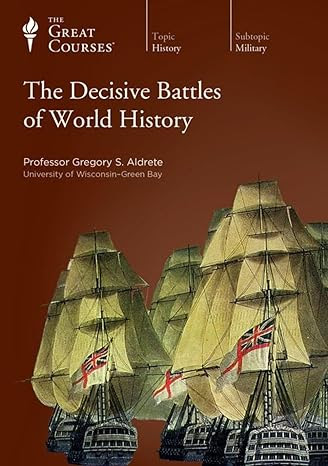
THE DECISIVE BATTLES of WORLD HISTORY (The Great Courses) (Audiobook) by Gregory S. Adlrete


Published by The Great Courses in 2014.
Lectures delivered by the author, Gregory S. Aldrete.
Duration: 18 hours, 29 minutes.
Unabridged.

As long as there has been war, there has been discussions about which battles were the most important, the most pivotal. This takes some analysis, since the temptation might be to simply discuss the battle that finally ended a long conflict, like Appomattox was the functional end to the American Civil War. 

The temptation might also be to collect a list of the biggest battles of history, but that would exclude Aldrete's tiniest choice - the Battle of San Jacinto. While that battle had less than 2,500 soldiers, he persuasively argues that the battle not only made Texas independent from Mexico, it also set off a chain of events that led directly the the American Civil War, Reconstruction and more.

In The Decisive Battles of World History, Adlrete presents the battles in chronological order and spends at least as much time on the background information of each battle as he does on the battles themselves. A few of the entries are not battles, but are entire campaigns.
The Battle of San Jacinto

Almost all of these lectures are informative and entertaining, but I did find the one set in Medieval Japan to be very hard to follow. I found that to be surprising since I took two classes on this topic back in college. 

I rate this audiobook 4 stars out of 5. It can be found on Amazon.com here: THE DECISIVE BATTLES of WORLD HISTORY (The Great Courses) (Audiobook) by Gregory S. Adlrete.

TULAROSA (audiobook) (Kevin Kerney #1) by Michael McGarrity


Published by Recorded Books in 2012.
Read by George Guidall.
Duration: 8 hours, 16 minutes.
Unabridged.

Tularosa features Kevin Kerney, a retired police detective living in New Mexico.

His former partner has come to him with a plea for help. His former partner's son (Kerney's godson) has gone AWOL from White Sands Missle Range in New Mexico. He had been a model soldier up to the time of his disappearance with clear plans to attend art school once he left Army career. 

Here's the difficulty. It wasn't Kerney's choice to retire - he was at the top of his game when he was shot twice in the line of duty in his gut and his knee. This happened because his partner and best friend was out of place -- drinking. 

It has been three years. It took Kerney a long time to physically and mentally rehabilitate and he never forgave his former partner for letting him get hurt.

Kerney is not asked to forgive his former partner, but to put aside his dislike to go and find his godson.

Kerney agrees and finds a whole lot more than he expected...

I really enjoyed veteran audiobook reader George Guidall's reading of the book - he is a classic narrator who set a high standard for all that followed. He has read more tham 1,200 audiobooks and did a good job with this one.

Well, he did as good job as one could with this book. The first half of the book was very good, but somewhere near the halfway point McGarrity started splitting the point of view that the story was told from more and more often (it had primarily been told from Kerney's point of view in the first part of the book) and it takes a lot of the steam out of the story. The mystery is removed from a story and then the book simply becomes a question of HOW the bad guy gets caught by the good guy and not IF the good guys can work out the mystery. It's too bad because McGarrity has one very good surprise twist in the middle that I did not see coming but he doesn't keep up with it.

I rate this audiobook 3 stars out of 5. It can be found on Amazon.com here: TULAROSA by Michael McGarrity.

Featured Post

<b><i>BAN THIS BOOK (audiobook)</i></b> by Alan Gratz

Published in 2017 by Blackstone Audio, Inc. Read by Bahni Turpin. Duration: 5 hours, 17 minutes. Unabridged. My Synopsis Ban This Book is t...

Popular posts over the last 7 days