Showing posts with label racing. Show all posts

RACER by John Andretti and Jade Gurss


Published by Octane Press in September of 2020.

I thoroughly enjoyed this autobiography because John Andretti was my favorite race car driver - period. 

I have watched auto racing for as long as I can remember. Some of my earliest memories are going to qualifications for the Indy 500. I have Janet Guthrie's autograph - not realizing when I got it that it was actually an amazing autograph to have. The sound of a single car circling the track with the roar and whine of the engine (it has both sounds at the same time) echoing off of the stands makes the hair on the back of my neck stand up. The history at that track cannot be topped by any other venue in the world.

I attended my first NASCAR race at Michigan in 1981 with my father. The spectacle of the whole thing was amazing. It was won by my favorite driver at the time, Richard Petty. In 1986, we went to our first Indy 500 and haven't missed one since (the 2020 race doesn't count since no spectators were allowed due to Covid-19). 

John Andretti first came to my attention as the cousin and nephew of his more famous relatives, Michael and Mario Andretti. He was like an also-ran compared to them because he didn't come with fully-funded top-notch rides and I paid him little attention - he had the famous name but I wasn't particularly fond of his cousin Michael Andretti. Michael had a reputation for complaining about everything and everyone. He has gotten much better as an owner and I have to say I am truly a fan of the way he manages his IndyCar teams.

So, when a local Indianapolis radio station started to interview him every week I listened with some serious skepticism. Before long, I found that I had a lot in common with John. We were born in the same hospital (5 years apart) and I live on the West Side of Indy, where he grew up. It became clear that he was much more of a regular guy race car driver than his more famous cousin. Plus, he had a great sense of humor. 

Soon enough, his segment became "must listen" radio for me and I became a fan. He started a go-kart race as a joke competition with one of the on-air personalities and raised money for Riley Children's Hospital in Indianapolis. It became know as the Race for Riley. I attended a few of them as the event grew from just a few thousand dollars to raising hundreds of thousands at a time (almost $5 million at the time this book was published). In fact, a portion of the purchase price of the hardcover edition of this book goes to Race for Riley.

John Andretti really lies at the intersection of my racing interests. I love the Indy 500 - and so did he. My favorite driver in NASCAR was Richard Petty and I was the absolute happiest as a fan when John drove Petty's 43 car. And John was the first driver to race the Indy 500, climb on a plane and then fly to Charlotte, North Carolina to race in NASCAR's longest race - the World 600 (as it was called then).

John's reaction when he discovered he had colon cancer was not surprising. His was so advanced when he found out that he really had almost no chance. He went out of his way to let people know that that was easily preventable and they could learn from his example and get a colonoscopy early on to have a better result. I did - one month before his death. And, it was a good thing, too! Thanks, John. 

Having heard John in several year's worth of weekly interviews, I can tell you that this book does have the true feel of his voice, which says a lot for his ghost author Jade Gurss. Gurss seems to specialize in racing-related books, which had to be a big help for writing this one.

The last page of this book hit me like a ton of bricks, even though I knew exactly how it ended. 

Left to Right: Richard Petty, John Andretti and
Michael Andretti. John ran a car with Richard
Petty's traditional colors for his cousin's
team in the 2010 Indy 500.
There are four forwards to the book and they are a testament to John Andretti's level of connection in the racing community: Mario Andretti, A.J. Foyt, Michael Andretti and Richard Petty. This is a collection of American racing royalty that is unrivaled. 

So, there is my mess of a review of a book that I absolutely enjoyed. I rate this book 5 stars out of 5. It can be found on Amazon.com here: RACER by John Andretti and Jade Gurss.

SPEED GIRL: JANET GUTHRIE and the RACE that CHANGED SPORTS FOREVER (kindle) by Stephen Talty


Published by Amazon Publishing in 2017.


Every racing fan has heard of Danica Patrick. She raced successfully for seven years in IndyCar, raced in 8 Indy 500s (with 6 top ten finishes) and 7 years in NASCAR (with less success). Long before Danica there was Janet Guthrie - a true pioneer in motorsports.

This short kindle book puts Guthrie's achievement in context in two ways. First, it details how truly startling it was to the drivers at the top levels of NASCAR and IndyCar for a woman to show up and try to add a little diversity to the field. Drivers that I always looked up to, like Richard Petty, said startlingly sexist comments about Guthrie.

The second way Speed Girl puts Guthrie's achievement in context is the more important one.  The author, Stephan Talty, describes how Guthrie worked her way up the ranks, tore apart engines, suspensions and body work and worked on her cars in her spare time as she gave up her personal life to go faster and faster in any car she could get her hands on. As a racing fan, this is the same story I have heard over and over again - which means she was what she always wanted to be - a racer. Not a fluke, not a curiosity - a racer.

Janet Guthrie, after qualifying for the Indy 500 in 1977.
I am a fan of the Indy 500. I've been to 32 straight Indy 500s and when I was 11 years old I got an autograph of Janet Guthrie in 1980 at a qualification day or practice for the Indy 500. Turns out that that was her last attempt to make the Indy 500 due to a lack of funding. Sponsors didn't know what to do with her and when there is no money, there is no car. There are times in a book like this that the truth is ugly, but it was good to read about the big names of yesteryear again, such as Foyt, Andretti and even Dick Simon.

The Kindle version of this book is enhanced with video built right into the page. It does little to advance the story, but it is fun. There is also an audiobook version of the book. They can be found on Amazon.com here: SPEED GIRL: JANET GUTHRIE and the RACE that CHANGED SPORTS FOREVER.

I rate this book 5 stars out of 5.


THE AVIATORS: EDDIE RICKENBACKER, JIMMY DOOLITTLE, CHARLES LINDBERGH and the EPIC AGE of FLIGHT (audiobook) by Winston Groom


Published by Blackstone Audio in 2013
Read by Robertson Dean
Duration: 17 hours, 23 minutes
Unabridged


Winston Groom, the author of Forrest Gump, has delivered an impressive triple biography of three of America's aviation pioneers with The Aviators. The book focuses on Eddie Rickenbacker (1890-1973), auto racer turned World War I flying ace, Jimmy Doolittle (1896-1993), test pilot and the first person to perform a landing using only instruments (this sounds sort of mundane but it meant that planes could take fly in all sorts of weather - not just on clear days), and the world famous Charles Lindbergh (1902-1974) - the first man to fly solo over the Atlantic in an airplane and a truly international celebrity.

Charles Lindbergh (right) with a P-38 on an island
in the South Pacific during World War II in 1944.

Each of these men had very different personalities but each shared a passion for being in the air. Charles Lindbergh is by far the most famous of the three, even now when crossing the Atlantic is an everyday occurrence. I found him to be the most enigmatic of the three and him to be the most difficult to identify with. But, Groom tells his story well and I did especially enjoy his tales of serving as a civilian adviser in Pacific in World War II. That was entirely new to me.

Eddie Rickenbacker was the reason that I picked this audiobook in the first place. I am a huge fan of the Indy 500 and I knew three facts about Rickenbacker - he was a World War I ace, he used to own the Indianapolis Motor Speedway and his plane went down in World War II and he floated on a life raft for a very long time until he was rescued. Rickenbacker's story is impressive simply because he ends up at the top of every endeavor he pursued - auto racing, fighter pilot, auto manufacturing, airlines. 


Of the three, Jimmy Doolittle is the one that I identified with the most. His fame was not nearly as great as the the other three, and when true fame finally came it was much later. He seemed to have been a bit more of a "regular guy". But, the story of the Doolittle Raid demonstrates that he was far from a "regular guy" - he thought big and he followed through when he was given the chance to do so. Groom's re-telling of the Doolittle Raid is one of the highlights of the book.

Robertson Dean's reading of this audiobook was excellent. While he did not create voices for people in the reading, he read the book in a lively and interesting manner. 

This is one of the best audiobooks I have listened to this year and may end up being the best book I have read all year. 

I heartily recommend this book - 5 stars out of 5.

This book can be found on Amazon.com here: The Aviators: Eddie Rickenbacker, Jimmy Doolittle, Charles Lindbergh, and the Epic Age of Flight

Blood and Smoke: A True Tale of Mystery, Mayhem, and the Birth of the Indy 500 by Charles Leerhsen


A Total Joy 

Published in 2011 by Simon and Schuster

Full disclosure: I am a huge fan of the Indy 500. I have been to every 500 since 1986 and I live within earshot of the track. I have whiled away many a day at the track watching qualifications, practice or just going through the gift shop during the winter when the track is silent.

Charles Leerhsen's recounting of the first few years of the Indianapolis Motor Speedway is an interesting, fun and controversial book.

What is interesting?

An ad from a San Francisco newspaper bragging that the
Marmon Wasp won the Indy 5000. Note the inclusion of the
riding mechanic even though Harroun did not have one.
Leerhsen tells the story of early 1900s Indianapolis, the beginnings of America's automobile culture, auto racing and the construction of the Indianapolis Motor Speedway in a nearly seamless manner so that it all becomes one large story. It is a story of inspired (crazy?) businessmen, a fascination with what is "modern", and a growing fascination with cars in a time when life was comparatively cheap (auto racing was extremely dangerous for drivers and spectators).

What is fun?

Leerhsen has a knack for finding the humor in any situation and keeping the story moving along in a fact-filled and entertaining way. It was truly enjoyable to get his take on life in Indianapolis around 1910.


What is controversial?

Leerhsen dares to challenge the conventional story of the first Indianapolis 500 and asserts that in the confusion of this very long race (200 laps in a time when 10 laps was considered a long race) Ray Harroun and his Marmon Wasp did not win. I remain unconvinced (as does the hugely-respected Indianapolis Motor Speedway historian Donald Davidson) but freely admit that the scoring system was flawed.

A thoroughly enjoyable read.

5 stars out of 5.

This book can be found on Amazon.com here: Blood and Smoke.

Reviewed on May 4, 2013

Fact. Fact. Bullsh*t!: Learn the Truth and Spot the Lie on Everything from Tequila-Made Diamonds to Tetris's Soviet Roots-Plus Tons of Other Totally Random Facts from Science, History, and Beyond! (Kindle edition) by Neil Patrick Stewart


Before You Try to Impress Your Friends with All of Your New-Found Factoids, Verify Them 

Published by Adams Media in 2011

This book was a first for me in a way. Fact. Fact. Bullsh*t! was the first book I ever read on my phone thanks to the Kindle app for my android phone. In a way, this book was made for reading on a little phone screen. It is entirely composed of a topic with three "facts" that follow. After that the reader will find out that at least one of those "facts" will be correct and at least one will be incorrect, or bullsh*t as the title notes. The  facts and the bullsh*t answers are explained.

This makes for fairly interesting short-term reading but it is not built for the long haul. This would be a great book to have for standing in line at the bank or if you have to wait for a bus or a train because you can get in and out of a topic in just a few minutes.

But...some of Stewart's facts are more factual than others. For example, he incorrectly states as a "fact" that Thomas Jefferson was the fourth president and the third vice president. In reality, he was the third president and the second VP.

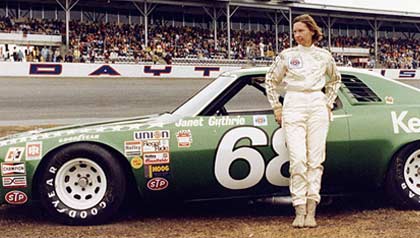
Janet Guthrie at the 1977 Daytona 500.
When it comes to the NASCAR set of "facts" there are multiple problems. He addresses the widely held belief that Danica Patrick is the first woman to race for NASCAR's Winston Cup, which he notes is incorrect, but on multiple levels that he fails to mention. Danica is not the first woman to race in NASCAR, which he correctly notes. However, he only mentions Janet Guthrie, who first competed in NASCAR in 1976. Other women competed in NASCAR's top level as early as 1949, but they are not mentioned. Also, he fails to note that Danica never competed for the "Winston" Cup since its name was changed in in 2004. Also, he notes in his "fact" section that the largest NASCAR event can hold as many as 170,000 fans. That is incorrect. The Brickyard 400 race at Indianapolis Motor Speedway has 280,000 seats available.

So, in short, this is a fun little book but don't trust everything that you read in it. Before you try to impress your friends and co-workers with your newfound factoids, verify them.

I rate this book 3 stars out of 5.

This book can be found on Amazon.com here: Fact. Fact. Bullsh*t!

Reviewed on November 2, 2012.

Jack Arute's Tales from Indy 500 by Jack Arute with Jenna Fryer


Published in 2006 by Sports Publishing

Jack Arute's first Indy 500 was in 1969 as an 18-year-old spectator. His family owns a track in the Northeast and racing is in his blood. His dad passed down a love for the Indy 500 in particular. Arute turned that love into a long career covering racing. 


In Jack Arute's Tales from Indy 500, Arute only tells stories from 1969 to the present (2004 in the hardback version, 2005 in the paperback version). Nothing too complicated and a real fun read, especially if you want to re-live some of the more exciting, interesting and sad moments from the last 35 years or so.

Jack Arute (center) 
joking with Tony Kanaan
I'd recommend the paperback version over the hardback since it has been expanded to include the 2005 race - the race where Danica Patrick became a household name.


This is a quick read - I finished it in just one evening, but to be fair, I did read into the wee hours of the morning because the stories were that much fun.

I rate this book 4 stars out of 5.

This book can be found on Amazon.com here: Jack Arute's Tales from the Indy 500

Reviewed on May 2, 2008.

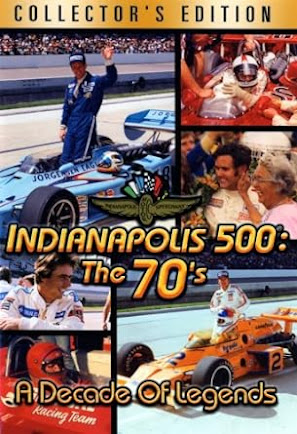
Indianapolis 500: The 70's A decade Of Legends (Collectors Edition) DVD


A must for Indy 500 fans

Part of a series of DVDs produced by the Indianapolis Motor Speedway, this collection reviews all of the races from 1970-1979, including A.J. Foyt's famed and unprecedented fourth win.

The collection features original TV & radio commentary, sound and video and lots of interviews with the drivers. Some of the interviews are from the 1970s and some are from nowadays looking back.
Janet Guthrie


Indianapolis 500: (The 70's A decade Of Legends) Collectors Edition is more than mindless promotion of the race - the lowlights (1973) are exposed along with the controversy associated with the arrival of Janet Guthrie, the first female participant in the 500. Changes with racing technology is highlighted throughout.

DVD features include collecting all of the bits and pieces of interviews with several drivers and some owners and adding a few bonus bits. Rick Mears and Roger Penske are especially strong interviews.

Well done.

5 stars out of 5.

This DVD can be found on Amazon.com here: Indianapolis 500: the 70's.

Reviewed on May 2, 2008.

They Call Him Cale: The Life and Career of NASCAR Legend Cale Yarborough by Joe McGinnis


A NASCAR legend deserves better


Published in 2008 by Triumph Books.

Cale Yarborough is a living symbol of NASCAR from its beginnings to the very creation of the dizzying heights that it has achieved nowadays. Sadly, most of the Johnny-Come-Lately fans have no idea, or at best, only a very dim idea who he is.

Sadly, this biography of Cale Yarborough, They Call Him Cale: The Life and Career of NASCAR Legend Cale Yarborough, only covers half of his career. Indeed, most of the book covers his life before NASCAR. There are only 203 pages in this biography and he joins NASCAR full-time on page 169. Considering that the last 11 pages discusses his retirement years, that leaves 23 pages to discuss his amazing run of 3 championships in a row, the famous fistfight at the 1979 Daytona 500, his decision to run a partial schedule for more than 7 years and his 11 year stint as team owner (just 5 pages for that).

The book could have been tremendously improved if the author had bothered to interview a few people. After all, his stable of drivers include a bevy of current and recently-retired drivers, including Dale Jarrett and John Andretti (his only win as a car owner came with Andretti). All of these drivers are media friendly. I've heard Andretti speak about Yarborough with nothing but praise.
Cale Yarborough's famed 28 car in the 1980s


The author should have included commentary about how Yarborough was able to field competitive cars running a partial schedule (nearly impossible to do today). How about Yarborough's willingness to have in-car cameras when most did not want them? How about Yarborough's involvement in a group that tried to set up an alternative to NASCAR after he sold his race team? Nope. None of that.

The lack of depth is not too surprising, really. The author's notes (p. 261) say that he got "many" of the stories in his book from Cale's autobiography and most of the rest came from 7 internet sites.

A nice feature of the book is the inclusion of more than 50 pages of tables that detail Yarborough's NASCAR and IROC career and his Indy 500 runs.

A disturbing feature is the naming of each of his children, grandchildren and the little towns in which they live in South Carolina. Jeez. There are weirdos out there, McGinnis. Why give out this sort of detailed info?

I give it two stars. The pre-NASCAR part of the book is interesting. It's just too bad the rest of the book couldn't follow up.

I rate this book 2 stars out of 5. It can be found on Amazon.com here: They Call Him Cale: The Life and Career of NASCAR Legend Cale Yarborough.

Reviewed on May 9, 2008.

Indianapolis 500: A Decade of Drama: The 90's - Collector's Edition DVD


"There's nothing as mighty as this in the world." - Nigel Mansell, F1 champion, Indy 500 driver


Published in 2005.

Part of a series of DVDs produced by the Indianapolis Motor Speedway, Indianapolis 500: The 90's - Collector's Edition reviews all of the races from 1990-1999.


The collection features original TV & radio commentary, sound and video and lots of interviews with the drivers. Some of the interviews are from the 1990s and some are from nowadays looking back.

The video is more than mindless promotion of the race - the lowlights (poor officiating in several races, for example) are exposed along with the controversy associated with the infamous CART-IRL split.
The DVD features include collecting all of the bits and pieces of interviews with several individual drivers and some owners that were in the feature and showing them in a longer format and adding a few bonus bits. The interviews highlighting many of the family connections are especially strong, although leaving the Andrettis out of it was odd, although they are highlighted in the review of the 1991 race. The feature on Scott Brayton who died in 1996 while practicing for the Indy 500 is touching.

The 1991 and 1992 races are especially well covered. Rick Mears makes a disparaging comment about Mario Andretti and Mears' comments about his reasons for retiring are not only enlightening, they are funny.

Well done. This is an enjoyable series. A must for an Indy 500 fan.

I rate this DVD 5 stars out of 5 and it can be purchased on Amazon.com here: Indianapolis 500: The 90's - Collector's Edition.

Reviewed on May 9, 2008.

America, 1908: The Dawn of Flight, the Race to the Pole, the Invention of the Model T and the Making of a Modern Nation by Jim Rasenberger


The strong points are very strong but there are flaws

Originally published in 2007 by Scribner.

America, 1908 covers some of the key cultural, political, manufacturing and just plain odd events that happened in 1908 in the United States in an easy-to-read, often fun format. These include the Race to the North Pole, the New York to Paris automobile race, the introduction of the Model T, the last time the Cubs won the World Series for more than a century, the Wright Brothers proving to the world that they really could fly (and do it for hours, not just seconds) and a series of horrible race-based lynchings.

While I enjoyed learning more about the Wright Brothers and the Model T, other parts seemed more than a bit skewed towards events in New York City (the Cubs win their last World Series and it's told from the point of view of the New York Giants?) and against rural areas and the South (the only references to the South are from newspapers mentioning events in NYC or about lynchings and attacks of corporate tobacco interests. Surely something happened that was not a lynching or some other violent act?)

The author seems to suffer from the same conceit that plagues a number of New York City-based authors - a failure to realize that the rest of the country not only matters but is just as interesting as NYC. For example, when describing the NYC-Paris race he mentions they drove through Indiana but fails to mention that they were in the process of planning the massive 2.5 mile Indianapolis Motor Speedway (it opened in 1909) - a facility designed to show off the capabilities of automobiles in competition without having to expose them to the vagaries of open road races like the NYC to Paris race.

So, to sum up, America, 1908 is a nifty piece of history, such as it is. It is hardly inclusive of America as a whole with a definite bias towards New York City-based events.
1908 Model T Ford


Personal note: Rasenberger's inclusion of a horrible anti-black race riot in Springfield, IL was especially thought-provoking as I watched the Obama inauguration this week. What a difference 100 years can bring in some attitudes! 

I rate this book 4 stars out of 5.

This book can be found on Amazon.com here: America, 1908: The Dawn of Flight, the Race to the Pole, the Invention of the Model T, and the Making of a Modern Nation.

Reviewed on January 23, 2009.


For Gold and Glory: Charlie Wiggins and the African-American Racing Car Circuit by Todd Gould


For racing fans of any stripe and any color

Published in 2007 by Indiana University Press

Todd Gould has written a number of articles and books on Indiana business and history. With For Gold and Glory: Charlie Wiggins and the African-American Racing Car Circuit he has addressed a fascinating time in racing history and Indiana history as well.

The main focus is Charlie Wiggins, an African-American auto mechanic originally from Evansville, Indiana who moved to Indianapolis in 1922 to take advantage of the bustling (yet segregated) cultural and business climate around Indiana Avenue. At the same time, several Indianapolis businessmen (both black and white) are looking into starting up the Colored Speedway Association (CSA), a racing division for Blacks that was to be modeled after Negro League Baseball. The hope was to demonstrate that African-Americans were fully capable of driving high-performance racecars and create a groundswell that would cause the American Automobile Association, the main sanctioning body of most races back then, to de-segregate big-time auto racing. Their main goal would be to race in the hometown Indy 500.
Charlie Wiggins
(1897-1979)

The title, Gold and Glory, comes from the name of an annual race, the Gold and Glory Sweepstakes started by the CSA at the 1 mile dirt track at the Indiana State Fairgrounds in Indianapolis. This one mile dirt track hosted 10 'Gold and Glory' 100 mile races. Charlie Wiggins won 4 of them and earned the nickname 'Negro Speed King' in race cars of his own design and manufacture.

Gould tells about the active role the KKK played in Indiana politics in the 1920s and does a nice bit of 'parallel lives' biography with Klan leader D.C. Stephenson and Charlie Wiggins for about 50 pages in the book. He also tells about the mini-Harlem Renaissance that occurred in Indianapolis in the 1920s and the cultural life of Indy's near west-side. He also ties in a lot of basic history of the early days of auto racing - of the dangers and pitfalls of dirt track racing, of mechanics building cars in their garages, of having to tow your race car with a rope and having a young apprentice steer it while it was being towed, of race tracks being built in the middle of a cornfield for a one day event, and so on.

Gould tells the story of the CSA, Charlie Wiggins and the racial politics of the time in a near-seamless fashion. He ties it all together and leaves the reader a bit amazed. Amazed at how far we have come politically, amazed at the changes that have taken place in racing (long gone are the days of a big-time racer building his own car in his spare time) and heartened by the fact that racing really knows no color. While the sport was strictly segregated by rule, every racer and race fan knows that every advantage has to be pursued in order to win - white teams helped black teams and black teams helped white teams. Why? Because regardless of color, racers are a group unto themselves.

This is a must read for all auto racing fans, but especially for fans of the Indy 500.

I rate this book 5 stars out of 5.

Reviewed on March 31, 2006.

This book can be found on Amazon.com here: For Gold and Glory: Charlie Wiggins and the African-American Racing Car Circuit.

Spectator Sport by James Alexander Thom


One of James Alexander Thom's first published books - shows his potential and rookie problems.


Originally published in 1978.

James Alexander Thom is one of my favorite authors. In my classroom I have had two of his books on my shelves - when kids come to me looking for something to read I recommend those books first due to the power of the storytelling. Those that accept my recommendations concerning his books are never disappointed. Great stuff!

While most of his books concern the frontier days of America's old Northwest Territory (Indiana, Michigan, Illinois, etc.), Spectator Sport concerns itself with the rain-shortened and deadly 1973 Indy 500. The race took part over the course of 3 days and was finally called after a little more than 300 miles due to rain and the fact that only 9 of the 33 starters were still on the track. Thom was at the race and the events inspired him to write this book and explore the motivations of race fans, violence on television and the news and voyeurism of all sorts.

This book however does not qualify as great - it is too up and down and inconsistent.

First - what is done well:

-Thom accurately portrays the way the 'Snake Pit' of the Indy 500 used to be - the dirt, the beer, the hedonism.
James Alexander Thom


-Thom accurately captures the feel of the 500 just before the race starts. The tension, the anticipation, the pomp and ritual.

-Thom's descriptions of the Speedway and its environs are dead-on. Especially the traffic and the insanity of the some of the police who are directing it.

What does not work so well:

-Too many characters - especially the boy from Kokomo who has to see the race no matter what. The girls who break out from the Indiana Girls' School (Indiana's prison for teenaged girls) and party in the infield are interesting but also fail to advance the story.

-Thom's theme is that sex, violence and power are all inter-related. The fighter pilot war hero and the soft-porn movie starlet, and the 500 festival princess who poses naked for the camera are all supposed to tie in with the race and the mayhem that occurred on the track, in the stands (debris and fuel were sprayed all over one section of the stands) and in the infield. However, I thought that Thom failed to connect all of these dots and the story gets too off-target. Too many themes means that he hits none of them well. It would have been better to have made two books - one exploring the violence of auto racing and the motivations of the racers and the fans, the other exploring sexuality, power and fidelity.

Fans of the 500 will appreciate:

-Transcripts of the race thrown into the text to tell the reader how far along the race is. These are actually transcribed from "The Voice of the 500" Sid Collins' personal tapes and include ads, Sid Collins and other local (Indy area) broadcasters such as Mike Ahern.

-Local sites such as the Indiana Girls' School, The Coke Lot, The Snake Pit and a local west side bakery that just has to be Long's Bakery.

Bottom line: The book has lots of faults, shows his great promise as an author but really does not quite deliver. Hardcore fans of the Indy 500 will certainly appreciate it.

**On a different note, why do they use a modern era Indy Car on the cover photo on the October 2000 reprint rather than a car from the 1973 race?

I rate this book 3 stars out of 5.

This book can be found on Amazon.com here: Spectator Sport

Reviewed on January 4, 2006.

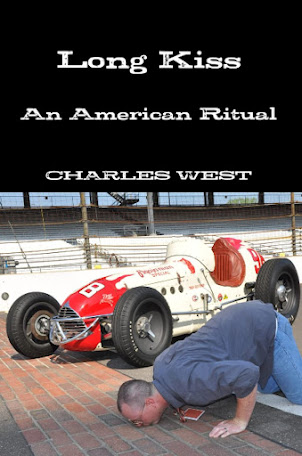
Long Kiss: An American Ritual by Charles West


As the month of May is coming close, this Indianapolis resident and attender of 25 straight Indy 500 races and all of the Brickyard 400s (17, I think) knows what it means to be in love with the Indianapolis Motor Speedway. So, I picked up this book in order to see what another gigantic fan had to say about this experience.

Charles West, unlike me, did not grow up visiting the Indianapolis Motor Speedway (my mother's parents lived just a few blocks from the main gate and I clearly remember attending several qualification days and hearing Tom Carnegie's sweet velvet baritone call out, "It's a neeeew traaaaack recoooord!")  Instead, West grew up in Texas and most of his memories were radio broadcasts and delayed TV broadcasts. He also clearly remembers seeing Johnny Rutherford's yellow Pennzoil Chaparral on display as a little boy - that hooked him. For me, it was hearing that distinctive whine of the engines in the 1980s as a lone car drove around the track - you could hear it echo over the stands as the car traveled around the 2.5 mile speedway. It gives me chills even now.

11 years ago, West decided to go to the race - to experience The Big Everything as he calls the 500. West was a long-time veteran attendee of big time auto racing, having been to several NASCAR races, IRL races and CART races. But, this was different and he knew it. West describes every race he attends for 10 years - his drive there, where he stayed, where he sat, the souvenirs and his pre- and post-race rituals. I loved those parts of the book - I knew every place he stayed, the routes he took, where he sat and the restaurants he ate (how can he hate Pizza King? Oh well, at least he loves the Noble Romans on West 10th Street). He even gives away my "secret" back entrance to the Town of Speedway that only us locals know about (How could you do that?!? If I have to sit in extra traffic this year...).

The rest of the book is more problematic. Charles West describes a difficult relationship with his family, his wife, his wife's family but does little to explain the difficulties with his wife and her family. He does do a lot of explaining and details his growth as a person during this difficult time in his life (and some problems are quite heart-breaking, especially where his father is concerned) but it was an odd combination of too much dirty laundry and not enough. He told too much personal information for a book that was primarily about a fan's love of a race, and not enough for a personal journal about his personal growth.

So, I buzzed through the personal stuff and read the racing parts. Despite the occasionally clunky turn of the phrase and the personal struggles story line, I very much enjoyed sharing this fellow fan's passion for the Indianapolis Motor Speedway and especially the Indy 500.

I rate this book 4 stars out of 5 with the caveat that no one but a hard core racing fan would have the remotest interest in this book.

This book can be found on Amazon.come here: Long Kiss

 Reviewed on May 9, 2011.

Speedweeks: 10 Days At Daytona by Sandra McKee


Disappointing

So, Speedweeks: 10 Days At Daytona is yet another coffee table book. See, what it is is that I have a friend who knows I am a NASCAR fan so he didn't know what else to get me for Christmas so he got me 3 NASCAR books. One of them was this one and I was fairly disappointed, mostly due to the fact that the title does not accurately describe the book. Nor does it accurately describe Speedweeks, 

Daytona Speedweeks is a racing happening - a racing festival. There are a multiple motorsports events, culminating in the Daytona 500. Check their website!

This book, however, focuses primarily on the Daytona 500 (90%) and barely mentions the other events. In fact, some events it doesn't mention at all. I have no problem with the NASCAR Cup level focus, just give the book a different title, like The Daytona 500. This, truly, is a book that you cannot judge by its title.

I give this book 2 stars out of 5. The title thing annoyed me, but there was also nothing here about the history of the speedway or of the race. Beautiful book but not much here of substance.

This book can be purchased on Amazon here: Speedweeks: 10 Days At Daytona.
 
Reviewed in February of 2005 (edited in 2011 and 2025 to update the events offered during Speedweeks)..

From Peanuts to the Pressbox: Insider Sports Stories from a Life Behind the Mic by Eli Gold


An enjoyable read from one of the true nice guys in American sports broadcasting

Published in 2009 by Thomas Nelson Inc.

I've listened to Eli Gold for years as one of the radio (and from time to time TV) voices of NASCAR. He's always come across as a nice guy and a straight shooter who is not out to grind any axes.

From Peanuts to the Pressbox: Insider Sports Stories from a Life Behind the Mic is Eli Gold's story of how he went from being a peanut vendor at Madison Square Garden to being a nationally known sports announcer. Eli tells it in an entertaining, light-hearted style and keeps it classy by not airing anyone's dirty laundry.

He does include lots of funny and interesting stories, including his tale of the day that he went to the airport with David Pearson, Bobby Allison's distinctive ritual when he flew his plane home after a win and the strangest thing Richard Petty ever signed (a duck!). The revelation that Supreme Court Justice Clarence Thomas is a big NASCAR fan who attends in his own RV was a bit surprising.

A good gift for the NASCAR (or Alabama or hockey) fan that has everything.

4 stars out of 5.

This book can be found on Amazon.com here: From Peanuts to the Pressbox: Insider Sports Stories from a Life Behind the Mic by Eli Gold.


Reviewed on December 15, 2009.

Richard Petty's Audio Scrapbook by Barney Hall


Fantastic. A must for Petty fans and fans of NASCAR history.


Published in 2009 by Audiobook Publishing, LLC.
4 CDs
Running time: approximately 4 hours

Richard Petty sits down for Richard Petty's Audio Scrapbook with his cousin and long-time crew chief Dale Inman (the only crew chief to win 8 championships) for a retrospective on their legendary careers with Barney Hall, the famed radio voice of NASCAR for 40 years on MRN.

Barney begins the interview by having the two cousins tell about their early lives in rural North Carolina. They tell about how they got involved in Lee Petty's racing operation as part-time garage help after school and how, once Richard turned 21, they were able to start racing themselves. The give and take between these two cousins and, more importantly, long-time friends makes this a fun trip down memory lane.

Petty's Dodge Charger, a legendary ride
As the interview moves along following Richard's career bits of audio from races are included as well as interviews with Richard's wife, Linda, Junior Johnson, Bobby Allison and David Pearson. Pearson's comments are especially poignant as Petty and Pearson recount a some of their close finishes. Pearson and Petty were the toughest of rivals on the track but they always drove with a sense of respect for each other. Petty compliments Pearson by noting how absolutely he trusted him on the track and Pearson, not once, but twice says of Petty, "He's always been my hero."

Barney Hall does a great job of pulling the stories from Inman and Petty. Lots of laughs, a lot of history and a tough bit as Richard discusses the death of his grandson Adam during a testing accident at a race track. Richard's natural sense of humility comes through as he notes his successes with comments like, "We got lucky" and "we were fairly successful" and we were "pretty good."

The car Petty won with at my first NASCAR race in 1981.
200 career wins. Most wins ever in a season. Most Daytona 500 wins. Most wins in a row (10). 7 Championships.

Yeah, that's pretty good.

Thoroughly enjoyable. This lifelong fan of Richard Petty was pleased.

I rate this 5 stars out of 5.

This audiobook can be found on Amazon.com here: Richard Petty's Audio Scrapbook by Barney Hall.

Reviewed May 24, 2010.

Featured Post

<b><i>BAN THIS BOOK (audiobook)</i></b> by Alan Gratz

Published in 2017 by Blackstone Audio, Inc. Read by Bahni Turpin. Duration: 5 hours, 17 minutes. Unabridged. My Synopsis Ban This Book is t...

Popular posts over the last 7 days