Showing posts with label FDR. Show all posts

WHEN BOOKS WENT to WAR: THE STORIES THAT HELPED US WIN WORLD WAR II (Audiobook) by Molly Guptill Manning


Published by Blackstone Audio in 2014.
Read by Bernadette Dunne
Duration: 6 hours, 49 minutes.
Unabridged.

When Books Went to War looks at the deliberate effort by the government of the United States to put books in the hands of its soldiers as they went off to fight in World War II. 

There were multiple reasons behind this idea. The first was simple: Reading books is a practical way to help soldiers pass the time. "Hurry up and wait" is a common refrain from soldiers of all eras and books helped fill the time.

Another reason was to remind the soldiers of what they were fighting for. Being on the front has a way of making life seem cheap and disposable, but reading a good story might help keep soldiers attached to the good things from back home. This may seem corny, but so many letters from the soldiers and sailors were written to the authors of these books that emphasized this very point.

Betty Smith, the author of A Tree Grows in Brooklyn wrote and spoke about all of the letters she got from soldiers that told them how her book reminded them of their home in any big city in America - Cleveland, Chicago, Boston, or wherever. She said she received 10 times more mail from soldiers than from civilians. 

One of the most important reasons to put books in the hands of soldiers was that being anti-book was a trait of the Nazis. They were infamous for holding massive book burnings and emptying libraries of books they disagreed with. The American program to put books in the hands of soldiers was the opposite - and it was intentionally designed to be that way. The bad guys take books away from you - the good guys want you to read and think for yourself and give you books to do just that.

Note: This philosophy contrasts strongly with the Trump Adminsitration's choice to ban nearly 400 books from the libraries of the various military academies. For example, here is an article from April of 2025 about 385 books banned from the Naval Academy. 

These books were designed to be as small and lightweight as possible. They were intended to go along with a soldier no matter where he went. The print was tiny, the margins were almost non-existent and they were usually stapled together. They could slide into a pack, a pocket, or in the nooks and crannies of any vehicle. They could bend to the counters of a pack.

Men read and re-read them. When books were handed out, men would be strategic about their choices in order to guarantee a wide variety of reading choices. Men from different units traded and some units created portable libraries in crates that went right along with the unit no matter where they went. Men were assigned to be the caretakers of the books.

Their was a lot of debate about the books they picked. They weren't policed too much when it came to content. Southerners were irritated at books that were critical of their Jim Crow laws. Steinbeck's Grapes of Wrath made the cut and it is hardly politically conservative. Some were strictly educational - books that explained science or math or philosophy. A great many were Westerns and there were a number of murder mysteries. By the time it was over, the U.S. government had printed 1,225 different titles and had given away 122 million books to its armed forces for free!

Here is a list of every book they printed.

This audiobook was interesting from beginning to end. As a book lover, it was inspiring to hear about men reading to their buddies in foxholes and men discovering that they actually liked reading. As a person that always has a book on hand, I understood completely.

I rate this audiobook 5 stars out of 5. It can be found on Amazon.com here: When Books Went to War: The Stories That Helped Us Win World War II

THEY CALLED US ENEMY (graphic novel) by George Takei, Justin Eisinger, and Steven Scott


Published in 2019 by Top Shelf Productions.
Illustrated by Harmony Becker.

Winner of the 2020 Eisner Award for Best Reality-Based Work.

Winner of the 2020 American Book Award.


George Takei is most famous for his part in the the original Star Trek series and the subsequent movies. But, over the last 20 years or so, Takei has been on a personal crusade to make sure that the Japanese Internment Camps are not forgotten. 

President Franklin D. Roosevelt issued an executive order in February of 1942 to place all of the Japanese on the west coast of the United States into camps because they could not be trusted not to help the Empire of Japan. This order applied to all Japanese, even if there was absolutely no reason to suspect them of doing anything at all to help Japan. Takei's family was included in this round up and this graphic novel is that story.

The graphic novel format is ideal for the story of a young man caught up in a situation he cannot possibly understand. Takei does a good job of going back and forth from his childhood perspective to multiple adult perspectives (Takei at various points in his life) in order to explain things better.

I rate this graphic novel 5 stars out of 5. It can be found on Amazon.com here: THEY CALLED US ENEMY (graphic novel) by George Takei, Justin Eisinger, and Steven Scott.

Note: This book has been listed on multiple book ban lists - in Tennessee (use the searchable database because the list has more than 1,100 unique titles) in 2025 and in Pennsylvania right after it was published. I suppose that people are scared of learning America's history.

LIFE AFTER POWER: SEVEN PRESIDENTS and THEIR SEARCH for PURPOSE BEYOND the WHITE HOUSE (audiobook) by Jared Cohen


Published by Simon and Schuster Audio in 2024.
Read by Kevin R. Free.
Duration: 14 hours, 4 minutes.
Unabridged.

In Life After Power Presidential historian Jared Cohen looks into the post-Presidential lives of seven Presidents and their quests for some sort of meaning after having one of the most important jobs you can have.

Some Presidents fade away due to health reasons, like Reagan. Others are eager to resume their former lives, like Washington. But, others still feel like they have something more to offer or have unfulfilled goals.

The seven Presidents he looked at are: Thomas Jefferson, John Quincy Adams, Grover Cleveland, William Howard Taft, Herbert Hoover, Jimmy Carter, and George W. Bush.

I have enjoyed hearing about John Quincy Adams' post-Presidential life ever since I first read John F. Kennedy's Profiles in Courage 30+ years ago. I've read more than one book about him and this re-telling is quite good. 

A photo of John Quincy Adams 
taken in 1844.
Jimmy Carter's lengthy post-Presidency is remarkable for how amazingly hard-headed he has been. Carter follows his conscience and lets the political consequences be damned. Cohen notes that Carter did not actually found Habitat for Humanity - he just joined it early on and is easily its most famous and perhaps longest term volunteer.

George W. Bush has done almost the opposite. He lived a very public life for years and has since retreated into more solitary pursuits such as painting. He has said almost nothing about politics in the almost 16 years since he left office.

Each of these men had a different reaction to leaving office. Some left after 2 successful terms, some after experiencing disappointment and 4 of them were defeated after just one term (this is what inspired Cleveland's determination to run again - and win.) I found some to be more interesting than others but, taken a whole, this is a solid set of mini-biographies.

I rate this book 4 stars out of 5. It can be found on Amazon.com here: LIFE AFTER POWER: SEVEN PRESIDENTS and THEIR SEARCH for PURPOSE BEYOND the WHITE HOUSE by Jared Cohen.


PROHIBITION in the UNITED STATES: A HISTORY from BEGINNING to END (kindle) by Hourly History


Hourly History publishes histories and biographies that you can read in about an hour. That can be a tough job for larger topics in history like "The Industrial Revolution" or "The Roman Empire" but it works out about right for this topic.

This history goes all of the way back to the arrival of the
 Mayflower in 1620. Turns out the Puritans brought hundreds of gallons of alcoholic beverages with them to the New World and immediately set up the means to produce even more.

The book then goes on to show the ups and down of America's relationship with alcohol. When the reader gets to the temperance movement, there is a solid context to understand why the 18th Amendment to the U.S. Constitution was passed in 1919 and why it was eventually abolished by the 21st Amendment a mere 14 years later.

For a short read, this book provides a lot of good, basic information. 

I rate this e-book 5 stars out of 5. It can be found on Amazon.com here: PROHIBITION in the UNITED STATES: A HISTORY from BEGINNING to END (kindle) by Hourly History.


THE AMERICAN STORY: CONVERSATIONS with MASTER HISTORIANS (audiobook) by David M. Rubinstein


Published in 2019 by Simon and Schuster Audio.
Voice work by various historians hosted by David M. Rubinstein.
Duration: 9 hours, 52 minutes.
Unabridged
.


David M. Rubinstein is an avid amateur historian and financial supporter of history-related projects. He organized a series of 16 interviews of historians by the Library of Congress with the intended audience to be actual members of Congress with invited guests. 

He picked historians who have written popular and professionally respected histories and biographies of famous Americans such as Ron Chernow (Alexander Hamilton), David McCullough (Adams and Truman), Cokie Roberts (Abigail Adams) and Doris Kearns Goodwin (Lincoln) and just let them discuss the person they studied.

Doris Kearns Goodwin
The audiobook consists of the actual audio of these interviews with a little introduction

The interviews were all solid, but could have been better if Rubinstein had not insisted on inserting himself in the middle of them so often. So many times the historian would be discussing an interesting topic and Rubinstein would interrupt to ask a question that totally changed the trajectory of the conversation. I noted to my wife that Cokie Roberts and Doris Kearns Goodwin were best at fielding his questions and then going right back to the topic they were pursuing. Perhaps they have a lot more experience with men interrupting to say something that was not relevant. 

This is still a good listen and I do recommend it. I did remove 1 star for the interruptions. Yes, I found the interruptions to be that annoying.

I rate this book 4 stars out of 5. This book can be found on Amazon.com here: THE AMERICAN STORY: CONVERSATIONS with MASTER HISTORIANS by David M. Rubinstein.

ON FASCISM: 12 LESSONS from AMERICAN HISTORY (audiobook) by Matthew C. MacWilliams


Published in September of 2020 by Macmillan Audio.

Read by Kevin Stillwell.
Duration: 4 hours, 18 minutes.
Unabridged.


MacWilliams is a sociologist who studies authoritarianism. He has done a number of surveys over American attitudes towards the Constitution and the freedoms of their fellow citizens and there are areas of concern that he outlines in On Fascism.

For example, "31% of Americans agree that having a strong leader who does not have to bother with Congress and elections is a good way of governing the United States" and "30% of Americans agree with the statement 'I often find myself fearful of other people of other races.'"

Other stats of concern are:

"44% of Americans agree that increasing racial, religious and ethnic diversity represents a threat to the security of the United States"

When you break down the numbers about "18 percent of Americans are highly disposed to authoritarianism. Another 23 percent or so are attitudinally just one step below them on the authoritarian scale." He goes on to explain that people who are disposed to authoritarianism value "authority, obedience and uniformity over freedom, independence  and diversity" and when they grow fearful or are manipulated by an autocrat they will not defend the freedoms of the minority - the freedoms enshrined in the Constitution. 

MacWilliams argues that this is not a new phenomenon. There are some old surveys he can access but there is also the historical record, which is spotty. He didn't have to look very deep - most of these items are in every school child's American history book. For example, the Alien and Sedition Acts of 1798, the Trail of Tears, The Dred Scott decision, the Japanese Internment camps and the McCarthy hearings. 

Lesson 1: American Enlightened or Authoritarian?
Lesson 2: Fomenting Fear
Lesson 3: All Lies Matter
Lesson 4: Gagging the press, Quashing Dissent
Lesson 5: Taking What is Rightfully Ours
Lesson 6: Using Fear and Violence to Control and Subordinate Others
Lesson 7: The Driving Out
Lesson 8: Fear as a Path to Power
Lesson 9: Galvanizing Group Identity
Lesson 10: Silence of the Law
Lesson 11: Fear Breeds Repression; Repression Breeds Hate; Hate Menaces Stable Government
Lesson 12: The Surveillance Society and the Big Lie


I found this short audiobook to be engaging and thought-provoking. I just kept wondering what MacWilliams would have thought about everything from Election Day up to January 6.

Highly recommended.

I rate this audiobook 5 stars out of 5. It can be found on Amazon.com here: On Fascism: 12 Lessons from American History.

1942: THE YEAR THAT TRIED MEN'S SOULS by Winston Groom


Originally published in 2004.


Winston Groom is best known as the author of Forrest Gump. He is also the author of 14 different non-fiction books and shows a real talent for writing narrative history.

1942: The Year that Tried Men's Souls focuses on the year that Groom considers to be the crisis year for the Allies and America in particular in World War II - 1942.  He starts his story just before World War II with the attack of Pearl Harbor on December 7, 1941 and ends it in February of 1943 with the ending of the fighting on Guadalcanal.

This was a bad time, especially early in 1942 when Japan conquered one territory after another and American forces were seemingly caught off guard or under-prepared everywhere.

Groom focuses primarily on the Pacific Theater in this book (75 % or more), although he does offer a decent look at the North African campaign. His look at the fall of the Philippines and the Bataan Death March was very compelling.

Groom has no problem pointing out incompetent leadership when he sees it. He also looks at the American home front, describes in detail the work to figure out Japan's secret code and how that successful effort affected the war.

Claire Phillips (1907-1960)
Groom likes to point out the stories of individuals in the middle of the war. He looks at a couple of pilots who took part in an extraordinary escape from a Japanese prison in China and eventually worked their way all of the way to India. He also looks at non-military people, like Claire Phillips, a night club owner in the Philippines who provided information to anti-Japanese forces and helped to sneak food and clothing into a Japanese-run POW camp of American soldiers. She believed her husband was in the camp, but continued to help after she discovered he had been dead for months. Her nickname was "High Pockets" because she used her bra to store money and useful information.

Very readable, informative and well-done.

I rate this book 5 stars out of 5. It can be found on Amazon.com here: 1942: THE YEAR THAT TRIED MEN'S SOULS by Winston Groom.

AMERICAN HERITAGE: GREAT MINDS of HISTORY interviews by Roger Mudd


Published in 1999 by Wiley and Sons.

Roger Mudd, formerly of CBS and NBC news, interviewed five historians about their special topics of expertise. They are all solid interviews that allow the historians to tell why their topics are important. Mudd does a great job of letting the interviews flow along a natural conversational path, but he does interrupt with questions that ask for clarification or challenge a point.

The historians are: Gordon Wood discussing the American Revolution; James McPherson discussing the Civil War; Richard White discussing Westward Expansion; David McCullough discussing the Industrial Era; and Stephen Ambrose discussing World War II/Eisenhower/Nixon.

This was a lot like sitting down with a talented professor in a coffee shop and letting him/her go on about their favorite topic. They weren't lectures, but more like a conversation. I know the work of four of these five historians and have read quite a bit of McCullough, Ambrose and McPherson.

McPherson is my favorite of these three since he and I share a deep interest in the Civil War. I was surprised to learn that he came to study the Civil War later than I thought. McCullough's interview is interesting because of his wide-ranging interests. He discussed the Industrial Era, but he has done a lot of work outside of that time as well, including a great biography of Truman and a history of just the year 1776 during the American Revolution. Ambrose's interview very much felt like my previous impressions of Ambrose - great historian, occasionally a prickly personality.

I rate this book 5 stars out of 5. Very enjoyable read. It can be found on Amazon.com here: AMERICAN HERITAGE: GREAT MINDS of HISTORY interviews by Roger Mudd.

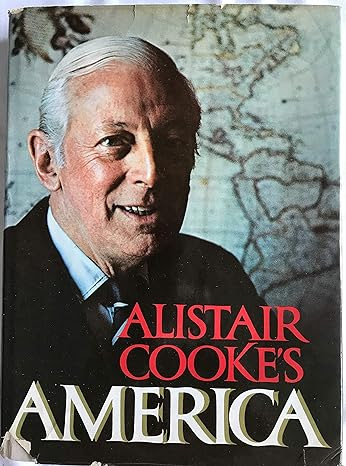
ALISTAIR COOKE'S AMERICA by Alistair Cooke


Published in 1973.

In 1973, undoubtedly to prepare for the upcoming 1976 bicentennial of the American Declaration of Independence, BBC reporter and author Alistair Cooke released a book and a television mini-series telling the history of the United States to the U.K. The book and the series came to America as well with the book selling nearly 2 million copies. This massive "coffee table" type book has 393 pages and weighs in at 3 pounds, 9 ounces (compare that to a random paperback book I weighed at just 5 ounces).

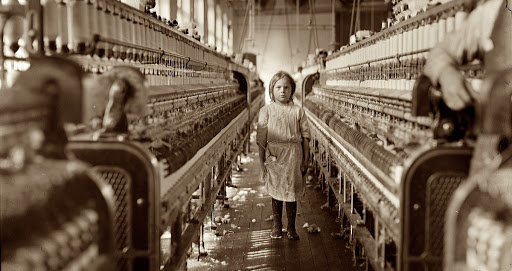
Photo by Lewis Hine
Cooke presents a straight-forward history of America, skimming over lots of details but getting the highlights. This has to be the case when you cover more than nearly 500 years of history in less than 400 pages. He focuses half of the book on the exploration/colonial/Revolutionary War/Constitutional era and it is by far the strongest part of the book.

This book is filled with beautiful, sometimes profound photographs. On pages 312-313 there is a two page spread of a lynching. Cooke claims that "no one knows who took this picture, or exactly when." (p. 311)   It was taken by Lawrence Beitler in Marion, Indiana on August 7, 1930. Beitler sold this photo for 10 days straight to sell as souvenirs of the lynching. Here is a link to a great book on the topic: 
A Lynching in the Heartland: Race and Memory in the Heartland by James H. Madison. Here is a link to the Wikipedia page on this lynching: Lynching of Thomas Shipp and Abram Smith.

The photograph of the girl working in a clothing factory in North Carolina is another great photograph in book full of great paintings and photographs. I have included it in this review.


It is very readable, but clearly a product of its time, and Cooke is a reporter, not an historian. The book has a bit of a racist feel to it. For example, when discussing where the United States lays on the globe (not too hot, not too cold), he notes: "...the United States spans the limits of the climates that white men can live and work in." Cooke mostly skips over the Native American civilizations that inhabited the Americas before Columbus. He spends almost as much time discussing entertaining but mostly nonsensical theories about the Phoenicians settling in the Americas as he does the actual Native American civilizations themselves. Cooke's reasoning is that he is covering a history of the United States itself, so Native Americans get the short end of the stick, except as an impediment to American expansion for the first 2/3 of the book.

Cooke does a similarly poor job dealing with African Americans, a group that he cringingly calls "the blacks" throughout. 
He does, however, clearly observe (in a clunky manner) that slavery and the continuing racial prejudice against African Americans is an ongoing open sore and has never been dealt with properly.

Final rating - 4 stars out of 5, keeping in mind that this history book is clearly old enough to be an historical artifact itself.

It can be found on Amazon.com here: 
ALISTAIR COOKE'S AMERICA by Alistair Cooke.

LEADERSHIP: IN TURBULENT TIMES (audiobook) by Doris Kearns Goodwin


Published in 2018 by Simon and Schuster Audio

Read by Beau Bridges. David Morse, Richard Thomas, Jay O. Sanders and the author.

Duration: 18 hours, 5 minutes.

Unabridged.


Doris Kearns Goodwin often is labeled with the title "presidential historian" and, really, that is a pretty accurate term for her. As a young historian, she worked personally with Lyndon Johnson on his presidential memoirs. She has written about both Theodore Roosevelt and Franklin Delano Roosevelt. Her book Team of Rivals is a modern classic and has redefined the popular image of the Lincoln administration.

In Leadership: In Turbulent Times, she looks at various qualities of leadership that each of these very different men exhibited. She begins with interesting pre-presidential biographies of each of these men. She focuses on Lincoln's expressed desire to become a person that was worthy of the esteem of his community. Theodore Roosevelt's ceaseless energy and desire to experience new things led him to meet all sorts of people and learn about their concerns. FDR's efforts to recover from polio were above and beyond. Also, she focuses on his habit of hiding his own problems from the people around him. LBJ's relentless push to put connect himself to people in power is interesting - a road map to power, if you will. But, it is not particularly inspiring (that comes later on for LBJ).

The author, Doris Kearns Goodwin
If the book were just those early biographies, it would be an impressive book. But, it goes on to look at an individual theme (in the case of Theodore Roosevelt, a single crisis) that developed in each man's presidency.

With Lincoln, the theme is the end of slavery. With Theodore Roosevelt, the crisis is a national coal strike (May - October 1902) that threatened to literally freeze millions of people. With FDR, the crisis is the Great Depression and his willingness to try and discard and try again in order to alleviate the suffering. For LBJ, the focus is on his push to pass Civil Rights legislation in wake of President Kennedy's assassination and the political cost he suffered in doing so. She also comments on the Vietnam War being the tragic result of his singular focus on domestic policy.

She identifies individual leadership lessons as she goes along. I have no idea how many there are because I listened to it as an audiobook and was not able to write them down as I went along.

Speaking of the audiobook version, this audiobook is read by five different readers. The author reads the opening and closing. The sections on the Presidents are each read by a different award-winning actor. Beau Bridges was absolutely excellent as the reader for the LBJ section. I wish he'd read more audiobooks.

I rate this audiobook 5 stars out of 5. It can be found on Amazon.com here: LEADERSHIP: IN TURBULENT TIMES by Doris Kearns Goodwin.

YOU LEARN BY LIVING: ELEVEN KEYS for a MORE FULFILLING LIFE (audiobook) by Eleanor Roosevelt


Originally published in 1960.

Published in December of 2018 by HarperAudio.

Read by Vivienne Leheny.
Duration: 5 hours, 29 minutes.
Unabridged. 


Eleanor Roosevelt, cousin of one president and wife of another became a celebrity and a political force to be reckoned with in her own right after the death of her husband in 1945.

She worked with the United Nations and wrote a regular newspaper column. Over her lifetime, Eleanor Roosevelt wrote more than 25 books, met thousands of people, visited dozens of countries and raised half a dozen children. All of that in addition to being First Lady for more than 12 years.

Eleanor's column was normally based on letters that were sent to her. A lot of those letters asked for her advice. This book is a distillation of the advice she had given over the years. It is written in a very approachable, simple manner and, as she notes at the end of her book, doesn't really teach anything new. Instead, there is a lot of practical advice and observations with a lot of personal anecdotes thrown in.

I enjoyed the book, but I have to rate it 4 stars out of 5 because there was nothing exceptional about it. Lots of good advice, lots of great stories, though. I recommend it, but I did not find it life-changing.

This audiobook can be found on Amazon.com here: YOU LEARN BY LIVING: ELEVEN KEYS for a MORE FULFILLING LIFE by Eleanor Roosevelt.

THE SOUL of AMERICA: THE BATTLE for OUR BETTER ANGELS (audiobook) by Jon Meacham


Published in 2018 by Random House Audio.
Read by Fred Sanders and the author, Jon Meacham.

Duration: 10 hours, 55 minutes.
Unabridged.

In The Soul of America, Jon Meacham takes a look at Presidential leadership from the Civil War onward, particularly the power of the President to lead the country to "do the right thing" in a time of crisis. He has a particular focus with how the President deals with people who want to abuse the rights of others. Well, to be completely honest, Meacham does not have a complete clear thesis in this book and I am not 100% sure what his overall goal was. What it turned out to be was an interesting, rambling work that looked at several crisis points in American history and how the politicians, mostly presidents, responded.

He looked at Lincoln (the source of the title), Grant during Reconstruction and the rise of the KKK, Theodore Roosevelt, Woodrow Wilson, Franklin Roosevelt, Harry Truman, Eisenhower, JFK and LBJ. There is a little discussion of George W. Bush and there is an implied criticism of Donald Trump at times, especially when he discusses demagogues like Huey Long and Joseph McCarthy. 

Meacham is much kinder towards Woodrow Wilson than most historians, when one considers how much he abused his authority during World War I (he acknowledges it and moves on). His look at LBJ was similarly friendly, but was much more interesting and inspiring because it focused on his work to get the Civil Rights legislation passed (and virtually ignored the Vietnam War).

The audiobook was read by Fred Sanders. He did a fine job, but I actually enjoyed the reading of the opening and closing thoughts by the author more.
LBJ and MLK discussing Civil Rights strategy - 

So, to sum up, this was an enjoyable, if muddled book. Worthy of your time.

I rate this audiobook 4 stars out of 5. It can be found on Amazon.com here: THE SOUL of AMERICA: THE BATTLE for OUR BETTER ANGELS.

LAST HOPE ISLAND: BRITAIN, OCCUPIED EUROPE, and the BROTHERHOOD THAT HELPED TURN the TIDE of WAR (audiobook) by Lynne Olson


An Exceedingly Well-Written History


Published in April of 2017 by Random House Audio
Read by Arthur Morey
Duration: 18 hours, 46 minutes
Unabridged

As Europe collapsed before the Nazi onslaught several governments-in-exile retreated to the United Kingdom in an effort to support their struggling underground resistance movements and to remind the world of their plight. Some brought a lot of soldiers (Poland), some brought money, some brought civilian ships and some brought not much more than a loud voice and the will to use it.

This was not an easy alliance. The UK was xenophobic and stunned at the rapid fall of France and many of the governments in exile were being ripped apart from their own internal politics. Misunderstandings, patronizing attitudes and differing agendas make everything more difficult.

When America and the Soviets joined the war the UK shifted its attention away from the governments-in-exile to its new, much more potent allies and those new allies had different agendas. Those new agendas often did not match those of the governments-in-exile. President Roosevelt was surprisingly indifferent to them and the Soviet Union was only interested in gobbling up as many of them as it could.

Olson begins Last Hope Island with the stories of how each country fell to Nazi Germany and their government's reacted. Most fled, but not all did. France did both with both Vichy France and Charles de Gaulle claiming supremacy. These stories are extremely well told and quite gripping.

The middle part of the book deals with Britain's intelligence or outright military operations in the conquered countries. 
Winston Churchill (1874-1965)
 and Charles de Gaulle (1890-1970)
 Interestingly, the UK's intelligence service thought that it was brilliant, but the reality was far from that. If you have seen the old TV show Hogan's Heroes, the reality is that the UK was far more like Colonel Klink than like Colonel Hogan. Truly embarrassing and idiotic mistakes were made for years on end.

The end of the book is very moving as it features the return of the different governments and what happened when they returned. For some, they were hailed as heroes, some were derided and some just disappeared behind the Iron Curtain.

Lynne Olson has a real talent for writing history and the reader, Arthur Morey did an excellent job as well. This was an informative, entertaining and often very moving history.


I rate this audiobook 5 stars out of 5.

This audiobook can be found on Amazon.com here: LAST HOPE ISLAND: BRITAIN, OCCUPIED EUROPE, and the BROTHERHOOD THAT HELPED TURN the TIDE of WAR (audiobook) by Lynne Olson

THE GENERALS: PATTON, MACARTHUR, MARSHALL and the WINNING of WORLD WAR II (audiobook) by Winston Groom


Published in November of 2015 by Blackstone Audio, Inc.
Read by Robertson Dean
Duration: 16 hours, 2 minutes
Unabridged

Winston Groom, forever associated with his iconic character Forrest Gump, has written an interesting and solid history of three equally iconic World War II generals: George Patton, Douglas MacArthur and George Marshall. 

Groom's triple biography format works quite well as all three of these men's life stories were on parallel tracks once they entered World War I and they all knew one another and had worked with one another in one capacity or another through the years (the story of Patton and MacArthur meeting up and working together on the front lines of World War I is a great one).

The histories of these men during peacetime only served to reinforce my impression that both of these men were eccentric, sometimes to the point of being bizarre - especially Patton. But, in wartime these men all shined, despite some controversies. I never had much of a positive opinion about MacArthur. He always seemed to me to more of a strutting peacock than he was a competent general - more good PR than real talent. But, this book has changed my opinion of the man's talents as a general. Still a strutting peacock, though...

This was an enjoyable and informative read. Winston Groom weaves the three biographies together in an interesting way, generally using their parallel lives to reinforce each other's stories. The reader, Robertson Dean, gave distinctive voices to each of the three generals and his reading enhanced an already strong text. 

I rate this audiobook 5 stars out of 5.

This audiobook can be found on Amazon.com here: The Generals: Patton, MacArthur, Marshall and the Winning of World War II

1944: FDR and the YEAR THAT CHANGED HISTORY (audiobook) by Jay Winik


A Review of the Audiobook

Published in 2015 by Simon and Schuster Audio
Read by Arthur Morey
Duration: 21 Hours, 10 minutes
Unabridged

The premise of 1944: FDR and the Year That Changed History is that 1944 is the most important year of World War II - the year that the Allies grew certain that they were going to win the war, the year that post-War plans were laid out, the year of the D-Day invasion and more.

This effort by Jay Winik is very readable and was an informative and entertaining listen. There are times when he creates fabulous images in the listener's mind that are worthy of any novelist. His description of the extent of anti-Jewish operations throughout Europe and particularly in Auschwitz and other death camps are so vivid and so striking that I can readily recommend this book as a good place to start for anyone who wants a serious look.

The book focuses on FDR, his personality and how he shaped the war effort and post-War institutions like the United Nations. Winik details Roosevelt's health problems and points out how Roosevelt's health affected his efforts and possibly affected his judgment.

However, there is a problem with the book and that is the title - what he wrote about does not match the title.

Josef Stalin (1878-1953), FDR (1882-1945) and Winston
Churchill (1874-1965) at the Tehran Conference in 1943.
He has written an excellent book, but I don't think that he proved his assertion of the title that 1944 was THE YEAR. The book covers all of FDR's life and spends a lot of time in every year of the war but 1944. The topics he covered were important and he covers them well. A great deal of the book covers the holocaust and FDR's response to the proof that the "final solution" was underway. I have no problem with this as a topic (I already noted this above) but I do have a problem with a book that purports to talk about the importance of 1944 to world history and goes on to literally spend more time talking about Anne Frank than the entire Pacific Theater of World War II. I am not kidding. Don't get me wrong - Anne Frank's story is compelling, but it is not, in and of itself, worthy of more mention than all of the fighting in Korea, China, the Philippines, the attempted invasion of Australia, the use of the atomic bombs, the war atrocities throughout the theater and the millions of soldiers and sailors involved in fighting throughout the theater.

The reader, Arthur Morey, did an excellent job, even going so far as to mimic the voice of FDR when he read quotes from him.

This is a well-written and immensely informative book that is simply mistitled. 


I rate this book 4 stars out of 5 because of the misleading title.

This audiobook can be found on Amazon.com here: 
1944: FDR and the Year That Changed History.

THE AVIATORS: EDDIE RICKENBACKER, JIMMY DOOLITTLE, CHARLES LINDBERGH and the EPIC AGE of FLIGHT (audiobook) by Winston Groom


Published by Blackstone Audio in 2013
Read by Robertson Dean
Duration: 17 hours, 23 minutes
Unabridged


Winston Groom, the author of Forrest Gump, has delivered an impressive triple biography of three of America's aviation pioneers with The Aviators. The book focuses on Eddie Rickenbacker (1890-1973), auto racer turned World War I flying ace, Jimmy Doolittle (1896-1993), test pilot and the first person to perform a landing using only instruments (this sounds sort of mundane but it meant that planes could take fly in all sorts of weather - not just on clear days), and the world famous Charles Lindbergh (1902-1974) - the first man to fly solo over the Atlantic in an airplane and a truly international celebrity.

Charles Lindbergh (right) with a P-38 on an island
in the South Pacific during World War II in 1944.

Each of these men had very different personalities but each shared a passion for being in the air. Charles Lindbergh is by far the most famous of the three, even now when crossing the Atlantic is an everyday occurrence. I found him to be the most enigmatic of the three and him to be the most difficult to identify with. But, Groom tells his story well and I did especially enjoy his tales of serving as a civilian adviser in Pacific in World War II. That was entirely new to me.

Eddie Rickenbacker was the reason that I picked this audiobook in the first place. I am a huge fan of the Indy 500 and I knew three facts about Rickenbacker - he was a World War I ace, he used to own the Indianapolis Motor Speedway and his plane went down in World War II and he floated on a life raft for a very long time until he was rescued. Rickenbacker's story is impressive simply because he ends up at the top of every endeavor he pursued - auto racing, fighter pilot, auto manufacturing, airlines. 


Of the three, Jimmy Doolittle is the one that I identified with the most. His fame was not nearly as great as the the other three, and when true fame finally came it was much later. He seemed to have been a bit more of a "regular guy". But, the story of the Doolittle Raid demonstrates that he was far from a "regular guy" - he thought big and he followed through when he was given the chance to do so. Groom's re-telling of the Doolittle Raid is one of the highlights of the book.

Robertson Dean's reading of this audiobook was excellent. While he did not create voices for people in the reading, he read the book in a lively and interesting manner. 

This is one of the best audiobooks I have listened to this year and may end up being the best book I have read all year. 

I heartily recommend this book - 5 stars out of 5.

This book can be found on Amazon.com here: The Aviators: Eddie Rickenbacker, Jimmy Doolittle, Charles Lindbergh, and the Epic Age of Flight

THE JEFFERSON RULE: WHY WE THINK the FOUNDING FATHERS HAVE ALL the ANSWERS (audiobook) by David Sehat


Published by Tantor Audio in May of 2015
Read by Tom Perkins
Duration: 8 hours, 16 minutes

If you are a person that likes to debate on the internet than you have undoubtedly experienced Godwin's Law. Godwin's Law states that if you debate long enough on the internet, someone will inevitably make a comparison to Nazism, Hitler, the Holocaust ("You don't like Donald Trump's hair? What are you? The hairdo Nazi?!?"). 

A similar rule exists when discussing American politics - eventually someone will refer back to the Founding Fathers. It is especially easy to quote Thomas Jefferson - he was so prolific and well-written that it is easy to break out a quote to support your point of view. In the case of Jefferson, it is often too easy because he was extremely inconsistent in his political views. To start easy, he did write "
We hold these truths to be self-evident: that all men are created equal; that they are endowed by their Creator with certain unalienable rights; that among these are life, liberty, and the pursuit of happiness." And, he also owned a whole lot of people and certainly did not allow them liberty or the pursuit of happiness. He was also advocated strictly following the letter of the Constitution...until it suited him not to when he became President, like with the Louisiana Purchase.

So, Jefferson is quoted all of the time because, likely as not, he has written or uttered a very lofty-sounding quote that supports your point of view, no matter what it is. In short, the man was so inconsistent that he was, at one point or another, on your side and and at a different point he was also against it.

Sehat uses this as a jumping off point in The Jefferson Rule to look at two general phenomena. The first is the traditional big activist government vs. small strict constructionist government argument. In the Washington Administration this was personified with Alexander/Washington on one side and Jefferson on the other.


But, the argument continues throughout American history and Sehat looks at some of the high points in his study, including the debate on slavery, the two crises with secession, The New Deal, the Civil Rights movement, The Reagan Revolution, The War on Terror, Obamacare and the Tea Party movement. 

In his second point, he notes that politicians have always referred back to the Founders and referred to them as if they were a united front, despite the ugly split in the Washington Administration itself. Also, the image of the Founders is changed as needed by current politicians.

I found the whole book to be fascinating and a well-told tour of American history. There were times when I thought Sehat was surprisingly harsh on the liberal side of things than I found him to be equally harsh on the conservative side. To be fair, I think Sehat is harsh on politicians in general and finds them all, no matter their political stripe, guilty of the same sin when it comes to referring to the Founding Fathers.

I rate this book 5 stars out of 5.

This book can be found on Amazon here: 
The Jefferson Rule: Why We Think the Founding Fathers Have All the Answers

The Plot Against America: A Novel by Philip Roth


Published in 2004 by Houghton Mifflin

In The Plot Against America, Philip Roth creates an alternate history centered around the presidential election of 1940. FDR doesn't run against Wendell Willkie. Instead, Charles Lindbergh enters the contest at the convention as an anti-war candidate and defeats Roosevelt.

In the real world, Lindbergh was  friendly towards the Nazi regime in Germany and made several public anti-Semitic comments so Roth's little twist to history is not out of line. Also, Lindbergh spoke at several "America First" anti-war rallies in 1940 and 1941. The first part of this book is the strongest. The alternate history moves briskly, the introduction to the Roth family and its main character, Philip (I can only assume that this is intended to be an alternate history autobiography) proceeds well.

Lindbergh speaking at an America First rally 
However, after the part of the book about the family trip to Washington, D.C. The Plot Against America just bogs down. The story moves forwards and backwards, sometimes weeks at a time and Roth seems more concerned about creating a sense of the atmosphere of pre-World War II Newark than he is about telling his story. Recently, I watched the movie To Kill A Mockingbird and it occurred to me that Roth was intentionally attempting to mimic the feel of movies like that, except in Newark, New Jersey. If that was intention, he succeeded, but he also succeeded in derailing his story with endless stories of secret bus trips and horses at orphanages. I am not quite sure what the point of all that was, but I know that I grew weary of it.

The end of the book is a mess. Roth tells the political ending long before he tells what happens to the Roth family and the little Jewish community of Newark. When he tells the ending so early, the drama is ruined, completely ruined. Also, the motivating factor given for Lindbergh's pro-German actions is so far-fetched, so ludicrous that I almost threw this book across the room.

So, I end up giving this book 3 stars. Great start, nicely realized (but oftentimes pointless) description of life in Newark, ridiculous ending.

This book can be found on Amazon.com here: The Plot Against America.


Reviewed on February 26, 2013.

The Presidents Club: Inside the World's Most Exclusive Fraternity (audiobook) by Nancy Gibbs and Michael Duffy


Very Interesting History of the Modern Presidency


Published by Simon and Schuster Audio in 2012
Read by Bob Walter
Duration: 22 hours, 1 minute
Unabridged

Nancy Gibbs and Michael Duffy, both editors at Time, have delivered a very listenable, fascinating look at each American president from Harry Truman to Barack Obama. No matter their political persuasion, their life experiences or their qualities as a human being, all 12 of these men share one thing: they were once President. This is an exclusive club and it seems that just about every president has looked to a former president for a shoulder to lean on, advice or even as a personal envoy sent to convey a sense of urgency to the message.

The Presidents Club is told in a rough chronological order starting with Truman. When Truman was President there was only one other member of the Presidents Club: Herbert Hoover. Yes, the same Hoover that Truman and FDR disparaged for 12 years. However, to his credit, Truman sent out feelers and discovered that Hoover was still willing and able to help. Together, they set up the ground rules for this "club." Hoover was tapped by Truman to get food to Europe at the end of World War II (Hoover did this at the end of World War I as well) and to help re-organize the Executive Branch.

Gibbs and Duffy discuss how each President interacted with his predecessor and his successor and even other presidents (for example, Nixon interacted with every President from Truman to Clinton). Gerald Ford had a similar lengthy history. They also discuss how the "Club" grew and shrank over the years. During Bill Clinton's presidency, there were as many as six members (Nixon, Ford, Carter, Reagan, Bush41 and Clinton). At one point in the Nixon years, there was only Nixon.
The current "Presidents Club" membership:
George H.W. Bush (41), 
Barack Obama,
George W. Bush (43), Bill Clinton and Jimmy Carter.

If you are a political junkie or a fan of modern American history, this anecdote-filled book is a must-read. It gives a different feel for the men, their personalities and their legacies. For example, I was surprised at how often Johnson reached out to Eisenhower for advice and reassurance concerning the Vietnam War.  I was even more surprised at how often Johnson was out hustled politically by Richard Nixon. I know Johnson was a world class politician, but Nixon maneuvered him and manipulated him throughout 1968. Johnson fared no better in his post-Presidential years.

Nixon comes off as talented but very deeply flawed. The authors quote longtime advisor to multiple presidents, Brent Scowcroft, calling Nixon a "shit" and former President George H. W. Bush (Bush41) referred to him as "first-rate intellect but also a third-rate person." However, you do have to admire how Nixon calculates how to get to the forefront of American politics again and again and again. Reagan comes off surprisingly cold. Carter, as an enigma. Gerald Ford comes off as principled and maybe even heroic for his decision to pardon Nixon and destroy any chance he had to be elected. The Clinton-Bush41 friendship was a joy to learn about and the source of some of the best stories.

Leadership lessons abound in this book. Every president had his own style in office and some even managed to exert a large influence long after they left office. Some Presidents chart the general path and expect their subordinates to follow it. Others are intimately involved in so many decisions that they are spread too thin. Some are charmers. Some intimidate. Some scheme and plan every move. No matter the president, Gibbs and Duffy take the reader behind the scenes and give a sense of the times and the way their administrations worked.


I found this audiobook to be thoroughly enjoyable. Bob Walter's narration was excellent. He varied his rate, read with a lot of emphasis and made a 22 hour long audiobook fly by. I particularly enjoyed his very slight inflections he put in his quotes. For example, his LBJ quotes had a small amount of Texas twang and his Reagan quotes had his characteristic tone to them (If you were alive during the Reagan Administration, think about his famed "Well...").

I rate this audiobook an enthusiastic 5 stars out of 5.

This book can be found on Amazon.com here: The Presidents Club.

Reviewed on February 1, 2013

Note: This audiobook was provided to me free of charge by the publisher in exchange for an honest review. I honestly thought this was an exceptional audiobook.

Featured Post

<b><i>BAN THIS BOOK (audiobook)</i></b> by Alan Gratz

Published in 2017 by Blackstone Audio, Inc. Read by Bahni Turpin. Duration: 5 hours, 17 minutes. Unabridged. My Synopsis Ban This Book is t...

Popular posts over the last 7 days